Schwalm Bodice Sleeve (1)

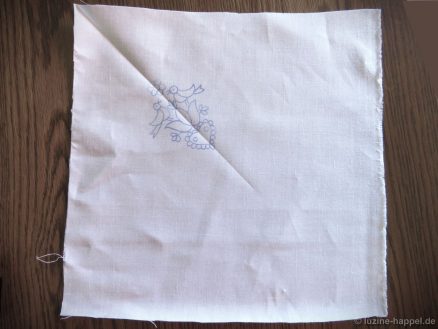
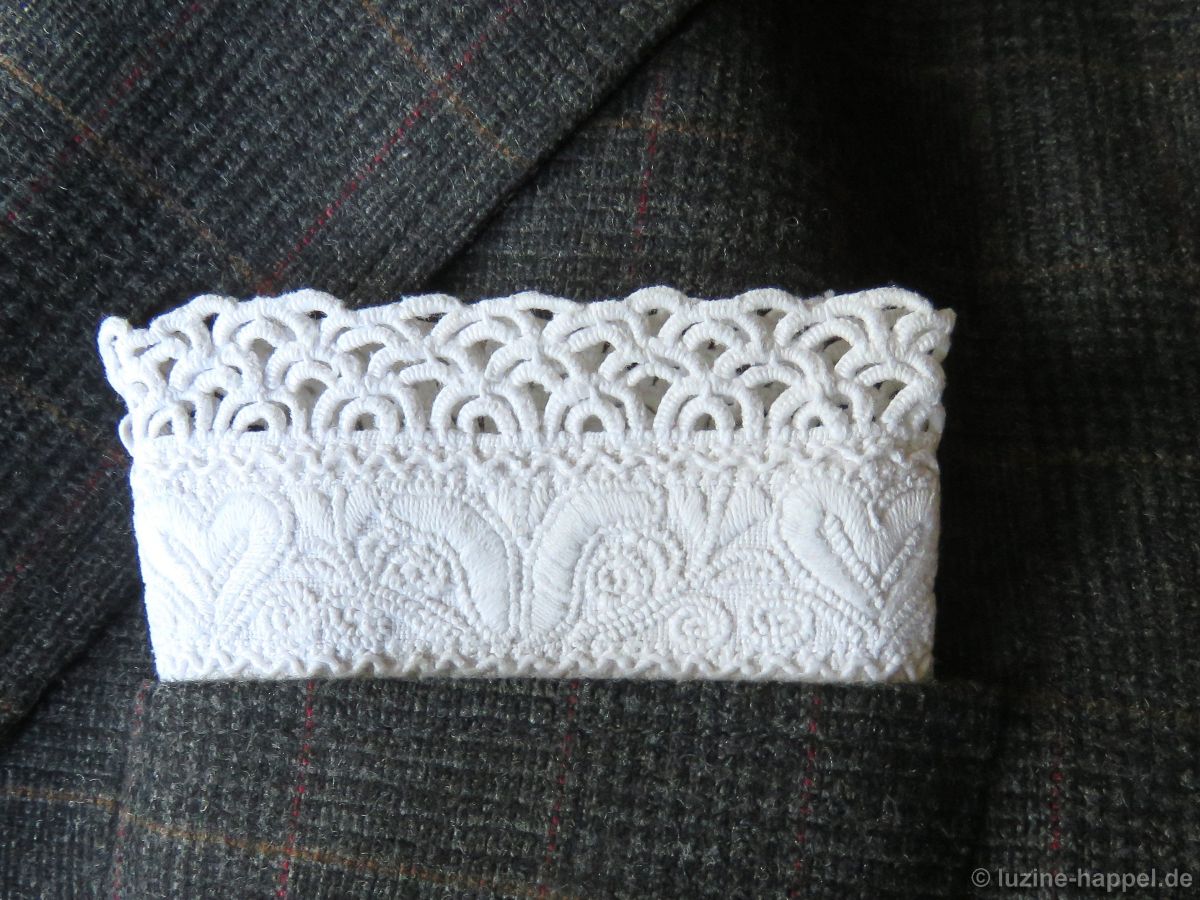
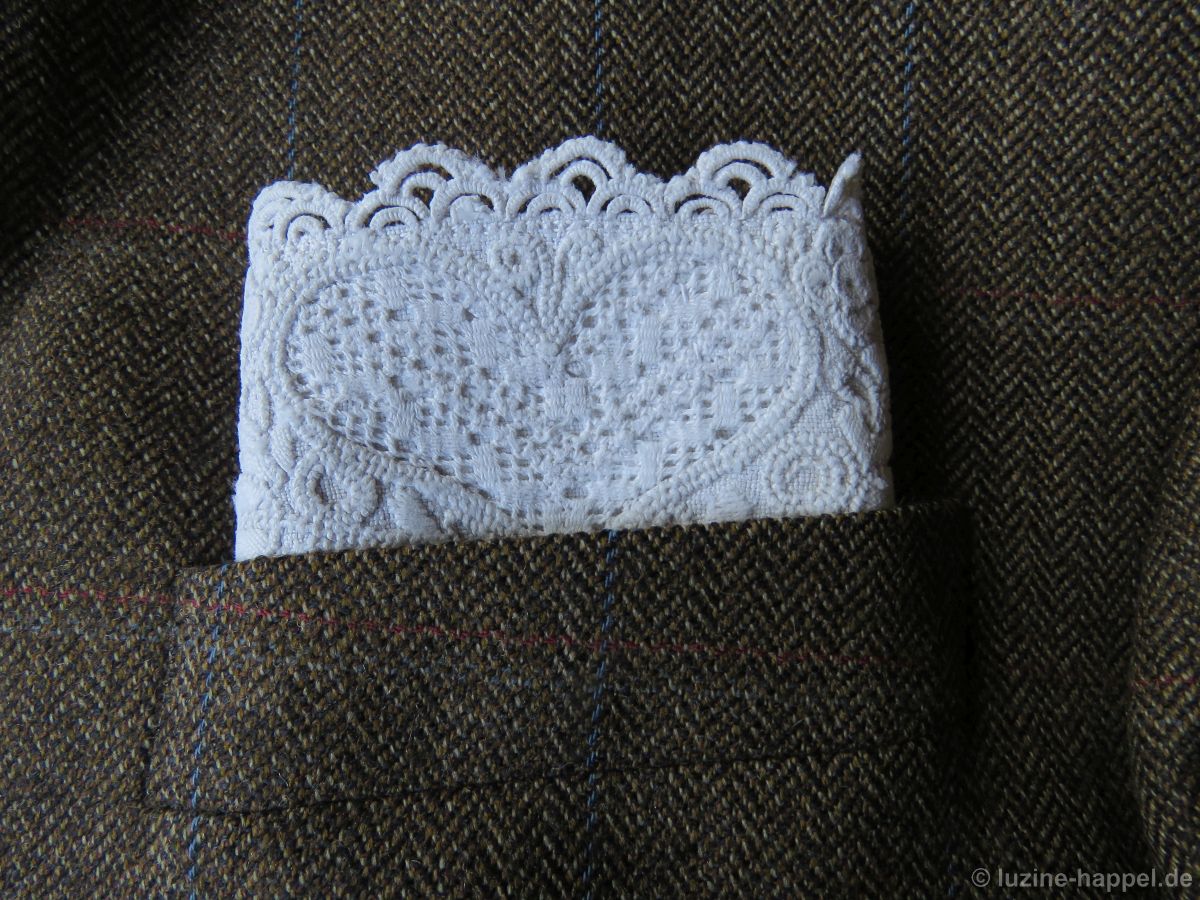
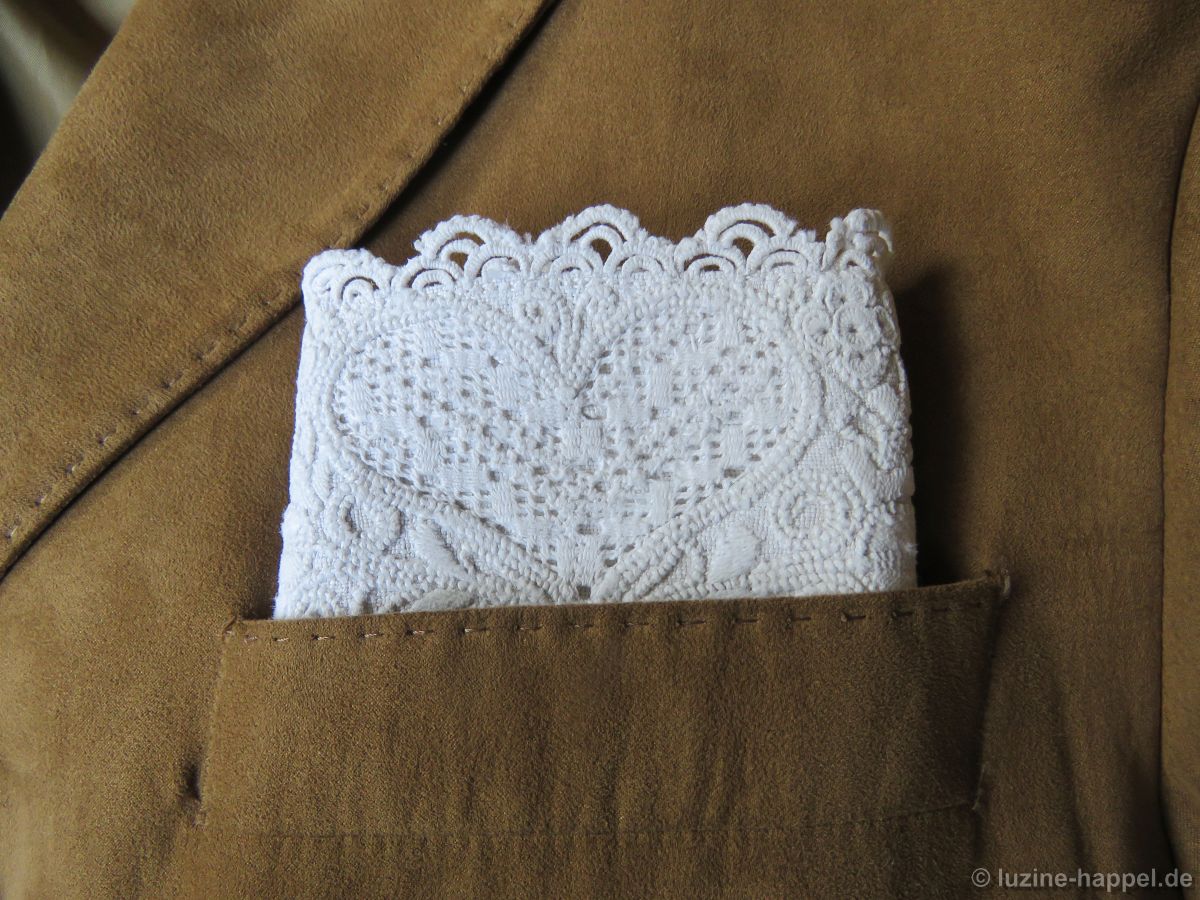
After the side seam has been opened, the approximately 200-year-old Schwalm bodice sleeve can be viewed in its entirety.

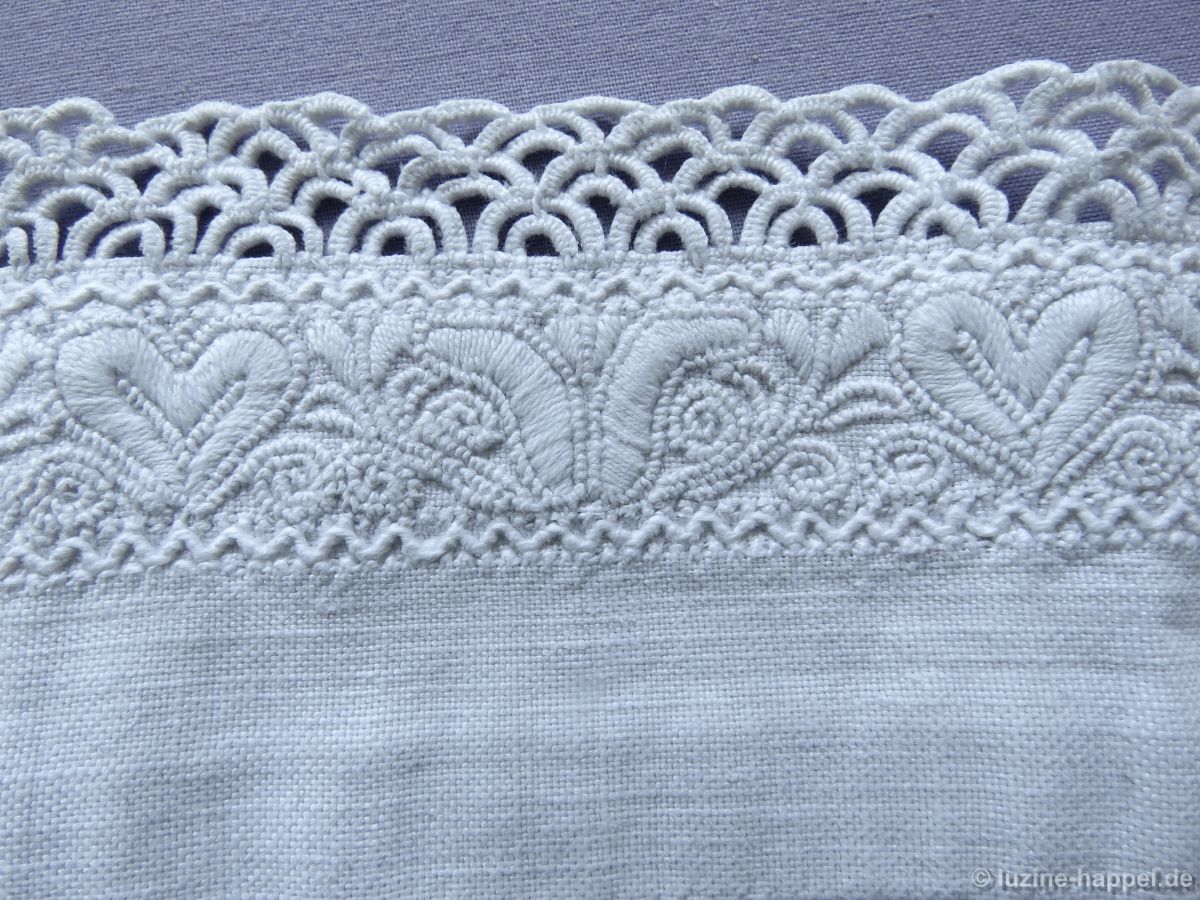
It has a total height of 40 cm, with a 4 cm wide double hem at the bottom reducing the finished height to 29 cm. The sleeve is 32 cm wide at the top and 40 cm wide at the bottom. A 5 cm high bobbin lace trim is attached to the top edge.

Then follows a 3 cm wide hem before the embroidered border begins. The border is 10 cm high, and 11.5 cm high in the area of ​​the initials.

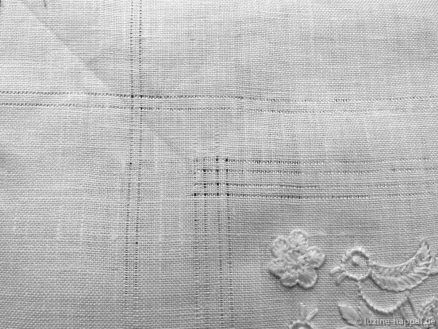
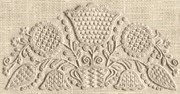
In the backlit photograph, it is clearly visible that the outline pattern from the 1820s was used here and its central part was transferred exactly.

The separate bodice sleeves are made of the finest batiste, a loosely woven, linen-weave fabric – probably cotton batiste. (Investigations to determine the material of the Schwalm accessories made of batiste revealed that it was mostly cotton batiste, but linen batiste also occurred. Batiste was a material that was not produced in the Schwalm region, but was obtained from traders. See Masterpieces in Blue – OIDFA)

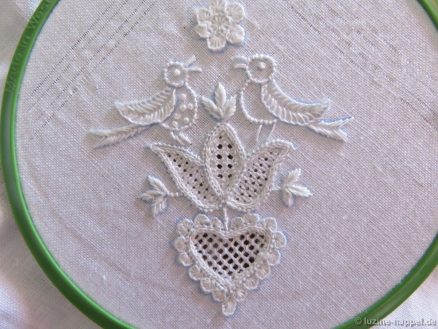
The elaborate embroidery is executed in the style of Dresden lace.
At the end of the 18th century – around 1770 – lace production declined in Dresden. However, it continued and was incorporated into folk art, where it was further developed. This was also the case in the Schwalm region. (You can learn more about this in the next blog post.)

Linen thread of varying thicknesses was used as the embroidery material. The threads had to be spun loosely so that they could conform to the desired outlines and the embroidery on the soft base fabric.

To highlight the individual motifs, the line drawing under the fabric were traced with a thick thread and secured with double back stitches.

On the front, these stitches appear as back stitches.

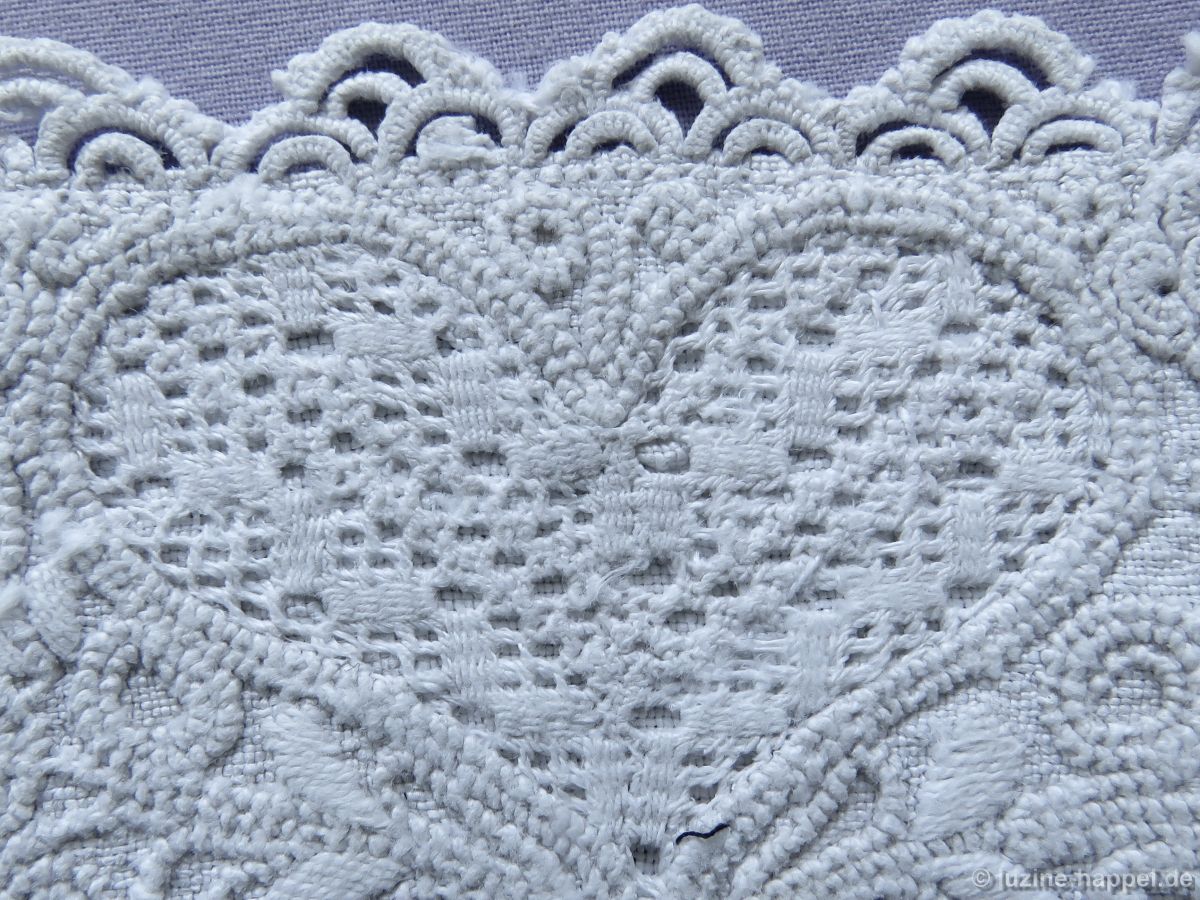
Different patterns are incorporated into the resulting surfaces by pulling the fabric threads together (pulled thread embroidery).

The batiste fabric used has 26/30 threads/cm.

Four fabric threads were bundled together for pattern formation and also for the cross stitches of the initials.

Satin stitches, rose stitches, four-sided stitches and cable stitches were used here.

The background is also almost completely filled with pulled thread embroidery.

After the patterned border was completed, the owner’s initials, A N C R O I, were embroidered next to the border, separated by small cross-stitch ornaments. A bobbin lace trim was added as the edge.

Only then was the white part dyed blue.

Originally, the blue parts of the traditional costume were dyed with woad from Thuringia. This gave them a bright, light blue color, as can be seen in paintings of the time. Later – from around the 1850s – indigo was used for dyeing, which, thanks to the opening of the sea route to India, was now readily available and cheaper than woad. Indigo was used to dye dark blue. To keep up with fashion, some costume pieces that had previously been light blue were now dyed again. This may also have happened to the piece presented here, as clearly lighter traces can be seen in some places on the reverse of the embroidery.

My collection includes several pairs of separate bodice sleeves made of the finest material. Watercolors by the painter Jakob Fürchtegott Dielmann (1809–1885) from 1841 show how such sleeves were worn.

Städel Museum, Frankfurt am Main

Back then, the traditional costume from the Schwalm region looked different than we know it today.

Jakob Furchtegott Dielmann – „Oberhesische Bauersfrau zur Kirche gehend“ – Städel Museum, Frankfurt am Main – auch als „Mädchen aus Wliingshausen“ bezeichnet
Jakob Furchtegott Dielmann – „Stehende Bäuerin im Sonntagsstaat“ – Städel Museum, Frankfurt am Main – auch als „Kirchgängerin aus Wliingshausen“ bezeichnet
The picture also shows the “pulled cap” and the “parade handkerchief”, which were elaborately embroidered, similar to the bodice sleeves.

Chance Encounter

I occasionally browse through my extensive collection. And I made a delightful discovery.

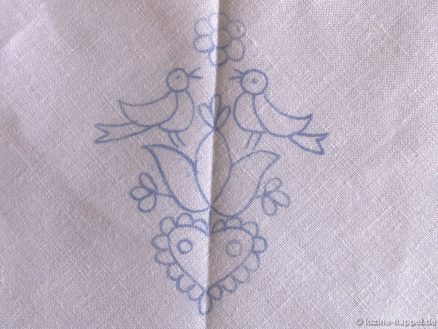
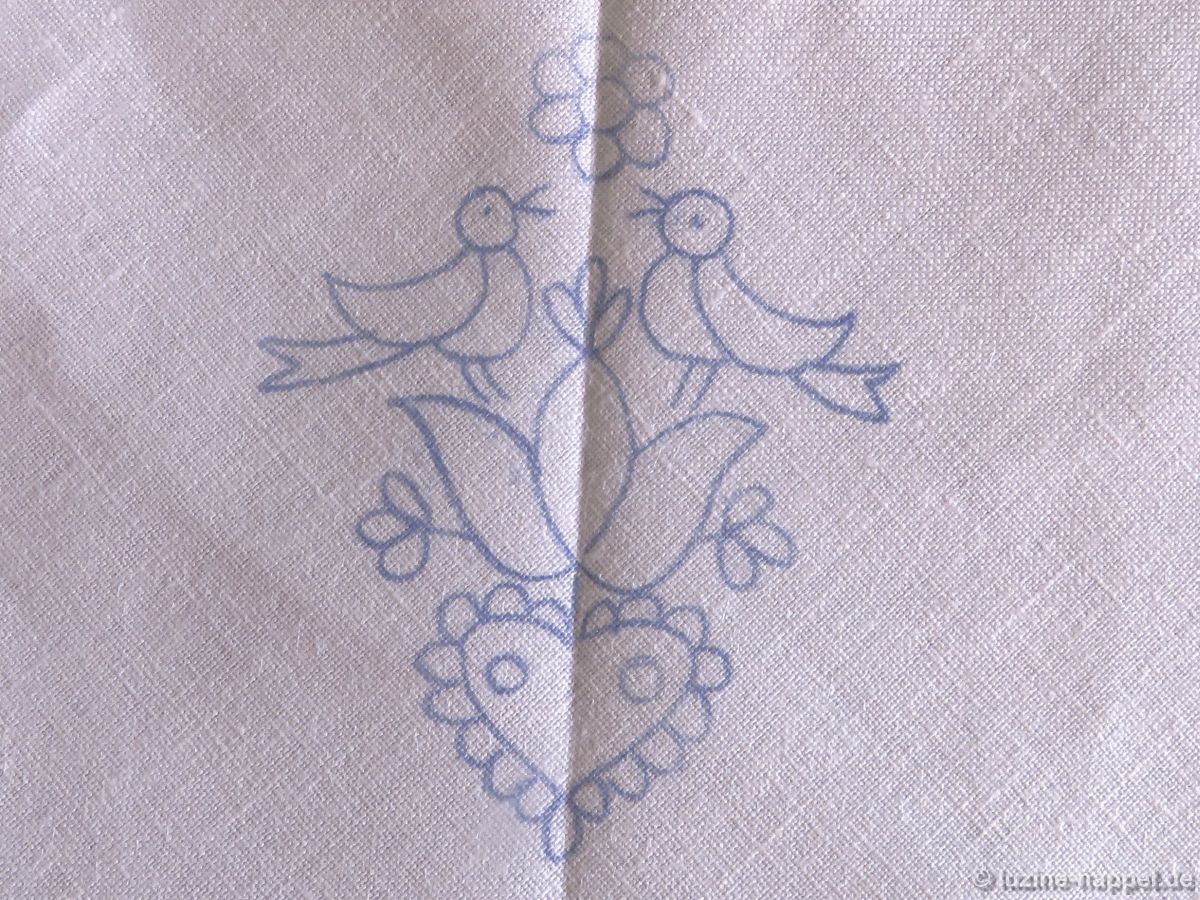
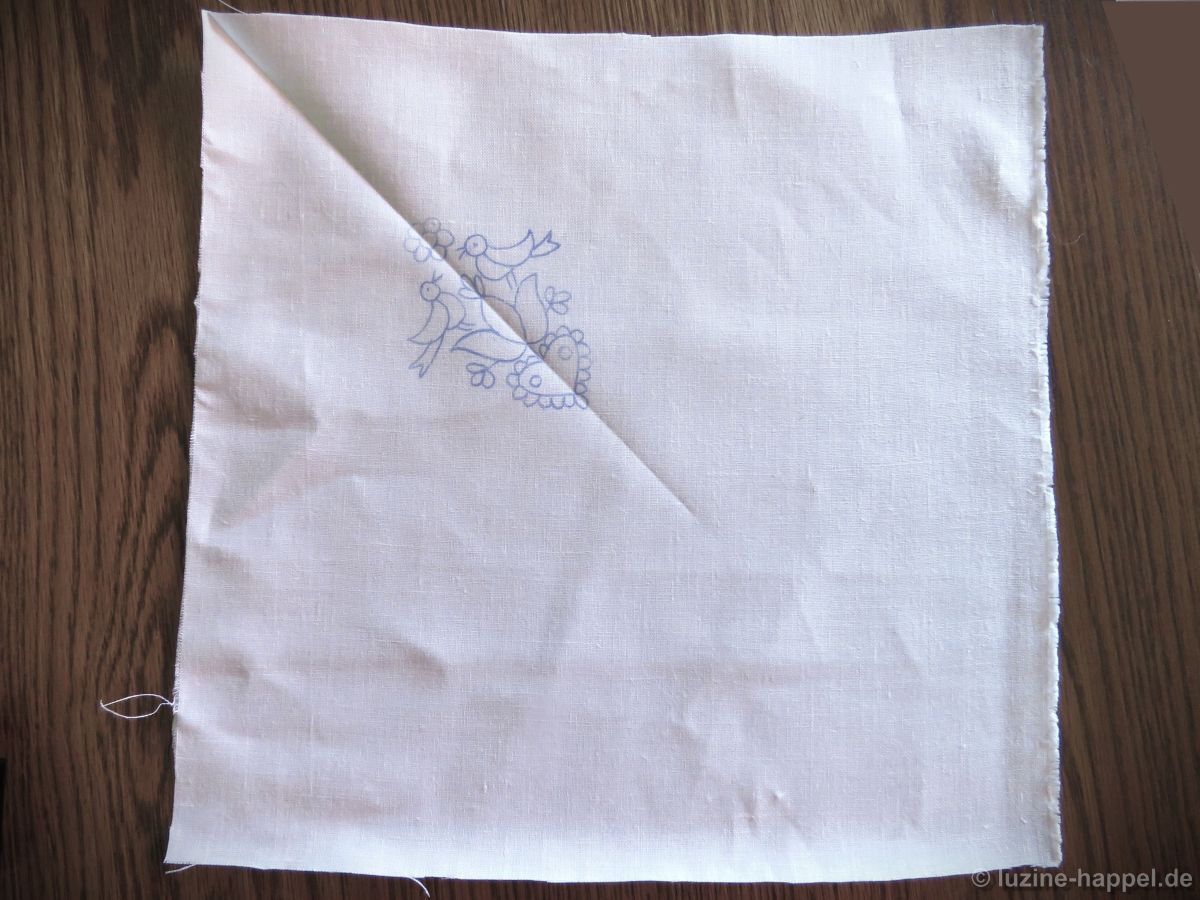
My collection includes very old outline patterns, all from the same source. Unfortunately, they are not dated, but based on similar dated patterns illustrated in Gandert/Miehe, p. 123, it can be concluded that they originated in the 1820s.

The design shown below are also among the samples.

(That it is only a sketch and not a final drawing can be seen from the undamaged paper. The final drawing samples contain many perforations because they were pinned to linen during the transfer process.)

The sketch has a central circle surrounded by eight hearts. Opposite these horizontally arranged hearts are hearts of the same size, spaced a short distance apart. These, in turn, are connected by a small circle around which three large hearts are grouped.

What could have been embroidered with such an outline pattern more than 200 years ago?

With the image of the pattern still in mind, I looked at parts of my bodice collection a short time later. I noticed the similarity in one piece – a Schwalm bodice sleeve in the style of Dresden lace.

Upon closer inspection, I was able to determine that the border of the bodice sleeve is embroidered exactly according to the central part of the pattern.

I also found a match in a second piece – a blue bodice. Although the resemblance isn’t immediately obvious, it’s there nonetheless. Not only is the central border replicated, but the edge borders also show similarities.

What stages might the pieces have gone through in the past 200 years to now meet again at my place?

Now I will open the seam of each sleeve to capture the entire embroidery in a photograph. You can see this and examine it more closely in the next blog posts.

See also:
Traditional Schwalm Bodice (D) Embroidery
Schwalm Bodices (3)
Schwalm Bodices (2)
Schwalm Bodices (1)
The Filling Patterns of theTraditional Schwalm Bodice A
Traditional Schwalm Bodice (B) Embroidery
Traditional Schwalm Bodice (C) Embroidery

4. The Chain Stitch

The 13 basic stitches of Schwalm whitework

A. The decorative stitches
4. The Chain Stitch

To cover the thread ends of the fabric threads that will be withdrawn later, chain stitches are embroidered closely within the coral knot stitches.

thread weight: depending on the fineness of the linen, coton à broder thread No. 25 or No. 30
building the rows: from right to left
direction of needle movement: from right to left
way of working: Bring needle up

and lay the thread in a loop to left and bottom.

Insert the needle in the emerging point, cross under the fabric a small step to the left and bring needle up again inner the loop.

The looped thread is below the needle tip.

Pull the needle through and the thread to the left.
The first link in the chain has formed.

Further chain stitches are added in the established way.

The chain stitches should be placed directly adjacent to the coral knot stitches, leaving no gap between them. If the chain stitches are placed too close to the coral knot stitches, the outer half of the chain stitches may overlap them. This should be avoided.

Chain stitches, like coral knot stitches, are line stitches, but they form a single line on the back

and a double line on the front.

This has the advantage that threads to be withdrawn can be cut close to the chain stitch line on the back,

but the thread ends are covered on the front by the inner half of the chain stitches.

One can also pull the edge stitches of the filling pattern under the inner chain stitch line to achieve a perfect edge finish.

This is also important for the clean drawing up of the basic stitch grids.

To achieve the best possible results, it is therefore important to embroider short chain stitches and to pull them evenly, but not too tightly. This makes them appear more rounded and cover a wider area than short, tightly pulled or long stitches.


1. The Coral Knot Stitch
2. The Blanket Stitch
3. The Satin Stitch

Famous: Waltraud’s Richly Embroidered Quilt (2)

As reported in the previous post, Waltraud combined the rhombus and the triangles. They now form a square measuring 160 cm X 160 cm. Since this size was not sufficient for the double bed, Waltraud planned for a 50 cm wide border on all sides.

In the border, she implemented her idea of ​​an intertwining tendril pattern. In the center of the lower border, she had planned a bowl from which two shoots grew out to the left and right.

These two tendrils meet again in the middle of the upper border.

In between stretches a lush vine with a wide variety of flowers and leaves.

The trim is interrupted at the corners to make sewing the fabric strips together easier.

Since the left tendril was to be mirrored on the right side, Waltraud noted all the thread colors and weights used, as well as the stitch types.

The embroidery was done on cotton satin.

Waltraud used various yarns in different thread weights and 15 colors:

4 different colors Kacoomda Hand Dyed Silk 2 ply twist
5 different colors Edmar Frost Perl (Rayon)
4 creme variations Finca Perl 8 + 12
1 green Finca Perl 8 + 12
1 gold Finca Perl 8 + 12

She worked the following and other stitches:

Cable plait stitch, Coral Knot. Cretan Stitch, Feather Stitch, Fly Stitch, French + Colonial Knots, Herringbone Stitch, Loop Stitch, Mountmellick Stitch, Palestrina Knots, Satin Stitch, Spider Web, Stem Stitch, Thorn Stitch, Vandyke Stitch, Wheat Ear Stitch, Reverse Chain Stitch

After all the pieces were sewn together, the bedspread measured 290 cm X 290 cm.

Then came the quilting. In custom quilting, the pattern is based on the embroidery. Structures are created by closely quilting the background.

Interspersed stripes and edges are also emphasized by individual patterns.

A professional quilter needed 8 1/2 days to machine quilt this quilt to an excellent quality. Afterwards, the bedspread had shrunk to a size of 280 cm X 280 cm and weighed 2.5 kg.

Under Waltraud’s hands, and through the realization of her ideas and visions, a significant work of art has been created, one that can be considered unique in our time. With this fantastic result, she has wonderfully rewarded herself for her years of work.

Congratulations, and may you enjoy many more years of looking at and feeling all the details and reliving all the necessary steps!

Thank you for allowing us to gain insight!

Let’s enjoy the last pictures:

Famous: Waltraud’s Richly Embroidered Quilt (1)

Measuring 280 cm X 280 cm and using 15 embroidery thread colors, a superlative embroidered quilt was created within 14 years.

Why am I featuring a quilt on my blog, which mainly focuses on Schwalm whitework?
I’m doing this to pay tribute to an outstanding achievement and to share my enthusiasm for beautiful handicrafts with others.

It wasn’t only in the Schwalm region that it was once common to richly decorate textiles with embroidery. However, particularly magnificent and elaborate examples were created there, as can easily be seen when visiting the museums in Ziegenhain and Holzburg.
Bed coverings, for example, were status symbols. A great deal of time and effort was invested in their lavish and exquisitely detailed embroidery. These pieces were used for decades, and subsequent generations also enjoyed these luxurious treasures.

Schwalm Bed Covering dated 1876

Today, such elaborately handcrafted pieces are rarely produced anymore. Times are too fast-paced, and fashion tastes change too quickly.

Therefore, I have not often been able to report on contemporary voluminous embroideries made by a single embroiderer.

There is the imposing, fabulous sampler by Rosemarie Landsiedel-Eicken.
There is the extraordinary bedspread by Gertrude Vorwerk.
There is the dreamy round Schwalm tablecloth by brubi
There is my large sampler, which was originally intended as a bedspread and now serves as a wall hanging.
There is the hand-stitched boutis by Heather Harteneck.
And there is the hand-embroidered and hand-quilted bed covering for a child’s bed by Waltraud Kater from Wagga Wagga in Australia.

When I presented this quilt in 2017, I was also able to show a picture of her large bedspread that was in progress.

Now her dream of a quilt as a bedspread for the double bed has come true – the masterpiece is finished and we are allowed to take a look at it!

She started it in 2011. She made a rough sketch outlining how the dream project should be put together.

Since Waltraud had no prior experience in embroidery, she first took a course to learn the necessary basics. There she embroidered her first square measuring 30 cm X 30 cm.

Block 1

Eight more squares of this size should follow.

Block 2

She continued her education and independently acquired further stitches and filling patterns through literature.

Block 3

The designs for her quilt were taken from many books and magazines, from photos and also Persian carpets.

Block 4

Block 5

Block 6

Block 7

Block 8

The first pictures reached me in 2012. At that time, she had just finished the center section of the bedspread. She had used a pattern from one of my books. The fabric had warped under the pattern. Looking for a solution, she slit the fabric open at that point from the back and lined it.

Block 9

This made the (burgundy) petals stand out in three dimensions. She repeatedly and effectively used this technique, which was actually born out of necessity, in prominent locations.

Waltraud put a tremendous amount of effort into creating the patterns and shapes. She consulted many books and other sources. The following books helped her in her search for interesting stitch combinations and fillings:

Mountmellick Embroidery – Yette Stanton & Prue Scott
Crewel Jacobean Embroidery – Hazel Blomkamp
A Fine Tradition – Margaret Light
Early Schwalm Whitework – Luzine Happel

The outlines of decorative fabrics and oriental carpets also served as inspiration.

She gathered a wealth of inspiration and then developed all the blocks, triangles, and borders one after the other. To do this, she copied the patterns from the various sources onto tracing paper with a pencil and, if necessary, enlarged them to the desired size using a scanner and computer. These templates were then glued together to create a 1:1 model of the bed covering.

Afterwards, tracing paper or tissue paper and the fabric for the individual parts of the quilt were cut and given final boundary lines (edges) so that the fabric pieces could be aligned precisely later.

All the outlines were accurately traced onto the paper cutouts from the templates. Then she sketched her idea of ​​the filling patterns into the outlines.

The following example shows a part of the block stitched above – block 9.

This is also how the 3-meter-long borders were created; that is, the templates were cut in one piece, measuring 3 meters long and 50 centimeters wide. As the penultimate step, the template was placed on the light box, and the cut fabric was placed on top. The final step was then “simply” tracing the patterns onto the fabric with a Pilot Frixion Ball, because the resulting lines can later be removed with heat (with iron or hairdryer).

The nine squares of the central section are joined by narrow, dusty rose-colored stripes, giving the rhombus a side length of 110 cm.

The central rhombus is surrounded by four triangles. Each pair of triangles displays the same pattern in mirror image.

The triangles are connected to the rhombus by slightly wider strips.

In the end, the bottom triangles look like this

and the top triangles like this:

A few detailed images reveal specifics and show the variety of stitches used. (Clicking on the images will enlarge them.)

The story continues in the next post.