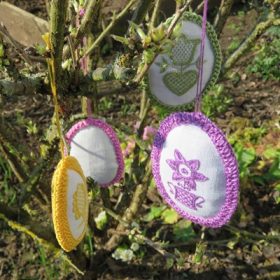
Another Easter Egg

After completing my tests, I calmly and very carefully allowed another egg to develop.
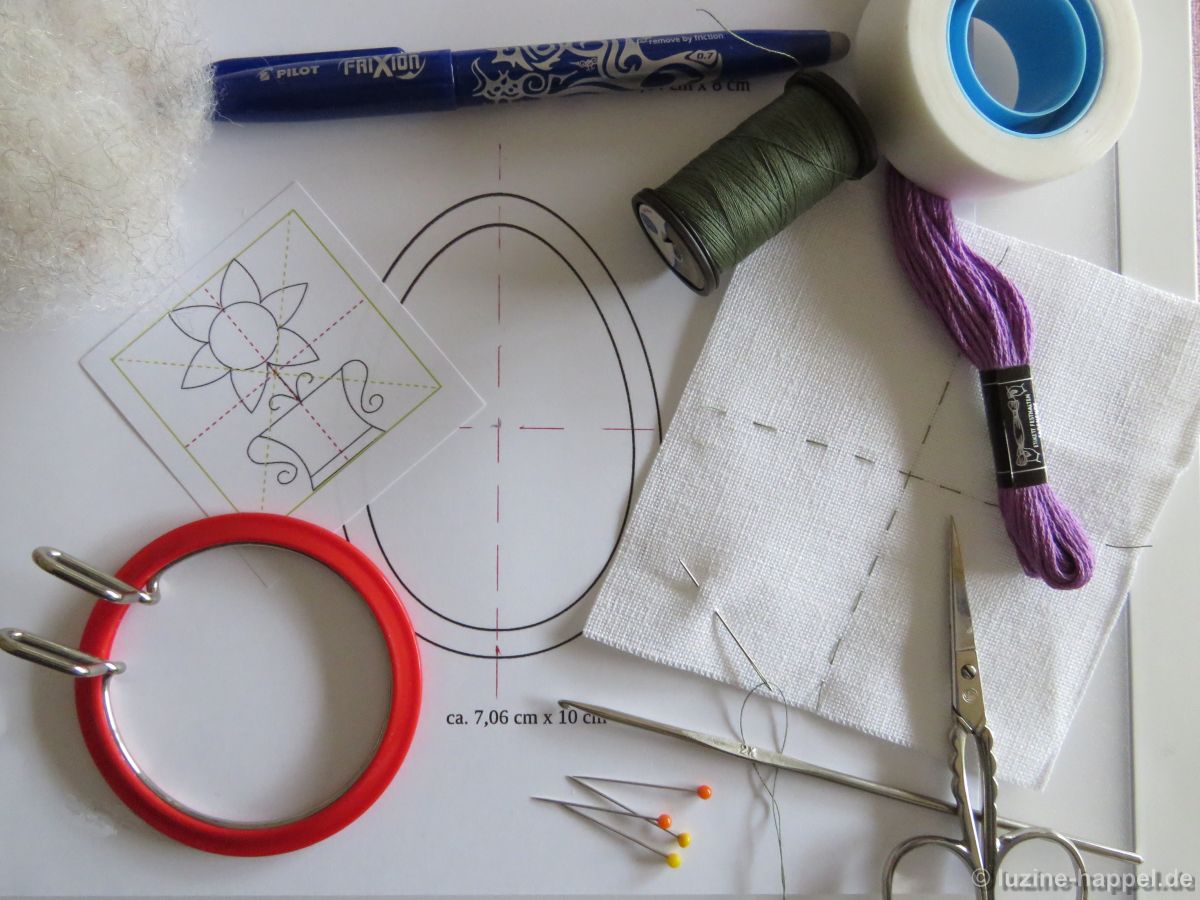
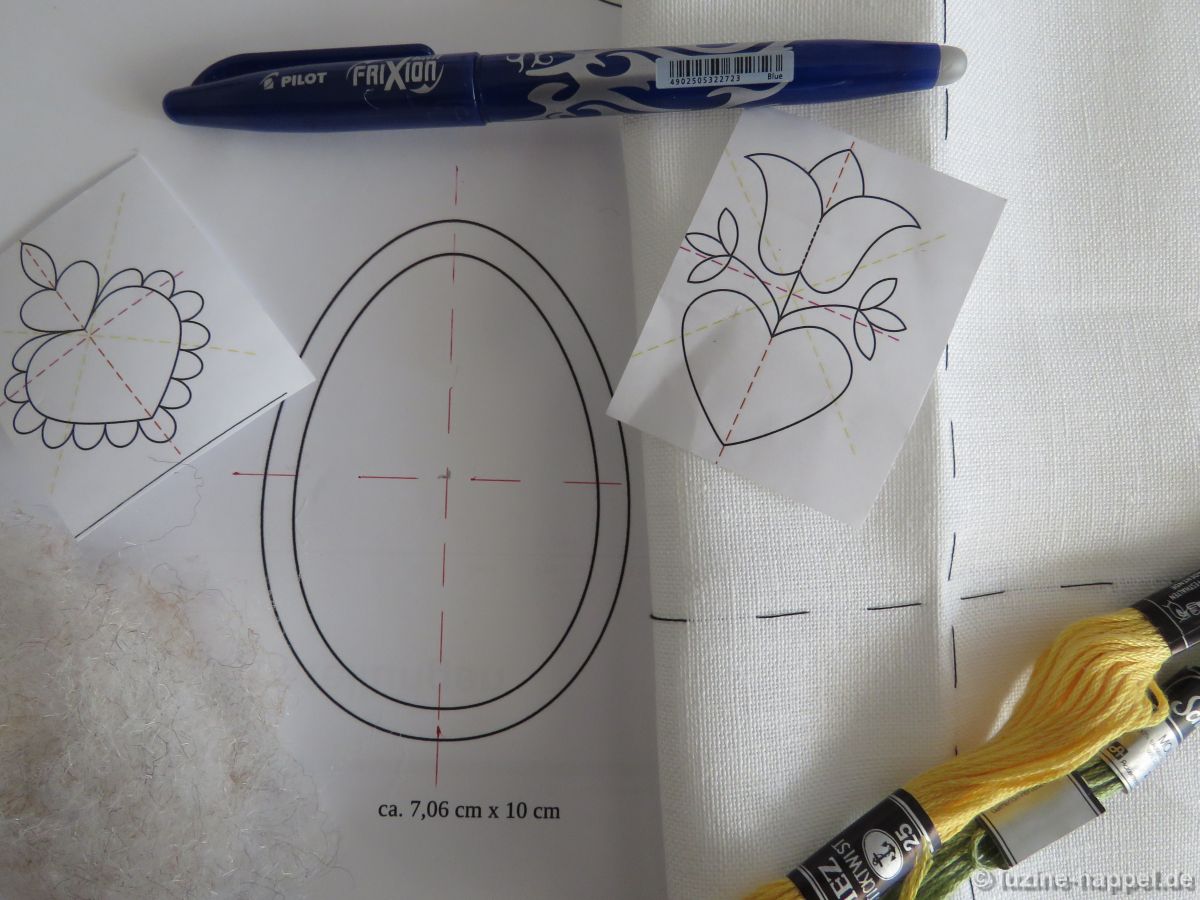
The necessary materials have been gathered.

The central axes were added to the drawing of the egg outline. The egg outline was first attached to a light panel, followed by the drawing of the chosen motif, aligning with the marked central axes and using removable adhesive tape.
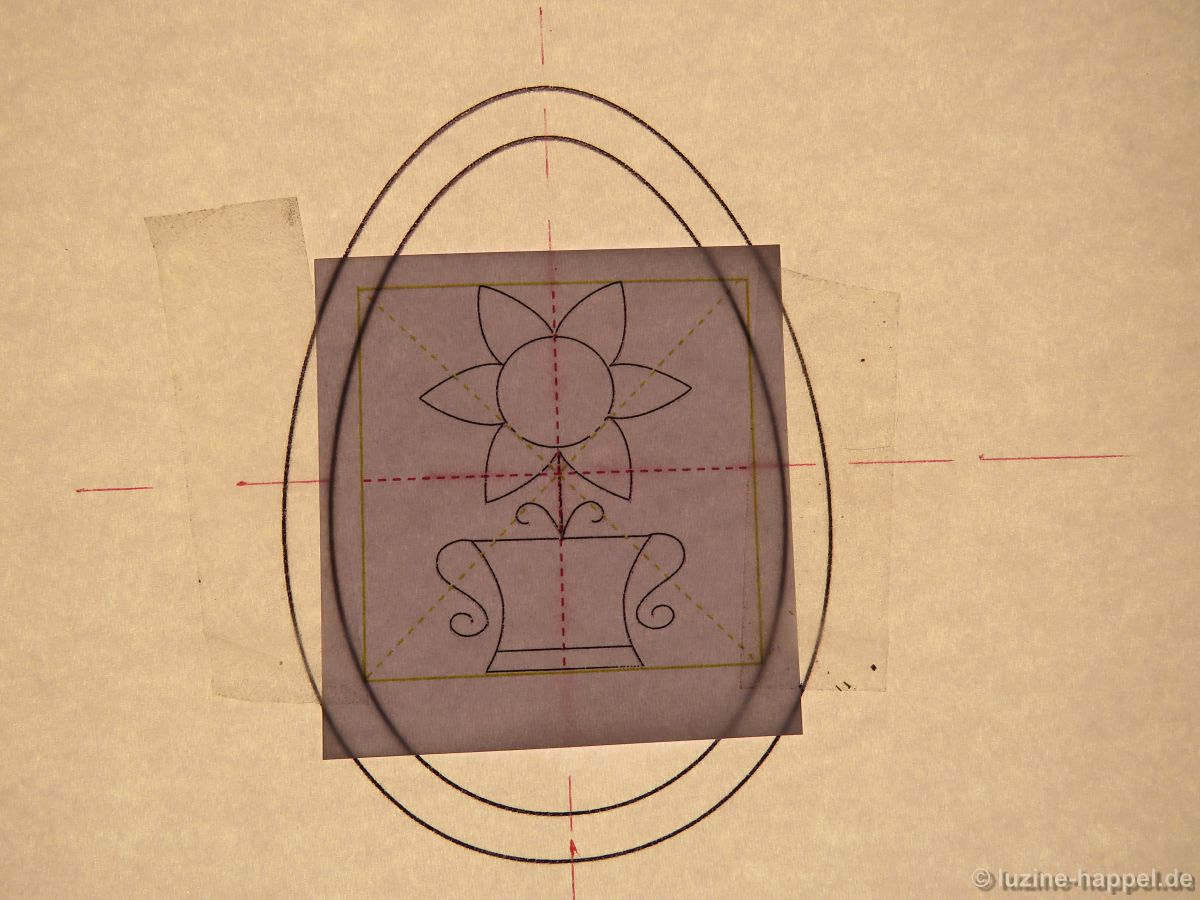
The piece of linen, also marked with center axes, was then attached. (My piece of linen was only about 11 cm x 11 cm. With a slightly larger piece – about 15 cm x 15 cm – the embroidery would have been much easier.)
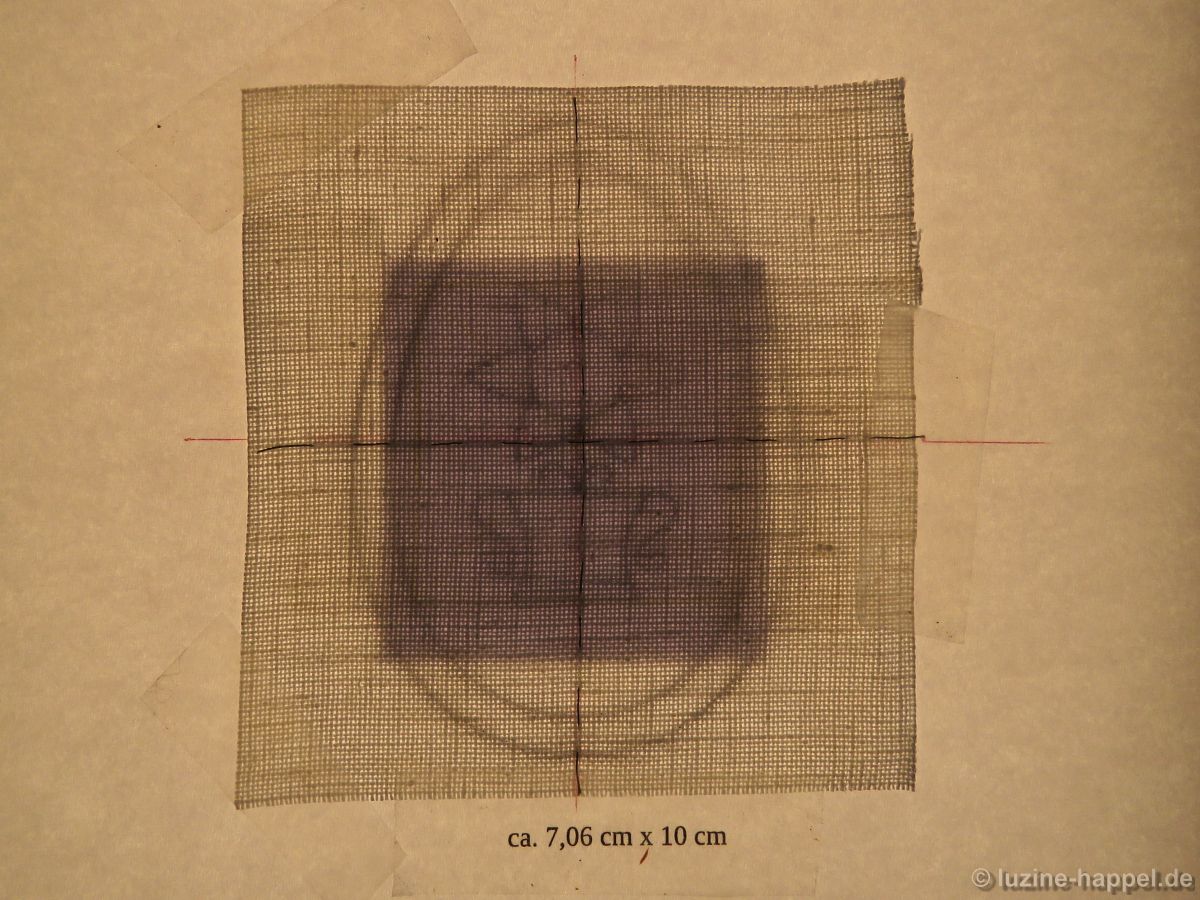
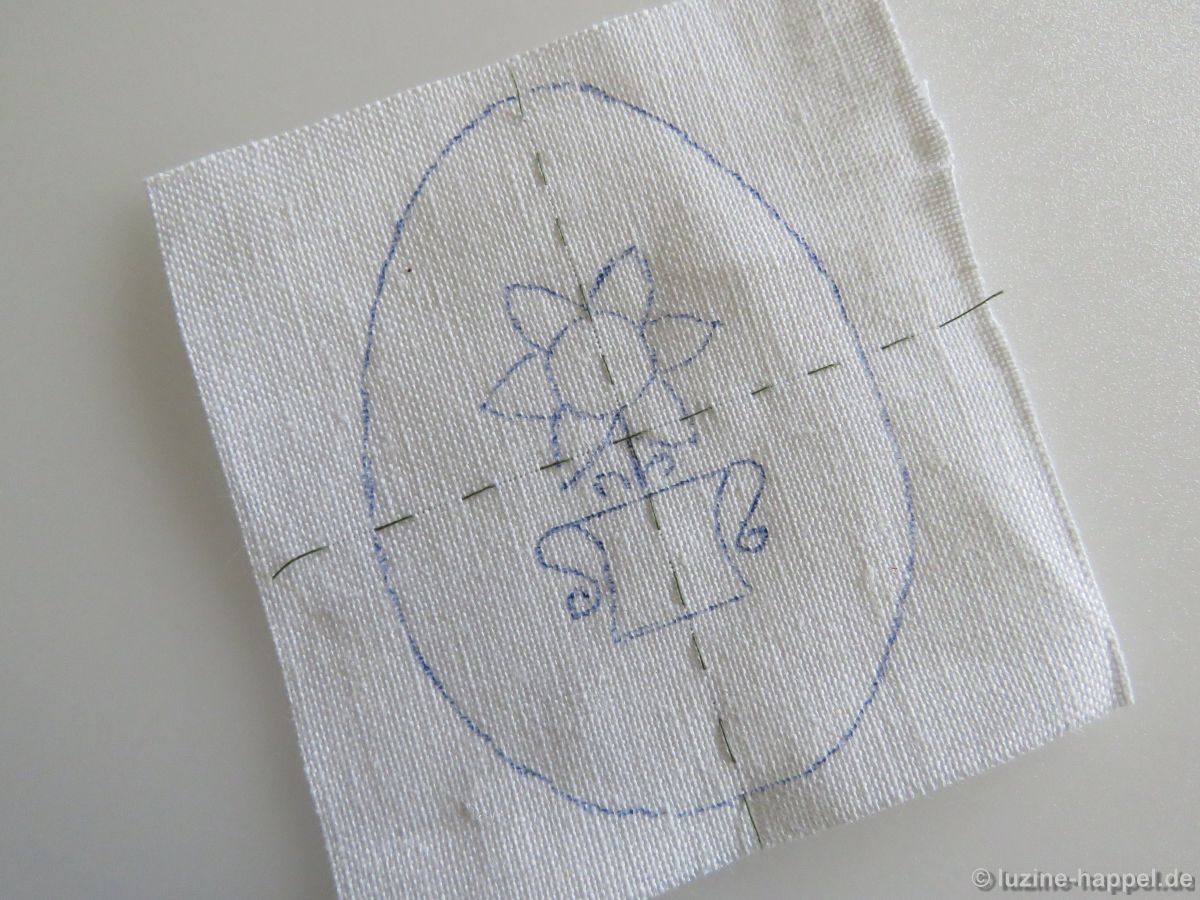
The motif and the outer egg outline were transferred to the linen using a heat-soluble pen.
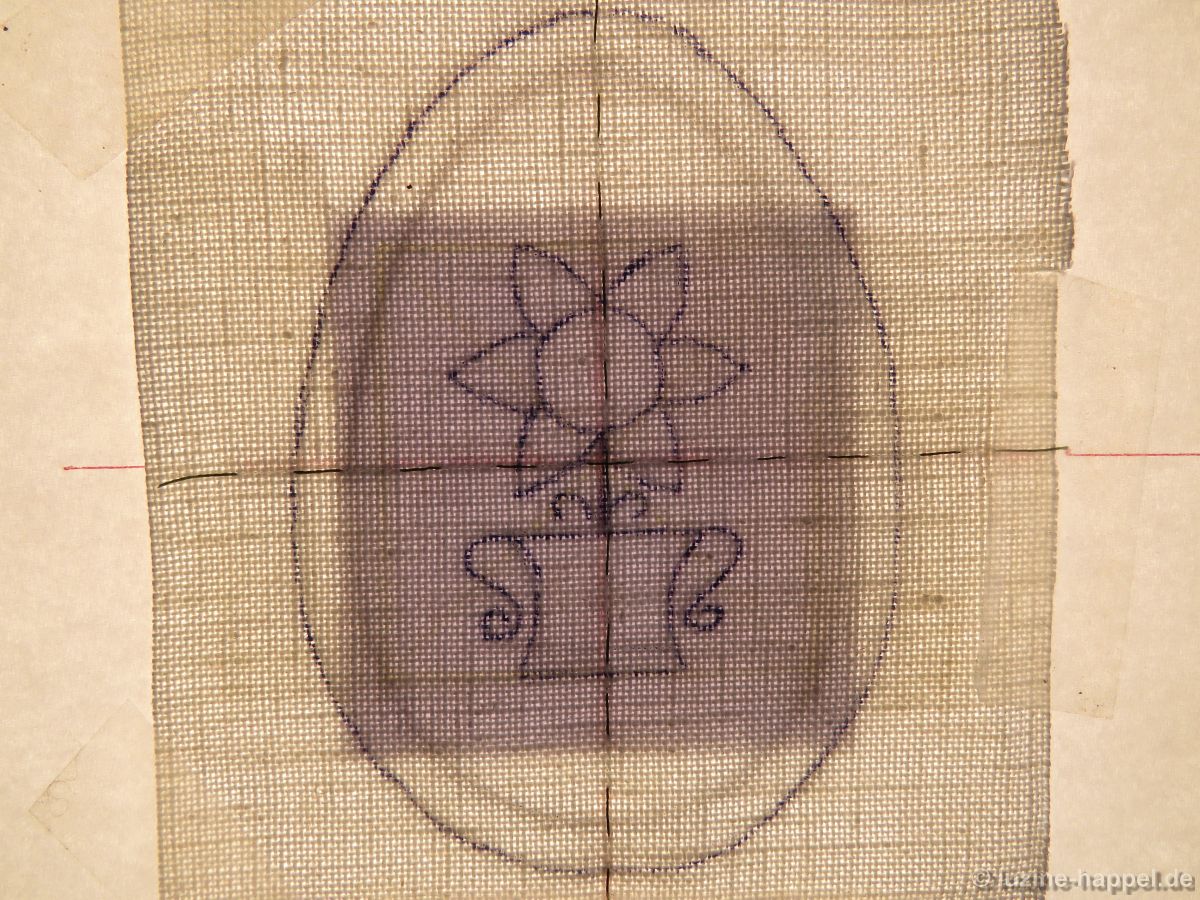
You have to press down hard to get enough ink on the fabric for a clear line. The fine tip of the pen tends to get caught in the grooves between the fabric threads.
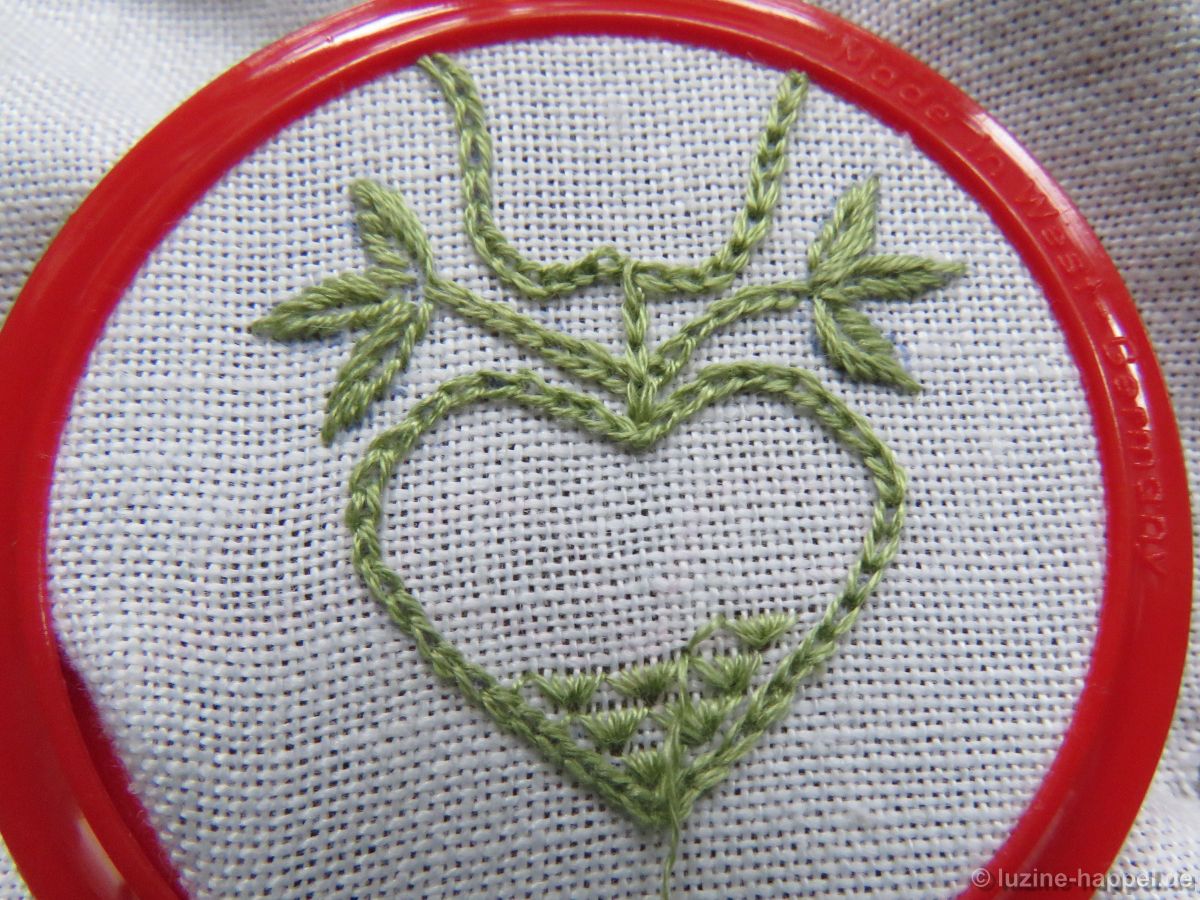
The design was embroidered. For coral knots and blanket stitches, I used two strands of 6-ply stranded cotton; for chain stitches and
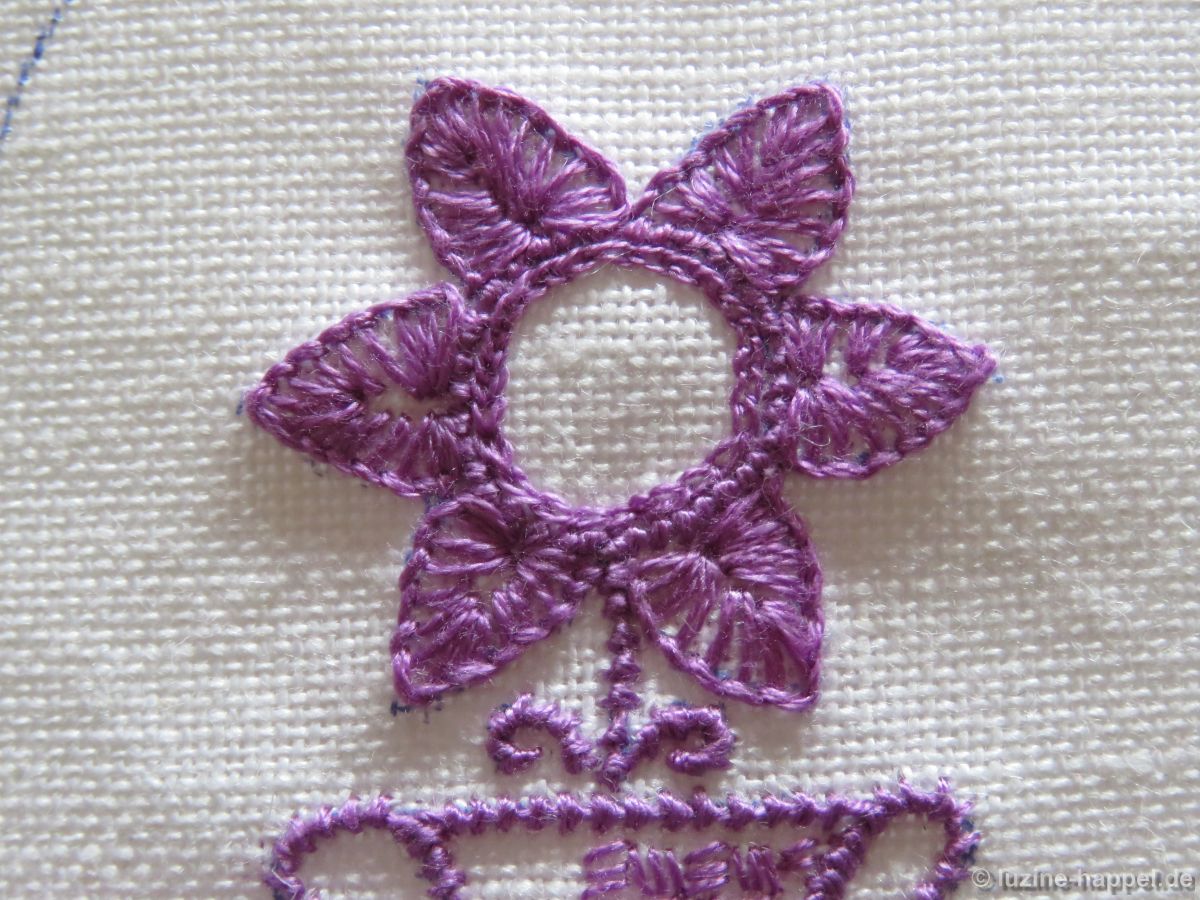
the filling pattern, I used only one strand.
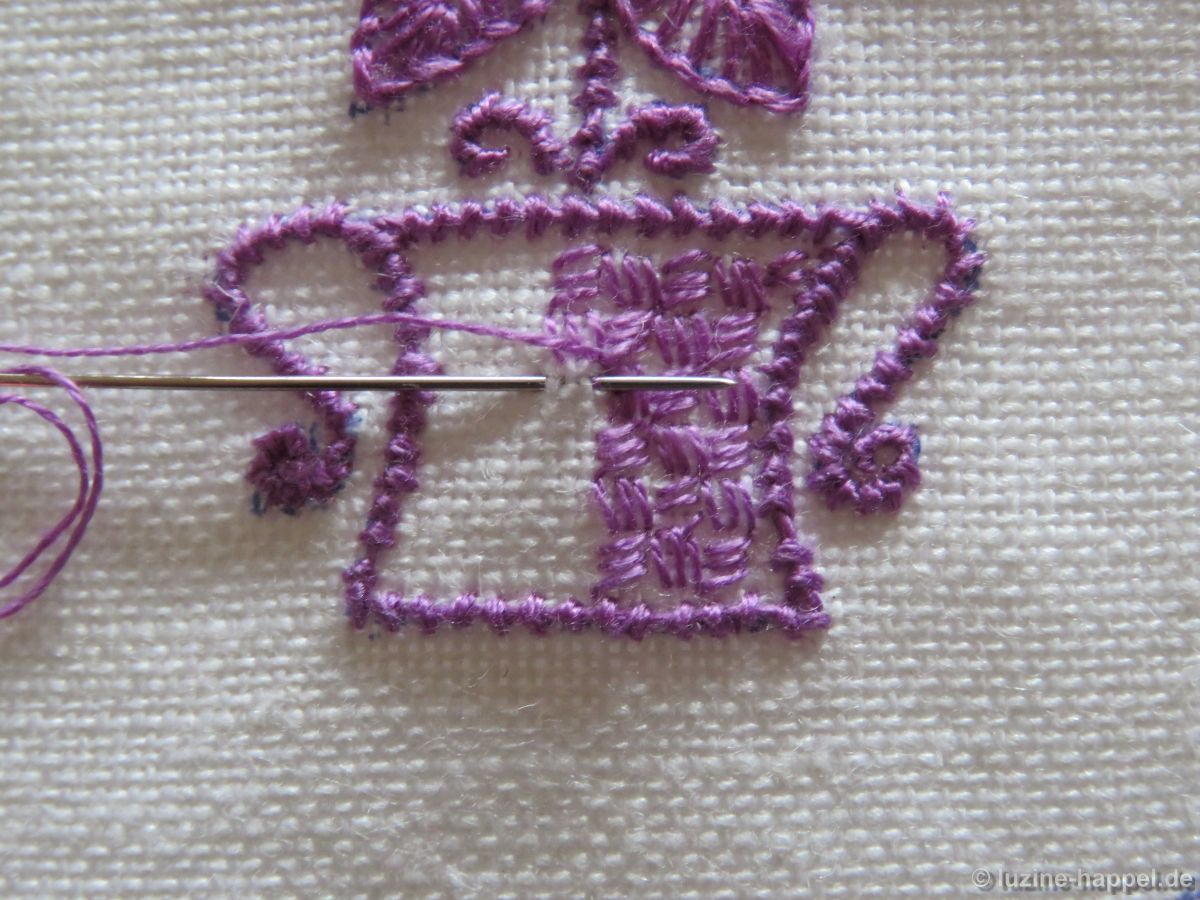
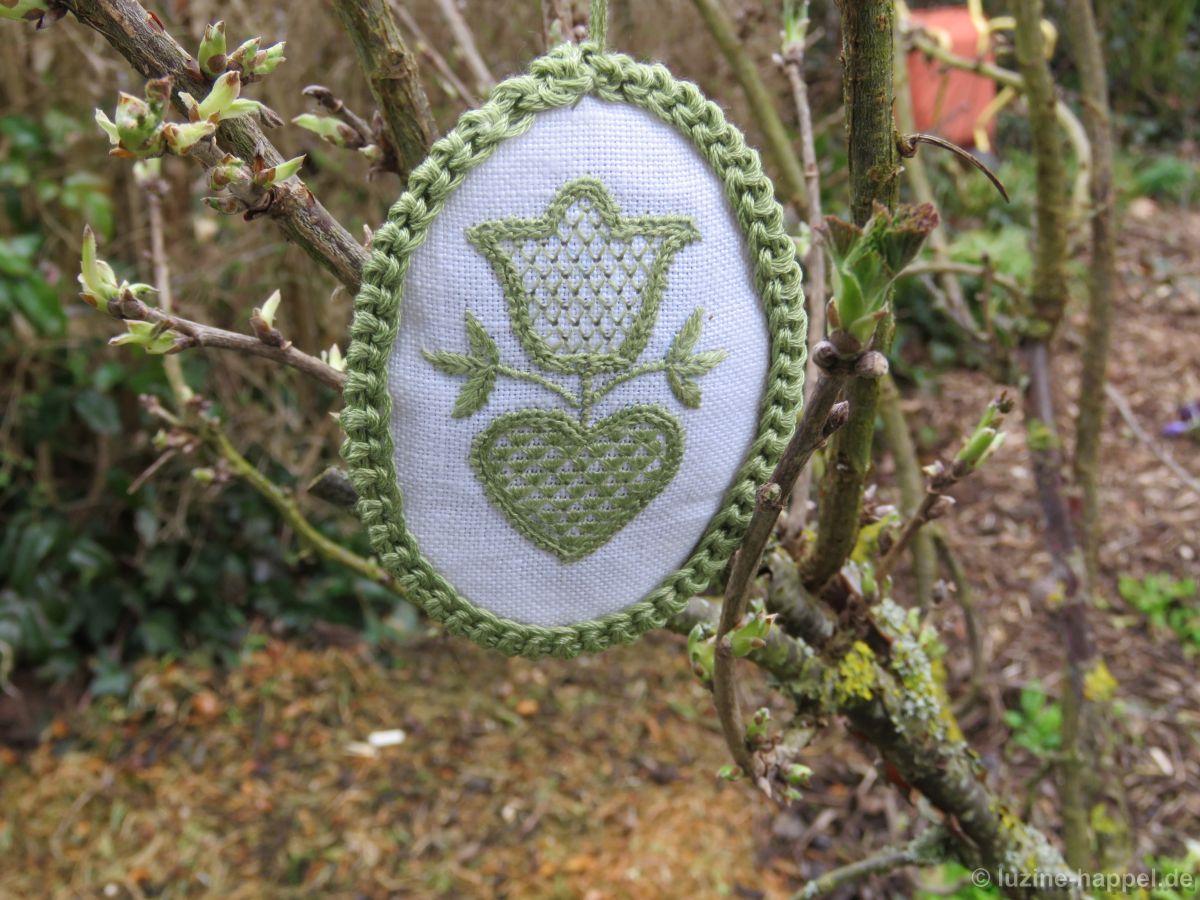
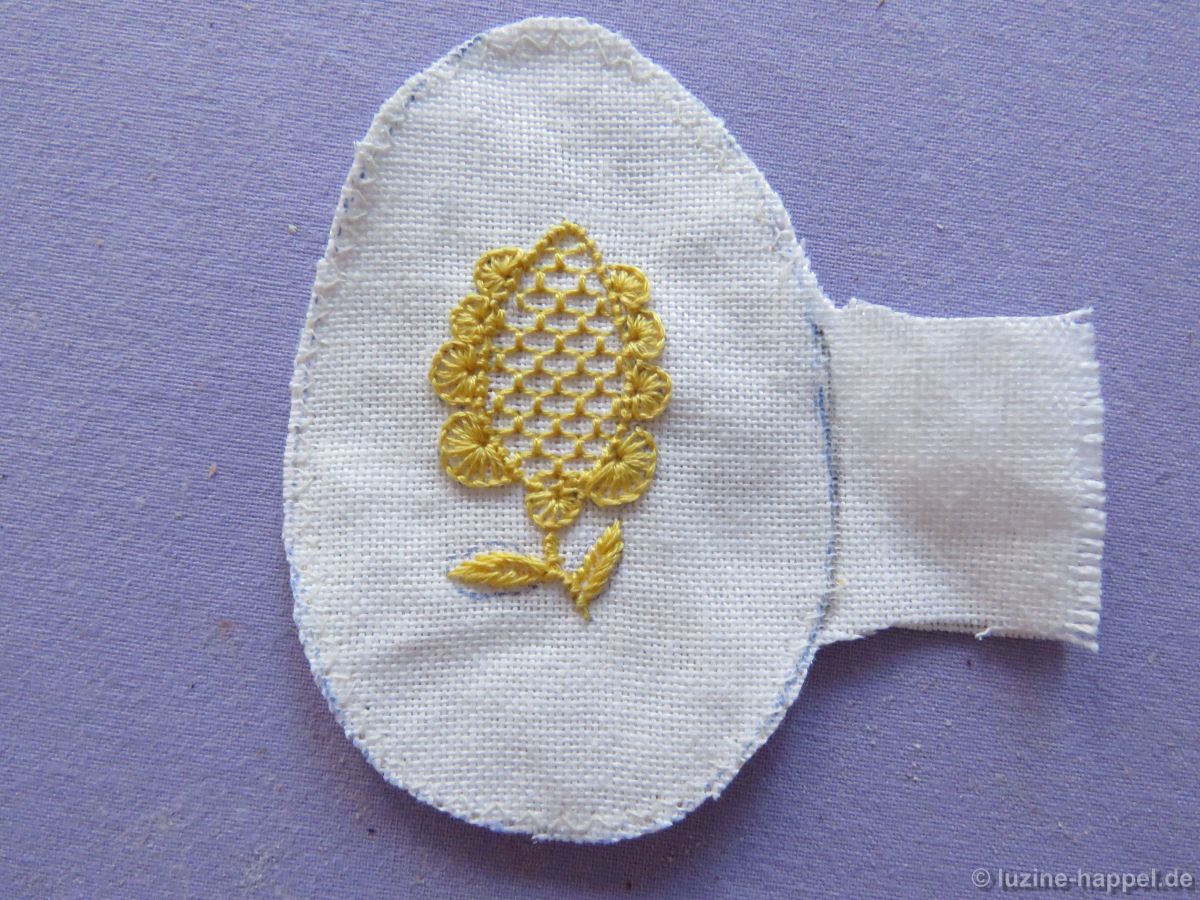
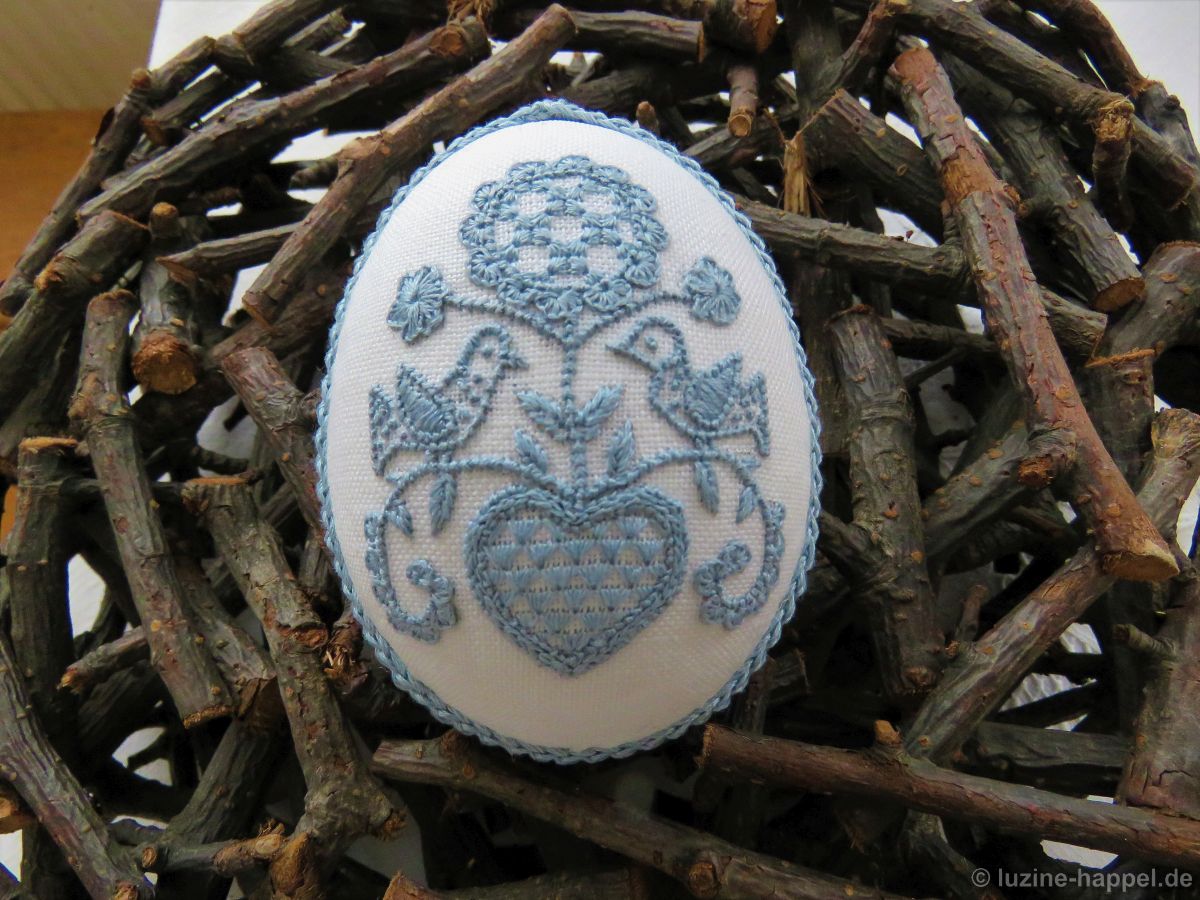
The basket received the “One Pattern”. Since the area to be embroidered is very small, I initially refrained from stitching chain stitches next to the coral knot stitches.
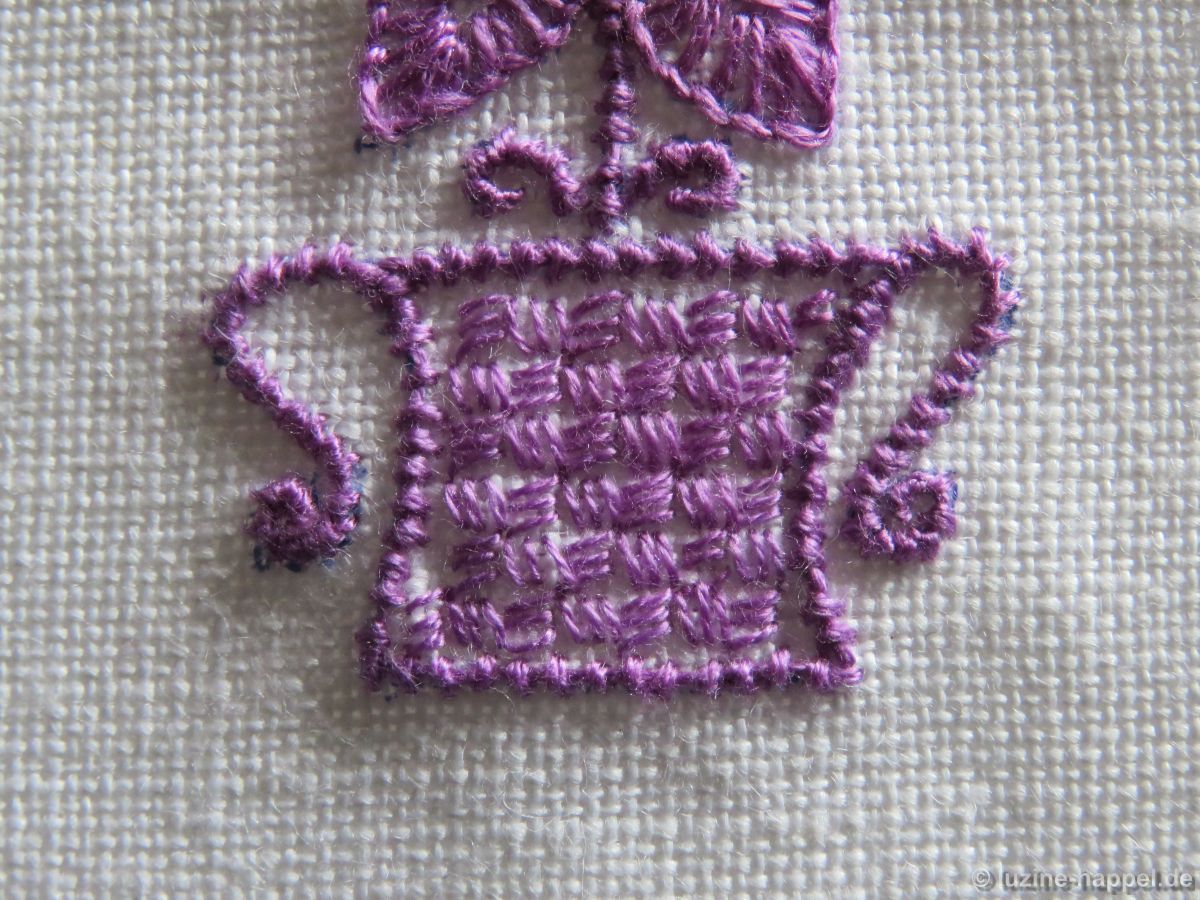
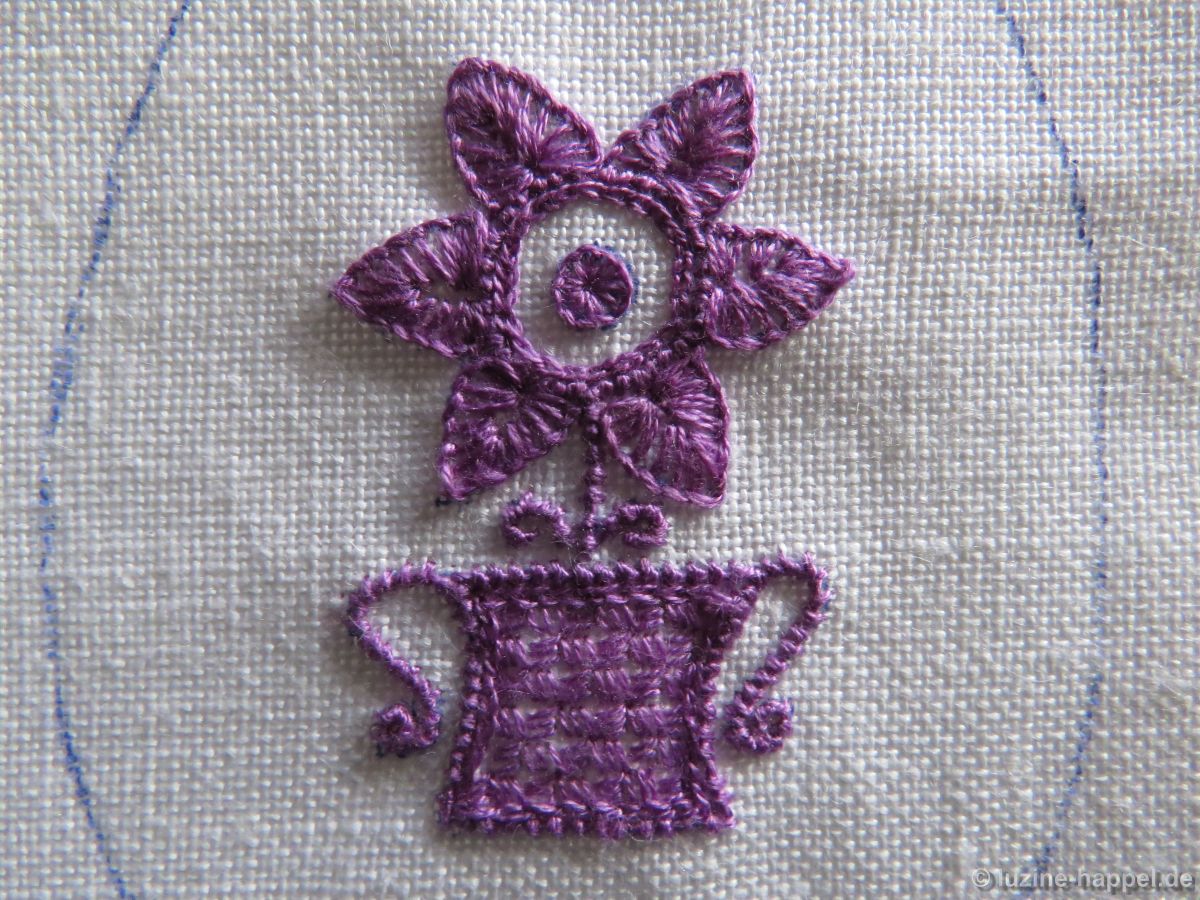
Since the edges looked too messy to me, I added chain stitches afterwards and added a small blanket stitch eyelet to the center of the flower.
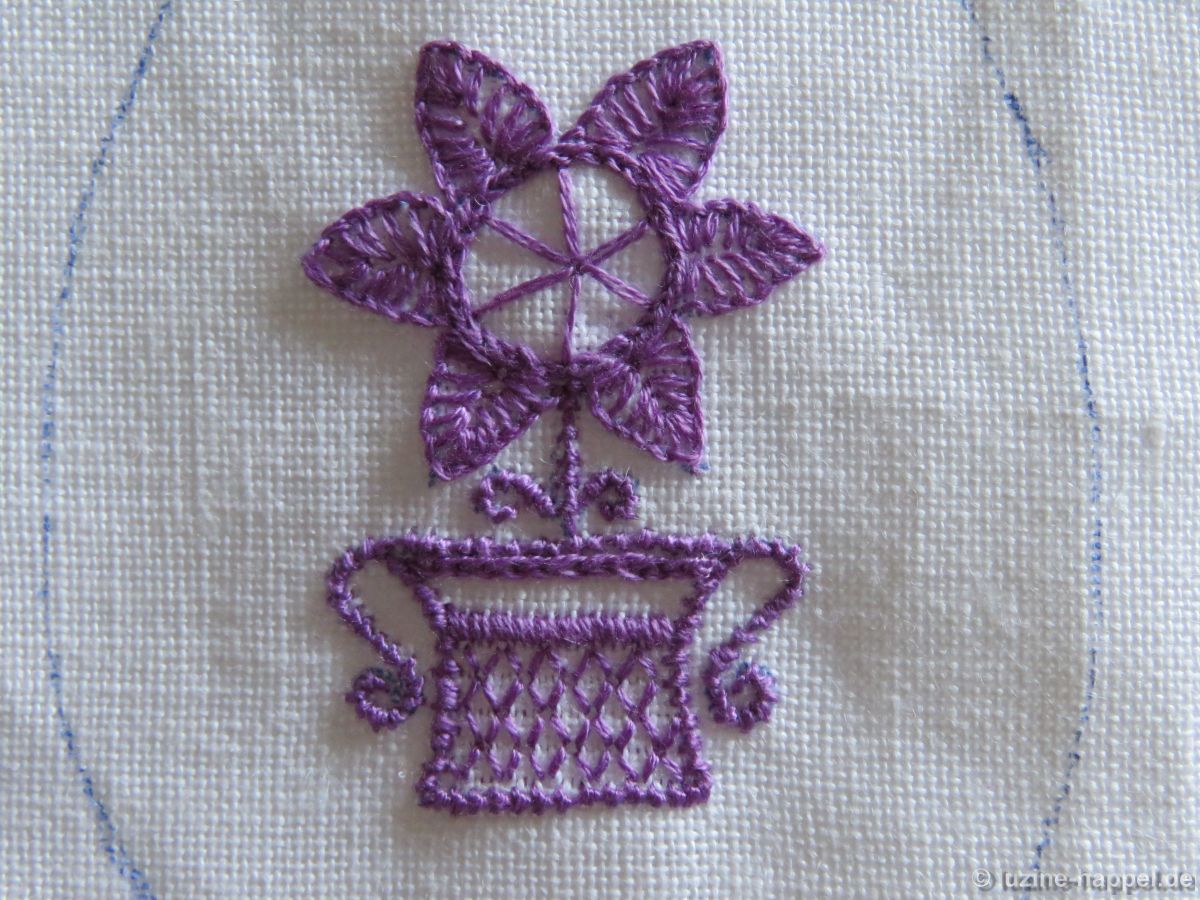
The second side was embroidered with the same motif, but the fillings were designed slightly differently.
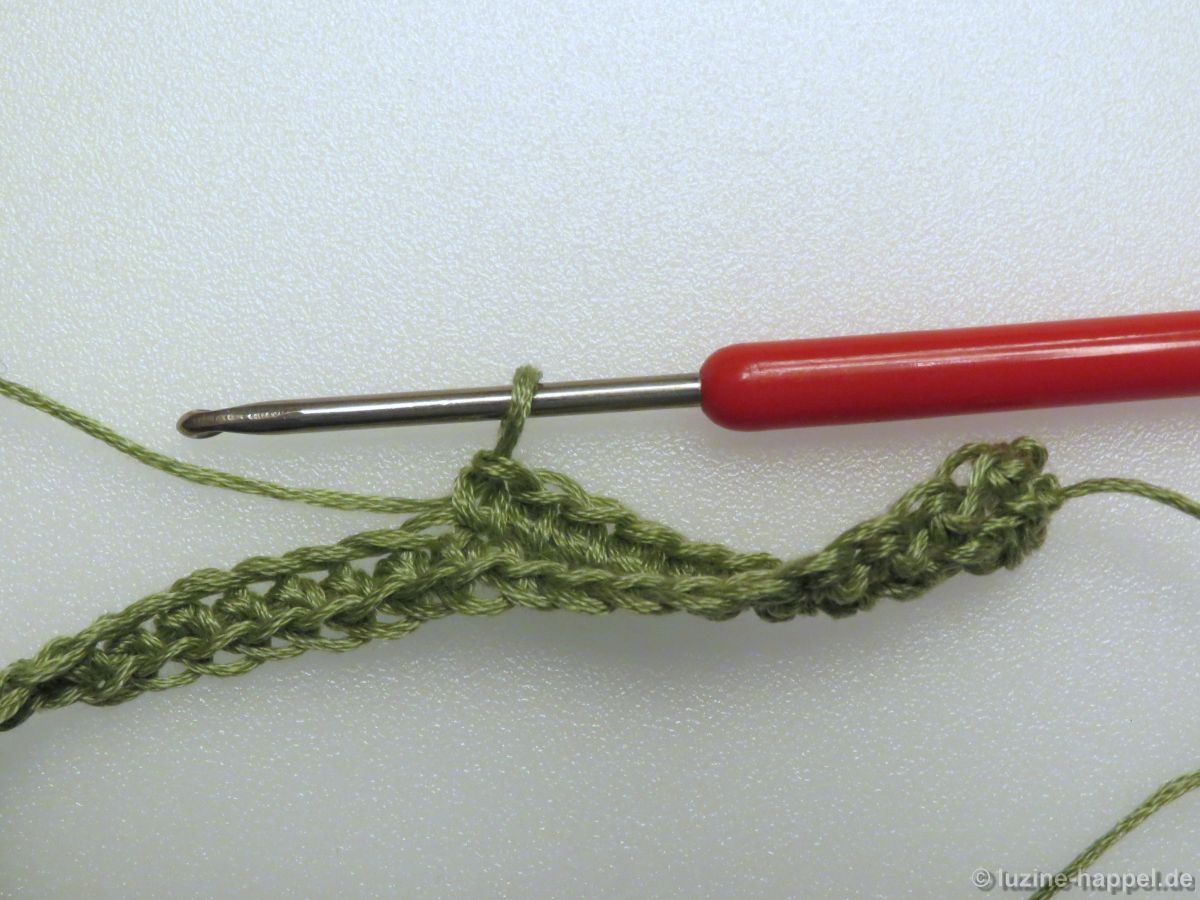
To keep the crocheted border from being too bulky, I crocheted a loose chain of stitches using a size 2 crochet hook and 3 strands of 6-ply stranded cotton. This required about 7 meters of half a skein of floss. Admittedly, it’s not easy to divide such a long strand, but it’s doable if you occasionally pin the end coming from the skein, hold the yarn up, and let it unwind.

You have to measure to see when the chain is long enough to completely cover the outline.
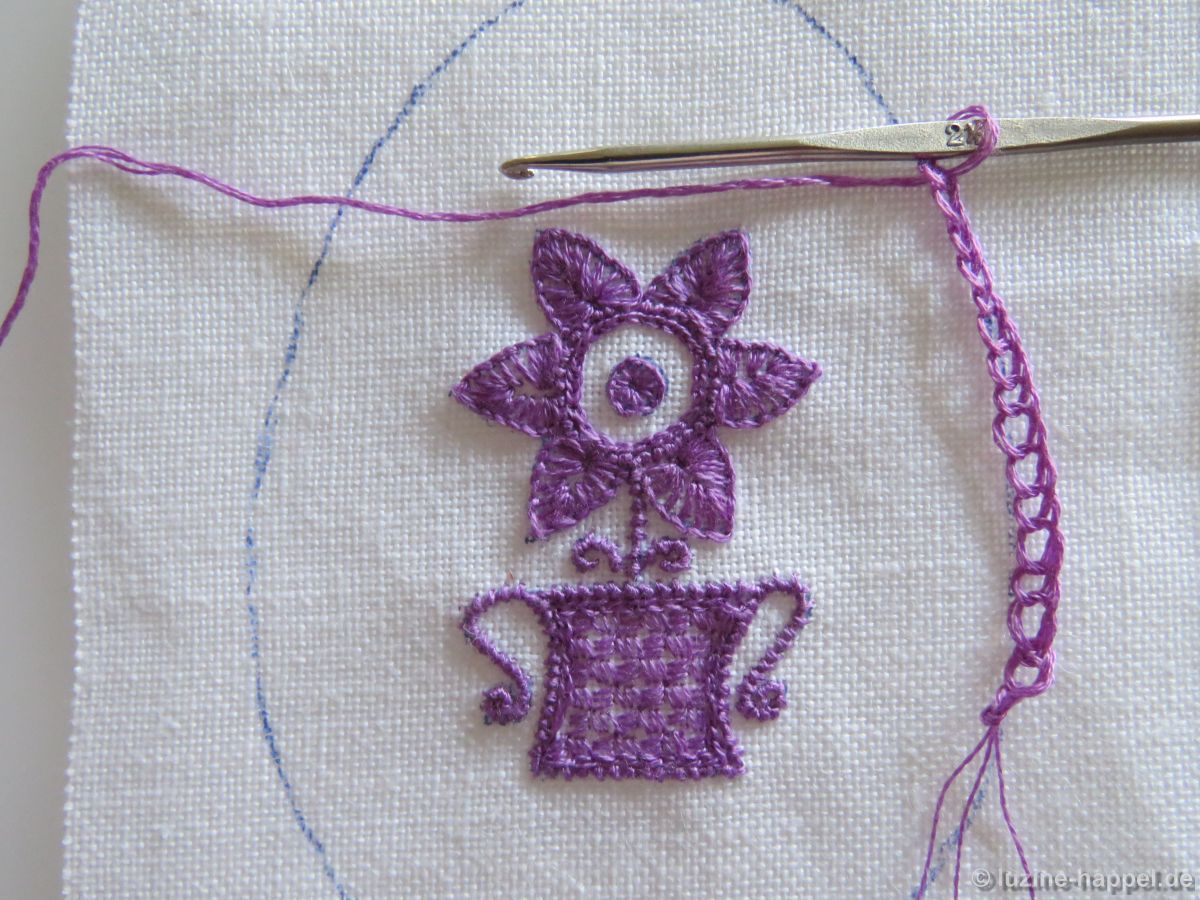
A row of double crochet stitches was crocheted over the chain stitches.
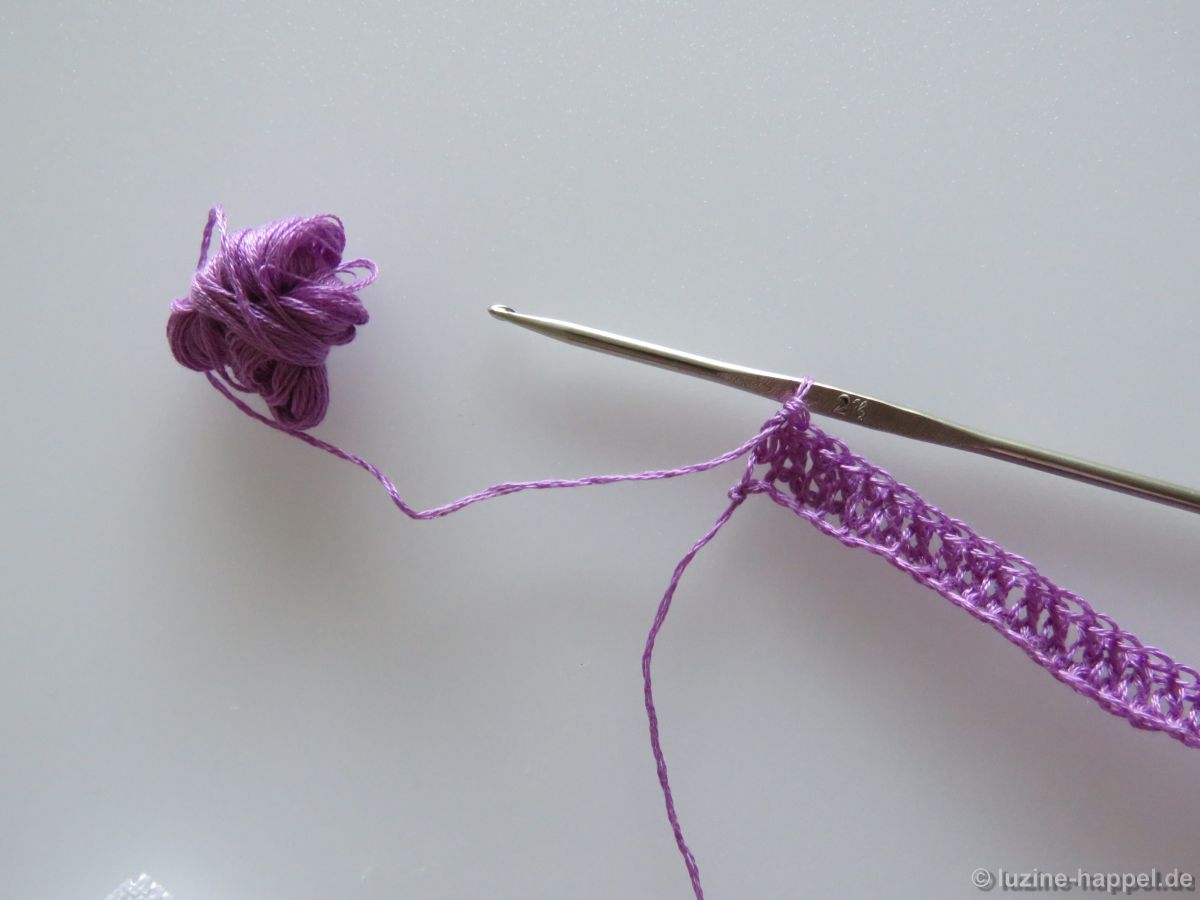
Once the end of the chain of stitches has been reached, the thread is brought back to the chain with two chain stitches, secured there and brought with two more chain stitches to the level of the second row of double crochet stitches, which is crocheted again along the chain.
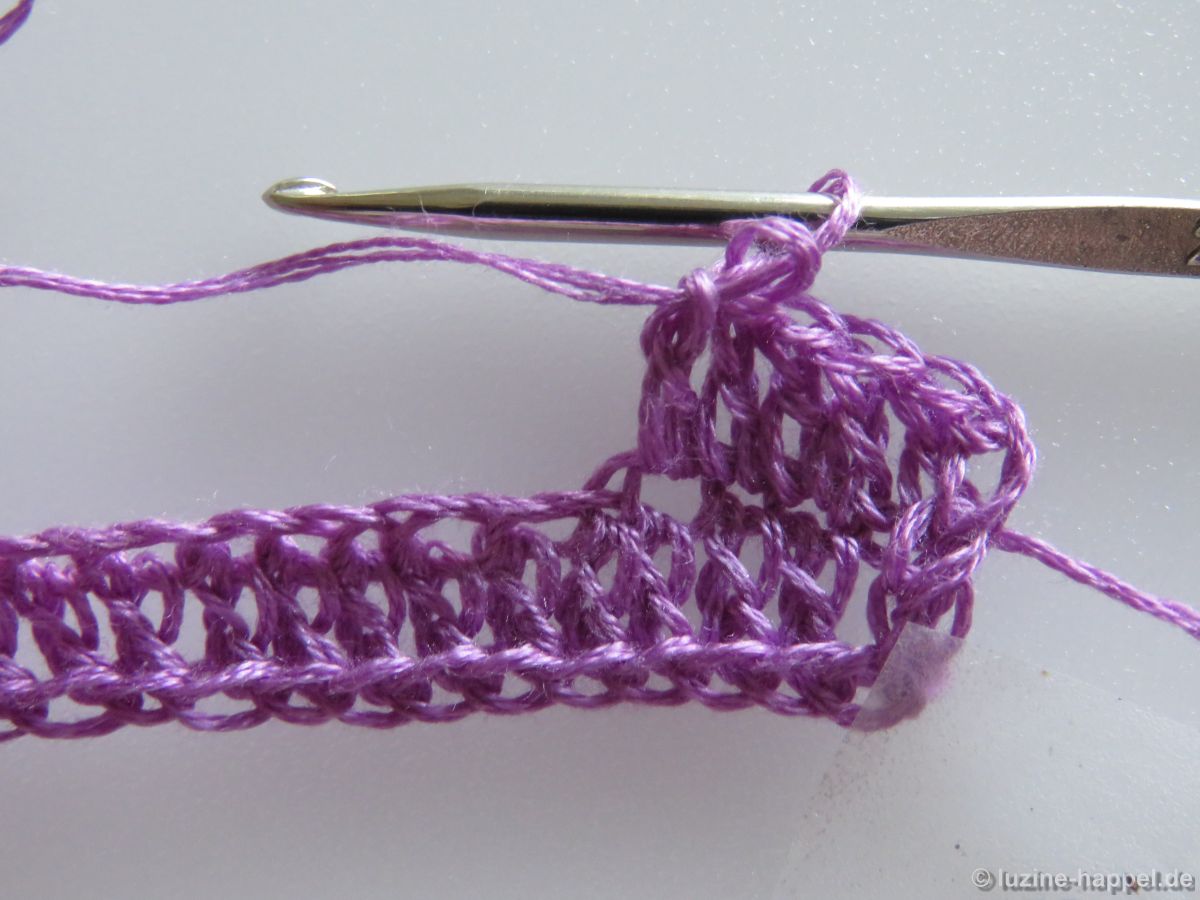
This creates a kind of fold in the middle, which makes attaching it to the edge easy. Finally, the thread is brought to the center, pulled through the last loop, and cut approximately 10 cm from the crocheted border.

The embroidered linen pieces are placed on top of each other with the right sides facing outwards, ensuring a precise fit, and pinned in place.
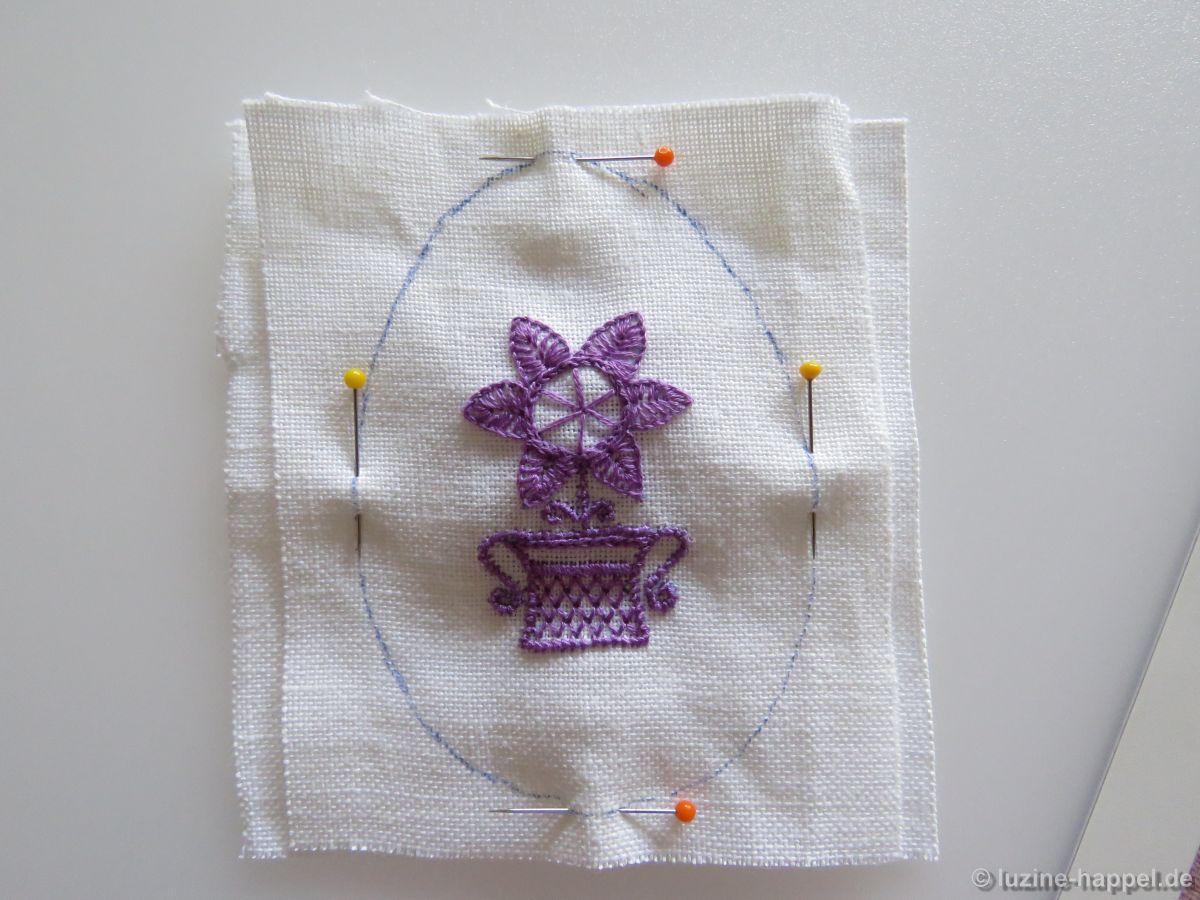
On the back, you can check if the lines have been correctly drawn. If not, you need to make corrections.
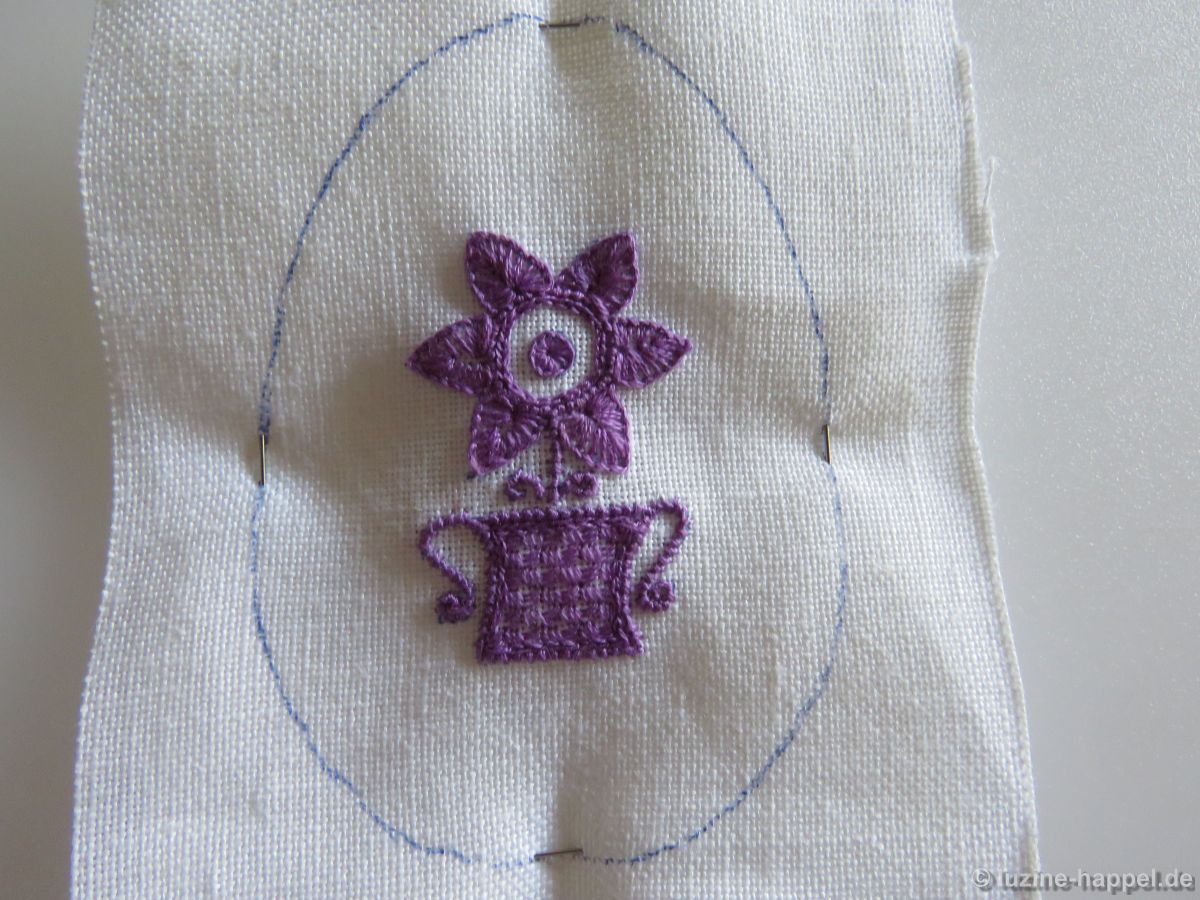
The parts are baste together with a small distance from the edge.
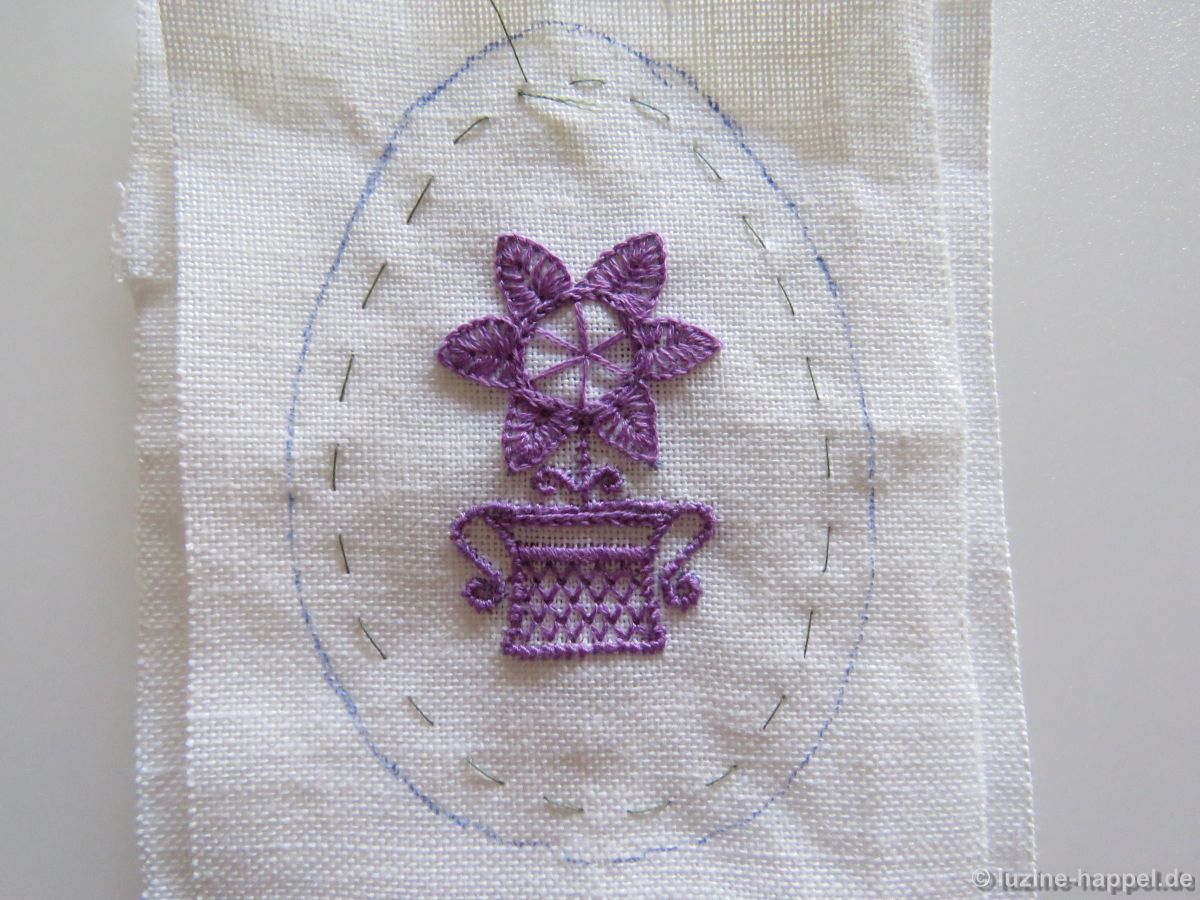
and sewn together with small zigzag stitches along the outline, except for an opening on the long side.
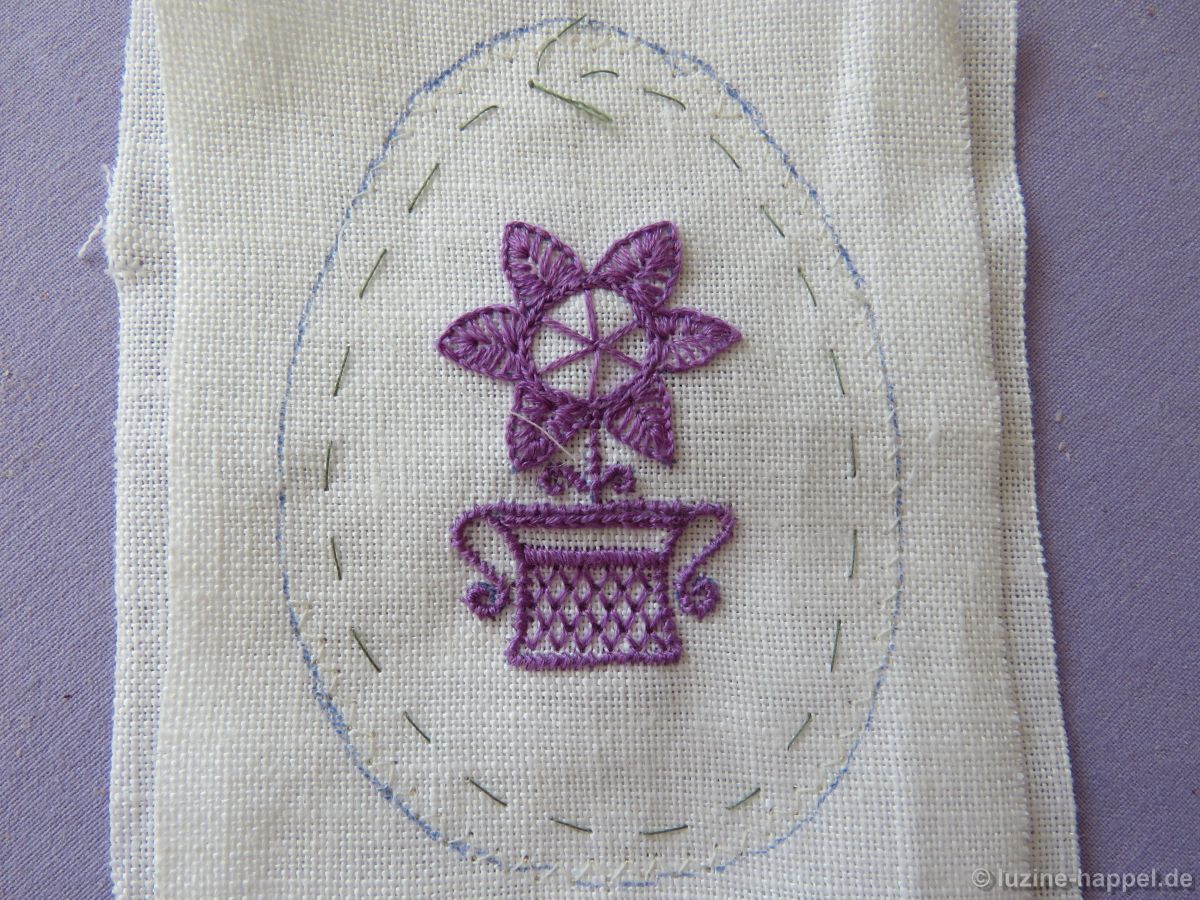
The egg is cut out, as described in detail in the previous blog post.
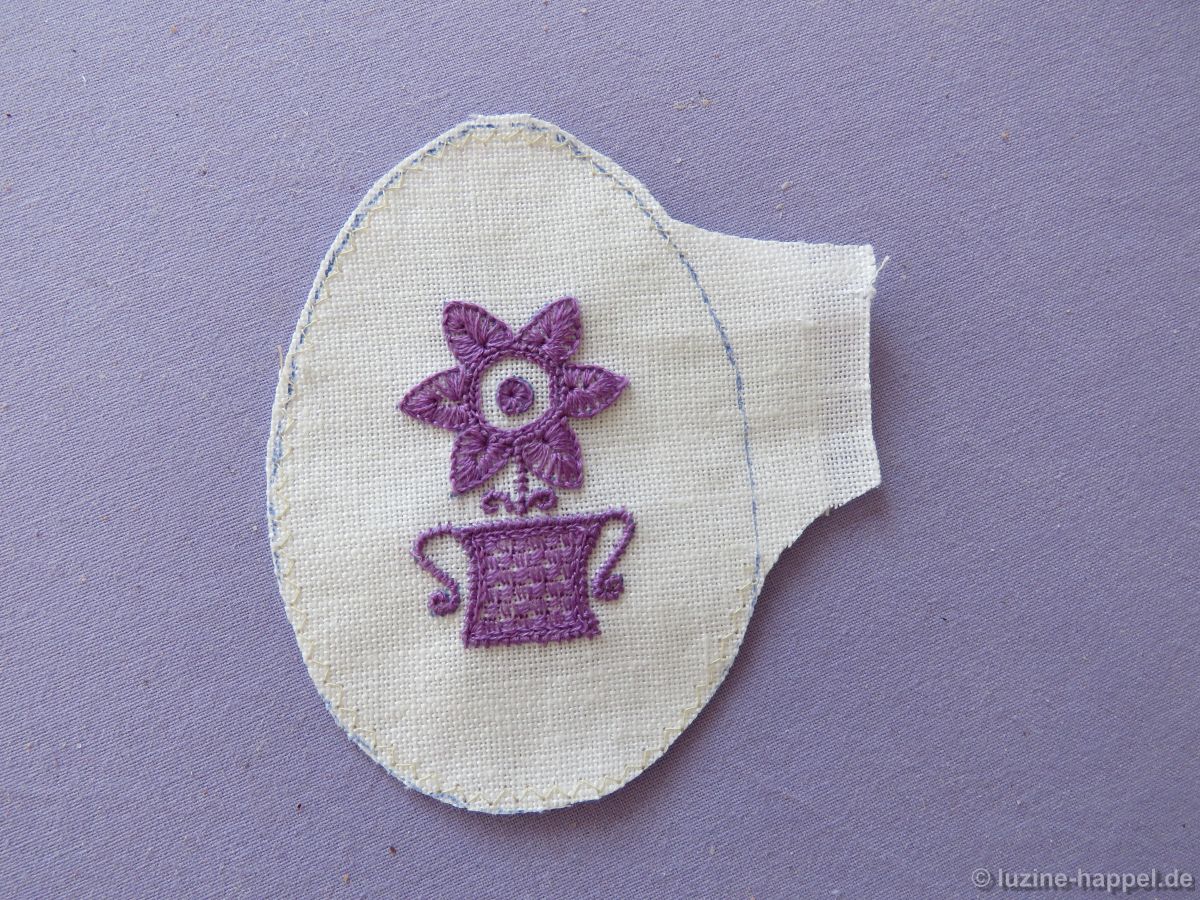
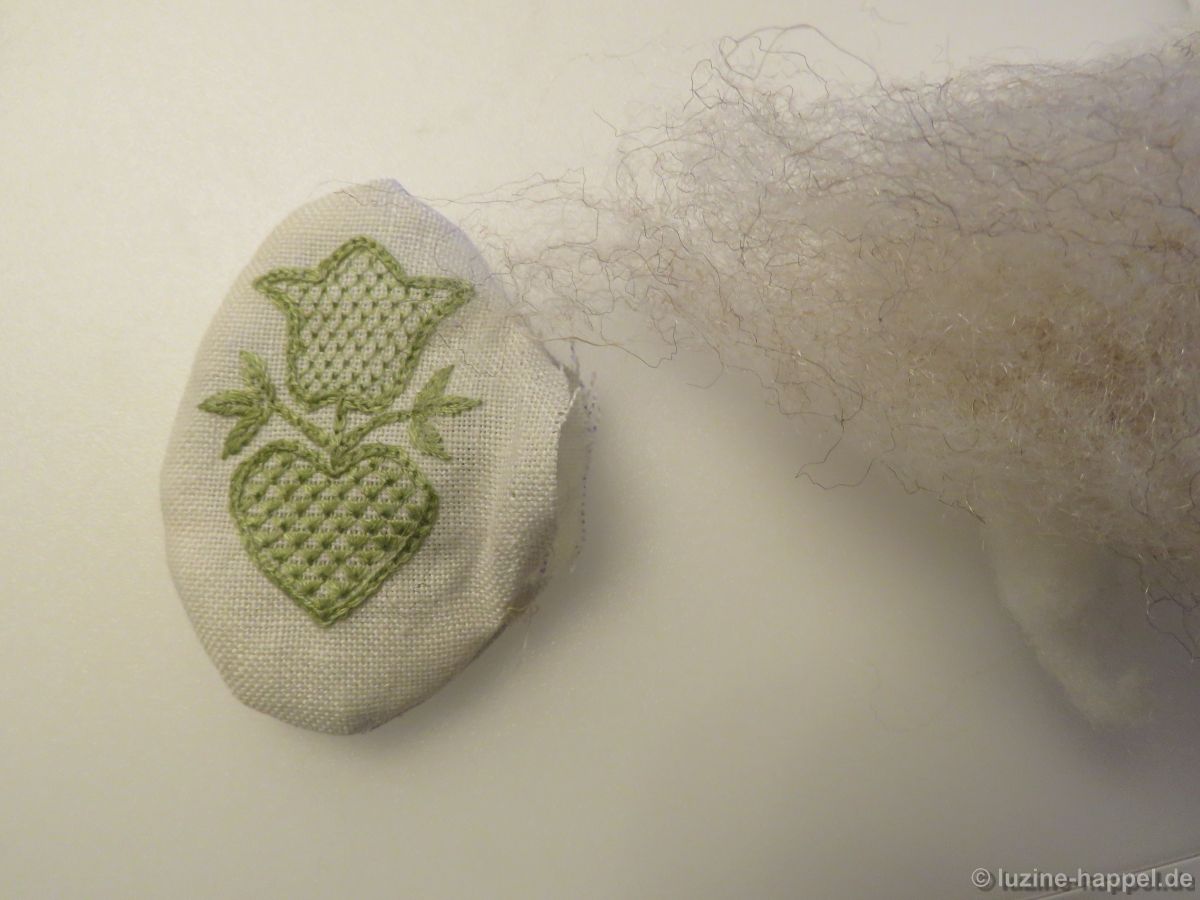
ironed, lightly filled, and closed.
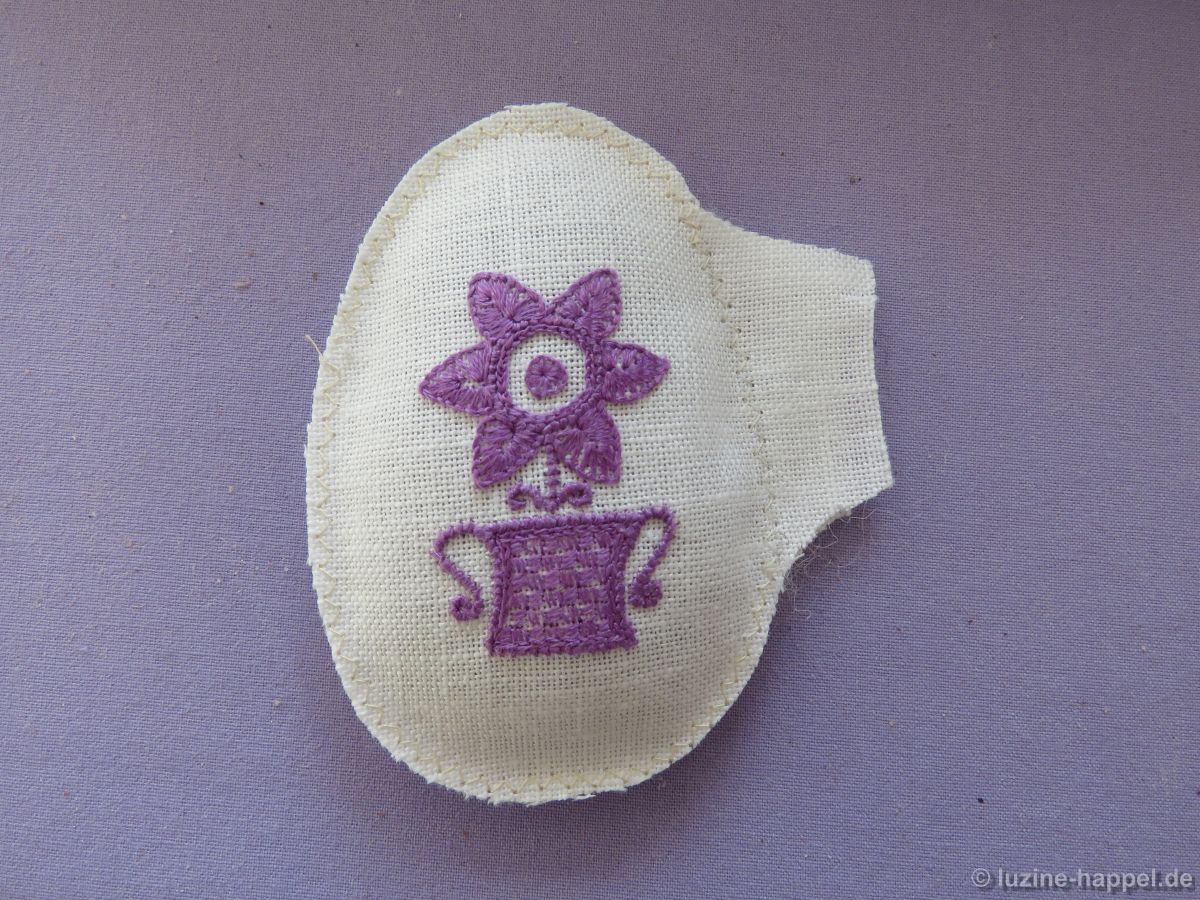
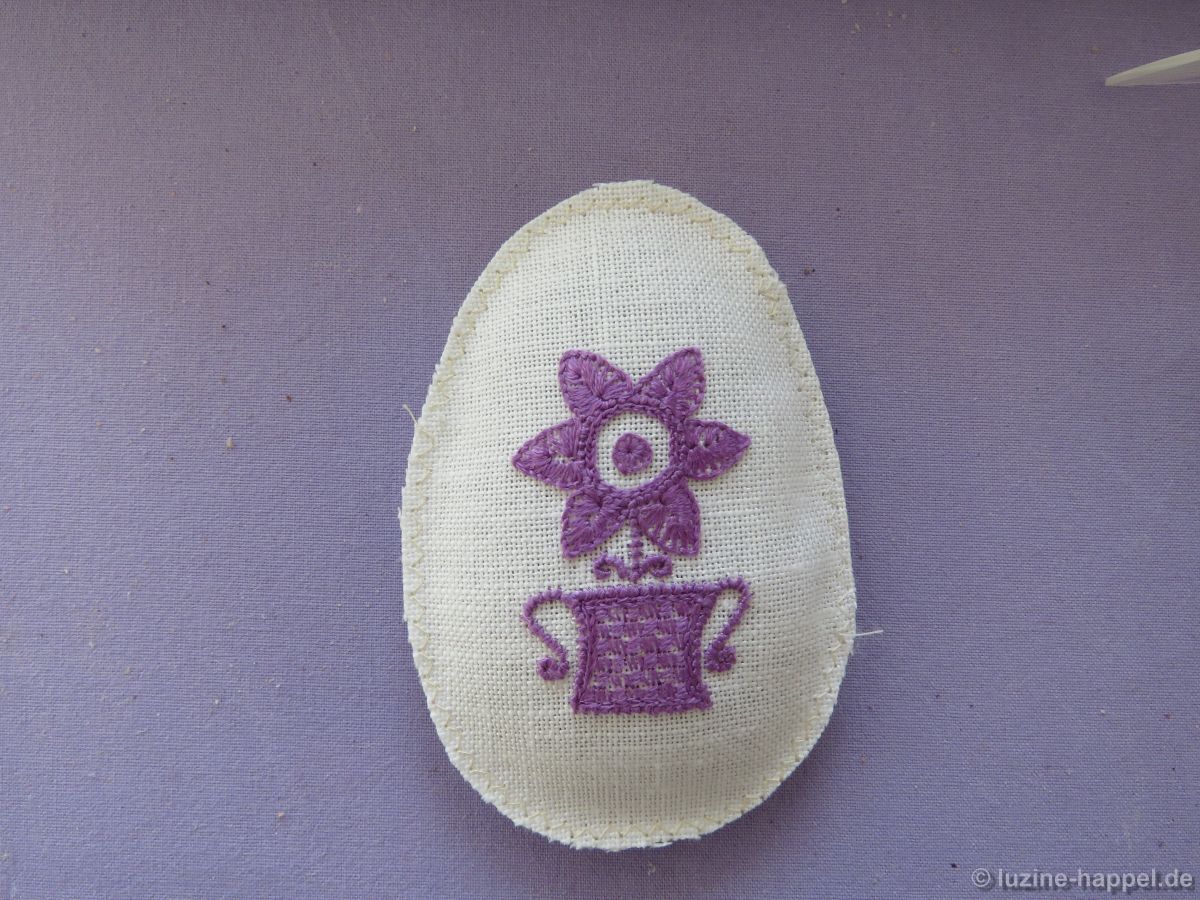
The remaining excess fabric is cut off.
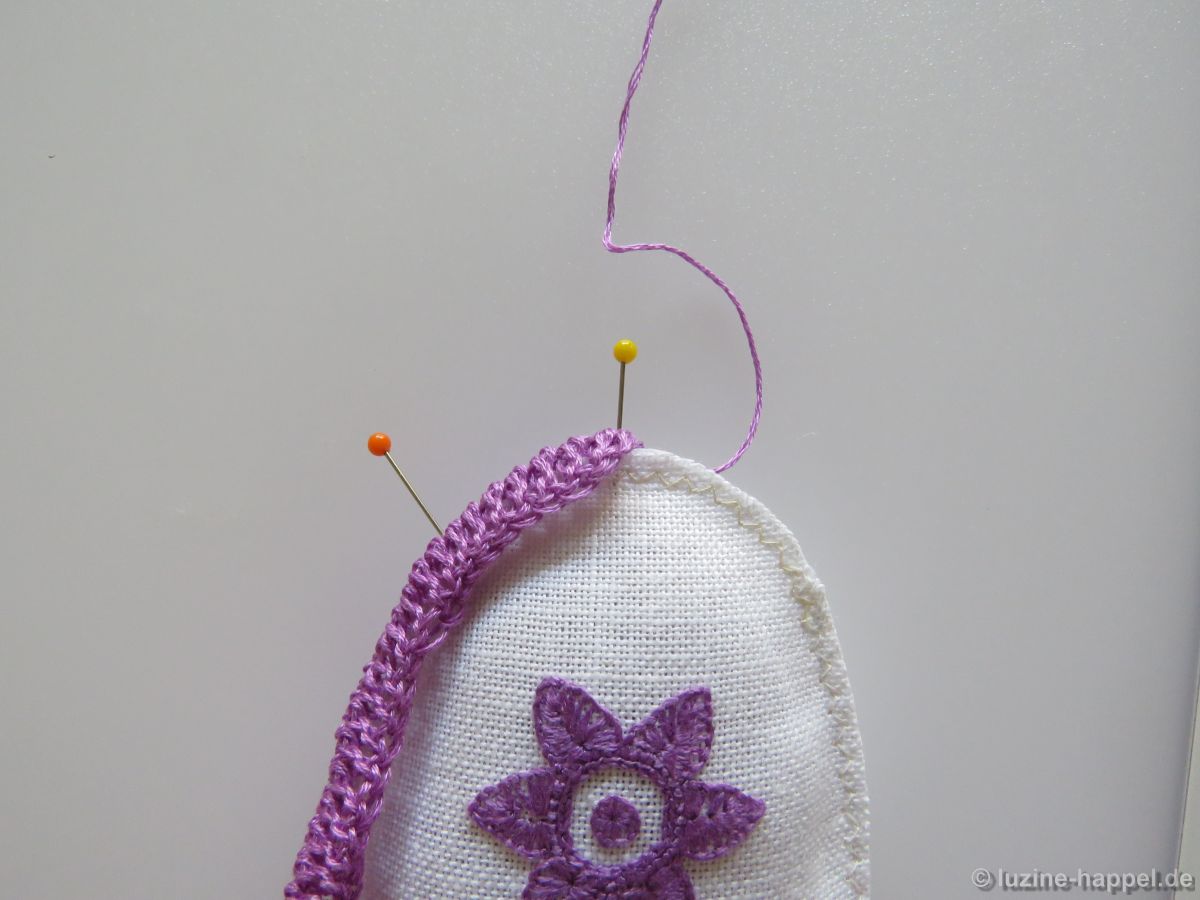
Starting at the top, the crocheted border is first attached with pins,
to ensure that the border is evenly distributed around the edge.
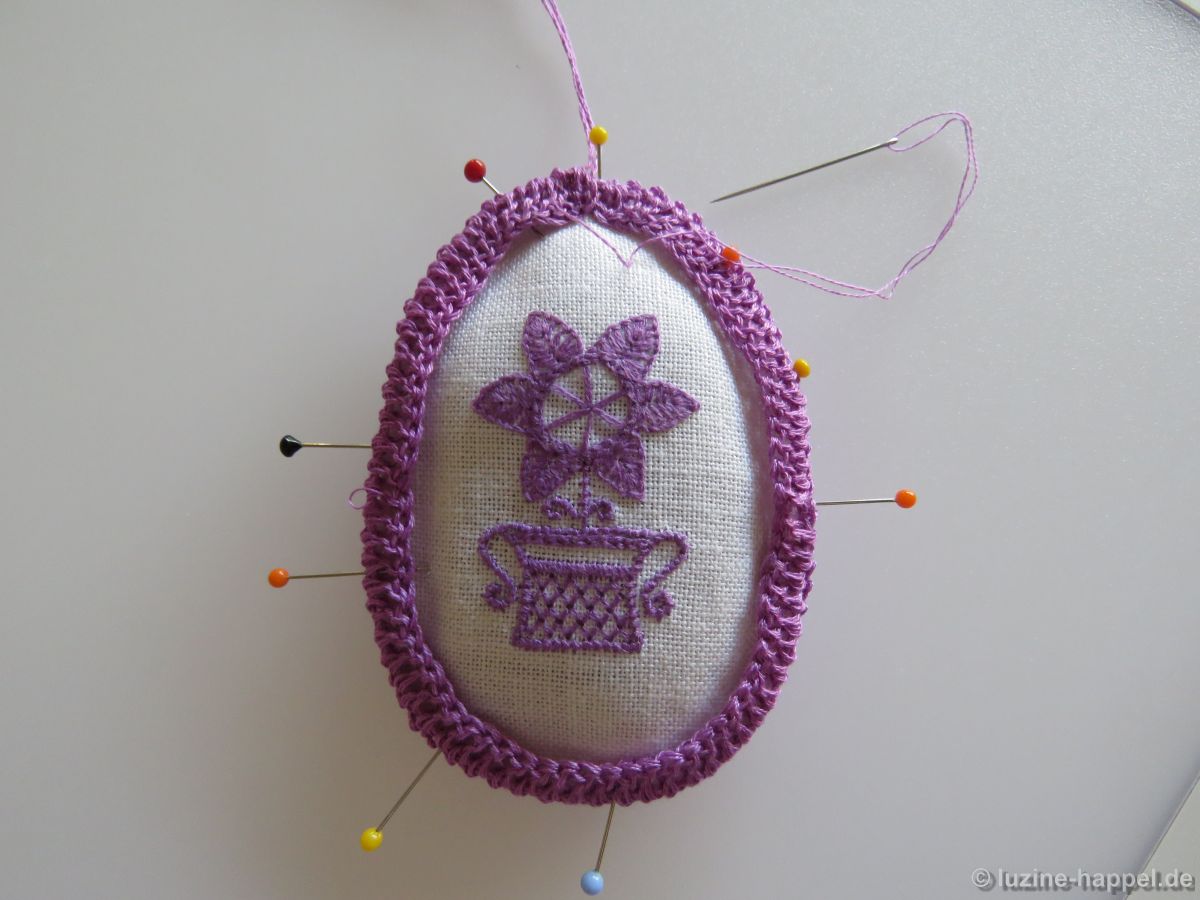
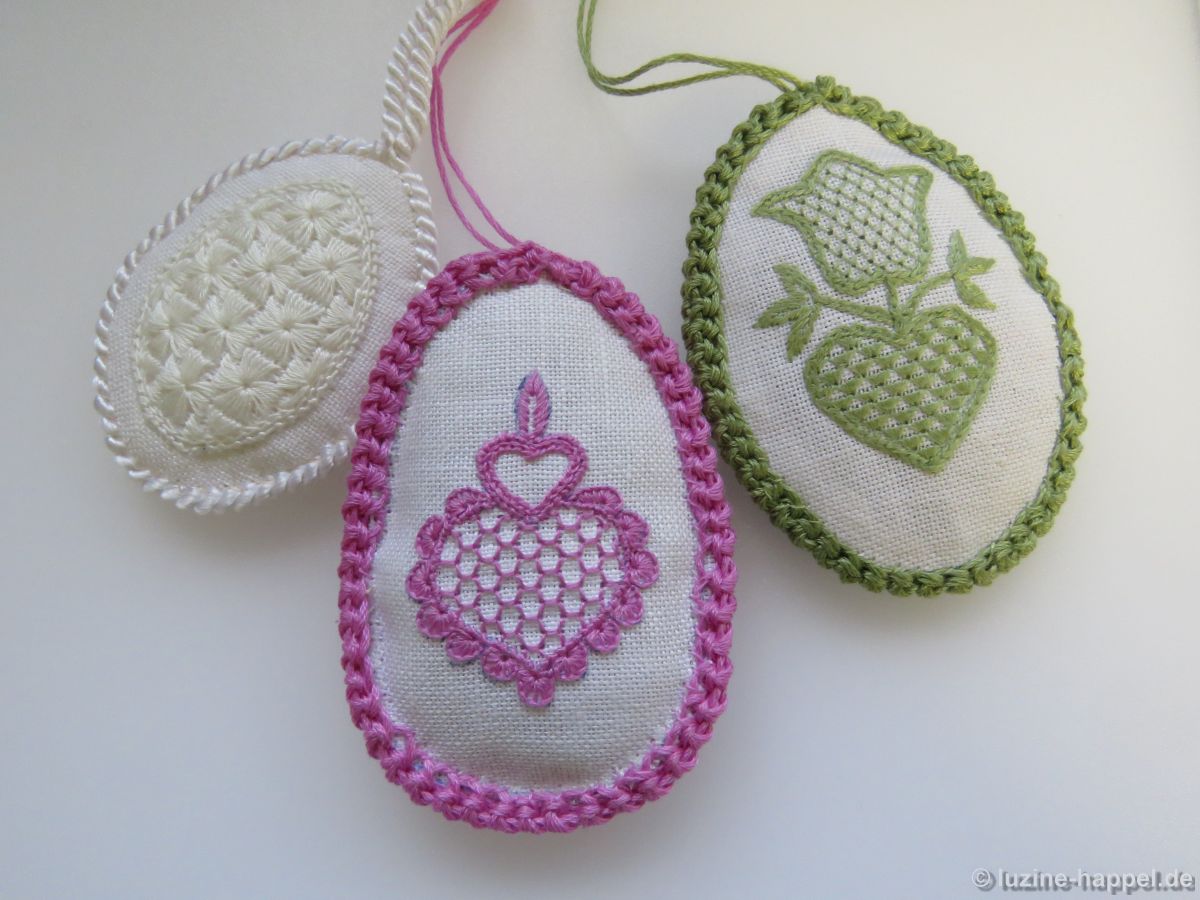
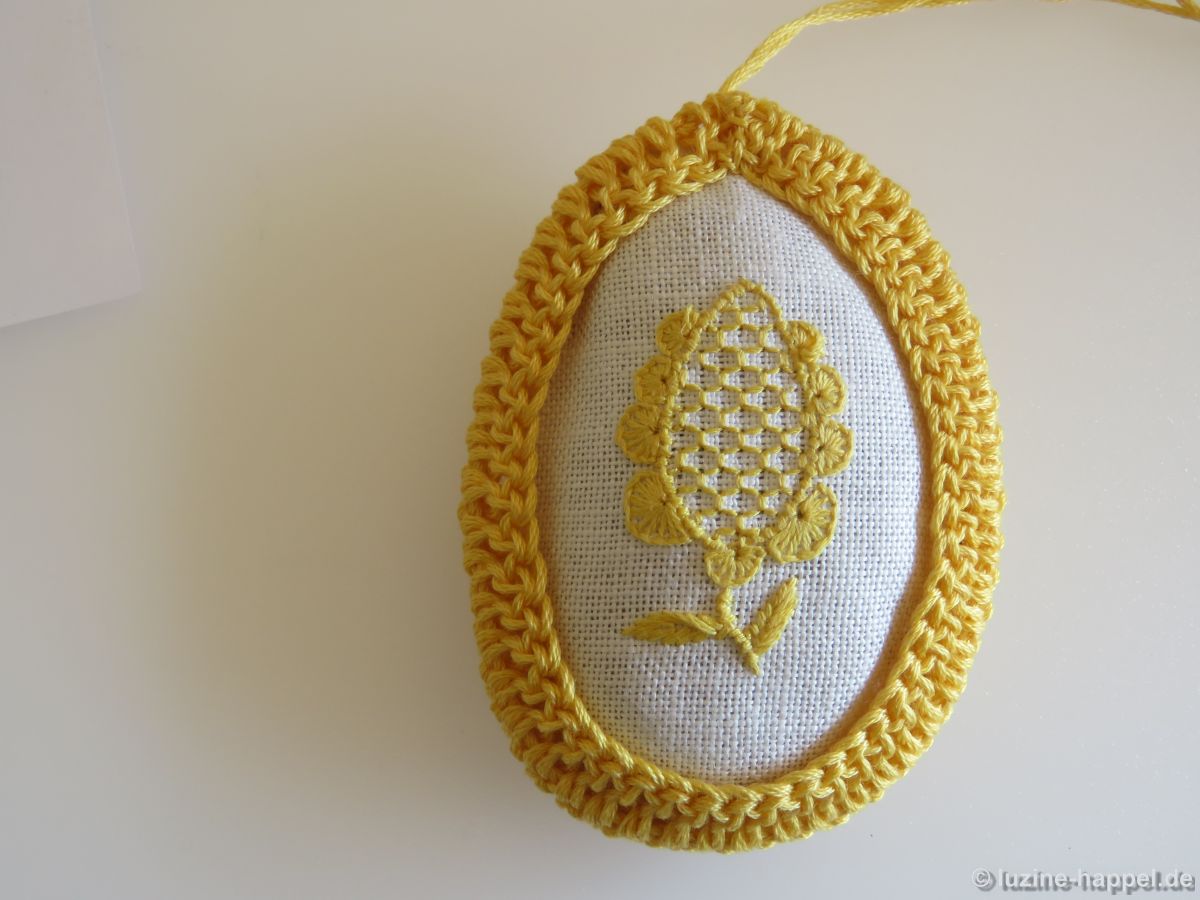
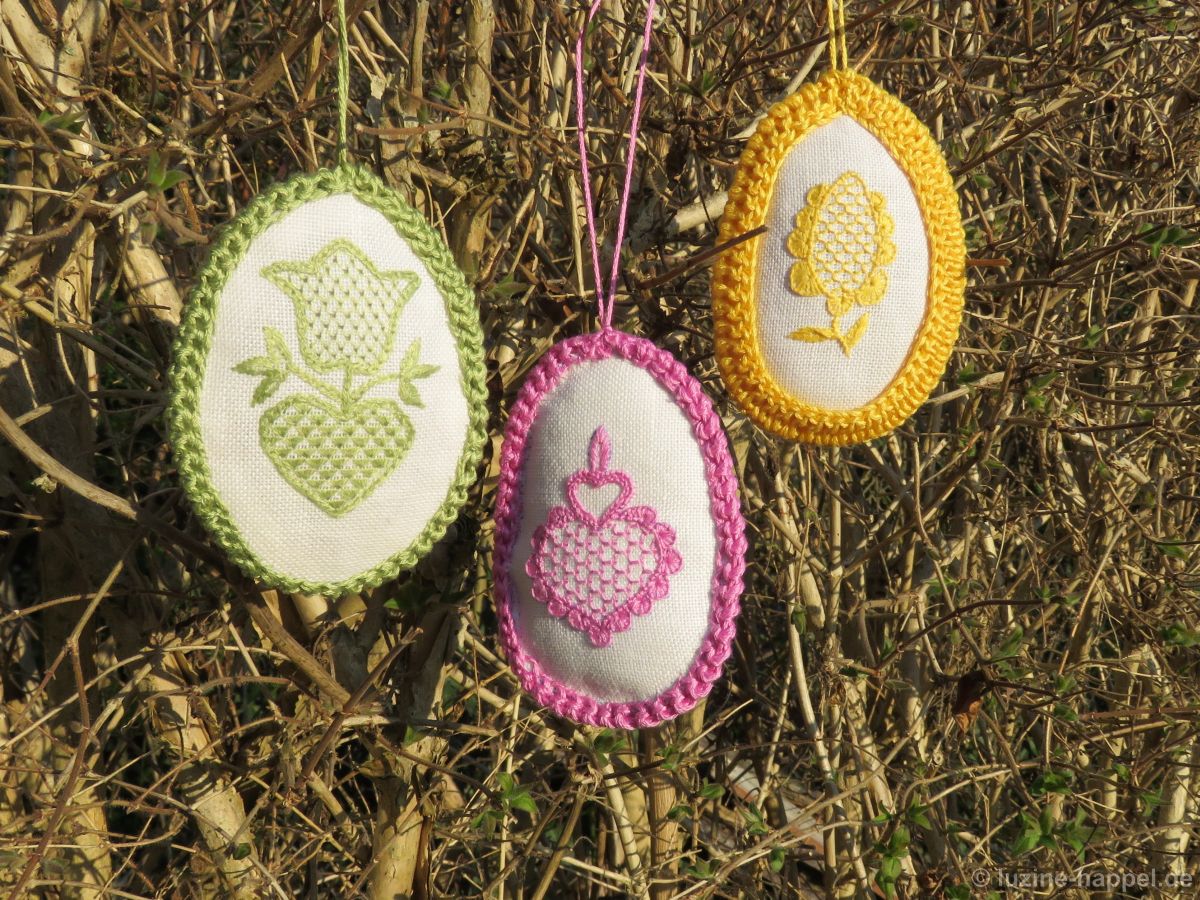
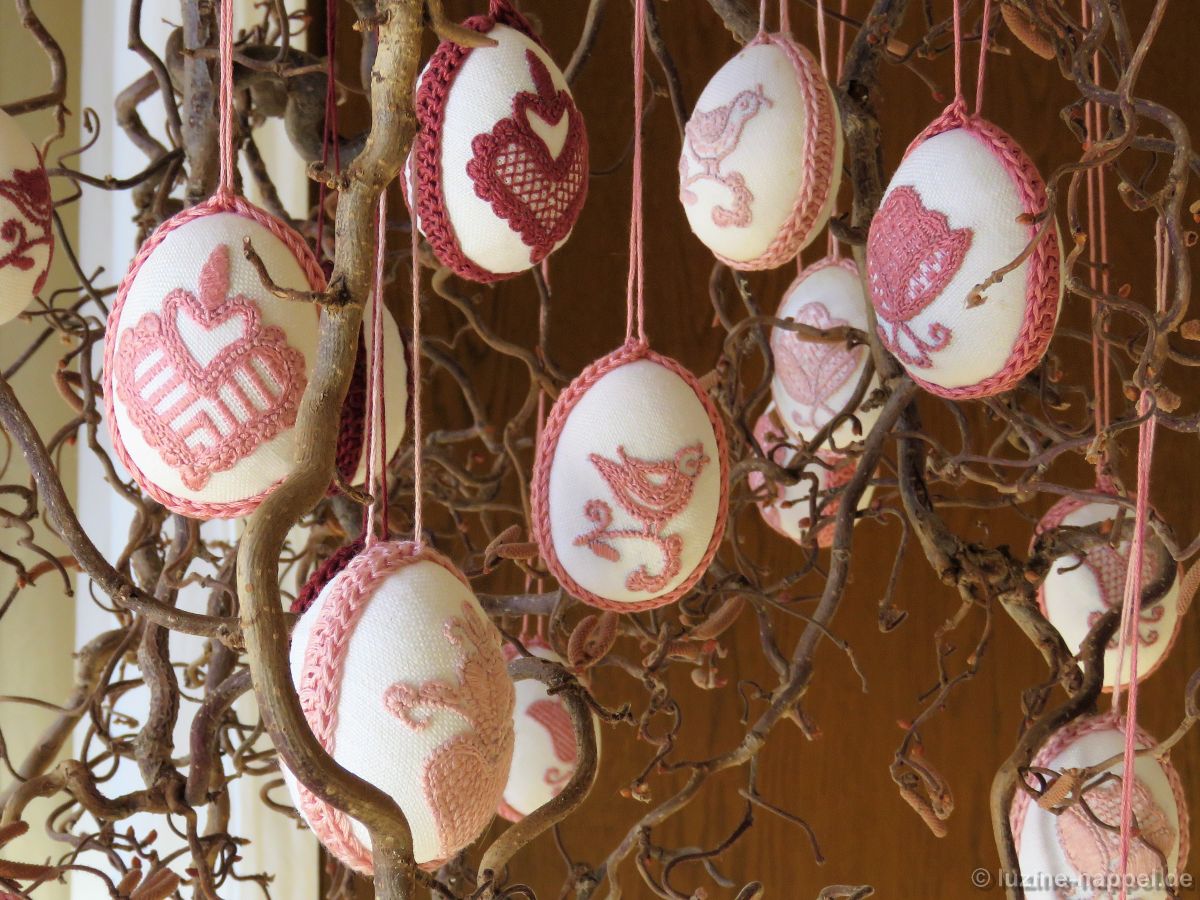
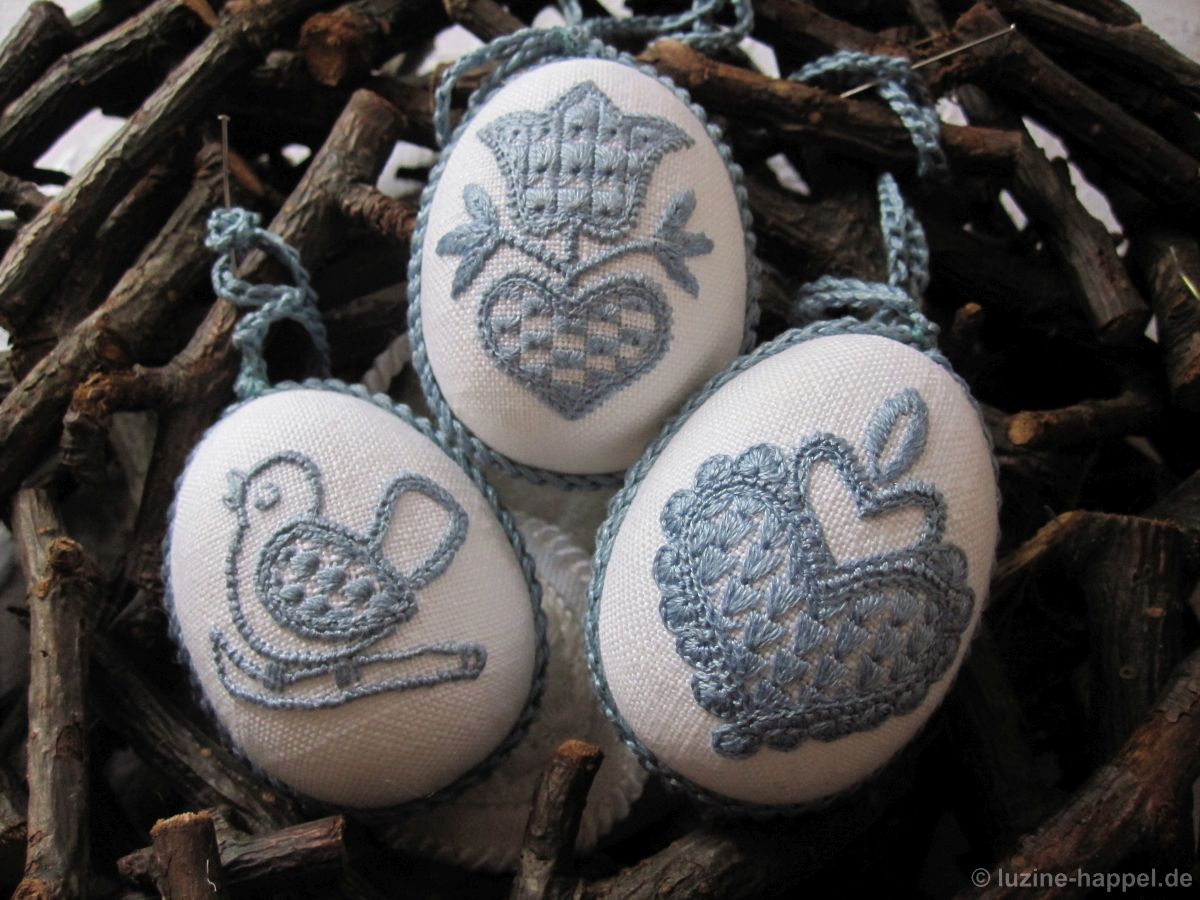
The border crocheted with only 3 strands of the stranded cotton isn’t as sturdy as the one crocheted with all 6 strands of the stranded cotton (the yellow one shown in the previous blog post). Therefore, I thought it would be better to sew it on. This time, I did it with stitches from the back to the front and back again.
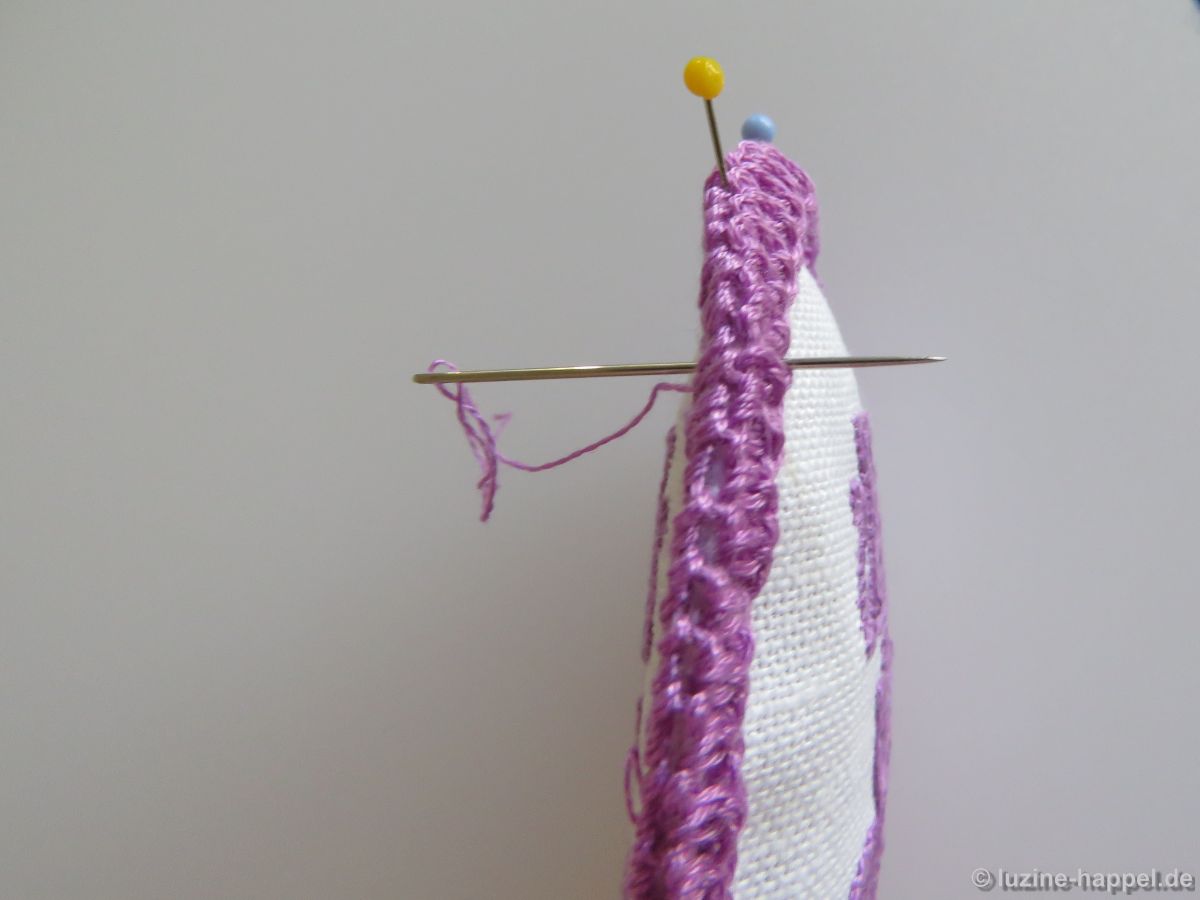
This has the advantage that the trim can be attached to both sides with an even width.
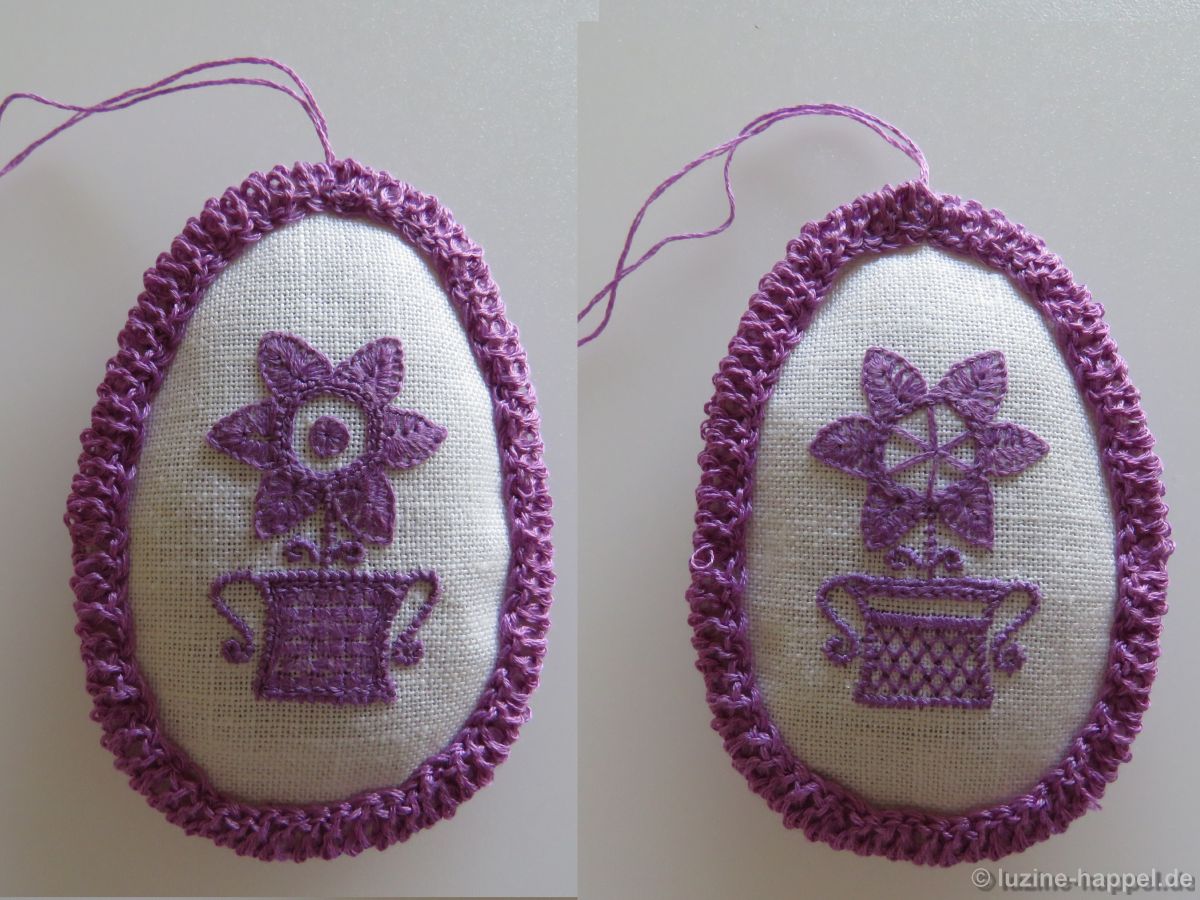
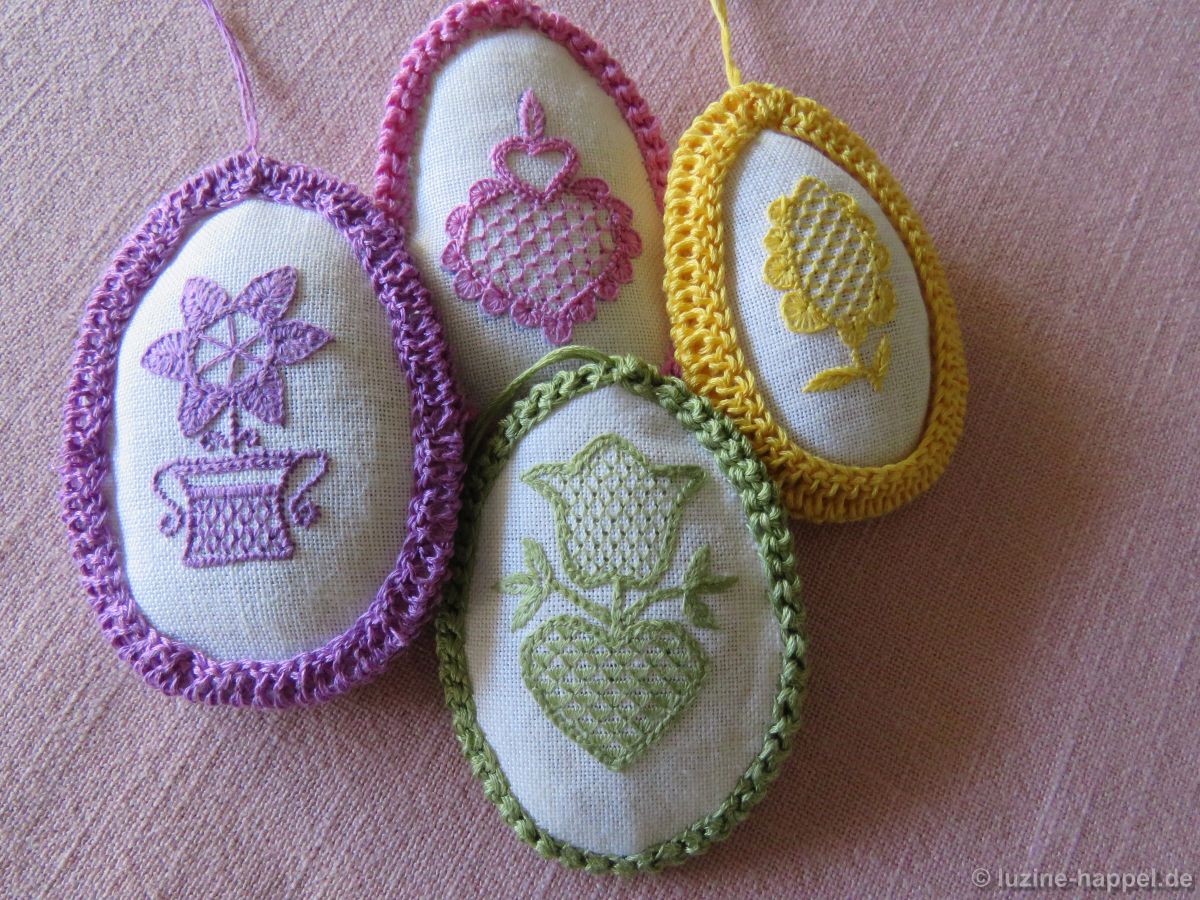
Perhaps I chose stitches that were too large, or perhaps I pulled the thread too tight. This makes the edge look less defined than the green and pink borders, which were attached stitch by stitch with overcast stitches.
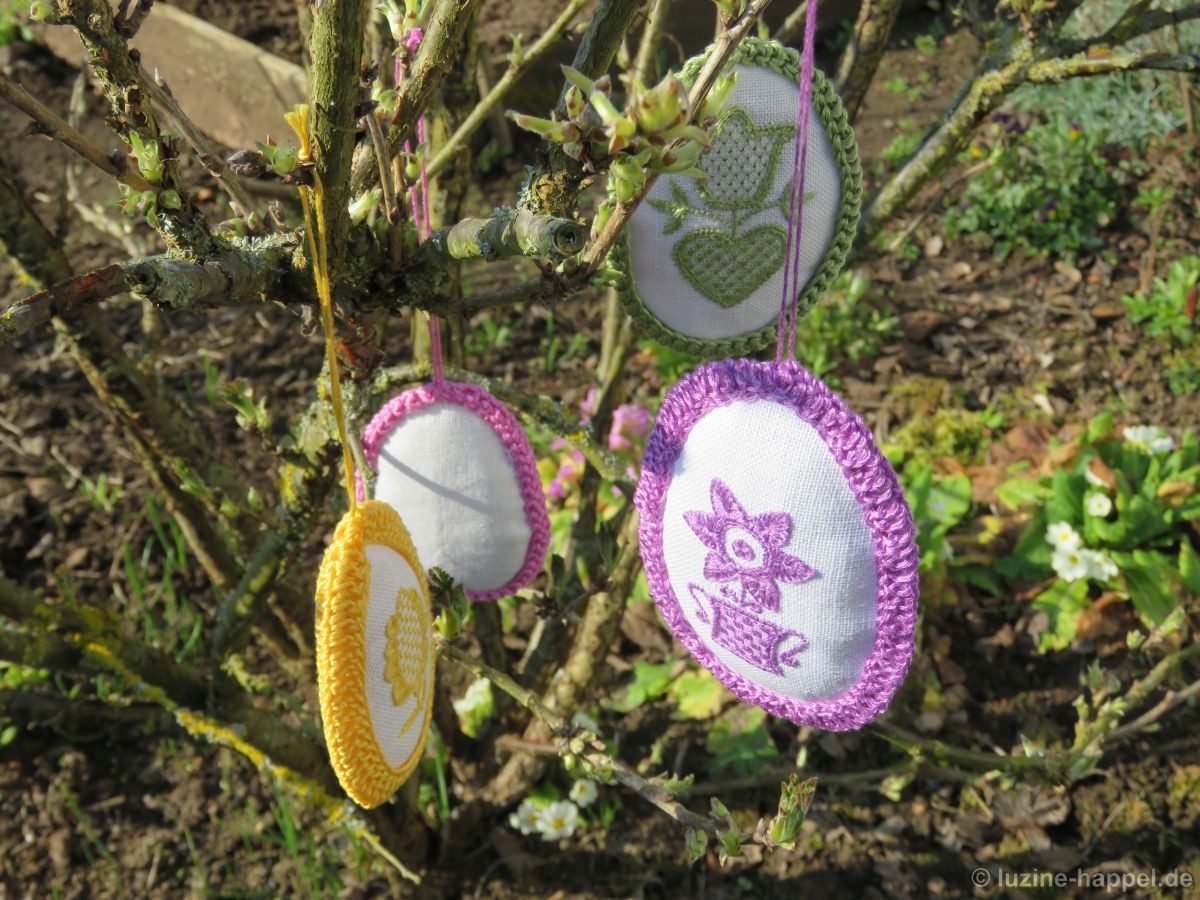
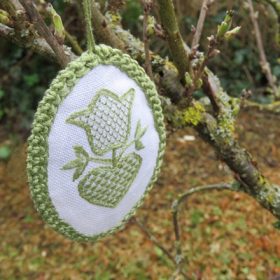
Hanging on the bush

and when gently swinging in a breeze, it no longer matters.
Finishing Filled Easter Eggs

For some, assembling small, embroidered motifs of the Schwalm whitework on plastic eggs the size of chicken eggs is too challenging.

So I looked for other ways to use these pretty motifs as hanging decorations for the Easter bouquet. At first, I worked with embroidered pieces, but later – to make faster progress – I preferred unembroidered linen for testing.

For my first attempt, I embroidered the front of the fabric and added a center seam with a wide opening to the back. Both pieces were placed right sides together and sewn in an egg shape. The seams were pressed firmly, the excess fabric at the curves was clipped up to the seam, and the excess was trimmed all around. The piece was turned right side out. The seams were pressed firmly again. The egg was stuffed with fiberfill. The opening of the back seam was closed. The edge was finished with a twisted cord.

Disadvantage:
These eggs can only be embroidered from one side:
After turning them over, small irregularities can occur at the edge due to the curvature of the shape.

The cord cannot conceal small irregularities at the edge.

For the second attempt, I proceeded similarly. Only this time I used two embroidered pieces and left an opening along the long side for stuffing.

The edge was covered with a crocheted border.

Disadvantage:
After turning, the curvature of the shape creates small irregularities at the edge.
Closing the edge opening is not entirely easy due to the slight curvature.
Advantage:
You can embroider the egg on both sides.
The crocheted trim conceals any small irregularities along the edge.
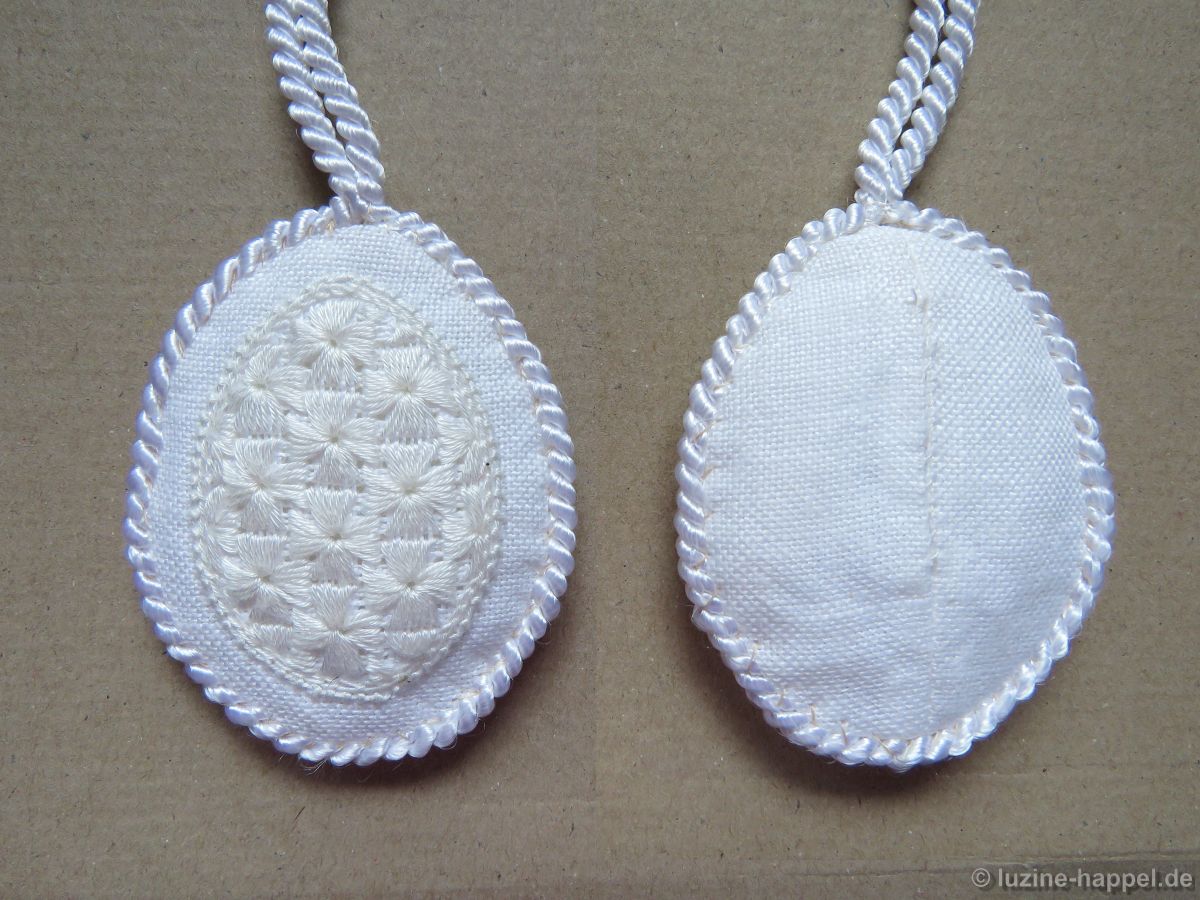
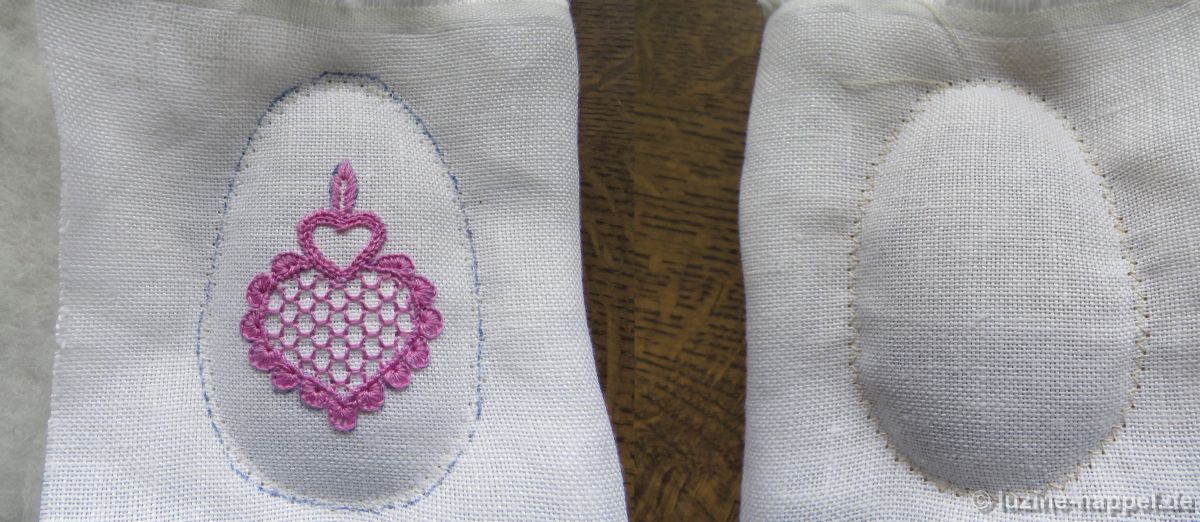
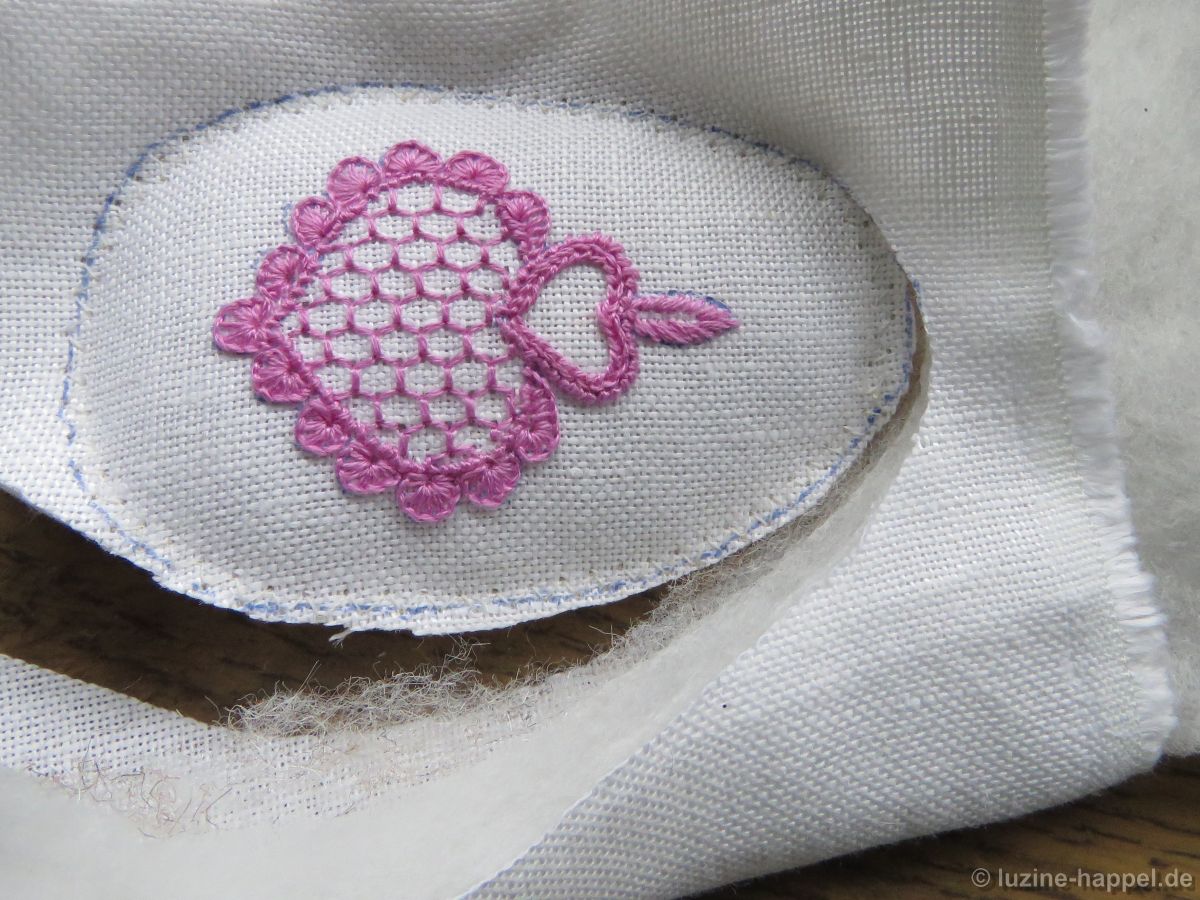
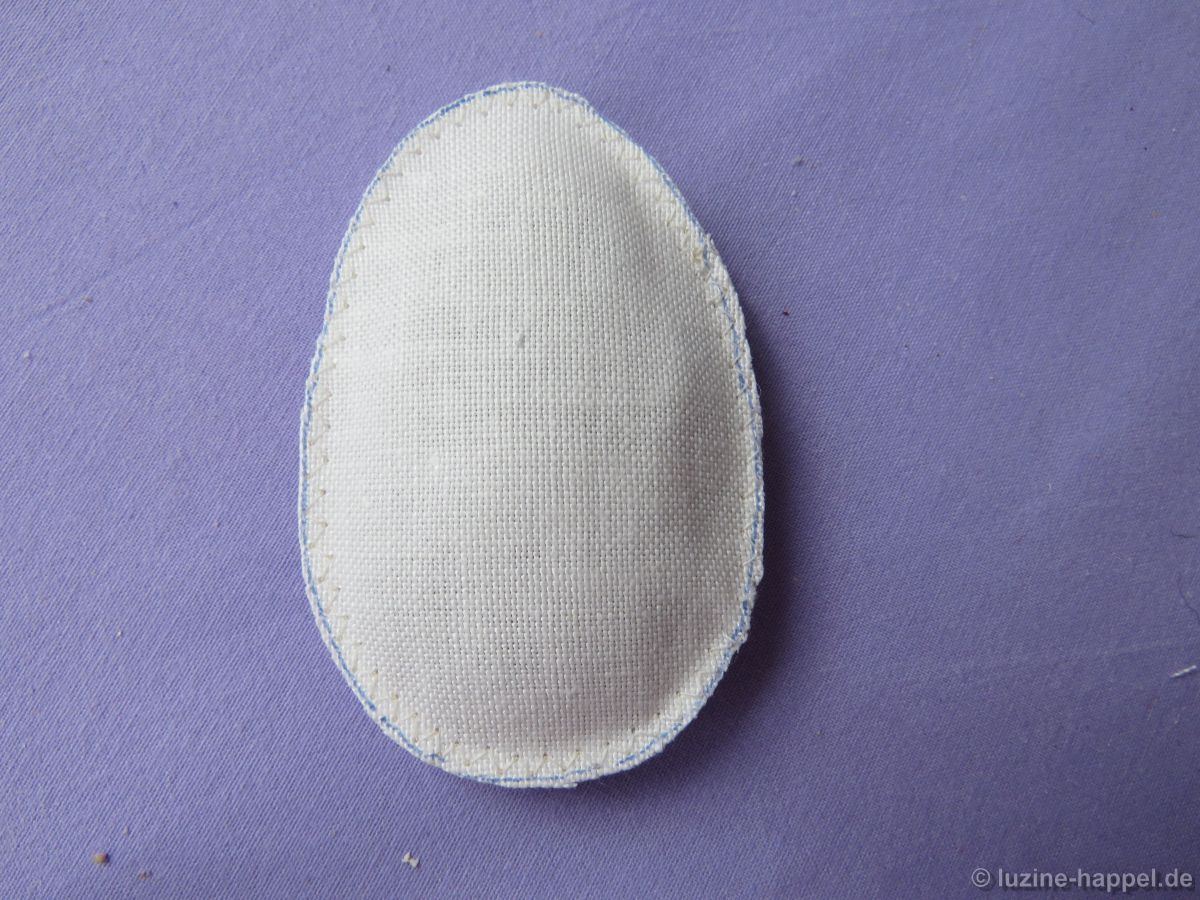
In a third attempt, I placed a fleece between the two pieces of linen and sewed the layers together in an egg shape using narrow zigzag stitches (picture: front and back).

After cutting, the edge is also slightly more voluminous due to the fleece. This makes attaching the crocheted trim a little more difficult.

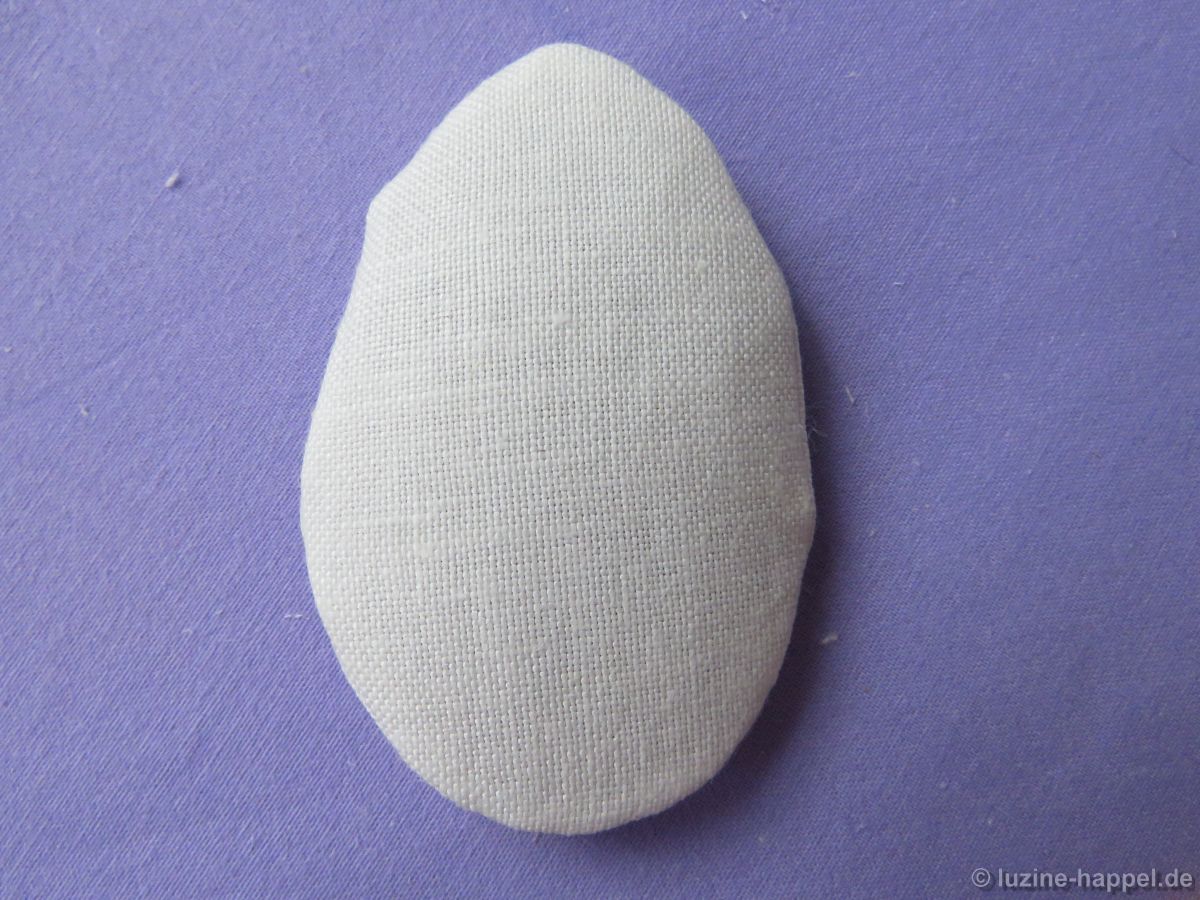
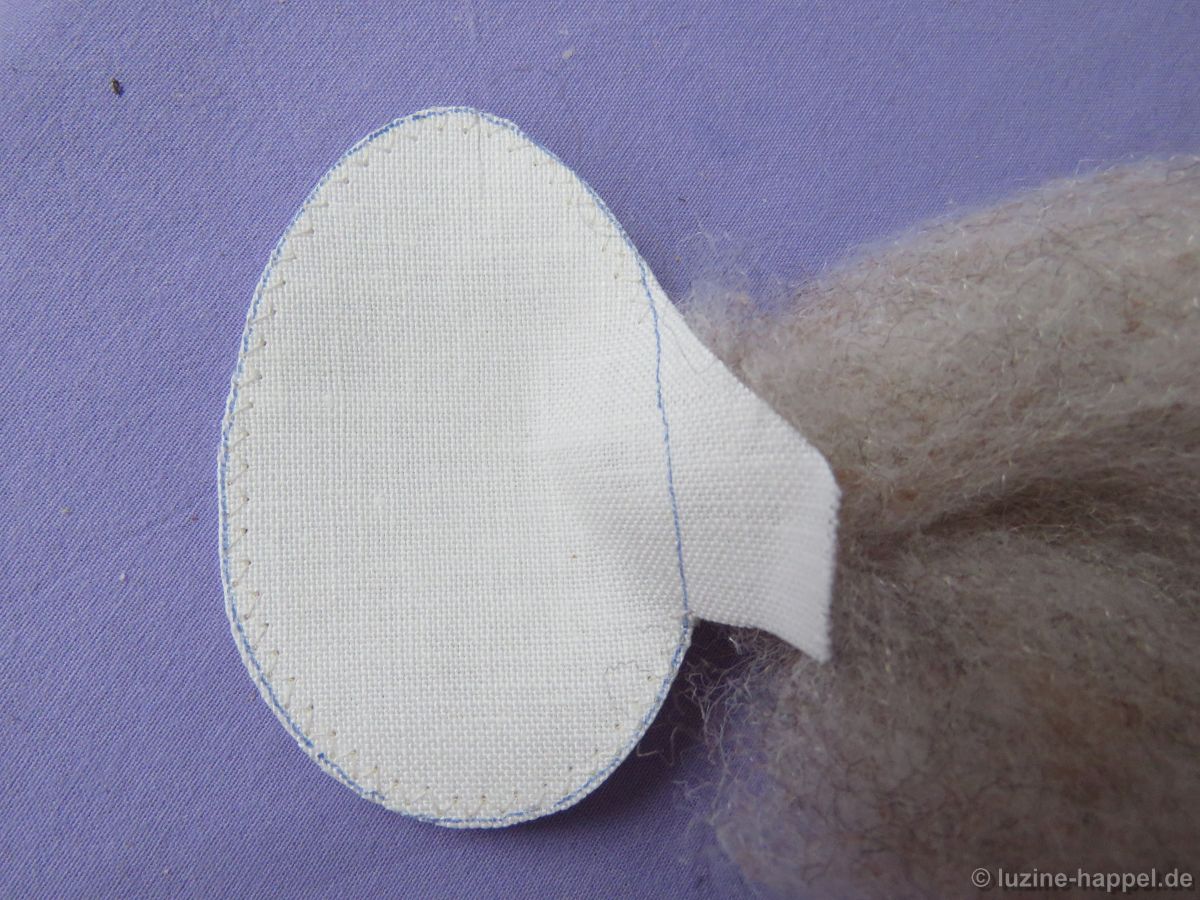
My last attempt is the most promising. The two pieces of fabric are sewn together along a marked line with small zigzag stitches – leaving an opening along the long side. The excess fabric is then trimmed along the outer seam line – except for the area at the opening.

The piece is filled and the opening is closed with the machine. The excess fabric remaining there helps to position the seam correctly. This will also be trimmed later.

What remains is a slightly arched egg with a relatively clean edge, which can easily be covered with a crocheted border.

So, if you want to make such eggs, you need:

  • Linen – 13.5-cm Thread count is well suited. 15 cm X 15 cm per side is good; pieces that are too small are difficult to embroider.
  • small designs
  • egg-shaped outline measuring 7.06 cm X 10 cm – for a border made of single crochet stitches, use the inner outline; for a border made of double crochet stitches, use the outer outline.
  • some sewing thread to mark the center lines
  • strandes cotton – depending on the chosen embroidery pattern, approx. 1.5 m for the embroidery, approx. 6 m for the crochet border made of single stitches and approx. 9 m for the border madeof double stitches
  • Pen for transferring the pattern onto the fabric – here I used a heat-soluble pen, so that the linen doesn’t need to be washed after the embroidery.
  • fiberfill
  • sewing machine
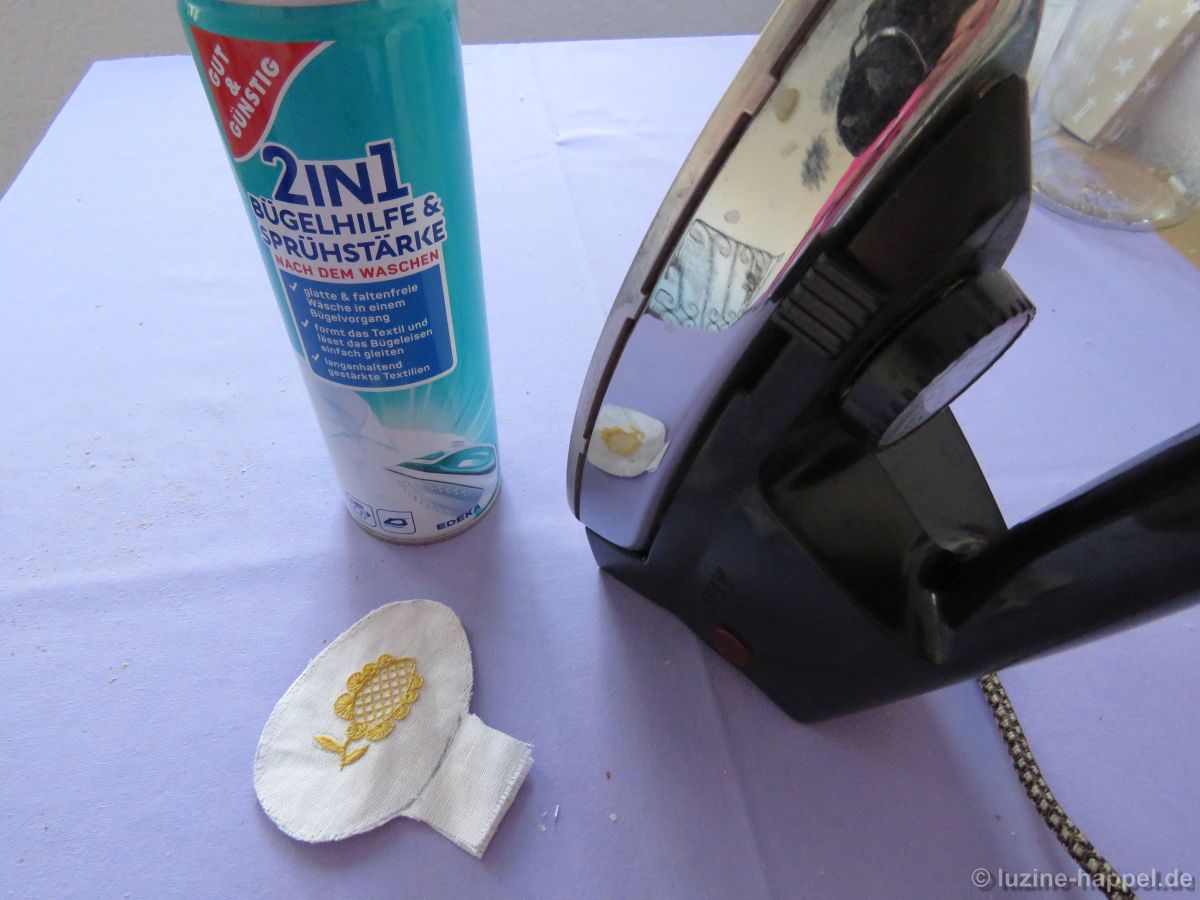
  • spray starch
  • iron
  • crochet hook 2.5

The pattern is transferred and stitched. Since threads cannot be withdrawn due to the small areas, the fabric threads must be counted.
For the outlines, half-eyelets, and leaves, I used two strands of embroidery floss; for the patterns, often only one strand.

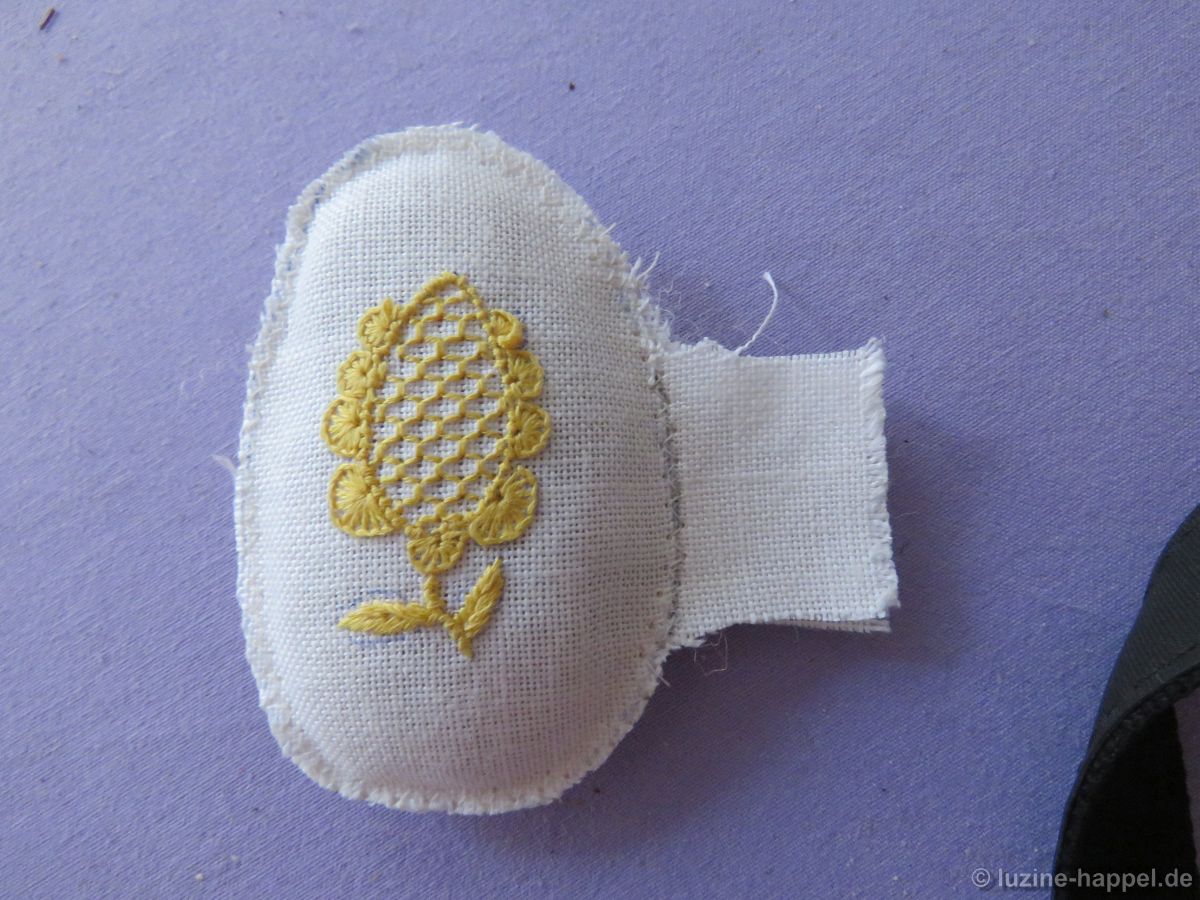
The finished embroidered pattern pieces are sewn together with the right sides facing outwards, leaving an opening along a long side of the egg. The excess fabric is then trimmed back as shown in the picture.

Using a little spray starch, iron the piece smooth. Beforehand, trace the outline at the opening with a pencil, as the heat-soluble line may disappear during ironing. Starch not only helps with smoothing but also protects the egg from getting dirty quickly later on.

Then the egg is stuffed with fiberfill. I don’t have much experience with this yet, but I think it’s better to only fill the egg lightly. The opening is sewn closed and the excess fabric is trimmed.

For the edge, you can either crochet a border using single crochet stitches. To do this, I crocheted a chain of 52 stitches and then worked single crochet stitches into it from both sides. The beginning and end threads will later serve as hanging loop.

A border made of double crochet stitches is crocheted similarly – with both rows of double crochet stitches starting from the chain stitches. This creates a kind of fold in the middle, which makes attaching it to the edge easy. The double crochet border covers the edge better. However, since it covers more of the surface, it should be placed around the larger egg shape. For this, you need approximately 55 chain stitches and more than 8 meters of embroidery floss. (I used a whole strand of floss.)

The border made of double crochet stitches fits nicely around the egg and only needs to be secured at the top with a few stitches.

As with all miniature work, a certain amount of dexterity is required, but you will be rewarded with a pretty and individual decoration.

Easter Eggs Embroidered with Schwalm Whitework Motifs (2)

An eye-catching Easter decoration is made with plastic eggs covered with linen embroidered with Schwalm motifs.

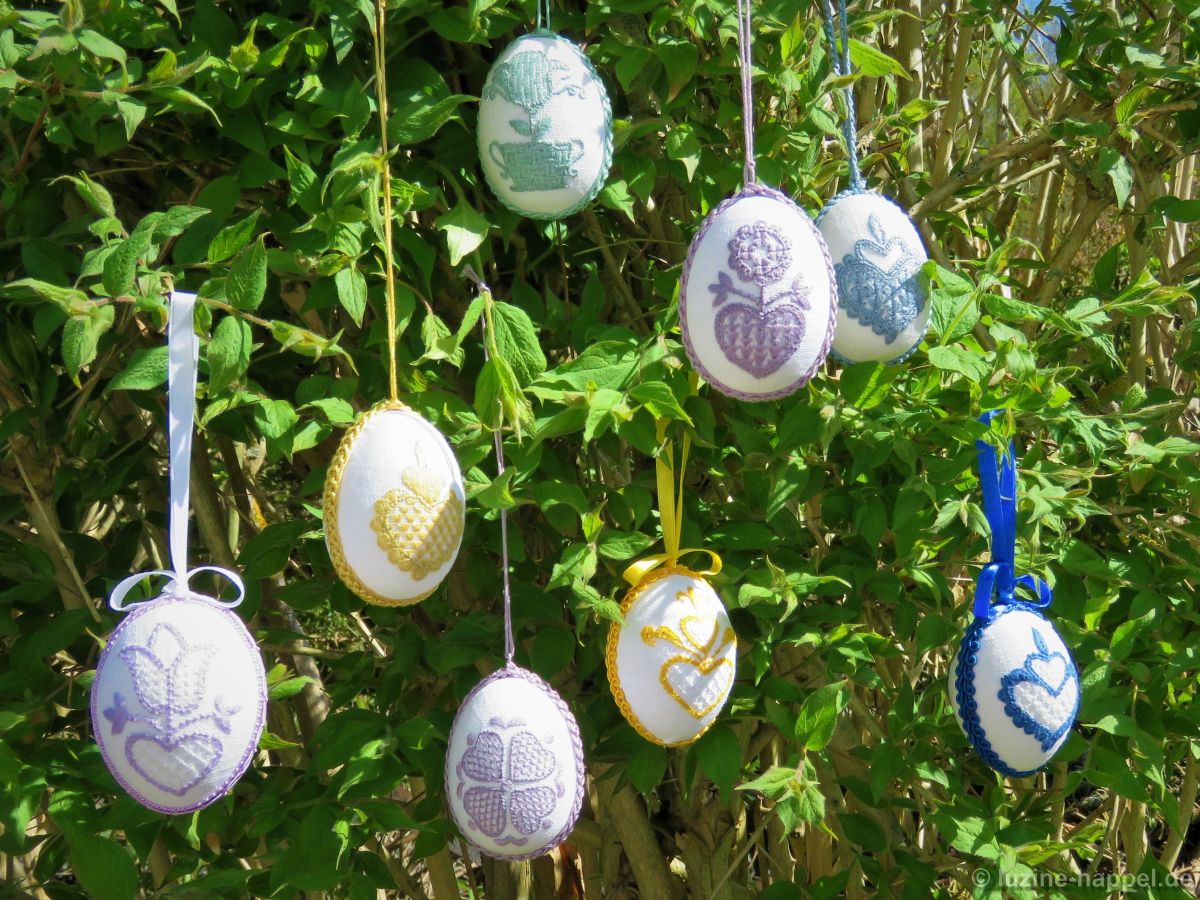
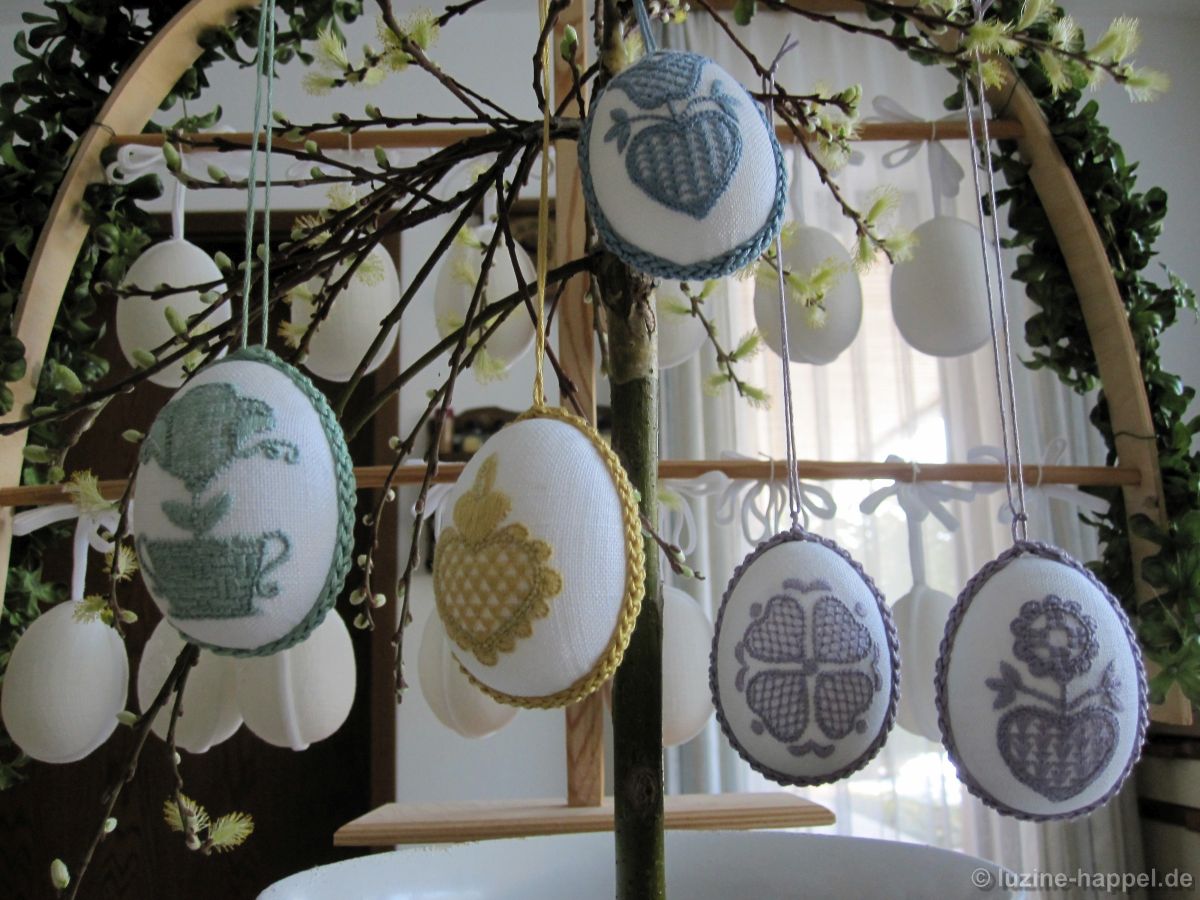
It doesn’t matter if one uses spring-like colours,

shades of one tone,

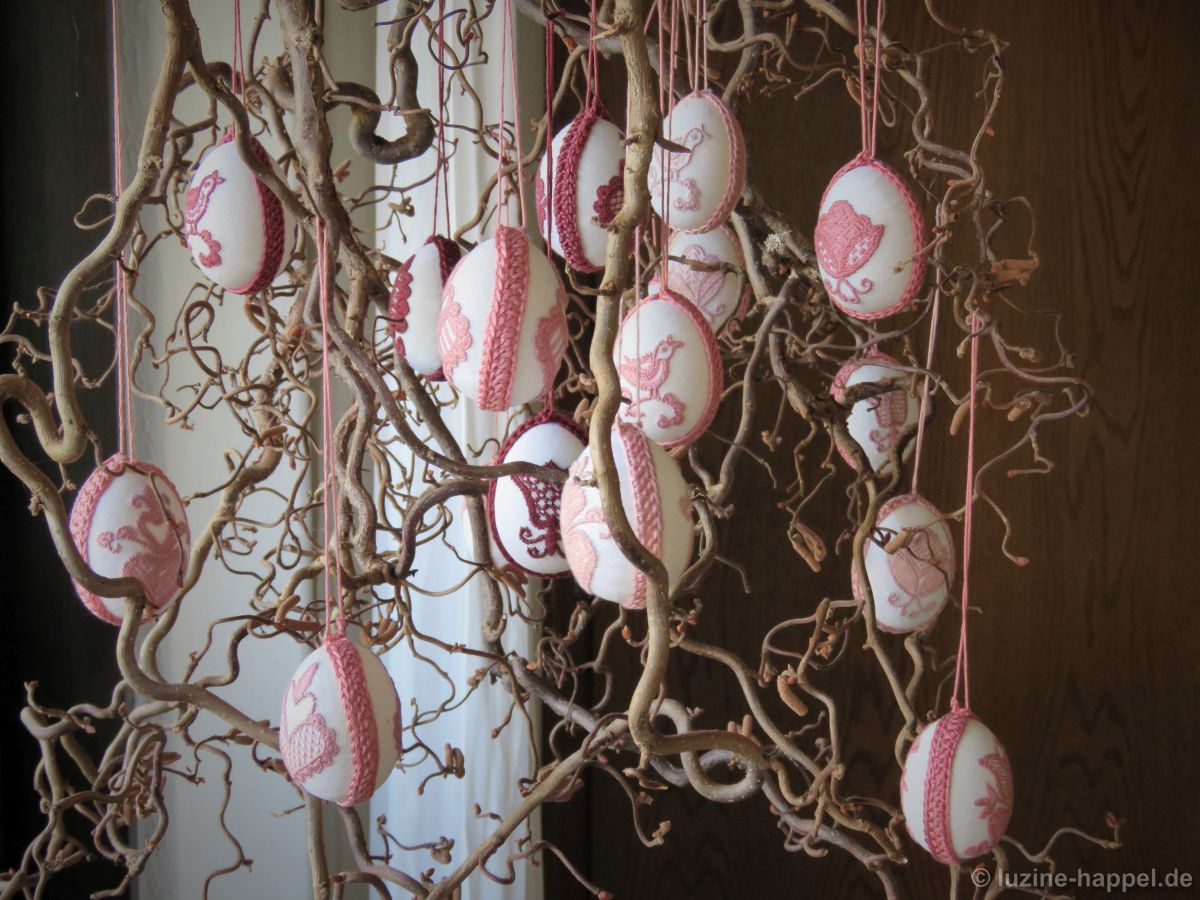
or only one colour.

Nice motifs in the perfect size can be found in 24 small Designs.
Detailed instructions and 60 designs for working those eggs can be found in Embroidered Easter Eggs.

If one wants to embroider somewhat larger eggs (e.g., goose eggs), appropriate designs can be found in Easter Eggs.

Easter Egg 2019

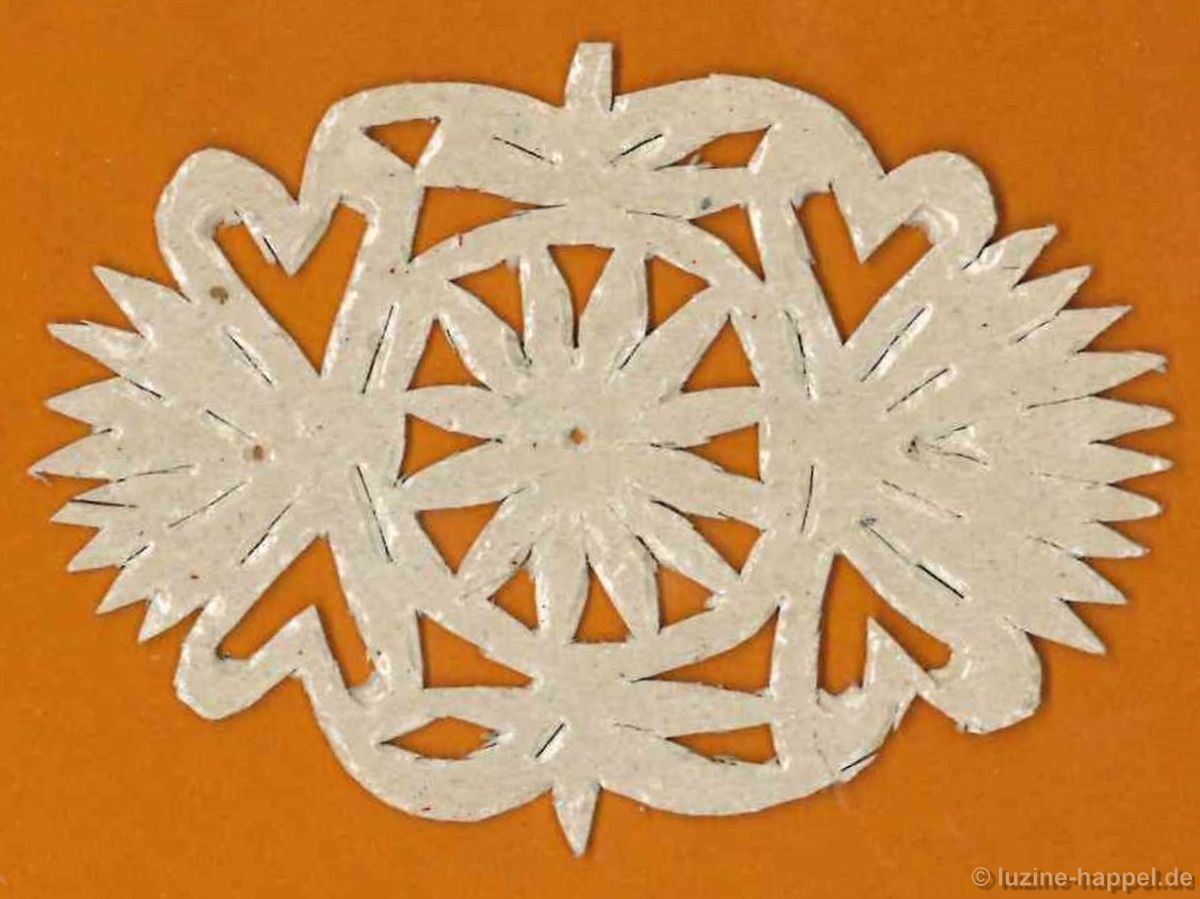
Some time ago I had the opportunity to purchase many old traditional templates from the last Schwalm template maker, Ludwig Schmerer. Among these templates were some for the bottoms of the caps.

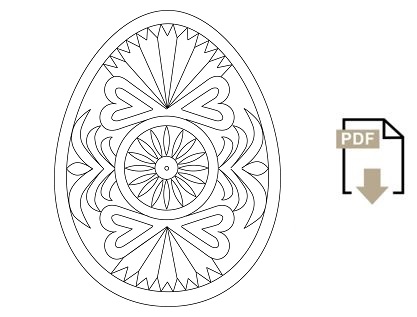
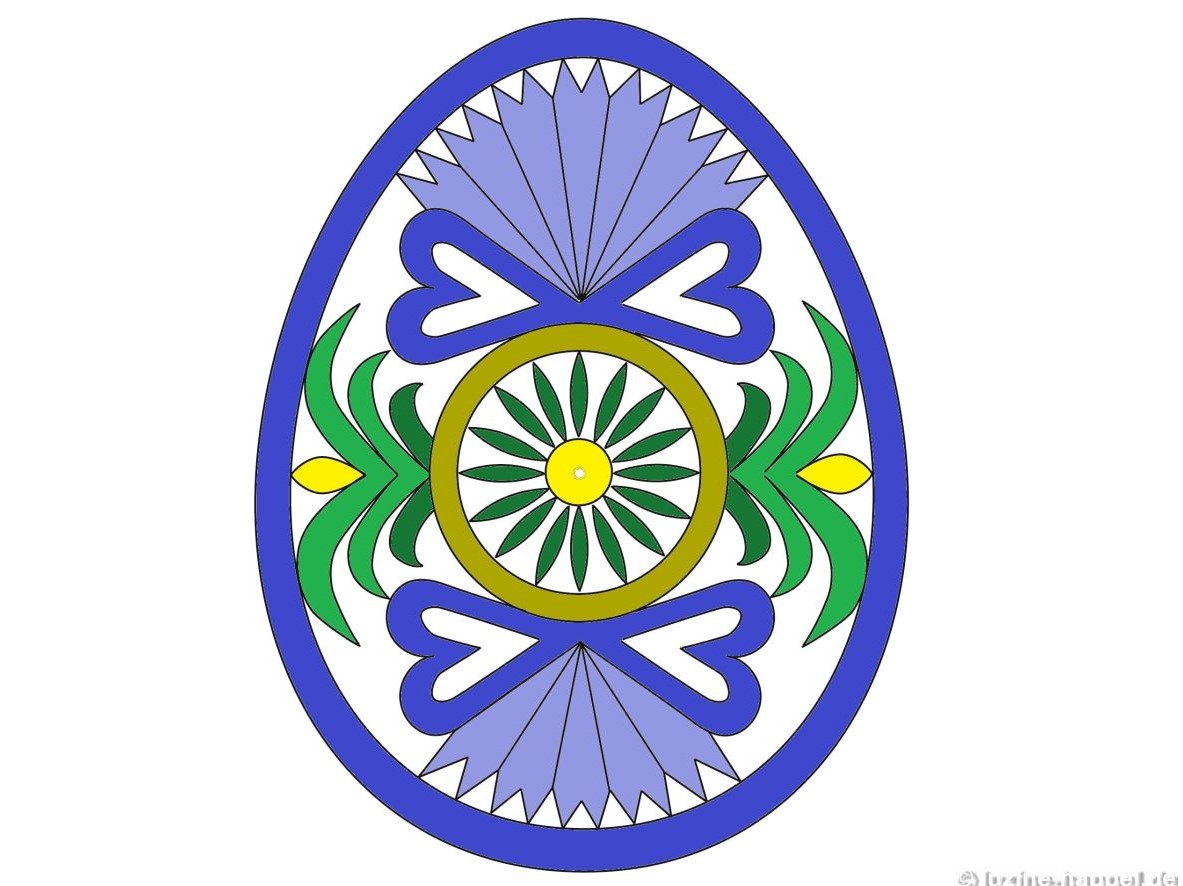
I enthusiastically looked for a contemporary use for the patterns. The oval shape of the cap bottom templates brought forth the idea to create Easter eggs. My graphic designer transferred the oval to an egg shape and created ten richly diverse drawings. I present the first of these this year.

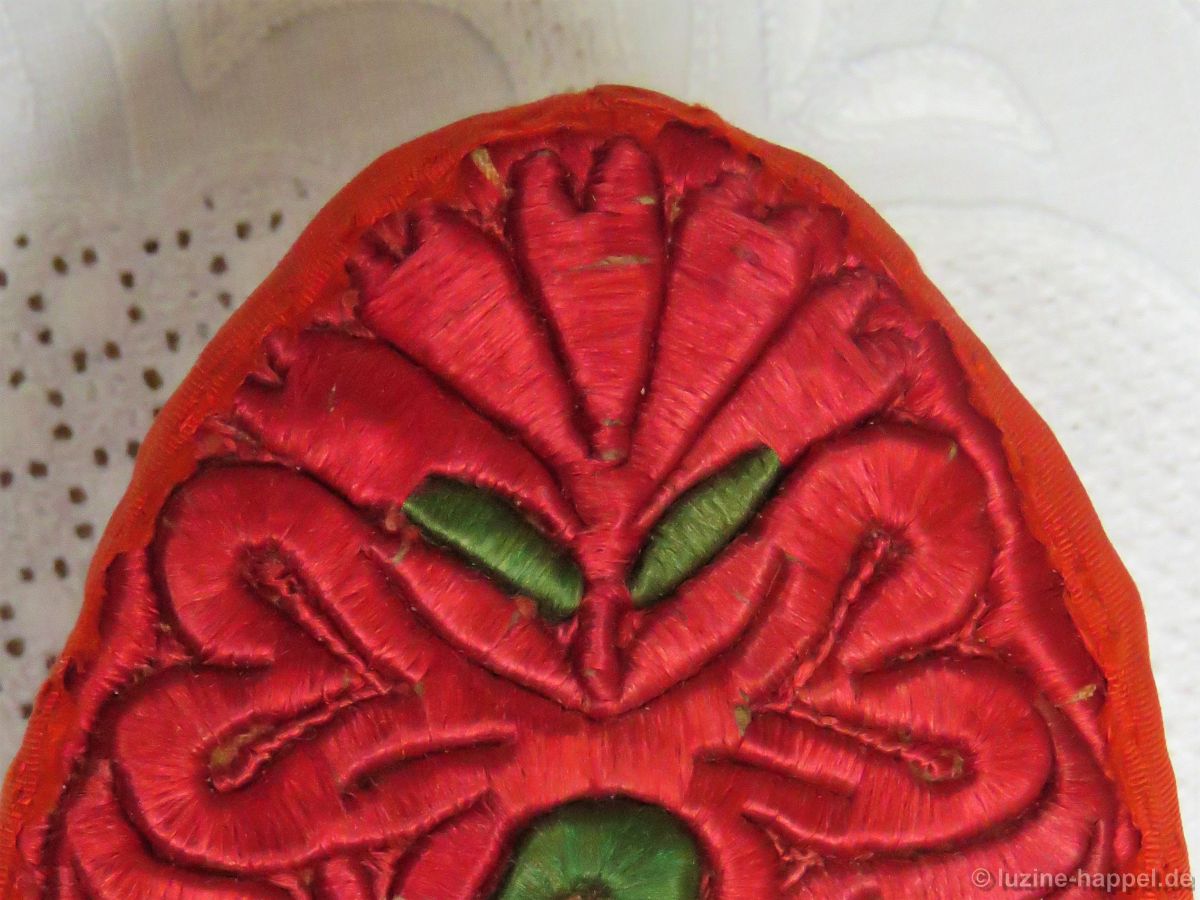
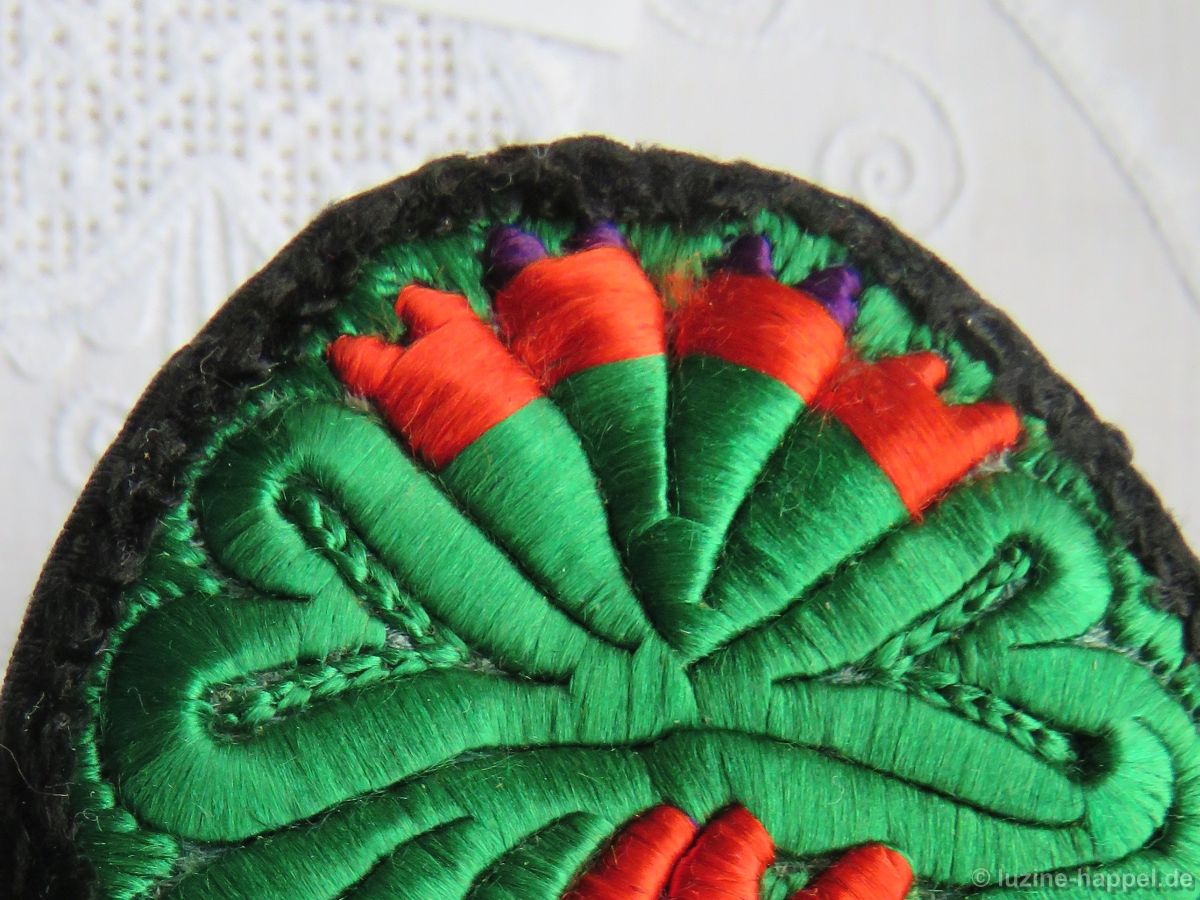
Unfortunately, I do not have in my collection an original cap with this exact pattern, but I do have a couple of caps with parts of the same design.

They are embroidered with silk threads in different colours

and sometimes also include gold and silver bullion.

In the past, to achieve a precise rendering of the single pattern segments, a special paperboard was inserted.

Unfortunately, I had neither a matching template nor the tools to make such a template. So I looked for alternatives.

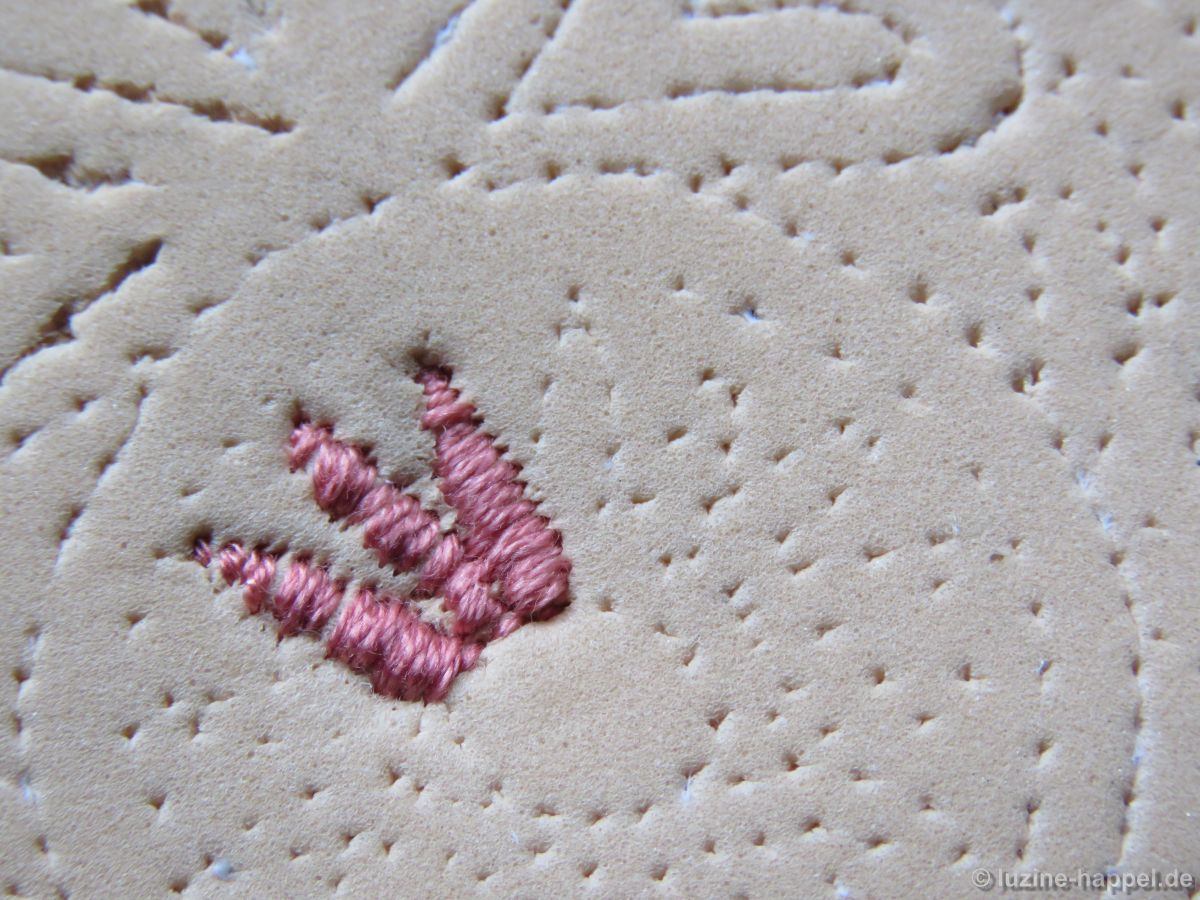
A template made from a sheet of craft foam is easy to make and comfortable to work with,

but, unfortunately, it is unsuitable because the thread gets lost in the soft material, and the edges end up looking jagged.

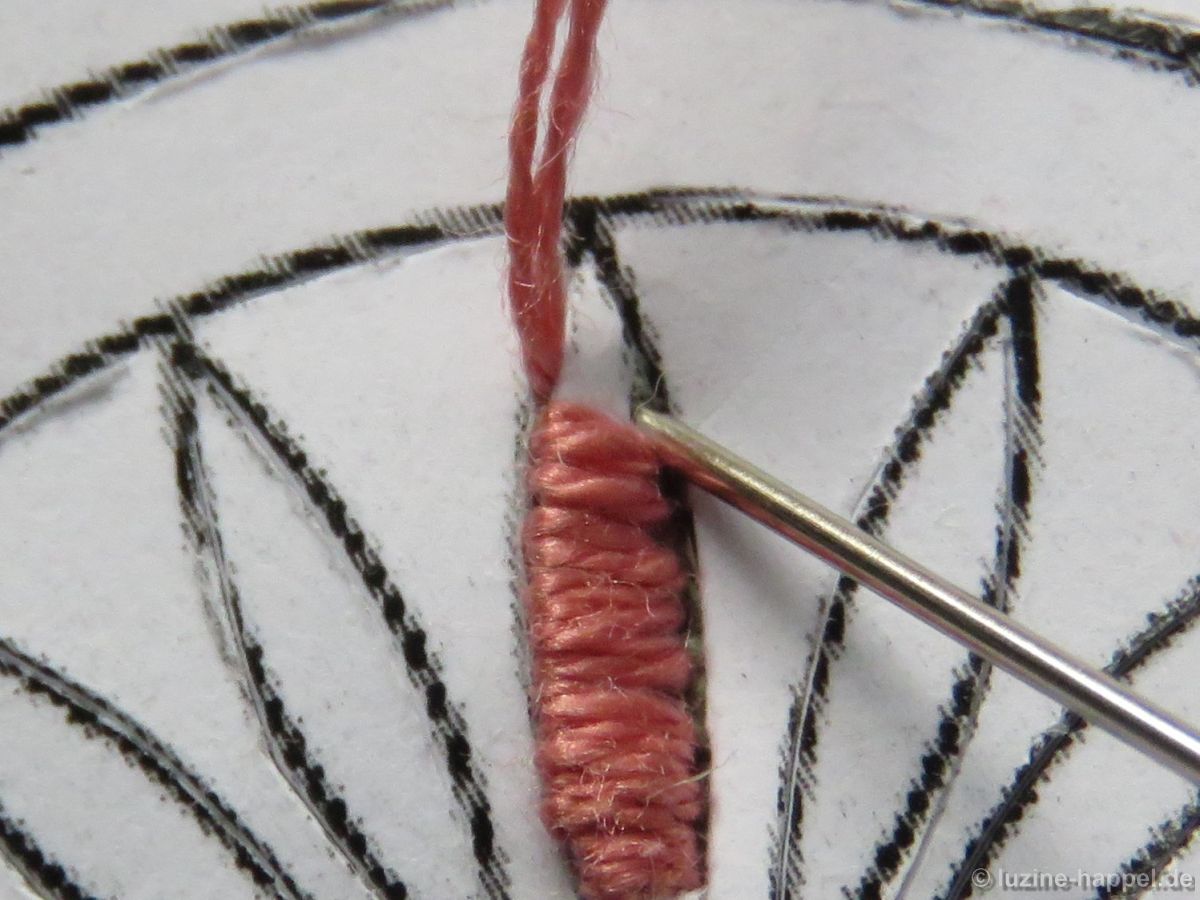
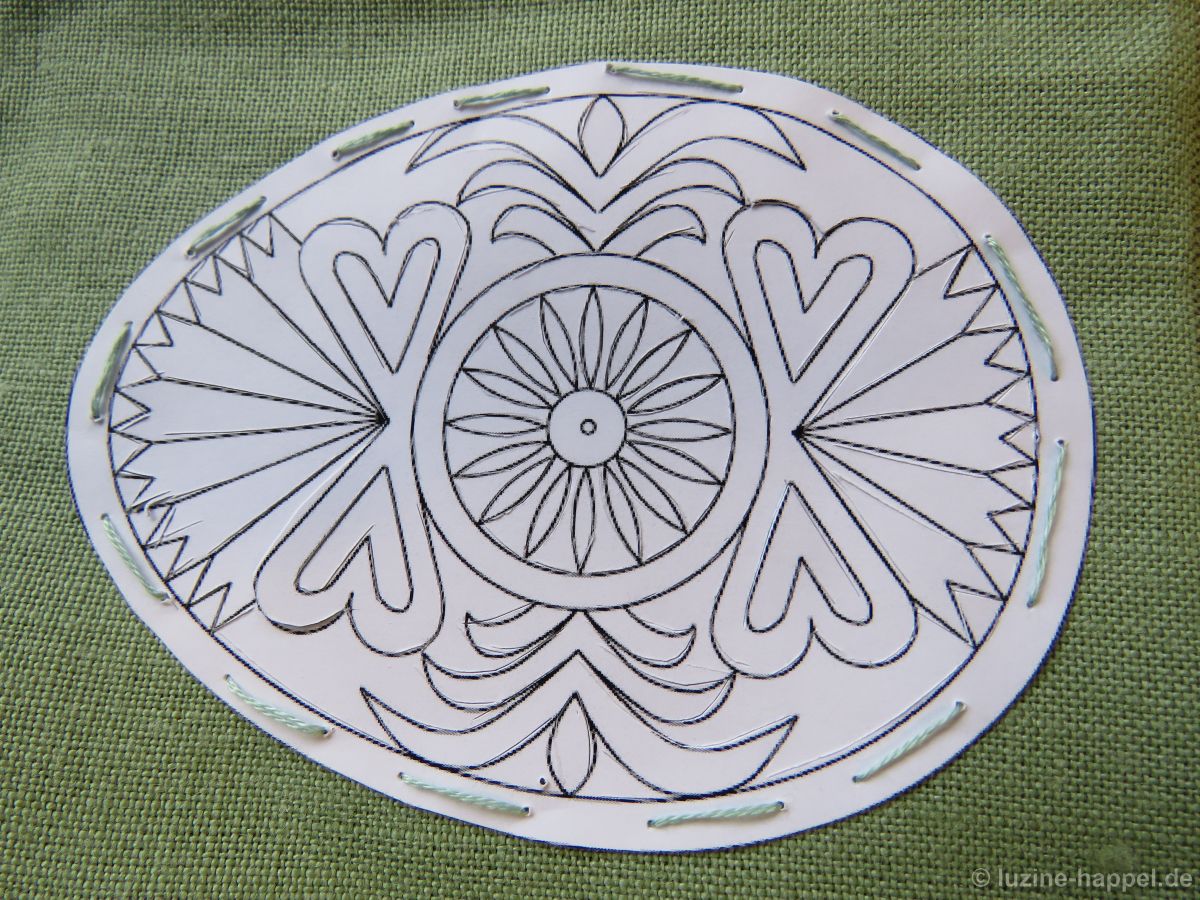
For my second attempt, I made a template using a craft knife and thick paper (image below: back side).

After cutting out the template, I basted it to the fabric.

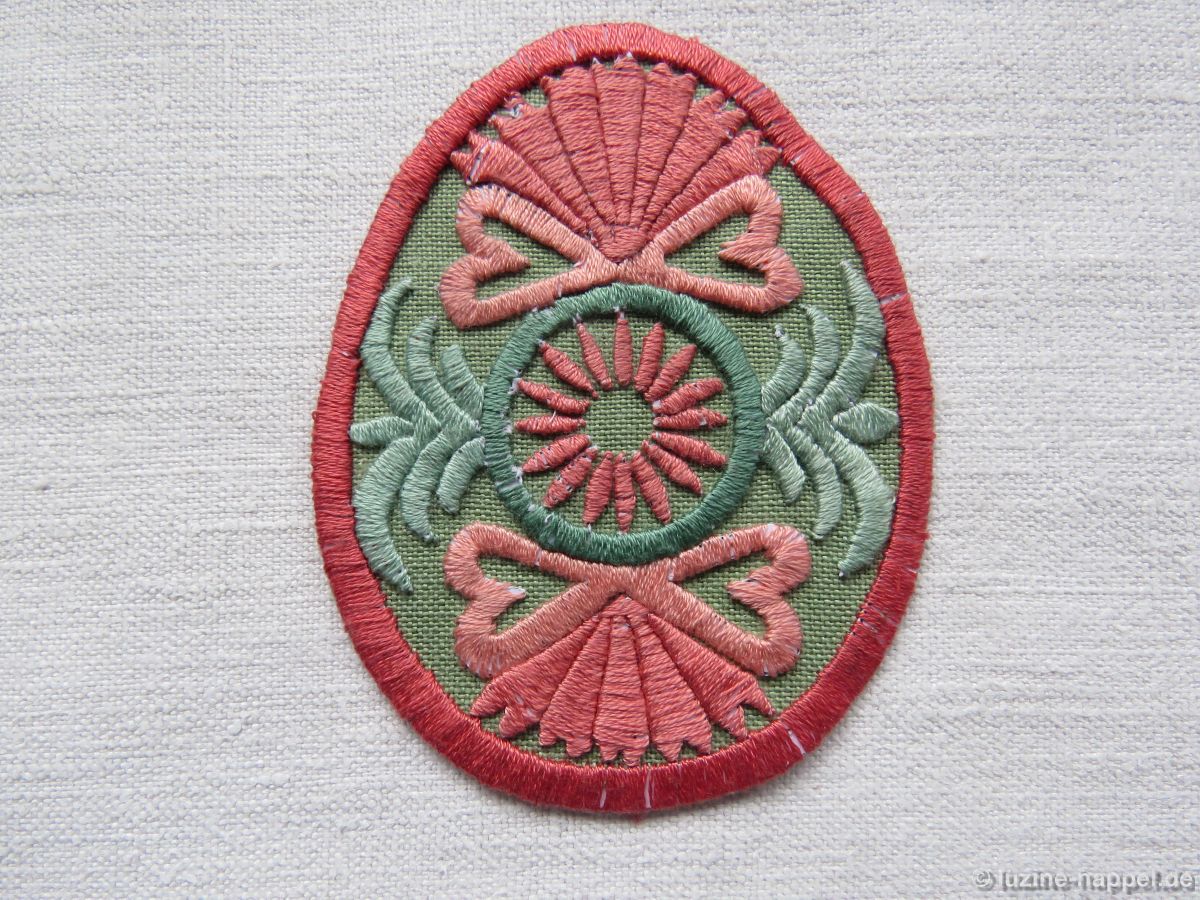
Afterwards, all single sections that I wanted to embroider were fastened to the ground fabric and then covered with densely placed stitches.

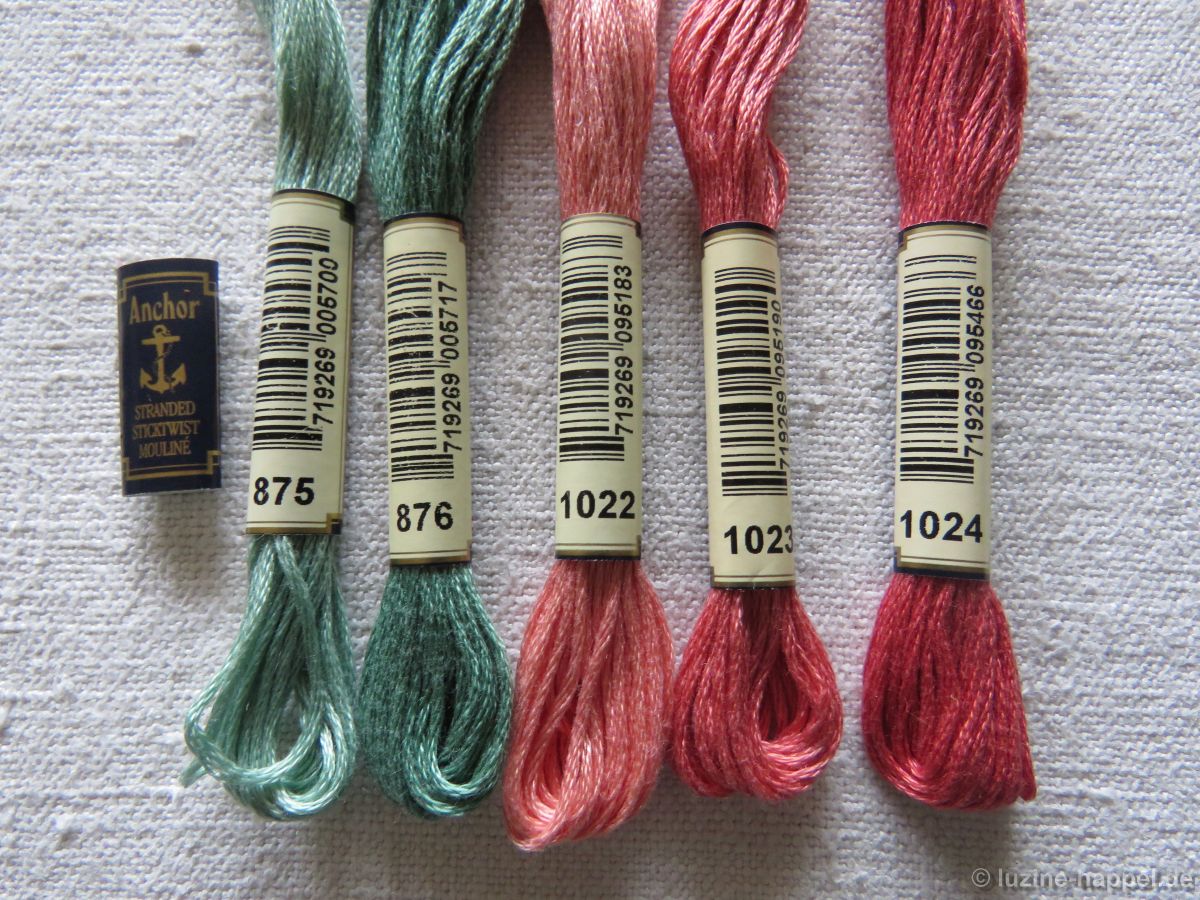
I used green linen fabric and – due to the lack of silk threads –

stranded cotton (Anchor 875, 876, 1022, 1023, and 1024).

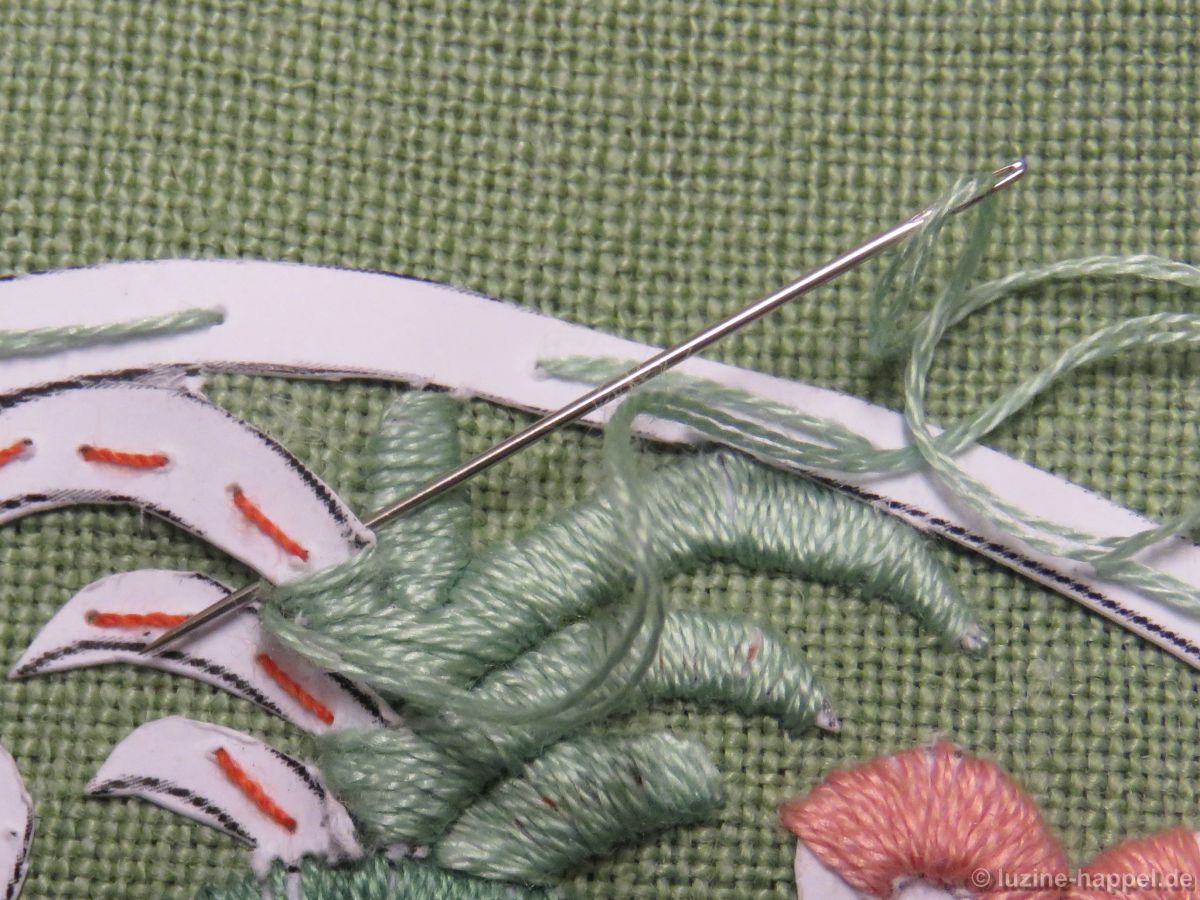
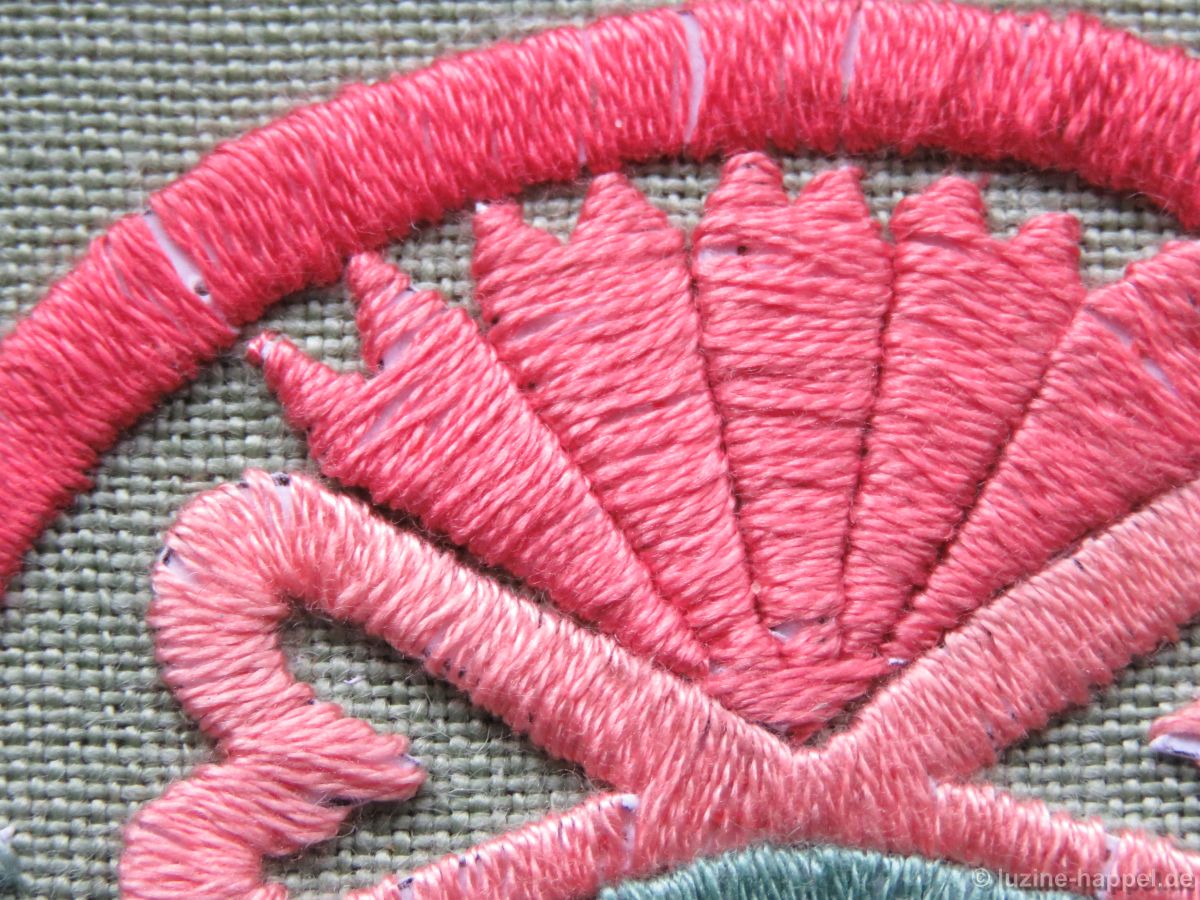
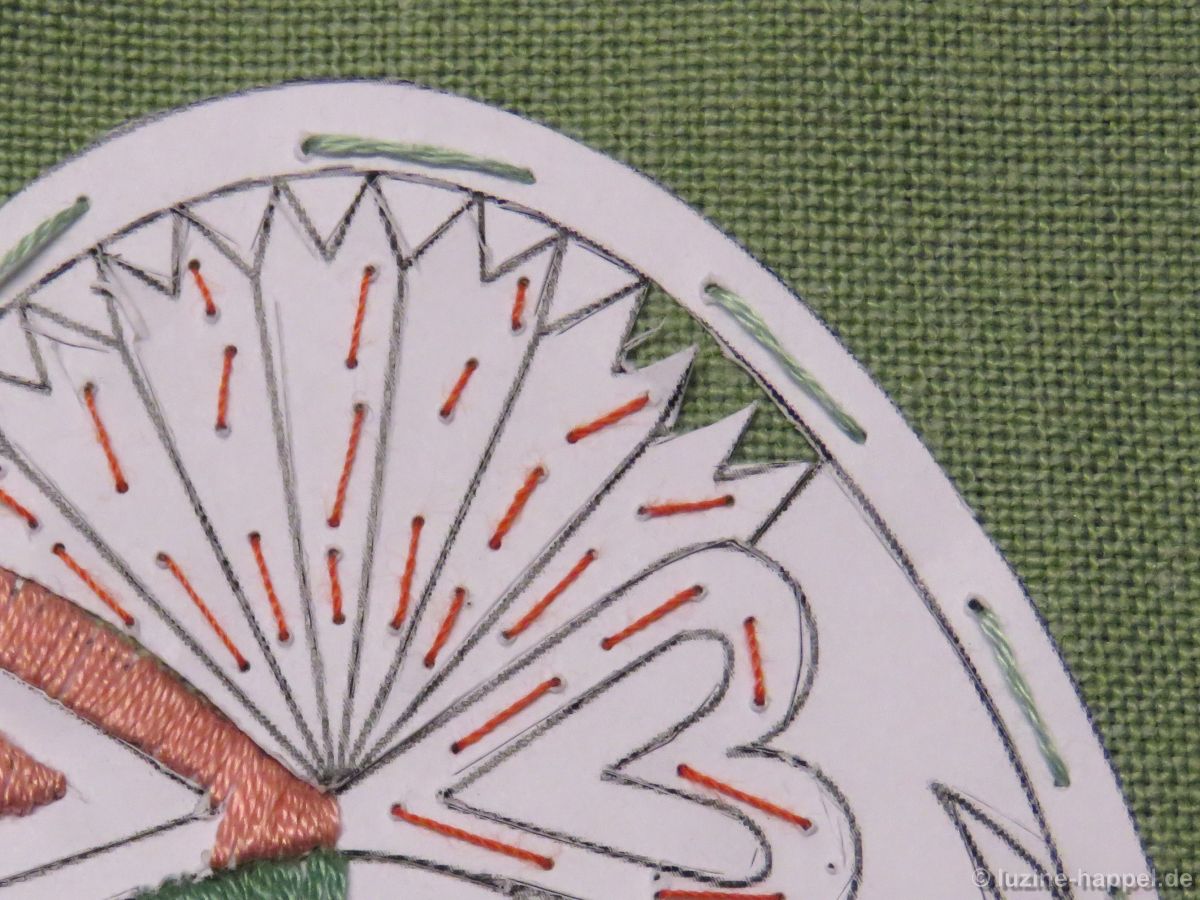
Using 2 strands of the 6-ply stranded cotton, the sections of the templates were embroidered along the cut lines in two steps – using a stabbing motion instead of a scooping motion. I thought this tedious.

Through my experimenting, I figured out that it is much easier to first withdraw the paper sections that will not be embroidered. In that way, it is much easier to embroider the remaining sections.

In the end, I was passably satisfied.

The single design sections are clearly distinct, but some of the stitches should have been worked more densely.

I liked the cut out egg decorated on a light ground more.

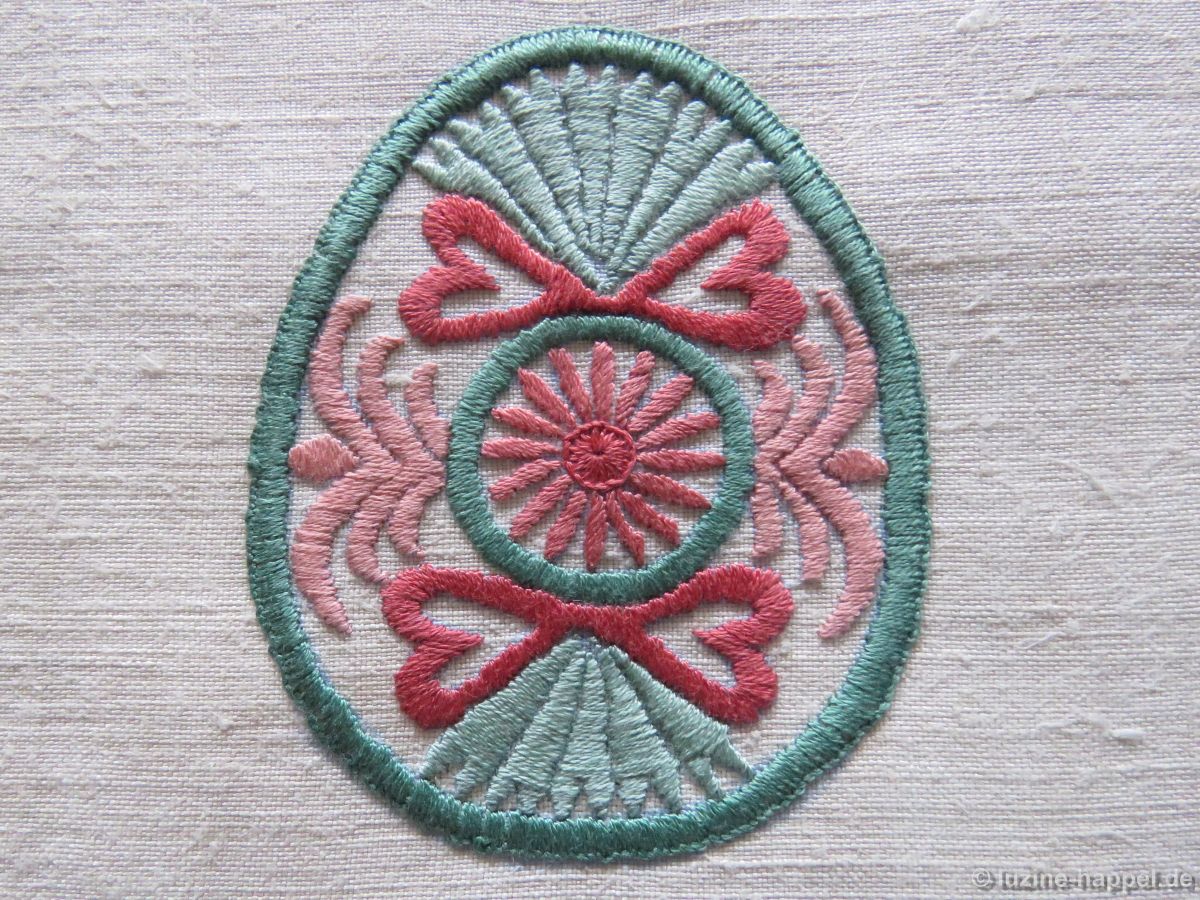
And so a second attempt was begun. The design was transferred to natural linen using an iron transfer method. It was embroidered in the style of the Schwalm crowns with the same colours as the first egg but in a different layout.

On the fine densely woven linen, the stitches could be placed closely and exactly together.

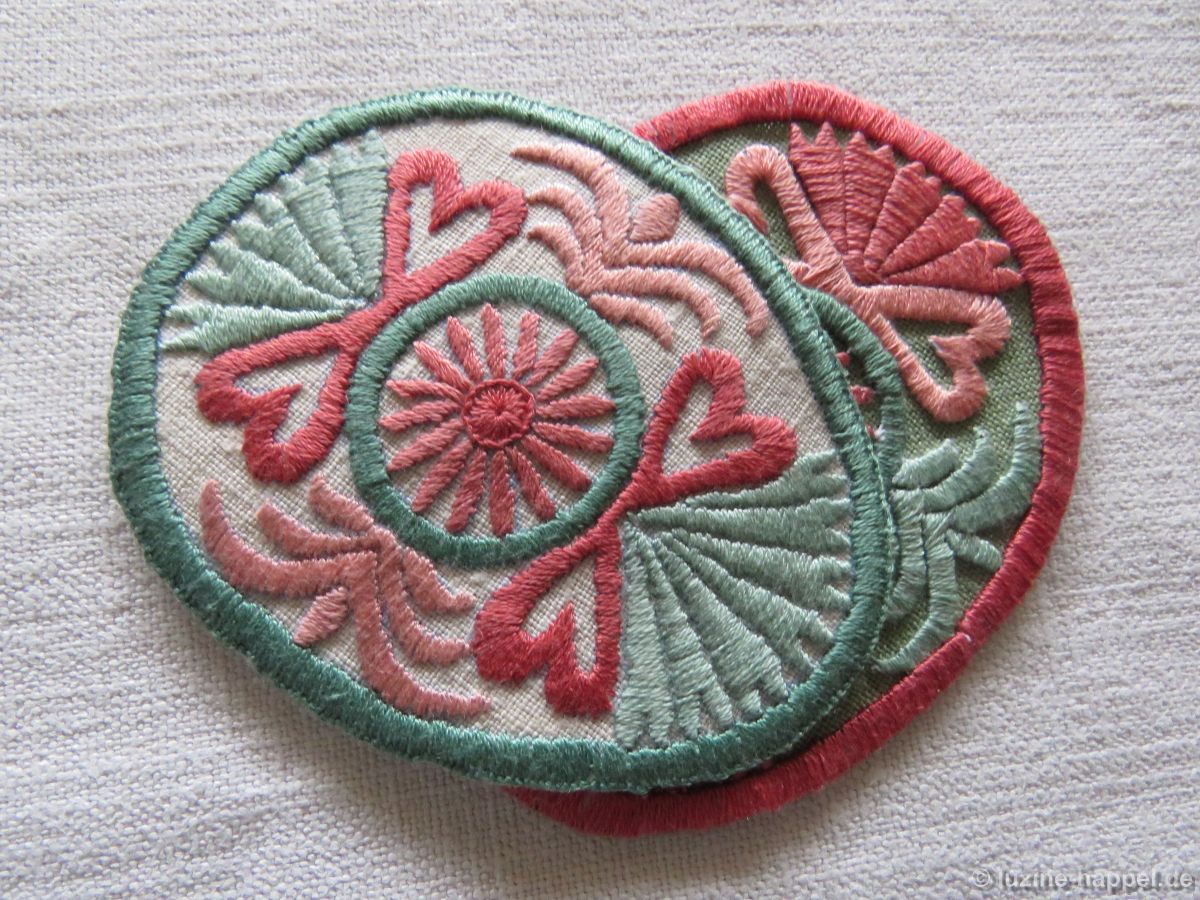
Embroidering this way was less tedious and much faster. But in comparing the two examples, the one stitched upon the template is more dimensional and is much more distinct.

So, at the next opportunity, I will begin a third attempt making a paperboard template in the way Schwalm people used for colour embroidery. And I will use silk threads.

I find the siena colours from the Werkstatt für historische Stickmuster fairly good.

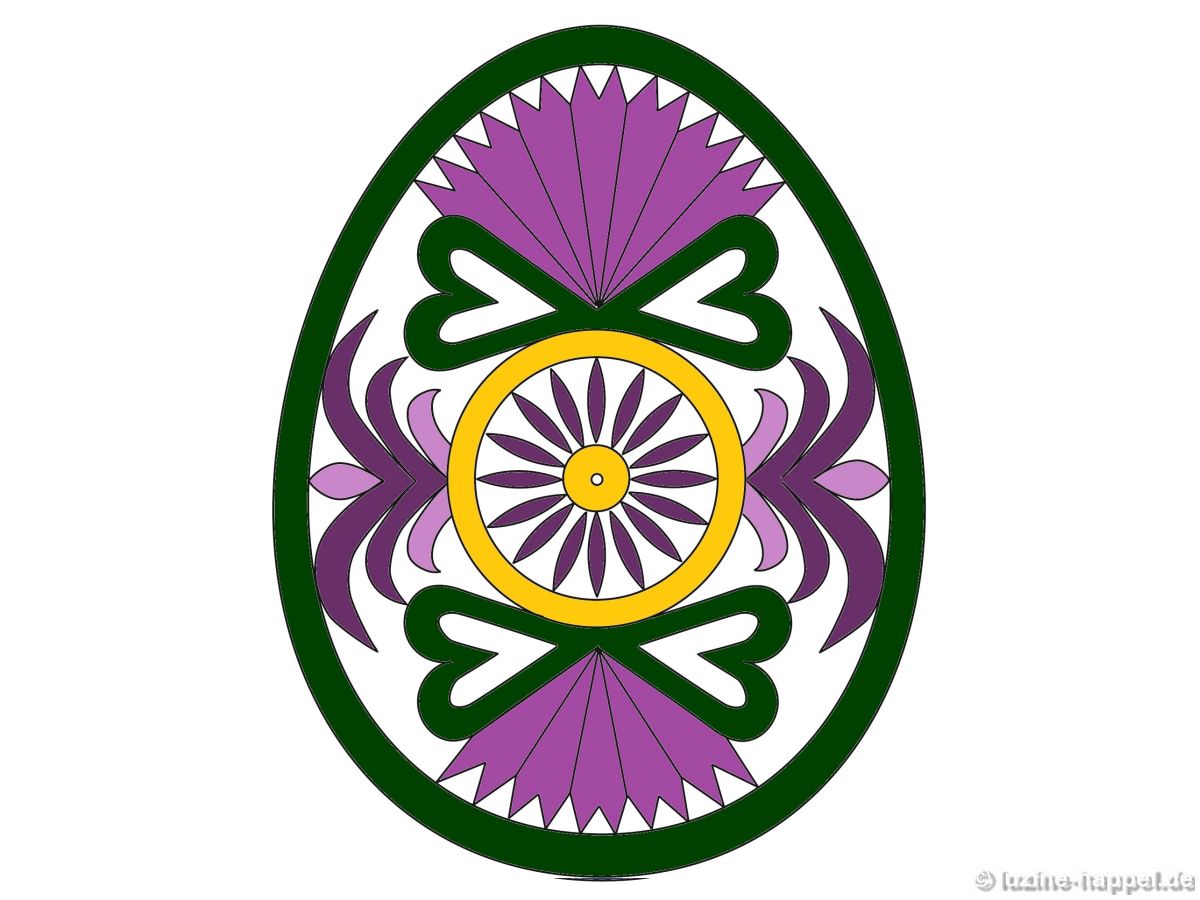
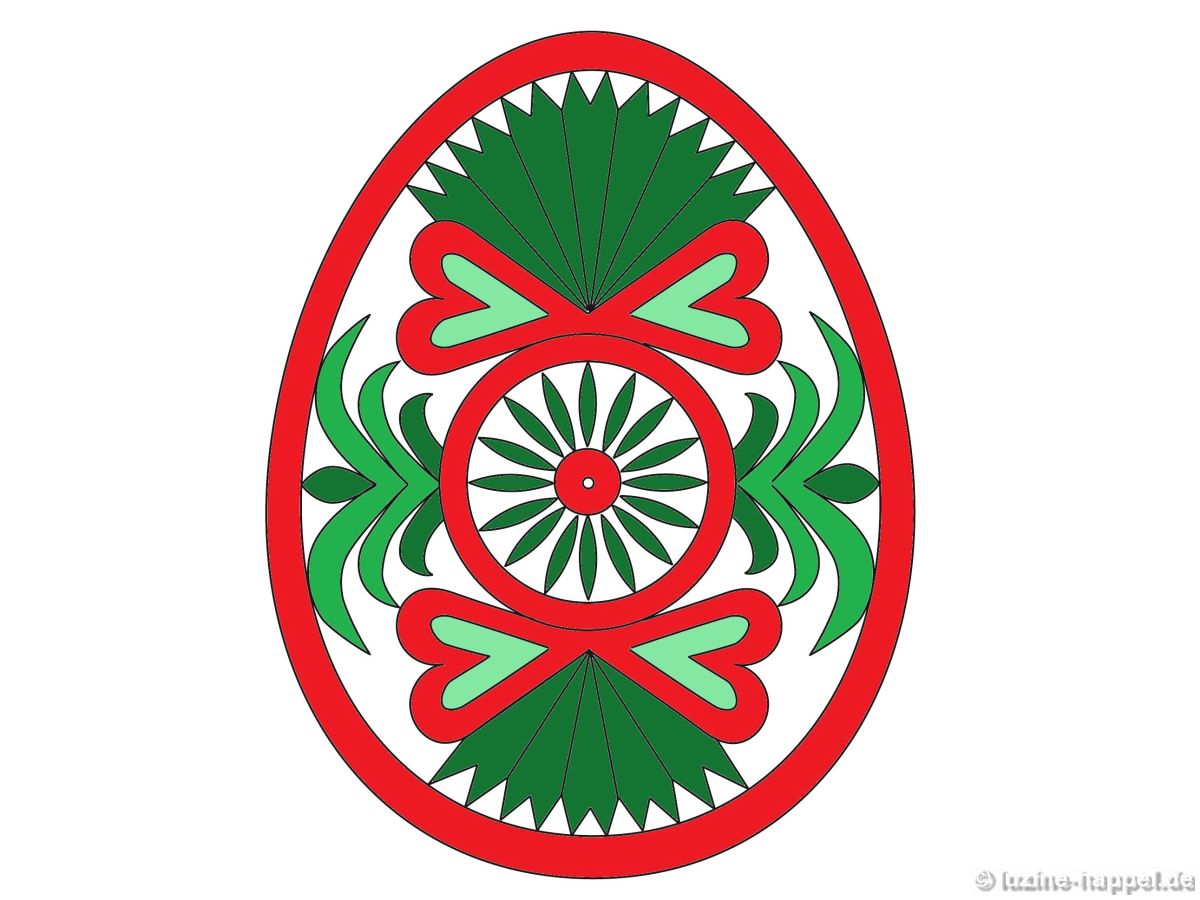
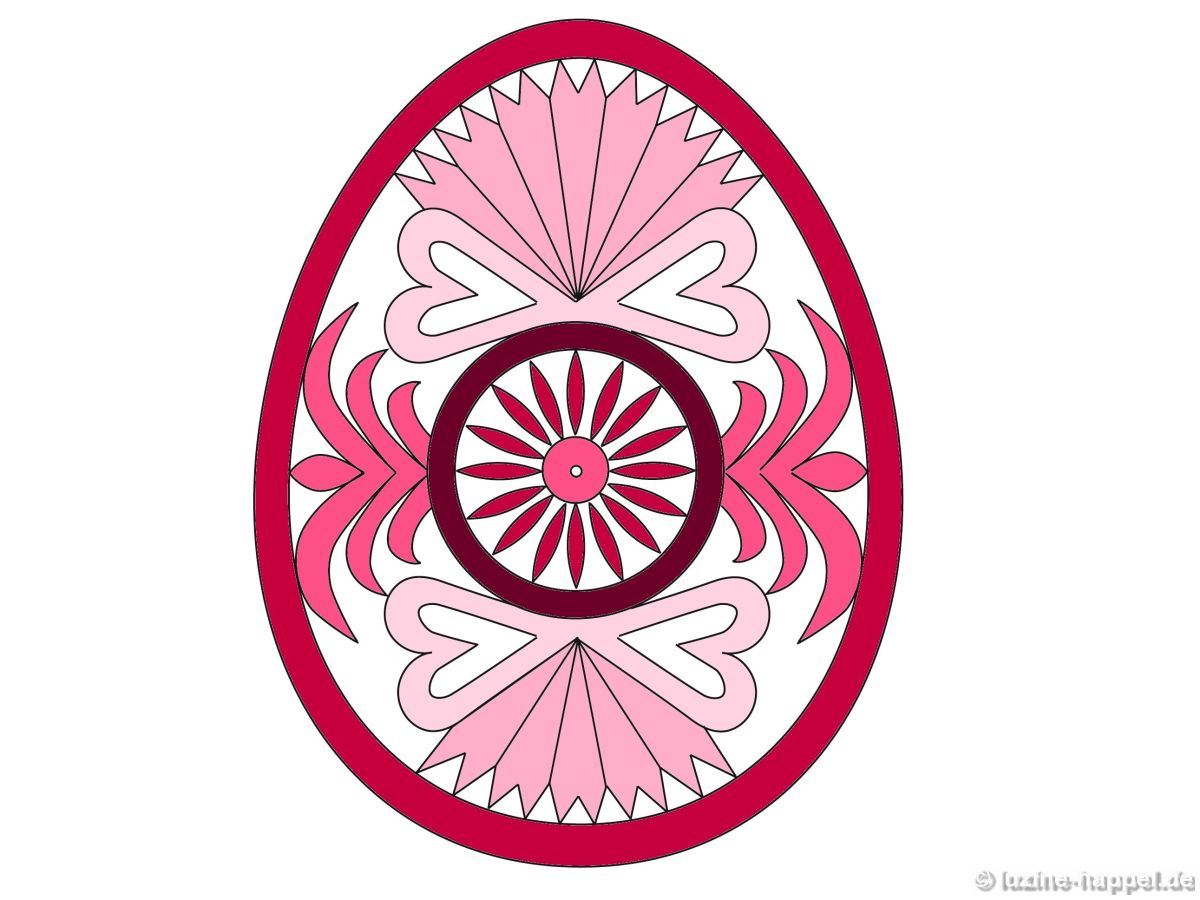
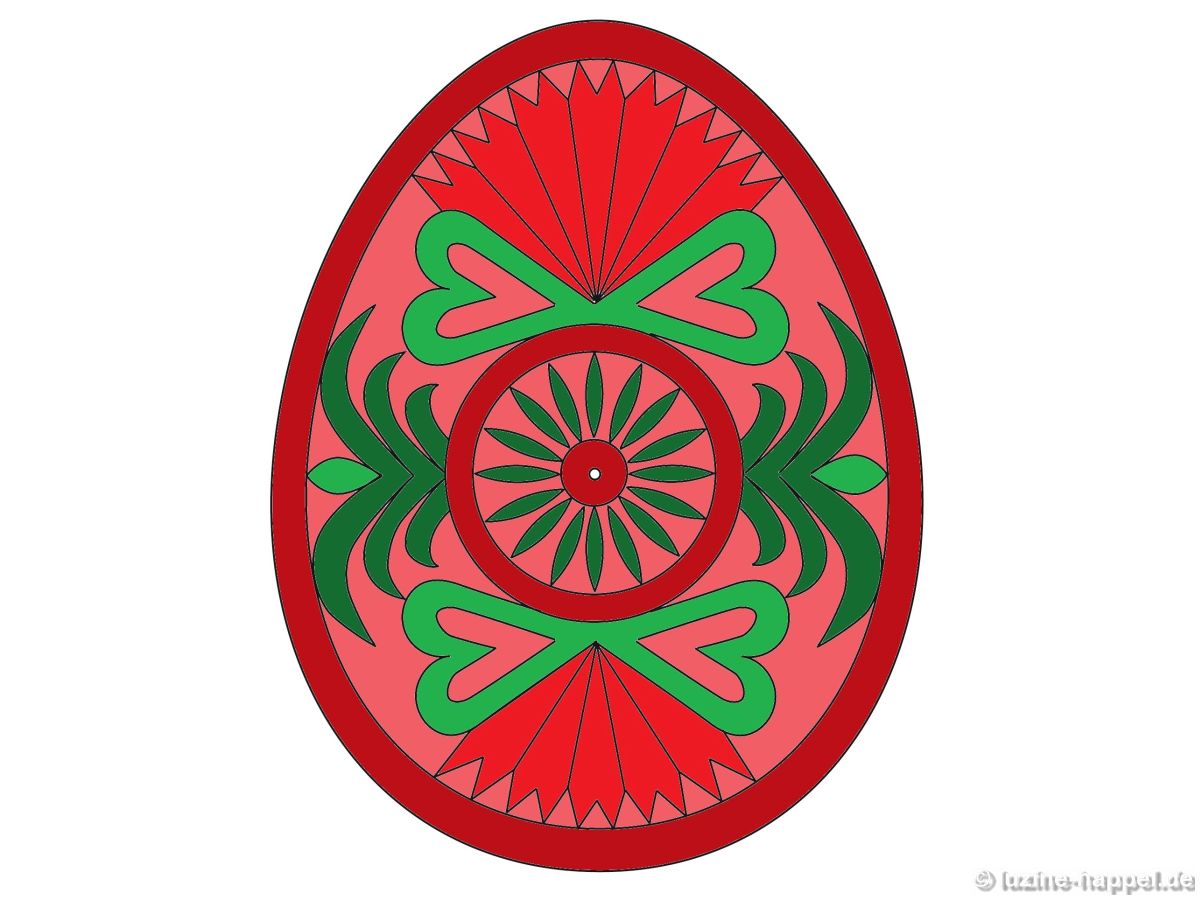
With other colour combinations, one can achieve – as the following drawings show – totally different effects.

Please give it a try using your own favorite colours; I look forward to seeing your results.

Happy Easter!

A Very Special Easter Egg

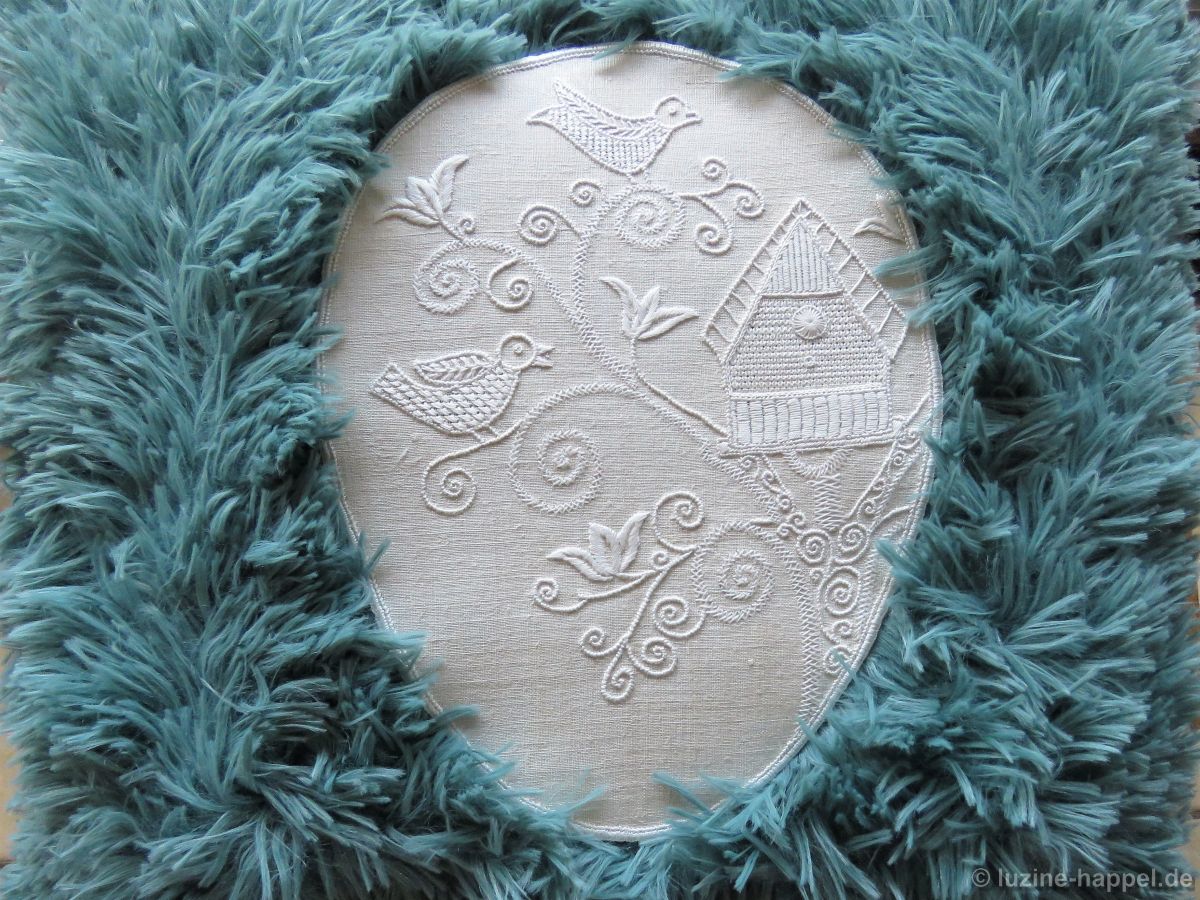
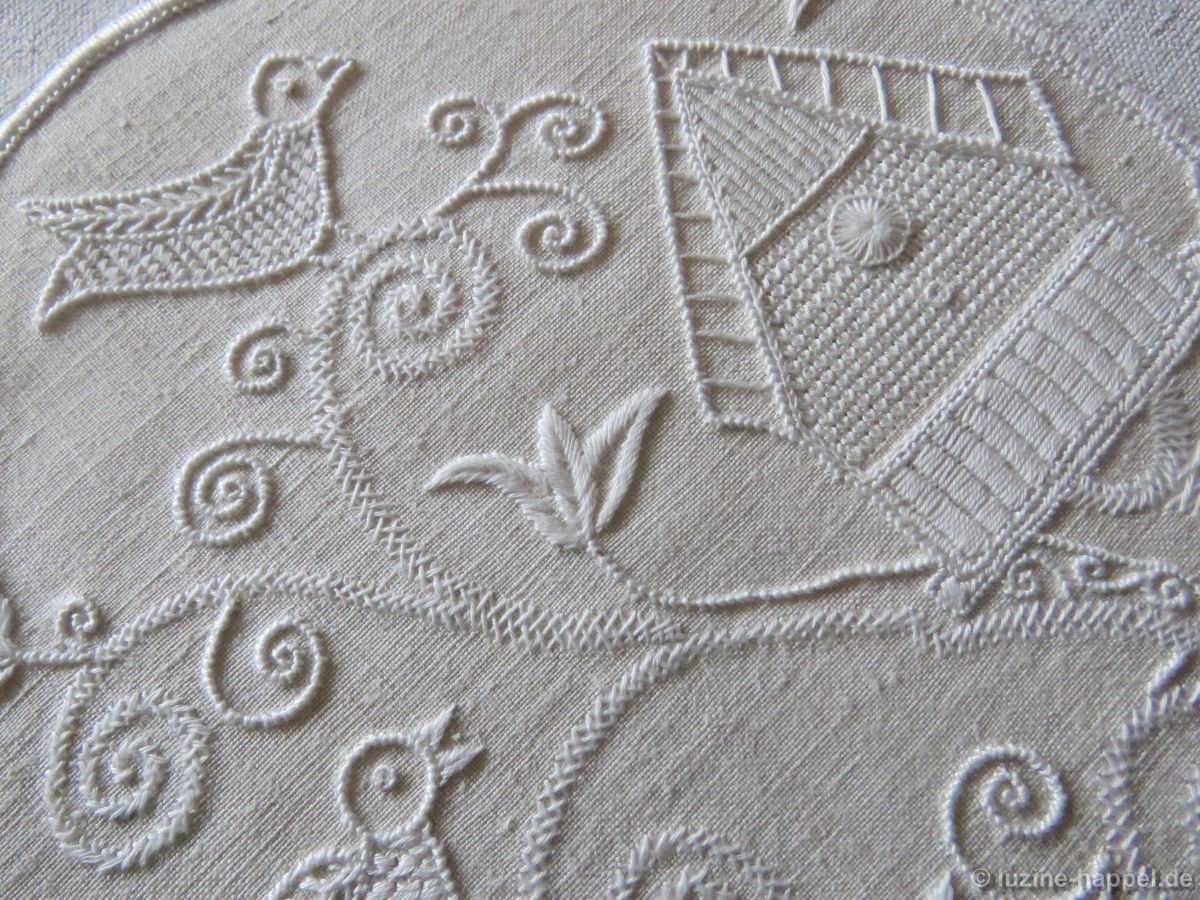
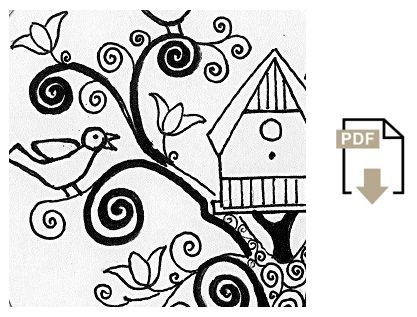
The artist Gudrun Hartwig created an extravagant, interesting, and spring-like design within an egg shape. Here a pillowcase is decorated with this embroidery.

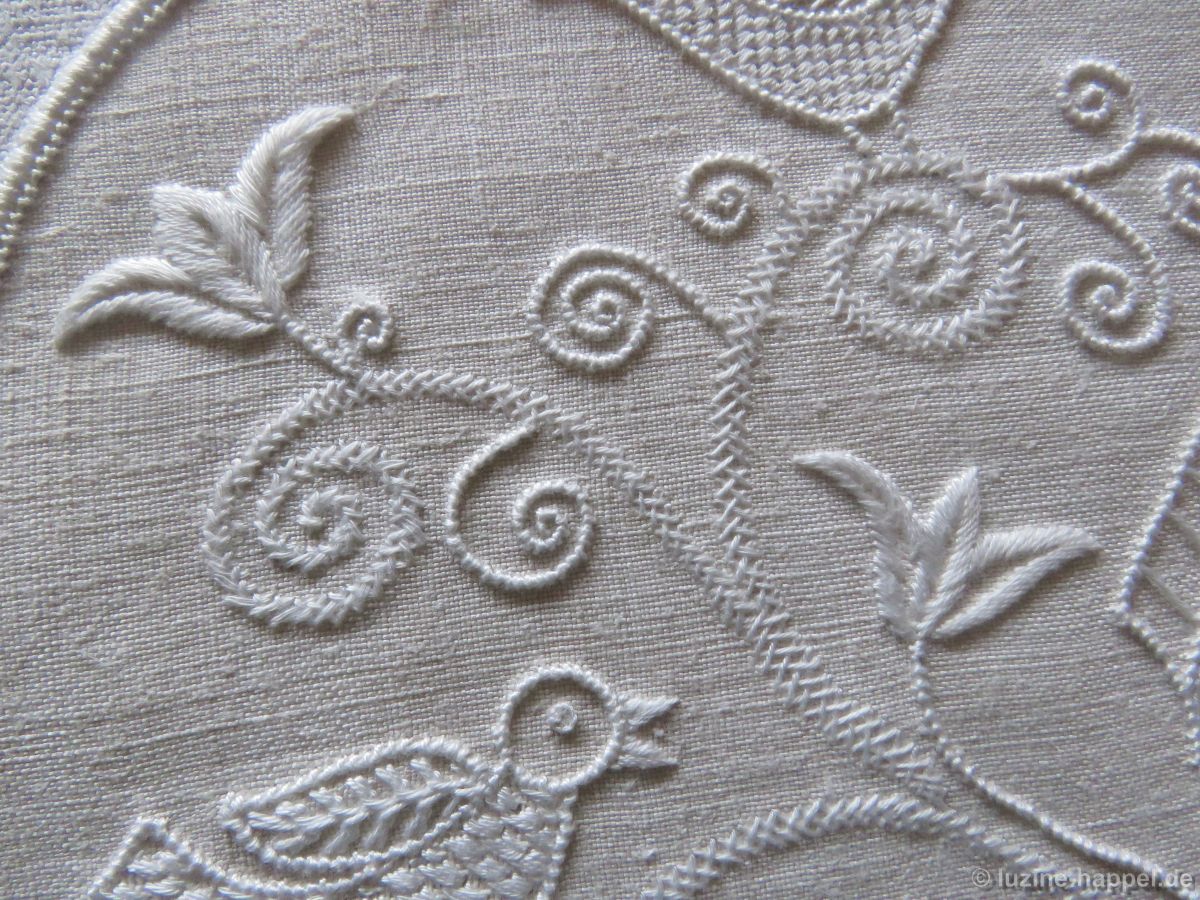
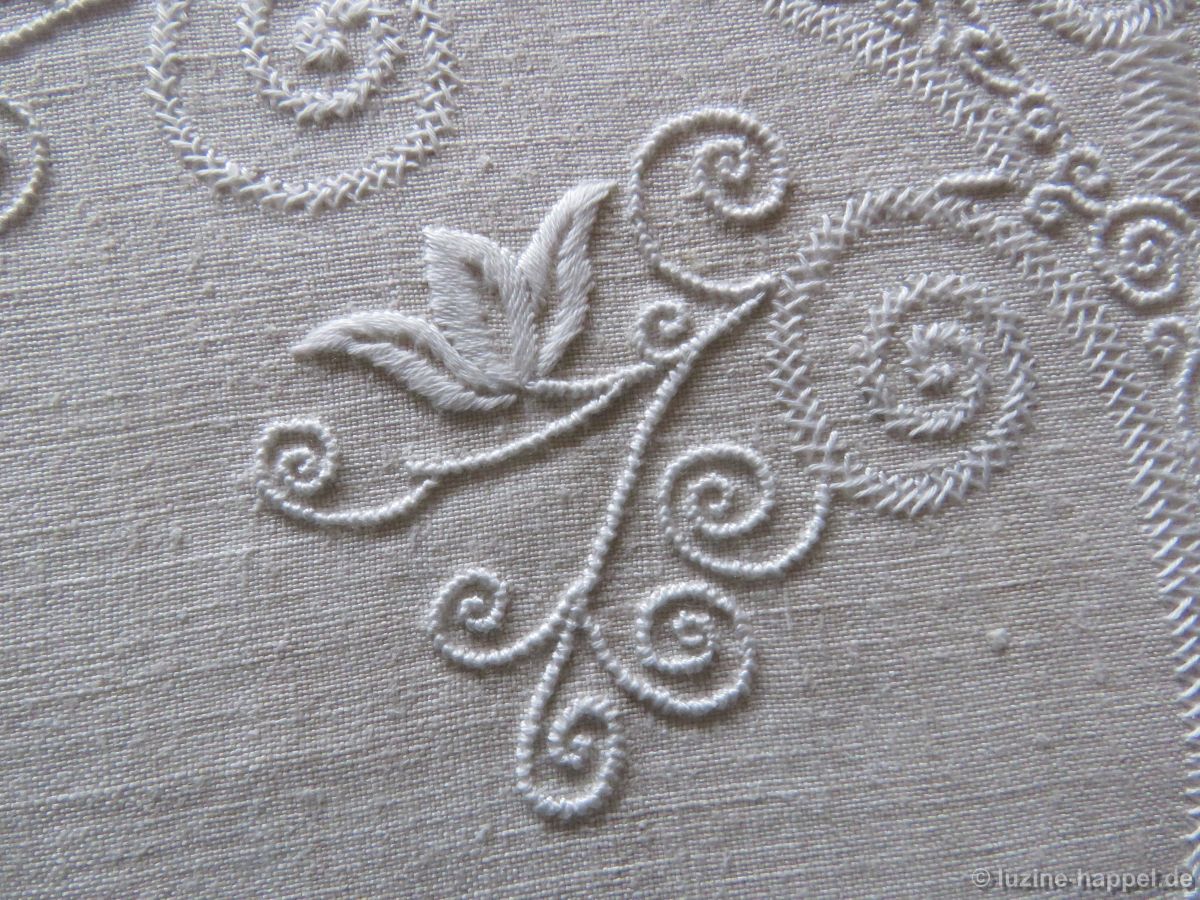
Flowers, spiral branches, and sprigs

sprout out of the tree. They show the power and beauty of nature awakening.

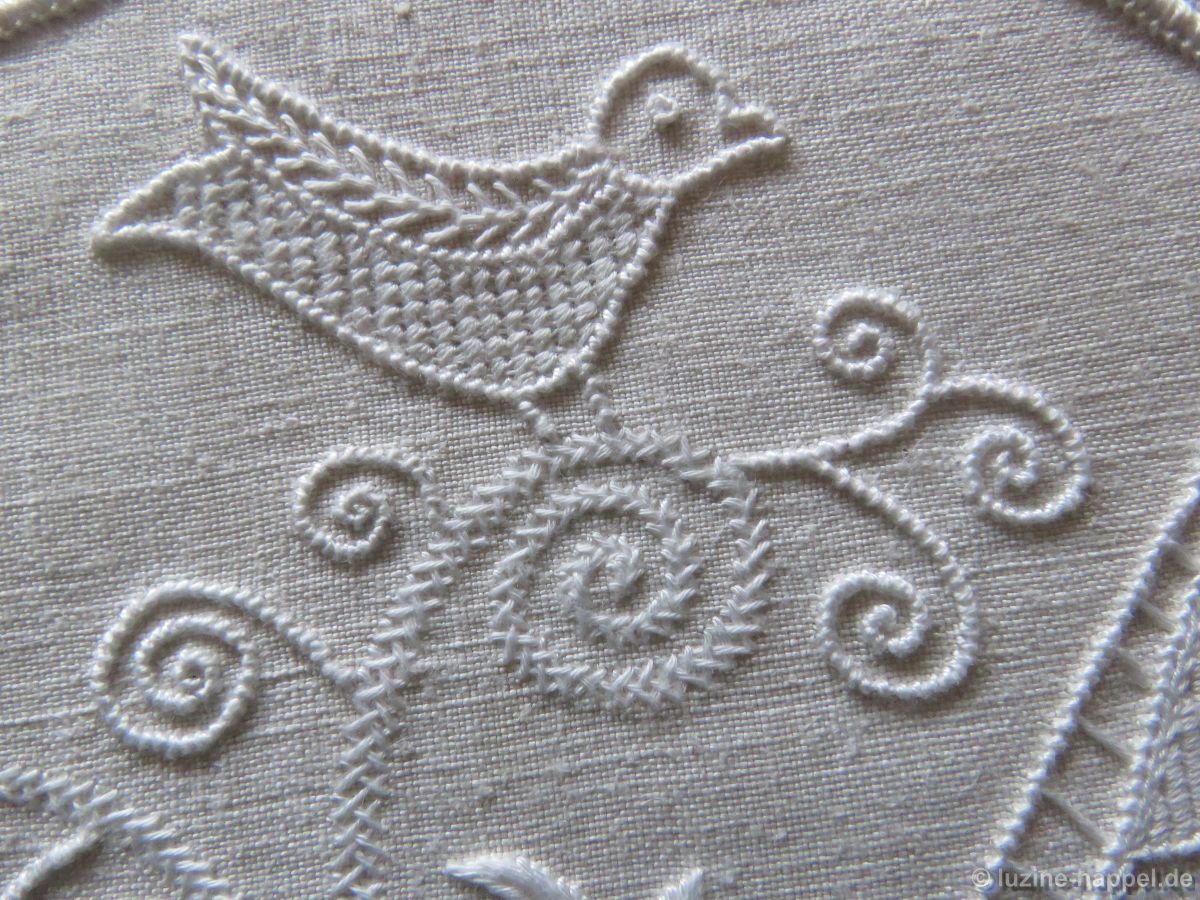
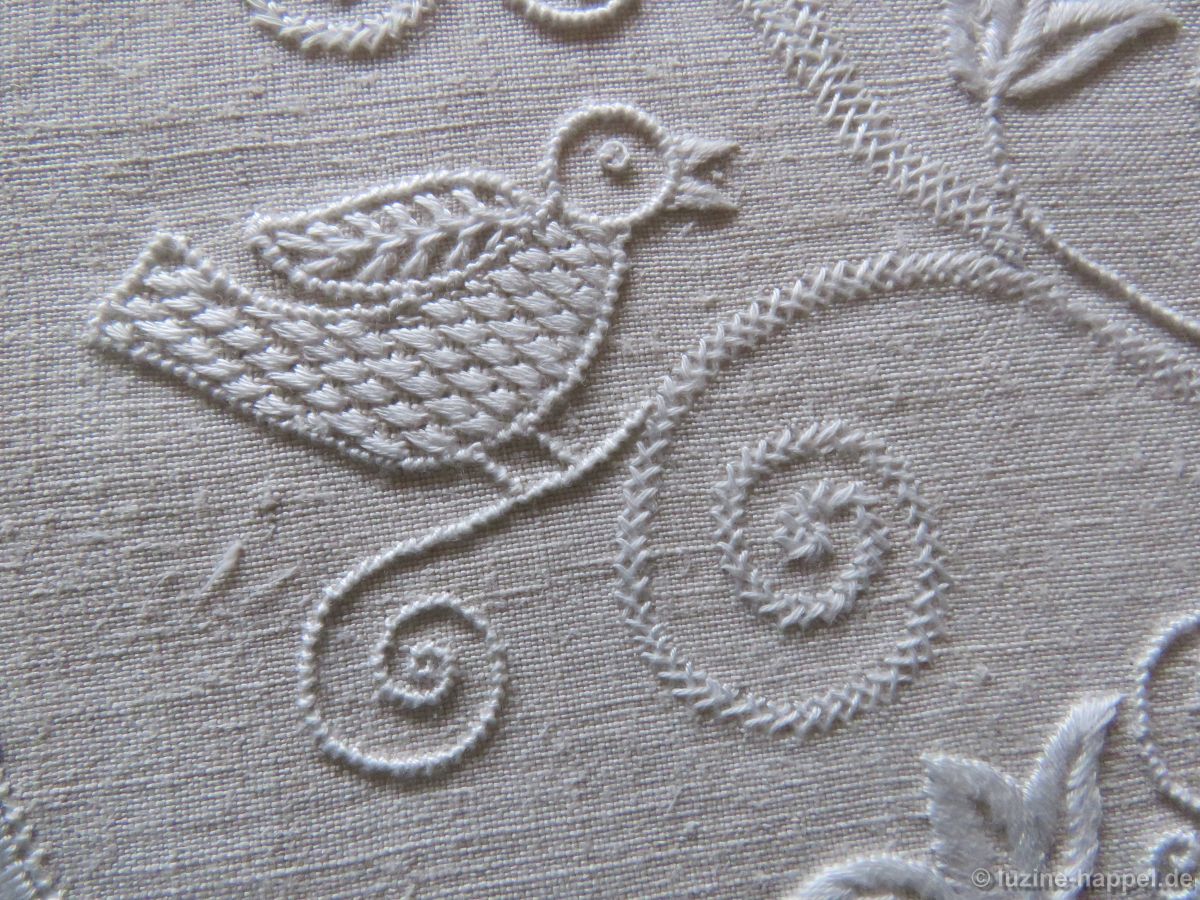
A pair of birds

finds housing there.

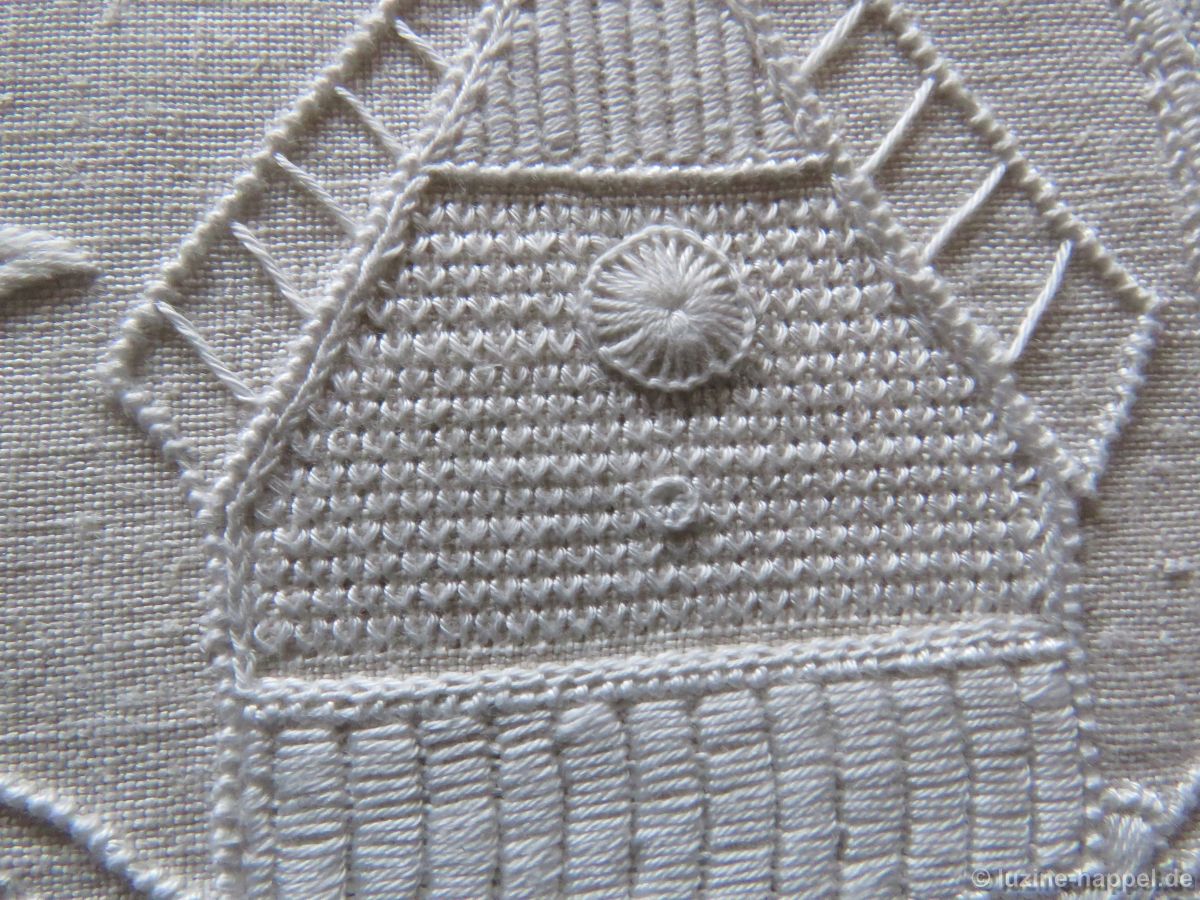
It is an extravagant design that guarantees both fun in the embroidering and plenty of room for practicing different stitches and stitch elements like tendrils, forks, and eyelets.