Schwalm Bodice Sleeve (1)

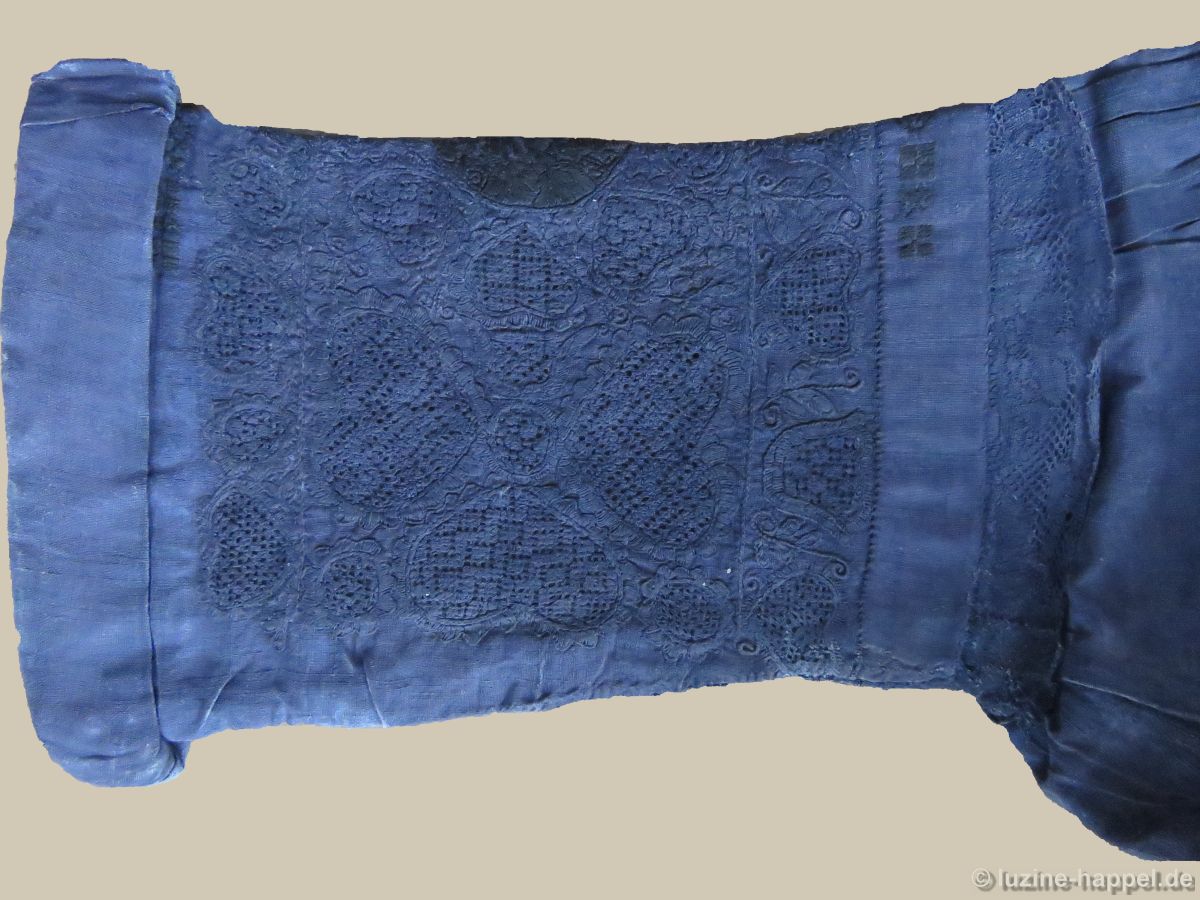
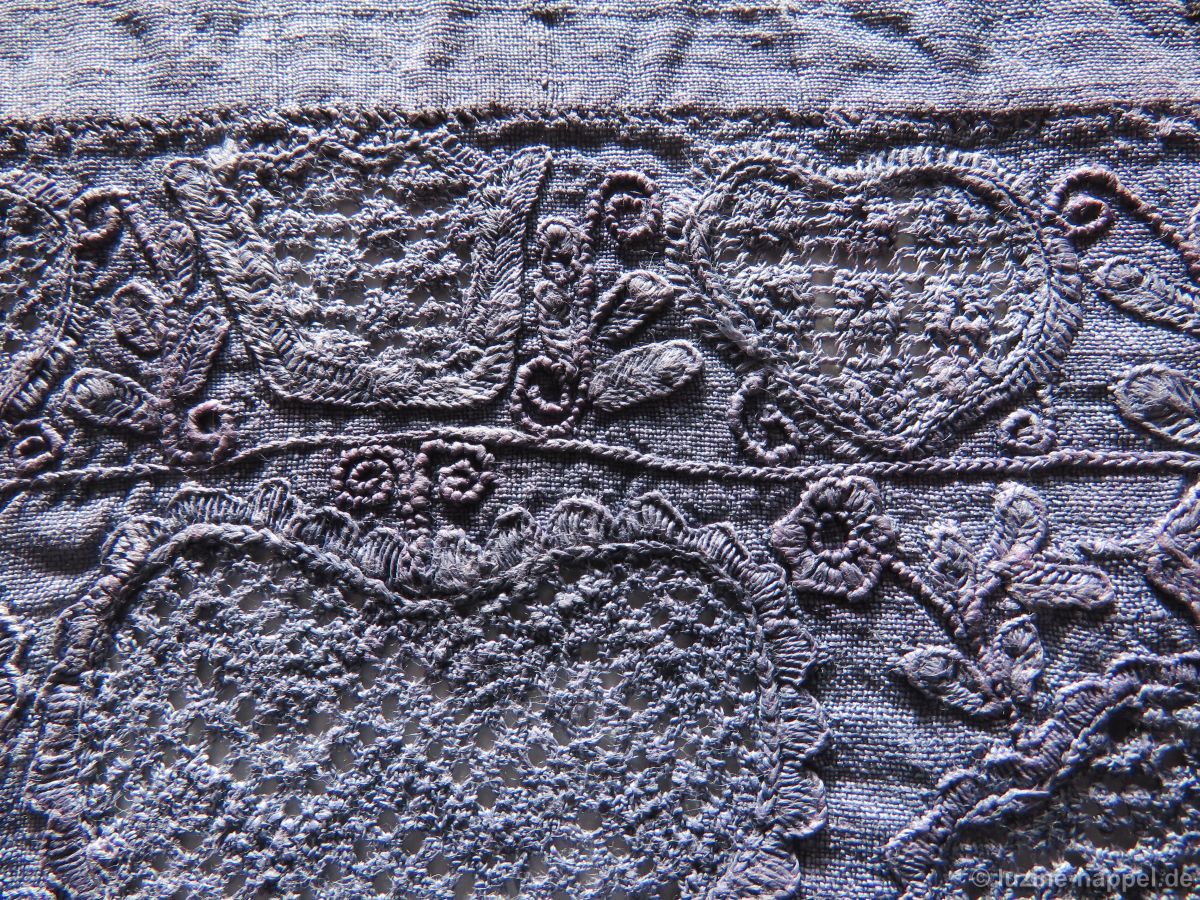
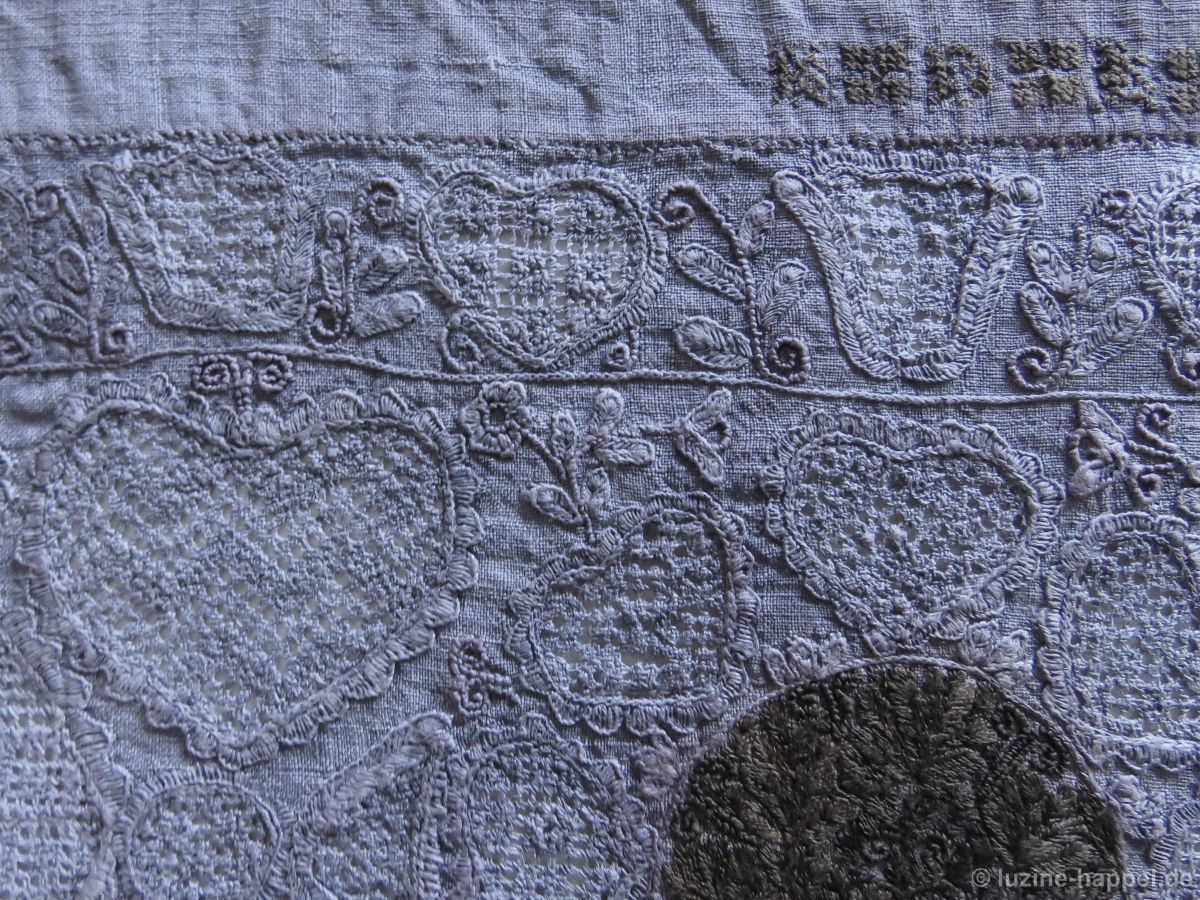
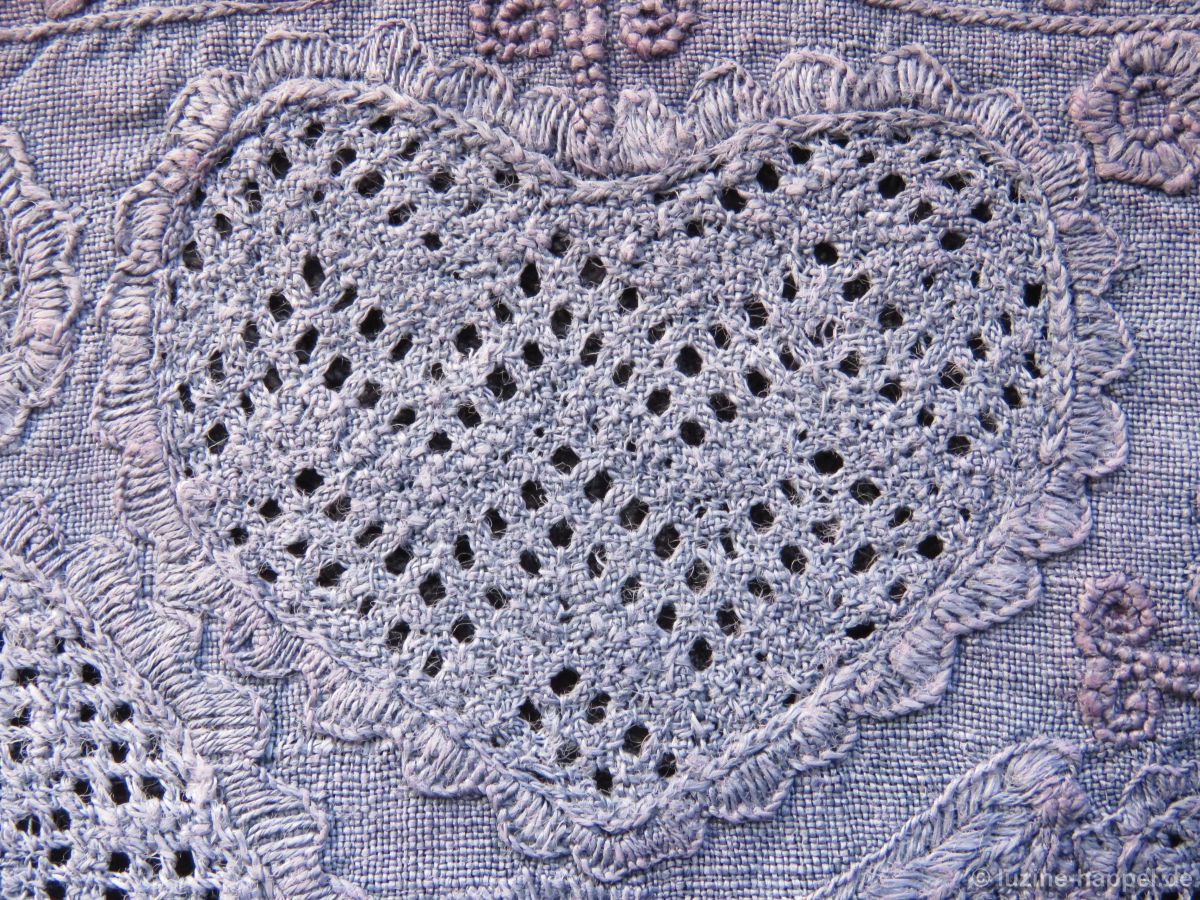
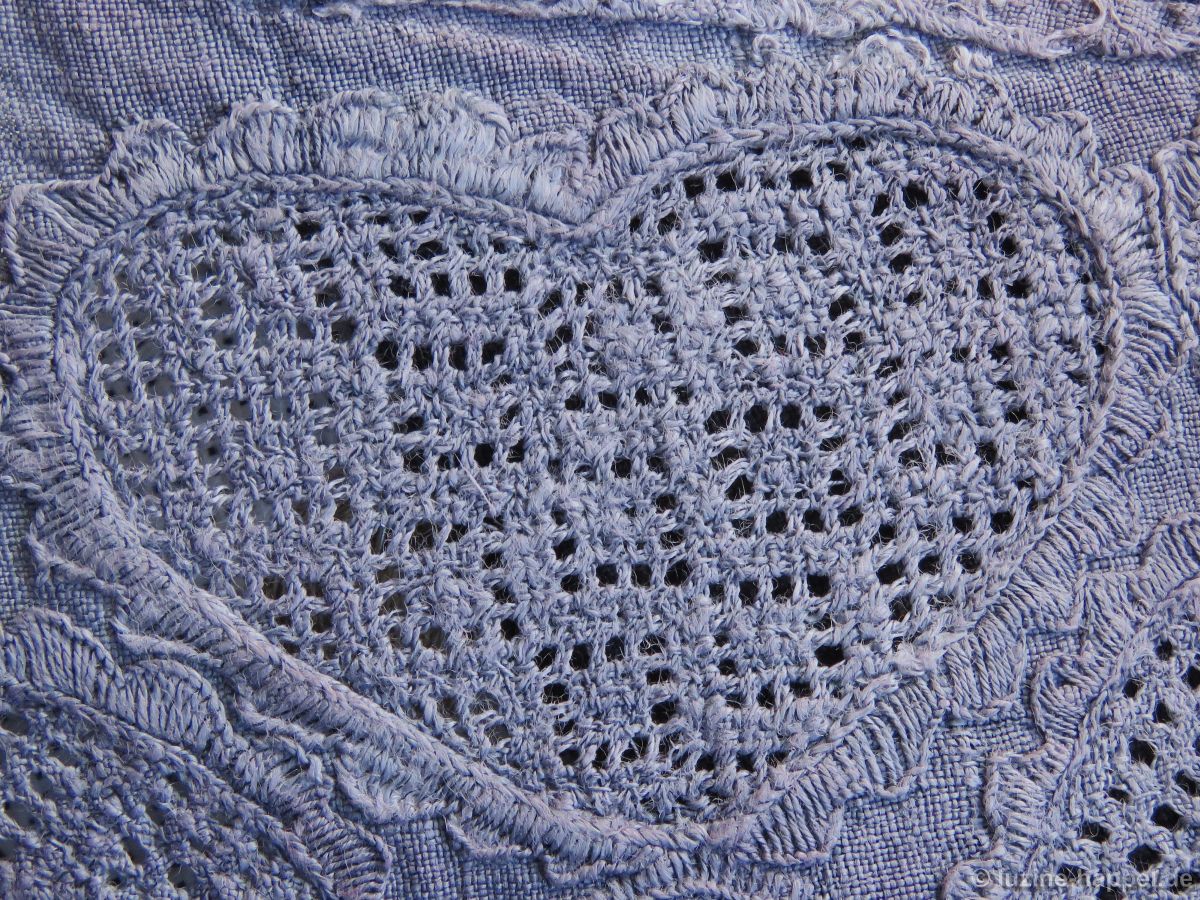
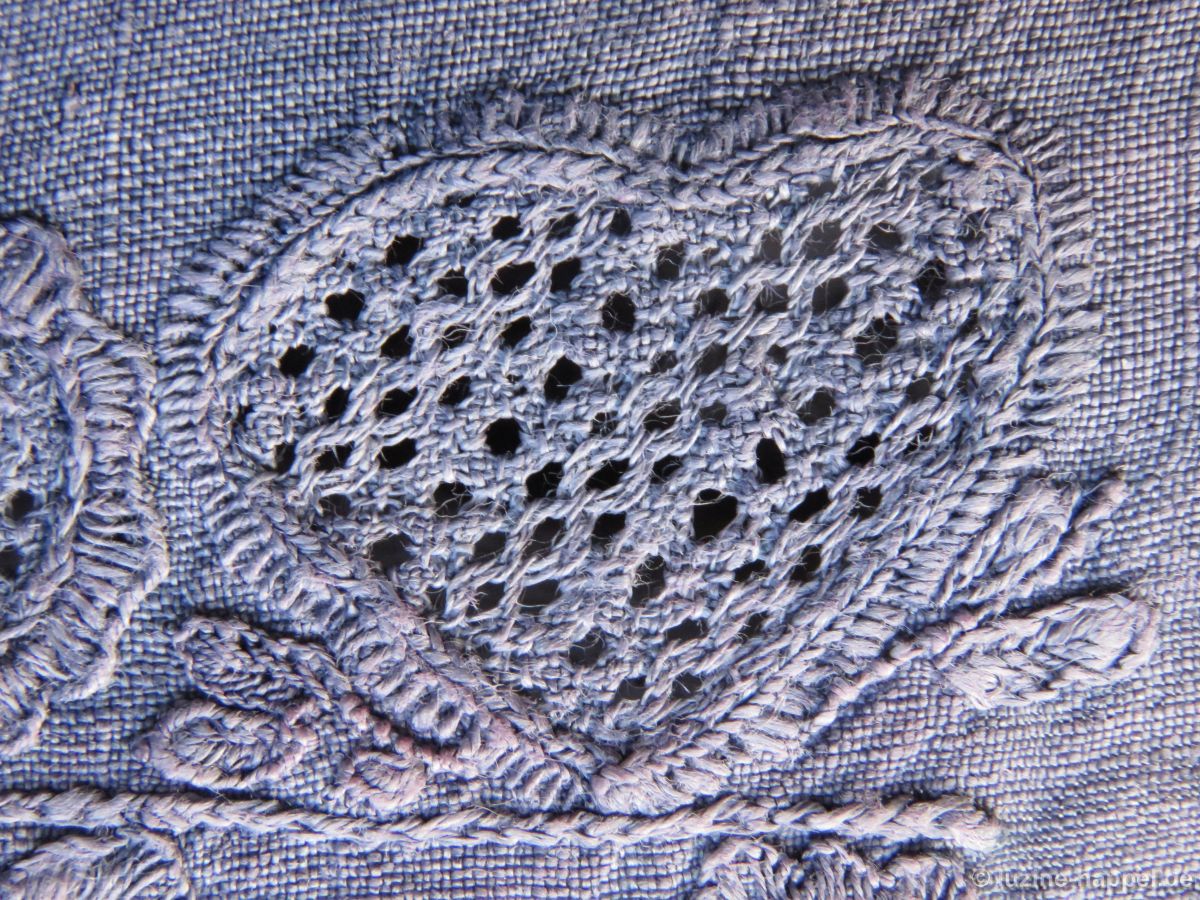
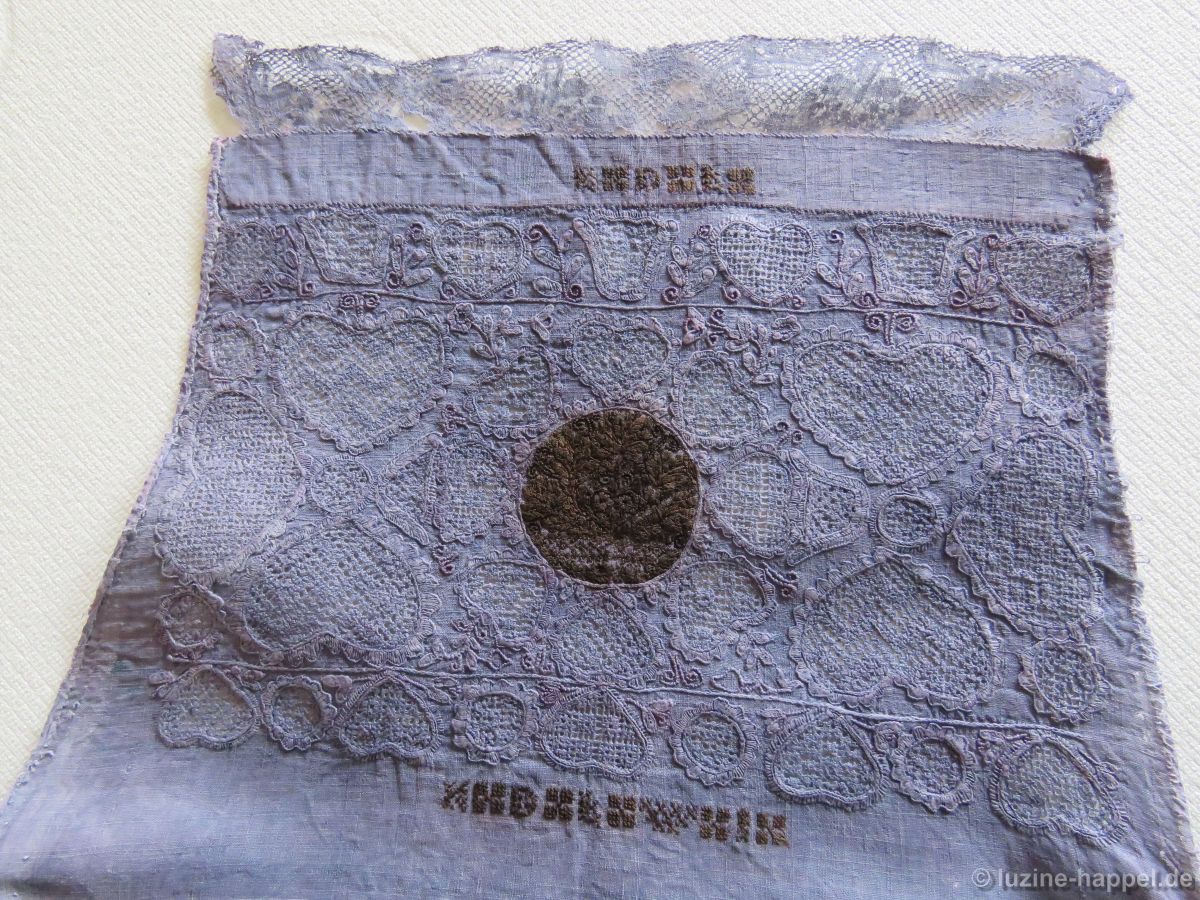
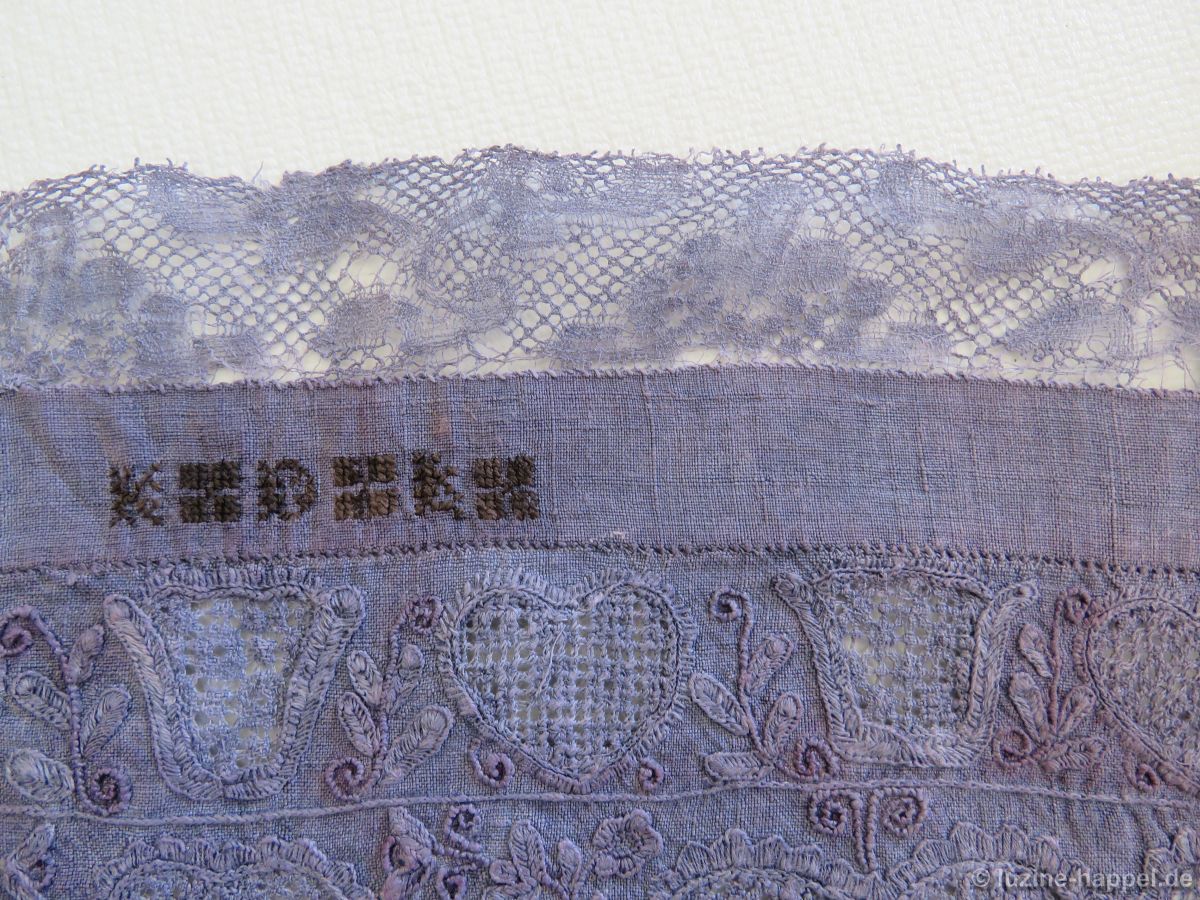
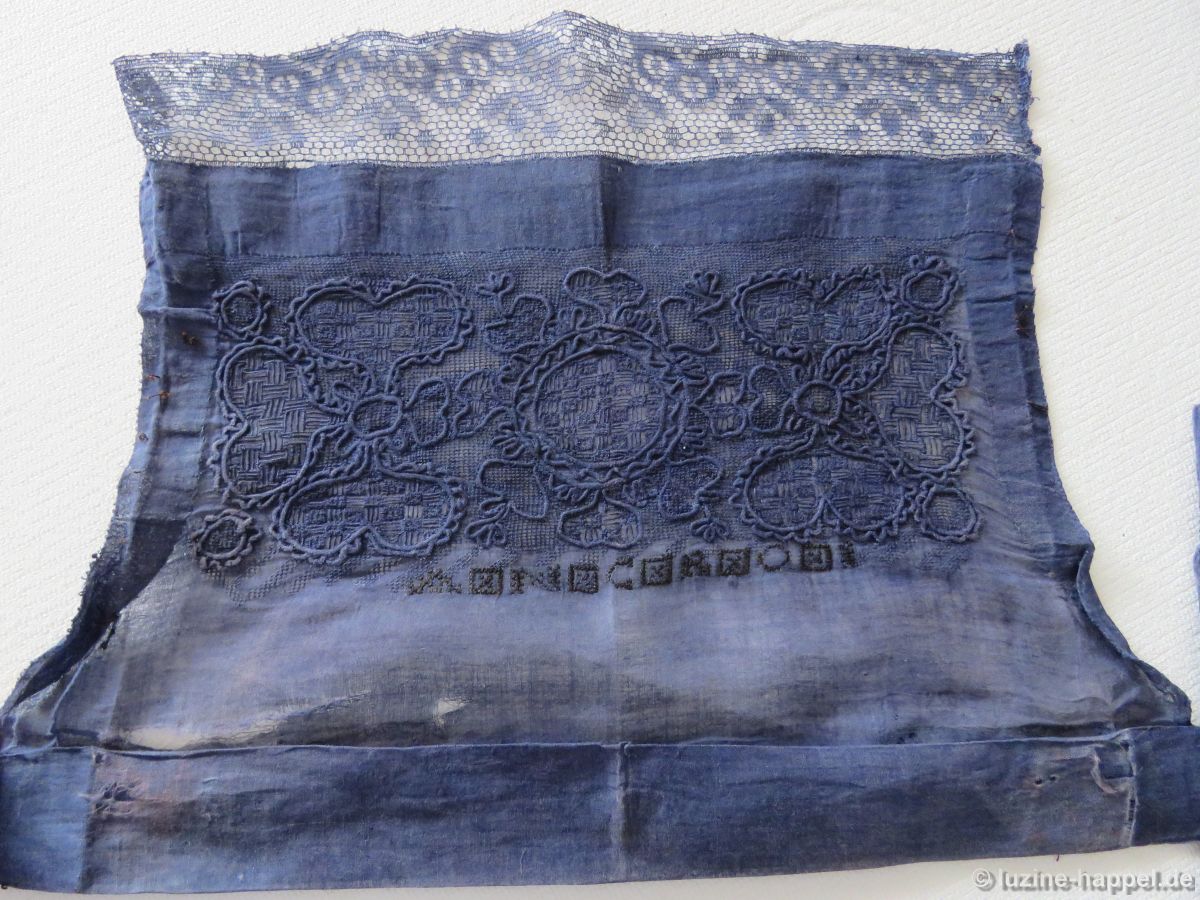
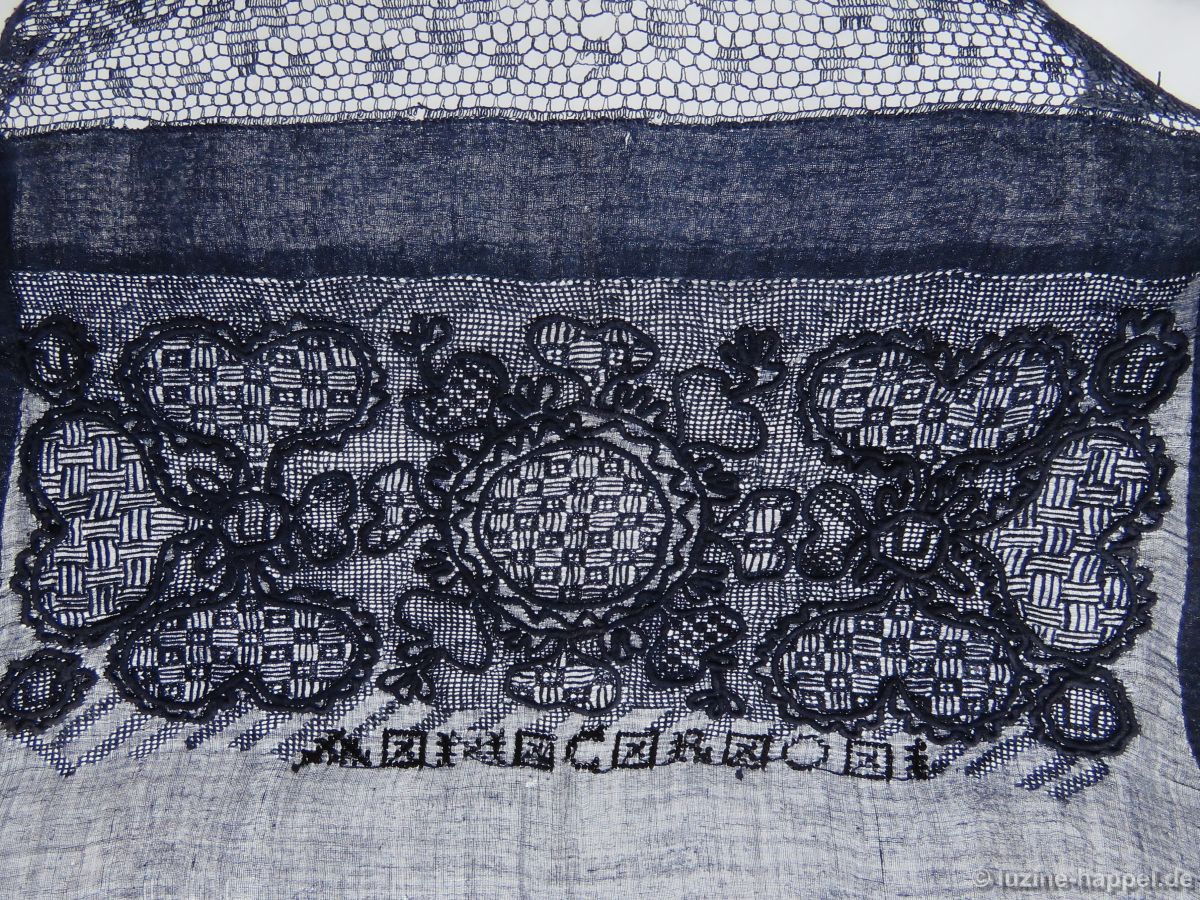
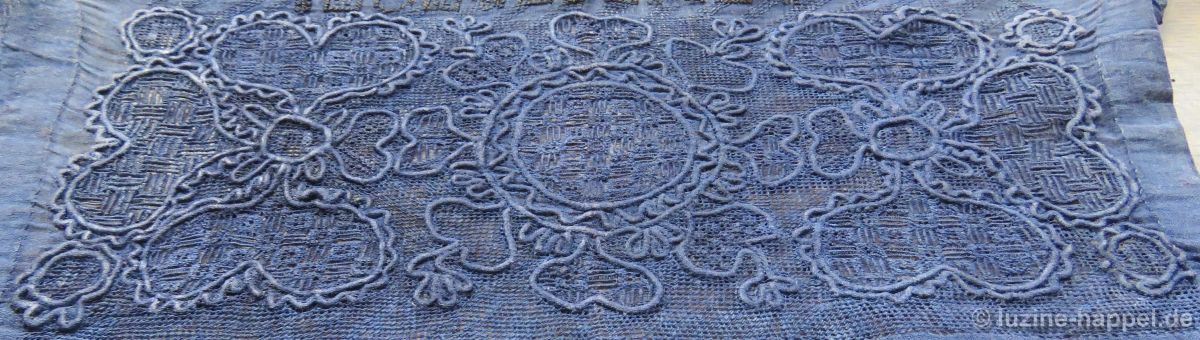
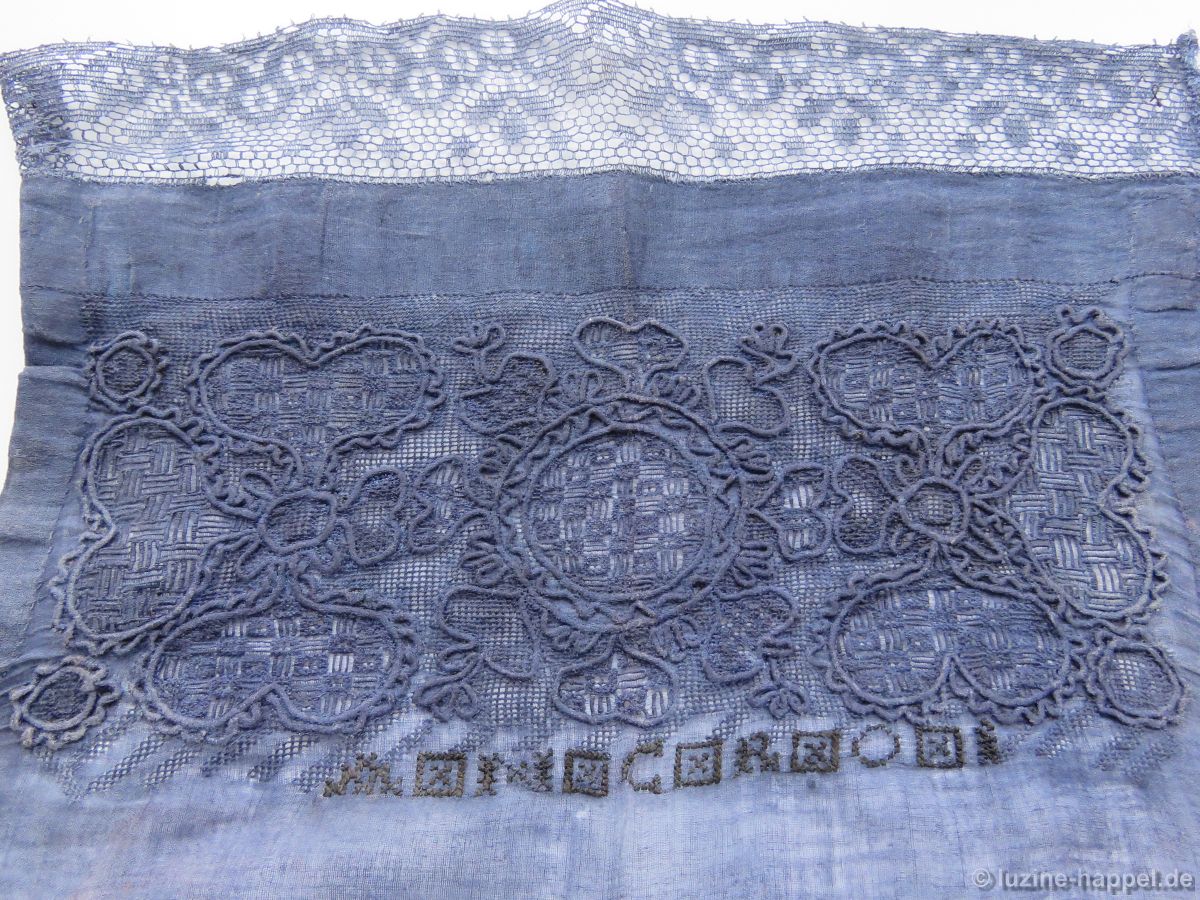
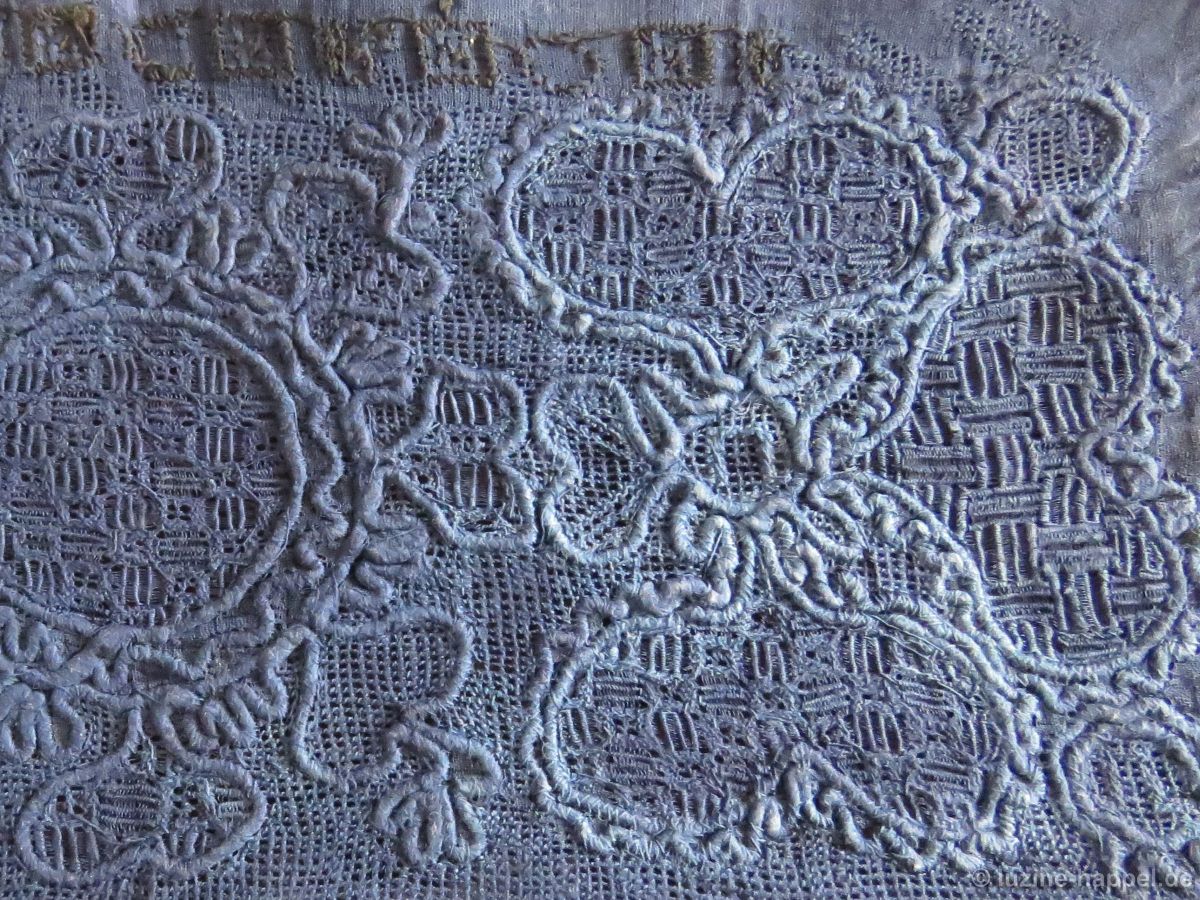
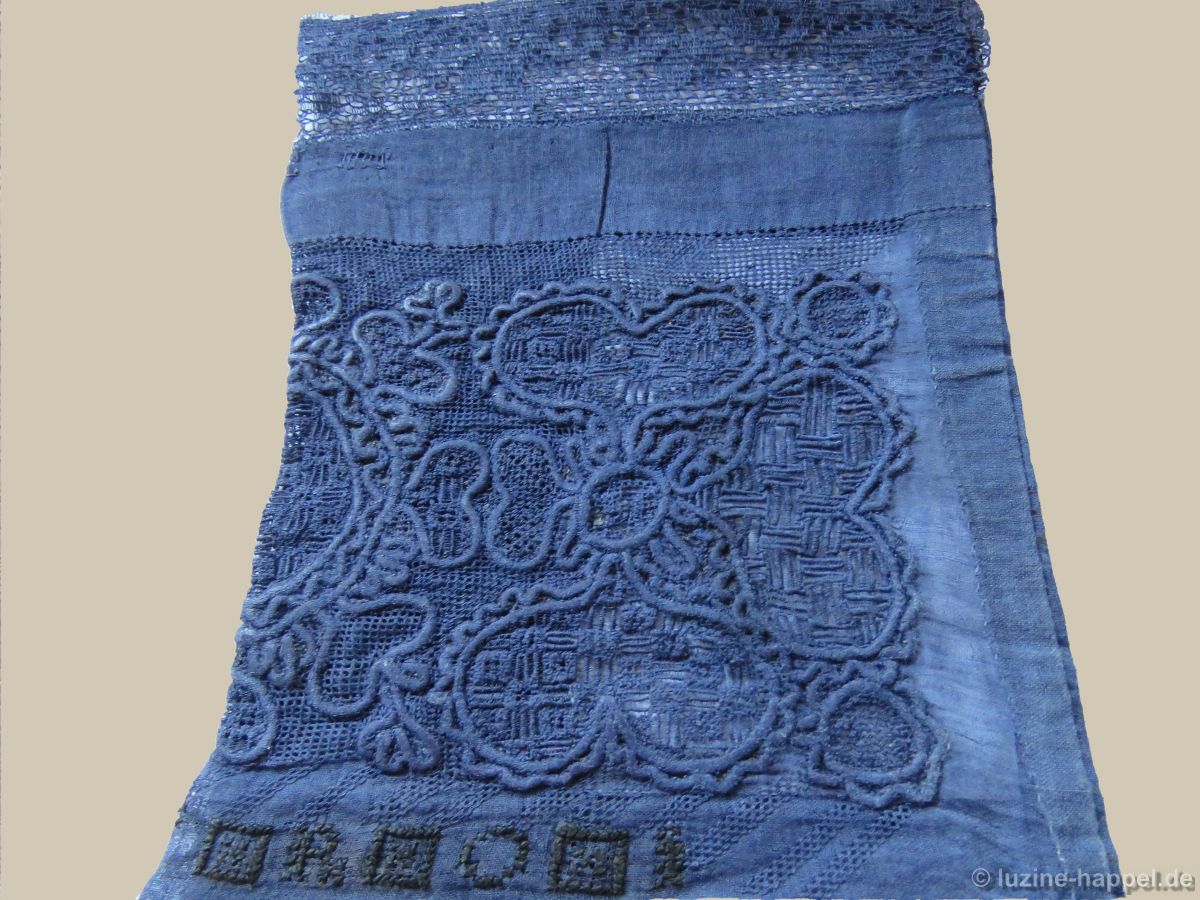
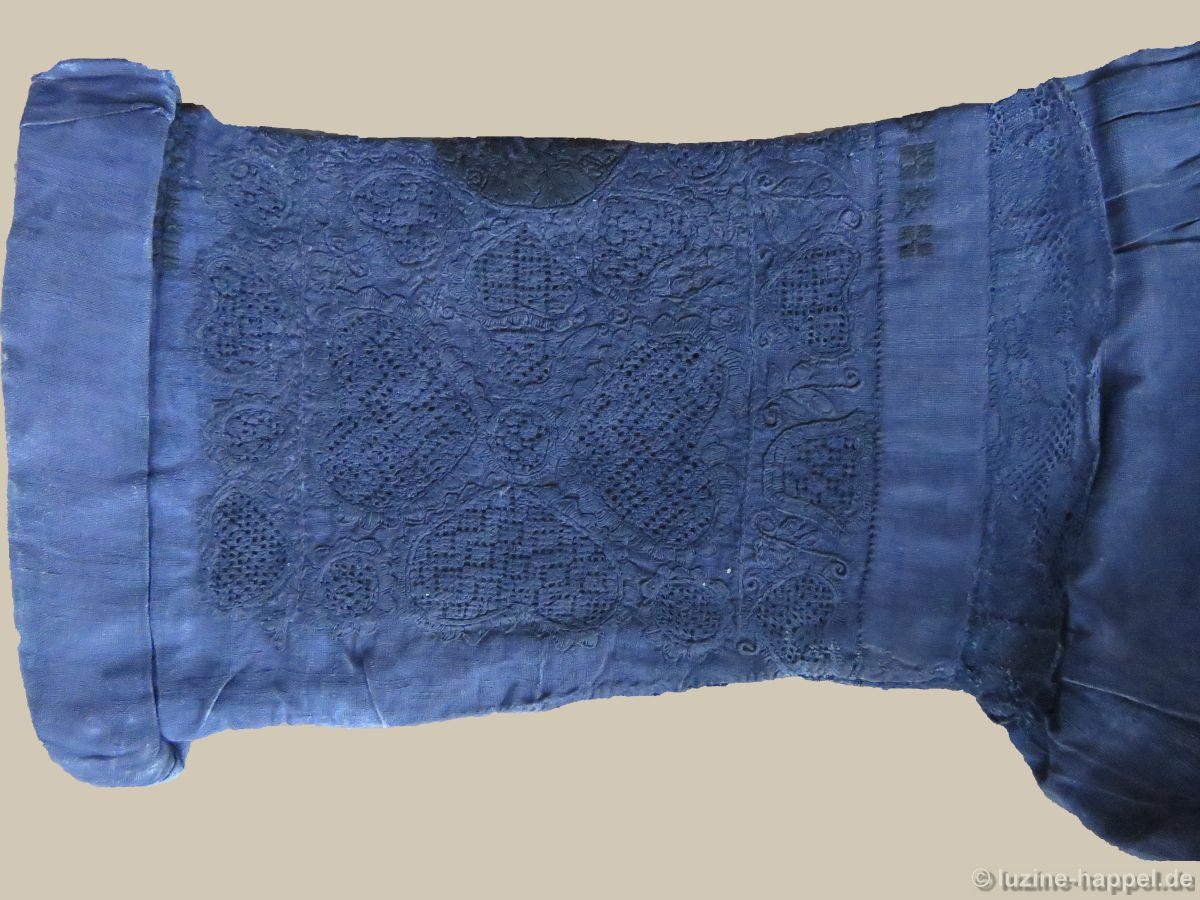
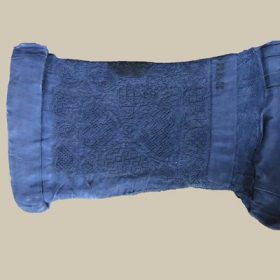
After the side seam has been opened, the approximately 200-year-old Schwalm bodice sleeve can be viewed in its entirety.

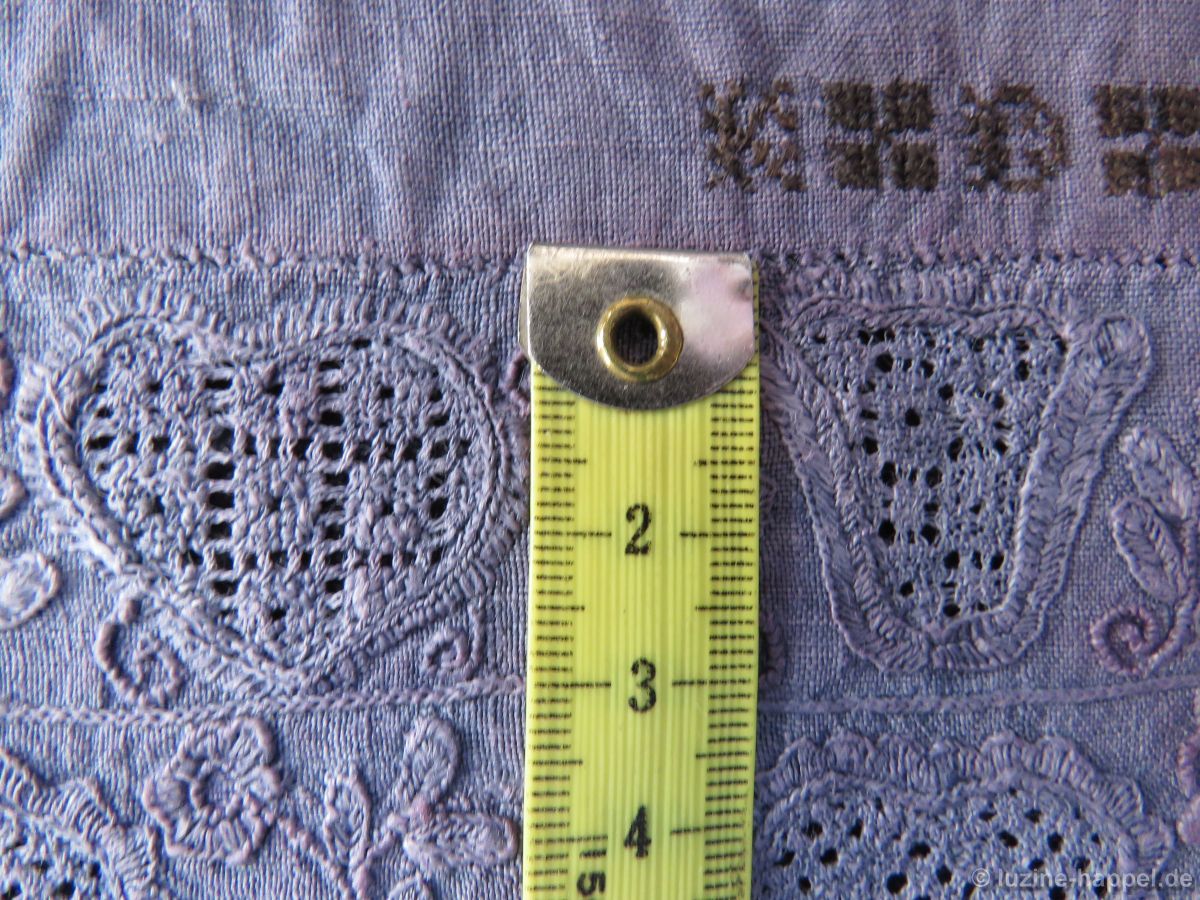
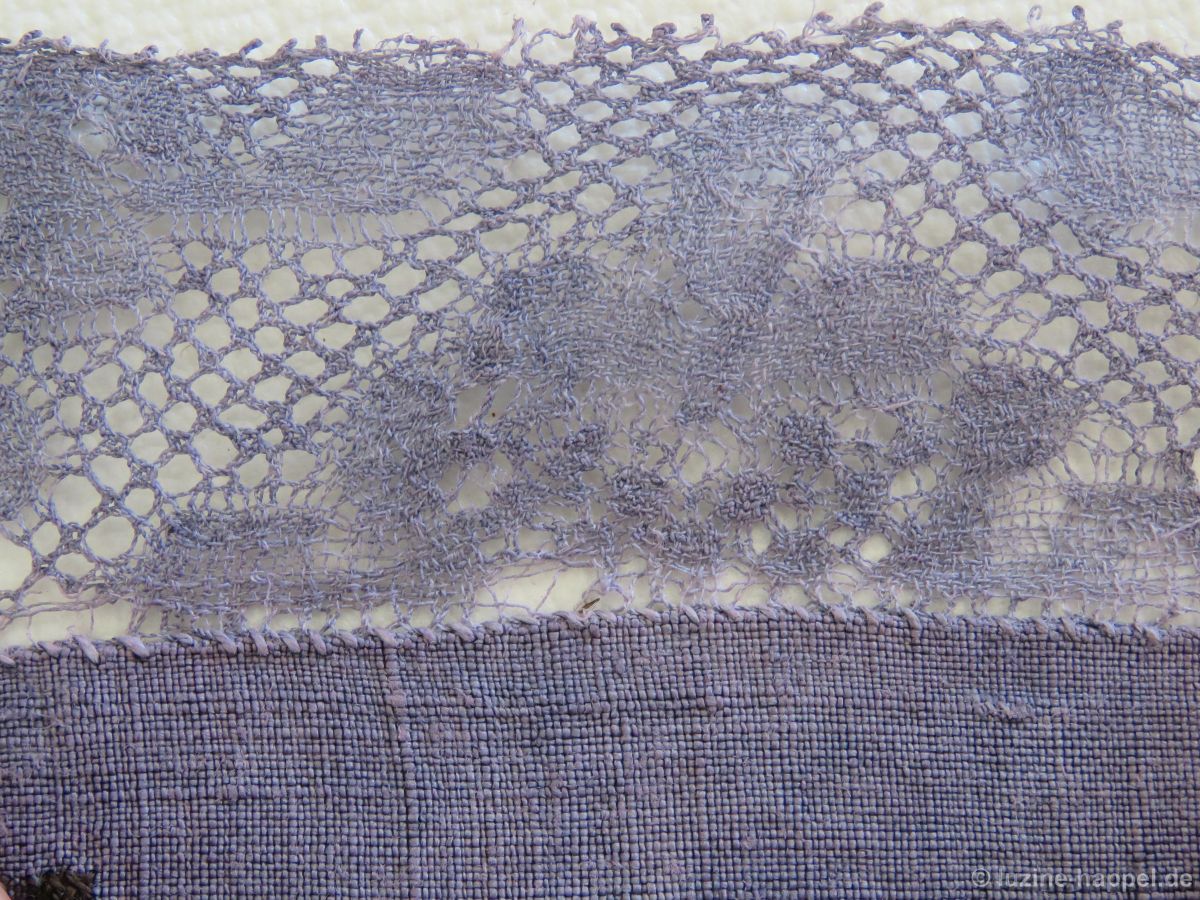
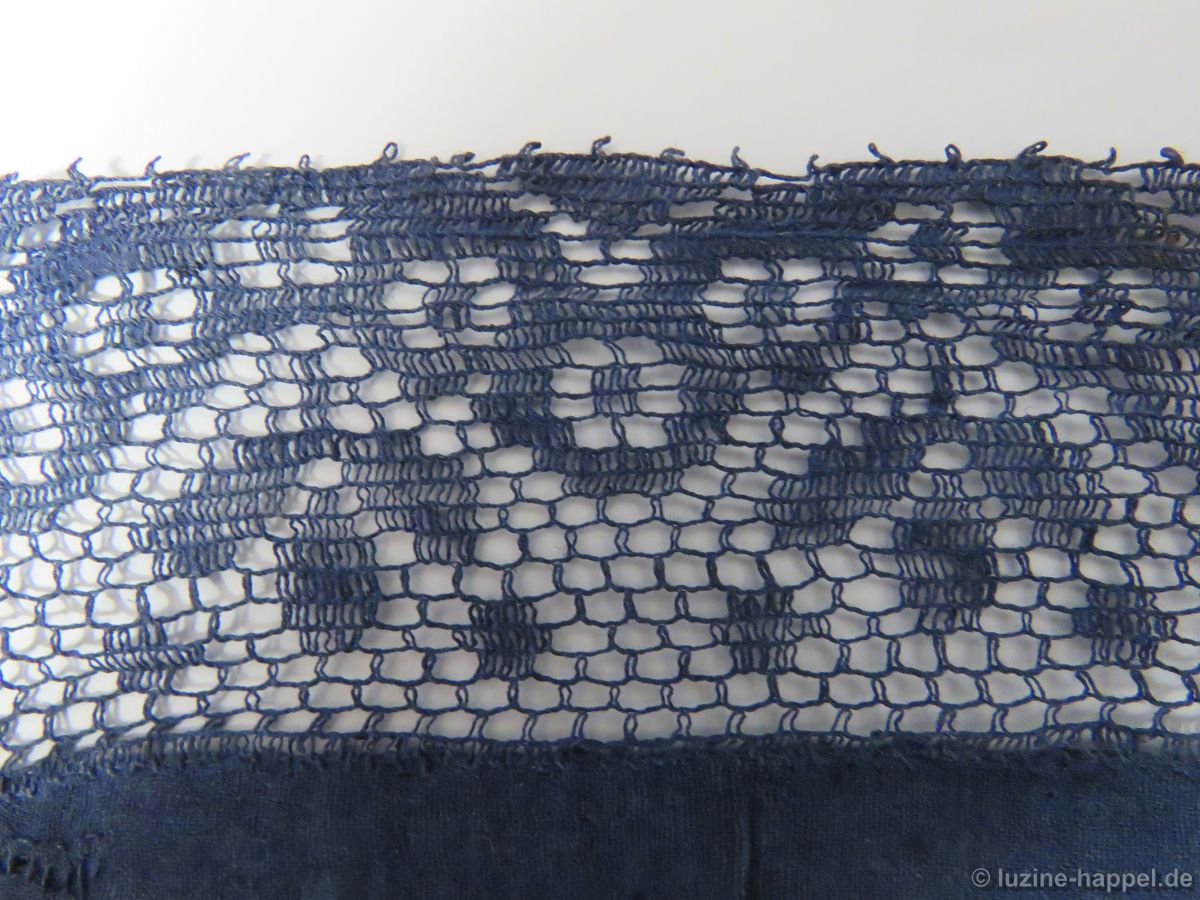
It has a total height of 40 cm, with a 4 cm wide double hem at the bottom reducing the finished height to 29 cm. The sleeve is 32 cm wide at the top and 40 cm wide at the bottom. A 5 cm high bobbin lace trim is attached to the top edge.

Then follows a 3 cm wide hem before the embroidered border begins. The border is 10 cm high, and 11.5 cm high in the area of ​​the initials.

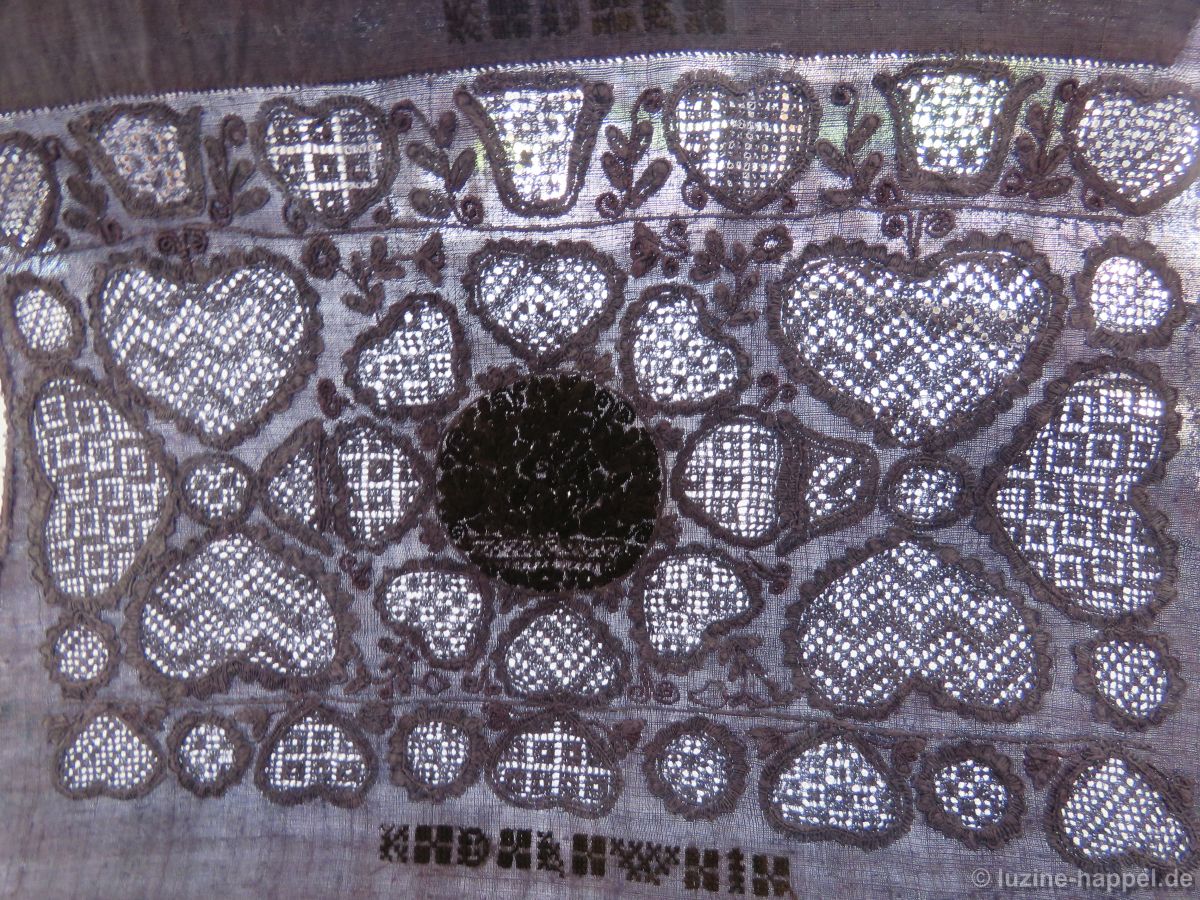
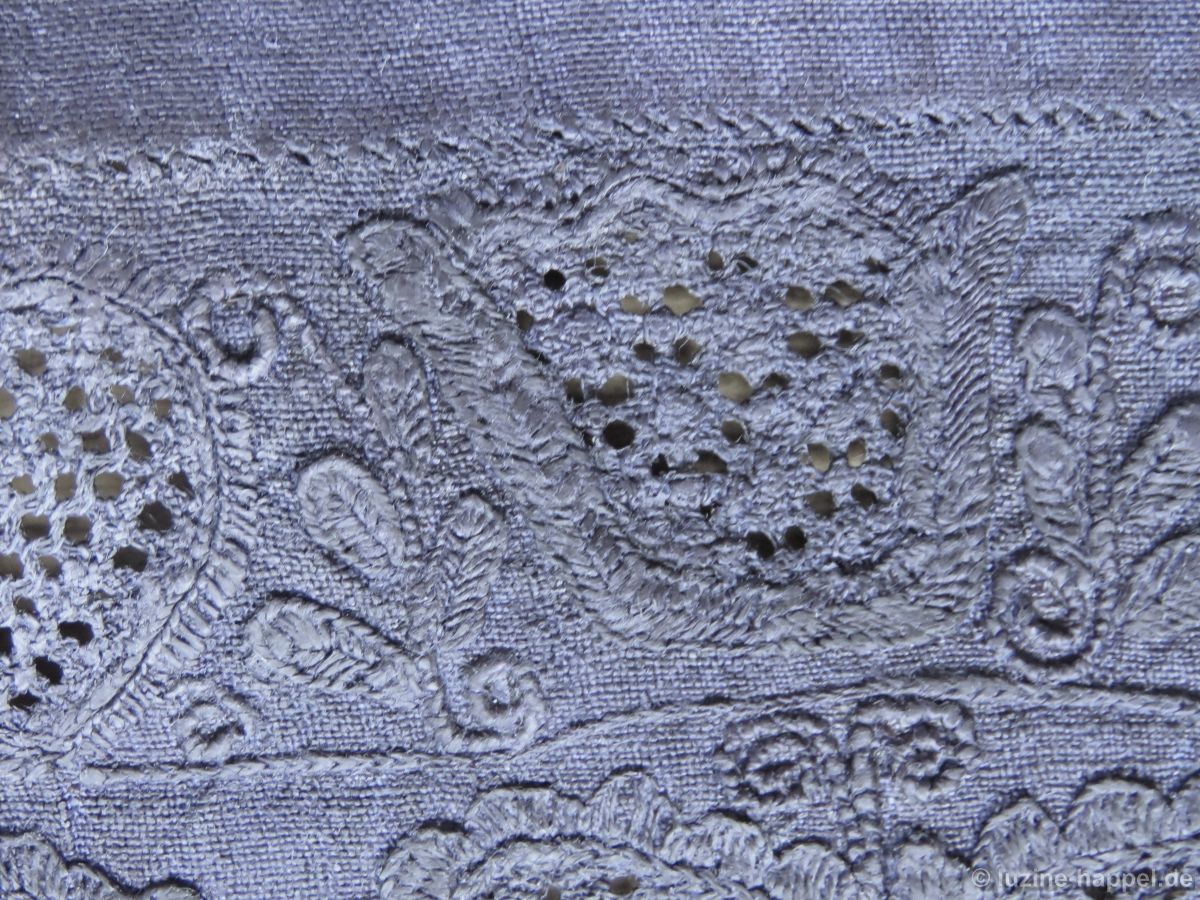
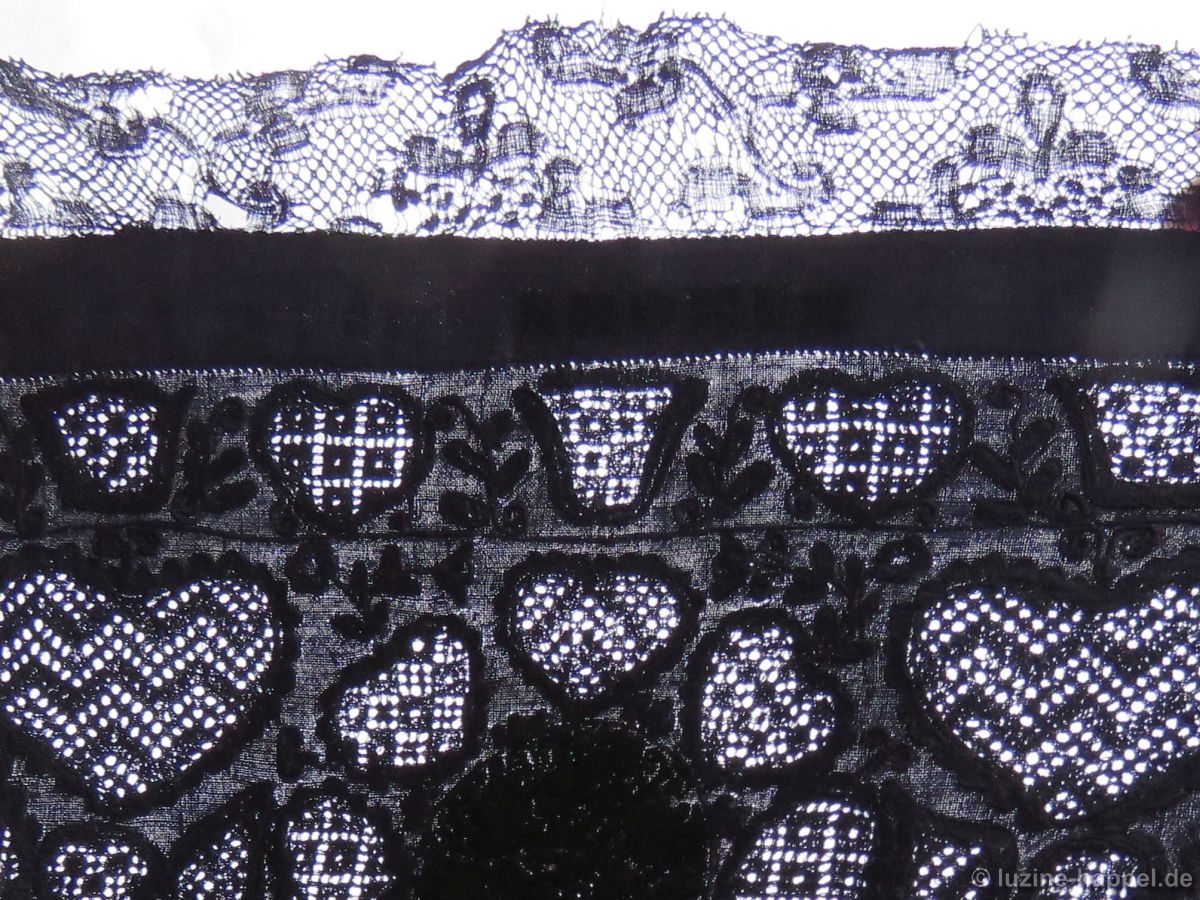
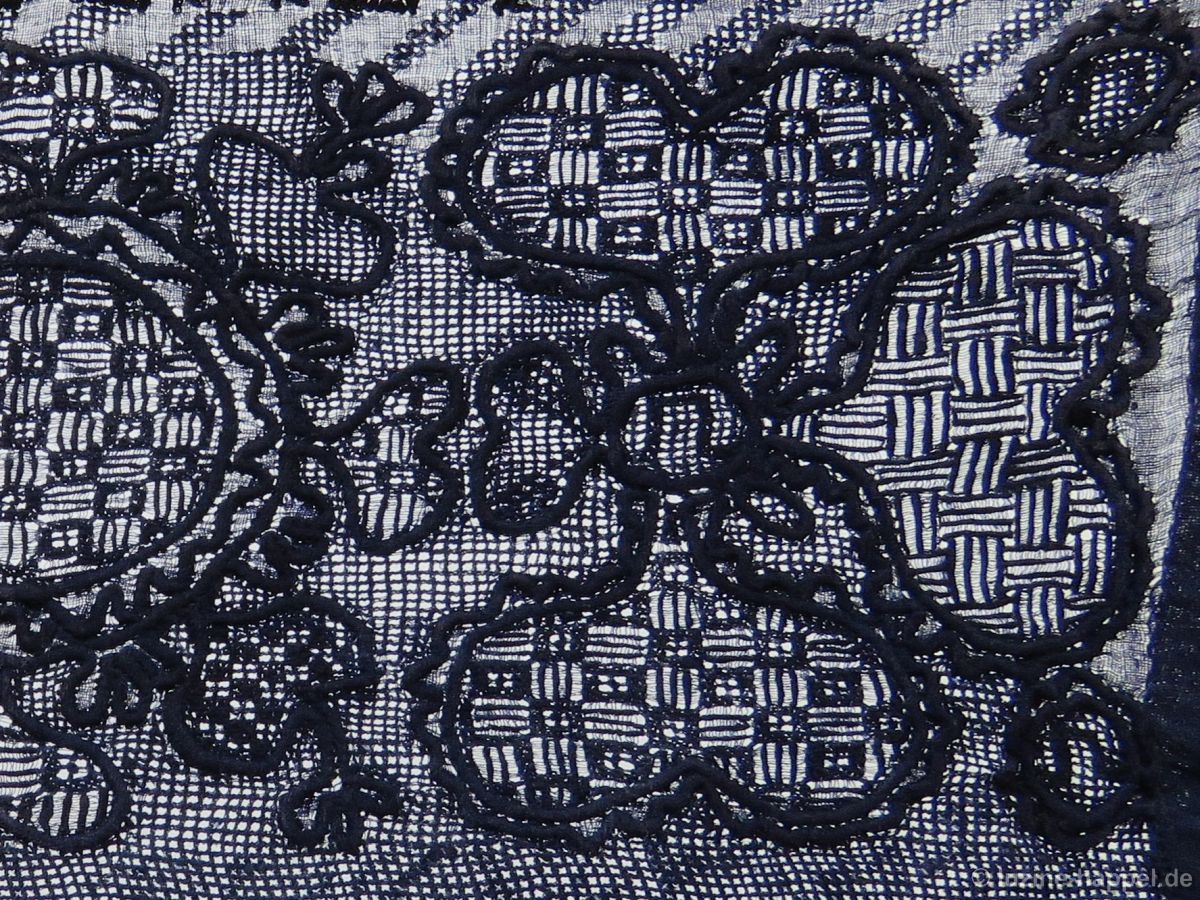
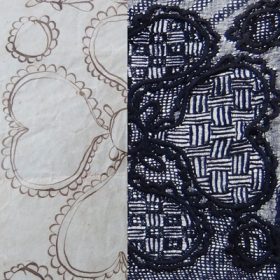
In the backlit photograph, it is clearly visible that the outline pattern from the 1820s was used here and its central part was transferred exactly.

The separate bodice sleeves are made of the finest batiste, a loosely woven, linen-weave fabric – probably cotton batiste. (Investigations to determine the material of the Schwalm accessories made of batiste revealed that it was mostly cotton batiste, but linen batiste also occurred. Batiste was a material that was not produced in the Schwalm region, but was obtained from traders. See Masterpieces in Blue – OIDFA)

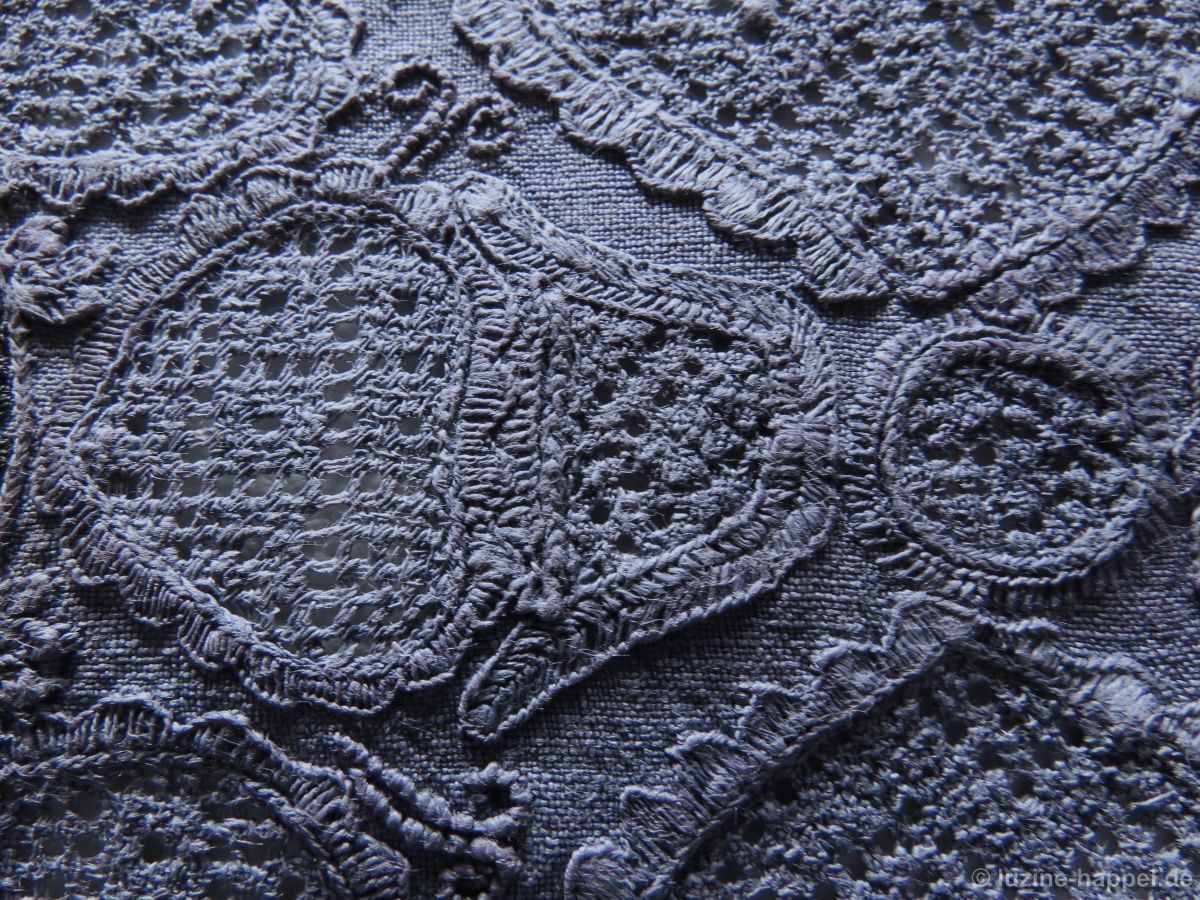
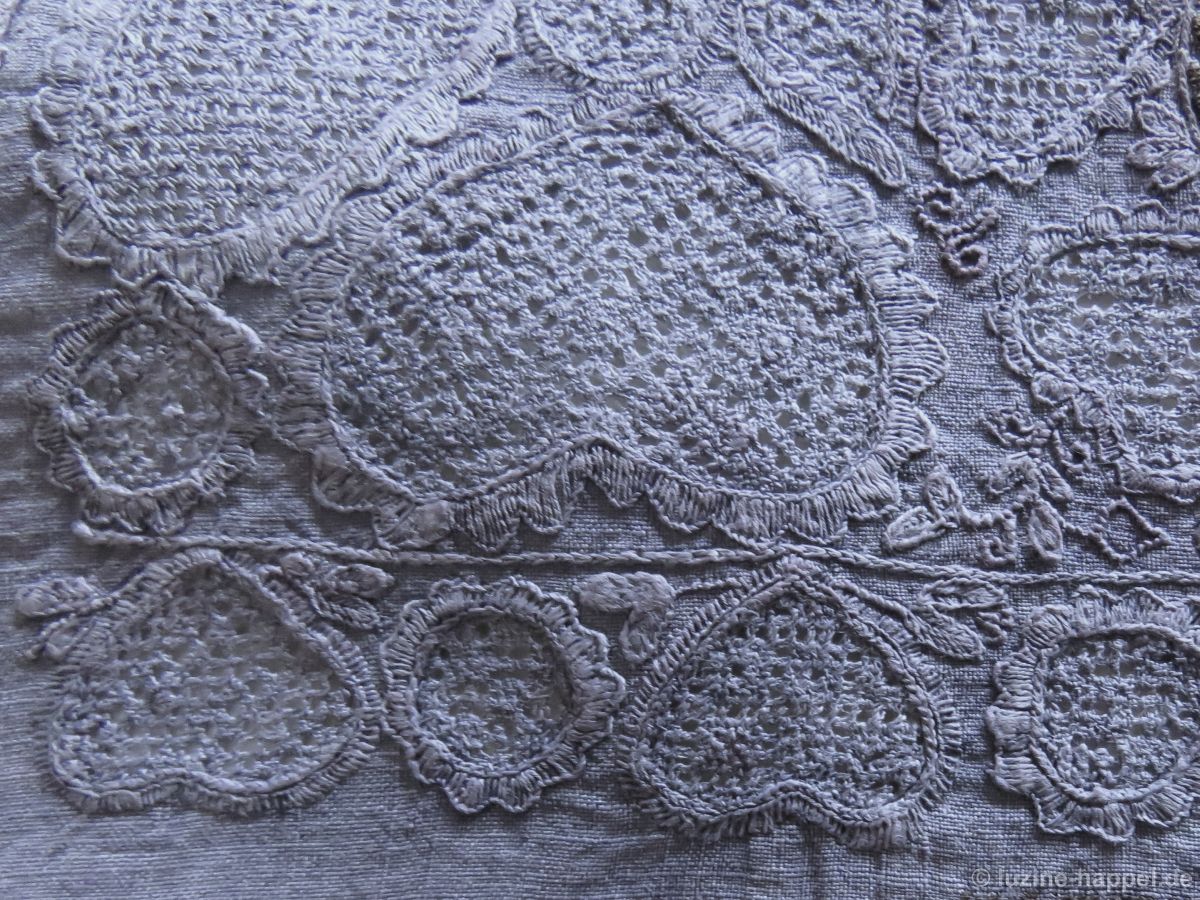
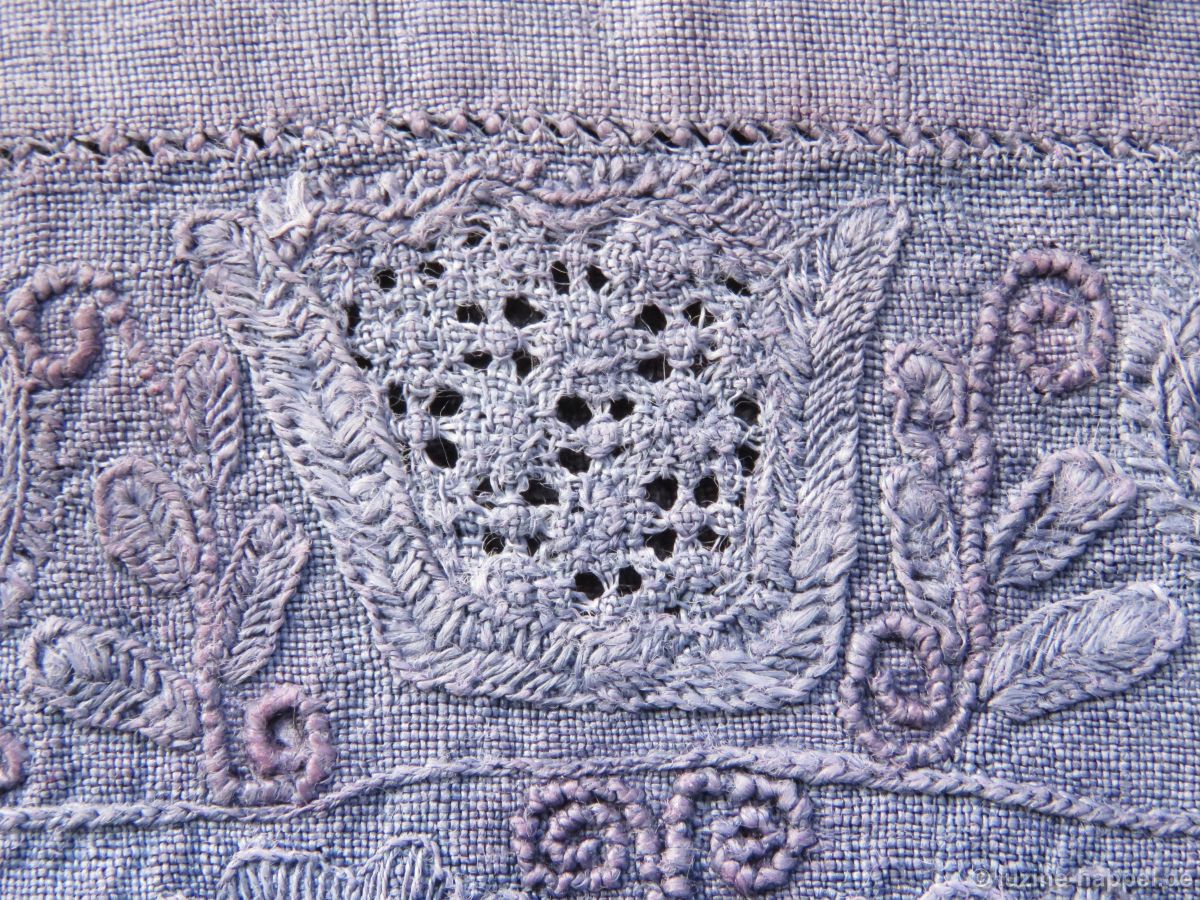
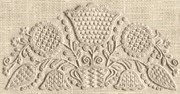
The elaborate embroidery is executed in the style of Dresden lace.
At the end of the 18th century – around 1770 – lace production declined in Dresden. However, it continued and was incorporated into folk art, where it was further developed. This was also the case in the Schwalm region. (You can learn more about this in the next blog post.)

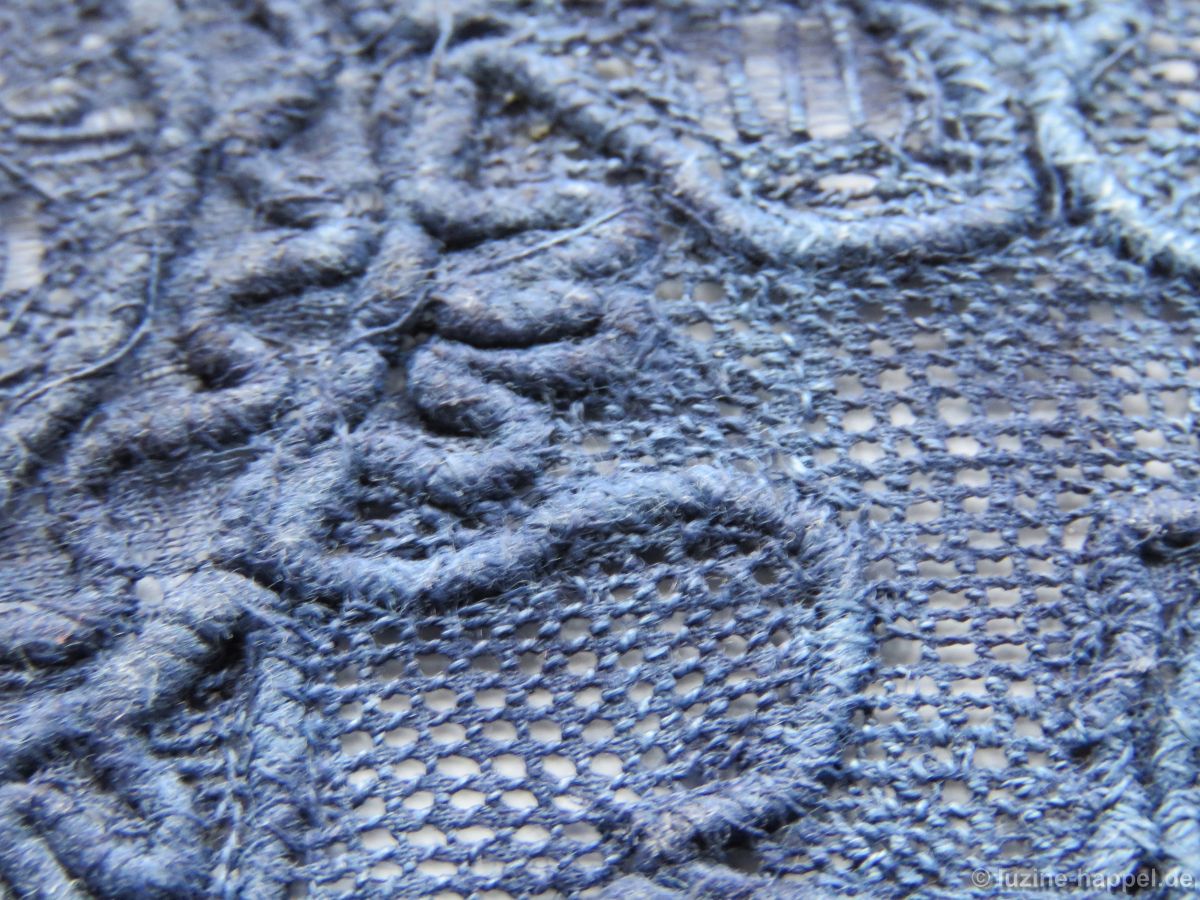
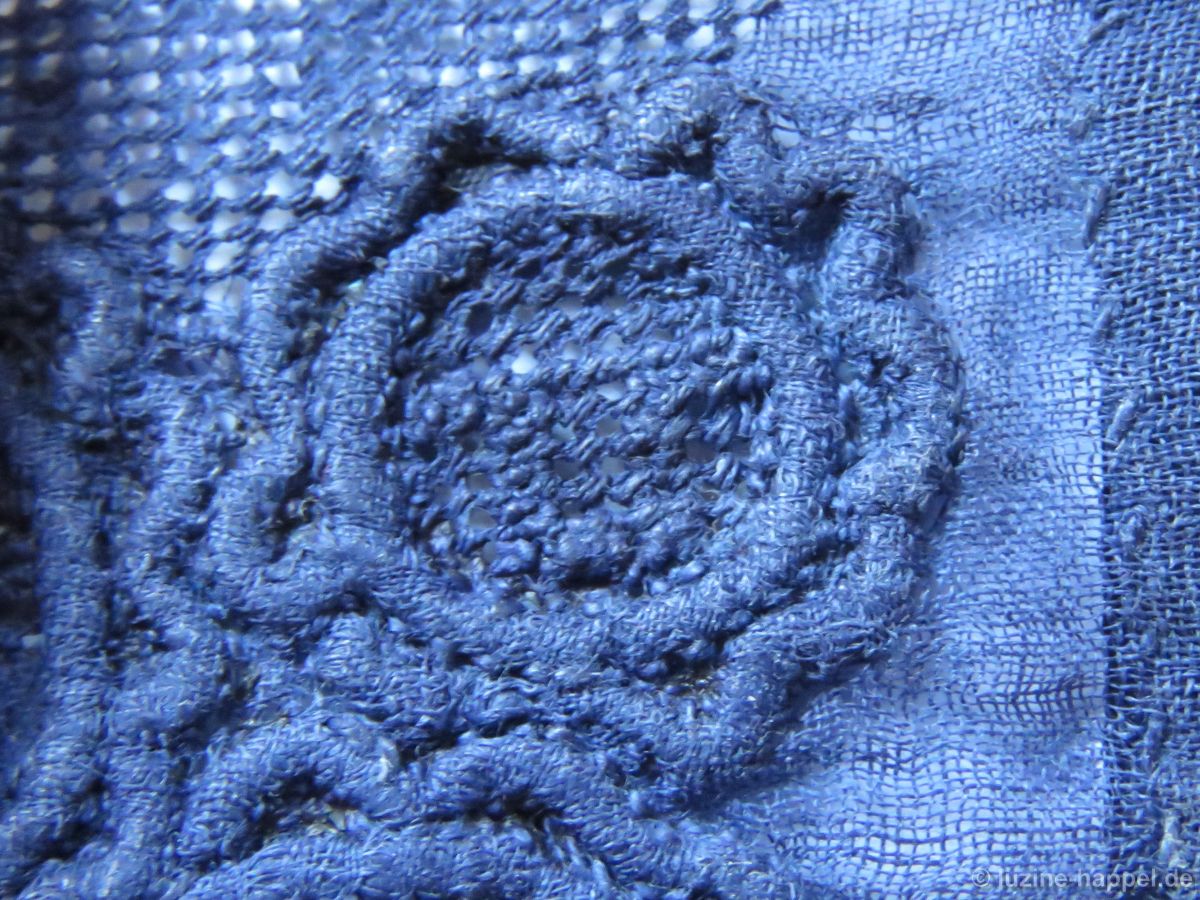
Linen thread of varying thicknesses was used as the embroidery material. The threads had to be spun loosely so that they could conform to the desired outlines and the embroidery on the soft base fabric.

To highlight the individual motifs, the line drawing under the fabric were traced with a thick thread and secured with double back stitches.

On the front, these stitches appear as back stitches.

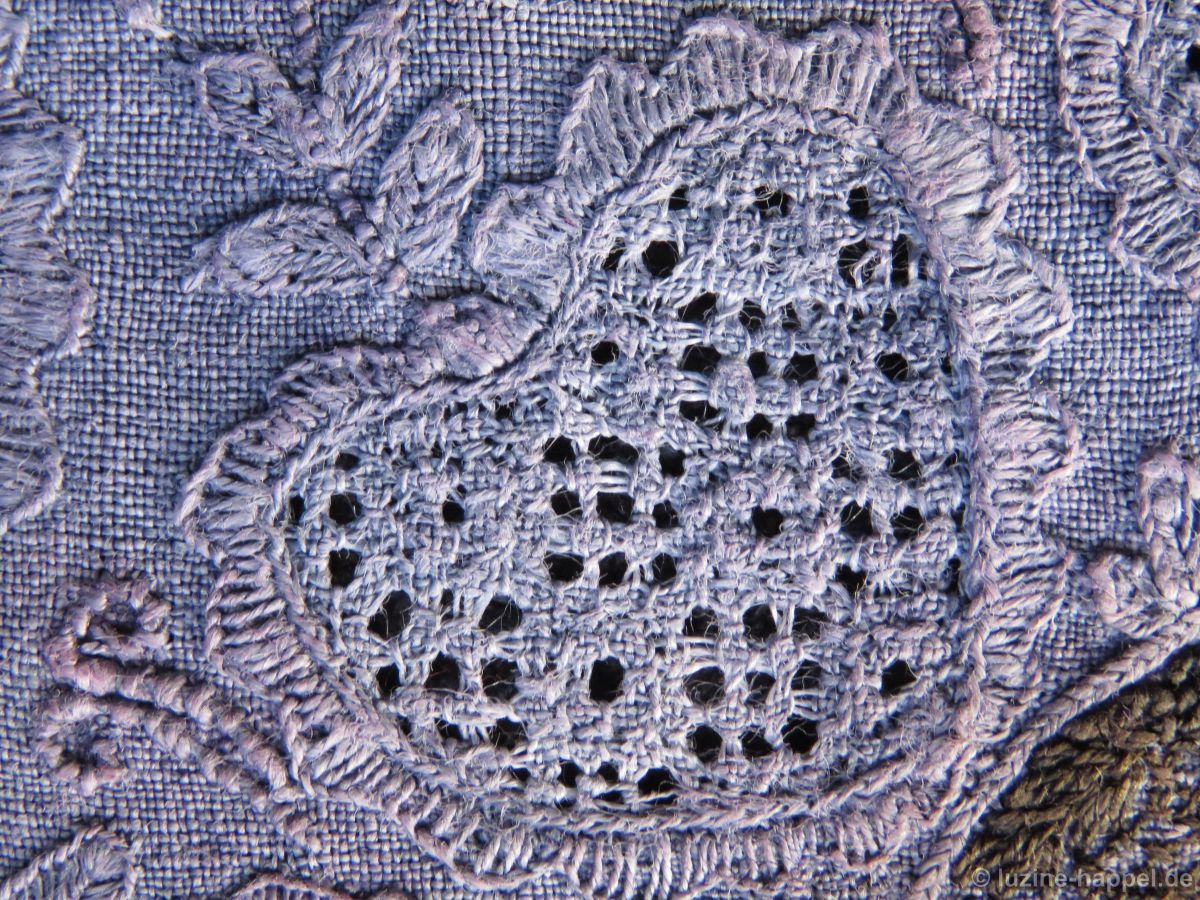
Different patterns are incorporated into the resulting surfaces by pulling the fabric threads together (pulled thread embroidery).

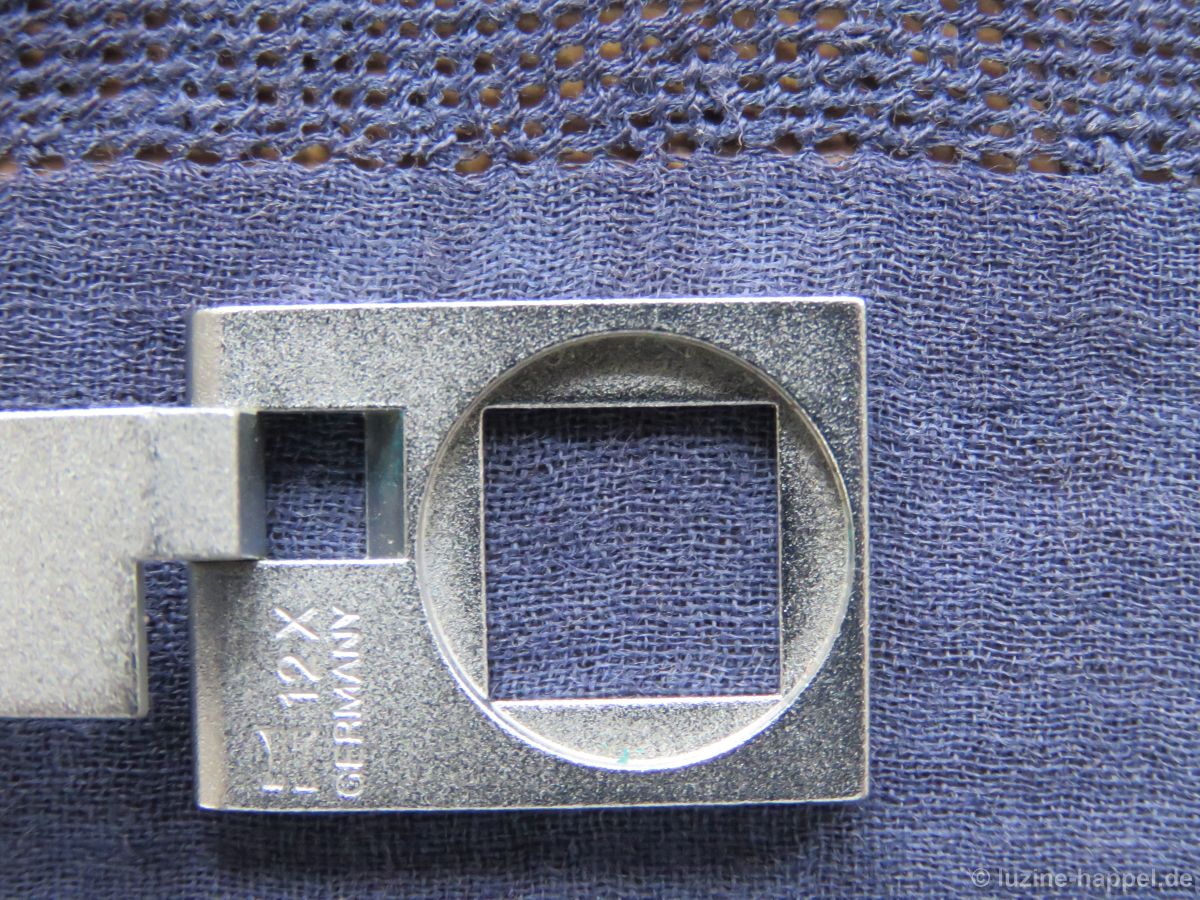
The batiste fabric used has 26/30 threads/cm.

Four fabric threads were bundled together for pattern formation and also for the cross stitches of the initials.

Satin stitches, rose stitches, four-sided stitches and cable stitches were used here.

The background is also almost completely filled with pulled thread embroidery.

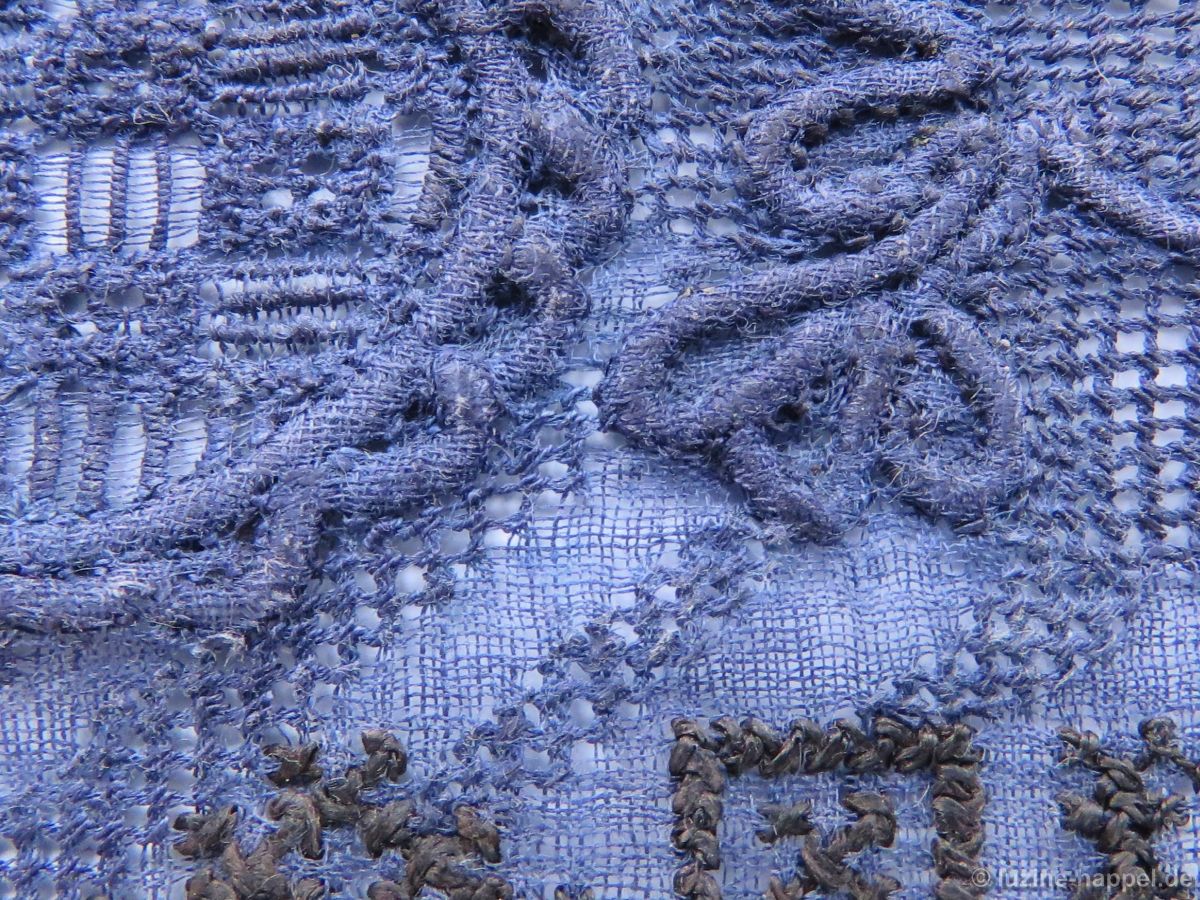
After the patterned border was completed, the owner’s initials, A N C R O I, were embroidered next to the border, separated by small cross-stitch ornaments. A bobbin lace trim was added as the edge.

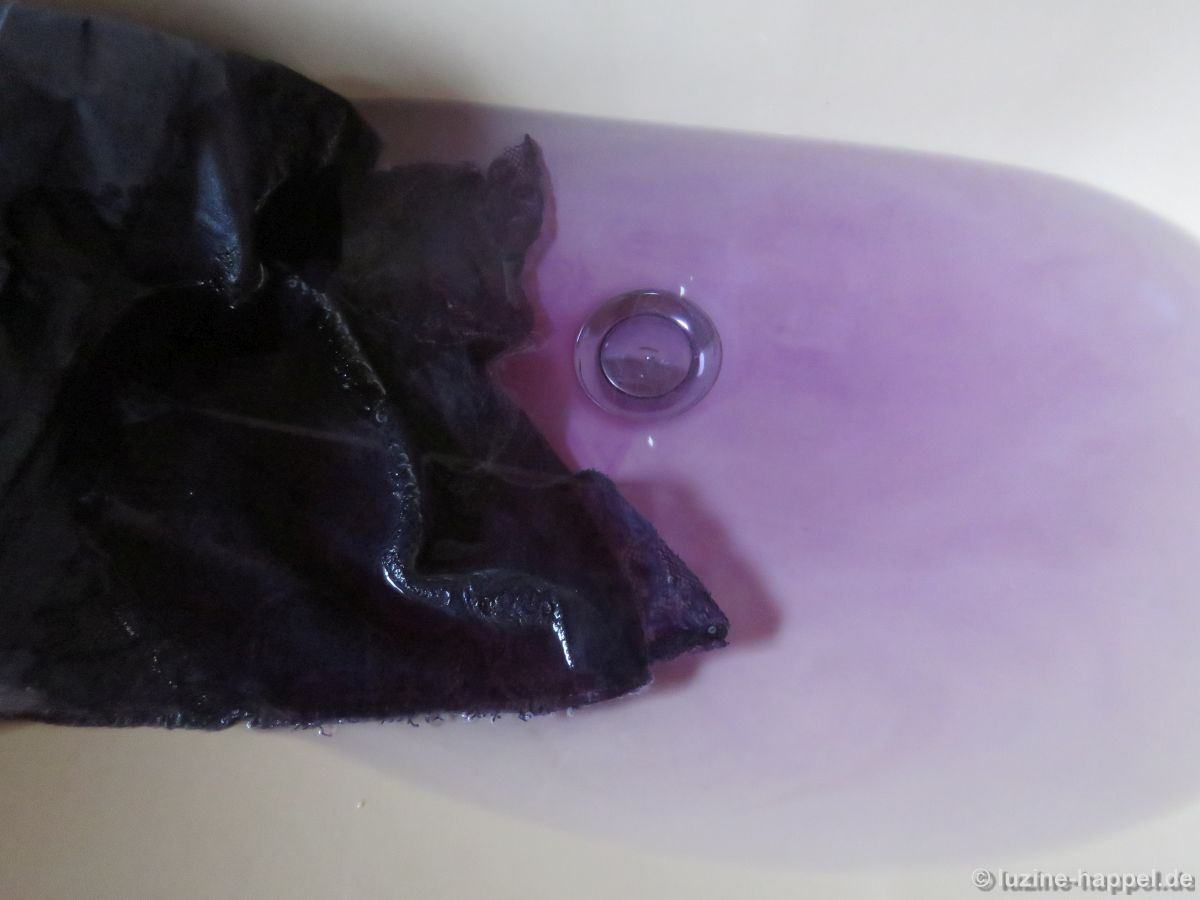
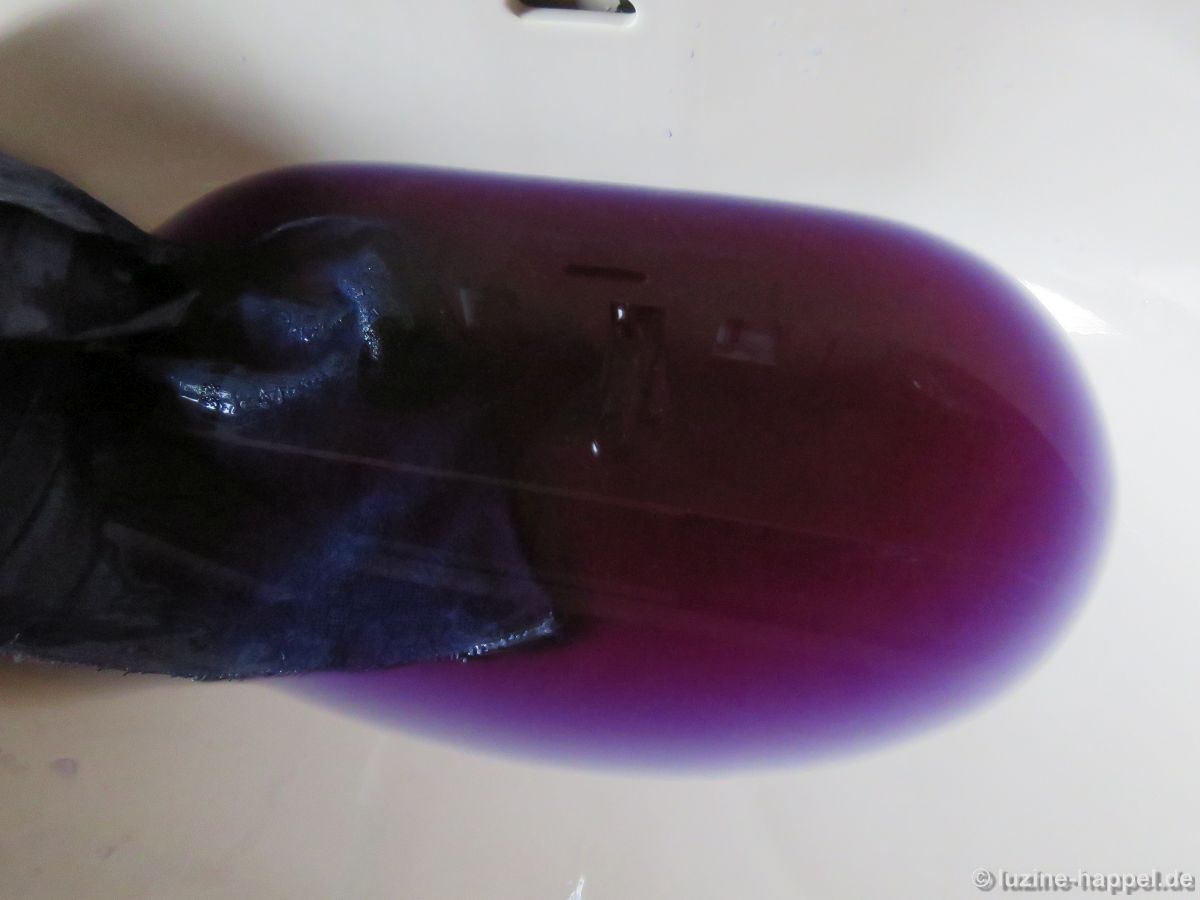
Only then was the white part dyed blue.

Originally, the blue parts of the traditional costume were dyed with woad from Thuringia. This gave them a bright, light blue color, as can be seen in paintings of the time. Later – from around the 1850s – indigo was used for dyeing, which, thanks to the opening of the sea route to India, was now readily available and cheaper than woad. Indigo was used to dye dark blue. To keep up with fashion, some costume pieces that had previously been light blue were now dyed again. This may also have happened to the piece presented here, as clearly lighter traces can be seen in some places on the reverse of the embroidery.

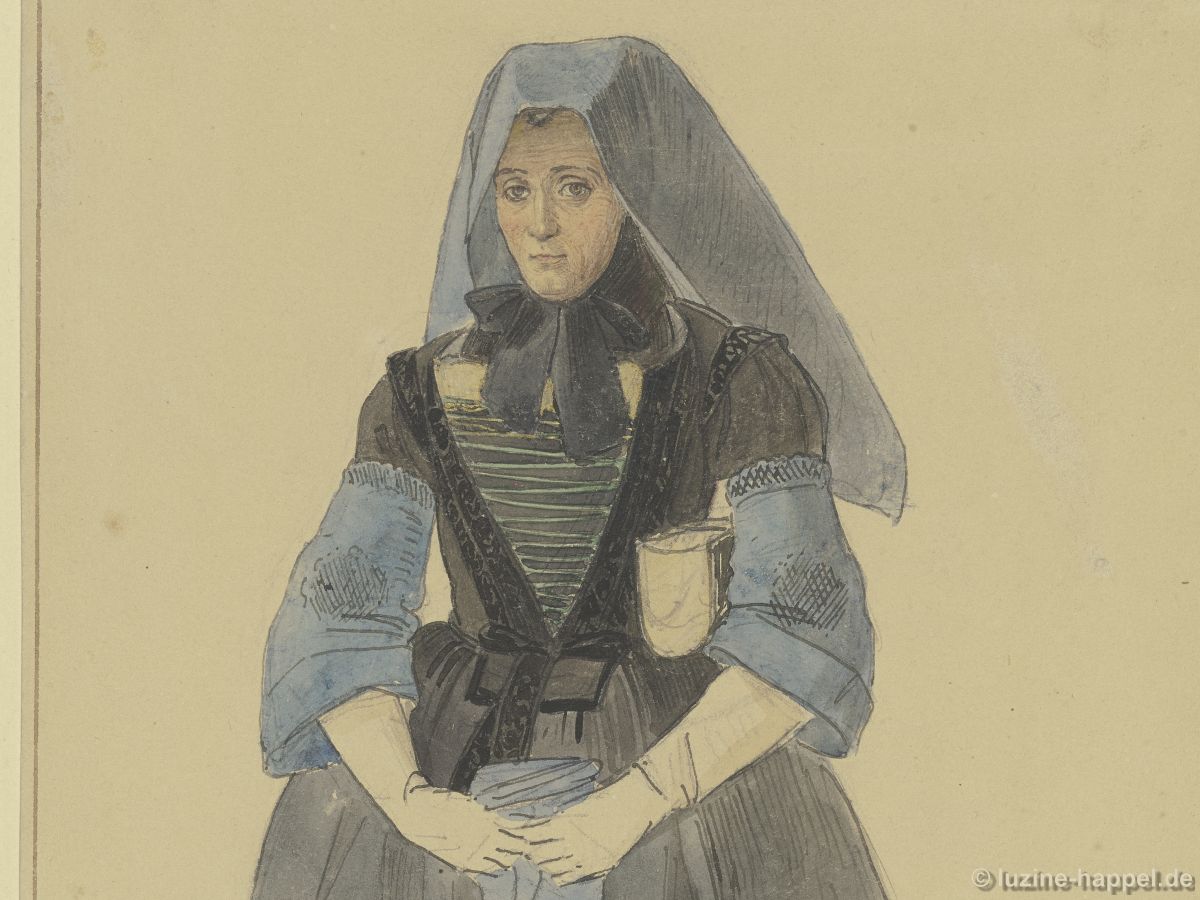
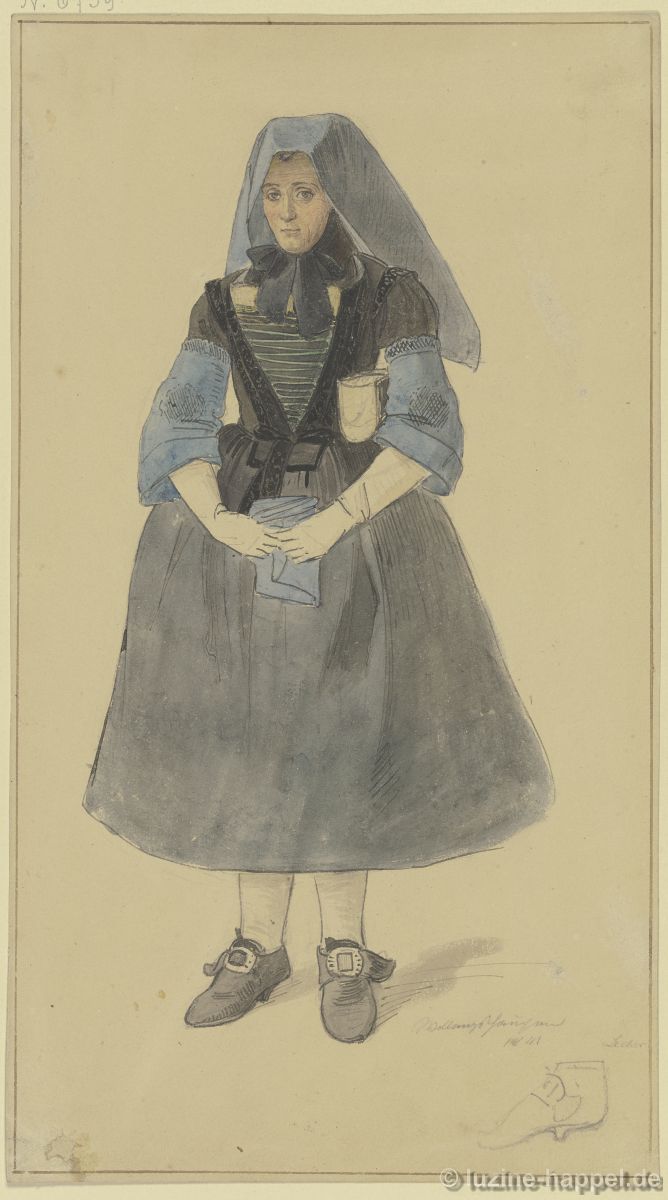
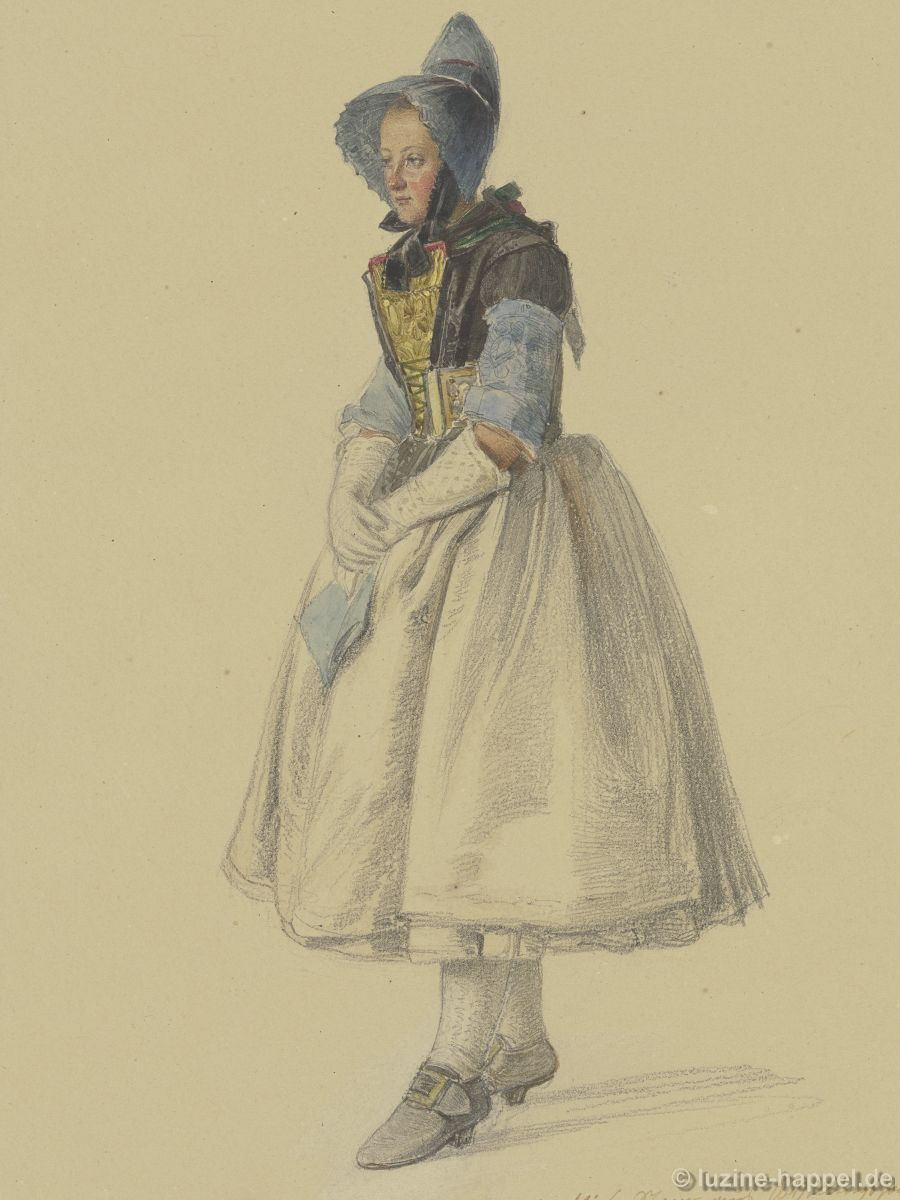
My collection includes several pairs of separate bodice sleeves made of the finest material. Watercolors by the painter Jakob Fürchtegott Dielmann (1809–1885) from 1841 show how such sleeves were worn.

Städel Museum, Frankfurt am Main

Back then, the traditional costume from the Schwalm region looked different than we know it today.

Jakob Furchtegott Dielmann – „Oberhesische Bauersfrau zur Kirche gehend“ – Städel Museum, Frankfurt am Main – auch als „Mädchen aus Wliingshausen“ bezeichnet

Jakob Furchtegott Dielmann – „Stehende Bäuerin im Sonntagsstaat“ – Städel Museum, Frankfurt am Main – auch als „Kirchgängerin aus Wliingshausen“ bezeichnet

The picture also shows the “pulled cap” and the “parade handkerchief”, which were elaborately embroidered, similar to the bodice sleeves.

Chance Encounter

I occasionally browse through my extensive collection. And I made a delightful discovery.

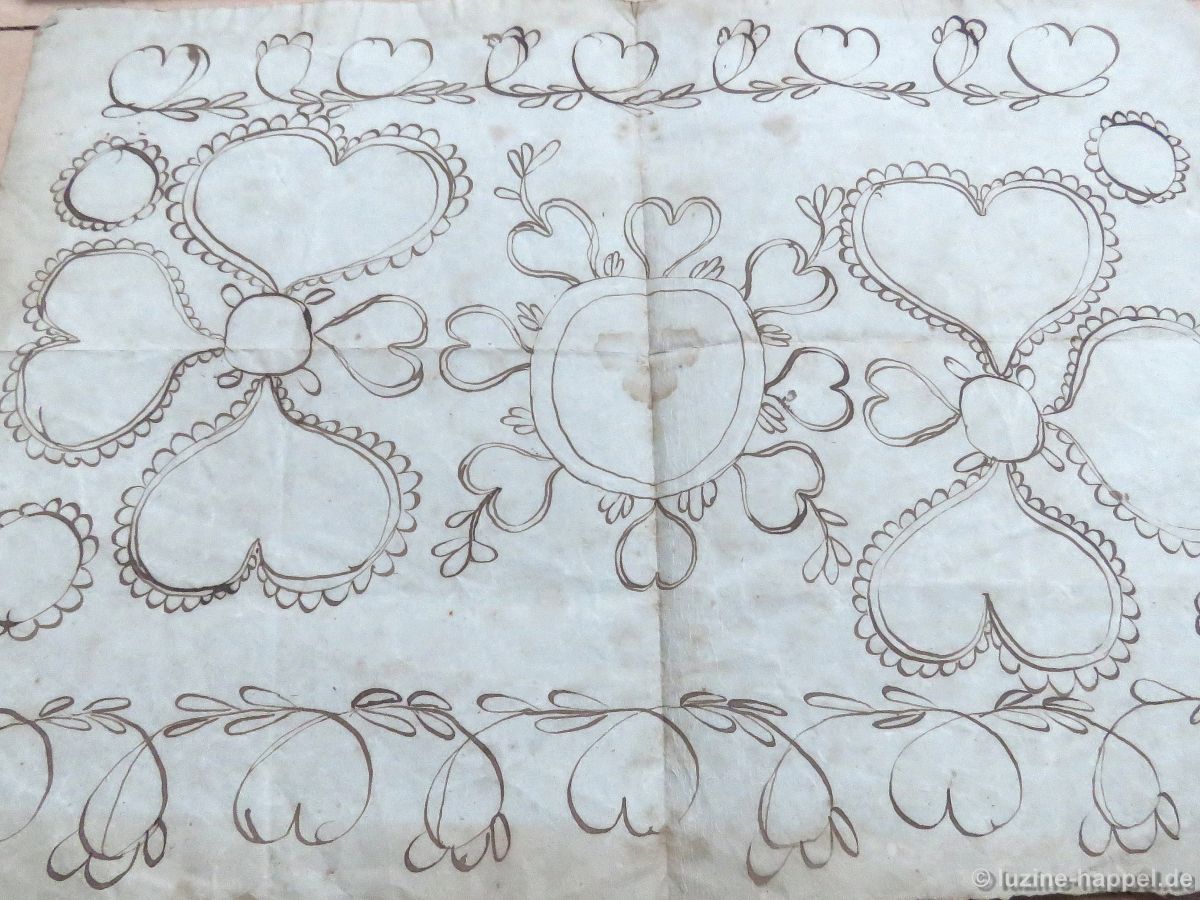
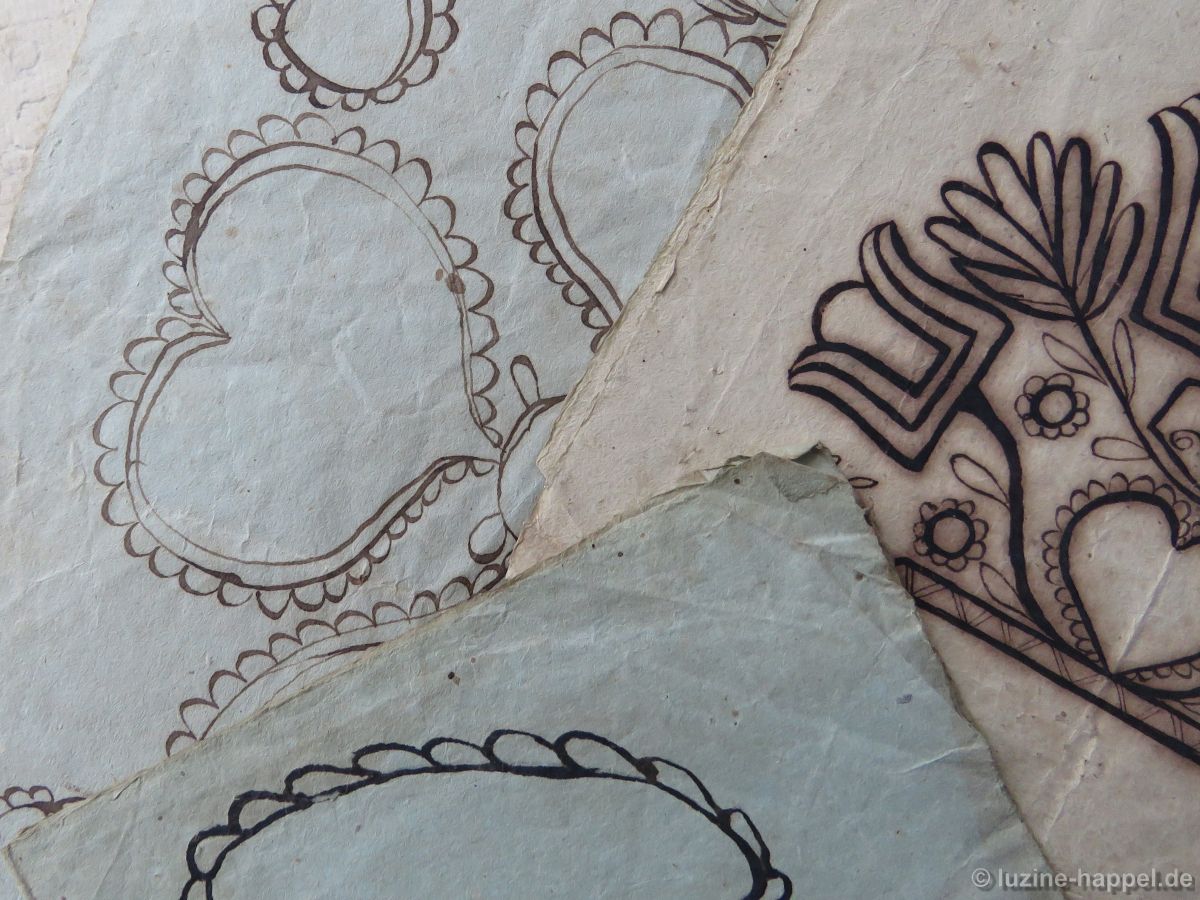
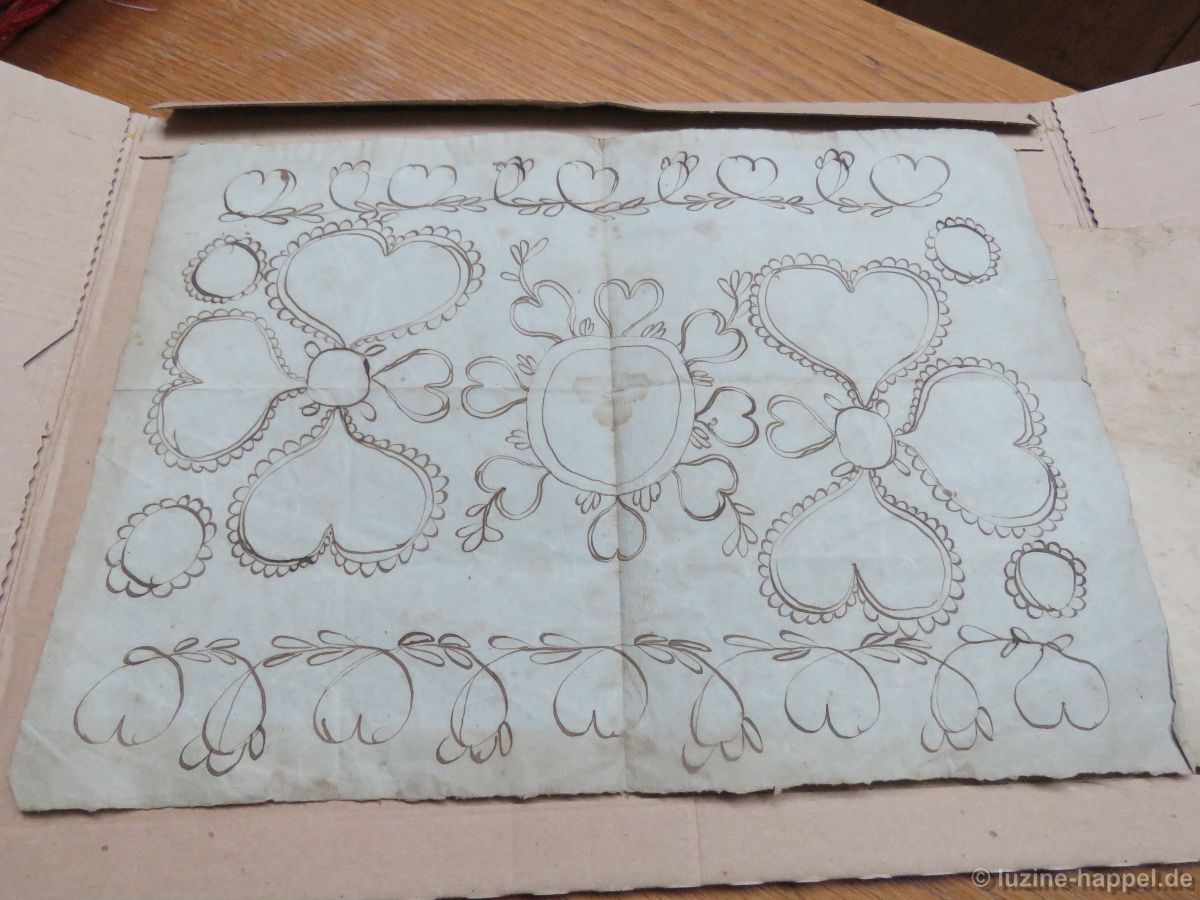
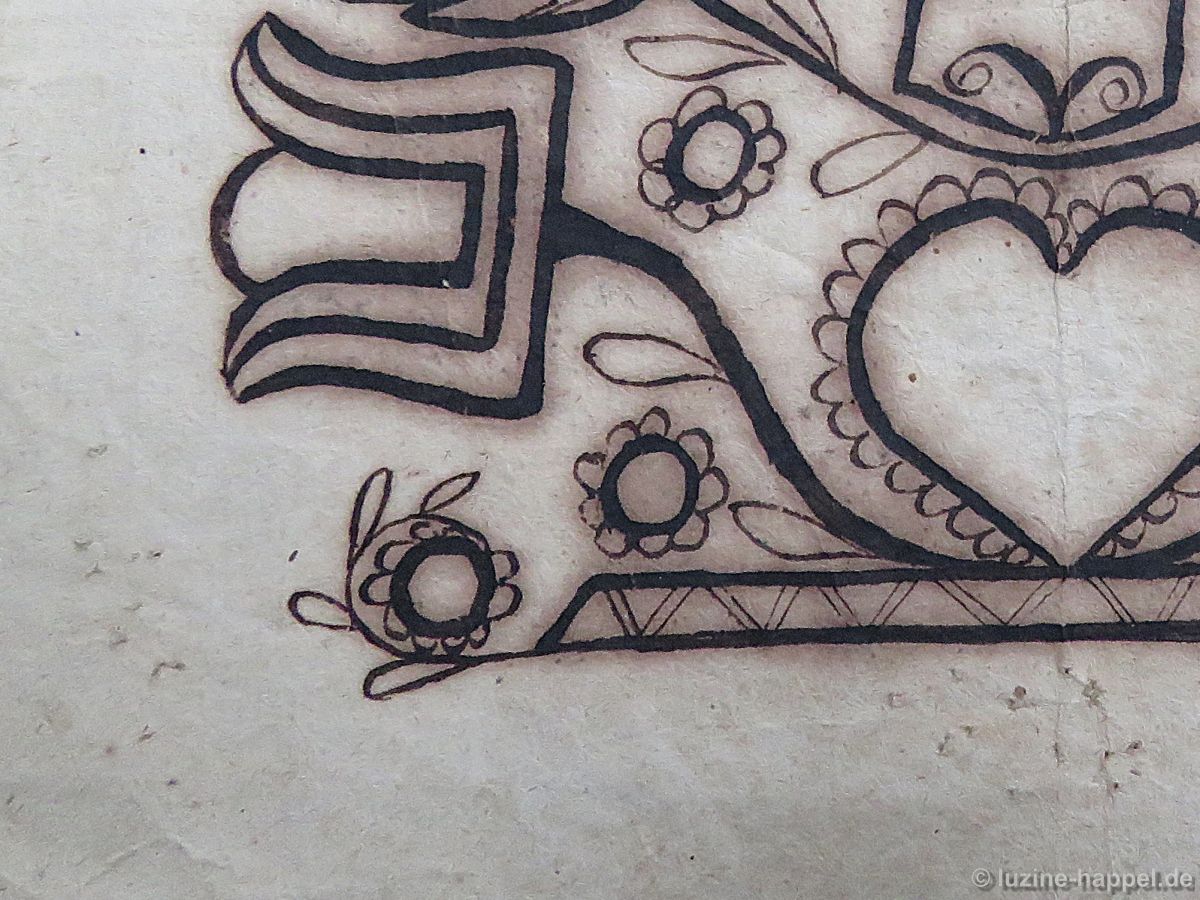
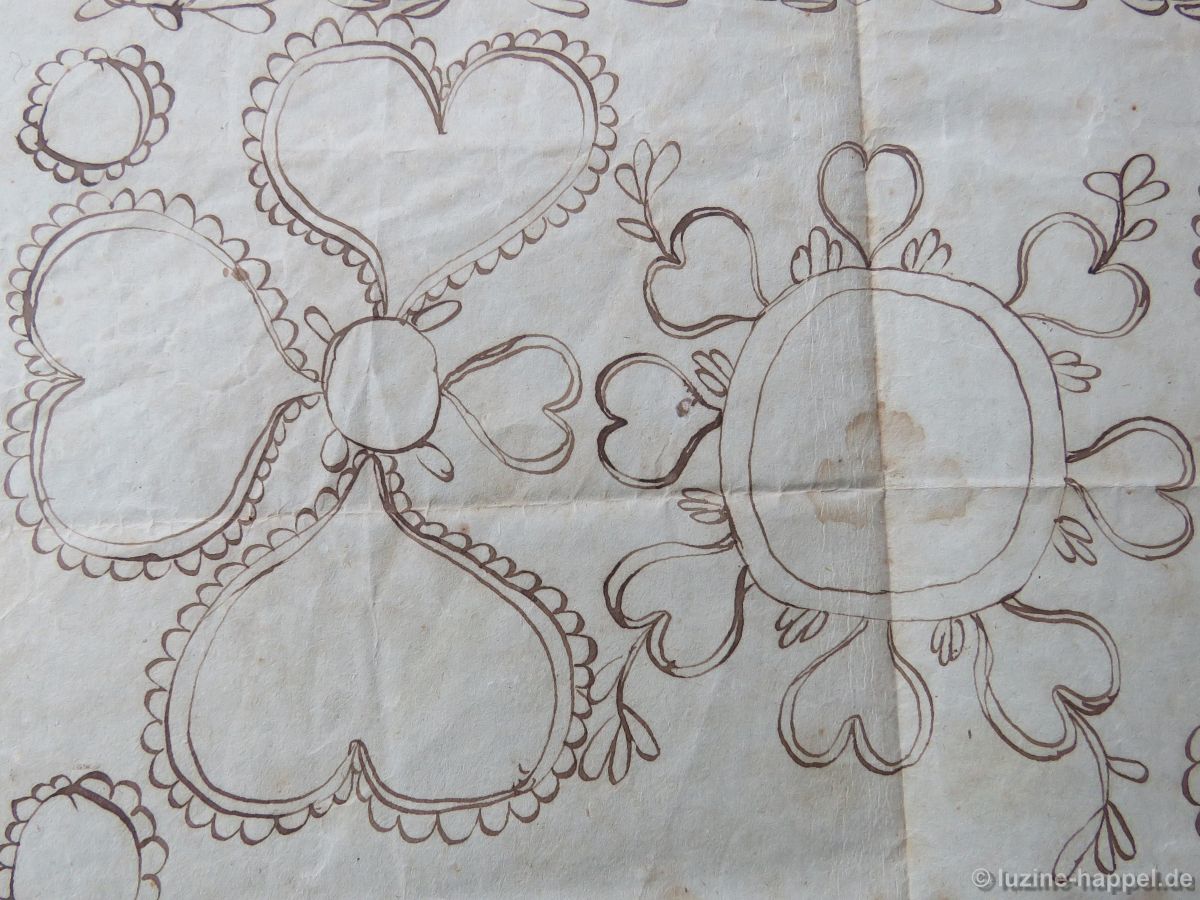
My collection includes very old outline patterns, all from the same source. Unfortunately, they are not dated, but based on similar dated patterns illustrated in Gandert/Miehe, p. 123, it can be concluded that they originated in the 1820s.

The design shown below are also among the samples.

(That it is only a sketch and not a final drawing can be seen from the undamaged paper. The final drawing samples contain many perforations because they were pinned to linen during the transfer process.)

The sketch has a central circle surrounded by eight hearts. Opposite these horizontally arranged hearts are hearts of the same size, spaced a short distance apart. These, in turn, are connected by a small circle around which three large hearts are grouped.

What could have been embroidered with such an outline pattern more than 200 years ago?

With the image of the pattern still in mind, I looked at parts of my bodice collection a short time later. I noticed the similarity in one piece – a Schwalm bodice sleeve in the style of Dresden lace.

Upon closer inspection, I was able to determine that the border of the bodice sleeve is embroidered exactly according to the central part of the pattern.

I also found a match in a second piece – a blue bodice. Although the resemblance isn’t immediately obvious, it’s there nonetheless. Not only is the central border replicated, but the edge borders also show similarities.

What stages might the pieces have gone through in the past 200 years to now meet again at my place?

Now I will open the seam of each sleeve to capture the entire embroidery in a photograph. You can see this and examine it more closely in the next blog posts.

See also:
Traditional Schwalm Bodice (D) Embroidery
Schwalm Bodices (3)
Schwalm Bodices (2)
Schwalm Bodices (1)
The Filling Patterns of theTraditional Schwalm Bodice A
Traditional Schwalm Bodice (B) Embroidery
Traditional Schwalm Bodice (C) Embroidery

Museum digital (2) – Tablecloth from 1927 from the Thielmann Workshop

Museum digital (2) – Tablecloth from 1927 from the Thielmann Workshop

The “Museum Digital” series presents outstanding examples of Schwalm whitework and documents them with numerous detailed photographs. Each photo is accompanied by a detailed description.
The pilot project – my Tulip Sampler – has met with great interest.

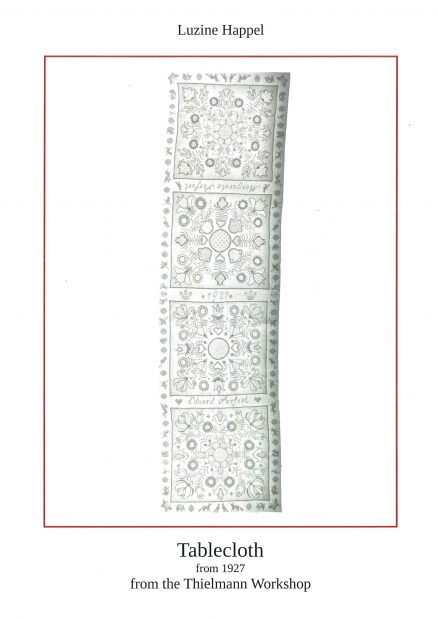
Now I have prepared another piece with first-class and remarkable embroidery: A beautiful and opulently embroidered tablecloth – dated 1927 – from the Thielmann workshop.

Much of my website is provided free of charge. I cover the costs of maintenance, updates, and upkeep.
Therefore, I ask for your understanding that such a time-consuming project as “Museum Digital” has a purchase price – albeit a small one.
In return, you will receive the “Tablecloth from 1927 from the Thielmann Workshop” with 140 high-resolution photos, which you can examine at your leisure and appreciate every detail. This is accompanied by a 12-page semantic description or, upon request, a 36-page description with inserted images.

By placing an order, you agree not to share or publish the photos and information in any way.

Museum digital (2)
Tablecloth
from 1927
from the Thielmann Workshop
140 photos
12 pages text
or
36 pages text with inserted images
text: English
60,4 MB file size
5,00 €
zum Shop

Museum digital (1) – Tulip Sampler

A Special Joining for Length of Linen

I recently held a special piece in my hands. Dated 1843, it appears to be a wedding bedsheet, as indicated by the letter combinations on the left side of the crown—C C H L—and on the right side—A C H L. C and A are the initials of the first names, and C H L is an abbreviation of the surname.

Although I have the cloth from Schwalm, the font and crown are not typical of Schwalm. A few special embroideries prompt me to present the details here.

The visible part of the sheet, which hung over the front edge of the bed and was decorated with a crown, initials, and the year, was made from the finest 21-cm-thread-count linen.
The lower edge is decorated with a two-centimeter-wide needle-weaving hem with a block pattern.

On the side panels you will find a one and a half centimeter wide cube needle-weaving hem.

Since the panels of handwoven linen were usually less than a meter wide, several panels had to be placed side by side.

For the part not visible to the viewer, a much coarser, 15/16-cm-thread-count linen was chosen.

A special feature that I hadn’t seen before were the connecting stitches in the style of a needle-weaving hem.

The distance between the two fabric panels is approximately 8 mm. Three threads were laid close together from one fabric panel to the opposite one, then weaved halfway. Then—and this is the special feature—the thread was moved to the nearest completed needle-weaving bridge and there wrapped around the center of the first laid thread. On the way back to the started needle-weaving bridge, the working thread was wrapped. Then the needle-weaving bridge was finished. It has a width of approximately 3 mm. The next bridge was started at a distance of approximately 4 mm.

Also unusual are the horizontal connections between the multi-unit needle-weaving bridges of the hem with block pattern on the lower edge.

See also:
Combining Lengths of Linen to Make Larger Pieces (1)
Combining Lengths of Linen to Make Larger Pieces (2)
Plaited Insertion stitch (Interlaced Insertion stitch) – how to work

Schwalm Tulip Motifs through the Ages (1)

The tulip is one of the main elements in Schwalm whitework designs. Tulip shapes can be modified indefinitely. They have also undergone changes in Schwalm over the centuries.
This blog post aims to trace this in broad outline.

While the tulip figures in early Schwalm whitework were were multi-

Detail from a parade cushion border – 18th century

and often small-part,

Detail from a door hanging border – 18th century

the filling patterns that were now in fashion required more space.

Detail from a bed covering, dated 1793 – Museum of the Schwalm in Ziegenhain

With the rise of Schwalm whitework toward the end of the 18th century, tulips were usually depicted in a single piece and in medium sizes. Smaller tulips were also available to fill the spaces. The bases of the tulips were usually only slightly rounded, often straight. The upper edges were slightly curved, rarely showing deeper incisions. The shapes varied – from long and narrow to wide-opening at the top to short and wide.

Detail from a bed covering, dated 1793 – Museum of the Schwalm in Ziegenhain

There have also been occasional split tulip shapes.

Detail from a bed covering, dated 1793 – Museum of the Schwalm in Ziegenhain

Initially they had a drop shape in the calyx,

Detail from a bed covering, dated 1823

but soon heart and

Detail from a parade cushion border, dated 1821

tulip outlines were added as calyx designs.

Detail from a parade cushion border, dated 1821

While the tulips were initially mostly medium-sized, very large motifs were added in the following decades.

Detail from a parade cushion border, dated 1804

Detail from a parade cushion border, dated 1842

Often their proportions were not adapted to the other motifs.

Detail from a parade cushion border – 19th century

Detail from a parade cushion border – 19th century

All of these representations remained constant throughout the 19th century.
It wasn’t until the 1920s that they changed significantly. Examples can be seen in the next blog post.