

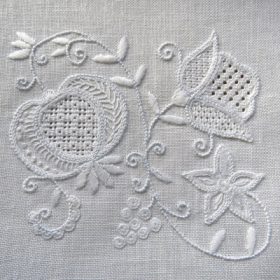
Calculation of the estimated thread rate of consumption for a pattern with a frequent repeat.
Sometimes it makes sense to determine the likely thread consumption before starting an embroidery project. There are various reasons for this: leftover threads you want to use up, colored threads that are no longer available for purchase, or—as in this example—very high shipping costs just to get hold of one or two additional skeins.
Embroiderers work in different ways. Some pull the thread tight, while others work a bit more loosely. Some place their stitches very close together, others leave a bit more space. Some secure even the tiniest remaining thread end, while others are more generous with their thread usage. Sometimes the thread gets so tangled that it is impossible to continue stitching.
There are, therefore, many variables involved. Consequently, it is impossible to say exactly—down to the last centimeter—how much thread will be required. However, it is at least possible to make a rough estimate.
I recently offered a cut piece of linen for a tablecloth with a pre-printed design. The buyer wanted to know how much thread she would need.
The printed pattern in this example consists of short repeats that occur a total of 34 times. Therefore, one only needs to stitch a single such section to make a rough estimate of the total thread consumption.
One pattern repeat was ironed onto a matching piece of linen,. (If you finish stitching the project yourself, you can of course stitch the original right away.) The thread was cut into 100 cm lengths (or 50 cm for the Coral Knot stitches)—a comfortable length for working. The number of threads for each thread weight was determined and recorded both before and after the embroidery was completed.
A few areas were designed so that, if enough threads remains, they can be embroidered with additional embellishments
The small sample piece is finished.
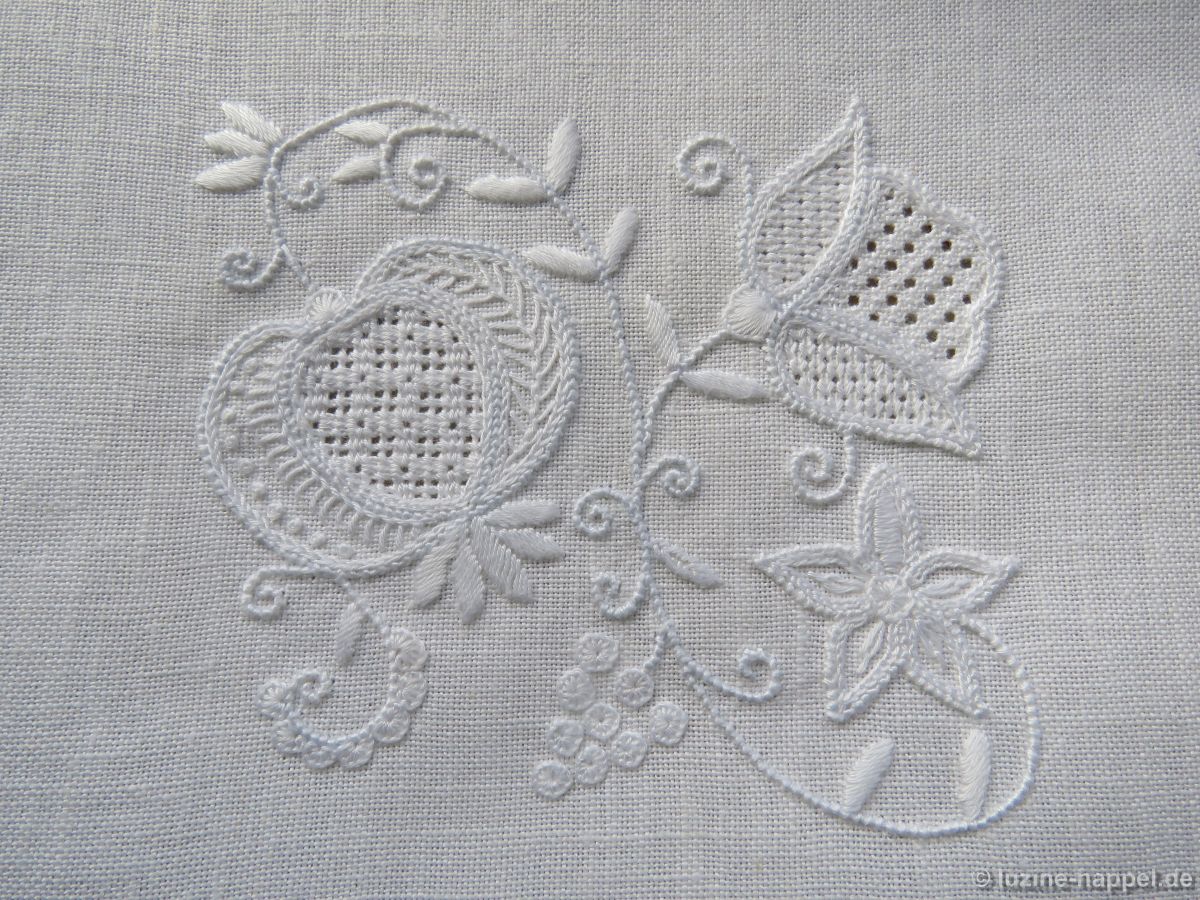
One could initially leave the star-shaped flower unfilled and later embroider it using Satin stitches or Lazy Daisy stitches.
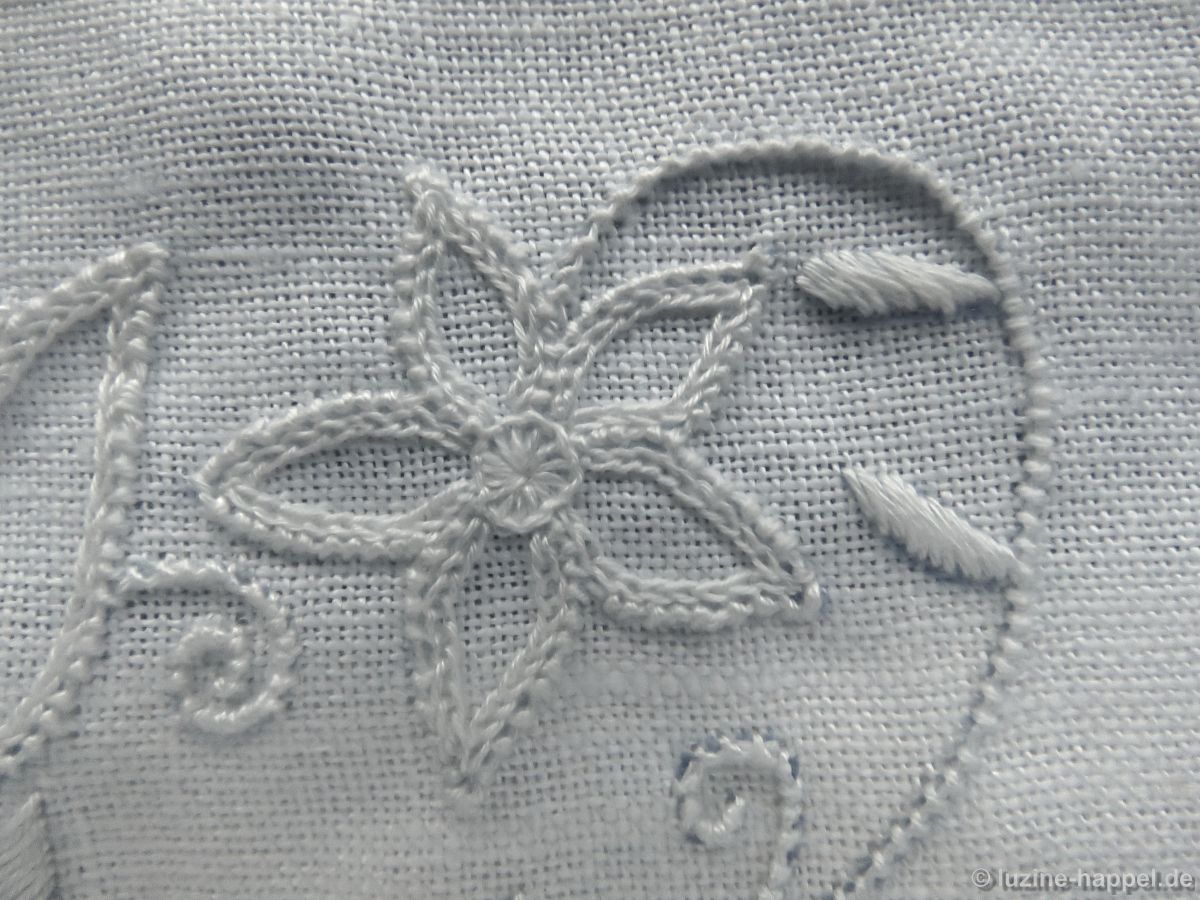
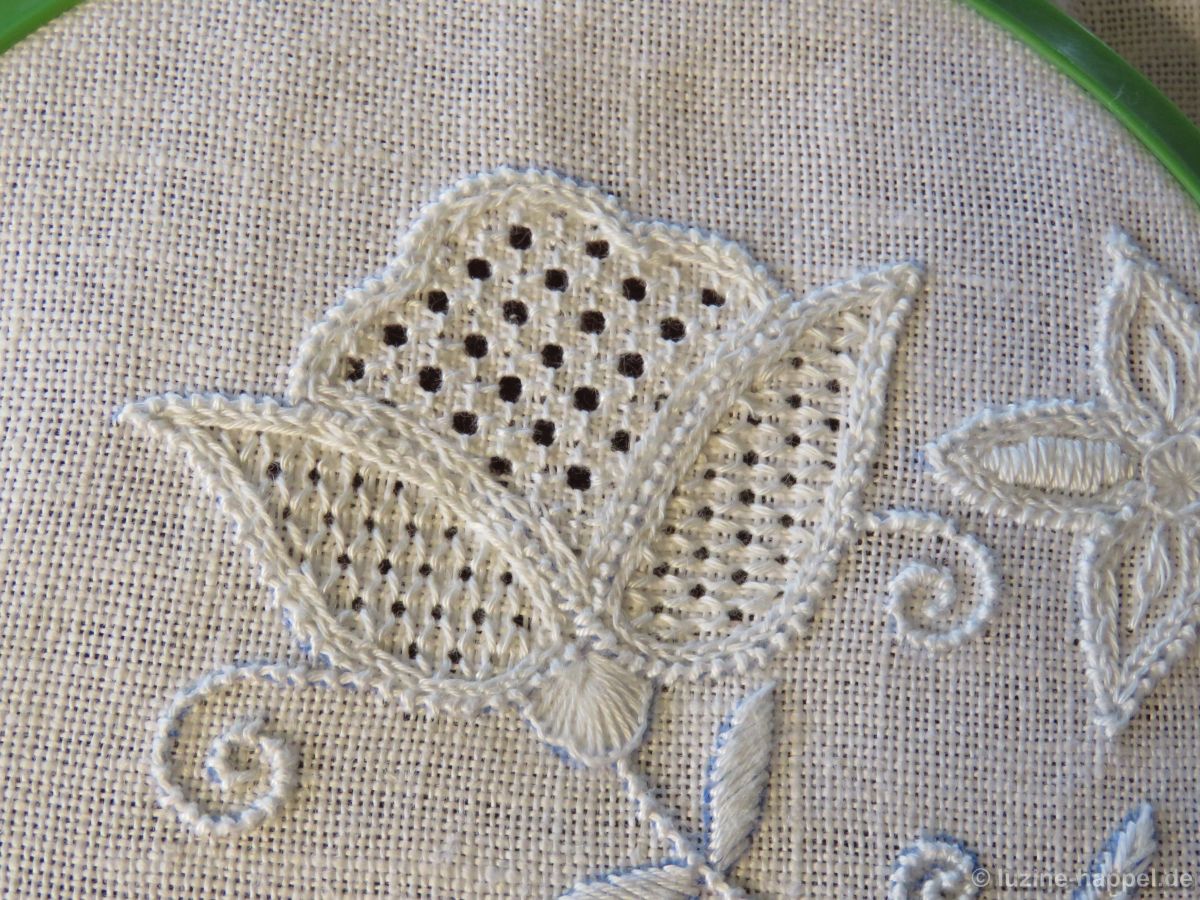
The center of the tulip was worked in a Limet pattern using Rose stitches. This could be modified using variations of the Rose stitch or by creating an openwork pattern with for example French stitch; the thread consumption would be similar.
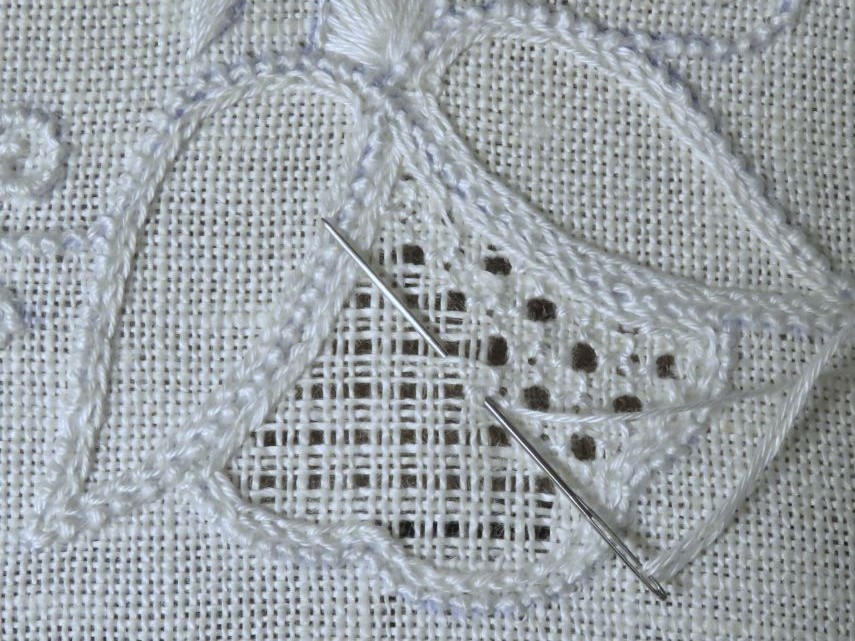
The side petals of the tulip were given a simple 3:1 thread withdrawing
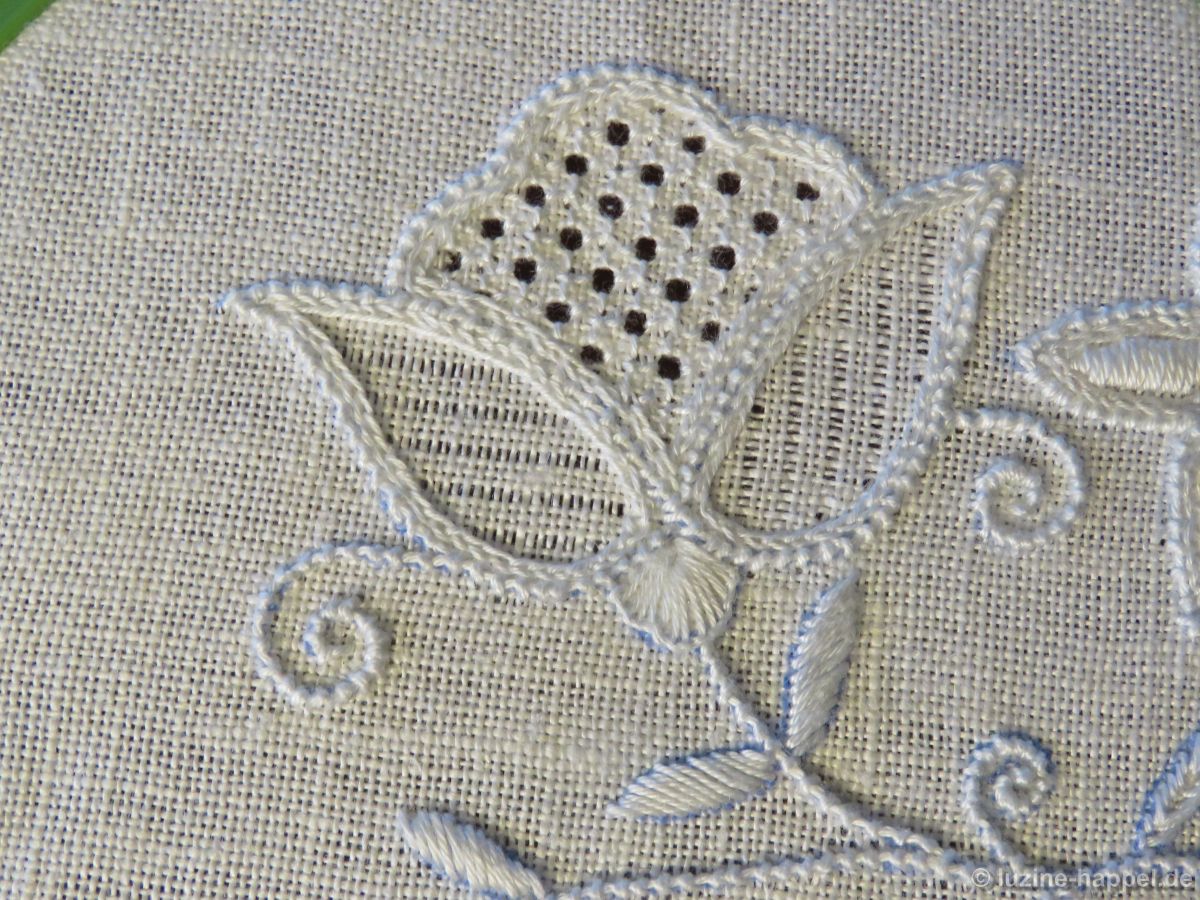
and Wave stitches as filling pattern.
The pomegranate was given a 2:1 thread withdrawing to establish an openwork pattern.
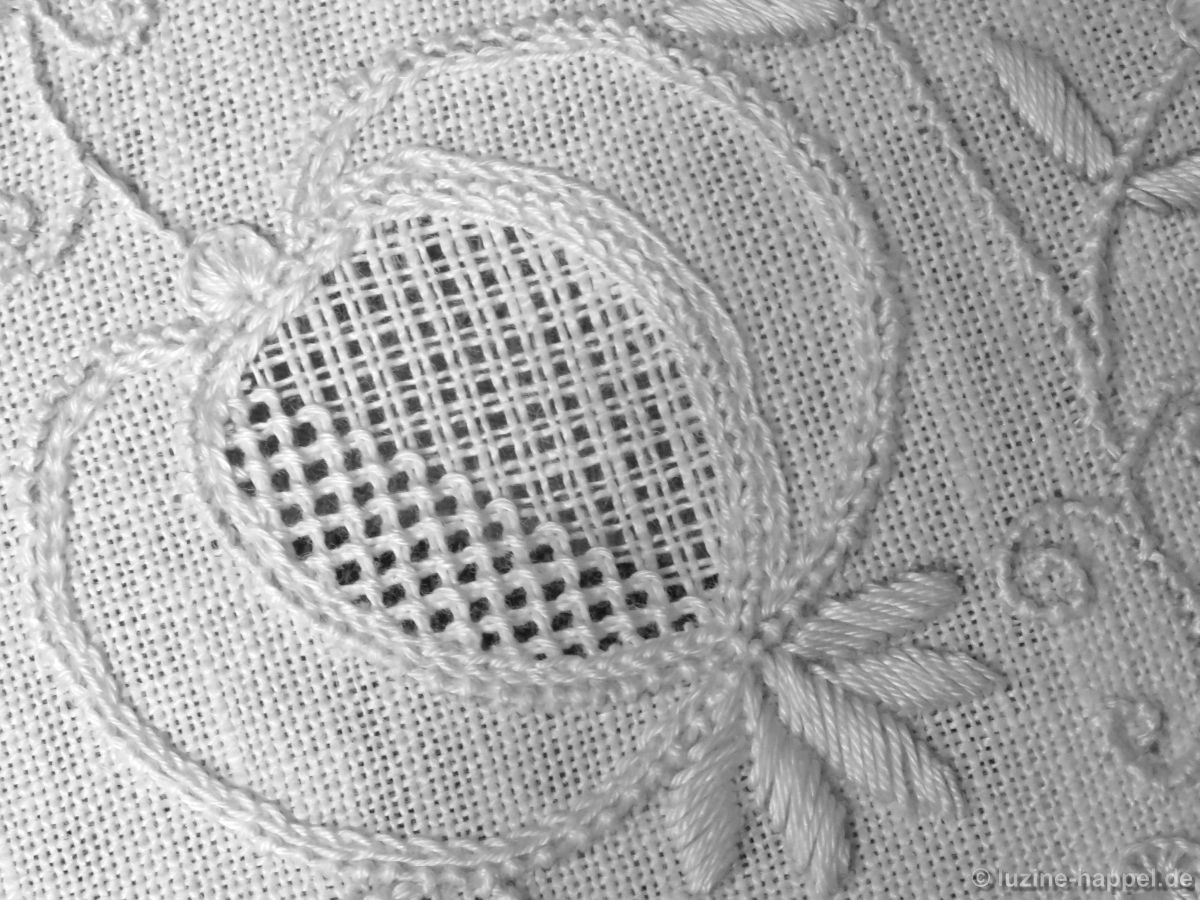
The area can only be stabilized using Cable stitches and be left as is.
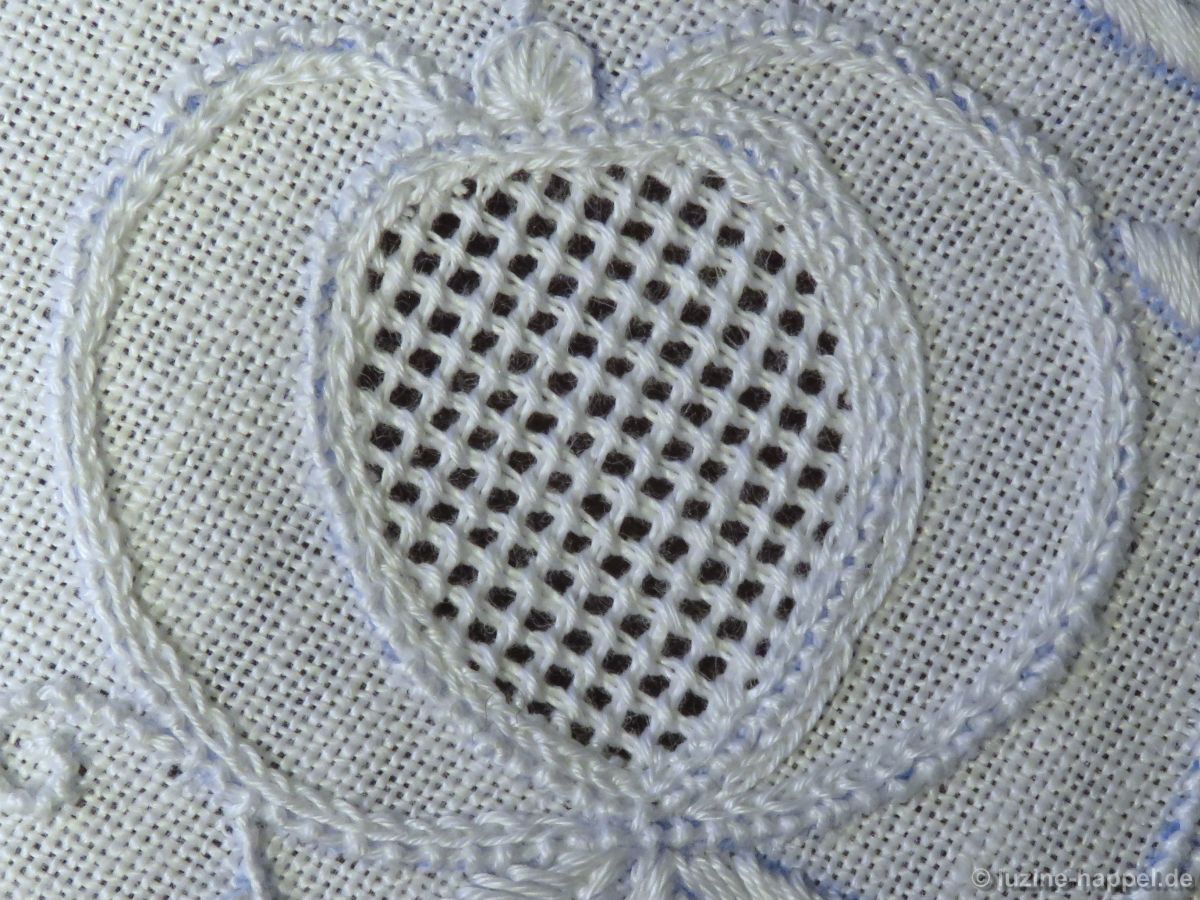
However, the reduced-size version of the grid also allows for stitching various small patterns.
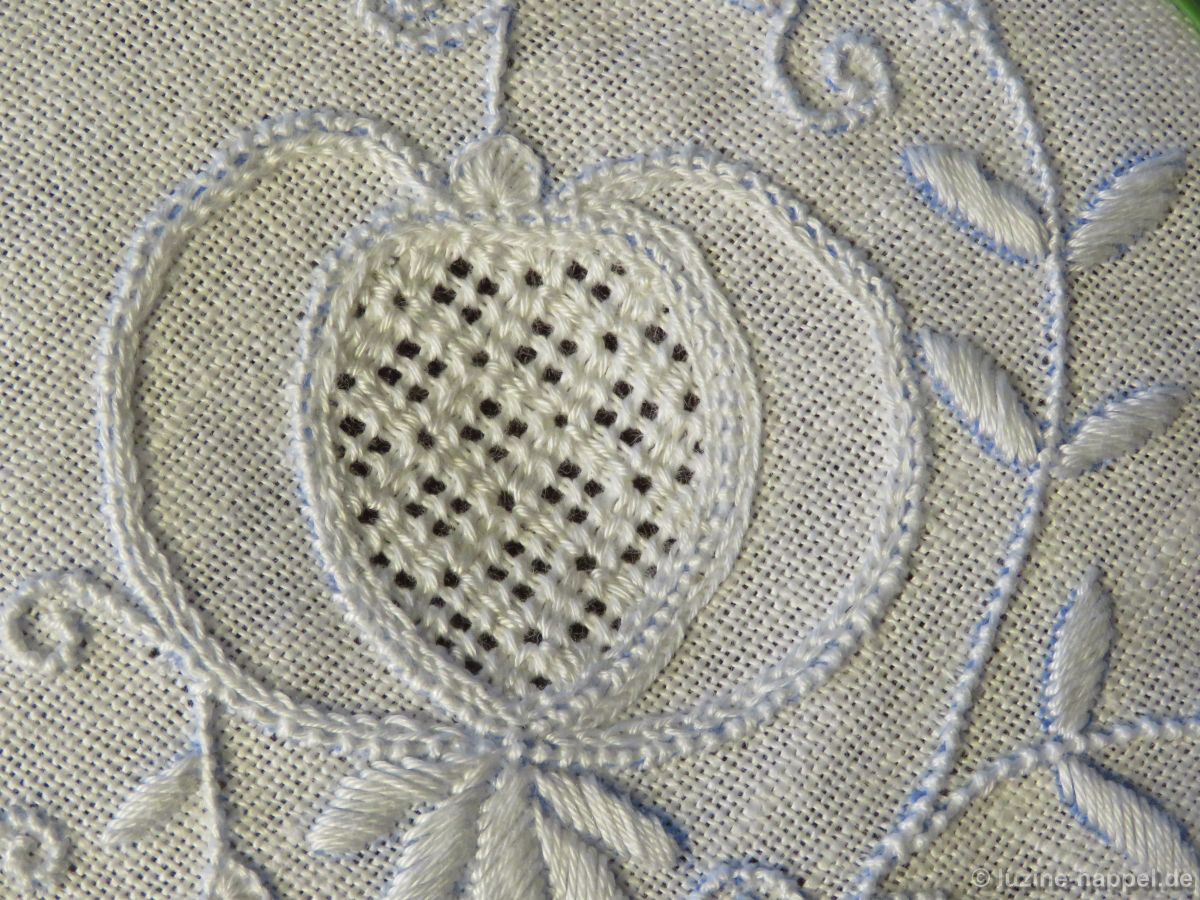
The sides of the pomegranate were designed differently – the thread consumption is similar.
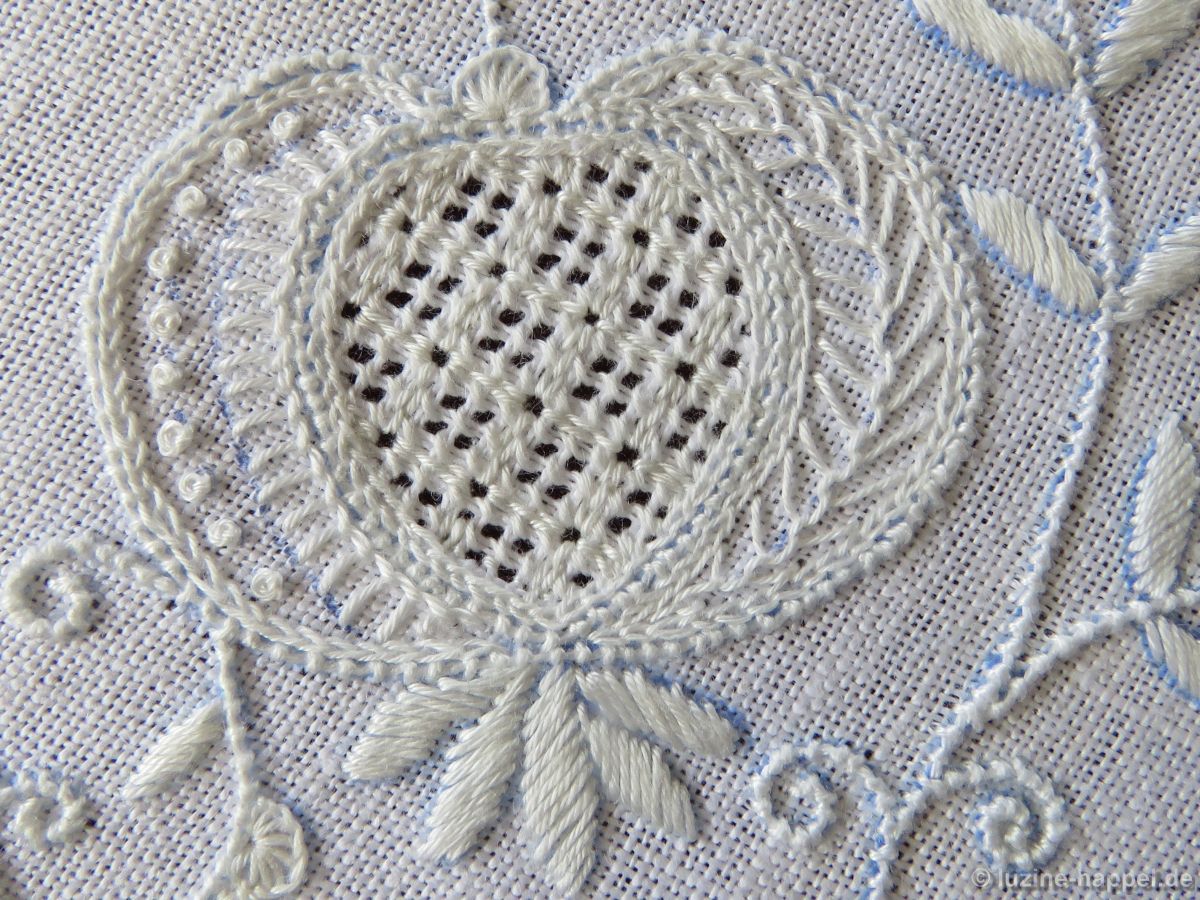
Instead of the five small satin-stitch leaves, perhaps Lazy Daisy stitches should have been worked at the tip of the pomegranate—that might have looked nicer. However, that would have required just as much thread as the Satin stitches.
In total, the following were required:
|
Stitches |
Thread weight No. |
Rate of thread consumption in meters |
|||
|
Total |
x 34 |
: 30 |
|||
| Coral Knot stitches |
16 |
7,00 |
|||
| Eyelash stitches |
16 |
0,20 |
|||
| Franch Knots with 2 wraps |
16 |
0,25 |
|||
|
7,45 |
253,30 |
8,44 |
|||
| leaves |
20 |
3,50 |
|||
| Needle-Weaving stitches |
20 |
0,70 |
|||
| Feather stitches |
20 |
0,35 |
|||
| Satin stitches star blossom |
20 |
1,00 |
|||
| Lazy Daisy stitches star blossom |
20 |
0,20 |
|||
| Wave stitches |
20 |
0,70 |
|||
|
6,45 |
219,30 |
7,31 |
|||
| Balnket stitch eyelets and half eyelets |
25 |
2,00 |
|||
| Rose stitches |
25 |
0,75 |
|||
|
2,75 |
93,50 |
3,12 |
|||
| Chain stitches |
30 |
4,00 |
|||
| Cable stitches |
30 |
1,10 |
|||
| 5,10 | 173,40 | 5,78 | |||
Since the pattern repeat appears 34 times on the table cloth, the consumption per unit had to be multiplied by 34.
Since a skein of MEZ Anchor coton à broder thread contains 30 meters, it was necessary to divide by 30 and round up.
This determined the amount of thread needed for the large tablecloth:
9 skeins No. 16
8 skeins No. 20
4 skeins No. 25
6 skeins No, 30
27 skeins in total

Leave a Reply
You must be logged in to post a comment.