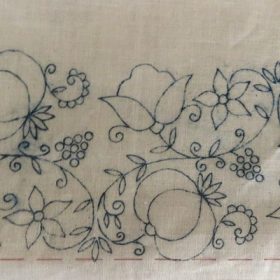
Double Outlines (9) – Coral Knot Stitches

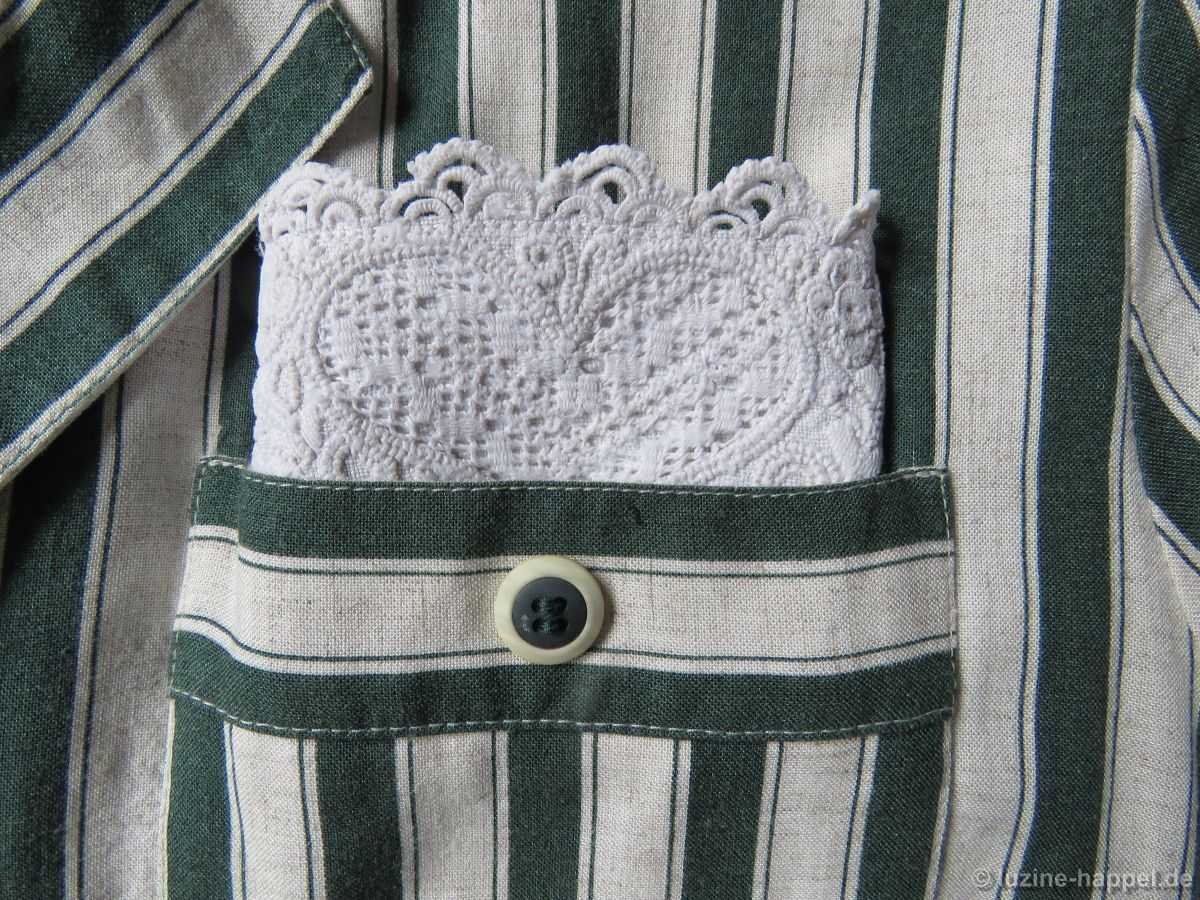
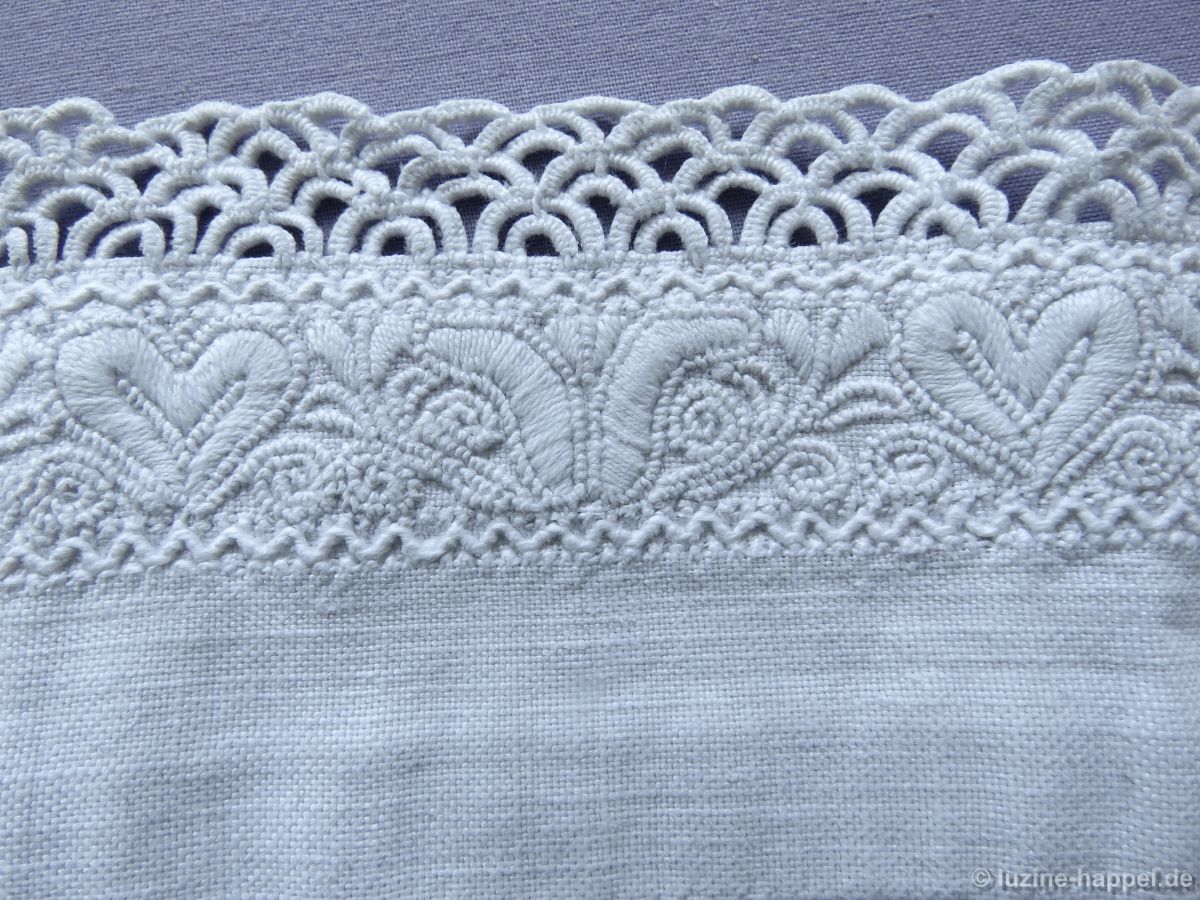
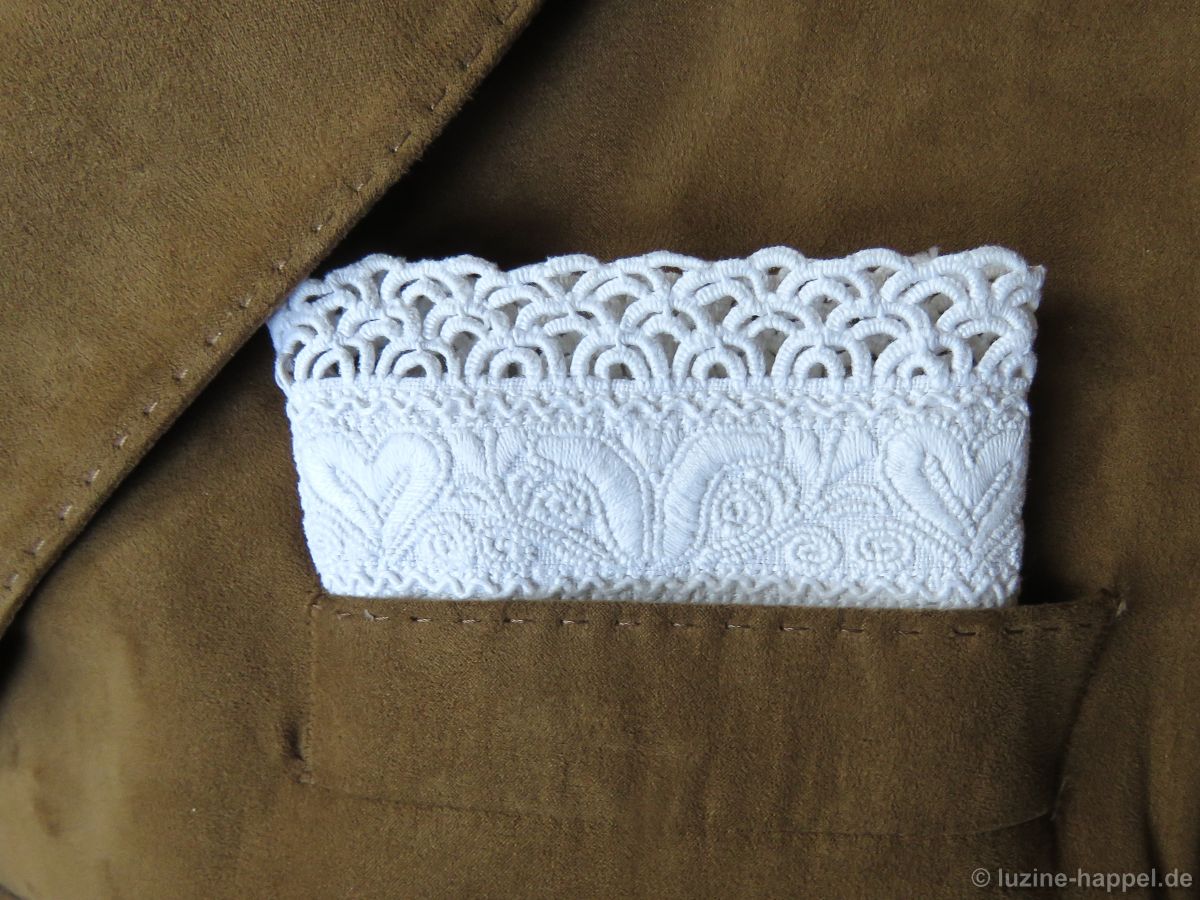
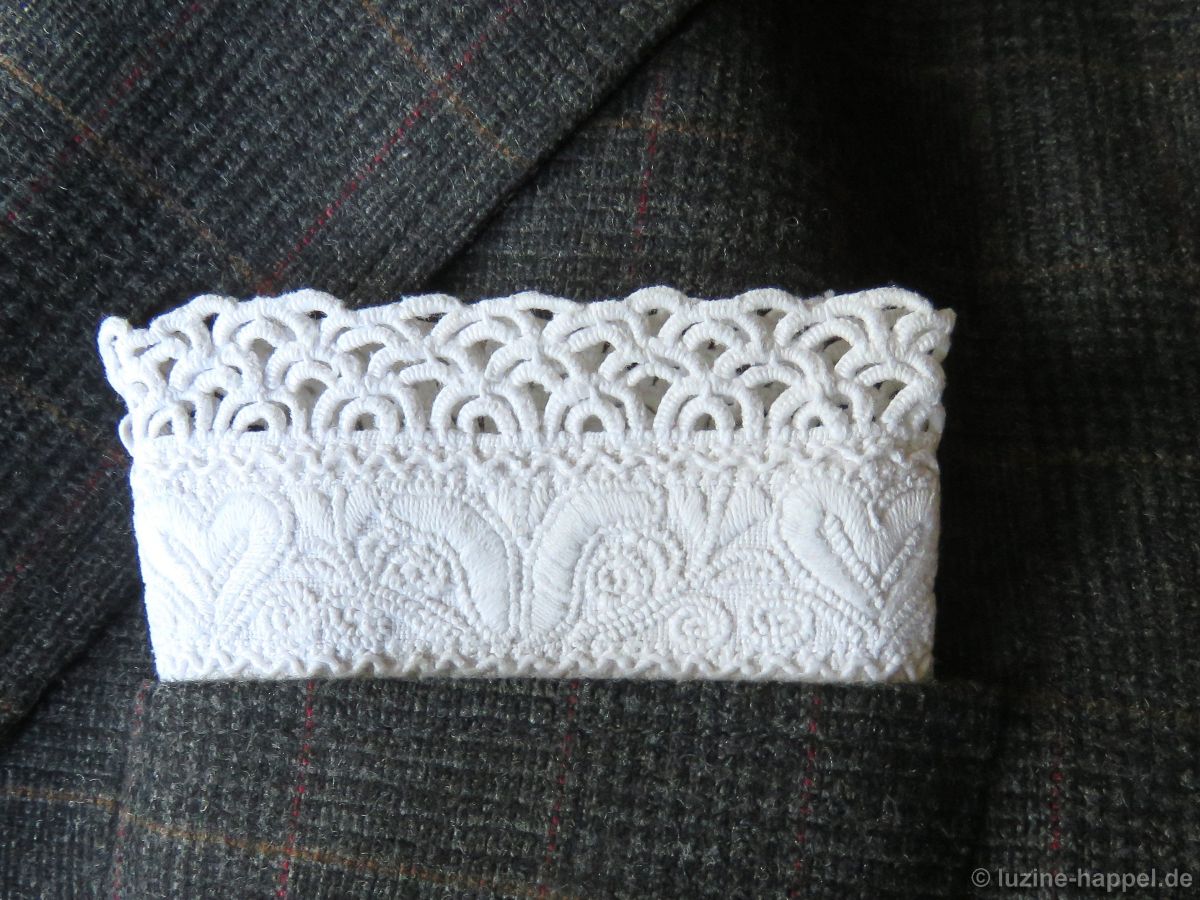
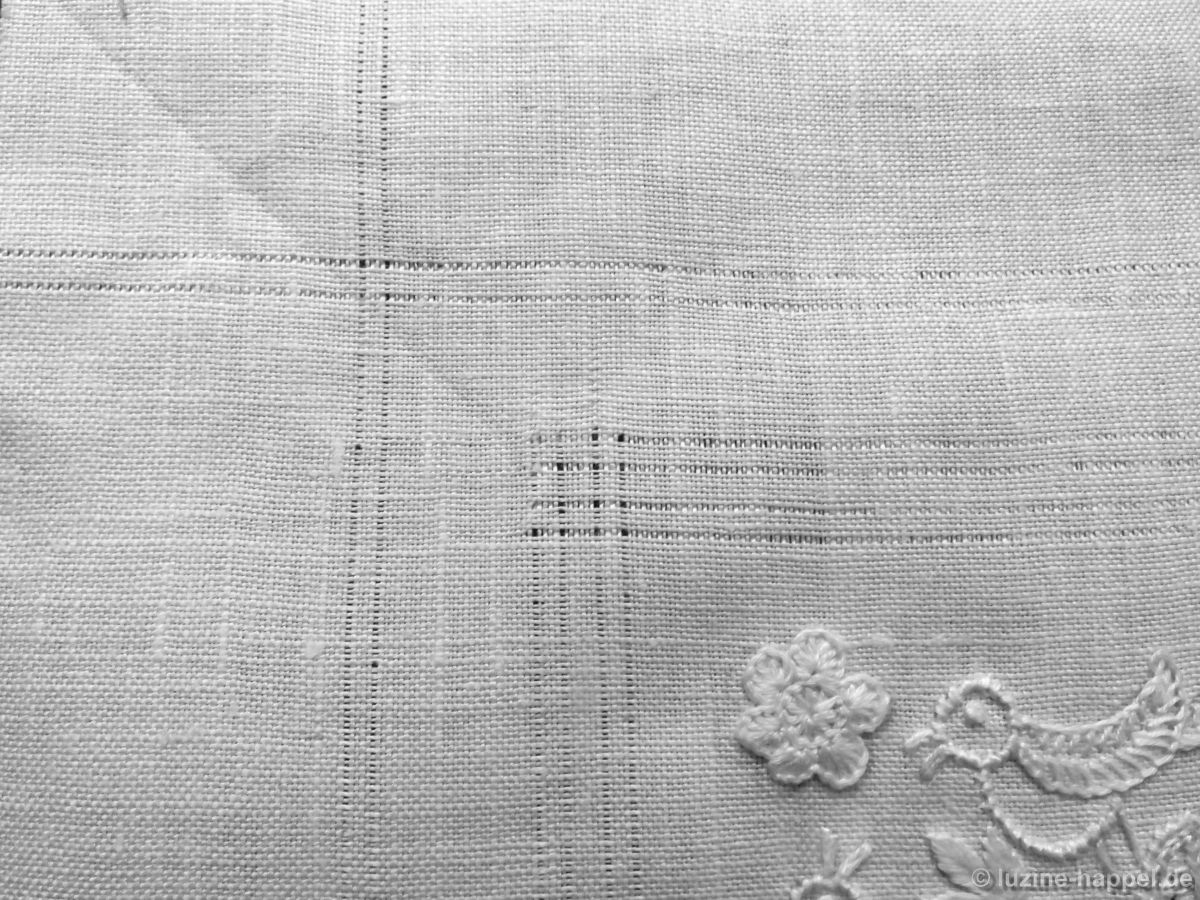
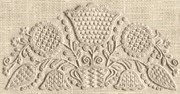
Another way to emphasize motif edges with double outlines is to embroider adjacent rows of coral knot stitches.

This variant can be found in many traditional models from the end of the 18th century onwards.

Many motifs were designed using this alternative on a densely embroidered bodice sleeve border.

The detailed photos show,

that a row of chain stitches with thick thread was often worked within the coral knot stitches.

These not only ensure a clean finish to the filling patterns, but also accentuate the edge.

However, there are also examples where the coral knot stitch double row forms the only border decoration.

Sometimes only part of the motif’s border is decorated in this way. The remaining edges are given a different design, as seen here with blanket stitches and – partially visible to the right – Interlaced Straight Stitches

See also:
Double Outlines (1) – Remaining Free Areas
Double Outlines (2) – Interlaced Straight Stitches
Double Outlines (3) – Interlaced Herringbone Stitches
Double Outlines (4) – French Knots
Double Outlines (5) – Bullion Knots Knots
Double Outlines (6) – Blanket Stitches
Double Outlines (7) – Honeycomb Darning Stitches
Double Outlines (8) – Chain Stitch Variations

Double Outlines (8) – Chain Stitch Variations

For large designs, the border is often finished with double lines spaced more or less widely.

Chain stitches are very well suited for filling the narrow space between two such lines. They are easy to stitch, very flexible, and offer a wide range of variations. Many variations can be achieved by using different thread weights and choosing the stitch length. Pay particular attention to these two characteristics in the following images.

In a parade cushion border from 1814, there are simply two adjacent rows of chain stitches around the edge of the motif.

Chain stitches, each stitched tightly within the coral knot stitches and with unworked space in between,

create a simple border decoration.

A single row of chain stitches in the middle between the coral knot stitches

fills the empty space.

Wide chain stitches, where the inserting and emerging points are not at the same point but slightly apart,

result in a different appearance.

A similar effect can be achieved with crossed chain stitcesh.

The emerging point of one chain link coincides with the inserting point of the following loop.

The working threads are alternately laid into loops to the left and to the right.

The crossed is more ample than the wide chain stitch.

It can also be used effectively to work with wide stems. One can vary the thread thickness, stitch width, and stitch length particularly well.

See also:
Double Outlines (1) – Remaining Free Areas
Double Outlines (2) – Interlaced Straight Stitches
Double Outlines (3) – Interlaced Herringbone Stitches
Double Outlines (4) – French Knots
Double Outlines (5) – Bullion Knots Knots
Double Outlines (6) – Blanket Stitches
Double Outlines (7) – Honeycomb Darning Stitches

Double Outlines (7) – Honeycomb Darning Stitches

Many designs with large motifs decorate their edges with double lines spaced more or less widely. One such design features a smaller heart placed inside a larger one. Its filling pattern also consists of Honeycomb Darning stitches.

It is therefore a good idea to also work Honeycomb Darning stitches between the outlines of the large heart. The distance between the lines is large enough to accommodate two rows of embroidery stitches.

It is advisable to start at one point and embroider the first row over half of the free area.

The second row is worked beside adapted to the shape.

This creates a pretty border decoration.

It adorns one of the “Apron Square Designs” on the edge of a tablecloth.

The Apron Square Designs are very diverse in design and are suitable for many different uses.

See also:
Double Outlines (1) – Remaining Free Areas
Double Outlines (2) – Interlaced Straight Stitches
Double Outlines (3) – Interlaced Herringbone Stitches
Double Outlines (4) – French Knots
Double Outlines (5) – Bullion Knots Knots
Double Outlines (6) – Blanket stitches

Egg à la Fabergé

An egg, embroidered in the style of Fabergé, adorns the Easter-decorated apartment.

The artist Gudrun Hartwig’s design is implemented into embroidery on handwoven linen.

The terraced base is decorated with wave stitches, while the oval shape features the cable stitch grid.

Only these two patterns are used for all areas of the design.

Leaves and small fillings are worked with satin stitches, whereby the continuation of the stitches from one leaf to the next along the coral knot stitches makes the stem subtly more distinctive.

The relatively small areas require small filling patterns, whose subtle effect

underlines the magnificent overall picture.
French knot stitches, placed between the coral knot stitch lines, create an attractive pattern in a simple way.

This results in an extraordinary and unusual Easter embroidery.

Anyone who wants to make it a truly special, magnificent jewel can decorate the “window” with small, colorful cross-stitch motifs

or fill them with tapestry motifs, as the photomontages suggest.


Happy Easter 2026!

More designs of the artist Gudrun Hartwig:
Embroidered Easter Egg Wreath
A Very Special Easter Egg
Horizontal Bird Border (1)
Tendrils – Practice Exercises (2)
Tendrils – Practice Exercises (3)
Fabulous Pictures in Whitework
Winter Tree with Berry Bowl

Another Easter Egg

After completing my tests, I calmly and very carefully allowed another egg to develop.

The necessary materials have been gathered.

The central axes were added to the drawing of the egg outline. The egg outline was first attached to a light panel, followed by the drawing of the chosen motif, aligning with the marked central axes and using removable adhesive tape.

The piece of linen, also marked with center axes, was then attached. (My piece of linen was only about 11 cm x 11 cm. With a slightly larger piece – about 15 cm x 15 cm – the embroidery would have been much easier.)

The motif and the outer egg outline were transferred to the linen using a heat-soluble pen.

You have to press down hard to get enough ink on the fabric for a clear line. The fine tip of the pen tends to get caught in the grooves between the fabric threads.

The design was embroidered. For coral knots and blanket stitches, I used two strands of 6-ply stranded cotton; for chain stitches and

the filling pattern, I used only one strand.

The basket received the “One Pattern”. Since the area to be embroidered is very small, I initially refrained from stitching chain stitches next to the coral knot stitches.

Since the edges looked too messy to me, I added chain stitches afterwards and added a small blanket stitch eyelet to the center of the flower.

The second side was embroidered with the same motif, but the fillings were designed slightly differently.

To keep the crocheted border from being too bulky, I crocheted a loose chain of stitches using a size 2 crochet hook and 3 strands of 6-ply stranded cotton. This required about 7 meters of half a skein of floss. Admittedly, it’s not easy to divide such a long strand, but it’s doable if you occasionally pin the end coming from the skein, hold the yarn up, and let it unwind.

You have to measure to see when the chain is long enough to completely cover the outline.

A row of double crochet stitches was crocheted over the chain stitches.

Once the end of the chain of stitches has been reached, the thread is brought back to the chain with two chain stitches, secured there and brought with two more chain stitches to the level of the second row of double crochet stitches, which is crocheted again along the chain.

This creates a kind of fold in the middle, which makes attaching it to the edge easy. Finally, the thread is brought to the center, pulled through the last loop, and cut approximately 10 cm from the crocheted border.

The embroidered linen pieces are placed on top of each other with the right sides facing outwards, ensuring a precise fit, and pinned in place.

On the back, you can check if the lines have been correctly drawn. If not, you need to make corrections.

The parts are baste together with a small distance from the edge.

and sewn together with small zigzag stitches along the outline, except for an opening on the long side.

The egg is cut out, as described in detail in the previous blog post.

ironed, lightly filled, and closed.

The remaining excess fabric is cut off.

Starting at the top, the crocheted border is first attached with pins,

to ensure that the border is evenly distributed around the edge.

The border crocheted with only 3 strands of the stranded cotton isn’t as sturdy as the one crocheted with all 6 strands of the stranded cotton (the yellow one shown in the previous blog post). Therefore, I thought it would be better to sew it on. This time, I did it with stitches from the back to the front and back again.

This has the advantage that the trim can be attached to both sides with an even width.

Perhaps I chose stitches that were too large, or perhaps I pulled the thread too tight. This makes the edge look less defined than the green and pink borders, which were attached stitch by stitch with overcast stitches.

Hanging on the bush

and when gently swinging in a breeze, it no longer matters.