Advent Calendar 2018 – No. 1

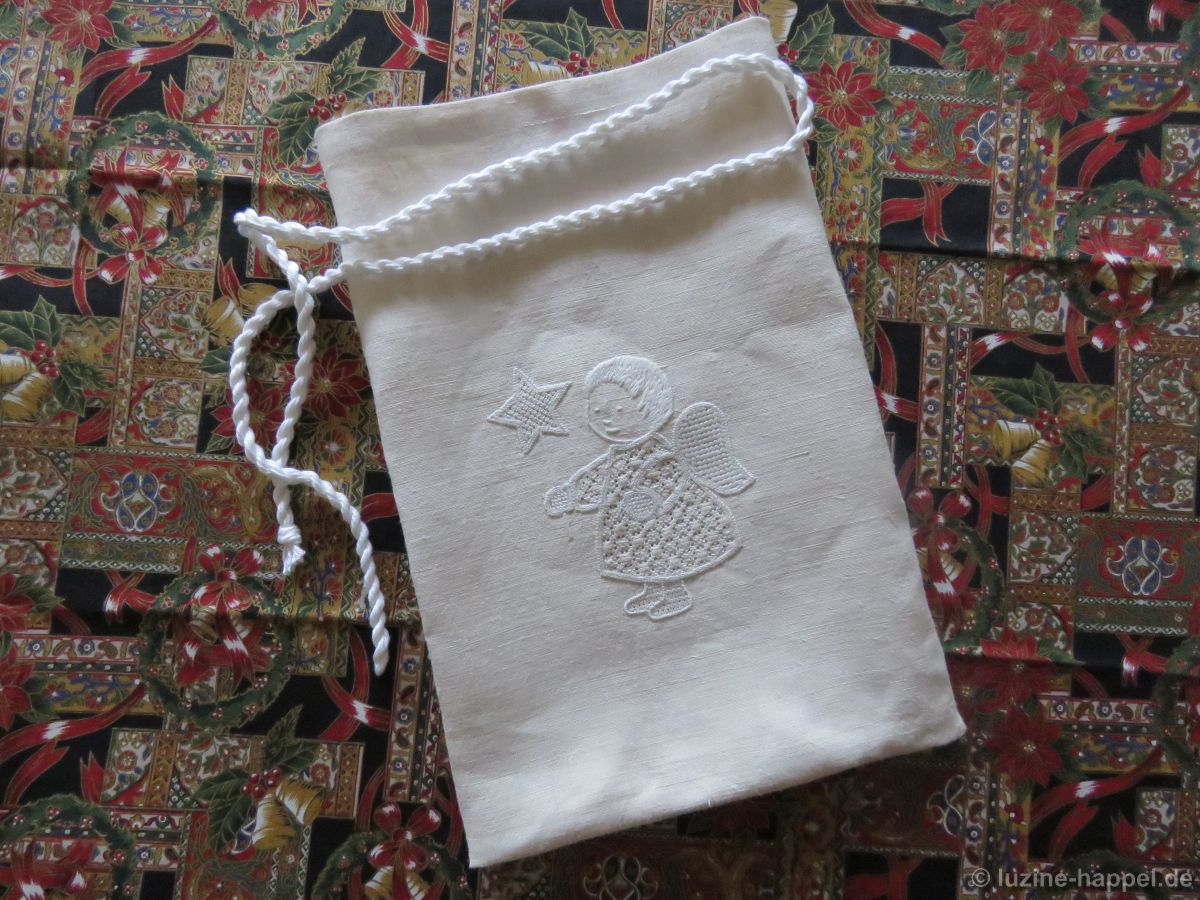
This little mischievous angel takes the lead.

The design measures about 12 cm X 11 cm. It was stitched on handwoven linen with an 18/cm thread count.

The hair was stitched with 2 strands of 6-ply stranded cotton.

Rose stitches (Basic Principles of Schwalm Whitework and Lesson #2) are worked in the star with a grid cut 1, leave 2.

Double Crosses in straight rows (Openwork Pattern Samplers) are worked in the gloves with a grid cut 1, leave 2.

Wave stitches (Basic Principles of Schwalm Whitework) are worked in the boots.

Net (Limetrosen I) are worked in the wing.
Röserich A1 (The most beautiful Röserich Filling Patterns) are worked in the dress.

It is suitable and easy to mount this angel in an embroidery hoop for a casual holiday display.

But if one wishes to hang it so that it is backlit (e.g., hung in a window), threads carried on the back side will be visible. One can remedy this by using double knots at the beginning and end of each small section separately and trimming the thread tails short.

I decided to place my little mischievous angel on a bag.

Advent Calendar 2018

Many of my blog readers are already looking forward to the Advent calendar. I’m glad because I really enjoy creating them, and I’ll give you a hint about this year’s: there will be a big gathering of angels.

For many centuries angels have been represented by embroidery stitches – mainly in Petit Point and Cross stitch embroidery. In these types of embroidery, the most diverse designs can still be found today.

At the turn of the nineteenth to the twentieth century, it was especially popular to integrate angel figures into Richelieu embroidery

and into Filet embroidery.

Angel motifs were even found in needlelace embroidery. At that time, the winged heavenly messengers were usually depicted unclothed.

In recent decades, these motifs fell out of favor with whitework embroiderers. Now they are gradually being viewed with interest. However, the illustrations have undergone a major change.

For example, Christa Waldmann drew angel motifs as an embroidery design. Unfortunately, I do not have an embroidered version of it.

A few years ago, Maria Deistler designed a pair of angels that were skillfully embroidered on the finest linen.

There are also designs for Schwalm whitework.
Angels were never depicted in traditional Schwalm whitework (at least I have never come across any). In fact, I’ve never come across any seasonal designs at all in traditional Schwalm whitework.

I’m not really a “cherub” type, so I’ve had a hard time deciding on this motif. But thinking more about the subject, I began to find joy in designing the winged heavenly messengers. The result is embroidery with a variety of characters – simple, small, big, playful, nostalgic, modern, floating, dancing, making music, walking . . .

They can be found on tea cloths, table runners, bands, bags, pictures, hurricane lamps …

It was only in October that I made the decision for this year’s theme. At that time I had only a few embroideries with angel figures. Since then, I have spent many hours stitching to give shape to my visions. Fortunately, some embroiderers could also provide treasures from their collections. And so there are twenty-four different projects altogether. Many thanks to all who contributed to this effort!

I hope the daily – starting tomorrow! – angelic surprises will delight you.

Schwalm Needle-Weaving Bands

Needle-weaving hems and needle-weaving bands are an inherent part of Schwalm whitework. And the huge number of different possibilities makes this special type of embroidery varied and interesting.

In Schwalm Whitework Lesson #4 – Needle-Weaving Band Sampler, I described how to work the different pattern categories in great detail. I have now collected into a new publication a huge number of band patterns with short explanations. This publication will enable embroiderers to find the perfect pattern for their taste and purpose.

The featured needle-weaving band patterns were found on pieces worked within the last two hundred years – 193 different patterns in all.

To both show the course of larger patterns and also enable a size comparison, all patterns are shown over a section of about seventy-two bundles.


The patterns are arranged into these categories:

  • A-patterns
  • one-piece block patterns
  • two-piece block patterns
  • two-piece block patterns with spiders
  • mirrored patterns
  • In addition, these patterns are also included:

  • divided patterns
  • needle-weaving with wrapped bundles patterns
  • pattern combinations
  • In each of the categories, the patterns are arranged according to their number of units. To make it easier to find a special pattern, the number of bundles of a single pattern segment is also provided for each pattern. (Of course all the special terms are clarified.)

    Some band patterns are easy to read, and others are more confusing. In an attempt to prevent errors from being made and to ease your work, I provide an additional service. For each band pattern, I have included the number of bundles for the individual bridges of the first unit; these are set in parentheses. Additionally, this pattern segment (the counted-out section) is marked with red lines at both ends.


    Tips for creating both new patterns and different samplers round out this very special and precious publication.

    Schwalm Needle-Weaving Bands

    Schwalm
    Needle-Weaving Bands
    collection of 193 different patterns

    67 pages
    more than 230 images
    plasic comb binding
    item price: €25
    (including 7% sales tax),
    €23.36 for customers outside the EU

    shop

    My Needle-Weaving Band Sampler

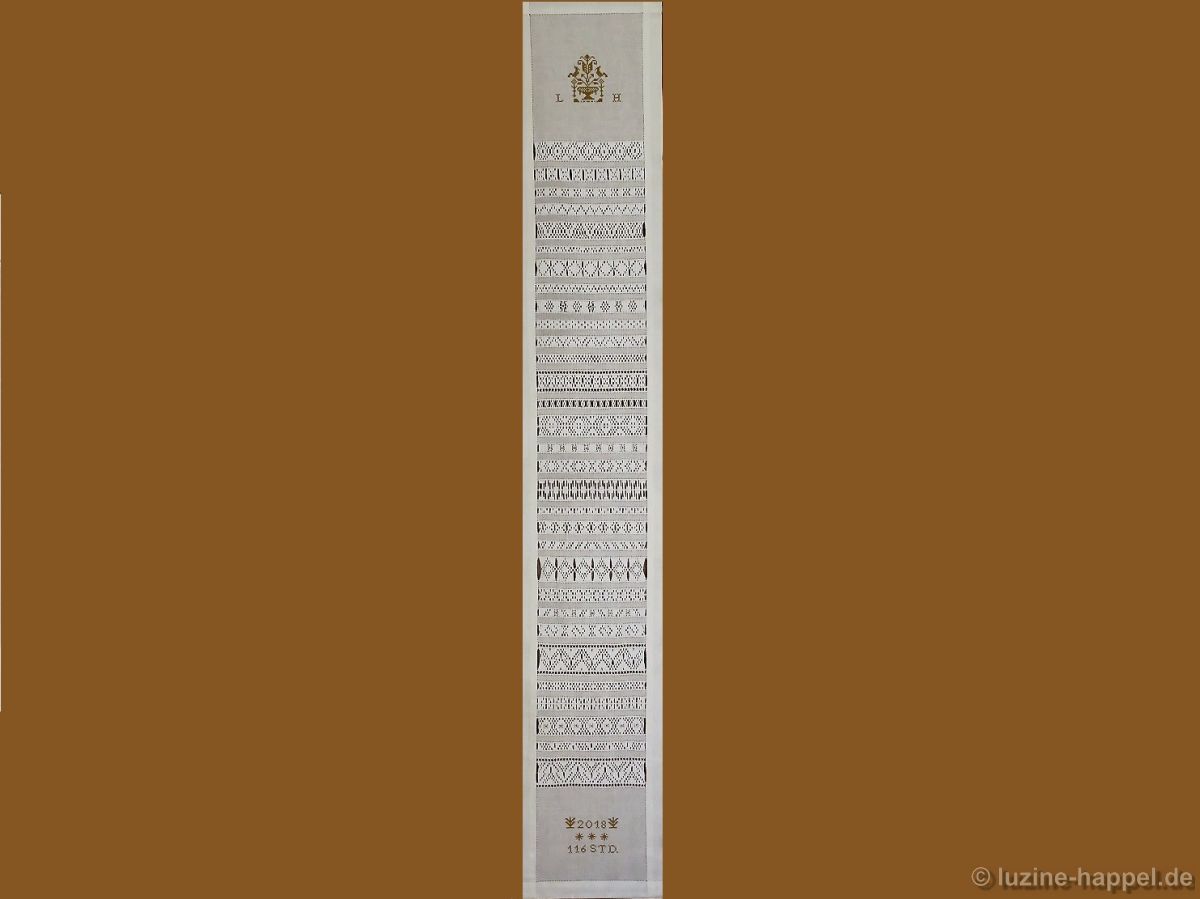
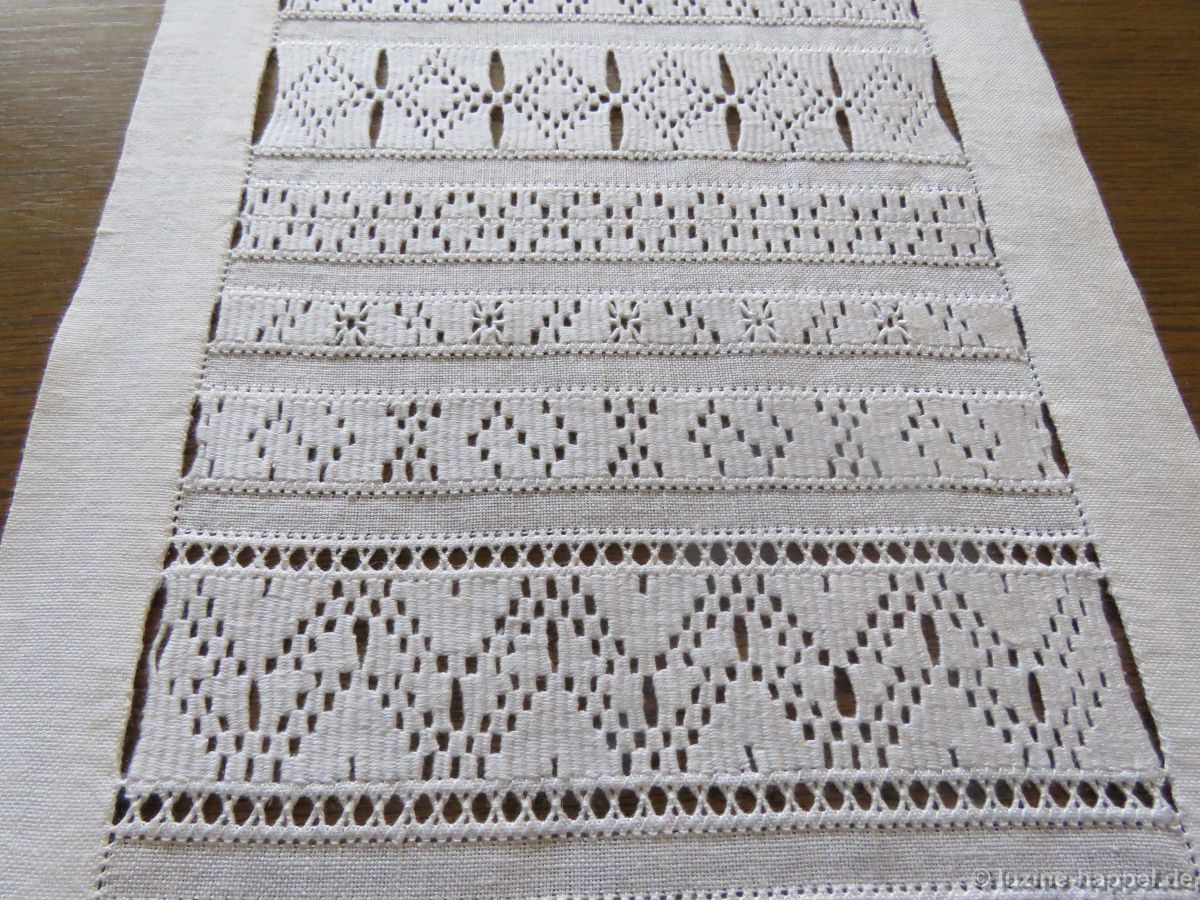
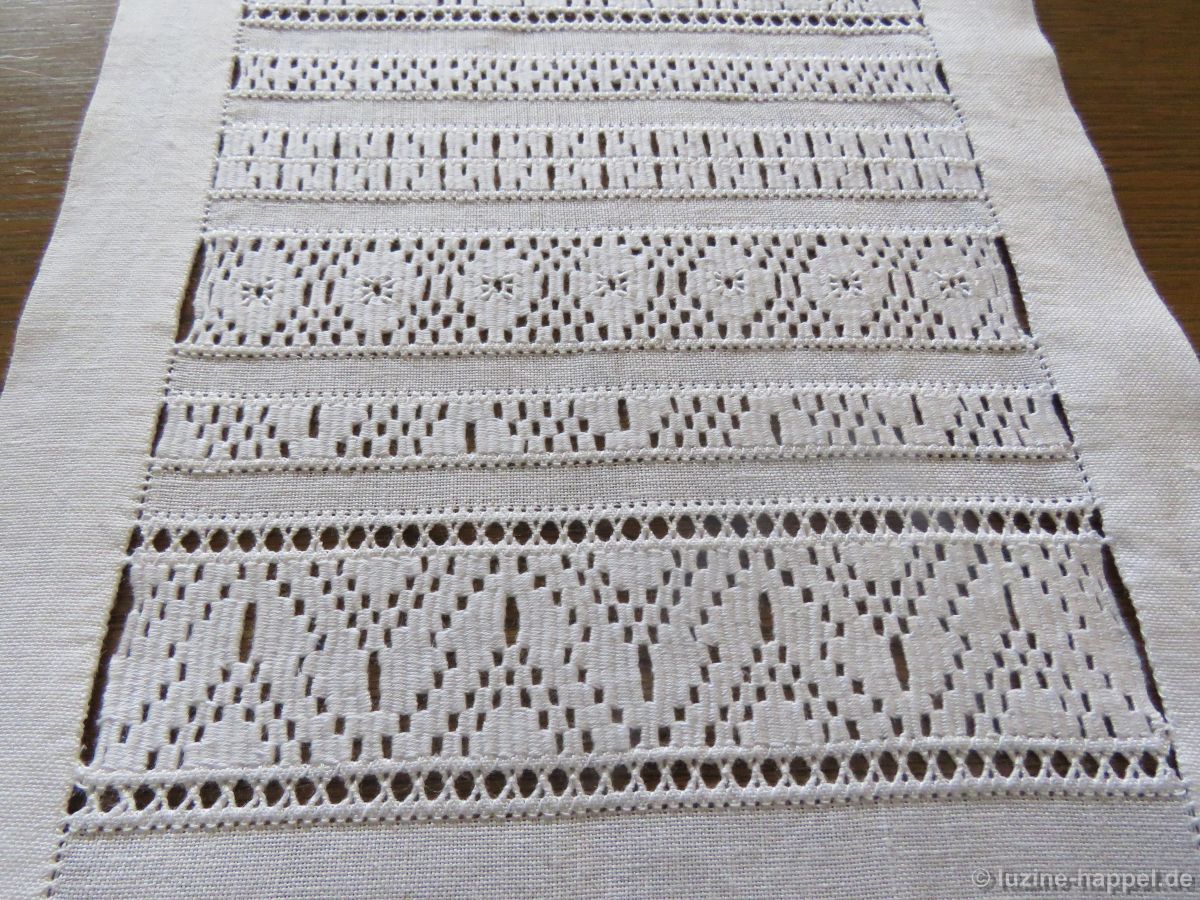
    While preparing to teach this summer, I worked a sampler consisting of thirty-one different needle-weaving bands with very different patterns. My students thought it gorgeous.

    The picture below shows the entire sampler. Because I cannot show overly long pictures on my blog, I sized a picture of the entire sampler to internet standards to give you a visual of the length to width ratio. The finished piece, hemmed and laundered, measures 28 cm X 170 cm!

    This sampler was worked on Weddigen linen with 13.5 threads per centimeter. The linen was cut to measure 40 cm X 183 cm. I used coton à broder No. 16 (16 skeins), No. 30 (5 skeins), and Anchor embroidery floss No. 888 (1 skein).


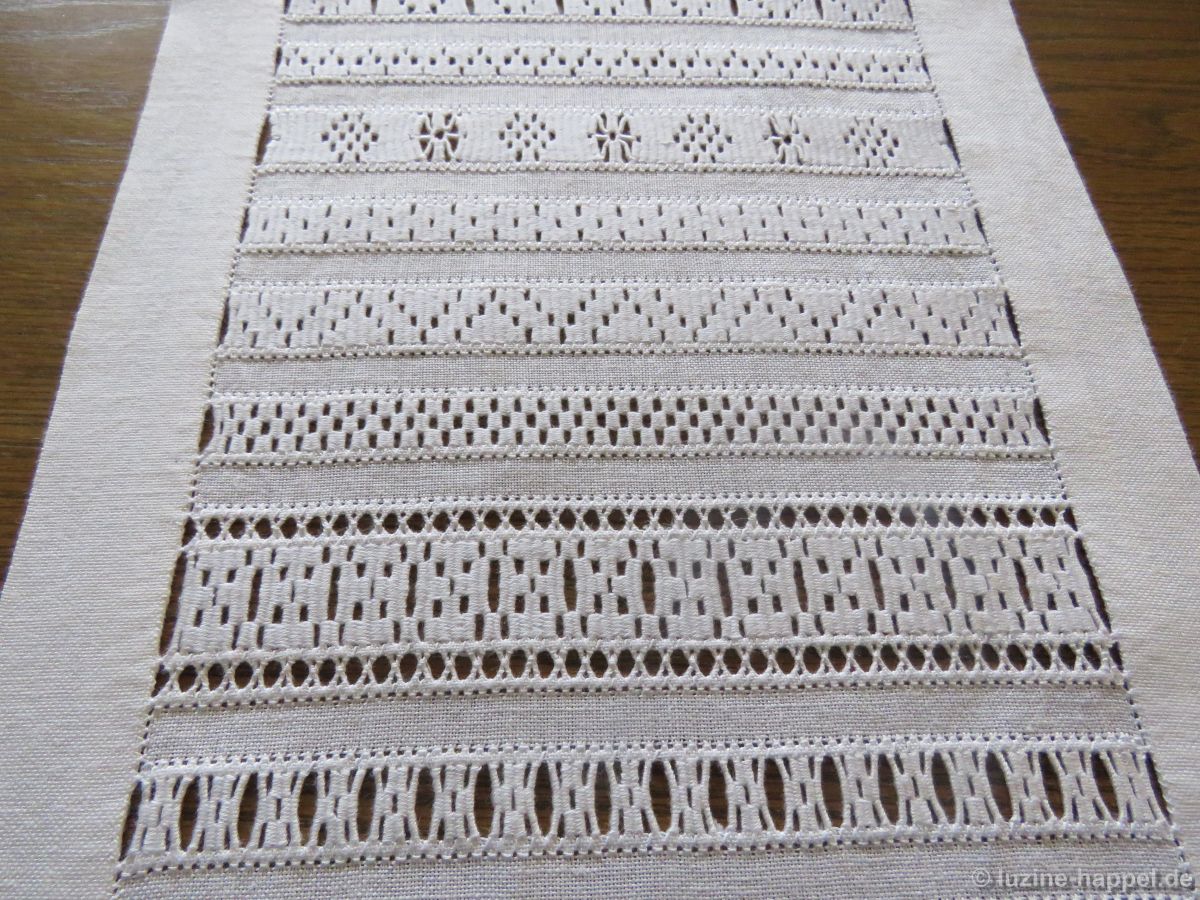
    Tall bands alternate with small bands. Examples of all pattern categories were worked – A-patterns, one-piece block patterns, two-piece block patterns, two-piece block patterns with spiders, mirrored patterns. In addition divided patterns and needle weaving with wrapped bundles patterns were embroidered.


    A huge collection of 193 – yes, 193! – beautiful patterns are found in my book Schwalm Needle-Weaving Bands (coming soon).
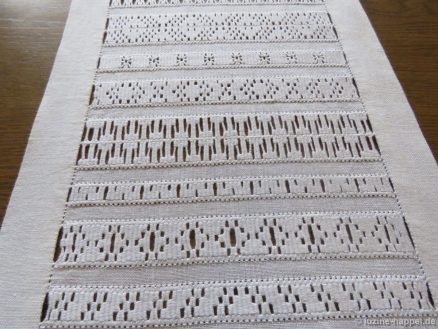

    All needle-weaving bands were worked over seventy-two bundles. It is advisable to choose a 72 (or a divisor or multiple of 72) bundle section for a band sampler because 72 is divisible without a remainder by many numbers, namely 2, 3, 4, 6, 8, 9, 12, 18, 24, 36. So, all one-piece block, all mirrored, and all divided patterns that have segments with these bundle numbers can be worked easily.


    The bands were worked up to the hem, and the cut thread ends are hidden in the hem.


    Perhaps this option looks less elaborate than securing the band ends with Blanket stitches, but there are some issues that make working Blanket stitches a little challenging. The thread ends have to be basted in place so to not hinder needle weaving, and later they have to be trimmed to match the width of the fold. (The hem is folded 1 cm. And if the thread ends are trimmed to fall within the fold section, they are not visible. If the thread ends are longer, they are visible through the fabric; they are not visible lying on top of two layers of fabric.)

    If the large gaps at the band ends – established in the course of needle weaving the pattern – are too obtrusive, they can be closed with small stitches meeting the level of the units from the back after the hemming is finished.


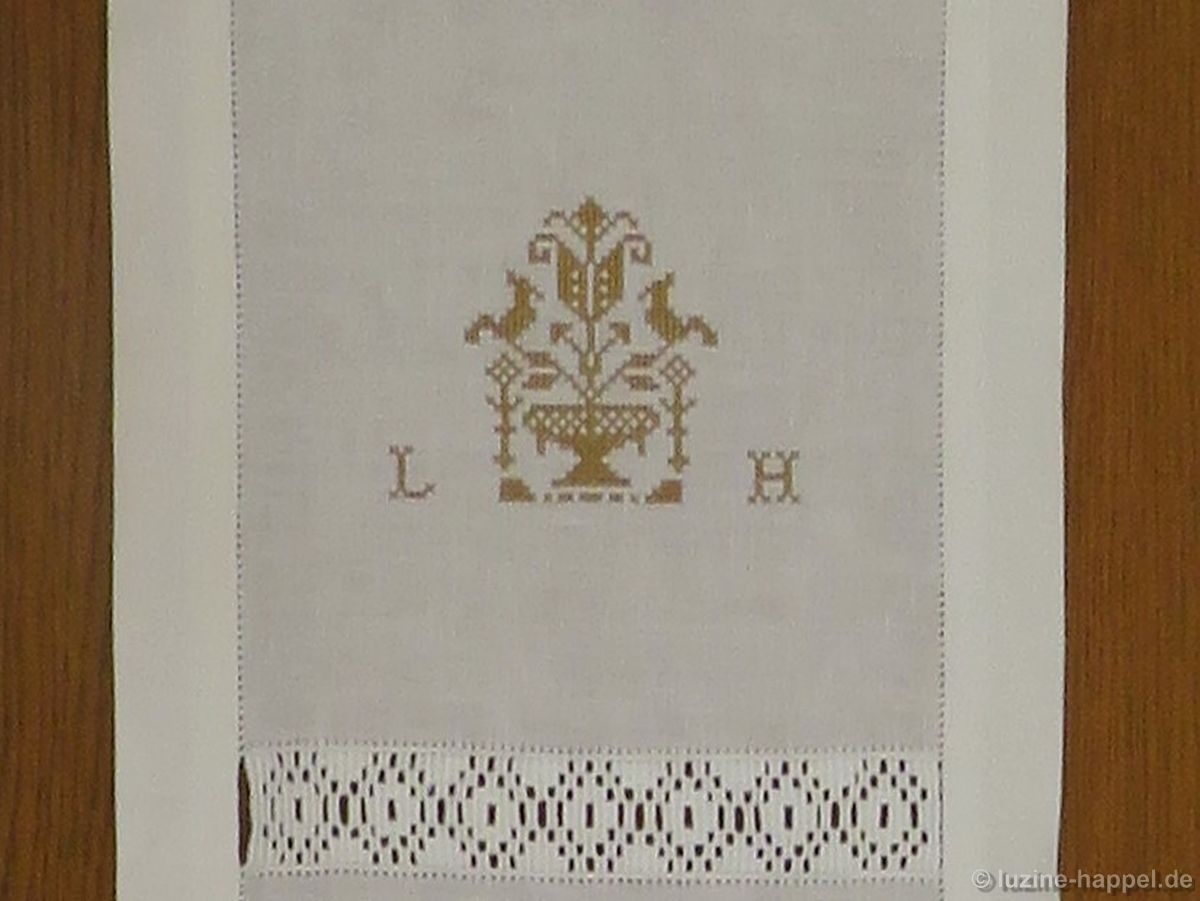
    A Cross stitch crown and initials were stitched in the space remaining at the top of the sampler.

    Crowning an elaborate piece is common in the Schwalm. Not all linen fabrics are woven densely enough to work Satin stitch crowns (see Schwalm Crowns and Grand Schwalm Crowns), but traditional Schwalm embroidery also provides a wide range of Cross stitch crowns. They can be found in Traditional Figural Patterns – charts for numbers, initials, birds and other animals, flowers, flowerpots, manikins, stars, ornaments, and others.


    The year, hours of working, and some small Cross stitch ornaments were added below the needle-weaving bands.

    It is always good to include the year in which a piece was worked. And it is common in the Schwalm to add small Cross stitch ornaments to numbers and letters.

    I think it is also good to add the approximate hours (German: Stunden, abbreviation: Std) spent doing the embroidery. It is useful to the embroiderer when looking to the piece years later and can help people (now or in the future) understand its complexity and perhaps rate its value.


    Even keeping the option open to cut the linen shorter at any time, I at first thought myself crazy to start such an elaborate piece with the goal to finish it within a few weeks. But after embroidering the first few bands, it was like an addiction. Every free minute I sat down to stitch. Weaving the stitches is so relaxing. It is similar to knitting socks; I could calm down and unwind while stitching.

    So I can recommend a needle-weaving project to all people wanting to take life at a slower pace.

    Are you interested in working such an eye-catching embroidery for your own home? Instructions, explained in great detail, for working needle-weaving bands and the different pattern categories are found in Schwalm Whitework Lesson #4 – Needle-Weaving Bands Sampler and Fancy Hems.


    Kit #4

    Kit #4 provides all materials required for lesson #4 Needle-Weaving Band Sampler. The lesson #4 project needs a linen piece measuring at least 50 cm X 60 cm. But perhaps one wants to add some more needle-weaving bands or a crown (content of a future article); to accommodate such a scenario, I decided to cut the linen to measure 50 cm X 100 cm – it can be easily cut to the desired length, whereas a too short piece is difficult to lengthen.

    • linen – 14/cm thread count Übelhör natural linen about 50 cm X 100 cm
    • linen – 14/cm thread count Übelhör natural linen about 30 cm X 30 cm for practicing
    • Tapestry needle No. 24
    • Tapestry needle No. 26
    • Coton à broder No. 16 – 4 skeins, and No. 30 – 1 skein


    Kit #4
    14/cm thread count natural linen
    needles
    threads
    item price: €27 (including 19% sales tax), €22.69 for customers outside the EU
    shop