A Framed Schwalm Sampler

In previous articles I presented Schwalm sampler cloths, door, and wall hangings. Instead of hemming, a sampler can also be framed. Because a frame is an important design element and the size of the embroidery must be adjusted to the size of the frame, it is good to look for an appropriate frame beforehand.
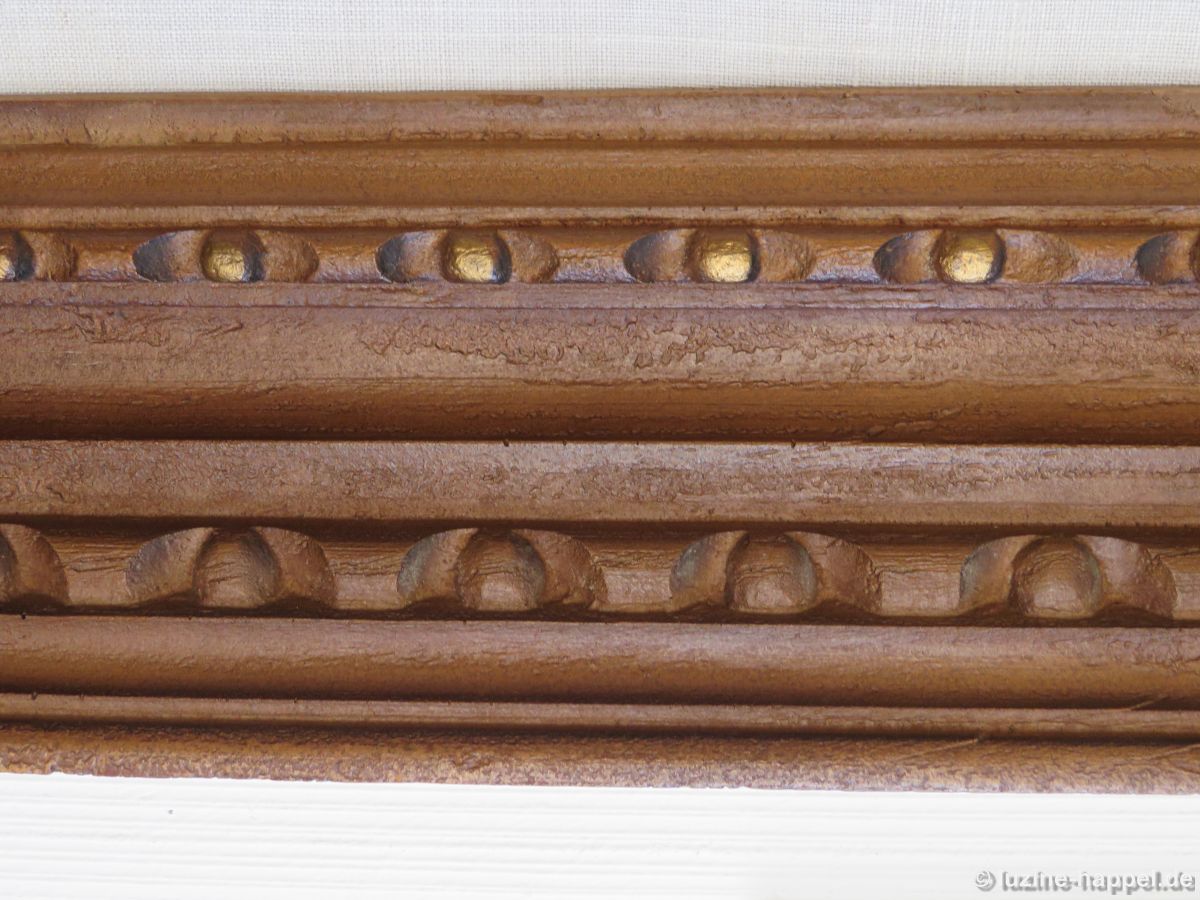
If the embroidery matches the frame, a perfect presentation – as seen below – can be created.
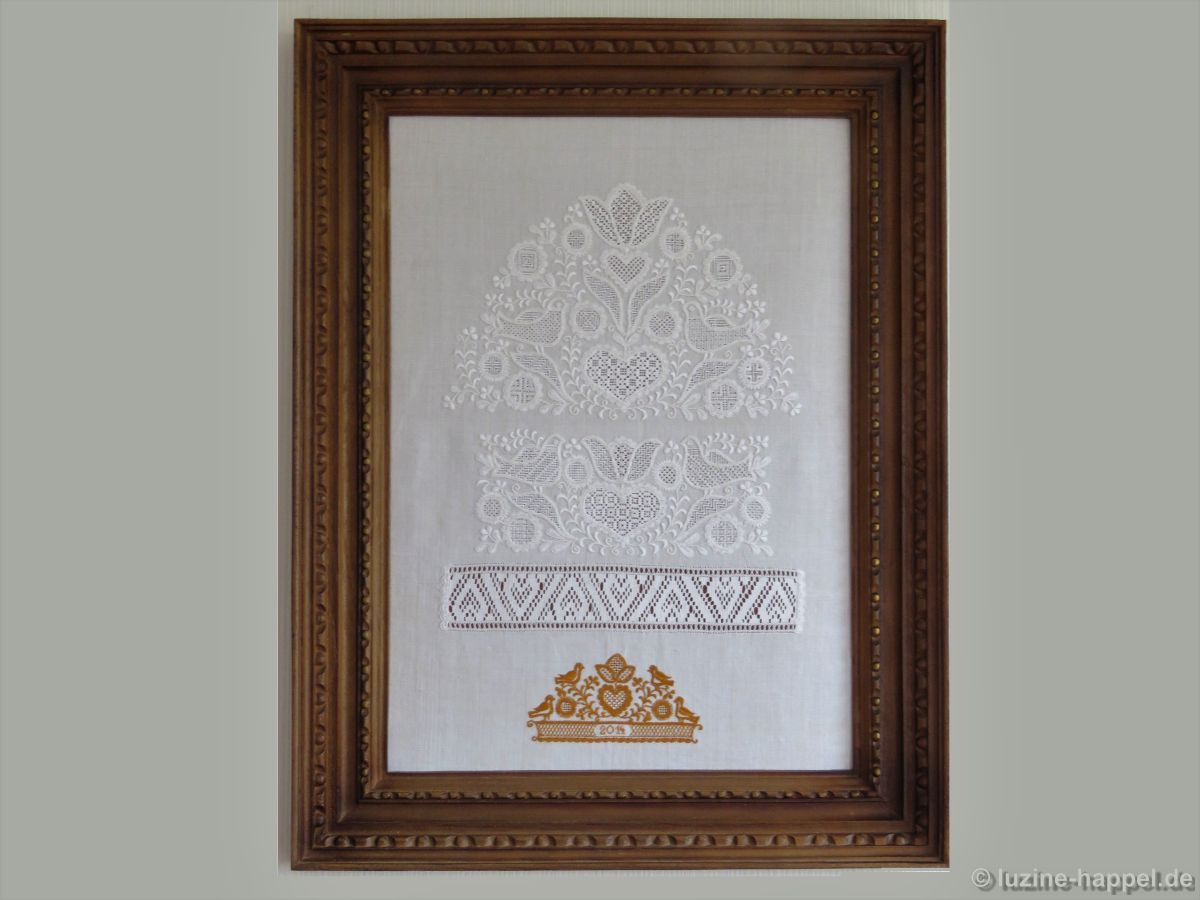

The sampler includes an elaborate and difficult-to-embroider needle-weaving band with a common Schwalm heart pattern.
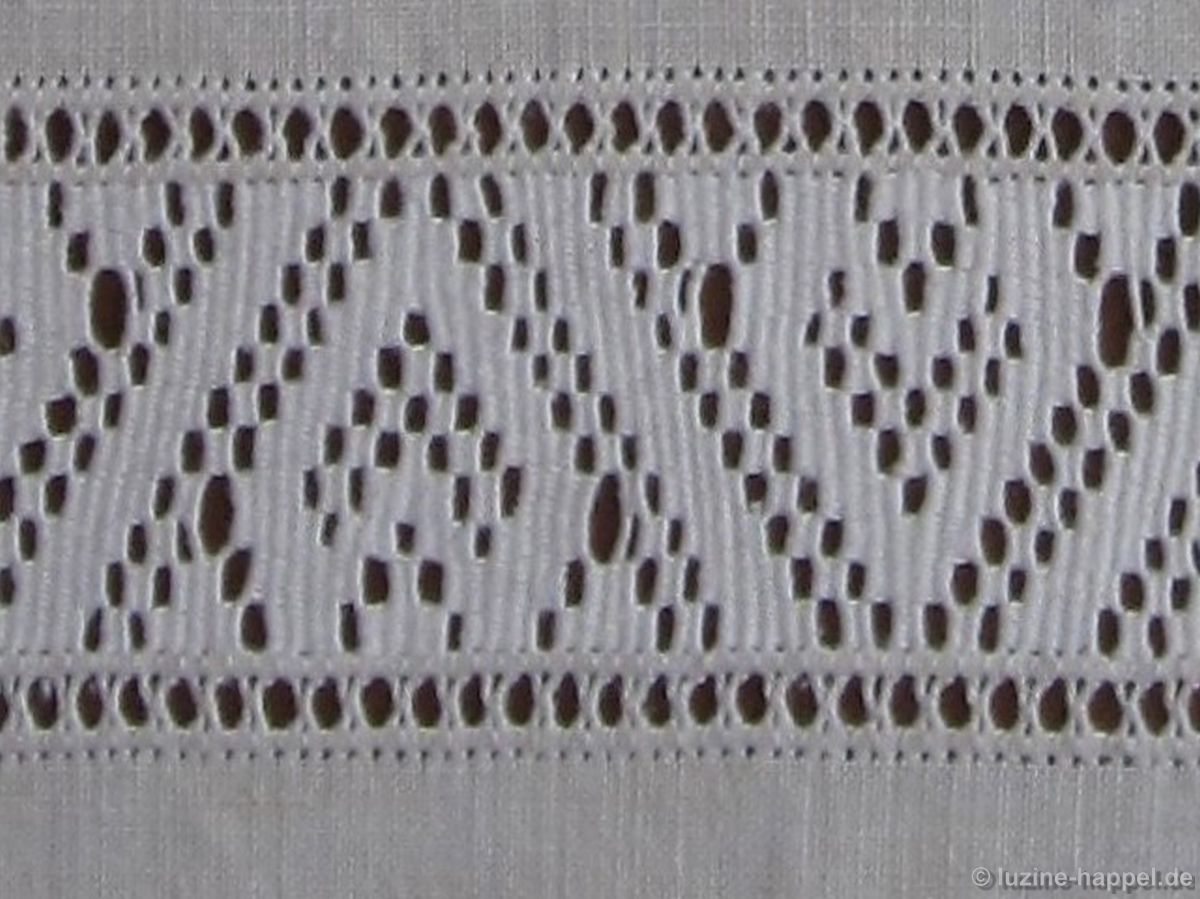

The needle-weaving band is additionally embellished with half-eyelet scallops at the sides.
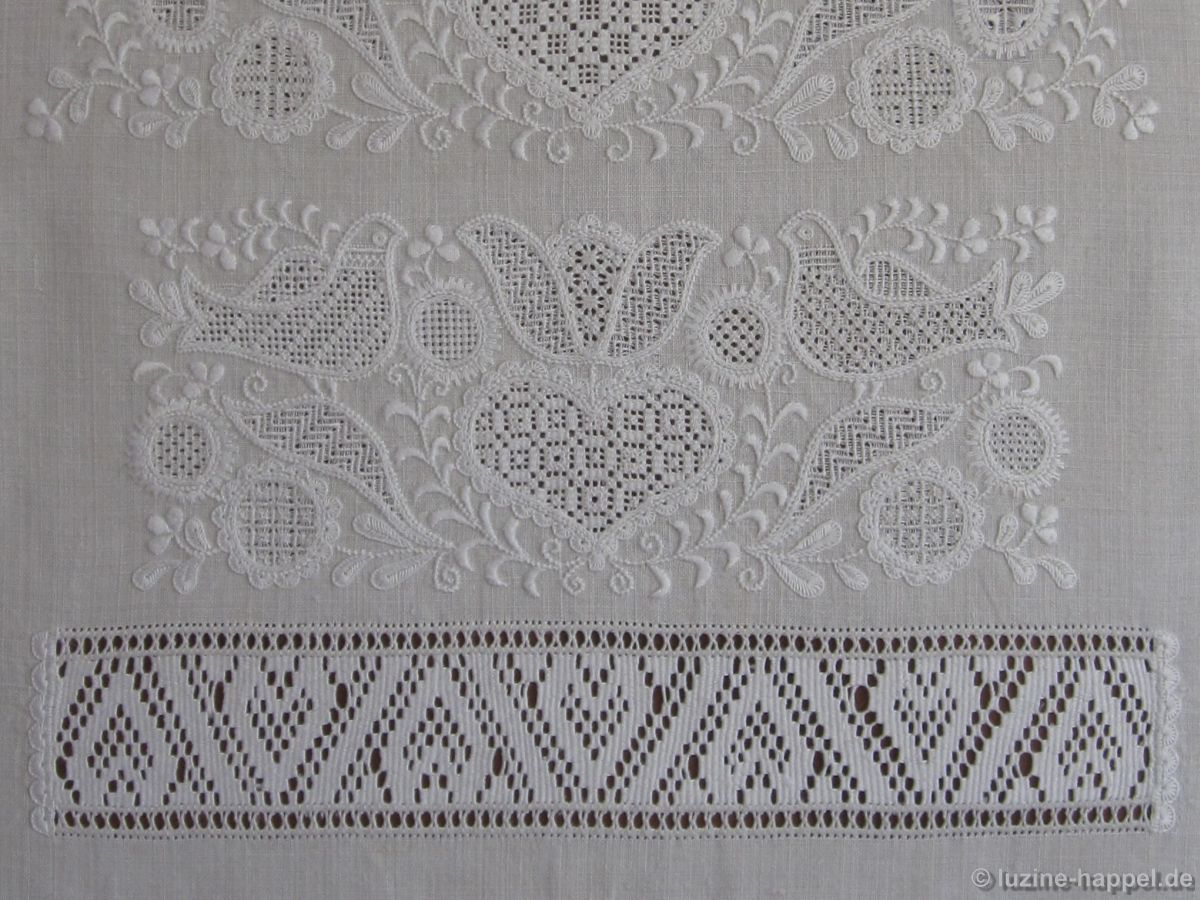
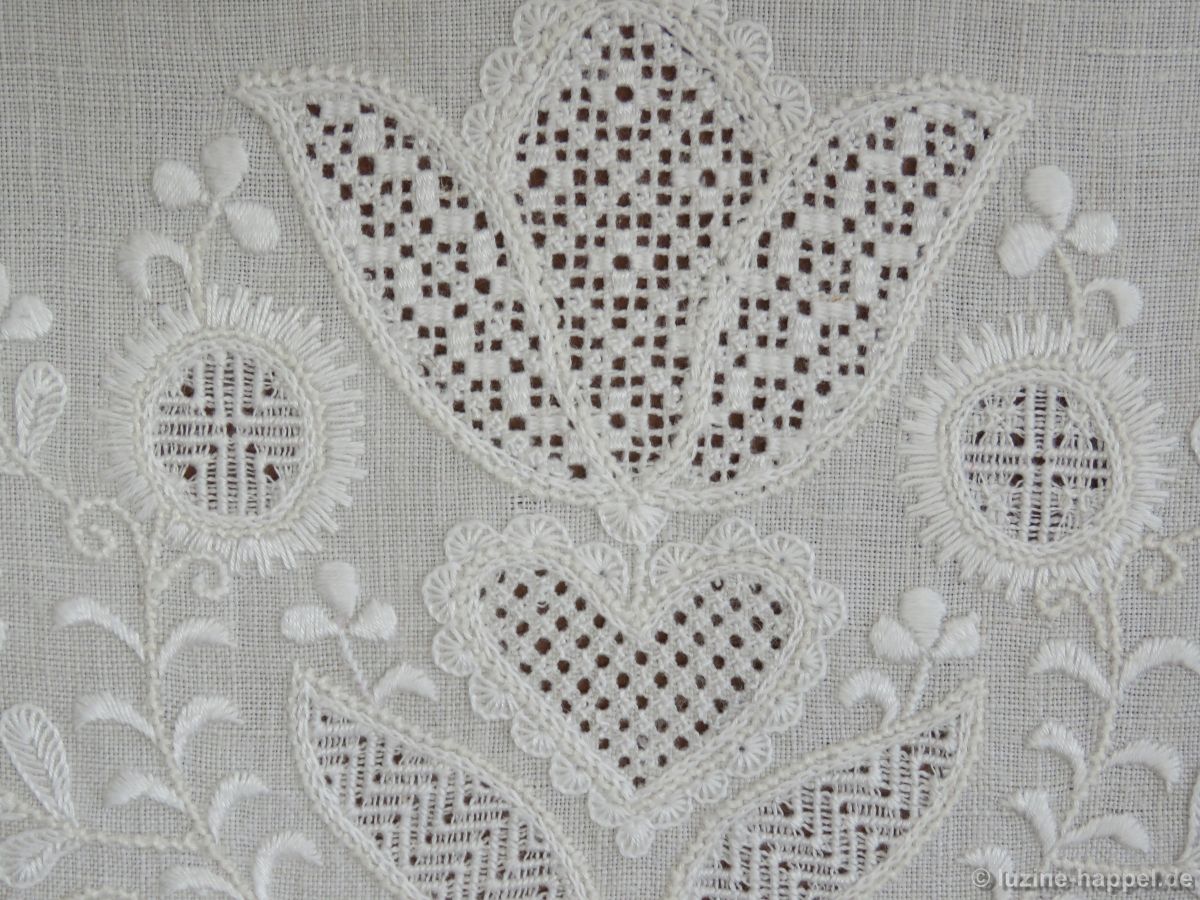
On top of the needle-weaving band, there is a rectangular whitework design that includes the most important Schwalm motifs – heart, tulip, bird, circle, and leaf. Between the densely arranged motifs, a lot of surface whitework embroidery was stitched including all the common elements, such as tendrils, pointed and rounded leaves, and small flowers.

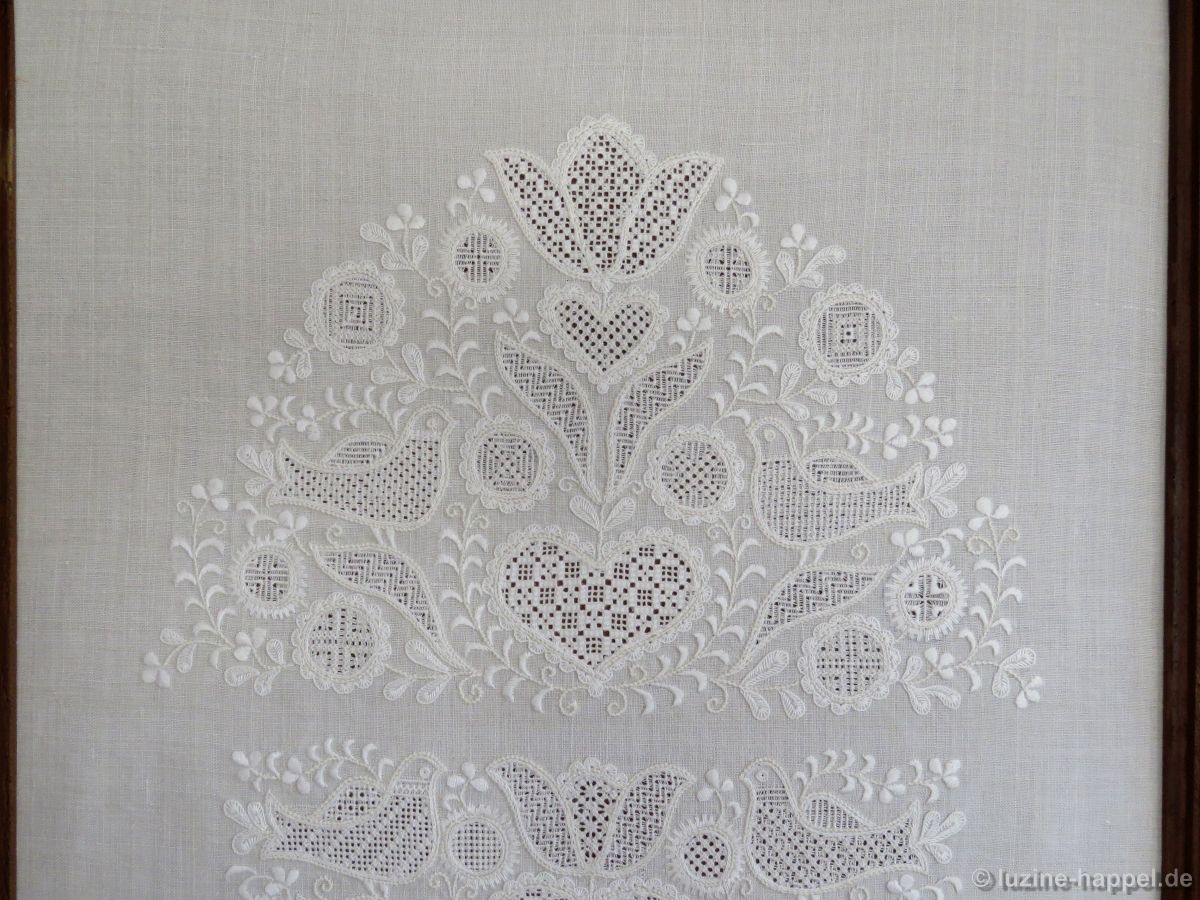
Matching the design elements of the border below and the width of the needle-weaving band, a whitework pattern was designed in the shape of a crown.

All three types of Schwalm filling patterns – simple withdrawn thread, Limet, and openwork – were embroidered.
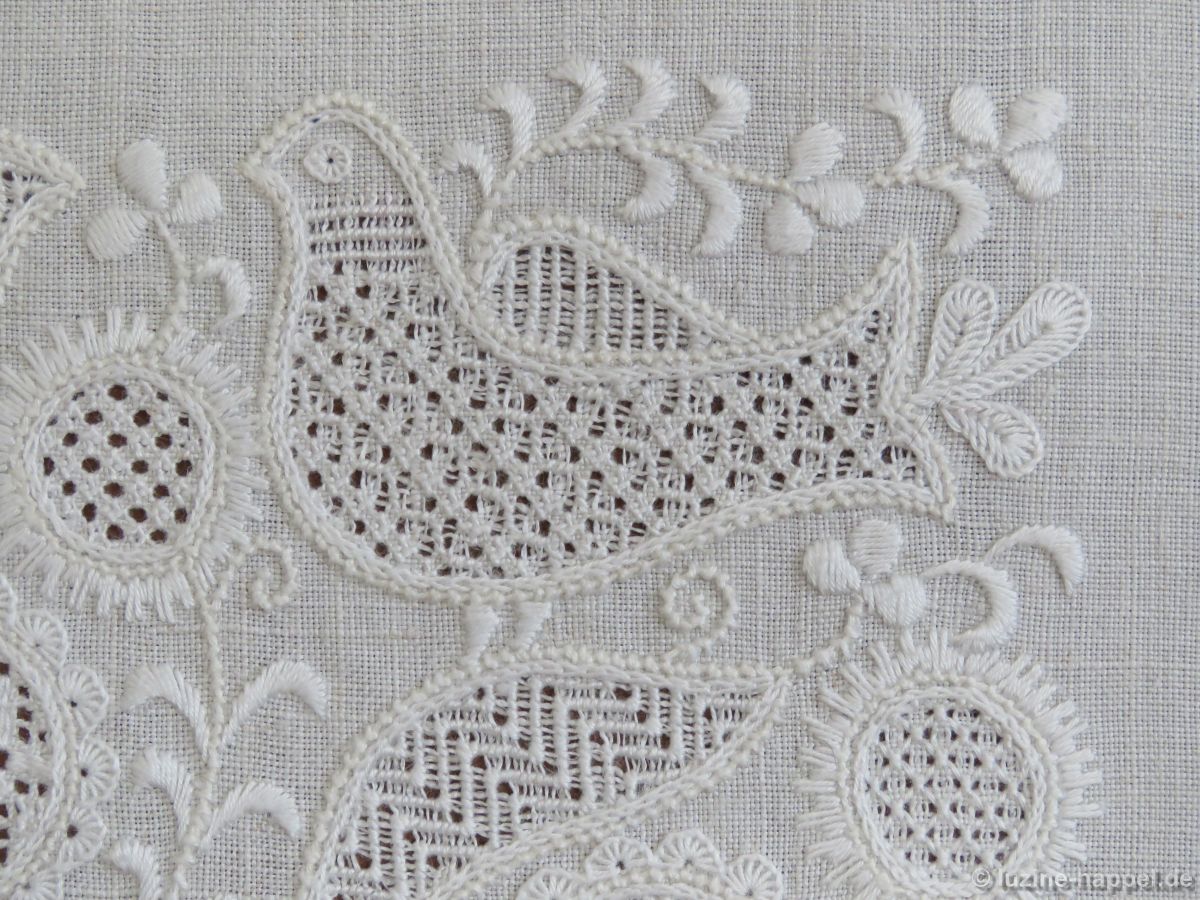

Many different patterns – perfectly matching the shapes – were chosen.
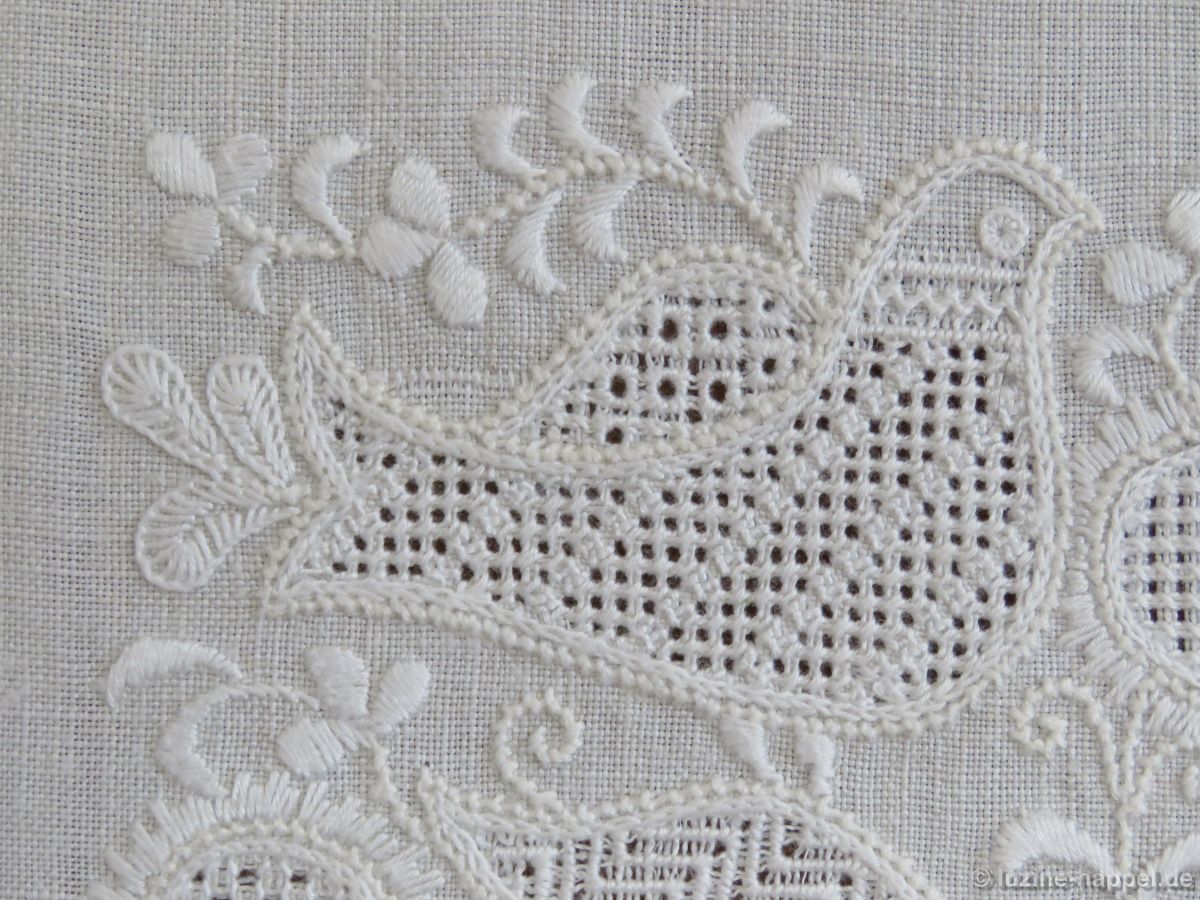

The embroiderer’s treatment of small details, like the ruffs of the birds, is notable.
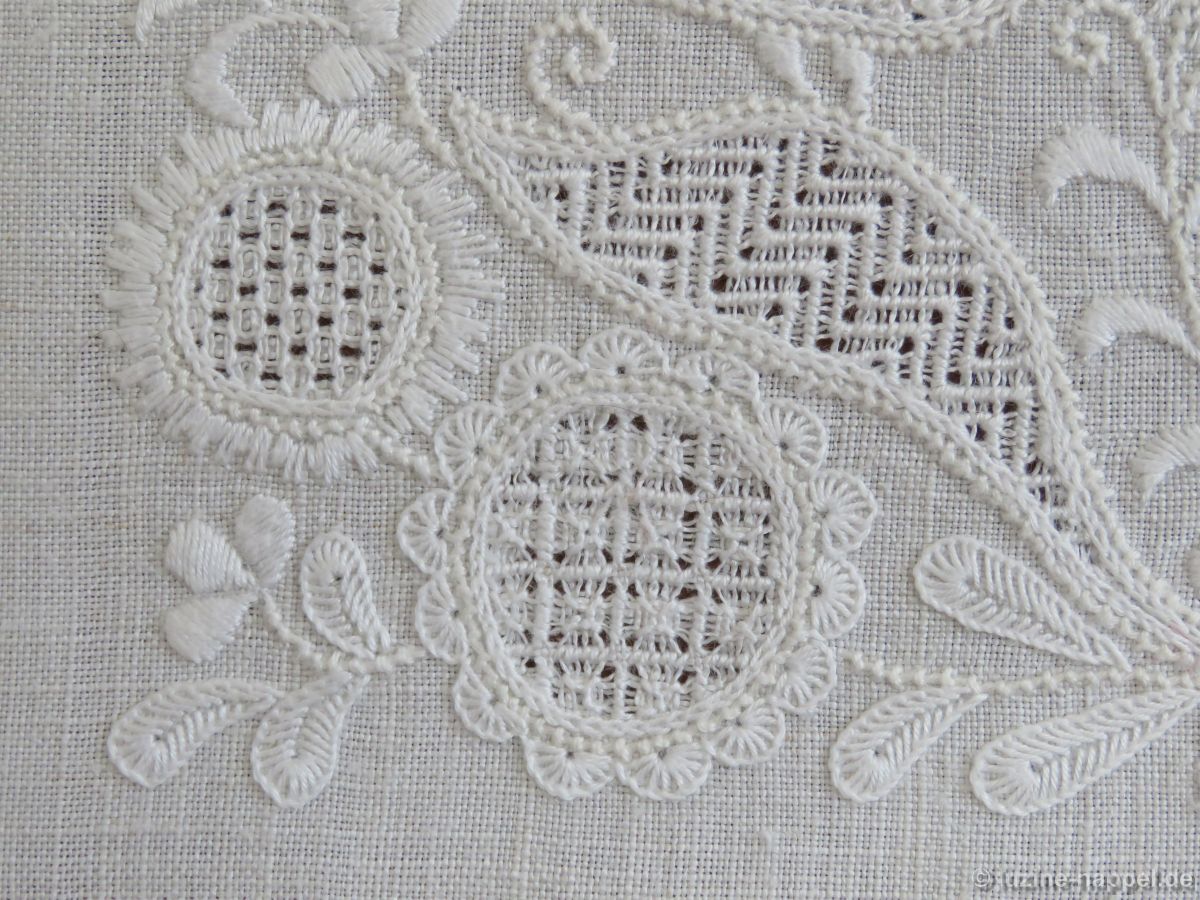

The embroiderer always looked for different patterns
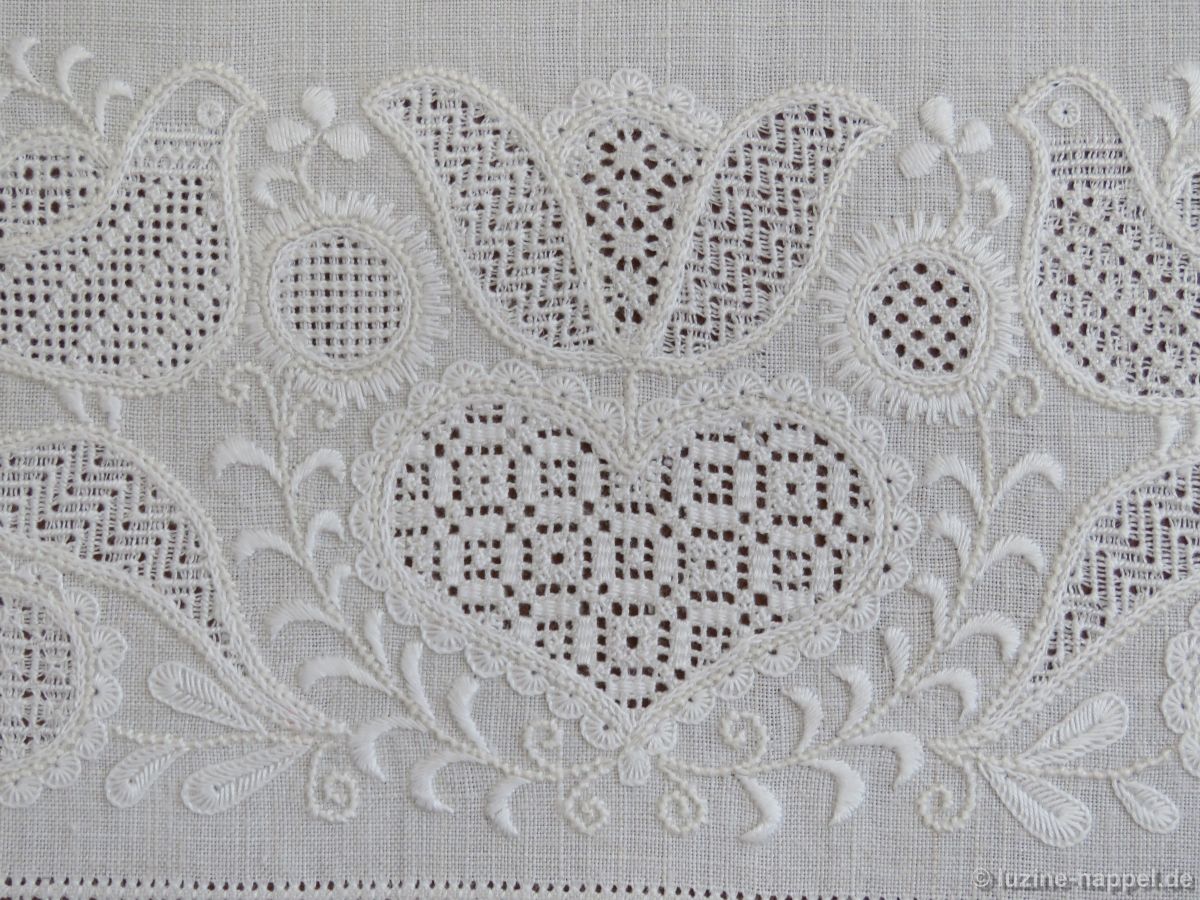

to match the shapes.
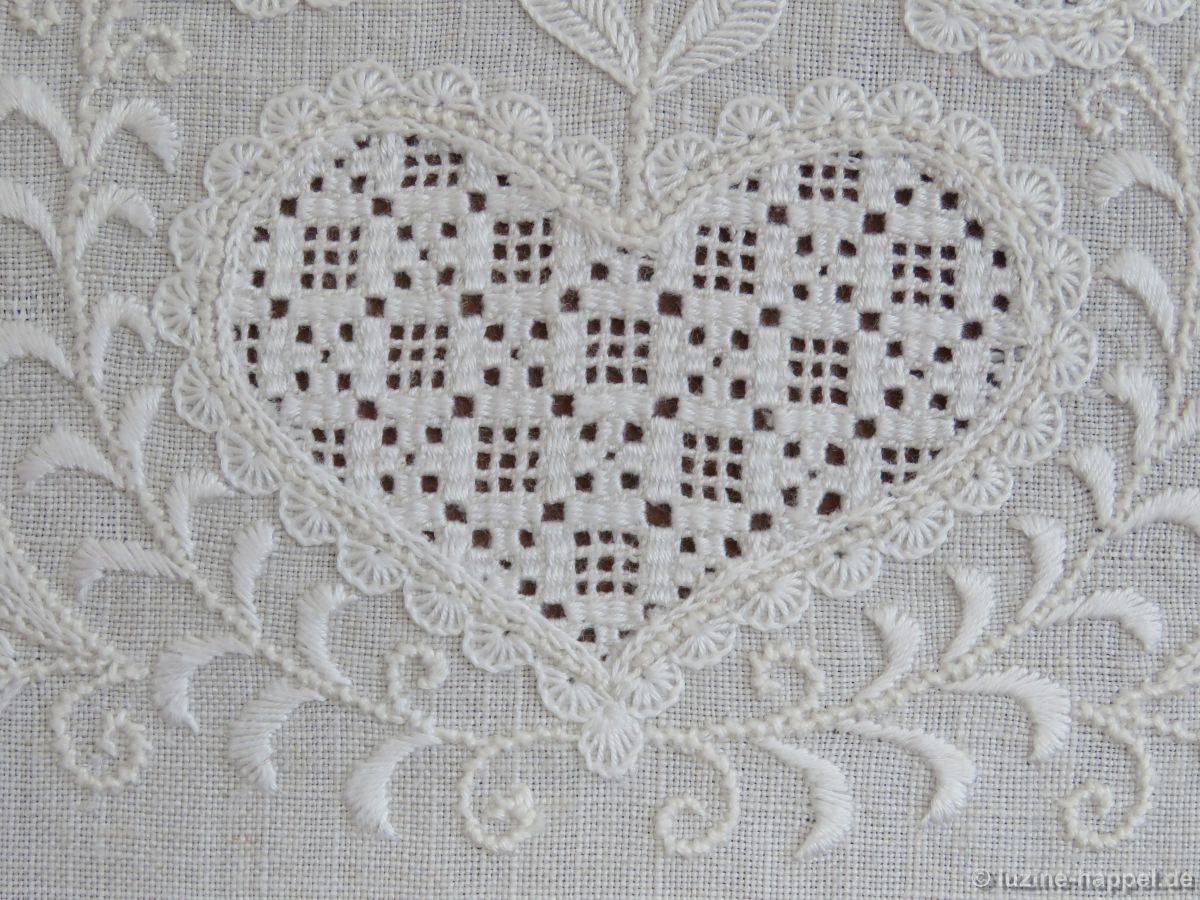

Often the circles were filled with crosses


or squares.


In total the sampler shows 31 different filling patterns!

And the nice golden crown at the bottom of the sampler picture – especially created to match the design – tops off the beautiful Schwalm embroidery.
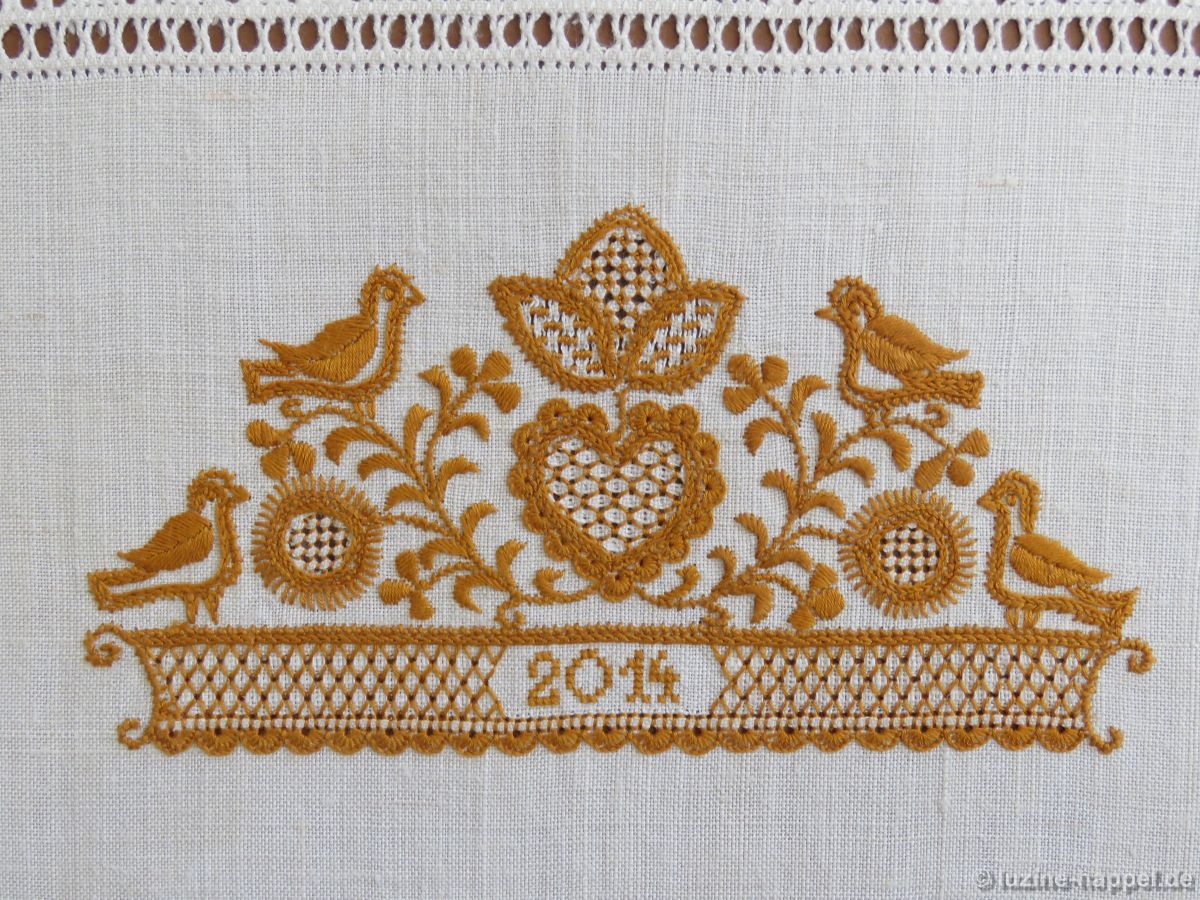

More pretty traditional Schwalm crown designs one can find in my books Schwalm Crowns and Grand Schwalm Crowns.

The sampler design is ready for all to enjoy as a downloadable document.

Lesson #3 – Openwork Circle Design Ornaments

Of the three types of withdrawn-thread patterns (simple, Limet, and openwork) in Schwalm whitework, openwork is the most important and richly diverse group. This is because shapes can not only be filled with endless patterns but also with figured patterns. The variety of figured patterns is vast – in addition to hearts, tulips and stars, birds and manikin are found. However, one can also find other animals and crowns. The Schwalm embroiderer loved diversification and liked to combine all the different possibilities.


Openwork patterns are especially durable because the embroiderer usually embroidered the shape twice – once for securing the grid with Cable stitches and again when working a pattern using Rose or needle-weaving stitches into the established grid. Learning to embroider openwork patterns is a little bit more arduous. But having learned the basic principles, countless and very different creative possibilities are opened up.

linienförmige Anordnung | arrangement in a straight line
The Ornament project is a continuation of the Happel Hearts project. It provides the opportunity to practice Coral Knot, Chain, and Blanket stitches that you learned in lesson #1, and it introduces new techniques and challenges:

1. Design transfer of a circle design
2. Thread withdrawal for an openwork grid with a square in the center
3. Working a Cable stitch grid
4. Openwork filling stitch: needle weaving
5. Working from a filling pattern chart
6. Openwork filling stitch: Rose stitch
7. Finishing
8. Thread withdrawal for an openwork grid with an intersection of bundled threads in the center

In addition, you will
• create your own different edge embellishment in basic star pattern charts,
• create your own star pattern chart,
• study more different pattern charts,
• study more embroidered star patterns.


The main focus of this lesson is to introduce Schwalm whitework’s third type of withdrawn-thread patterns – openwork patterns. (Simple withdrawn-thread filling patterns and Limet-Filling patterns have already been covered in lesson #1 and in lesson #2 respectively.)


In this lesson you have to establish an openwork grid, stabilize it with Cable stitches, and fill it with different figured patterns using needle weaving and Rose stitches. In the end, excess fabric is cut away.

Other finishing possibilities are square ornaments, coasters, and bands.


The project is small, but there is so much to learn!
Everything you need is included in the kit #1. Did you order it already?
To save you shipping costs, I made this document downloadable. Of course, a printed version is available upon request; should you prefer this option, please email me.

Schwalm Whitework
Lesson #3
Openwork Circle Design Ornaments
31 pages
more than100 images
text: English
21.95 MB file size
item price: € 20 (including 19 % sales tax), 16,81 € for customers outside the EU

shop

A Visit from Japan

Some time ago two ladies from Japan visited my exhibition and took a workshop with me. The interest in learning Schwalm whitework grows considerably in Japan. Kazuyo Narukawa and Sumiyo, her daughter, own an embroidery shop in Kanagawa. Because they have a large group of interested persons at home, they wanted to learn more about Schwalm whitework; their goal is to impart to their students the most authentic and accurate techniques and information as possible.


They both were very skilled in embroidery and learned a lot. We did not have language problems because we could communicate by using English. Any remaining confusion could be removed by practical instructions. They had lots of different questions regarding Schwalm whitework. They had prepared themselves ideally for the workshop. They wanted to know why I describe methods of working differently from some other authors, why I prefer using Weddigen linen #160 and #925, and why some stitches have other names in the English books written by other authors. I was able to answer all questions and to support my answers with examples.


They enjoyed seeing so many different exhibits. They could view many different design ideas. They took home not only my books but also a great deal of knowledge. Now they are well prepared to share it all with their customers.


In their shop, Stitch Garden, they offer the full range of supplies for Schwalm whitework. My books are also available there!

Kit #2B

This kit provides all the needed materials for lesson #2 Tulip Wreath, for the project worked with 13.5 per cm thread-count linen.

The kit includes all of the following:
• linen – 13.5/cm thread count Weddigen linen about 60 cm X 60 cm with the pre-transferred design
• linen – 13.5/cm thread count Weddigen linen about 20 cm X 20 cm for practicing
• Coton à broder No 16 – 1 skein, No. 20 – 2 skeins, and No. 30 – 3 skeins
• Chenille needle No. 24
• Chenille needle No. 26
• Tapestry needle No. 26
• washing powder

Kit #2B
13.5/cm thread count linen with the pre-transferred design
needles
threads
item price: € 34.00 (including 19% sales tax), 28.57 € for customers outside the EU
shop

Kit #2A

This kit provides all the needed materials for lesson #2 Tulip Wreath, for the project worked with 16 per cm thread-count linen.


The kit includes all of the following:
• linen – 16/cm thread count Weddigen linen about 45 cm X 45 cm with the pre-transferred design
• linen – 16/cm thread count Weddigen linen about 20 cm X 20 cm for practicing
• Coton à broder No 20, and 25 – 1 skein each, and No. 30 – 2 skeins
• Chenille needle No. 26
• Tapestry needle No. 26
• washing powder


Kit #2A
16/cm thread count linen with the pre-transferred design
needles
threads
item price: € 25 (including 19% sales tax), 21.01 € for customers outside the EU
shop