Historical Schwalm Whitework and Lace

Schwalm whitework was often combined with lace. The most common was needlelace, but there were also other kinds of lace in the Schwalm.

So far I have found six kinds of lace in Schwalm:
1. needle
2. bobbin
3. machine-made
4. sprang
5. filet
6. Dresden

Sleeve cuff of a traditional Schwalm bodice decorated with needlelace, whitework, and a needleweaving hem.

Sleeve cuff of a traditional Schwalm bodice decorated with needlelace, whitework, and a needleweaving hem.

1. Needlelace was the most commonly used lace in the Schwalm. In combination with Schwalm whitework, it is found at the edges of bodice sleeve cuffs, at the front edges of dyed to black bodice jackets, at the upper edges of the waistbands of the white aprons, and at the collars, the cuffs, and the necks of men´s shirts.

Needlelace was worked in a wide variety of different patterns.

Needlelace was also worked with coloured thread to embellish garters and cap bands.

Sleeve cuff of a traditional dyed-to-blue Schwalm bodice decorated with bobbin lace, whitework, and Cross stitch initials.

Sleeve cuff of a traditional dyed-to-blue Schwalm bodice decorated with bobbin lace, whitework, and Cross stitch initials.

Traditional dyed-to-blue Schwalm decorative handkerchief with bobbin lace, whitework and Cross stitch crowns and initials.

Traditional dyed-to-blue Schwalm decorative handkerchief with bobbin lace, whitework and Cross stitch crowns and initials.

2. Bobbin lace, in combination with Schwalm whitework, is found at the sleeve cuffs of the blue bodices and at the edges of the dyed-to-blue decorative handkerchiefs.

Bobbin lace is also found on bed coverings, door hangings, and at the front edges of the dyed-to-blue communion caps. It is also found on knitted baby caps.

Parade cushion decorated with machine-made lace, Peahole hem and Four-Sided stitch hem, and a crown with the year and initials in Cross stitch.

Parade cushion decorated with machine-made lace, Peahole hem and Four-Sided stitch hem, and a crown with the year and initials in Cross stitch.

3. Machine-made lace is found on parade cushions, bed coverings, and door hangings. Most often it is used as an additional edge decoration in combination with Schwalm whitework. Sometimes it is used in combination with needle weaving hems and Schwalm crowns. There are also examples of elaborate and pretty Schwalm whitework borders with machine-made lace as an insertion.
Spitze_5
Two parts of a door hanging decorated with Schwalm whitework borders, Peahole hems, a needle weaving hem and sprang.

Two parts of a door hanging decorated with Schwalm whitework borders, Peahole hems, a needle weaving hem and sprang.

4. Sprang is found on bed coverings and door hangings.
Bed covering with two different crowns with initials, filet, and a machine-made lace.

Bed covering with two different crowns with initials, filet, and a machine-made lace.

5. Filet is found on bed coverings and door hangings.
Very old decorative handkerchief dyed to blue. It is decorated with a Schwalm crown and initials worked with Cross stitches, whitework motifs, and a band with Dresden lace at two edges (and a small bobbin lace band at the remaining two edges – not shown in this picture).

Very old decorative handkerchief dyed to blue. It is decorated with a Schwalm crown and initials worked with Cross stitches, whitework motifs, and a band with Dresden lace at two edges (and a small bobbin lace band at the remaining two edges – not shown in this picture).

6. Dresden lace was found on a decorative handkerchief.

All of these will be subjects of more detailed articles in the future.

The Filling Patterns of theTraditional Schwalm Bodice A

The embroidery of the Schwalm bodice design A has many variants. The linen used has an 18–20/cm thread count. The picture shows the entire border in a photomontage.
MA2_0_gesamtPlease note that the border design has a width (from needlelace to needle weaving band) of about 14 cm. The following pictures show the embroidery enlarged; the embroidery is actually very fine.

Below I show details of the arrangements of the single shapes. Here is a numbered overview to ease the assignation of the single motifs to the whole design.
MA2_0_Zuordnung1.
There are no Coral Knot stitches outlining the circle; instead of 2 rows of Chain stitches were worked. As an outline embellishment 2 short-2 long was used. The shape was filled with a pattern established by using Satin stitch blocks and Rose stitches. Unfortunately the pattern is difficult to recognize, even using a magnifier. It is a little bit similar to pattern 450.
I figured it out and will present the result in detail as filling pattern 478 in one of my next posts. It is common to work this pattern as a Limet pattern (cut 1, leave 3 in both directions). Here it was worked as a simple drawn thread filling pattern; that means threads were only withdrawn vertically. And the thread withdrawal was cut 1, leave 2. The result is a somewhat blurred appearance. And also thread withdrawal was made by leaving 2 and cutting 1. However, the Satin stitches were worked slanting and crossing 2 fabric threads in the height. So, a Satin stitch bar is made with 8 stitches in all. Also, the stitches were worked alternating rising up to the right and then to the left.

The remaining area between the circle motif and the next motif was filled with closely worked Coral Knot tendrils and single dots of French Knots.
MA2_12.
The tulip was outlined with knife points with Blanket stitches. The shape was filled with an openwork pattern (cut 2, leave 2) with a Cable stitch grid. Into the grid a Rose stitch pattern was worked by distributing squares of 2 X 2 Rose stitches like a checkerboard. The pattern is called “four windows of Rose stitches.”
MA2_2The area to the right of the tulip was filled with a stem of Coral Knot stitches leading to the next circle shape, leaves, and a narrow tulip worked with Coral Knot stitches and Satin stitches. Also, some single dots of French knots were embroidered.

3.
Because the individual motifs were placed so close together, the sunflower (circle shape) was only partially outlined with Blanket stitch half-eyelet scallops.
MA2_3One must keep in mind that not all embroiderers had detailed line-drawn designs. Often only the outlines of the simple figures were transferred to the fabric, as shown in the example below. Details of the embroidery emerged while it was being worked.
Working in such a way the outlining of some motifs inevitably had varying widths.
MA2_4The circle shape was filled with an openwork pattern without a complete Cable stitch grid. Up from
the bottom right, the pattern was established as follows: 3 rows of Cable stitches, 2 rows of Rose
stitches, 4 rows of Cable stitches, and 2 rows of Rose stitches. Into the grid made with the 4 rows of
Cable stitches, a pattern was woven in a stair-step manner with needle weaving over 3 squares.
The remaining area in the top right of the circle was filled with a Blanket stitch eyelet.
4.
The heart was outlined with a knife point decoration. The shape was filled with an openwork pattern with a Cable stitch grid. Into the grid the Rose stitch pattern “8 Rose stitches in a square around a center with a distance of one square from one to another” was worked (please refer to my book Basic Principles of Schwalm Whitework, pages 62-65).

It looks like the Chain stitches outlining the shape were worked after finishing the filling pattern.
This method I used to practice myself. By working the Chain stitches last and on top of the filling pattern, the edges of the pattern appear clear and clean, but working the Chain stitches last is not as comfortable as working them first. It is more difficult to get the stitches evenly sized.

The heart motif was placed so close to the side edge of the sleeve that it partially disappeared into the seam during construction.
To fill the remaining areas at the bottom of the heart, tight Coral Knot tendrils and single dots of French Knots were worked.
MA2_55.
The heart in the center of the design was outlined with 2 rows of Coral Knot stitches. Chain stitches were not worked. The shape was filled with an openwork pattern without a Cable stitch grid.
Double-row Rose stitch rhombi with one square remaining free in the center were embroidered. (1 outside edge of a rhombus is made with 3 Rose stitches.)
MA2_66.
The upper leaf had both a Coral Knot stitch and a Chain stitch outline. However, the Chain stitches were worked outside of the Coral Knot stitches.
The shape was filled with the same pattern used for filling the circle No. 3, an openwork pattern without a complete Cable stitch grid. Up from the bottom right, the pattern was established as follows: 2 rows of Rose stitches, 4 rows of Cable stitches, and 2 rows of Rose stitches. The remaining areas were filled with Cable stitches. Into the grid made with the 4 rows of Cable stitches, a pattern was woven in a stair-step manner with needle weaving over 3 squares.
While this pattern was worked in both circle shapes No. 3 (mirrored on the longitudinal axis)
pointing to the top right, it was worked in both leaf shapes mirrored, as the top picture of this post shows.
MA2_7In the same leaf shape of the second sleeve, the filling pattern had a better arrangement, as the comparison between upper and lower pictures shows.
MA2_7a7.
Also, the lower leaf had both a Coral Knot stitch and a Chain stitch outline. However, the Chain stitches were worked outside of the Coral Knot stitches.
The shape is filled with a Limet pattern. It developed by working blocks of 3 Satin stitch bars alternating vertically and horizontally and stitched like a checkerboard all over the shape. This pattern is called “3-pattern.”
The Limet grid was created by leaving only 2 threads and cutting 1. Satin stitches were worked slanting on the front and straight on the back. The bars were worked from bottom to top and back without turning the piece. So, the stitches rise up alternating to the top right and to the top left.
MA2_88.
The upside down tulip was outlined with Coral Knot stitches and Chain stitches inwards. On the outside it was decorated on 3 sides with Blanket stitch knife points. The shape was filled with an openwork pattern without a Cable stitch grid. Double- row Rose stitch rhombi with a single Rose stitch in the center were embroidered. (1 outside edge of a rhombus is made with 4 Rose stitches.) The pattern developed clearly, but it is not positioned at the center of the shape.
MA2_99.
The circle is outlined with a double row of Chain stitches. Eyelash stitches were embroidered outside the perimeter in the areas open enough for an additional decoration. The shape was filled with an openwork pattern without a Cable stitch grid. Crisscrossing double rows of Rose stitches were worked at such a distance so that single row Rose stitch rhombi with one square remaining free in the center could be placed between.The pattern is not positioned at the center of the shape.And the pattern does not develop clearly because it is too large for such a small area (if it were embroidered in a larger area, it would become a very elegant pattern).
MA2_10The same pattern is more easily recognized in the mirrored circle shape.
MA2_10a10.
The small tulip lying on its side was outlined with Coral Knot stitches and Chain stitches inwards.
Satin stitch knife points were embroidered outwards in any place where there was sufficient room for additional decoration. The shape was filled with an openwork pattern with a Cable stitch grid.
Into the grid a Rose stitch pattern was worked. The pattern does not develop clearly – again, because it is too large for such a small area (if it were embroidered in a larger area, it would become a nice pattern).
MA2_1111.
The narrow heart was outlined with 2 rows of Coral Knot stitches. The shape was filled with an openwork pattern without a Cable stitch grid. The pattern consists of 1 row of Rose stitches and 1 row of Cable stitches always alternating.
MA2_1212.
The big tulip was outlined with Coral Knot stitches and Chain stitches on the outside of the Coral Knots. 2 short-2 long were embroidered around perimeter. This additional decoration was not made with even stitches; the stitch length has to match the available room. The shape was filled with a simple drawn thread filling pattern; that means threads were withdrawn only vertically. Thread withdrawal was made by leaving 2 and cutting 1. The pattern develops by always alternating 3 rows of Satin stitches and 3 rows of Wave stitches. However, the Satin stitches were worked slanting and crossing 2 fabric threads in the height. The Satin stitch bars were worked from bottom to top and back without turning the piece. So, the stitches rise up alternating to the top right and to the top left.
Patterns with alternating Satin stitch rows and Wave stitch rows were common and often used in Schwalm whitework.
MA2_1313.
The circle at the top edge was outlined with 2 rows of Chain stitches. Blanket stitch half-eyelet scallops were embroidered outwards in any place where there was enough room for additional decoration. The shape was filled with an openwork pattern without a Cable stitch grid. The pattern consisted of always alternating 2 rows of Rose stitches and 2 rows of Cable stitches.
MA2_1414.
The arch at the top of the center tulip was outlined with Coral Knot stitches. Inwards, along the upper edge, Chain stitches were worked. On the outside edge Blanket stitch half-eyelet scallops were worked. The shape was filled with an openwork pattern without a Cable stitch grid. A zig-zag pattern made with alternating single and double rows of Rose stitches was embroidered.
MA2_1515.
The center tulip was outlined with Coral Knot stitches and Chain stitches worked outside the Coral Knot stitches. At the upper corners and at the bottom edge, the Blanket stitch half-eyelet decoration of the total motif was continued. The shape was filled with an openwork pattern with a Cable stitch grid. Rows of always alternating 3 Rose stitches and 1 remaining free square were worked horizontally and vertically at a distance of 3 remaining squares.
MA2_1616.
The shapes on both sides of the center tulip were outlined with Coral Knot stitches and along the curved edge additional decorated with Chain stitches were worked inwards of the Coral Knot stitches. As mentioned above, Blanket stitch half-eyelet scallops outside the Coral Knot stitches continued around the total motif. The shape was filled with an openwork pattern without a Cable stitch grid. The pattern consists of always alternating 1 row of Rose stitches and 1 row of Cable stitches. As seen in the above picture, the pattern was worked mirrored.
MA2_1717.
And finally, the narrow heart is shown. It is outlined with a double row of Coral Knot stitches. The shape was filled with a simple drawn thread filling pattern; that means threads were withdrawn only vertically. Thread withdrawal was made by leaving 2 and cutting 1. Wave stitches – a common and well suitable pattern for small shapes – were worked.
MA2_18I hope you enjoyed this analysis of a traditional, about 170 years old, piece of embroidery. Do you have questions or a request? Simply send me an email or leave a comment below.

Hannie’s Beautiful Fire Screen

Well, I actually wanted to end my 2015 posts with the ornament articles. But then I saw Hannie’s enchanting fire screen and thought it ideal for a Christmas post!
HFS_1Doesn’t it warm your heart!

Hannie lives in South Africa. She is an embroidery teacher and, beside other techniques, is keen on doing Schwalm whitework. Recently she sent me pictures of her just-finished Schwalm Bird Tree project. I was so fascinated by it that I immediately asked her for permission to share it with you. She agreed (and surely she will be pleased if you leave a comment for her here). Hannie wrote:

Thank you for the honor of placing my fire screen on YOUR website! You are most welcome, since it is after all said and done your magnificent design. I loved the Schwalm Bird Tree pattern when I first saw it. I purchased it but was never sure what I wanted to do with it. It was only when I bought my antique, teak wood, fire screen that I knew the Schwalm Bird Tree was made for it!
I used “Weddigen” linen with a thread count of 16 per cm. (article #925). The fabric I received is a beautiful Ecru colour and to match the fabric and the rich colour of the wood, I decided to use Ecru Broder #30.

HFS_2Instead of coral knots I used double strands of Broder to do Palestrina knots – they are more prominent. I also changed the satin stitching and did more dense long and short stitches at the bottom of flowers and all the bigger leaves.

Other than that I stuck to the pattern. I found it so well planned and set out that it was only a pleasure to stitch.
HFS_3After washing and ironing it twice, it was ready for stretching, which I also did by myself. My husband fitted it into the screen and voila!
HFS_4Congratulations on completing such a masterpiece!

Merry Christmas!
and
Happy New Year!

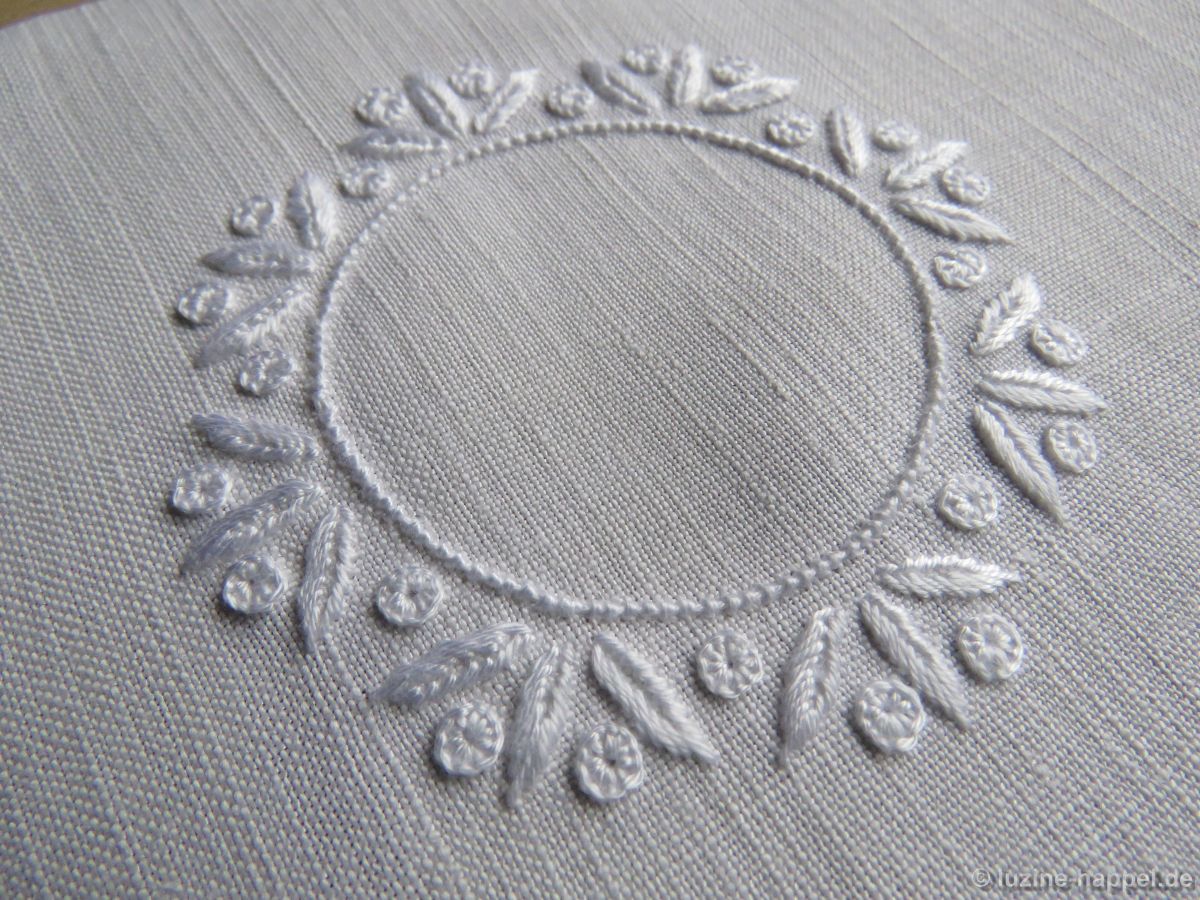
A Knife Point Doily

A doily with an extravagant knife point decoration is worked.
A circle design with a knife point outline is transferred to the center of a linen (16/cm thread count) square measuring 30 cm X 30 cm. The original design measures 12 cm in diameter.
2015-12-12_pdf
Coral Knot stitches are worked along the circle line using Coton à broder No. 16.
The knife points are worked with Satin stitches using Coton à broder No. 20. Please use the instructions here: Schwalm Designs – Knife Points (3).
MSpD_2Inside the Coral Knots stitches Chain stitches are worked using Coton à broder No. 25.
The shape is filled with pattern 475 using Coton à broder No. 30.
MSpD_3To get a hem decoration to match the center design, knife points of the same size (as those on the center design) are worked.

A hem of approximately 2 cm (+ 1 cm wide fold) is chosen. So from the linen square 30 cm X 30 cm a square of 20 cm X 20 cm is remaining. The base of one knife point measures 1.2 cm.
20 cm : 1.2 cm = 16.67
So 16 points can be worked.
16 X 1.2 cm = 19.2 cm
0.4 cm each side is taken to the additional hem width.
The basic line of the hem is 5.4 cm up from the edges, where a thread is withdrawn.

A design, with 16 points of 1.2 cm in the width and 2 cm in the height, is drawn on paper.
MSpD_4At one side a corner design is added. The knife point decoration is placed outwards from the basic line.
MSpD_5The design is transferred to the linen, along each side, always carefully watching that the withdrawn thread line has the exact same lenght of the paper design (ironing the linen in one or the other direction helps to get the right length).
MSpD_6After working the knife points, a thread is withdrawn 1 cm up from the edges.
MSpD_7The hem is fastened at the basic line.
MSpD_8Washed, starched and ironed a nice doily with an extravagant knife point decoration is finished.
MSpD_9

Marina’s Lovely Tablecloth

Some time ago a lady emailed me; included in the email were pictures of a beautiful project. It is absolutely worth seeing, so I want to share it with you now.
Marina_1In my post on 30 November 2013 I added a link to a special project. Simple_Spontaneity[1].pdf
In Canada Barbara Kershaw had started a group project, using as its focus and inspiration my book Fancy Hems. You can see the gorgeous results by following the project link. A very similar project was started by Erma Scrimgeour.
Marina_2As chance would have it, one of the students, Marina, had to move to Turkey; she took with her the newly commenced embroidery and my instruction book.

Now she has finished the project — u n a s s i s t e d !

The following is our correspondence:
I thought you might like to see my adaptation of your Fancy Hems design. I started working on it when I was living in Montreal, Canada. At the Lakeshore Creative Stitching Guild we organized a special group led by Erma Scrimgeour where we were stitching our tablecloths from your Fancy Hems book. It took me a while to finish it. During this time, I’ve managed to move from Canada to Turkey and this was my first piece that I’ve finished at the new place. It’s the first time I’ve attempted to tweak a design like this and I must say I’m pretty pleased with the end result. I thoroughly enjoyed stitching the design and look forward to your new releases.

Congratulations, Marina!

Your tablecloth looks sooo very pretty. All the details are perfectly worked: the different decorating stitches, the needleweaving, the Peahole hems and the double Peahole hems, and last but not least the corners! I especially love the small flower border and the matching ornament in the corners very much.Marina_3
Marina told me, she used Strathaven linen which is about 32/33/inch thread count (13/cm thread count). She also used a combination of threads: pearl cotton #8 thread for the satin stitch (she wanted some shine for the satin stitch), and coton à border #20 for needle weaving, and #25 for pulled stitches.Marina_4
Always enjoy embroidery—maybe your new friends will want to follow your example and work a similar tablecloth.

Good luck in your new home and thanks for sharing, Marina!Marina_5