A Small Doily

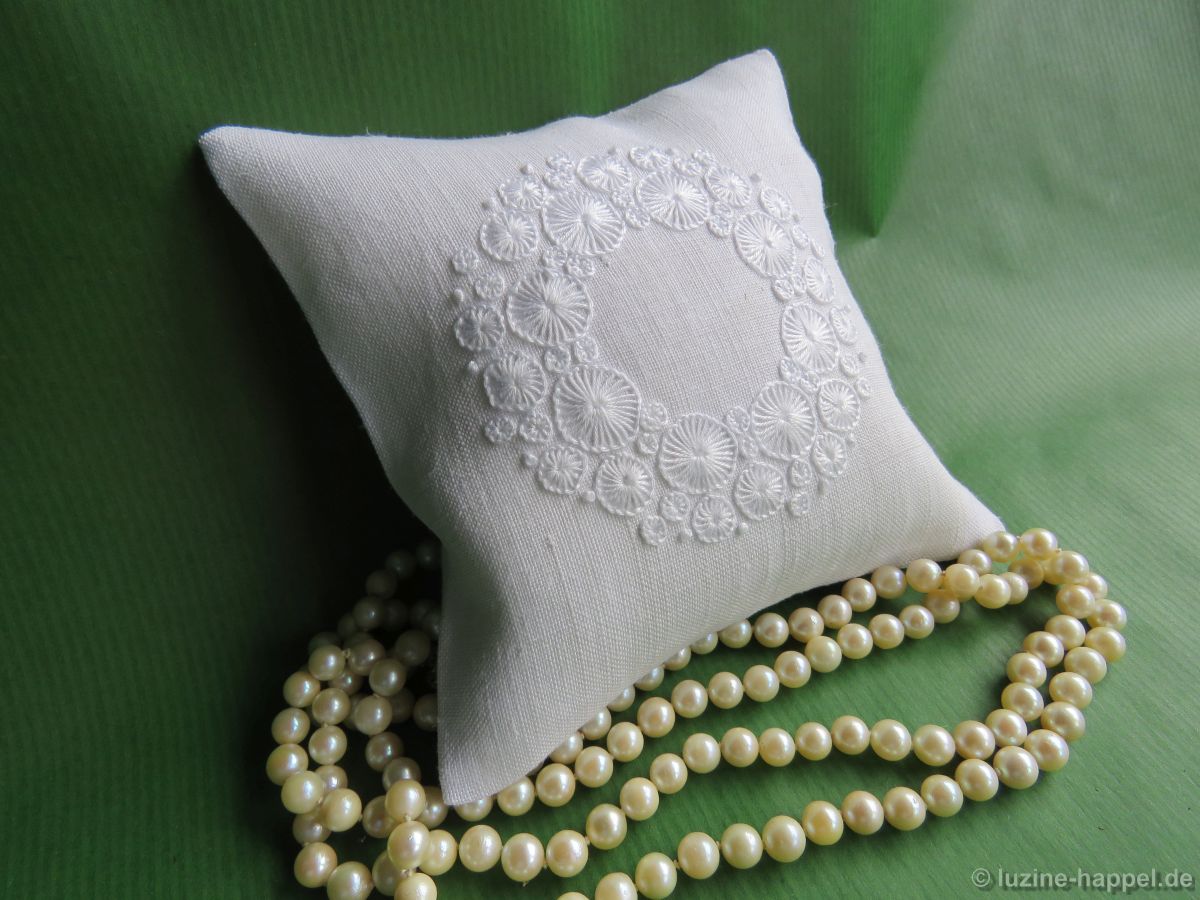
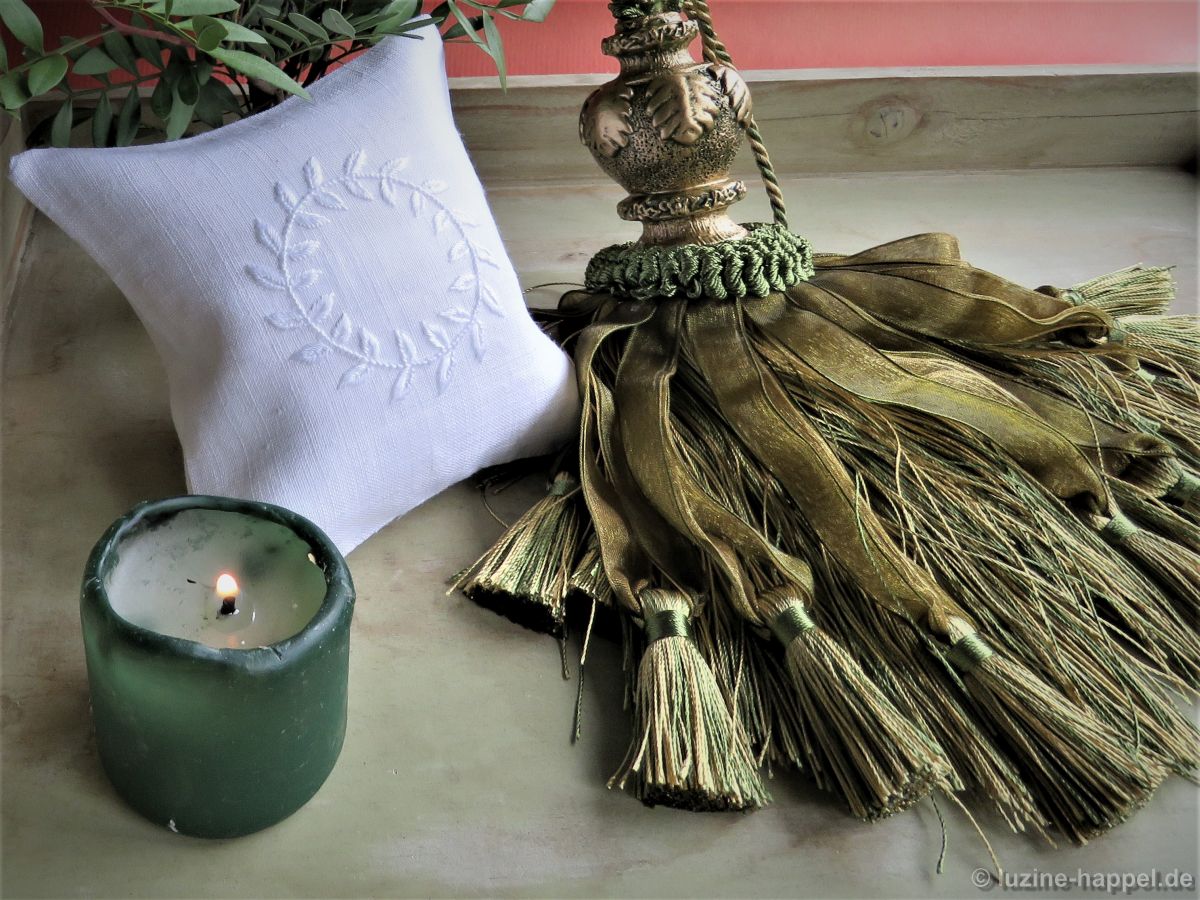
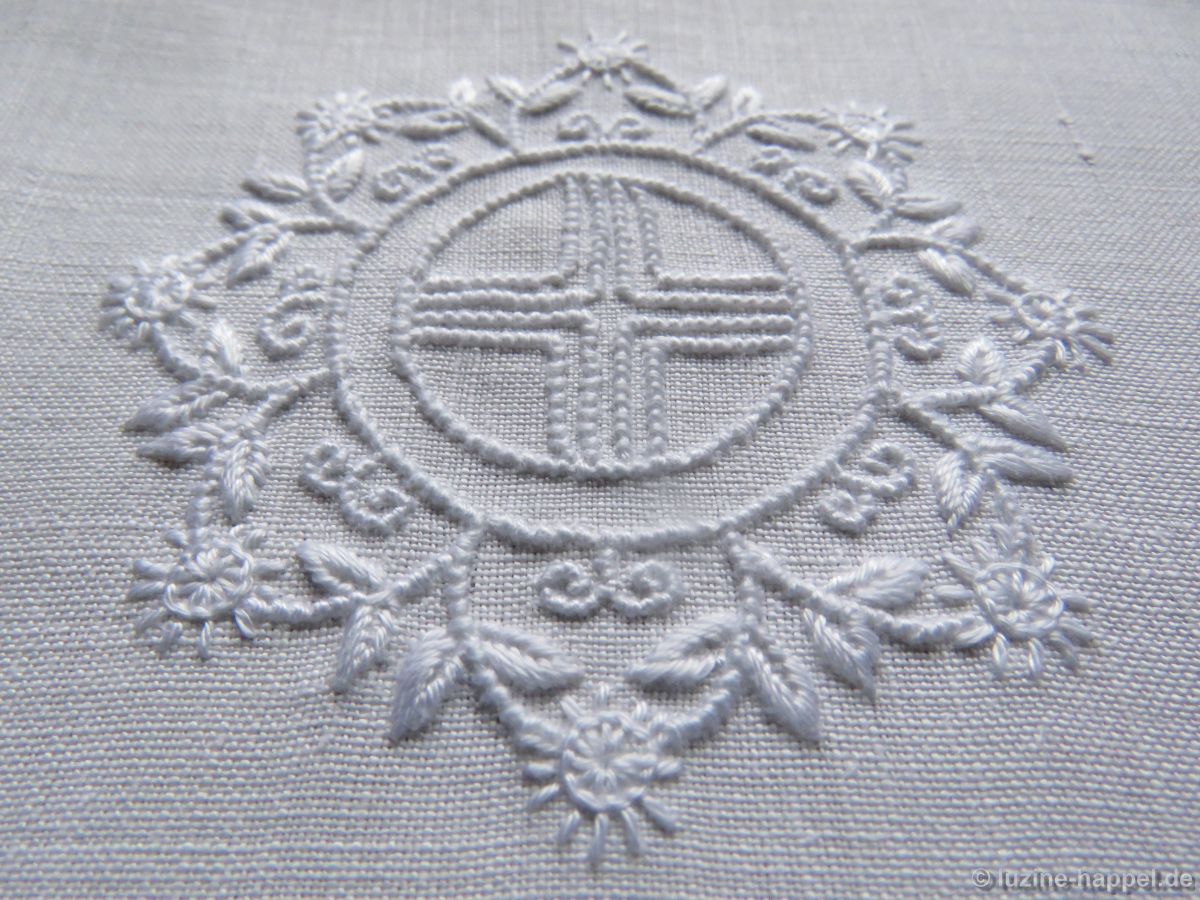
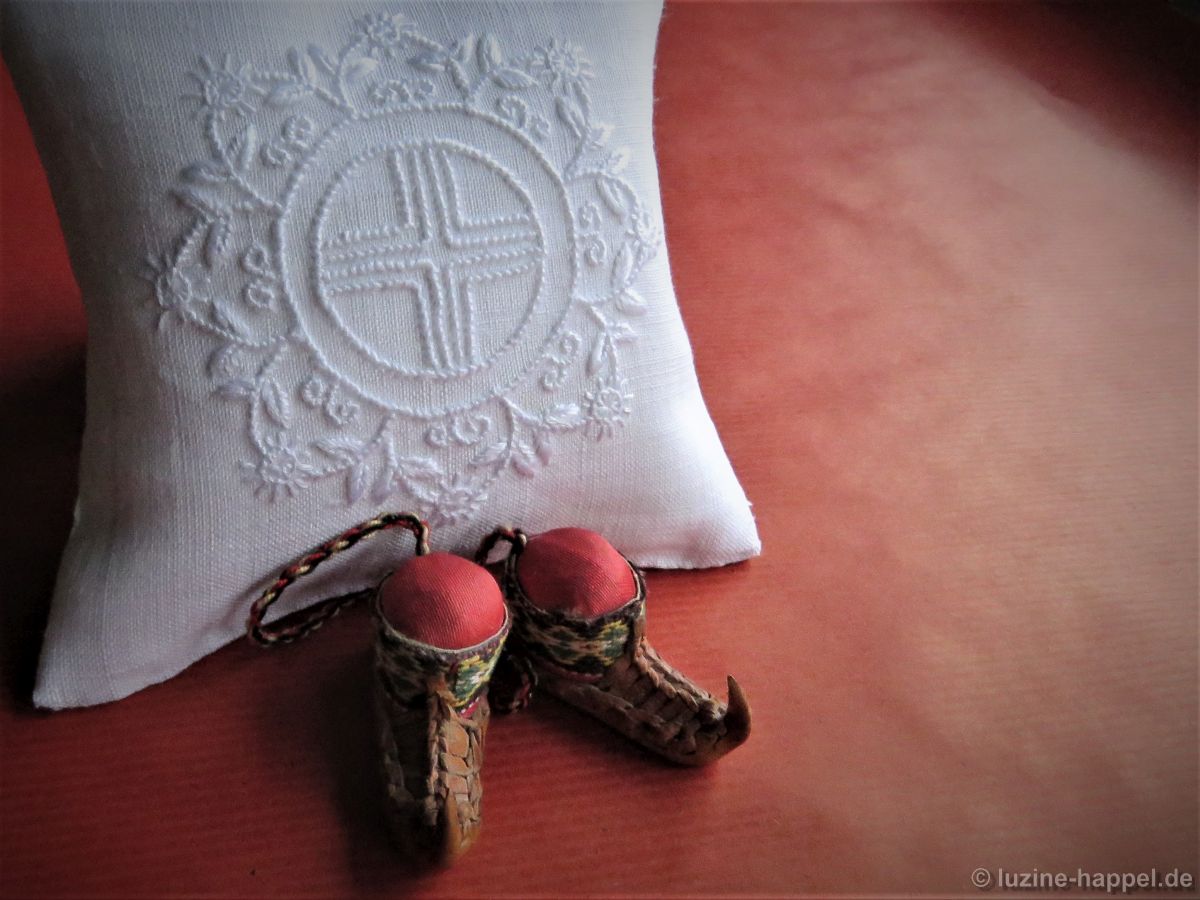
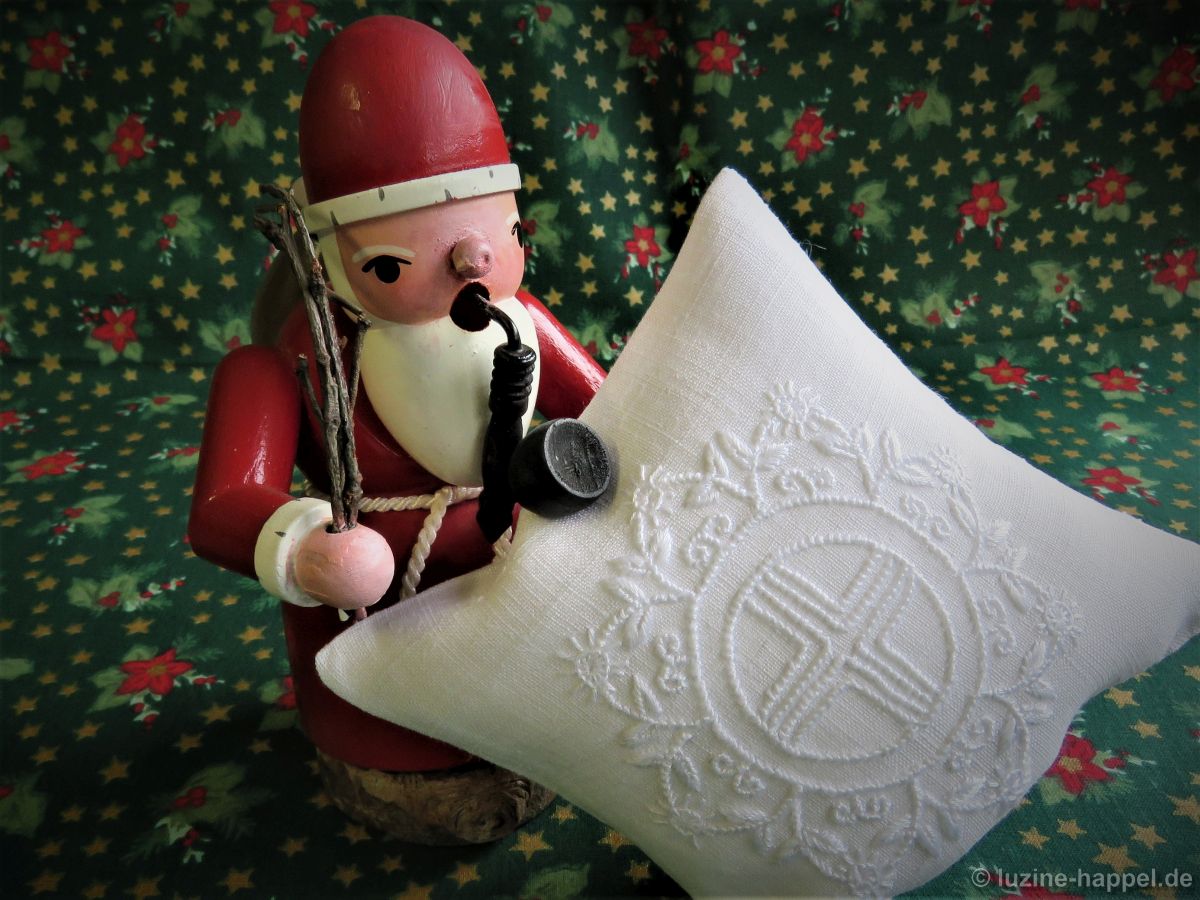
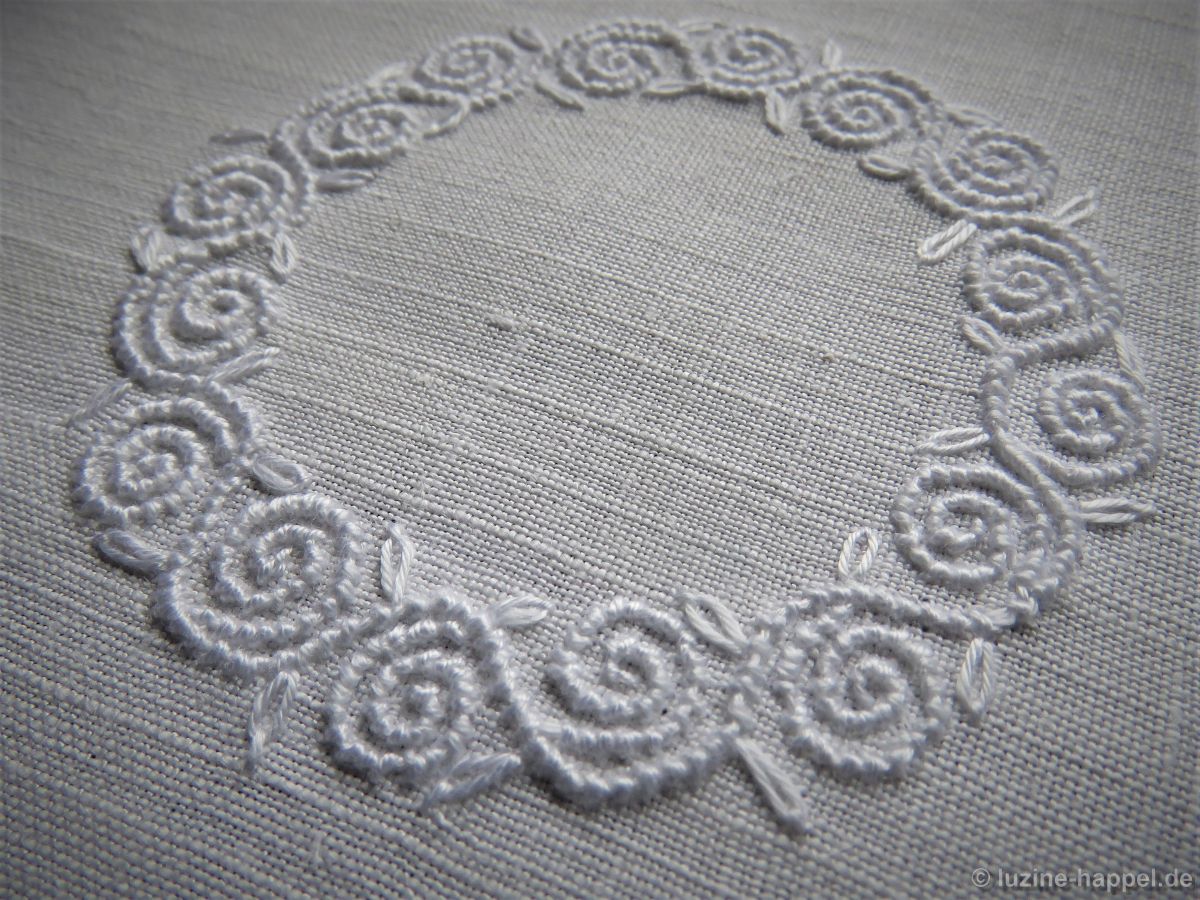
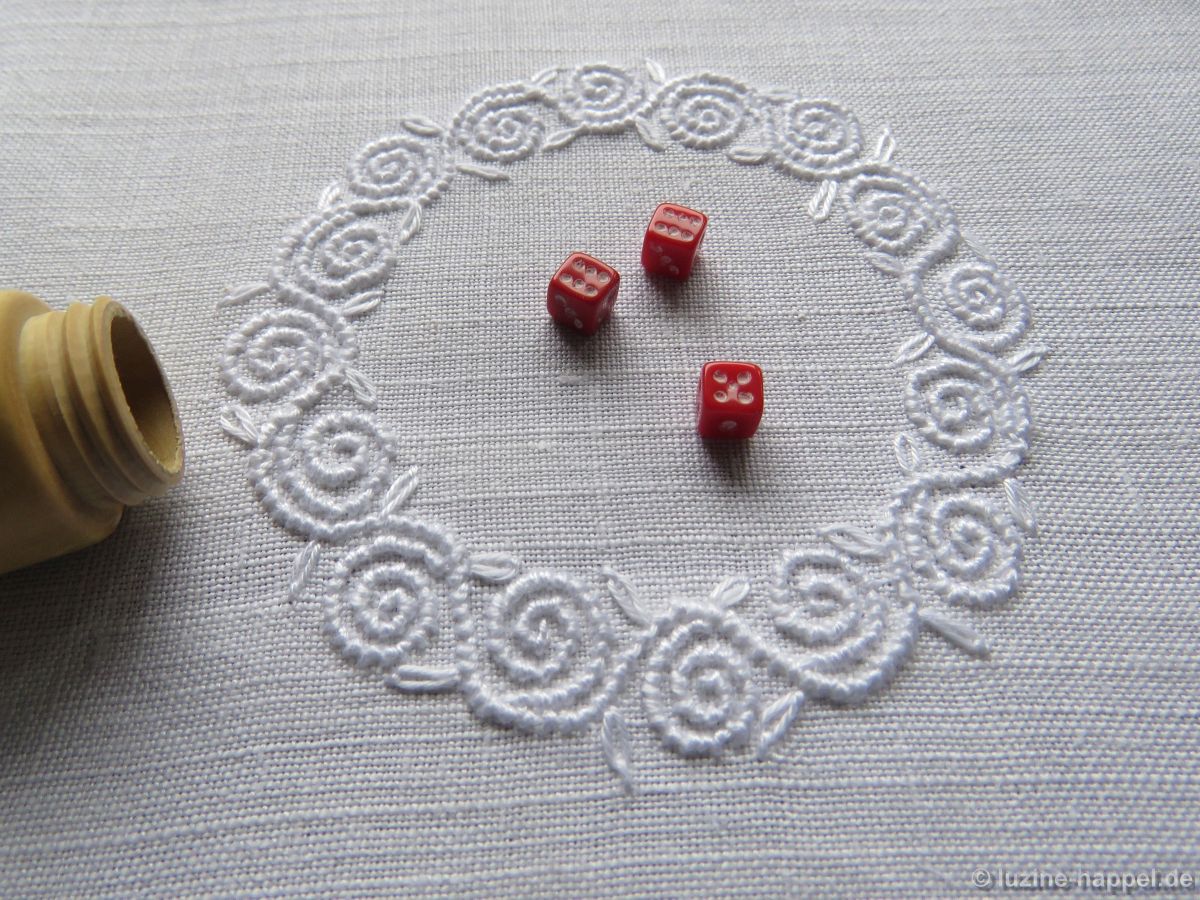
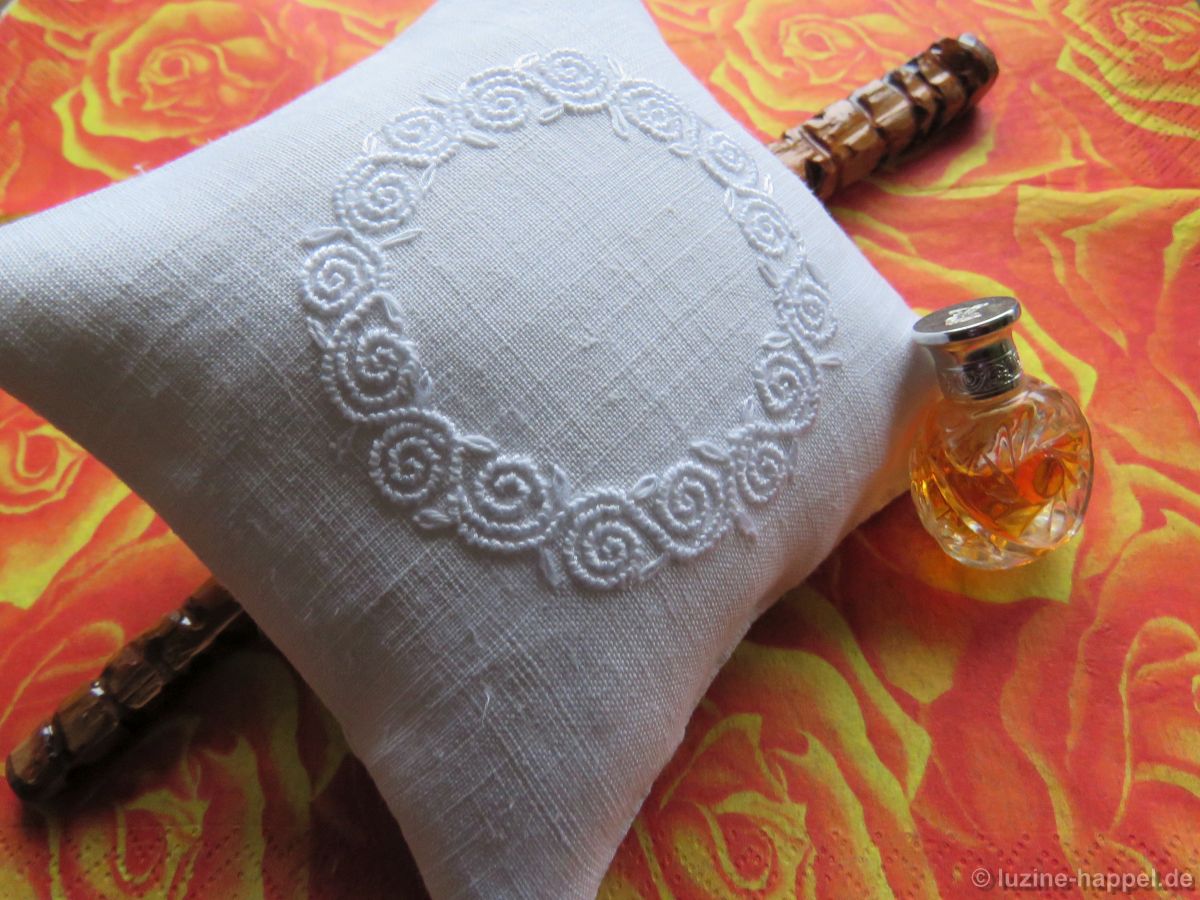
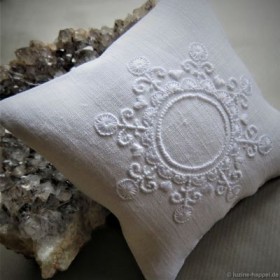
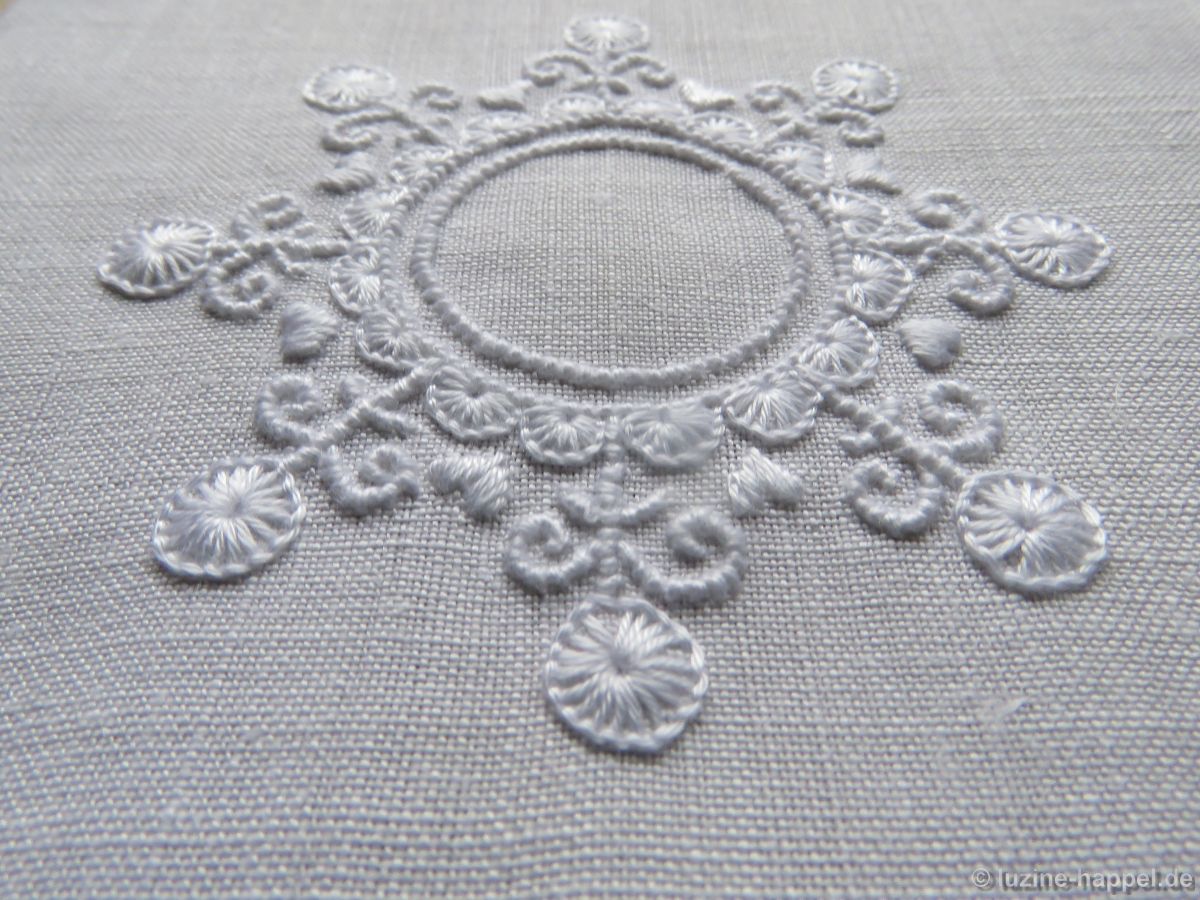
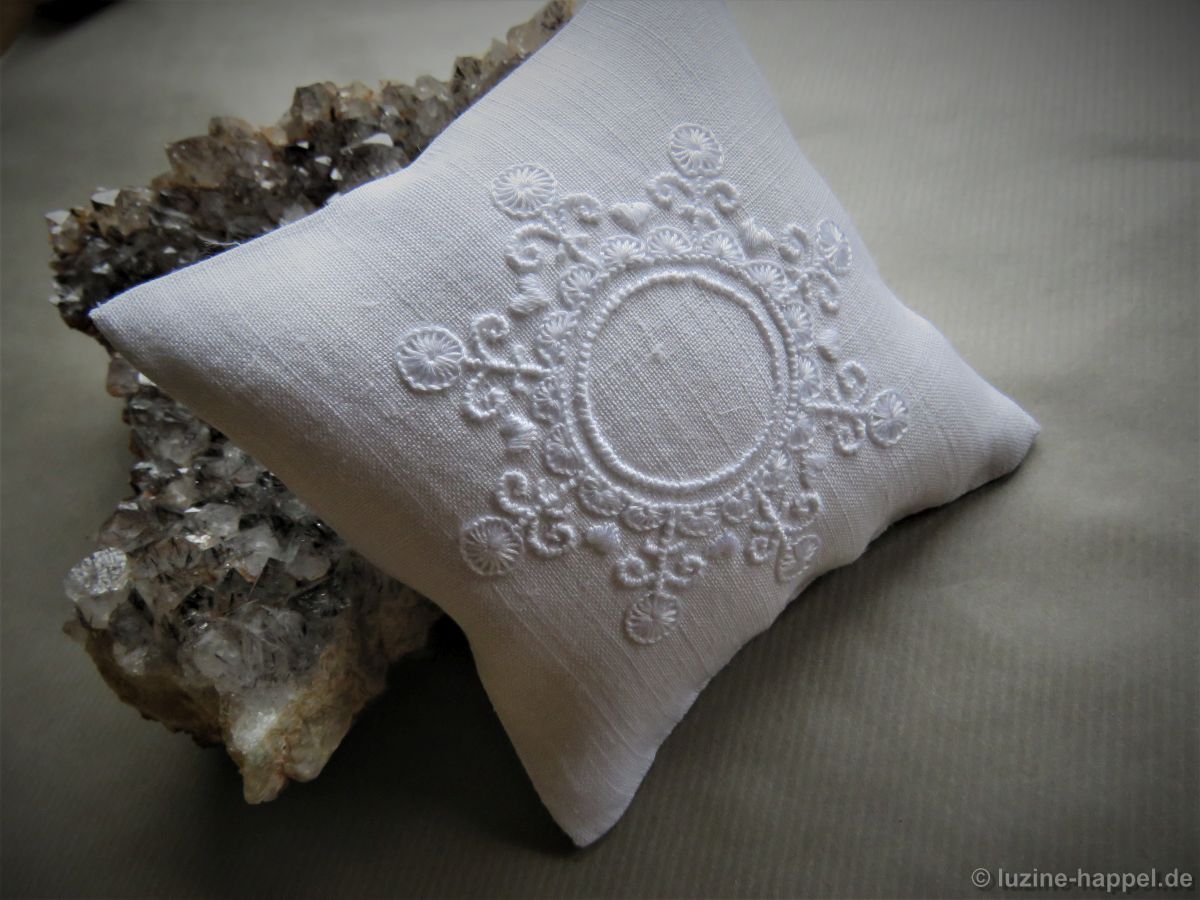
A small doily with a center design is worked.
The design, a circle with a leaves and scallops, is transferred to the center of a piece of linen (13.5/cm thread count) measuring 20 cm X 20 cm.
474_d_1The original design measures 8.5 cm X 8.5 cm.
2015-11-07_pdf
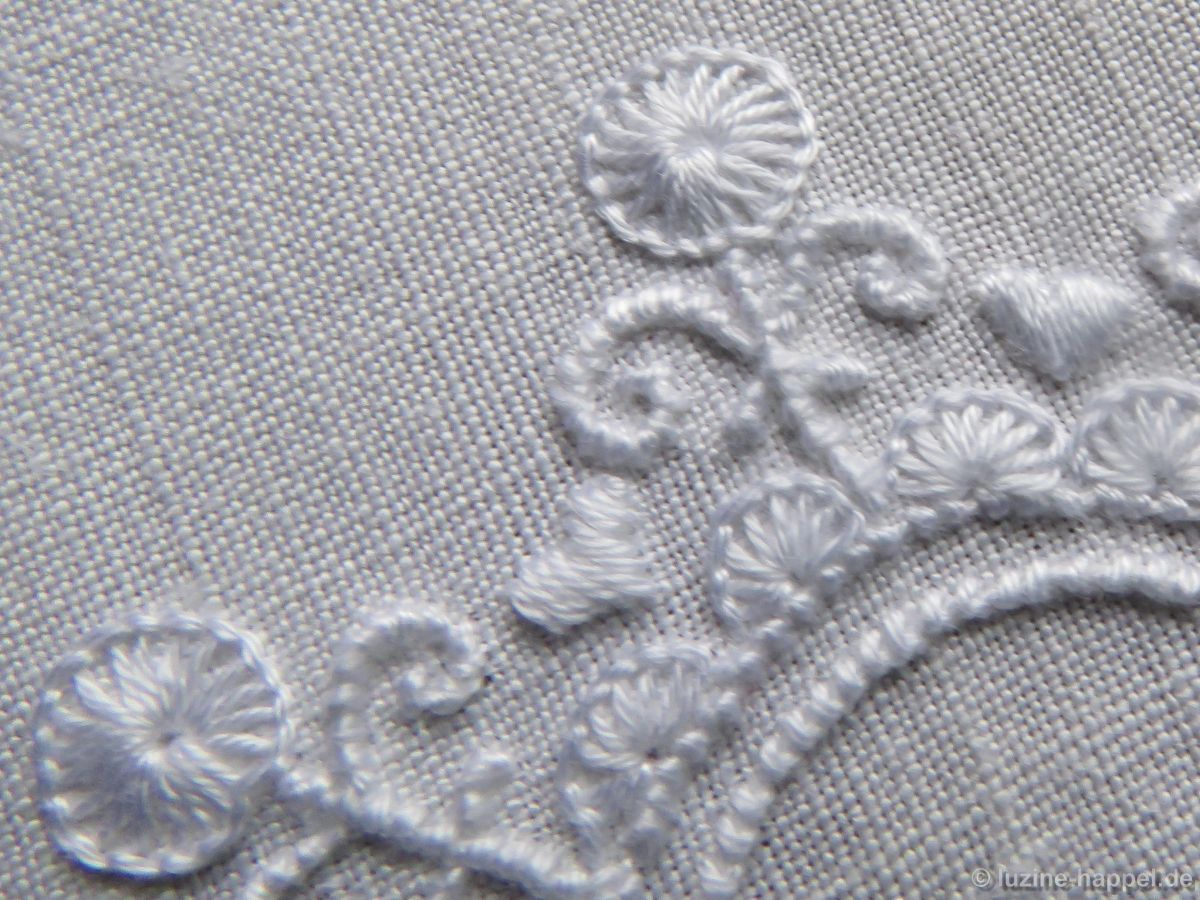
Coral Knot stitches are worked along the circle line using Coton à broder No. 16.
Using Coton à broder No. 20 for both, the leaves are worked with Satin stitches, and the scallops are worked with Blanket stitches.
474_d_3Inside the Coral Knot stitches, Chain stitches are worked using Coton à broder No. 25.
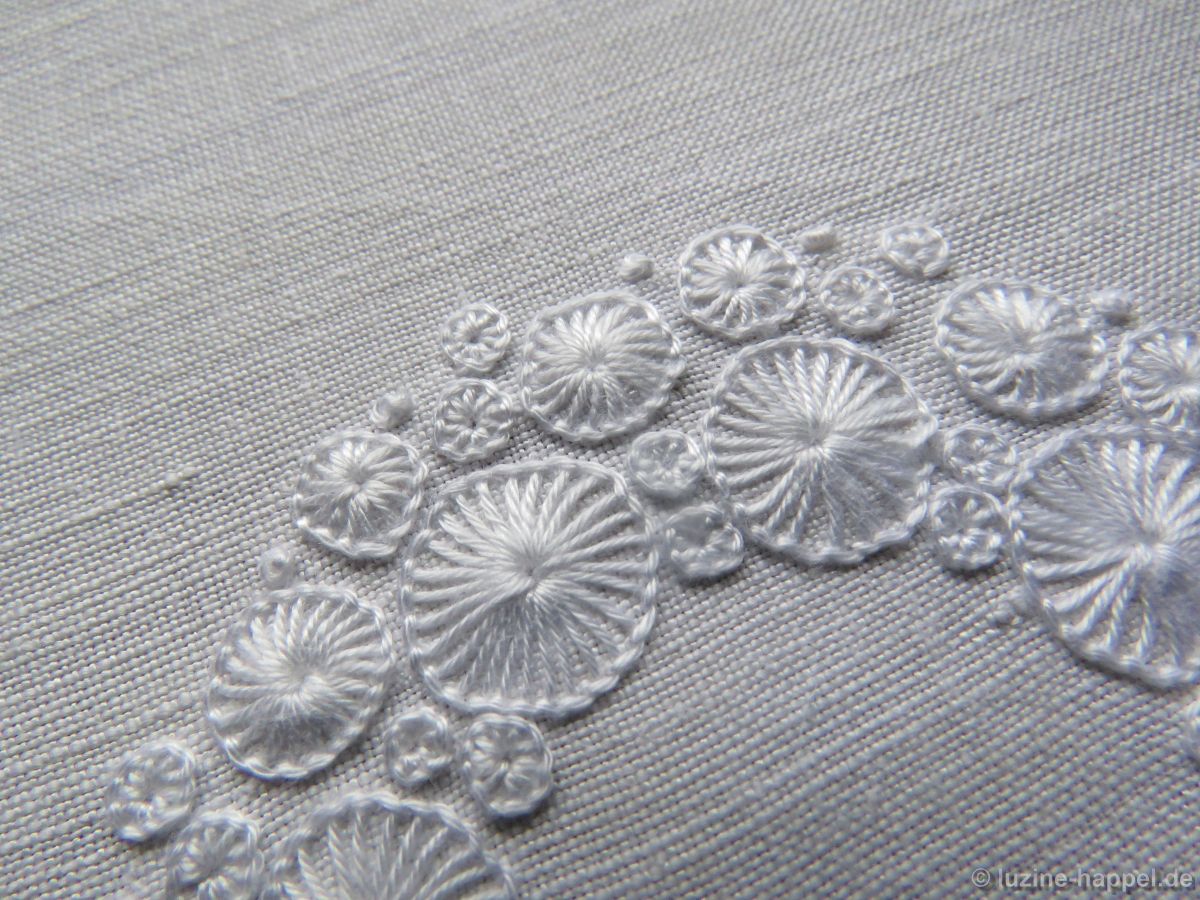
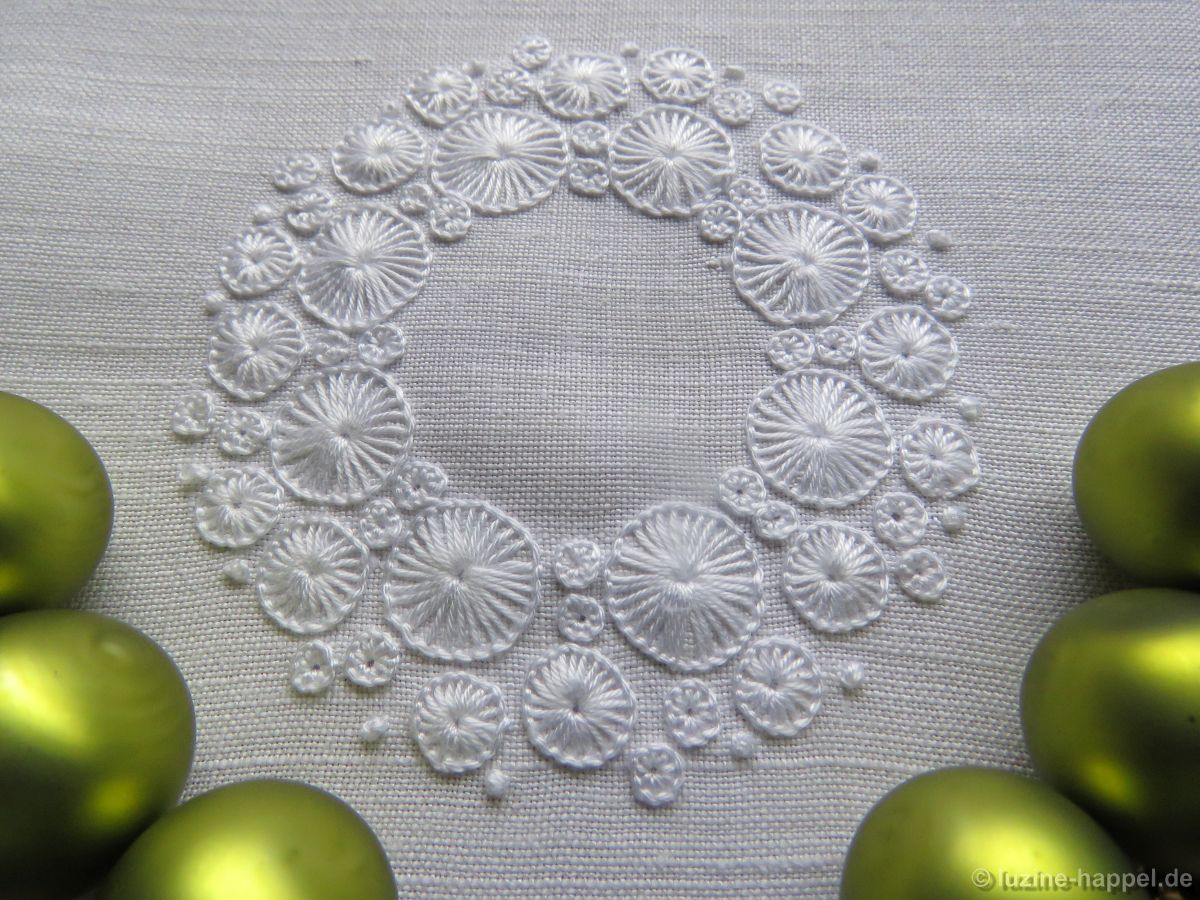
The circle is filled with pattern 474, using Coton à broder No. 30.
474_d_4A hem depth of 2 cm (+ 1 cm fold) is chosen.
So, for the basic line of the hem, a thread is withdrawn 5 cm in from the edges, and a second thread, adjacent to and inward of the thread just removed, is also withdrawn. For the fold a thread is withdrawn 1 cm from the edges.
474_d_5The 1 cm fold and the 2 cm hem is marked by creasing the linen using your thumbnail or other tool.
The corner is trimmed on the bias 1 cm outside the intersection of the creased hem lines.
474_d_6The 1 cm, bias-cut seam allowance at the corner is folded back,
474_d_7the hem is laid into place, basted, and secured with hem stitches.
474_d_8Hem stitches are also worked along the inside edge of the withdrawn thread line in order to maintain a stable and regular edge.
474_d_9The corners are sewn with small invisible hand stitches.
474_d_10The basting threads are removed.
474_d_11Washed, starched and ironed a nice small doily is finished.
474_d_12

A Bolster Cover Embroidered with Schwalm Borders

A beautiful, eye-catching bolster cover is embroidered with Schwalm borders. Narrow Schwalm borders are worked relatively quickly. And it is always possible, just as the fancy takes one, to add more borders to a design.
Nackenrolle_1First a bolster pillow form must be found. The bolster pictured has a pillow form that measures 40 cm long with a 15 cm diameter.
A linen piece was cut to a size of 58 cm X 52 cm.

Along the 58 cm edge, measure out 20 cm from the center axis to both ends and work Four Sided stitches along these two lines. These lines will mark the ends of the roll later.
Nackenrolle_2Inwards of the two Four Sided stitch rows, typical Schwalm borders are embroidered. A great quantity of similar Schwalm borders can be found in the booklet Schwalm Curved Lines, Narrow Borders, and Ornamental Stitches.

In the middle, a design of three Schwalm borders is stitched—each border separated from the next with one row of Four sided stitches. A wide range of different filling patterns is used.

The edges at the two ends get hems measuring 2 cm + 1 cm fold. They are additionally decorated with needlelace.
Nackenrolle_3Before sewing the long edges together, the piece is washed for shrinkage.

Then it is ironed and sewn together. Begin and end the long seam before the hems. A cord—for gathering and closing the ends—is inserted into the hems of the bolster cover.
Nackenrolle_4The pillow form is inserted into the embroidered bolster cover, and the ends are gathered and closed.
Nackenrolle_5A very decorative bolster is finished.
Nackenrolle_6Of course such narrow border designs have a multitude of applications. The designs can be re-sized to become suitable for different kinds of miniatures, for example a pincushion roll or a pincushion square.

I hope I have given you some good ideas for Christmas gifts!

One Schwalm Design – Two Interpretations (7)

Filling the open areas between the motifs – typical in Schwalm whitework – tendrils, small leaves and small flowers were worked. Embroidering these small embellishments is straightforward with little opportunity for variations, so both runners are very similar in these areas.
Bild_45
The tendrils on the oval runner were worked with Coton à broder No. 20.
Bild_46
The tendrils on the rectangular runner were worked with Coton à broder No. 16.
Bild_47
Bild_48
For the short stem with small flowers and rounded leaves on the oval runner Coton à broder No. 20 was used for the Coral Knot stitches and No. 25 for the Blanket stitches.
Bild_49
On the rectangular runner the leaves were worked using Satin stitches instead of Blanket stitches.
Coton à broder No. 16 was used for the Coral Knot stitches, No. 20 for the Blanket stitches and Satin stitches.
Bild_50
Of course, the same threads were used on the remaining stems with small leaves and small flowers.
Bild_51
On the oval runner Coton à broder No. 20 was used for the Coral Knot stitches and No. 25 for the Blanket stitches.
Bild_52
On the rectangular runner the leaves were again worked using Satin stitches instead of Blanket stitches. Coton à broder No. 16 was used for the Coral Knot stitches, No. 20 for the Blanket stitches and Satin stitches.
Bild_53
The first part of this series can be found here.
The previous part of this series can be found here.

This comparison of two embroideries using the same outline design shows the wide range of possibilities one has in choosing filling patterns, stitches, thread weight, and hem decoration.
Abundant variations make Schwalm whitework unique, and the working of it so exciting.

One Schwalm Design – Two Interpretations (6)

Along the sides of the longitudinal axis three different smaller motifs are found: one tulip and two circle shapes. The first circles (here a little bit enlarged) are surrounded with “2 short–2 long”.
Bild_36On the oval runner “2 short-2 long” was stitched closely following the marked lines; the thread used was too thin. The result is not 100% satisfactory.

The circle was filled with the Limet pattern “Limetrosen” (Limetrosen I, page 27).

Coton à broder in the following sizes was used: No. 20 for the Coral Knot stitches, No. 25 for the Satin stitches, No. 30 for the Chain stitches and the filling pattern.
Bild_37On the rectangular runner the stitches were more densely placed and a thicker thread was used.

The circle was filled with the Limet pattern “Kleines Ochsenaugenraster” (Limetrosen I, page 15).

Coton à broder in the following sizes was used: No. 16 for the Coral Knot stitches, No. 20 for the Satin stitches, No. 25 for the Chain stitches and the filling pattern.
Bild_38The second circles (here enlarged) are surrounded with scallops.
Bild_39On the oval runner all lines were covered with Coral Knot stitches. Inside the scallops Chain stitches were worked beside the Coral Knot stitches. The inside areas of the scallops remain unworked.

The circle was filled with the Limet pattern “Rosenstiche” (Basic Principles of Schwalm Whitework, pages 50-52).

Coton à broder in the following sizes was used: No. 20 for the Coral Knot stitches, No. 30 for the Chain stitches and the filling pattern.
Bild_40On the rectangular runner the scallops were worked as half-eyelet scallops (Basic Principles of Schwalm Whitework, page 24).

The circle was filled with the openwork pattern “Double Crosses – in straight rows” (Openwork Pattern Samplers, pages 46 and 47).

Coton à broder in the following sizes was used: No. 16 for the Coral Knot stitches and the filling pattern, No. 20 for the Blanket stitches, No. 25 for the Chain stitches.
Bild_41The small tulip motif looks like this:
Bild_42On the oval runner all lines were covered with Coral Knot stitches. The outside petals were filled with Satin stitches. The areas between the outside petals and the center remain unworked.

The center section of the tulip was filled with the Limet pattern “Gefieder” (Limetrosen I, page 9).

Coton à broder in the following sizes was used: No. 20 for the Coral Knot stitches, No. 25 for the Satin stitches, No. 30 for the Chain stitches and the filling pattern.
Bild_43On the rectangular runner all lines were covered with Coral Knot stitches, and the outside petals were filled with Satin stitches. The areas between the outside petals and the center were surrounded with Chain stitches. The inside spaces remain unworked.

The center section of the tulip was filled with the Limet pattern “Diagonal Cross Filling stitch” (Basic Principles of Schwalm Whitework, pages 39 and 40).

Coton à broder in the following sizes was used: No. 16 for the Coral Knot stitches, No. 20 for the Satin stitches, No. 25 for the Chain stitches and the filling pattern.

Bild_44The first part of this series can be found here.
The previous part of this series can be found here.

One Schwalm Design – Two Interpretations (5)

The center circle is flanked by additional tulips. The outline is shown here a little bit enlarged:
Bild_31 The center part of the tulip is well suited for a filling pattern. Outside the center are 2 narrow, long and pointed petals on each side. How to stitch those forms?

To better accommodate the center section’s filling pattern, it would be possible to change the lines of the upper petals.
Bild_32 Regardless, the shapes of the outside petals are too narrow to embellish them with withdrawn thread patterns. There must be other ways.

On the oval runner the petals were embroidered with Satin stitches. To control the stitches and to keep them neat, the petals had to be divided. (More detailed information on how to stitch divided leaves can be found in Basic Principles of Schwalm Whitework, pages 29 and 30).
Bild_33 In the center part of the tulip the Limet Pattern “Kleiner Reißverschluss – versetzt gearbeitet” (Wickelstiche I, page 29) was worked.

Coton à broder in the following sizes was used: No. 20 for the Coral Knot stitches, No. 25 for the Satin stitches and the filling pattern, No. 30 for the Chain stitches.

It is also possible to stitch the outlines of the pointed petals with Coral Knot stitches and to fill the remaining area with Satin stitches (as worked on the rectangular runner, seen in the picture below).

As mentioned in an earlier post, in early Schwalm whitework there are many patterns suitable for long, narrow shapes. So, I used the opportunity to mix both techniques here also. In the bottom petals I used an element of the early Schwalm whitework embroidering a variation of the Wheatear stitch (Early Schwalm Whitework, page 75).
Bild_34 In the middle section of the tulip, one stripe of the Limet pattern “Krönchen” (Limetrosen I, page 55) was worked. The areas at both sides were filled with Four-Sided stitches. For the tulip opposite, I made some changes; the areas of the top petals, inside the Chain stitches, remain free of further embellishment, and I worked one row of Satin stitches between the “Krönchen” stitches to get the pattern centered.
Bild_35 Coton à broder in the following sizes was used: No.16 for the Coral Knot stitches, No. 20 for the Satin stitches and the variation of the Wheatear stitch, No. 25 for the Chain stitches and the filling pattern.

The first part of this series can be found here.
The previous part of this series can be found here.