Schwalm Band (16)

Filling Patterns of Section 1 II

The small tulips receive a simple horizontal thread withdrawing 3:1.

The area is embroidered with Honeycomb Darning stitches (coton à broder No. 20).

The circle receives a Limet thread withdrawing 3:1.

The area is embroidered with Röserich No. 453 in variant A2 (The most beautiful Röserich Filling Patterns, page 8).

This pattern only develops its special effect after washing.

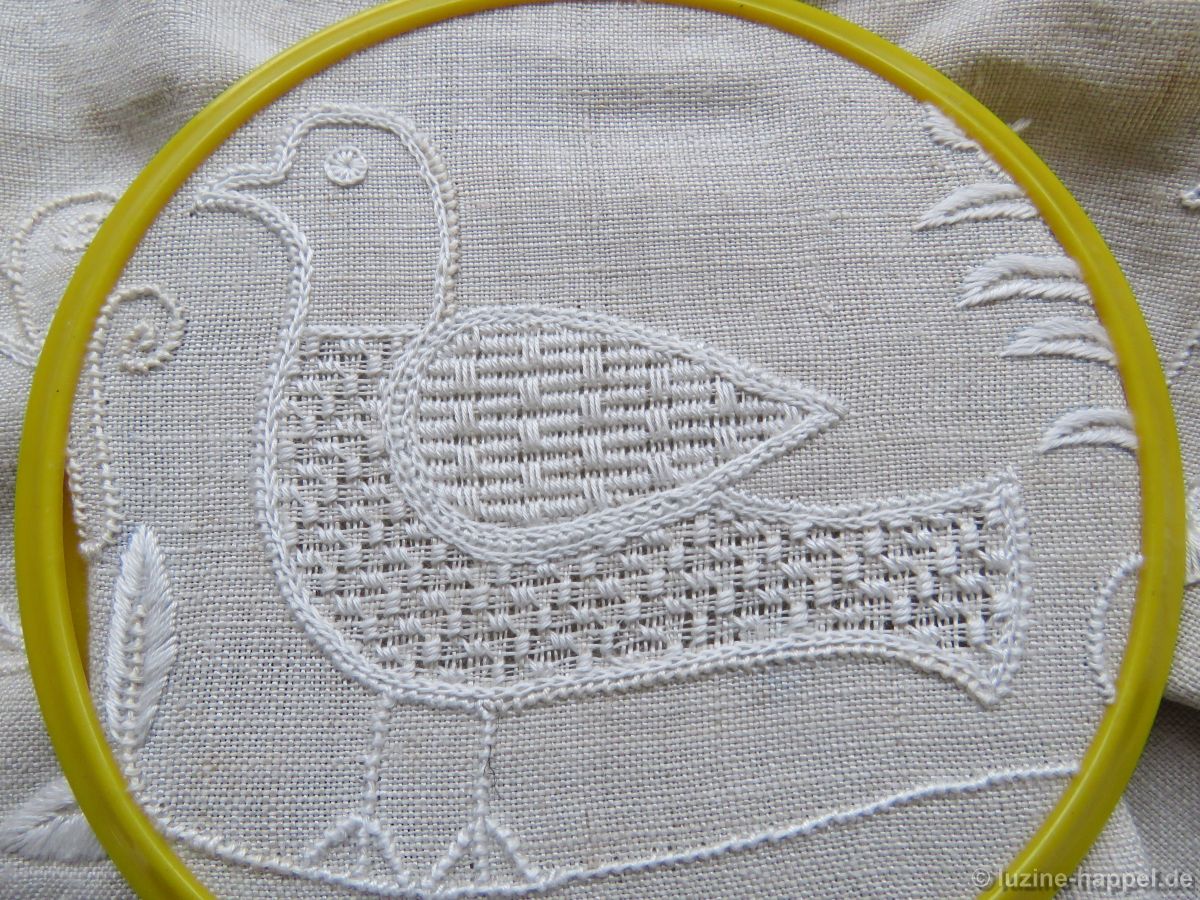
The birds’ bellies receive markings that match their shape and are approximately the same distance apart.

Then Raised Band Stem stitch b (Early Schwalm whitework, page 58) is worked using coton à broder No. 20.

The wings receive a simple vertical thread withdrawing 3:1. The area is embroidered with Wave stitches (coton à broder No. 20).

This means that the last section has also received its filling patterns.

Before the big finale with many beautiful pictures of the finished, magnificent embroidery, there will come a blog post describing the final work.

Schwalm Band – Outline Design
Schwalm Band (1) Design Transfer
Schwalm Band (2) – Preparatory work of section 5
Schwalm Band (3) – Preparatory work of section 4
Schwalm Band (4) – Preparatory work of the sections 3 – 1
Schwalm Band (5) – Filling Patterns of Section 5 II
Schwalm Band (6) – Filling Patterns of Section 5 I
Schwalm Band (7) – Filling Patterns of Section 4 b II
Schwalm Band (8) – Filling Patterns of Section 4 b I
Schwalm Band (9) – Filling Patterns of Section 4 a II
Schwalm Band (10) – Filling Patterns of Section 4 a I
Schwalm Band (11) – Filling Patterns of Section 3 II
Schwalm Band (12) – Filling Patterns of Section 3 I
Schwalm Band (13) – Filling Patterns of Section 2 II
Schwalm Band (14) – Filling Patterns of Section 2 I
Schwalm Band (15) – Filling Patterns of Section 1 II

Schwalm Band (15)

Filling Patterns of Section 1 II

The areas of the trefoil are relatively small. Therefore the middle receives a thread withdrawing of 2:1

and a Rose stitch pattern (coton à broder No. 30).

The sides are too tiny for withdrawing thread patterns. A large Daisy stitch on each side – except for the tip, overlaid at two other points so that it holds its shape –

and a smaller Daisy stitch placed in it forms the decoration (coton à broder No. 20).

The little heart receives a thread withdrawing 3:1

and the Limet pattern “Pigtails” (coton à broder No. 25) (Limetrosen I, page 14).

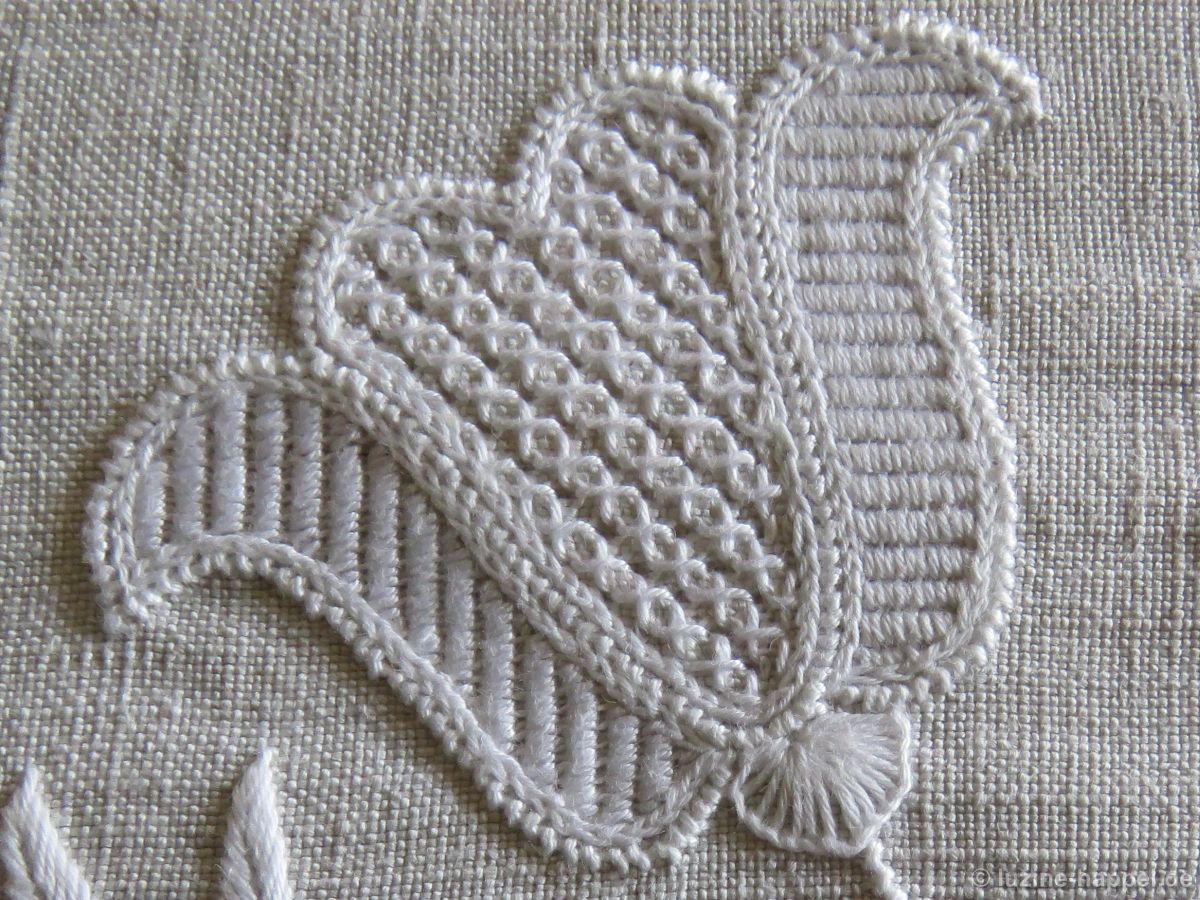
The small tulip receives a thread withdrawing of 2:1.

Filling pattern No. 549 is embroidered with coton à broder No. 25.

The wing of the very large bird receives a thread withdrawing of 3:1.

With coton à broder No. 20 is a strip of the filling pattern No. 578, framed by a row of Stain stitches. The remaining area is filled with Four-Sided stitches.

The bird’s belly should be embroidered with Four-Sided stitches to match the wing. To do this, the thread is withdrawn 3:1 to the edge of the neck.

Four-Sided stitches are embroidered in the Limet grid (coton à broder No. 20). A Satin stitch bar is placed between the head and body as a finish (coton à broder No. 20).

The bleeding heart receives a thread withdrawing 3:1.

With coton à broder No. 20 filling pattern No. 577 is embroidered.

This means that Section 1 II also received its filling patterns. There is only one more section left to be mastered. As always, all patterns look more striking after washing.

Schwalm Band – Outline Design
Schwalm Band (1) Design Transfer
Schwalm Band (2) – Preparatory work of section 5
Schwalm Band (3) – Preparatory work of section 4
Schwalm Band (4) – Preparatory work of the sections 3 – 1
Schwalm Band (5) – Filling Patterns of Section 5 II
Schwalm Band (6) – Filling Patterns of Section 5 I
Schwalm Band (7) – Filling Patterns of Section 4 b II
Schwalm Band (8) – Filling Patterns of Section 4 b I
Schwalm Band (9) – Filling Patterns of Section 4 a II
Schwalm Band (10) – Filling Patterns of Section 4 a I
Schwalm Band (11) – Filling Patterns of Section 3 II
Schwalm Band (12) – Filling Patterns of Section 3 I
Schwalm Band (13) – Filling Patterns of Section 2 II
Schwalm Band (14) – Filling Patterns of Section 2 I

Schwalm Band (14)

Filling Patterns of Section 2 I

Since I accidentally showed the daisy in the previous blog post and the small buds were transformed into leaves in the outline drawing, only the large tulip remains from this section.

Thread withdrawing is made 3:1.

A pattern similar to filling pattern No. 569 is embroidered with coton à broder No. 20, but here not as openwork, but as Limet pattern. As such, I like it even better.

The tulip tip also receives a 3:1 thread withdrawing.

Using coton à broder No.20, Four-Sided stitches are embroidered, alternating one row from the front and one row from the back.

It doesn’t look particularly spectacular at first, but after laundry the picture changes.

This means that Section 2 I also received its filling patterns.

Schwalm Band – Outline Design
Schwalm Band (1) Design Transfer
Schwalm Band (2) – Preparatory work of section 5
Schwalm Band (3) – Preparatory work of section 4
Schwalm Band (4) – Preparatory work of the sections 3 – 1
Schwalm Band (5) – Filling Patterns of Section 5 II
Schwalm Band (6) – Filling Patterns of Section 5 I
Schwalm Band (7) – Filling Patterns of Section 4 b II
Schwalm Band (8) – Filling Patterns of Section 4 b I
Schwalm Band (9) – Filling Patterns of Section 4 a II
Schwalm Band (10) – Filling Patterns of Section 4 a I
Schwalm Band (11) – Filling Patterns of Section 3 II
Schwalm Band (12) – Filling Patterns of Section 3 I
Schwalm Band (13) – Filling Patterns of Section 2 II

Schwalm Band (13)

Filling Patterns of Section 2 II

The middle part of the pomegranate should have an openwork pattern. Therefore the thread withdrawing is made 2:2. The grid is secured with Cable stitches (coton à broder No. 30).

Filling pattern “Needle-weaving stitches with spiders” (Openwork Pattern Samplers, pages 72 and 73) is embroidered with coton à broder No. 20 .

The sides of the pomegranates do not receive any thread withdrawing. With coton à broder No. 16 horizontal Daisy stitches are worked adjacent to the openwork pattern area. The outer area is decorated with Feather stitches.

I embroider a tendril of monastery stitch/overlay stitch on the fluffed bird with coton à broder No. 16 and No. 30.

The little heart receives a 2:2 thread withdrawing and only a Cable stitch grid (coton à broder No. 20).

I like the tiny tulip buds better without any additional filling.

The daisies could be decorated with a daisy stitch with a very long overlay stitch in each petal. I gave up on it.

This means that Section 2 II also received its filling patterns.

Schwalm Band – Outline Design
Schwalm Band (1) Design Transfer
Schwalm Band (2) – Preparatory work of section 5
Schwalm Band (3) – Preparatory work of section 4
Schwalm Band (4) – Preparatory work of the sections 3 – 1
Schwalm Band (5) – Filling Patterns of Section 5 II
Schwalm Band (6) – Filling Patterns of Section 5 I
Schwalm Band (7) – Filling Patterns of Section 4 b II
Schwalm Band (8) – Filling Patterns of Section 4 b I
Schwalm Band (9) – Filling Patterns of Section 4 a II
Schwalm Band (10) – Filling Patterns of Section 4 a I
Schwalm Band (11) – Filling Patterns of Section 3 II
Schwalm Band (12) – Filling Patterns of Section 3 I

Schwalm Band (12)

Filling Patterns of Section 3 I

The areas of the tiny hearts are very small. They will not receive a thread withdrawing. Using 2 strands of the 6-ply stranded cotton, Satin stitches are embroidered from the central axis to both sides, falling towards the base of the leaf.

The wings of the next bird get a thread withdrawing of 2:2.

The filling pattern “Diagonal Cross Filling–French Variation/half with a gap” Openwork Pattern Samplers, pages 35-37) is embroidered (coton à broder No. 20).

The birds’ bellies are given a less conspicuous pattern in contrast to the conspicuous wing pattern. To do this, threads are only withdrawn horizontally 3:1.

Back Honeycomb Darning stitch is done with coton à broder No. 20.

As with all other stitches, they look more prominent after washing.

The circles receive a thread withdrawing of 3:1.

The filling pattern consists of alternating Satin stitch bars and rows of Four-Sided stitches (coton à broder No. 20) arranged at right angles to the center.
All Satin stitches are embroidered first because the Four-Sided stitches bundle fabric threads and it is difficult to stitch between the bundled fabric threads afterwards.

This means that Section 3 I also received its filling patterns.

Schwalm Band – Outline Design
Schwalm Band (1) Design Transfer
Schwalm Band (2) – Preparatory work of section 5
Schwalm Band (3) – Preparatory work of section 4
Schwalm Band (4) – Preparatory work of the sections 3 – 1
Schwalm Band (5) – Filling Patterns of Section 5 II
Schwalm Band (6) – Filling Patterns of Section 5 I
Schwalm Band (7) – Filling Patterns of Section 4 b II
Schwalm Band (8) – Filling Patterns of Section 4 b I
Schwalm Band (9) – Filling Patterns of Section 4 a II
Schwalm Band (10) – Filling Patterns of Section 4 a I
Schwalm Band (11) – Filling Patterns of Section 3 II