Another Easter Egg

After completing my tests, I calmly and very carefully allowed another egg to develop.
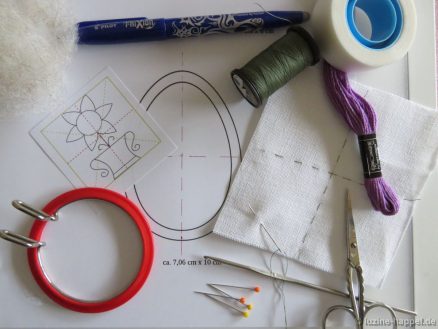
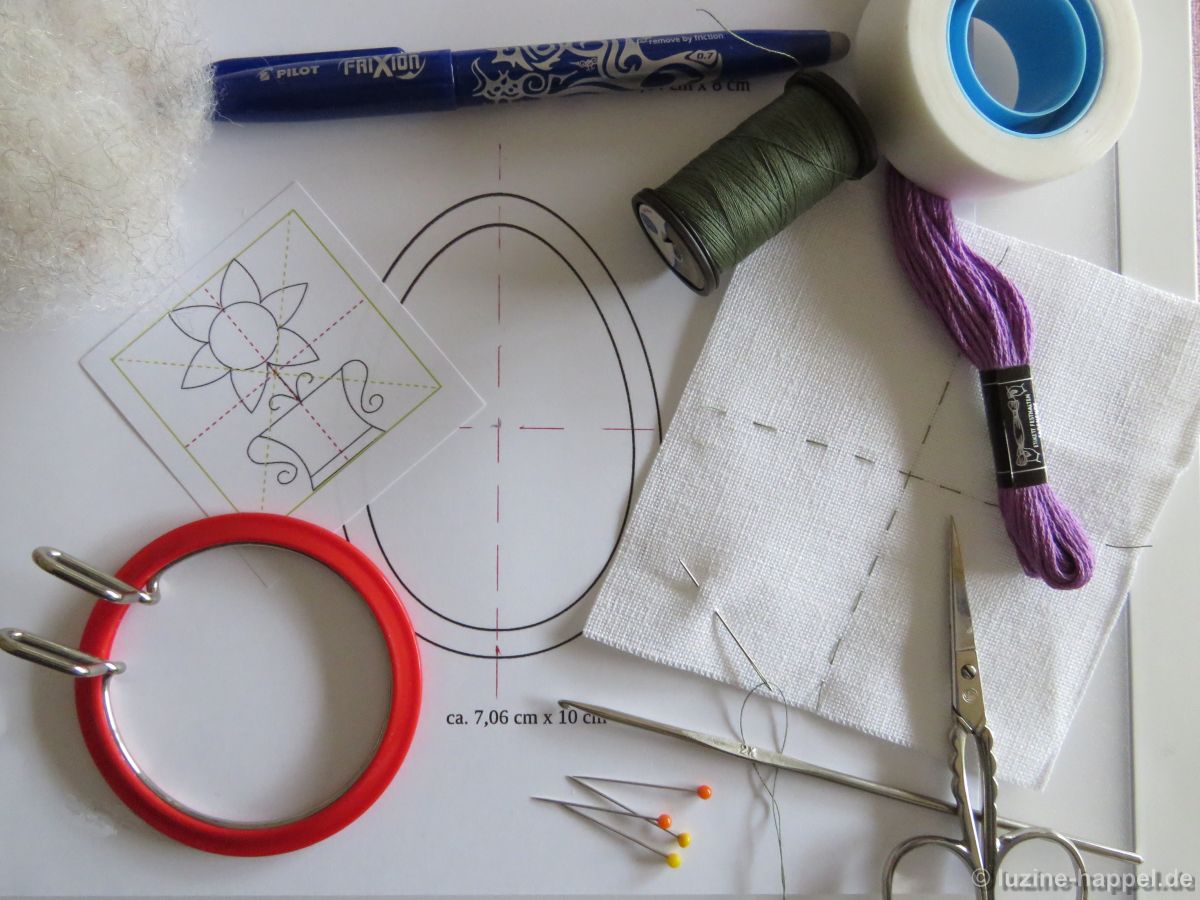
The necessary materials have been gathered.

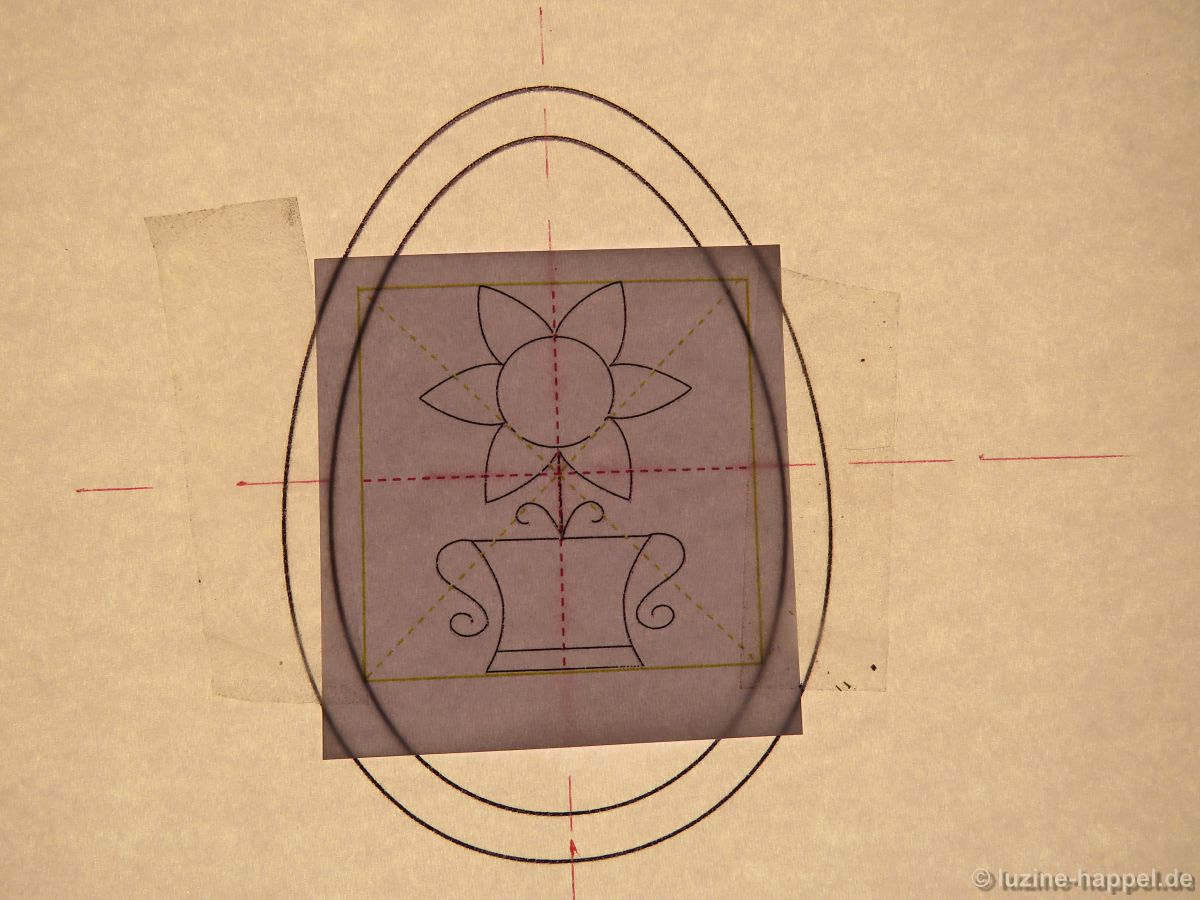
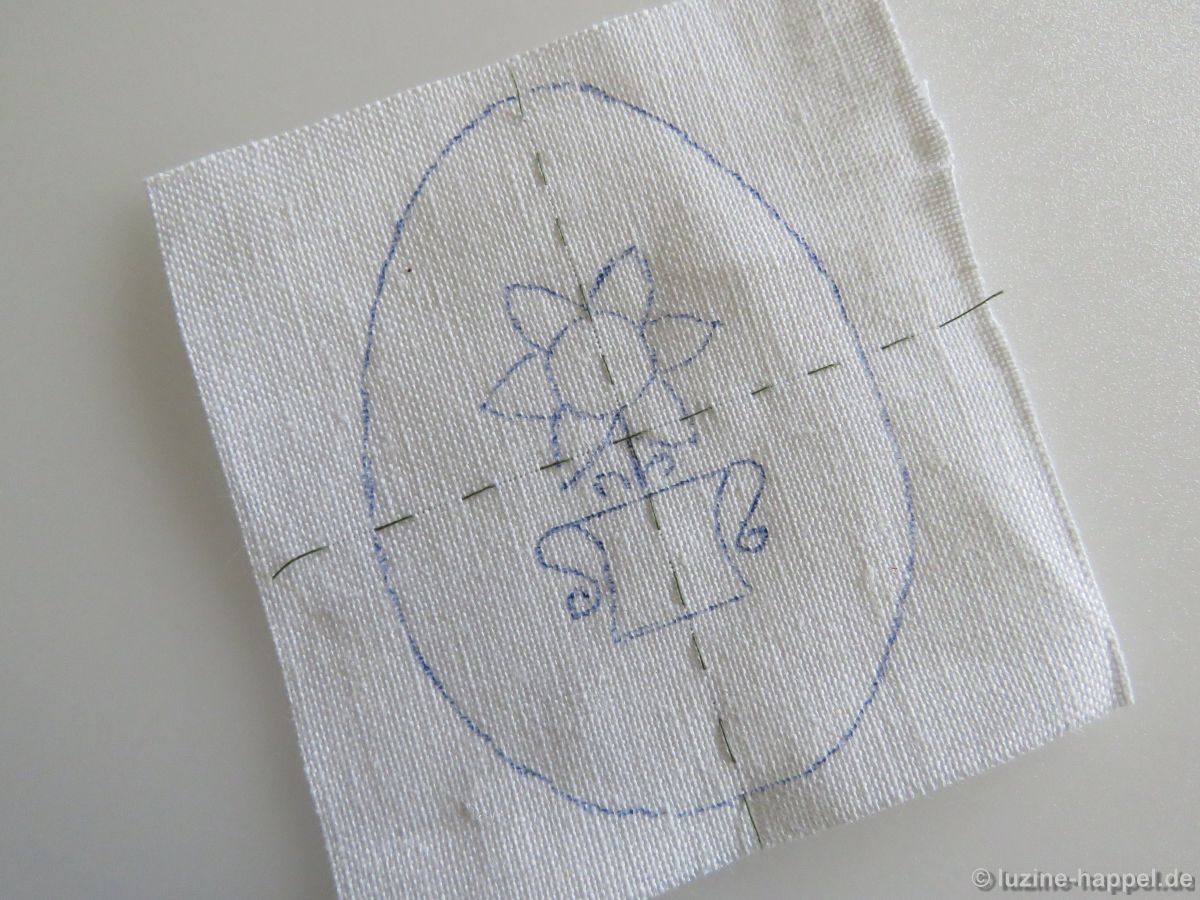
The central axes were added to the drawing of the egg outline. The egg outline was first attached to a light panel, followed by the drawing of the chosen motif, aligning with the marked central axes and using removable adhesive tape.
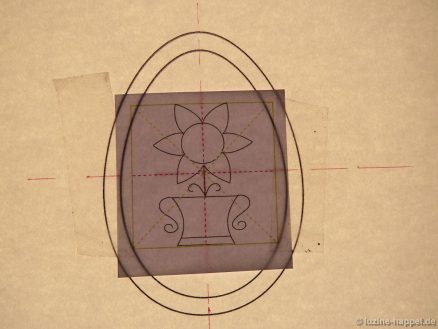
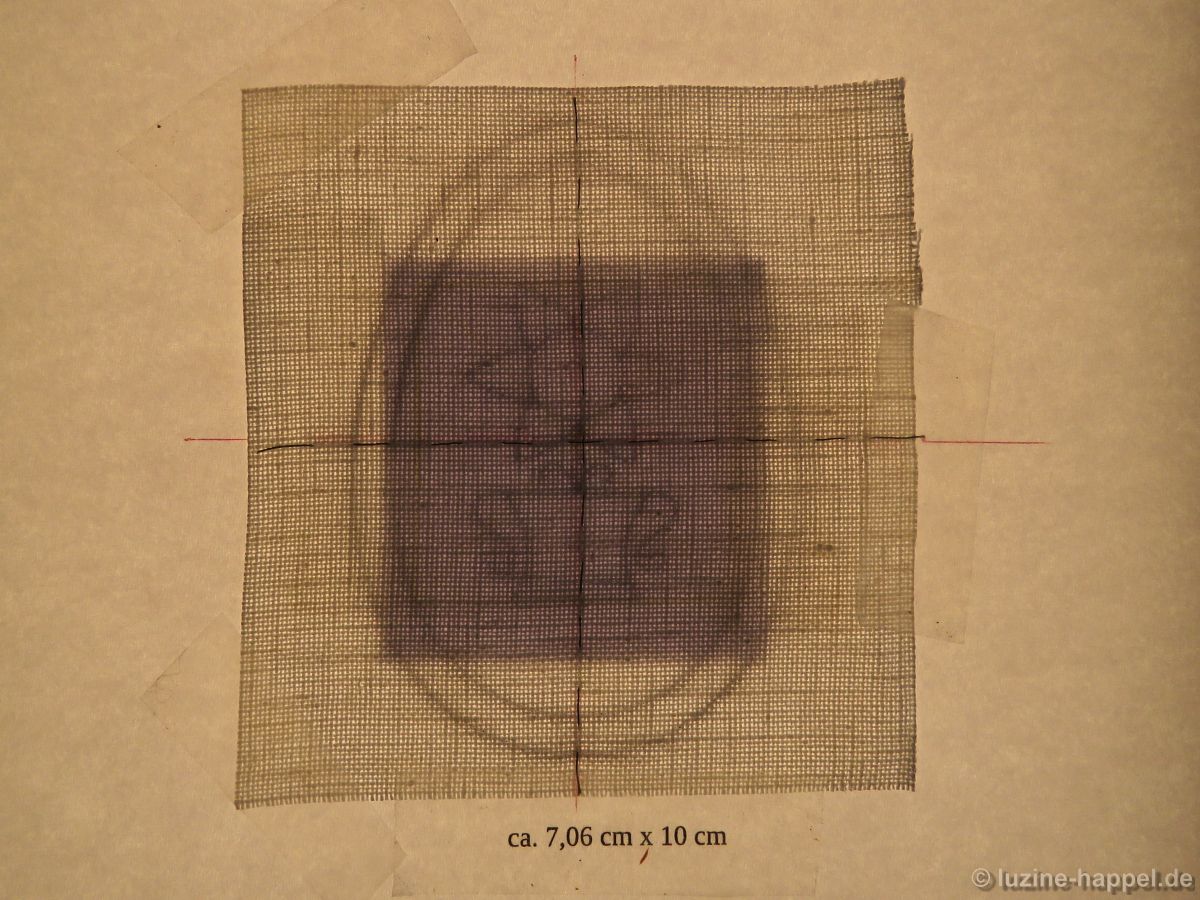
The piece of linen, also marked with center axes, was then attached. (My piece of linen was only about 11 cm x 11 cm. With a slightly larger piece – about 15 cm x 15 cm – the embroidery would have been much easier.)
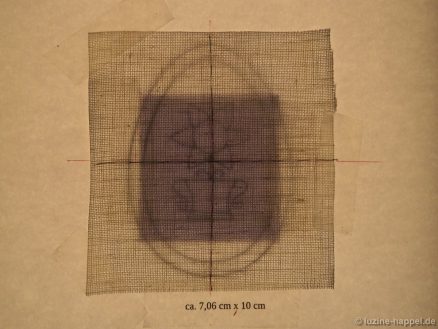
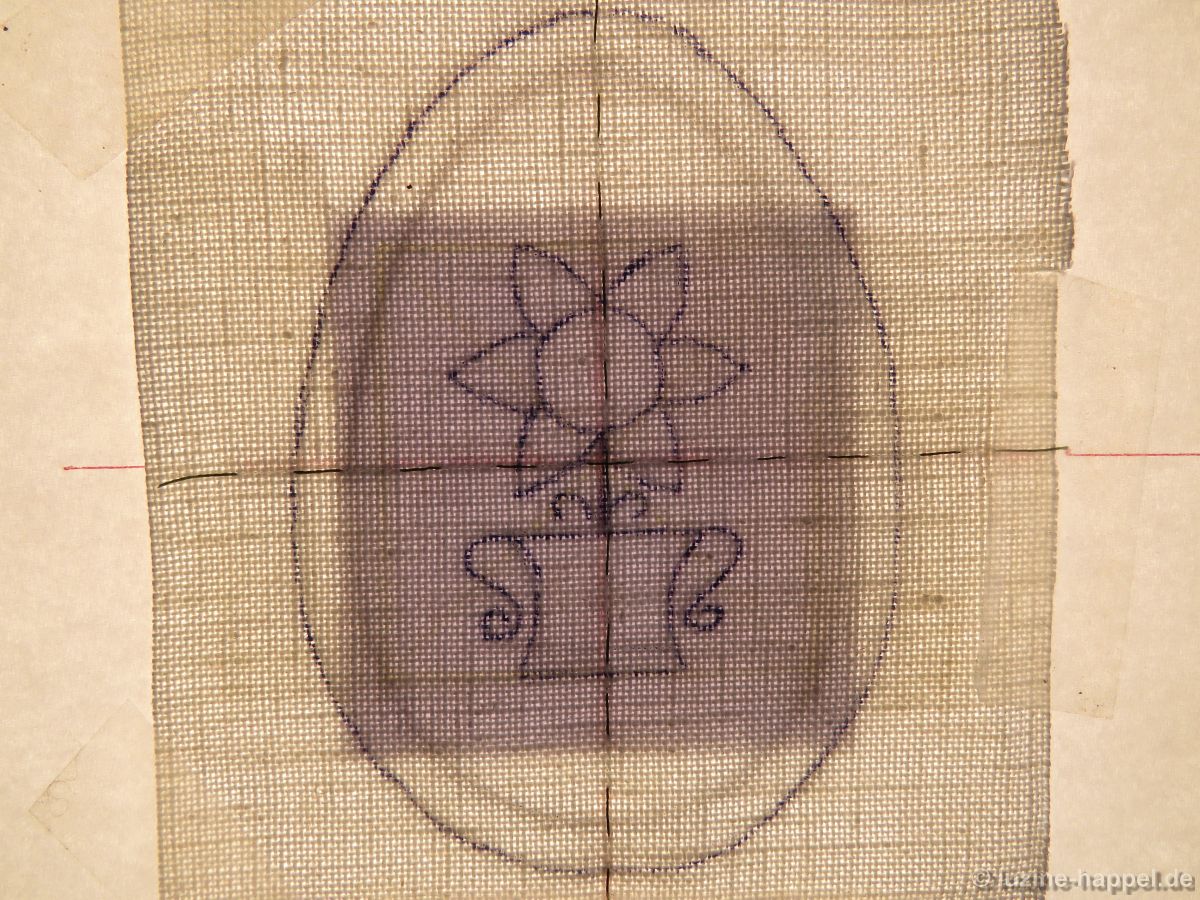
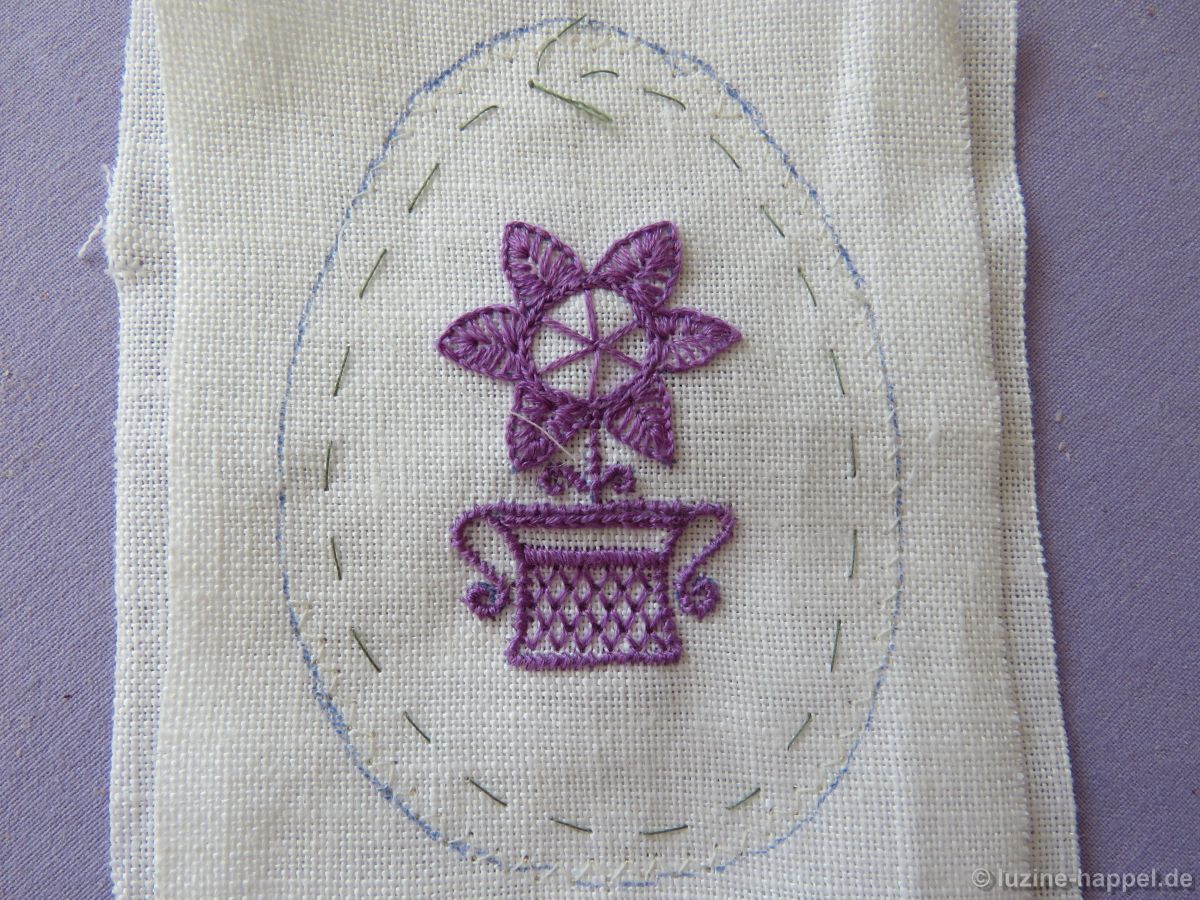
The motif and the outer egg outline were transferred to the linen using a heat-soluble pen.
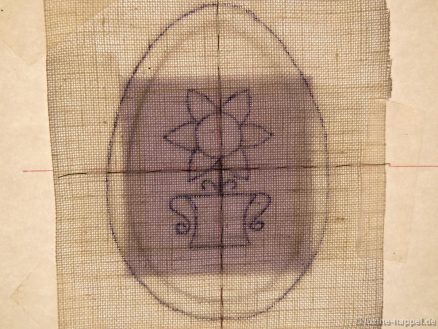
You have to press down hard to get enough ink on the fabric for a clear line. The fine tip of the pen tends to get caught in the grooves between the fabric threads.
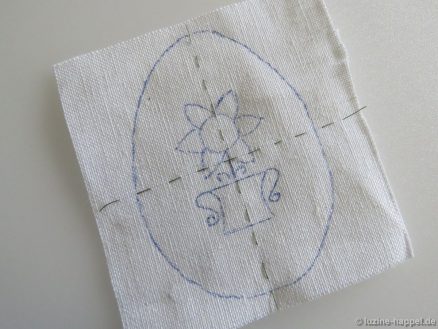
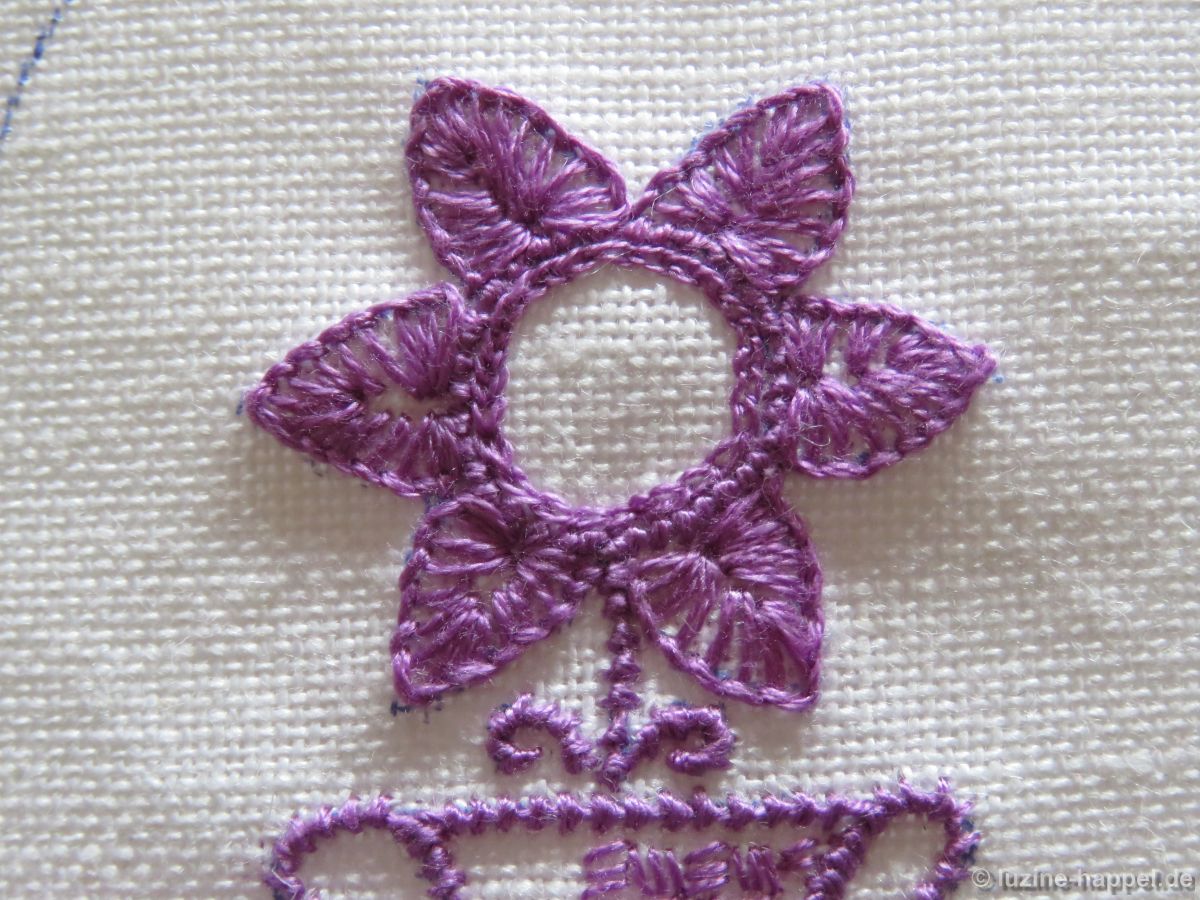
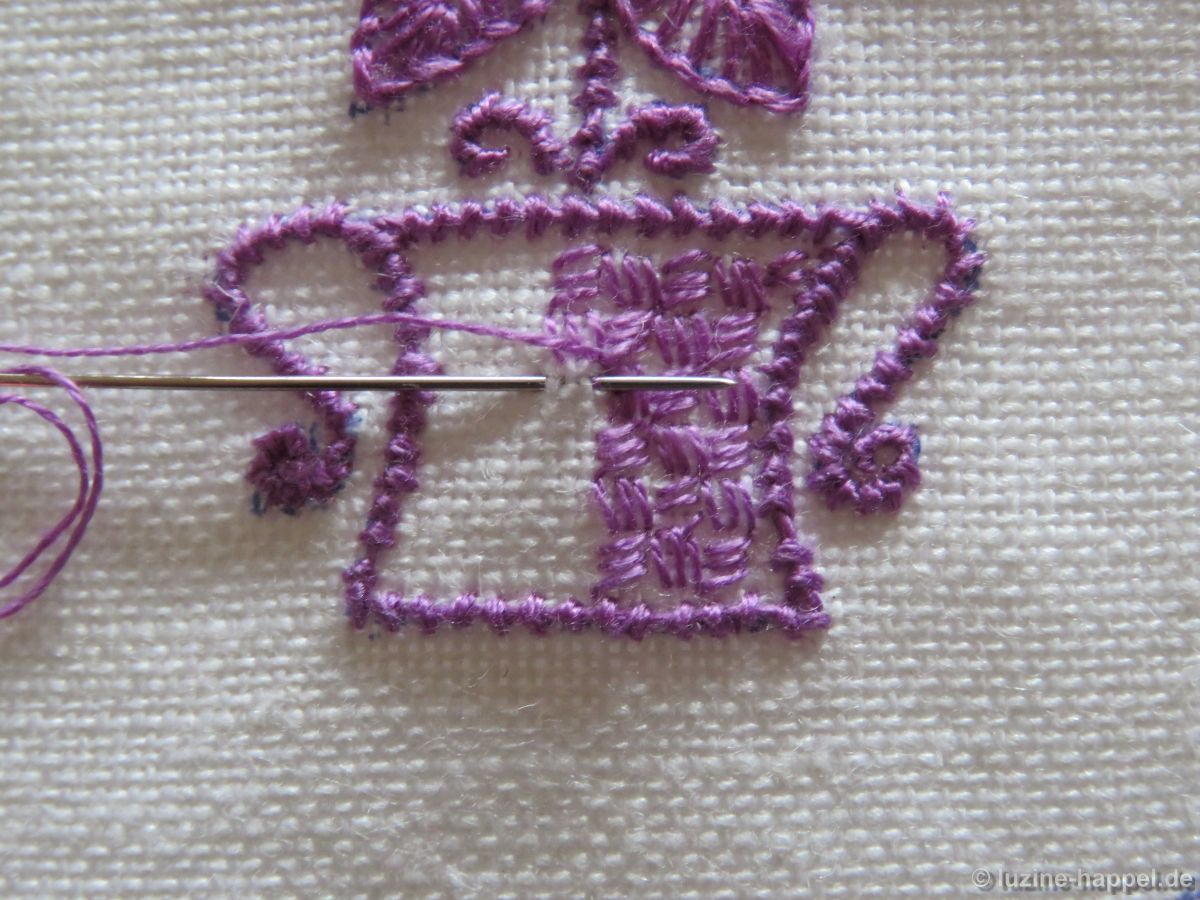
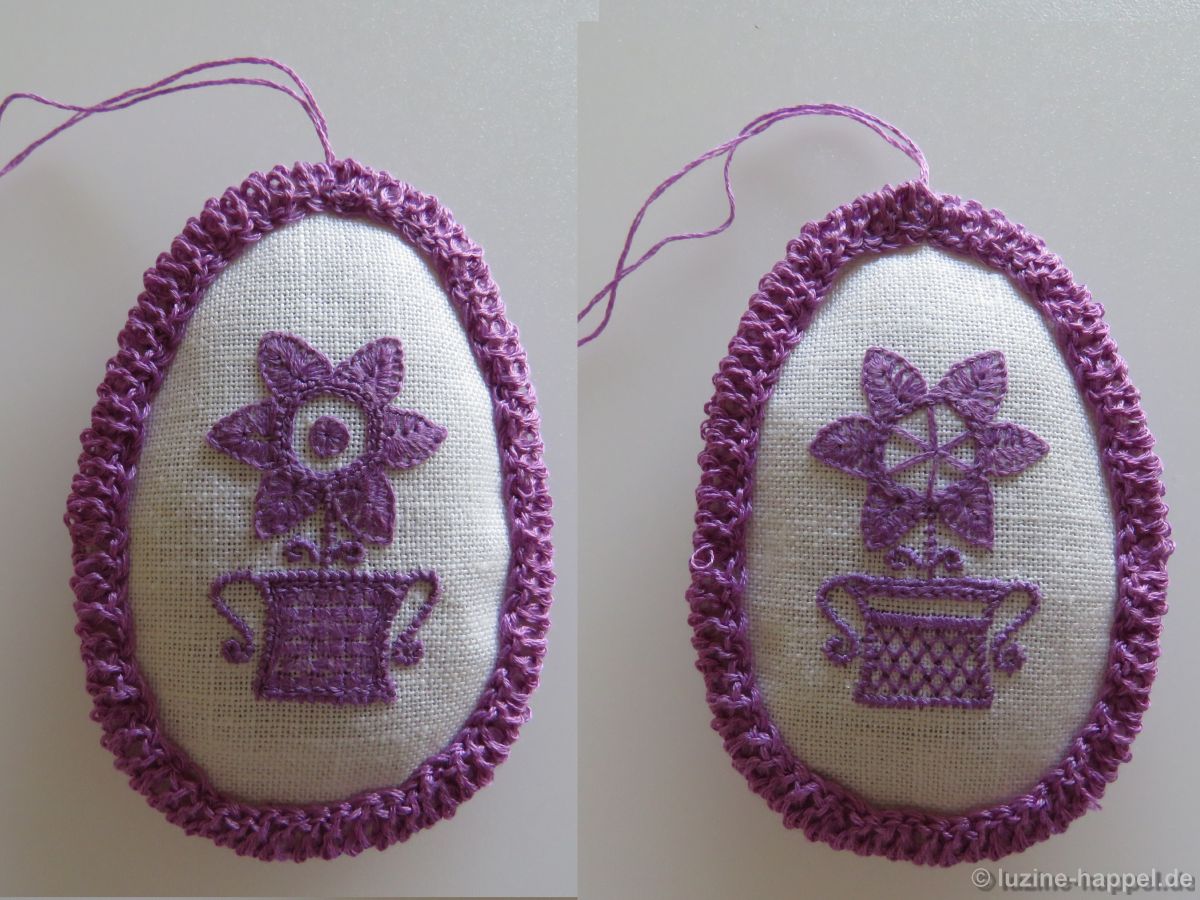
The design was embroidered. For coral knots and blanket stitches, I used two strands of 6-ply stranded cotton; for chain stitches and
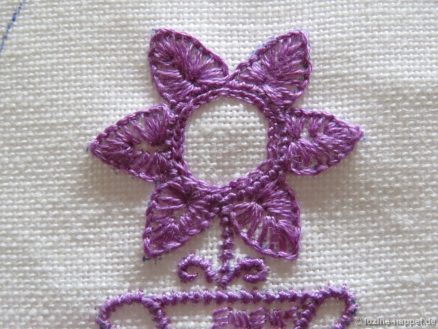
the filling pattern, I used only one strand.
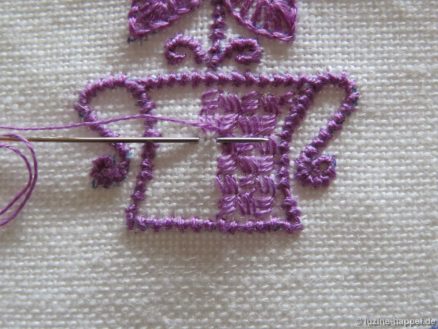
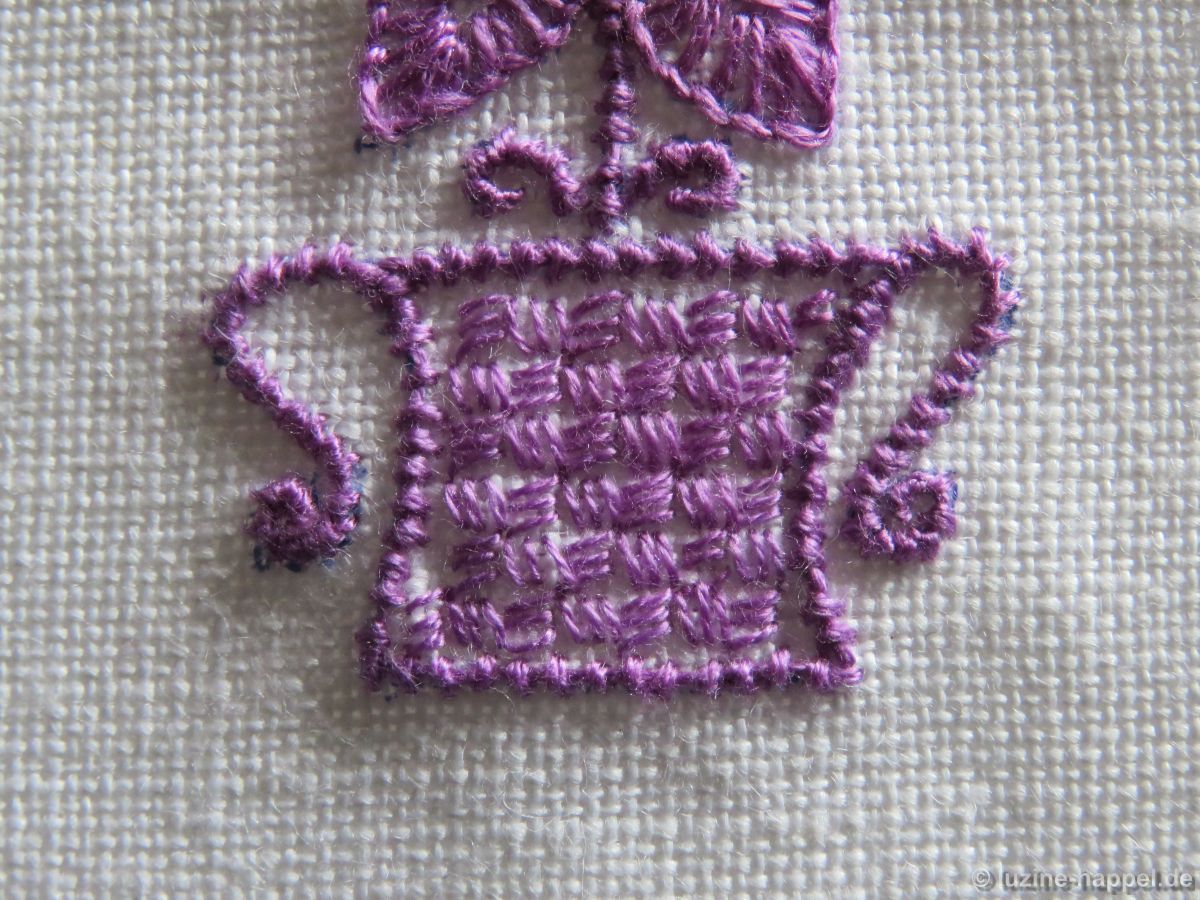
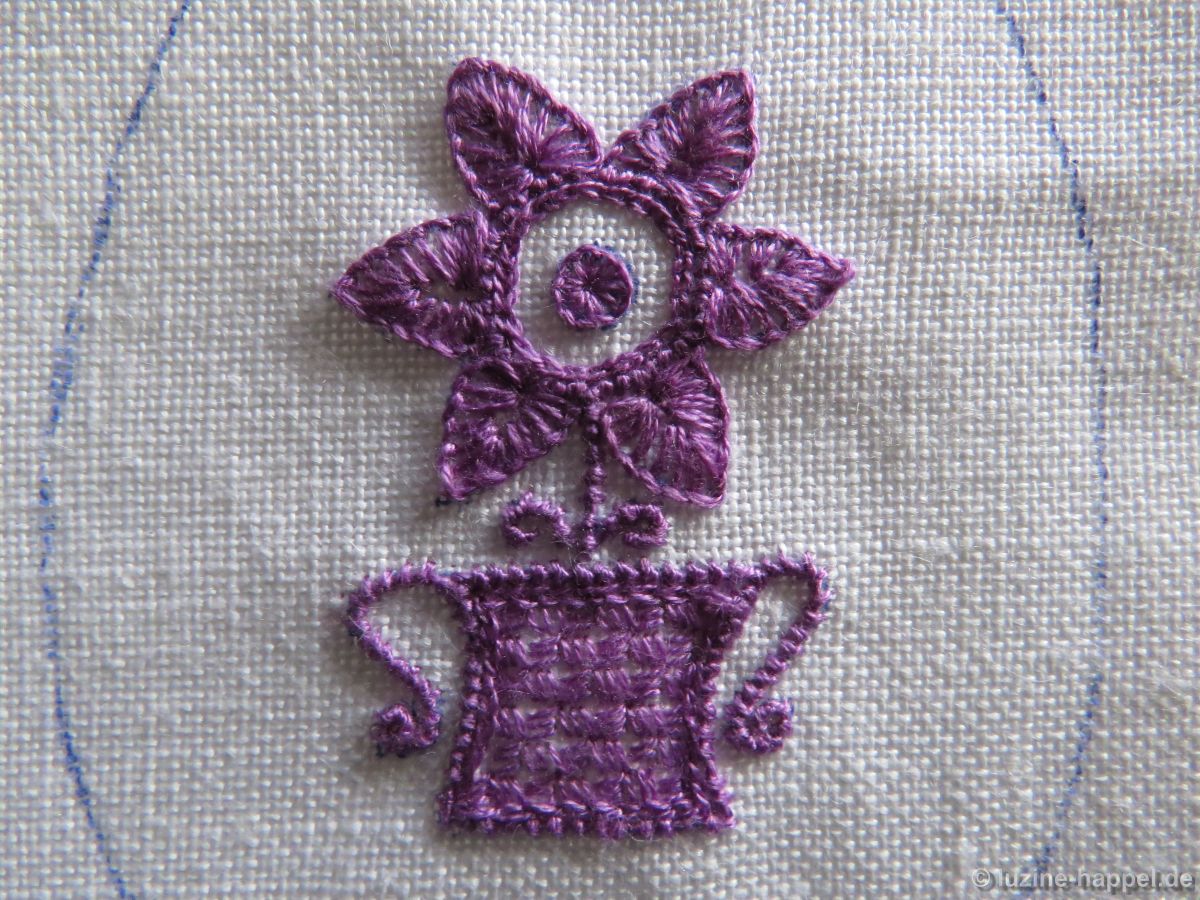
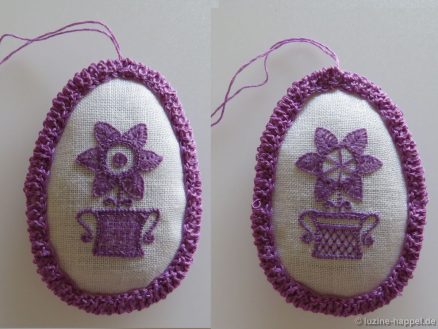
The basket received the “One Pattern”. Since the area to be embroidered is very small, I initially refrained from stitching chain stitches next to the coral knot stitches.
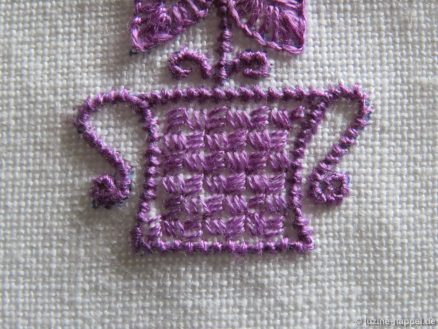
Since the edges looked too messy to me, I added chain stitches afterwards and added a small blanket stitch eyelet to the center of the flower.
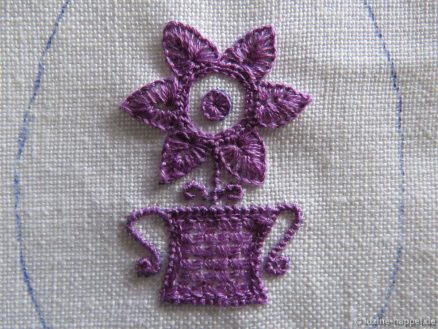
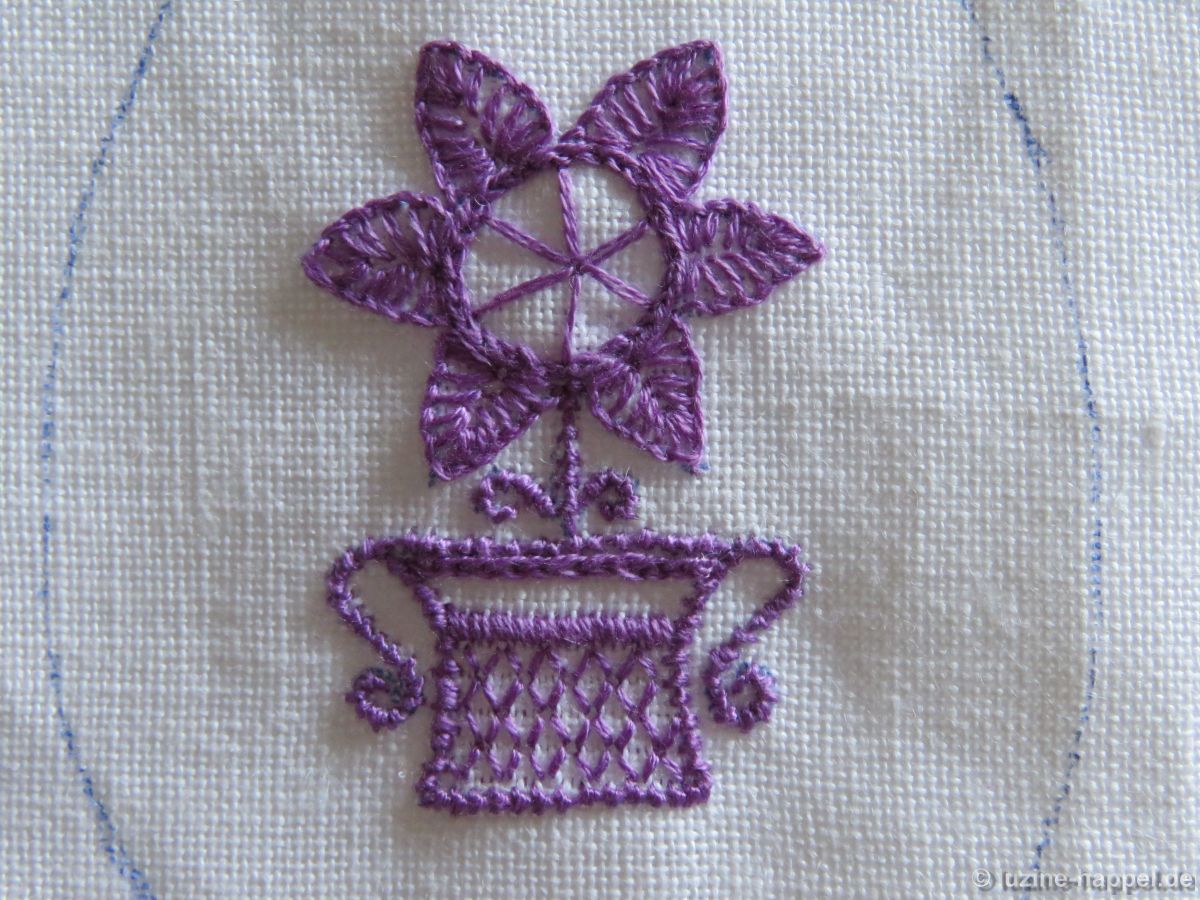
The second side was embroidered with the same motif, but the fillings were designed slightly differently.

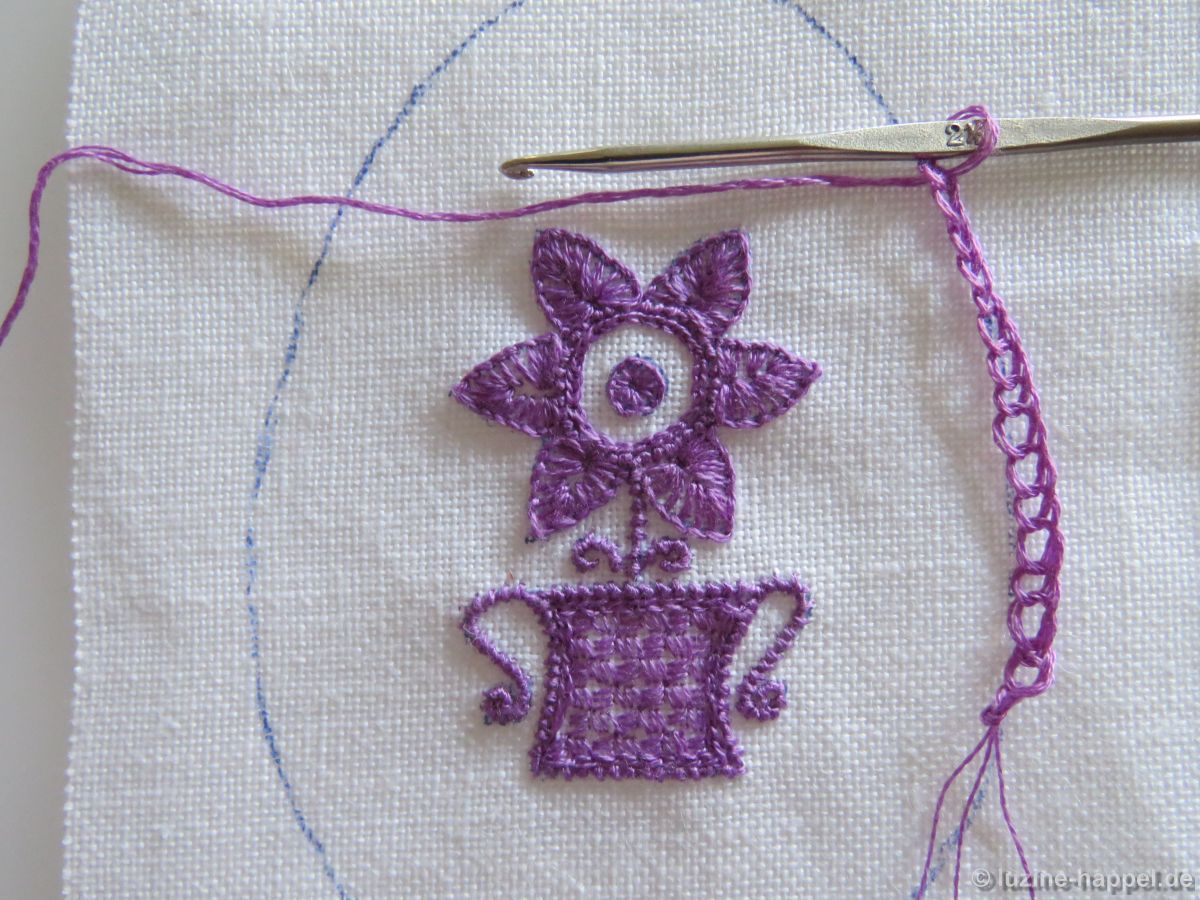
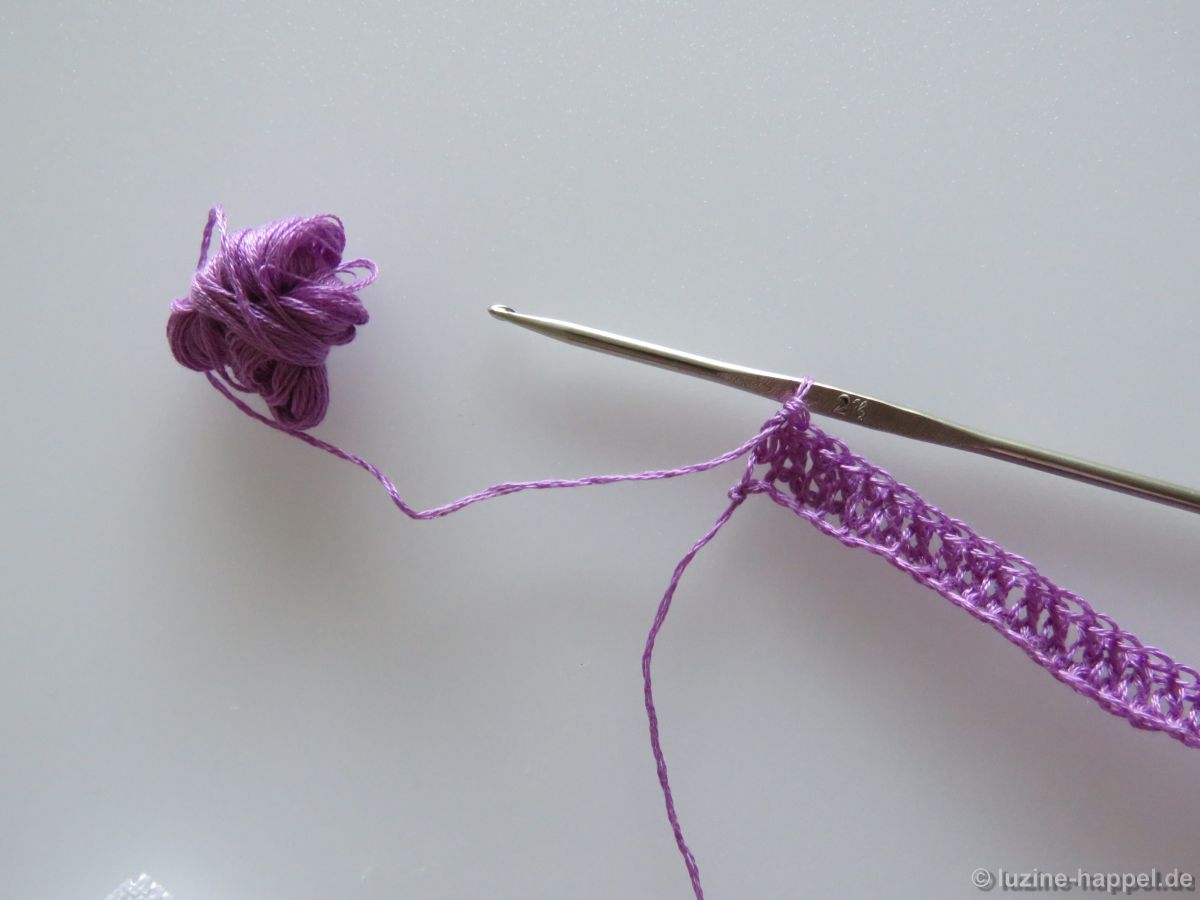
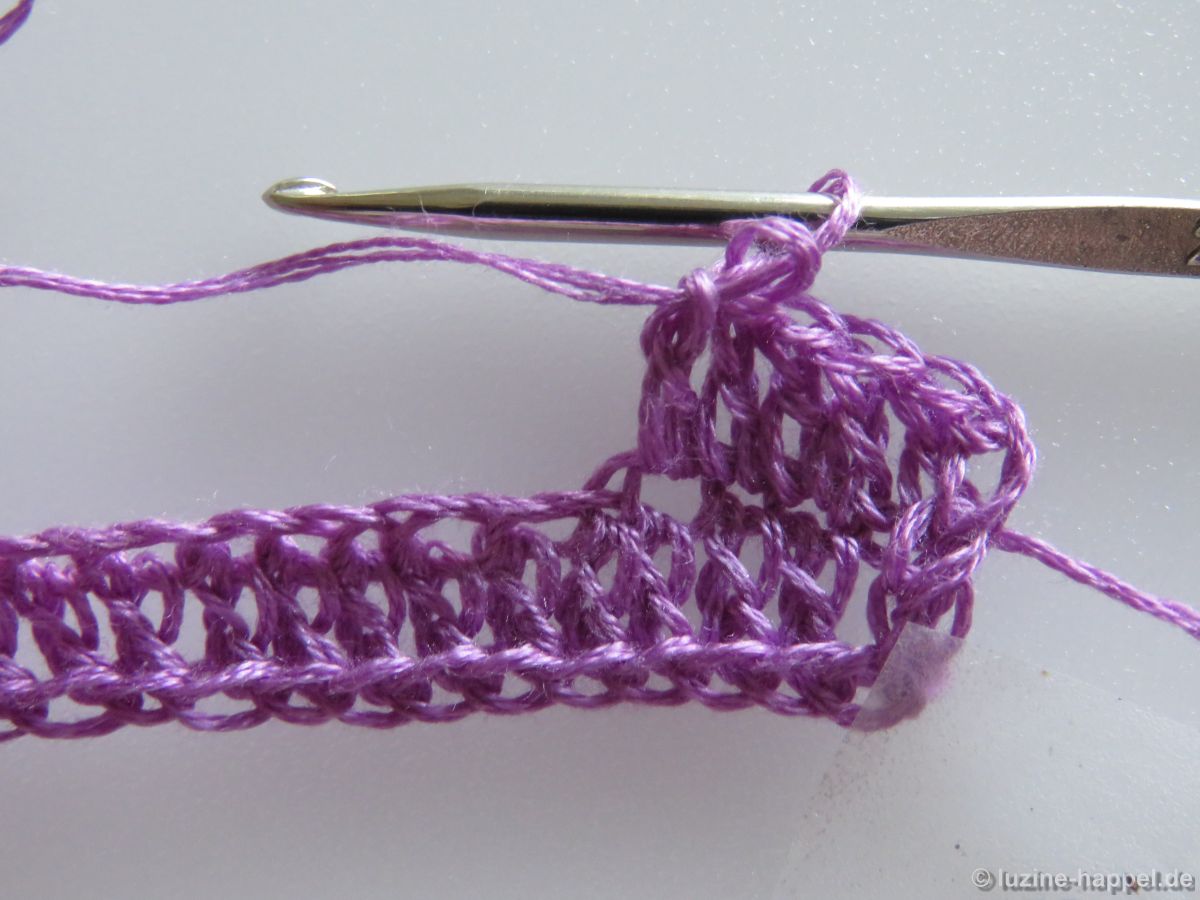
To keep the crocheted border from being too bulky, I crocheted a loose chain of stitches using a size 2 crochet hook and 3 strands of 6-ply stranded cotton. This required about 7 meters of half a skein of floss. Admittedly, it’s not easy to divide such a long strand, but it’s doable if you occasionally pin the end coming from the skein, hold the yarn up, and let it unwind.

You have to measure to see when the chain is long enough to completely cover the outline.
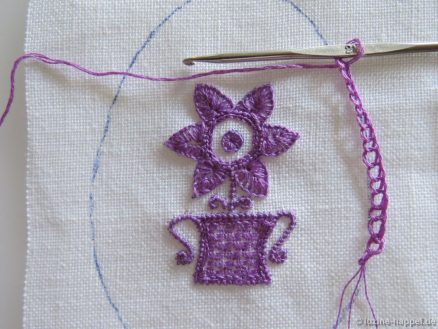
A row of double crochet stitches was crocheted over the chain stitches.
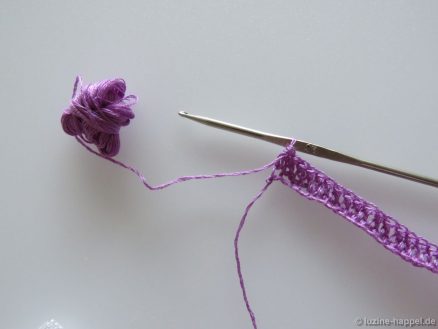
Once the end of the chain of stitches has been reached, the thread is brought back to the chain with two chain stitches, secured there and brought with two more chain stitches to the level of the second row of double crochet stitches, which is crocheted again along the chain.
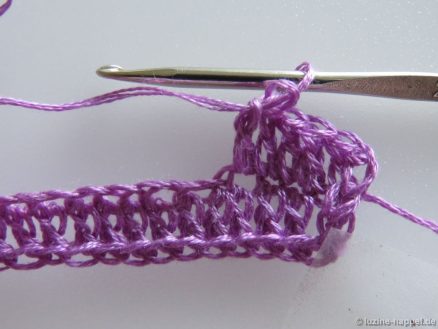
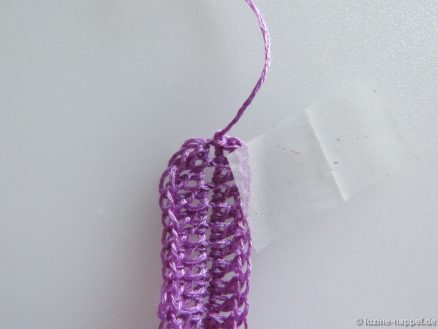
This creates a kind of fold in the middle, which makes attaching it to the edge easy. Finally, the thread is brought to the center, pulled through the last loop, and cut approximately 10 cm from the crocheted border.
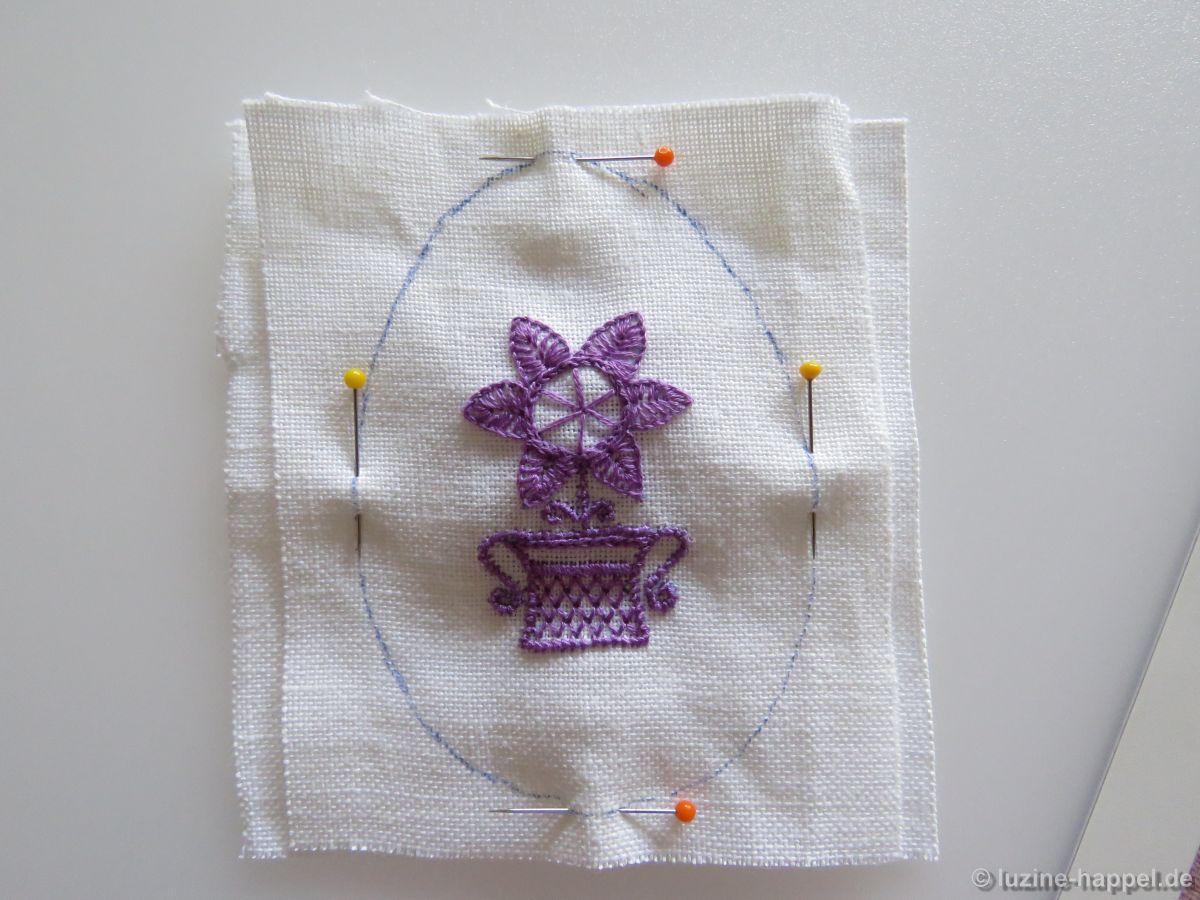
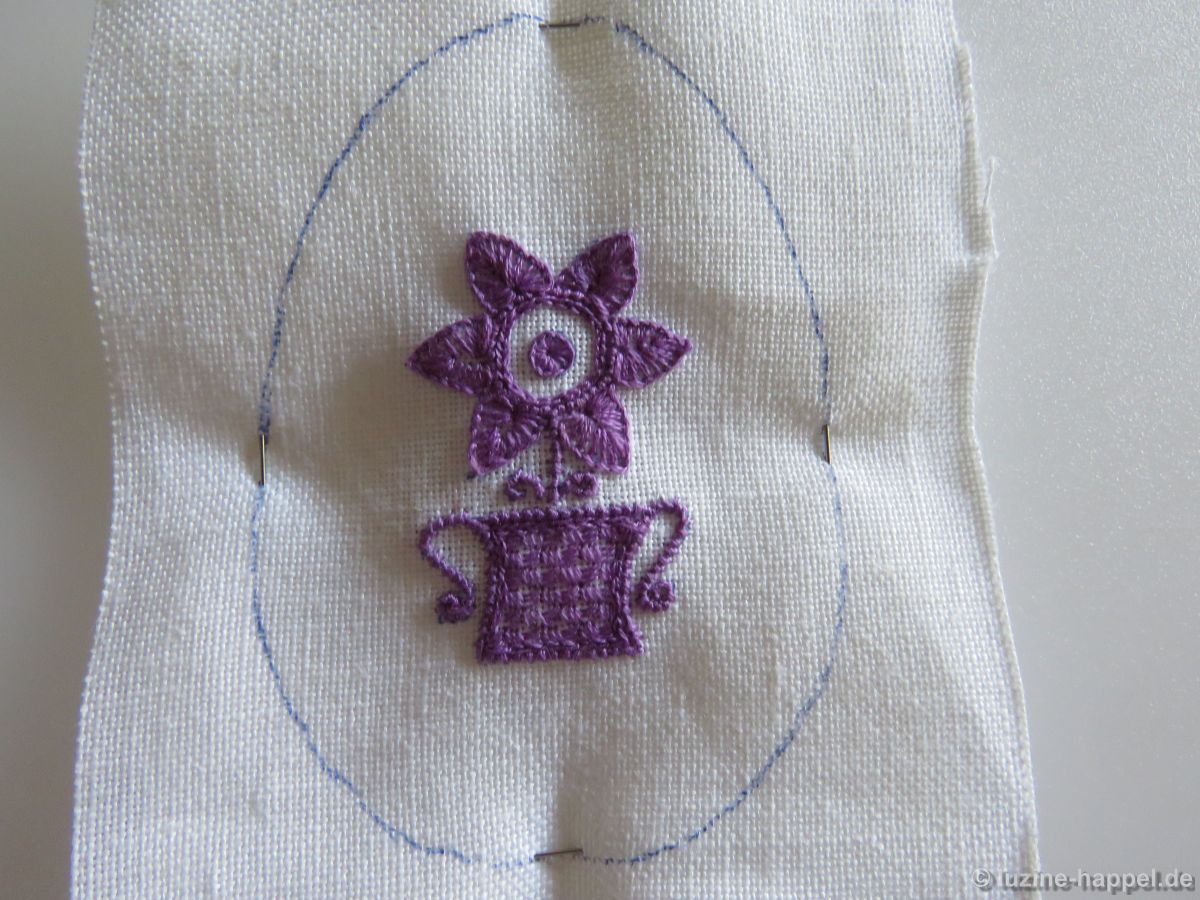
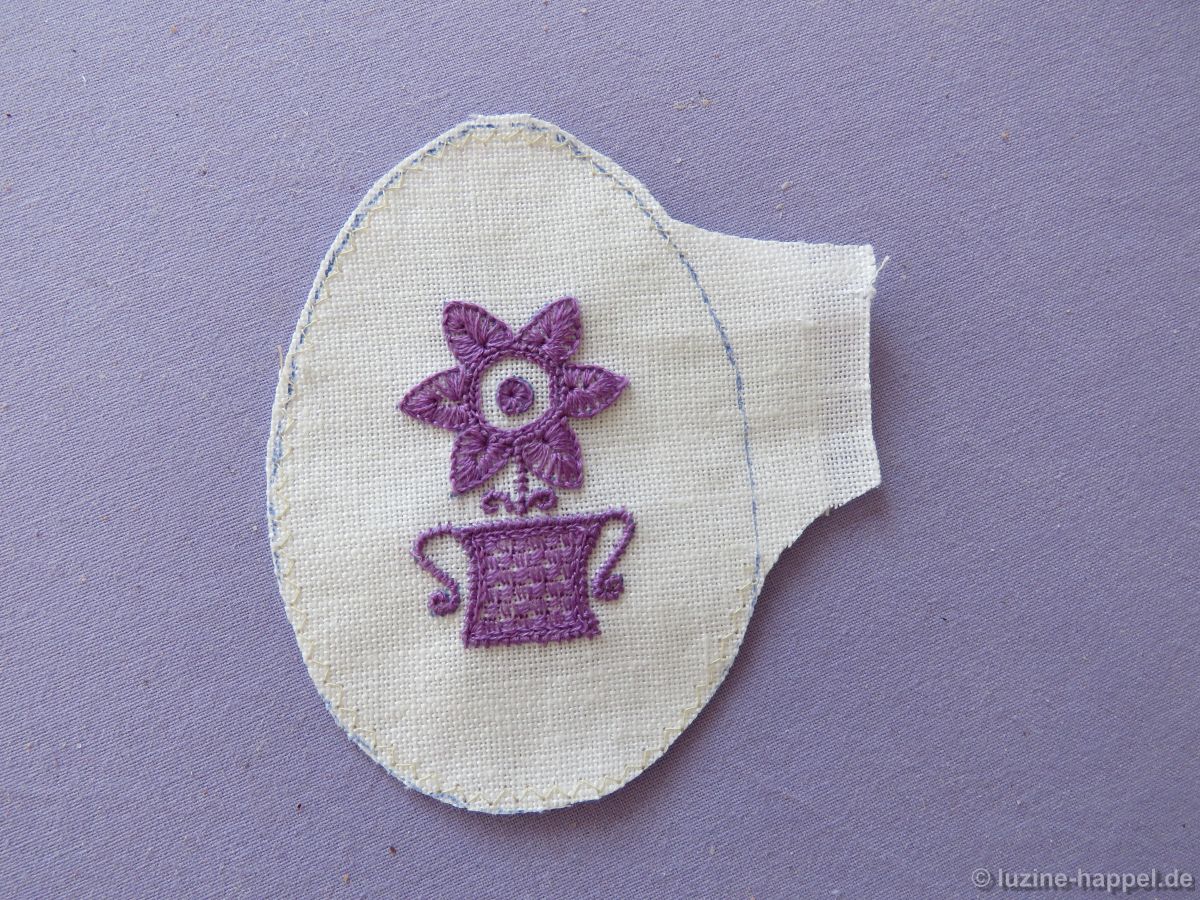
The embroidered linen pieces are placed on top of each other with the right sides facing outwards, ensuring a precise fit, and pinned in place.
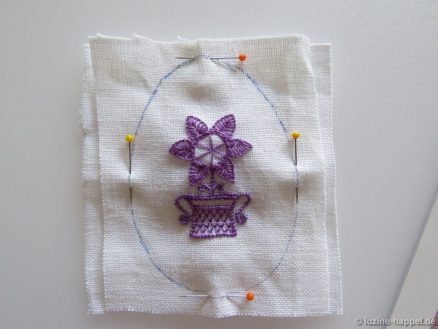
On the back, you can check if the lines have been correctly drawn. If not, you need to make corrections.
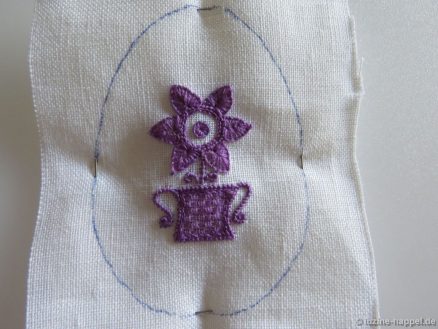
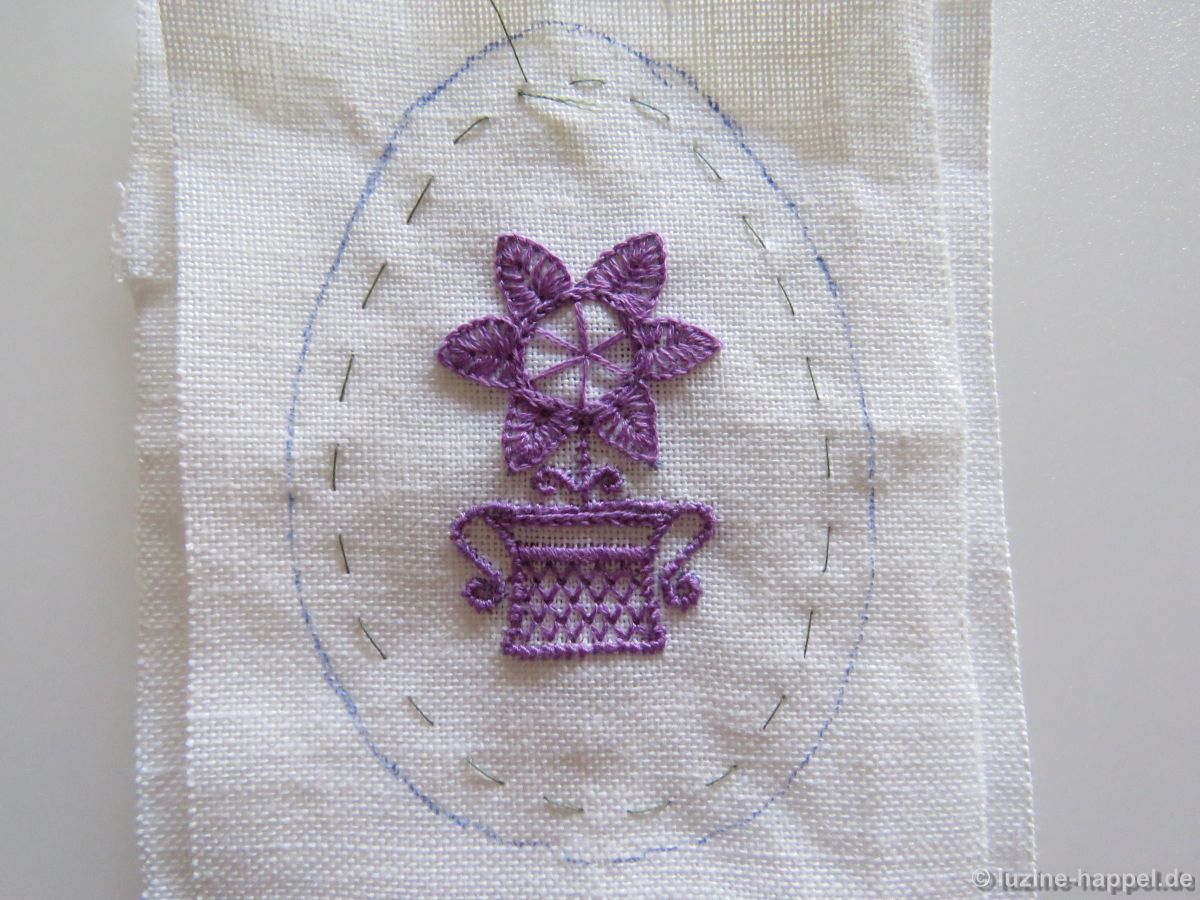
The parts are baste together with a small distance from the edge.
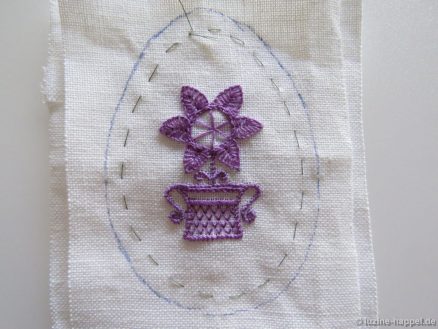
and sewn together with small zigzag stitches along the outline, except for an opening on the long side.
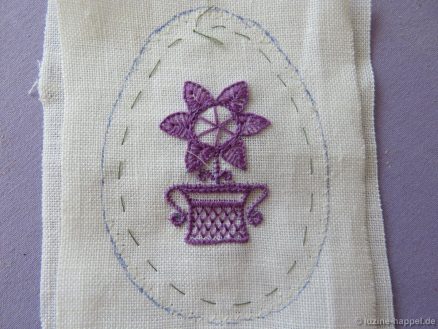
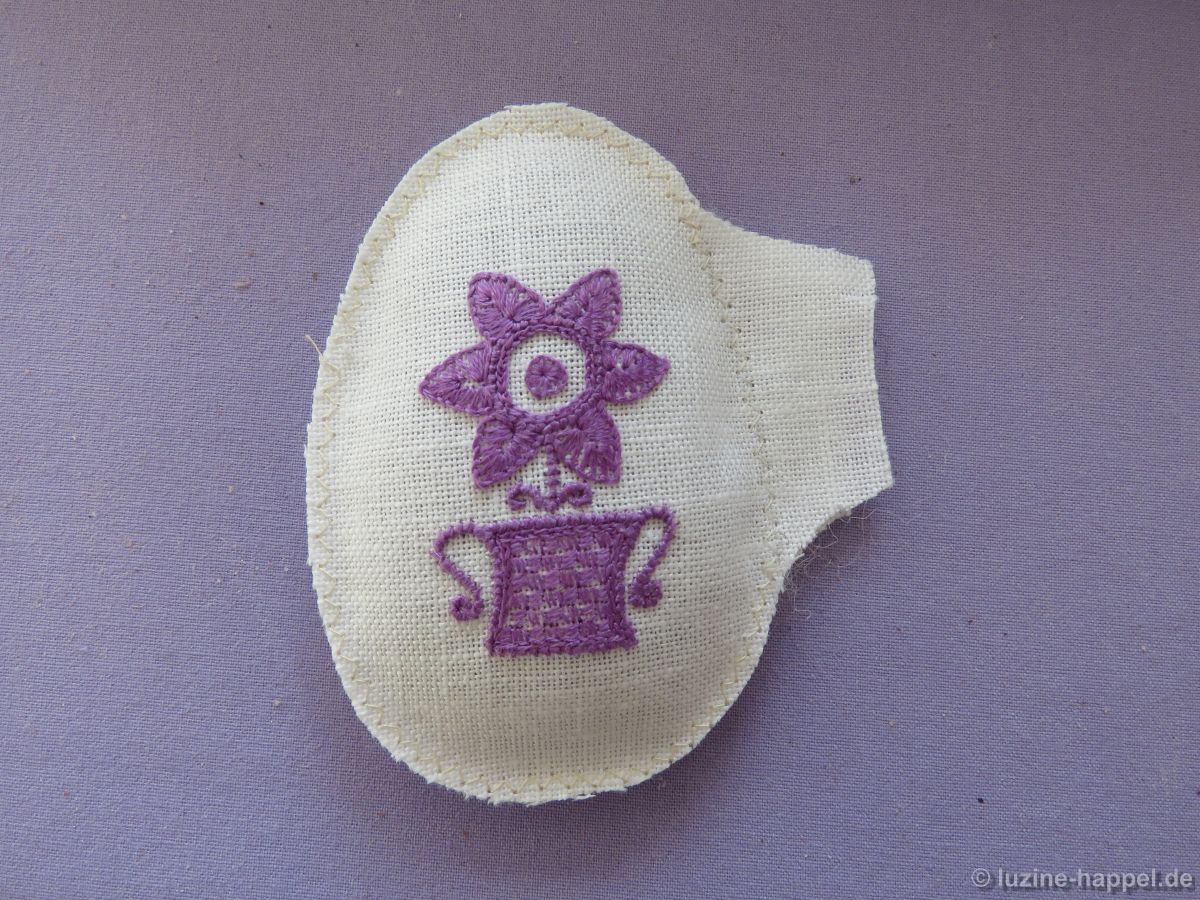
The egg is cut out, as described in detail in the previous blog post.
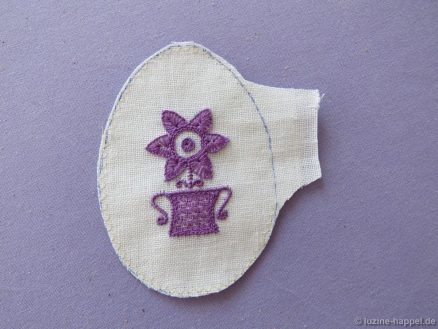
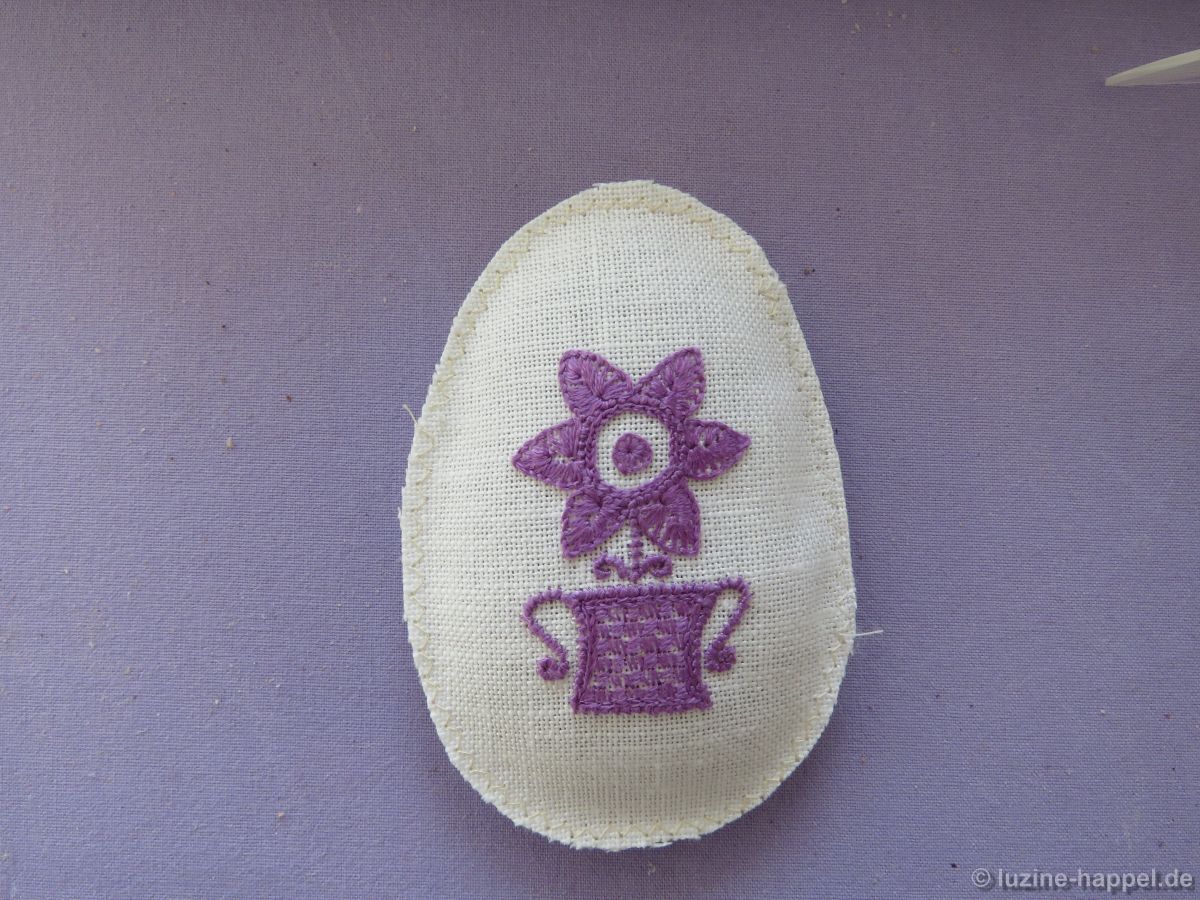
ironed, lightly filled, and closed.
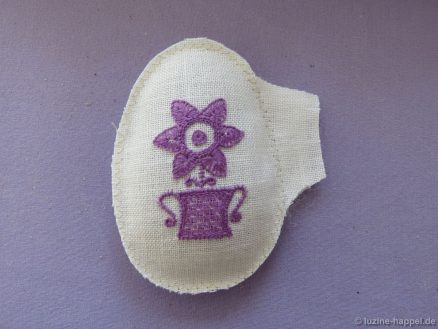
The remaining excess fabric is cut off.
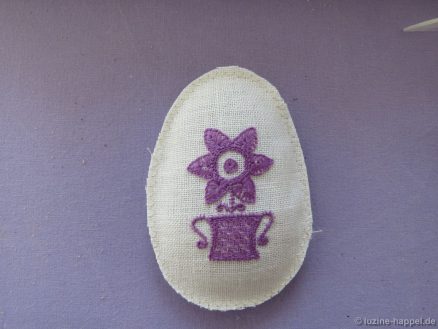
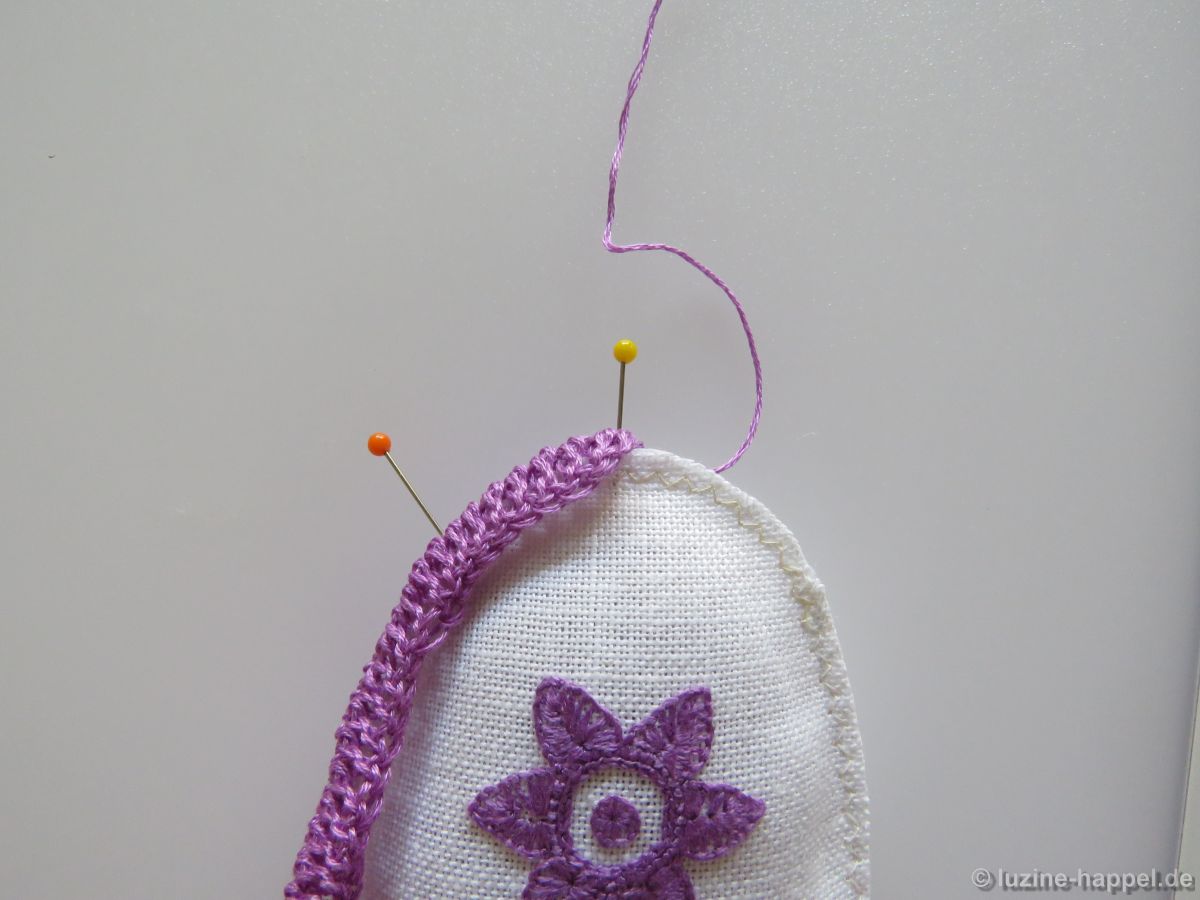
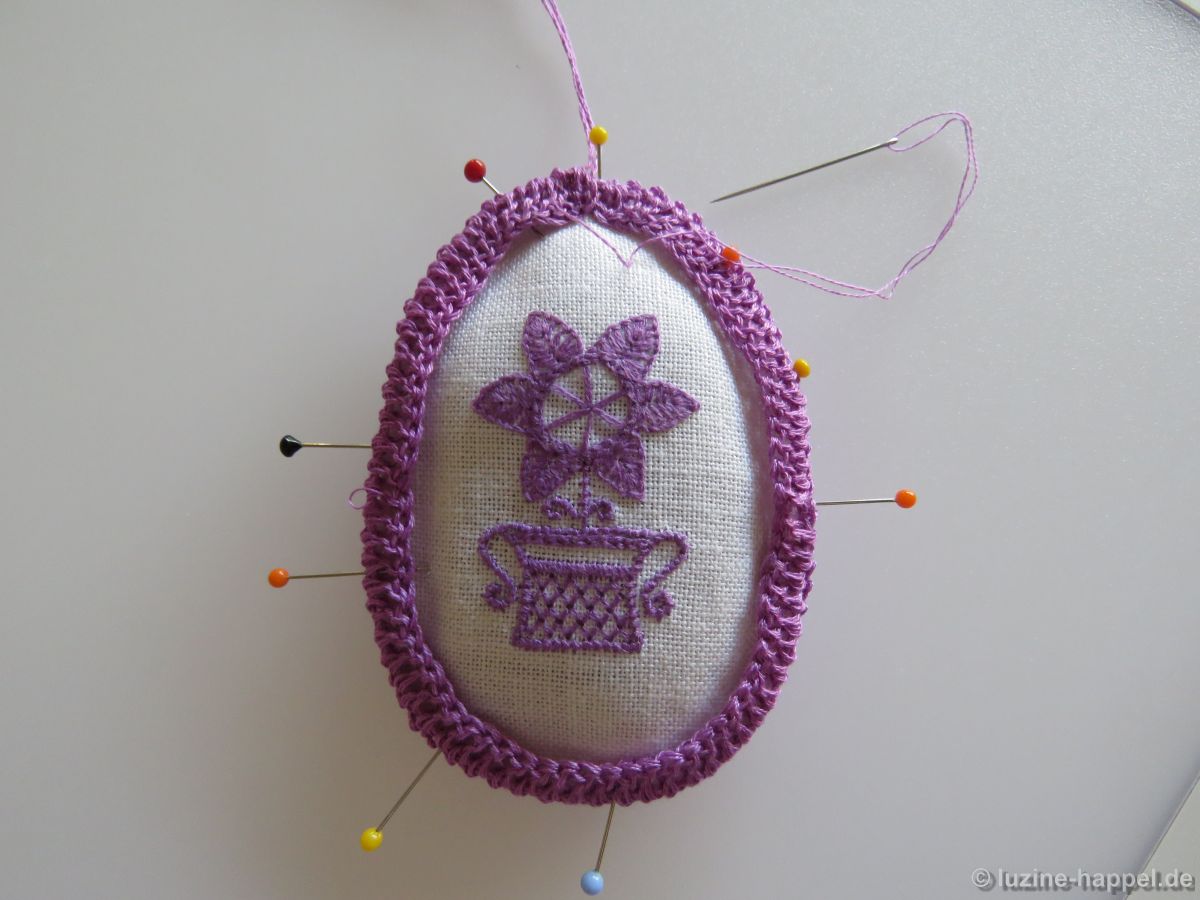
Starting at the top, the crocheted border is first attached with pins,
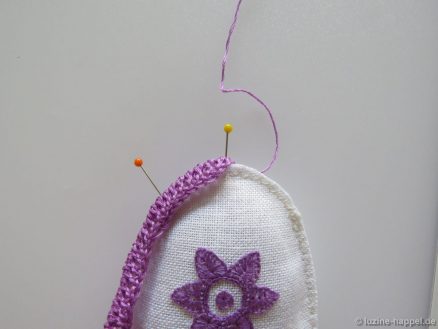
to ensure that the border is evenly distributed around the edge.

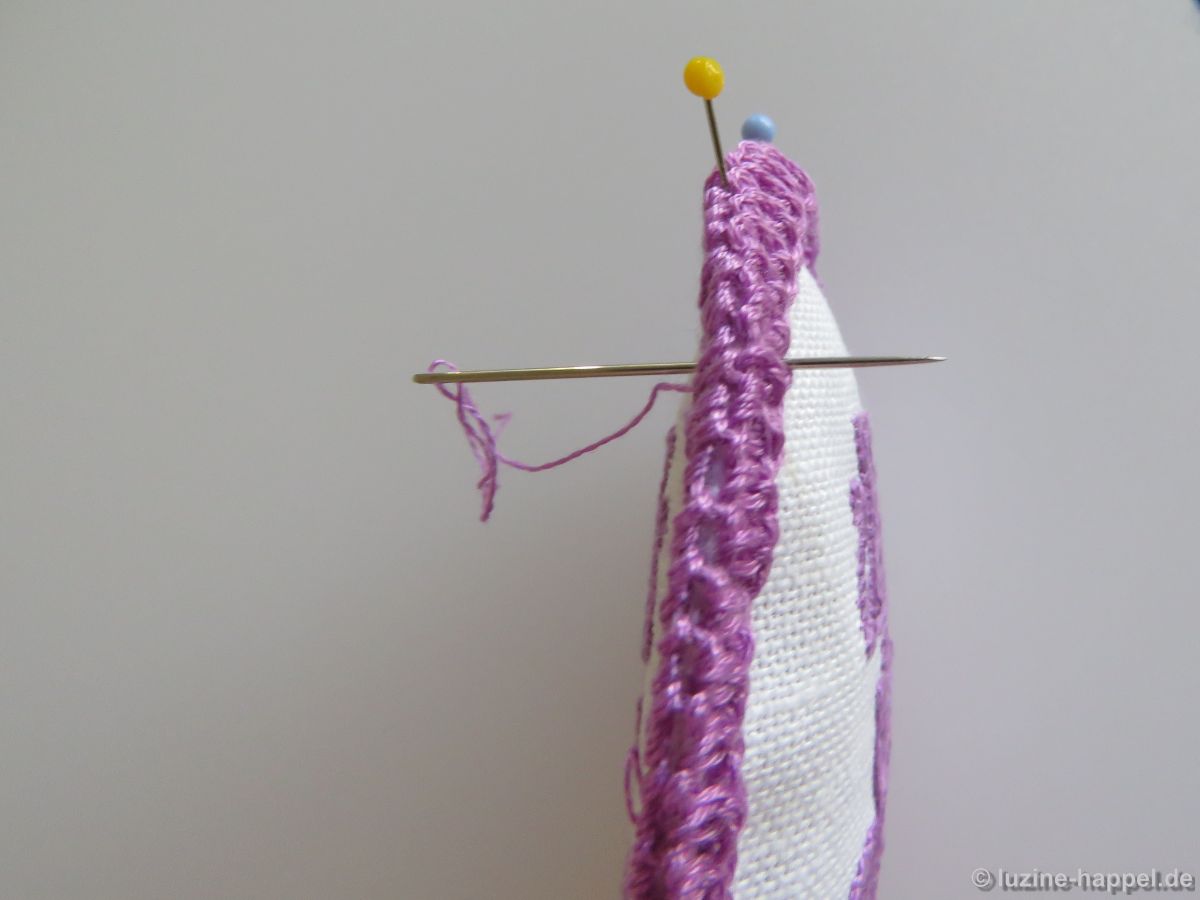
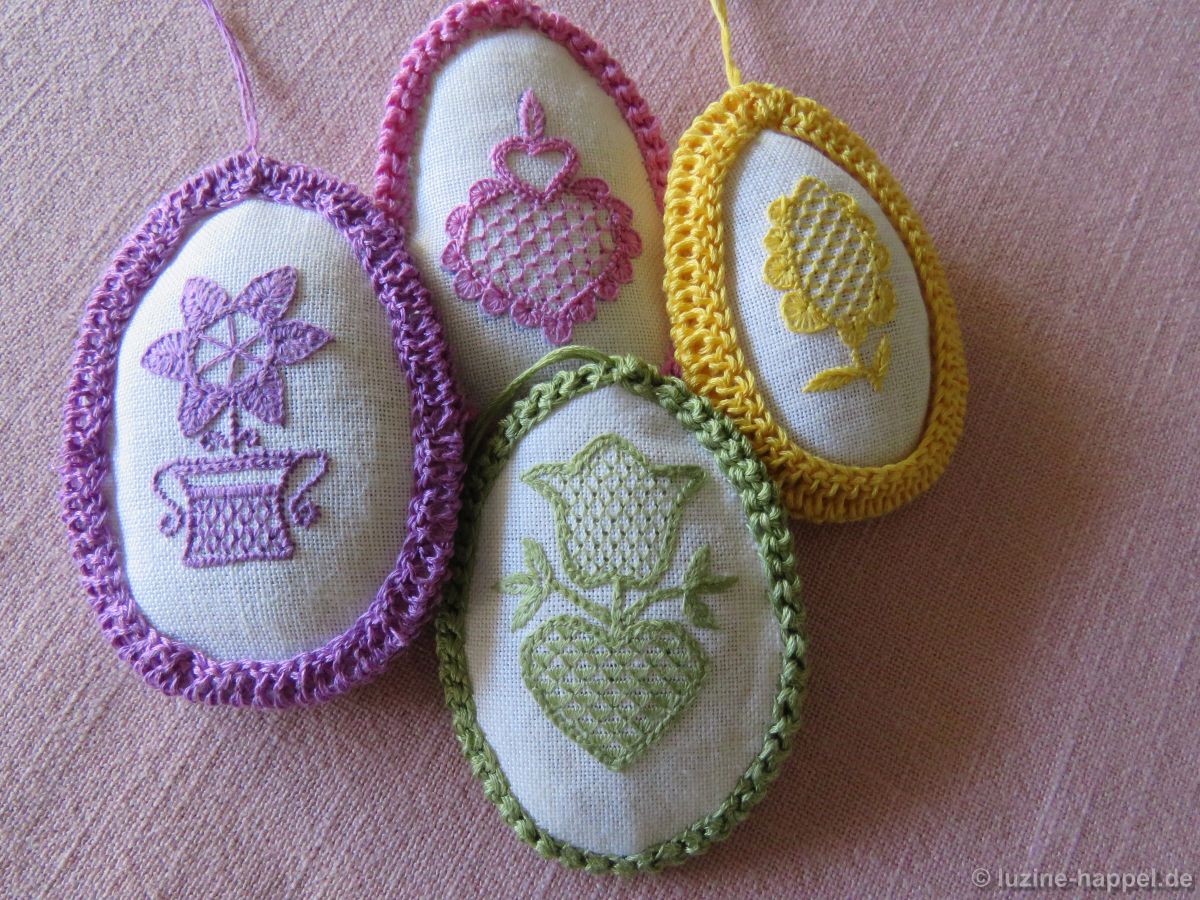
The border crocheted with only 3 strands of the stranded cotton isn’t as sturdy as the one crocheted with all 6 strands of the stranded cotton (the yellow one shown in the previous blog post). Therefore, I thought it would be better to sew it on. This time, I did it with stitches from the back to the front and back again.
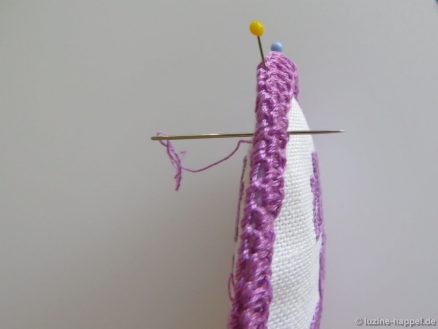
This has the advantage that the trim can be attached to both sides with an even width.
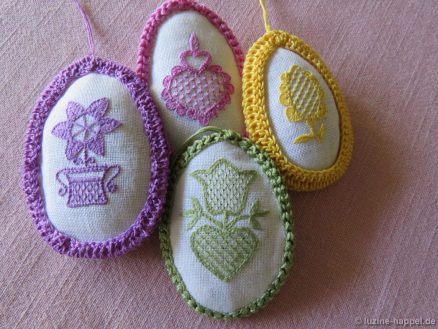
Perhaps I chose stitches that were too large, or perhaps I pulled the thread too tight. This makes the edge look less defined than the green and pink borders, which were attached stitch by stitch with overcast stitches.
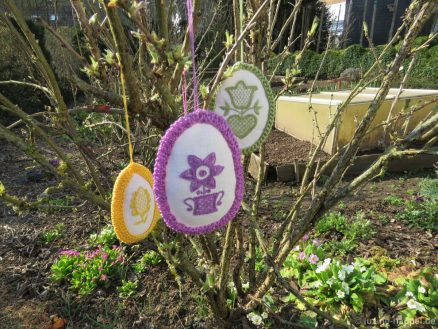
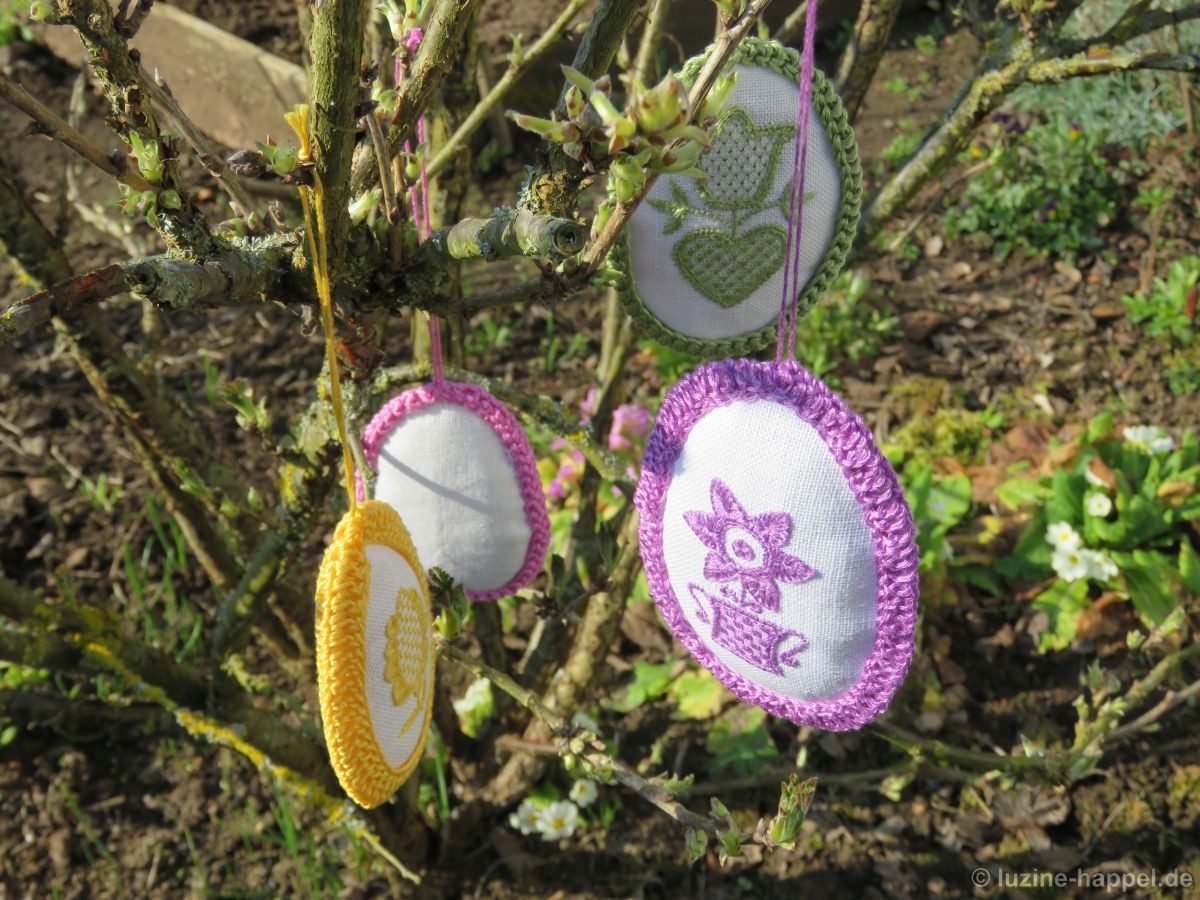
Hanging on the bush
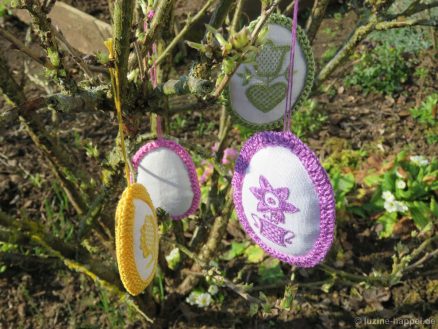
and when gently swinging in a breeze, it no longer matters.
Embroidery for a Bag (2)

The embroidery is finished.

I would like to attach it to the bag in such a way that one can easily remove it again at any time – to wash it or use it for another purpose.

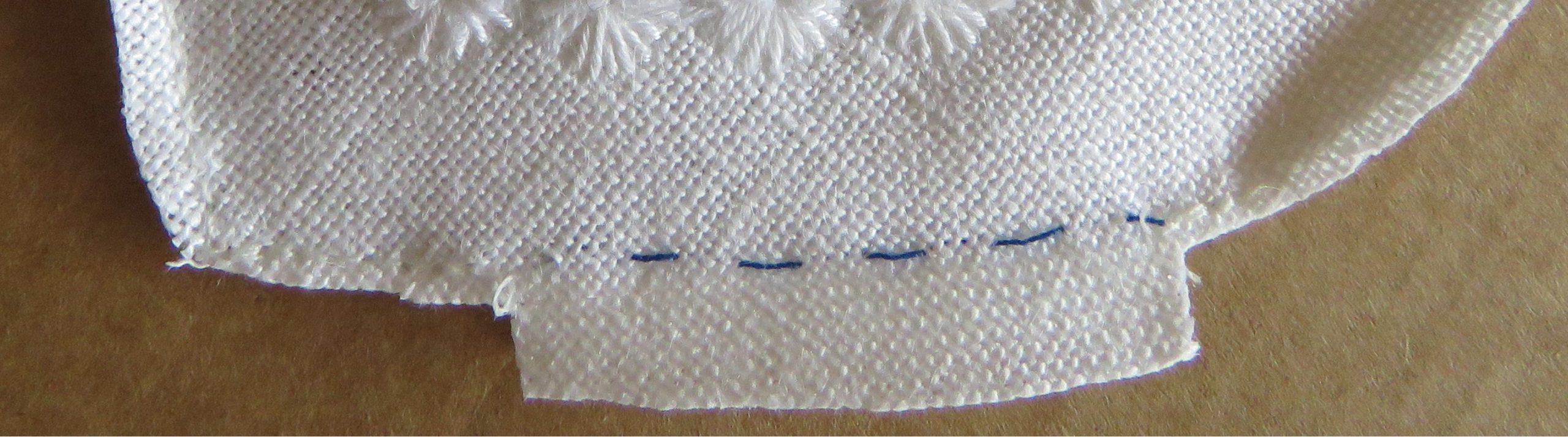
The edges of the fabric are secured with zigzag stitches. The 1 cm seam allowance is folded to the back. The hem is sewn close to the edge of the fabric so that you can thread a safety pin through the tunnel.
Double rubber thread (length about twice all four sides) should hold the embroidery on the bag.

The corners of the hem remain open. This way you can use the safety pin to pull the rubber thread through the hems of all four sides and then distribute it evenly.

It is advisable to pull auxiliary ribbons through the loops of the rubber threads at the corners so that you can easily pull the rubber thread away from the fabric later.

The rubber thread ends are knotted together. The rubber is distributed evenly so that there are no too many wrinkles anywhere.

The embroidery should be fastened at the corners with buttons. I determine the position of the buttons and pull a thick thread through the back of a twine button.

One end of the thread is threaded through the felt at the specified position

and pulled to the inside.

The other end of the thread is threaded and pulled through the felt close to the first inserting point.

Both ends of the thread are pulled further into the inside of the bag,

until the button lies tightly on the felt.

Inside, the thread ends are knotted together well and then trimmed.

The embroidery is attached to the buttons as a test.
To do this, first pull on the auxiliary ribbon to pull the rubber thread out of the linen at the corners,

slip the loop over the button

and then remove the auxiliary ribbon.

If everything fits,

the embroidery is removed again – remember to pull the auxiliary ribbons back in – washed, starched and ironed.

It is then reattached to the bag’s buttons and is ready for use.

Embroidery for a Bag (1)

Large felt bags are popular at the moment. You can buy them in many colours and different sizes.
I find a bag like this very practical for transporting my utensils when I want to take part in the embroidery circle.

To my regret, the bags have a label that I don’t find very nice.

So I thought about how the bag could be redesigned according to use. I came up with the idea of ​​embroidery covering the lettering.

I choose hand-woven linen because I like the structure and colour of it well with my anthracite-coloured felt bag.

My bag is 45 cm wide and 30 cm high. The handles start at a height of 23 cm. The remaining space for embroidery is 45 cm x 23 cm, approximately half as high as it is wide. I don’t want to fill the entire space, but I want the embroidery to match the bag size and cover all of the printed characters.
Therefore, I choose a finished size of 38 cm x 19 cm and add a seam allowance of 1 cm on each side. So I cut the linen to size 40 cm x 21 cm. A pattern that fits this format can be printed quickly.

The embroidery can begin.
(Since I would like to use this project as photo material for a short presentation of Schwalm whitework, I don’t proceed as usual, but only work in partial areas. This way one can follow the necessary steps in a single photo.)

But that shouldn’t bother you and you should of course proceed as established.

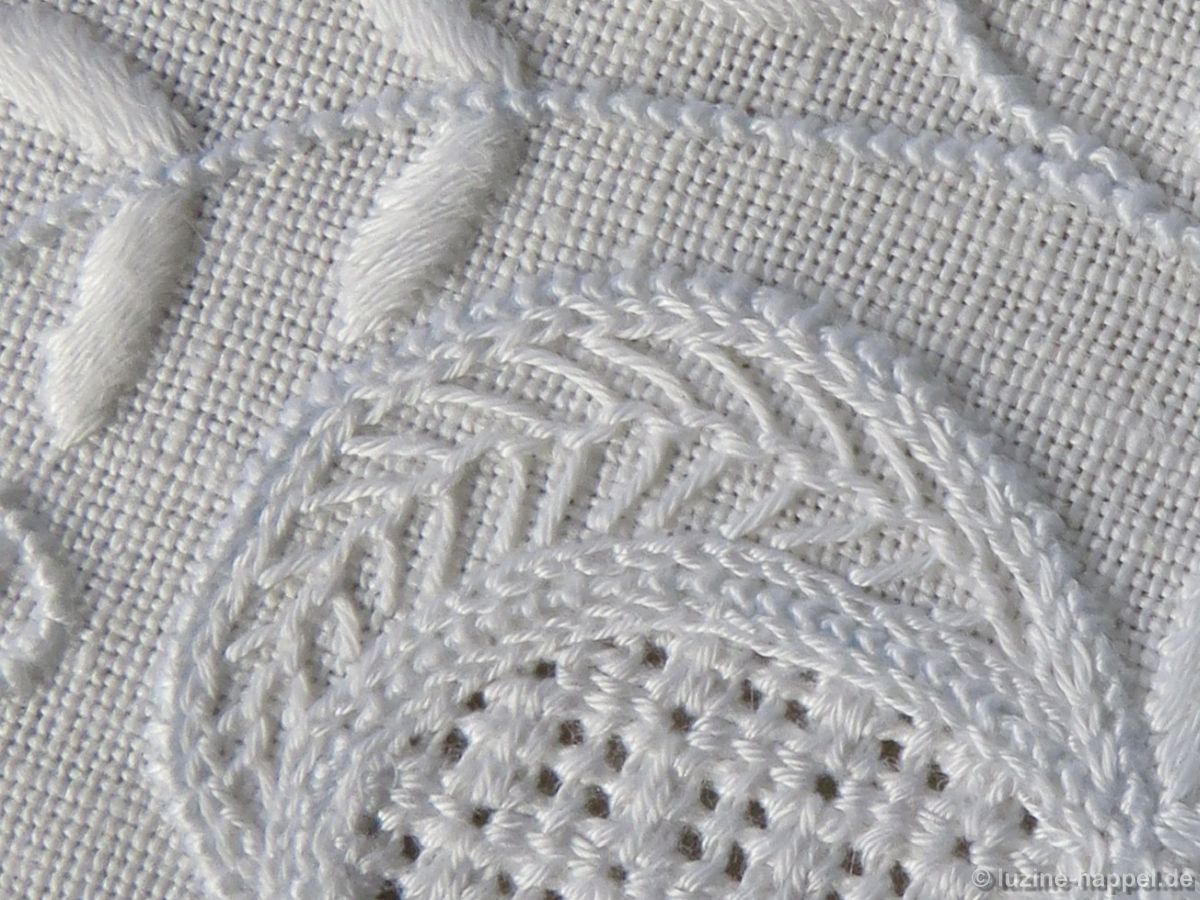
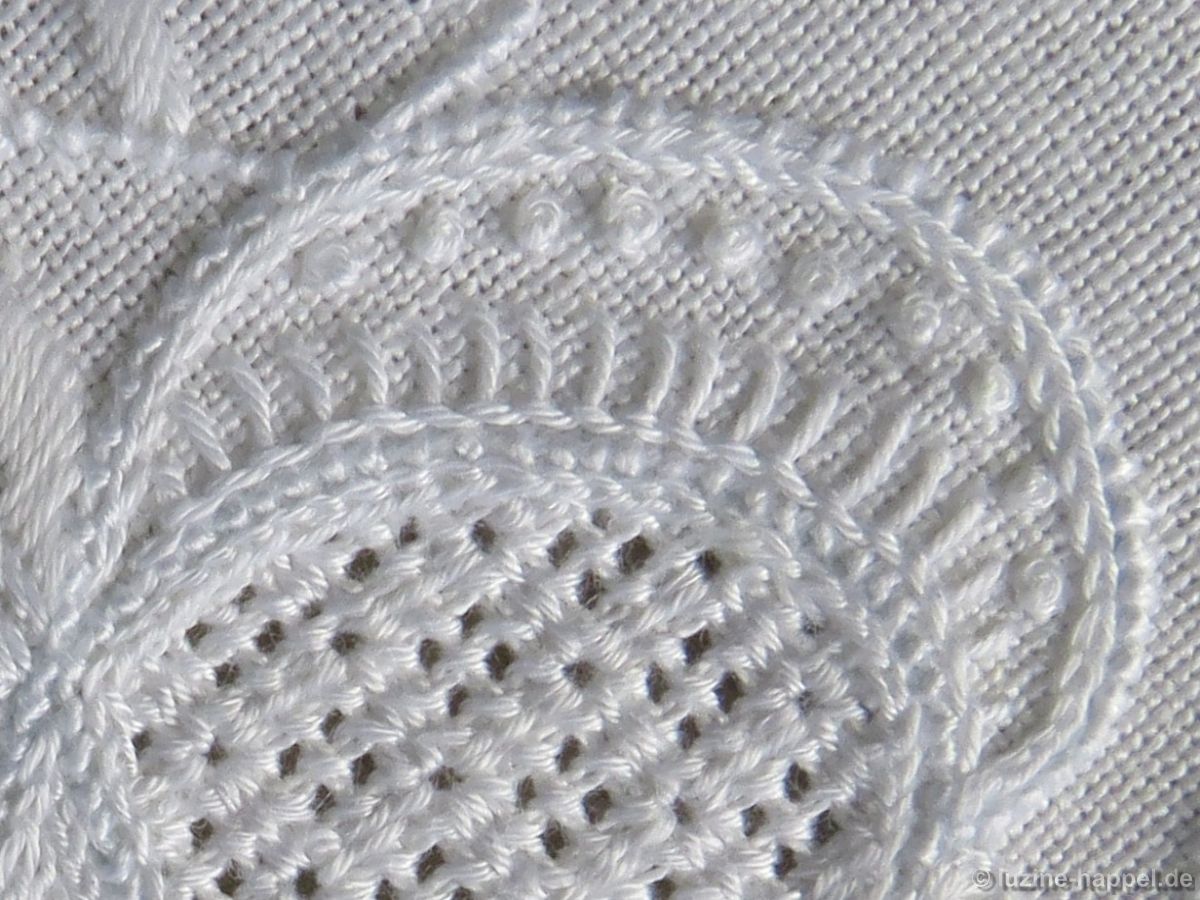
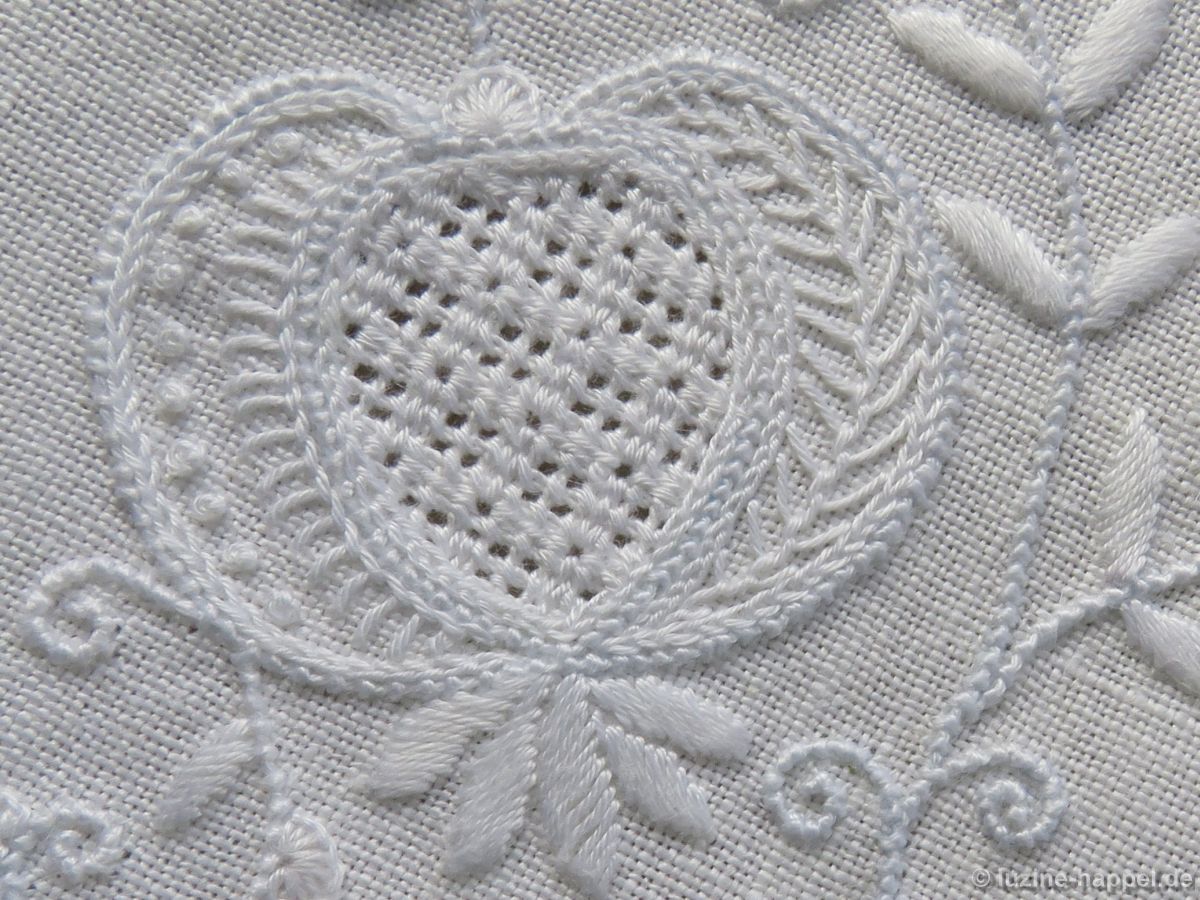
The heart receives an openwork thread withdrawing 2:2. The grid is secured from the back with Cable stitches. Filling pattern 442 is worked using needle-weaving stitches.

The tulip receives a Limet thread withdrawing 3:1 and a Röserich filling pattern (The Most Beautiful Röserich Filling Patterns)

The small circle gets a Limet thread withdrawing of 4:1 in width and 3:1 in height in order to be able to set the pattern evenly despite the uneven fabric. A cross made of Satin stitch bars is placed in the center. The remaining areas are each decorated with a Rose stitch

The bird’s belly is given a simple 3:1 withdrawn thread pattern with Honeycomb Darning stitches.
The bird’s wing has a relatively small area. Therefore, thread withdrawing is made 2:1 and the grid is secured from the back with Cable stitches.

The large leaf gets a 3:1 Limet thread withdrawing and Diagonal Cross stitches as a pattern.

The year of embroidering should be hidden in the small tulip. Therefore the thread withdrawing is made 2:1. The thread grid is secured with very thin thread with Cable stitches from the front (Single Faggot stitches on the back). The first part of the year is embroidered with Rose stitches (the second part goes into the tulip on the opposite side).

The second small circle remains. Since I want to show all the techniques used in Schwalm whitework on this sample, I fill the area with needlelace.

ou will find out what happens after the embroidery is finished in the next blog post.

Heart Cushion

To make a small heart-shaped pillow, you need two pieces of linen fabric. They should be large enough so that they can be easily placed in an embroidery hoop. The attached heart motif istransferred via iron-on or via direct tracing, using a water or a heat soluble pen, to one of the two parts.

The outer heart line is marked using coloured thread with short Running stitches. The heart with half-eyelet scallops is embroidered.

The finished embroidery and the other piece of linen – with the addition of a little washing powder –

are first soaked in water and then boiled.

Both parts are dried and well ironed and placed on top of each other so that the back of the embroidery is placed on the outside. Both parts are now sewn together closely along the marking line. Only in one place – as straight as possible – does a piece of approx. 4 to 5 cm remain open. The marking remains there, otherwise it is removed.

The edges of the fabric are unfolded and

the seam is smoothed with the thumbnail very well.

The excess fabric is ctrimmed close to the seam, but be careful – at least two fabric thread cross hairs must remain outside the seam so that the fabric does not fray later. Only in the unclosed area is a remaining fabric of approx. 1 cm.

The embroidery is carefully turned inside out. The seams are positioned on the outer edge by carefully pushing back and forth between the fingertips. Small, loosened portions of Poly-Fil or wadding are inserted through the opening into the heart bag and first transported to the edges with the fingers. The entire area is gradually padded up.
After enough filling has been added, the remaining fabric excess is folded inwards at the level of the marking. The marking thread is removed and the seam is closed with small, delicate hand stitches.
A cord is twisted using cotton yarn that is not too thin. If there is a Twister, this is child’s play. But you can also do it the old way with a pen or wooden stick.

Starting at the top center, attach the cord over the seam. The beginning and end are sewn together tightly close to the fabric.

The remaining ends are knotted together to form a hanging loop.

Together with a square cushion, the cones, small angels, bells, the cut out hearts, the snowballs and maybe also the mushrooms, the grapes and leaves or even small bags (here you can find the instructions), bag or hanging it can become a pretty and very individual Christmas tree decoration.

The Hare and the Hedgehog

In Germany Easter is, among other things, associated with the Easter bunny, who hides the Easter eggs in the nest for the children.

Somehow this picture also reminds me of our current pandemic situation.

The Race between the Hare and the Hedgehog

So I chose this section from the embroidered fairytale-like wall hanging by Rosemarie Landsiedel-Eicken, to wish you

Happy Easter!

She was it, giving the inspiration for the Global Schwalm Sampler. In one of my future articles I will show details of the sampler which was shown in total then.

Rosemarie Landsiedel-Eicken embroidered different wall hangings, amongst others also a fairy-tale like one including the representation of The Hare and the Hedgehod. May be, I can show more details of this sampler in the future.