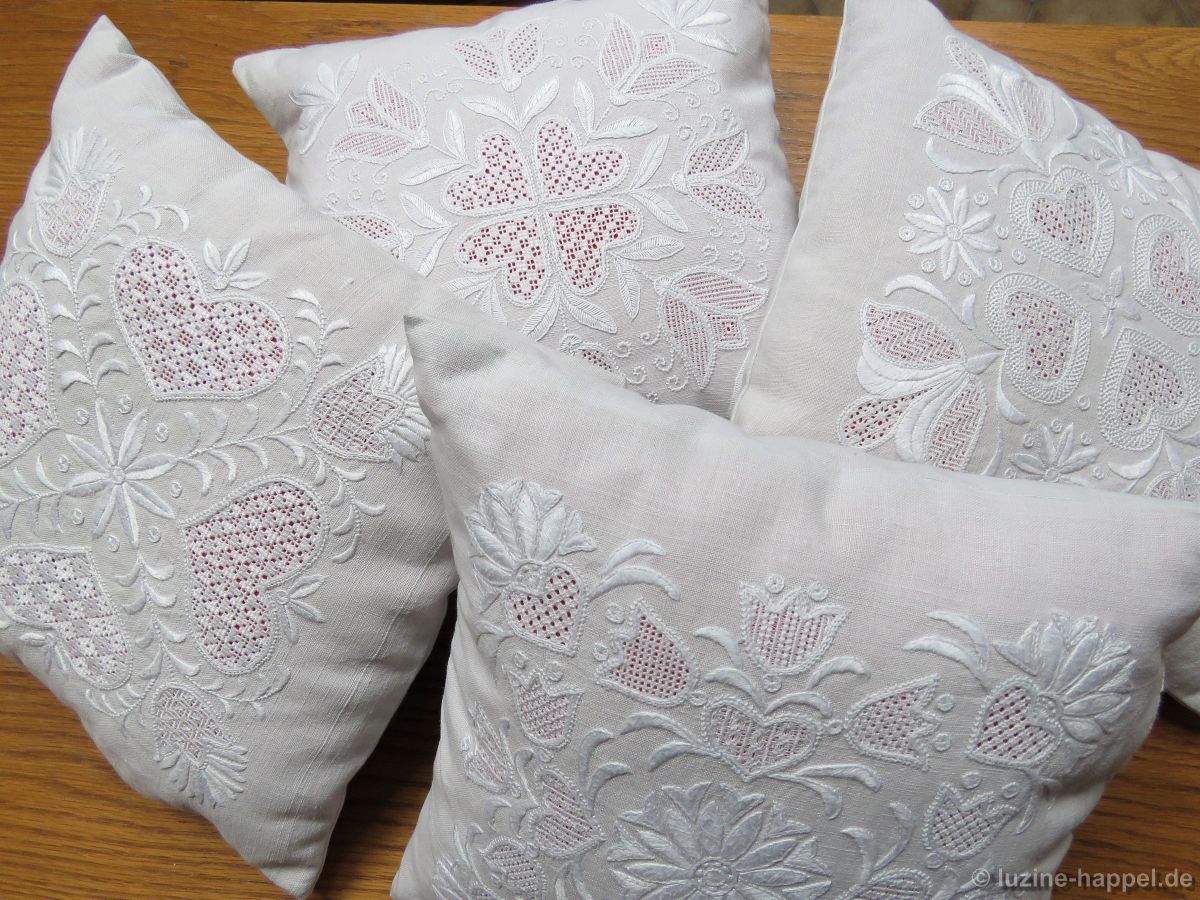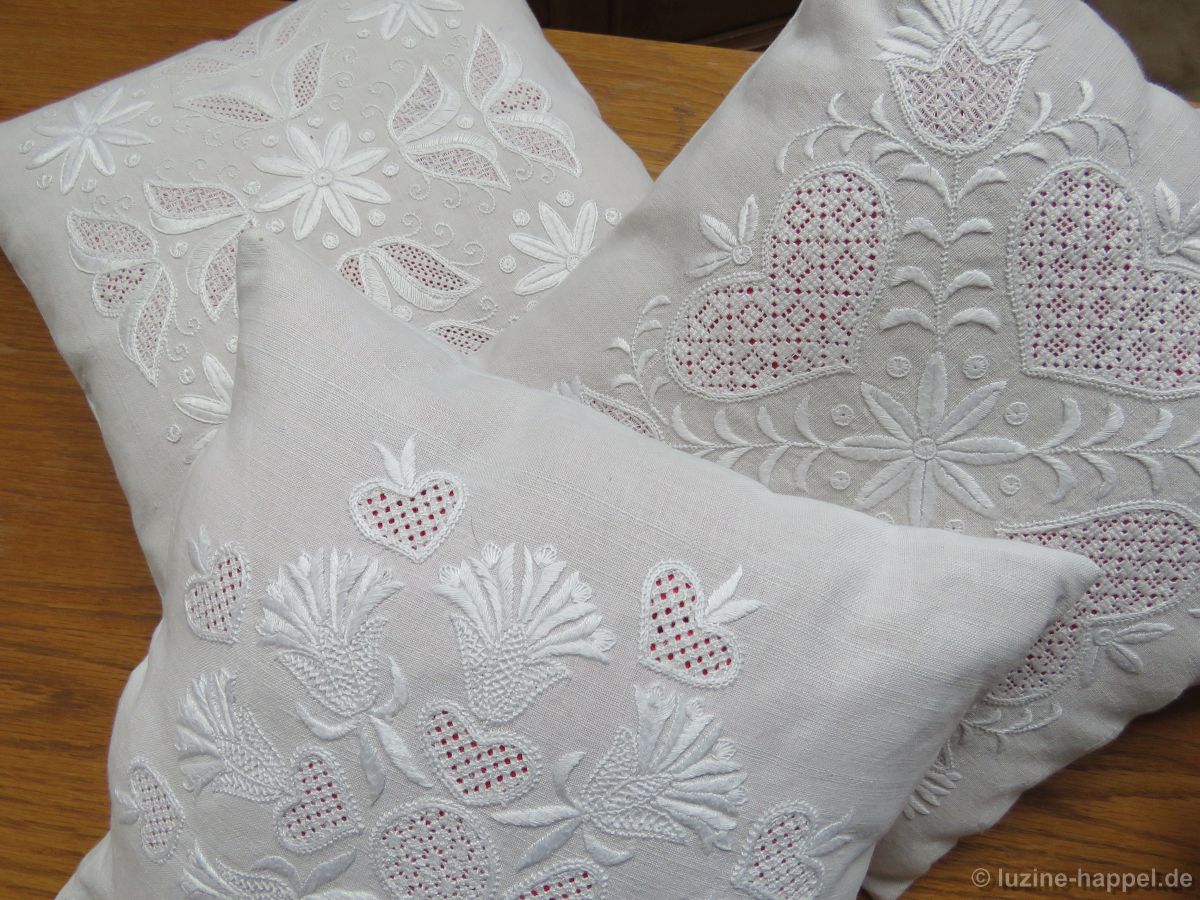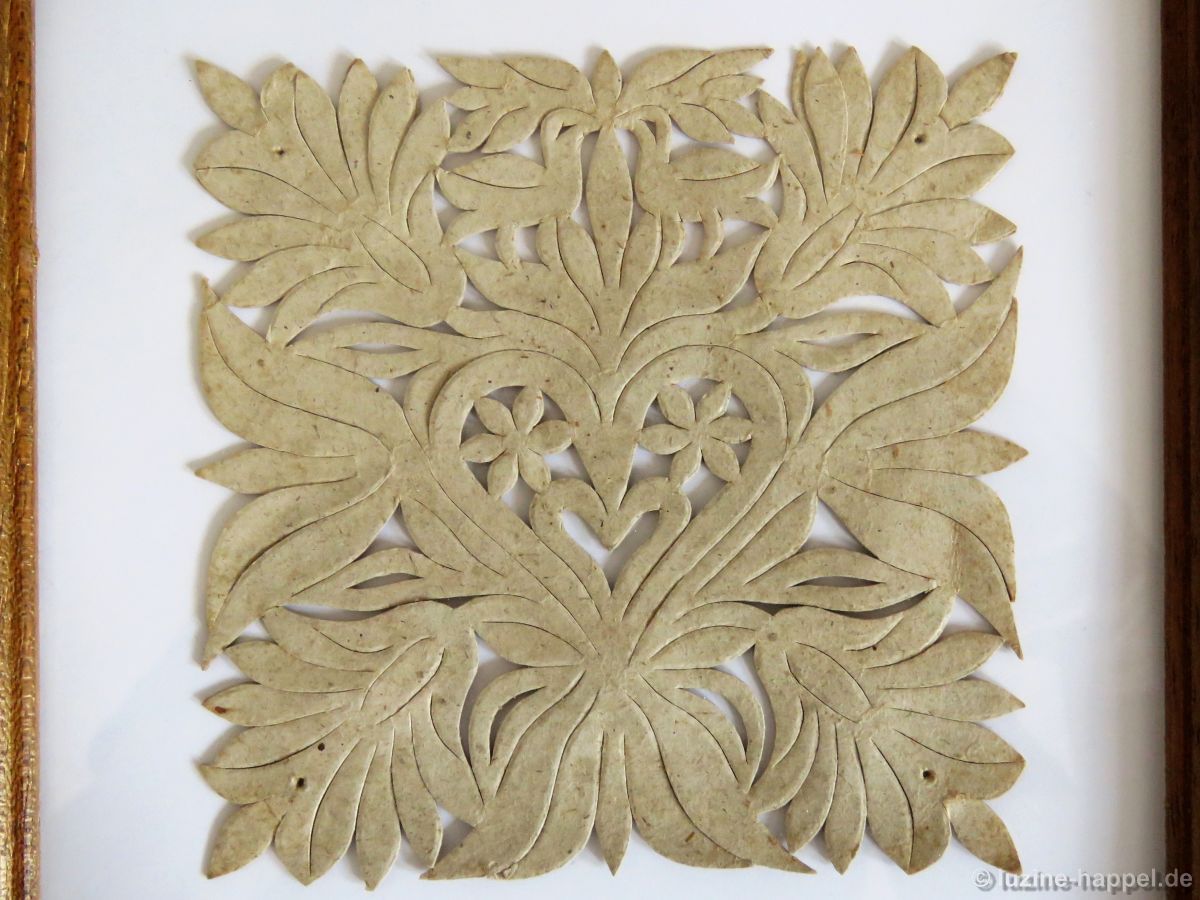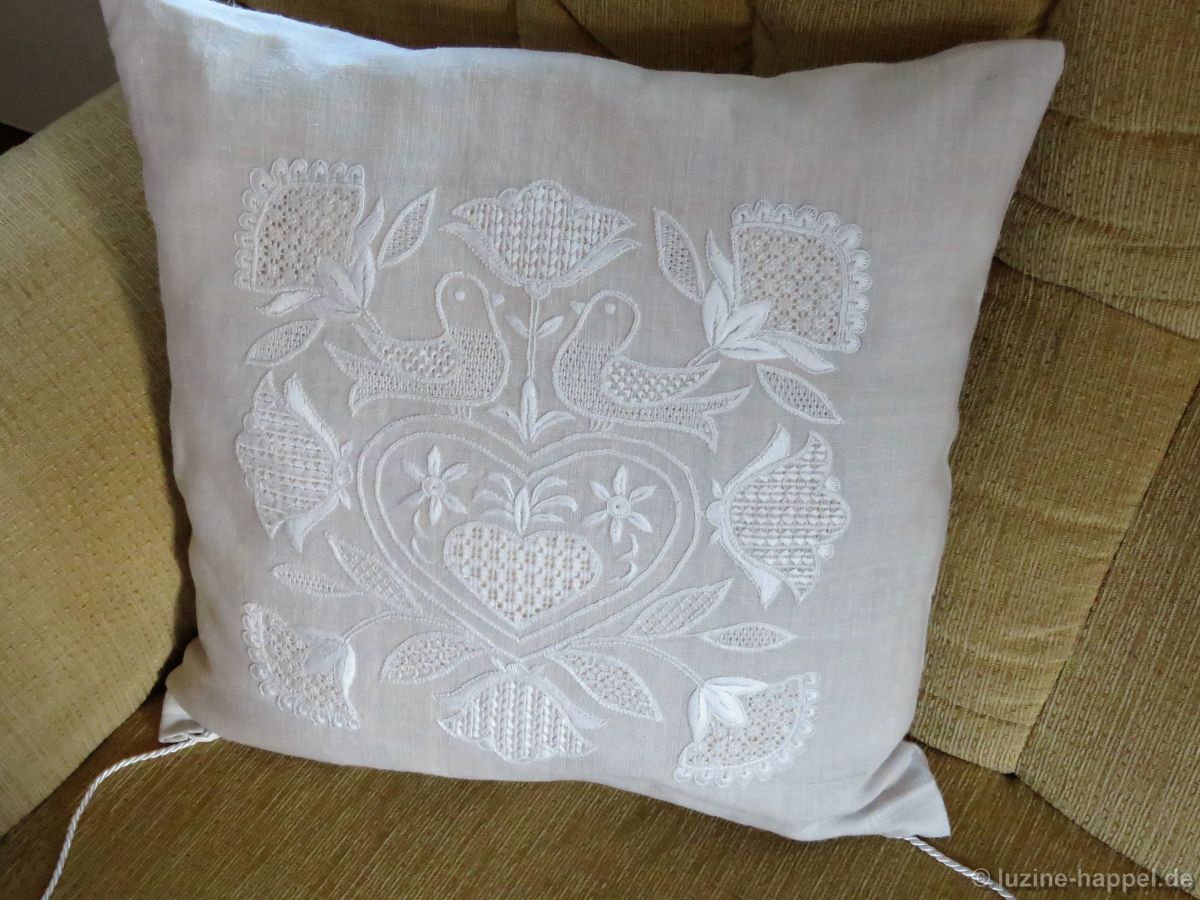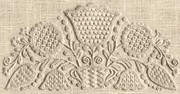
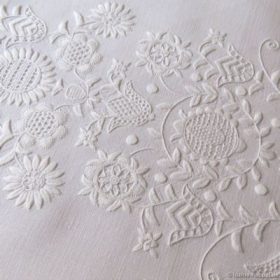
It makes my day every time I view this very special table runner.
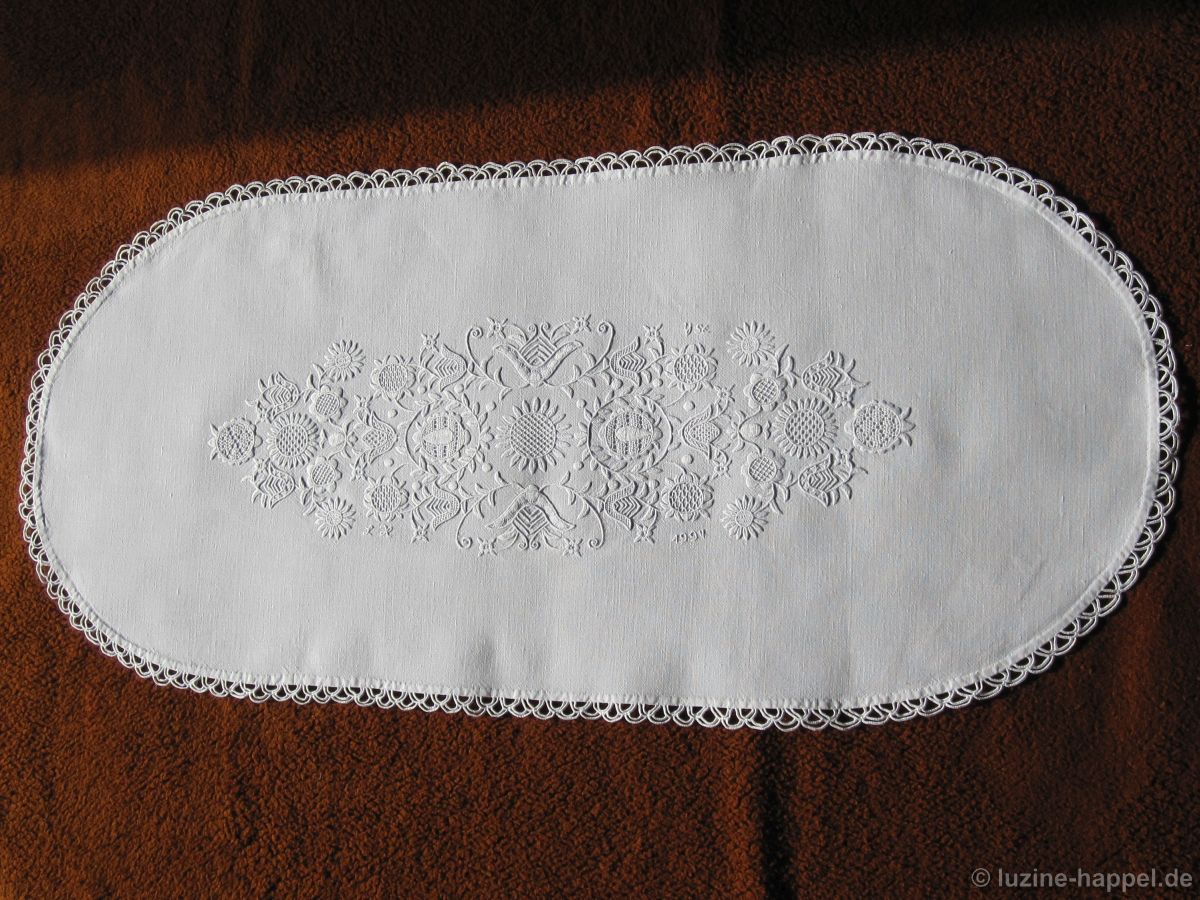
The excellent design is from Barbelies Schäfer. The design incorporates traditional patterns and was part of adult education classes. Irmgard Mengel embroidered it perfectly.
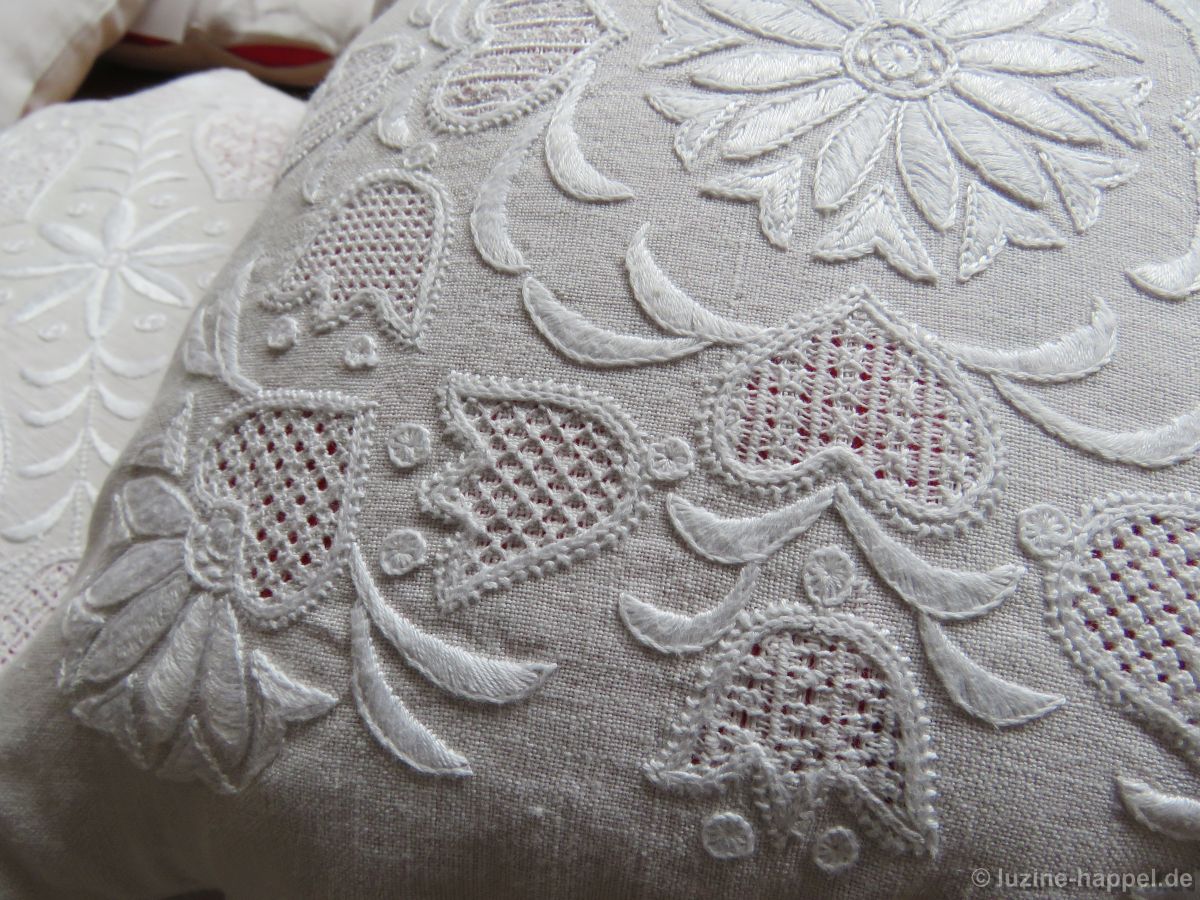
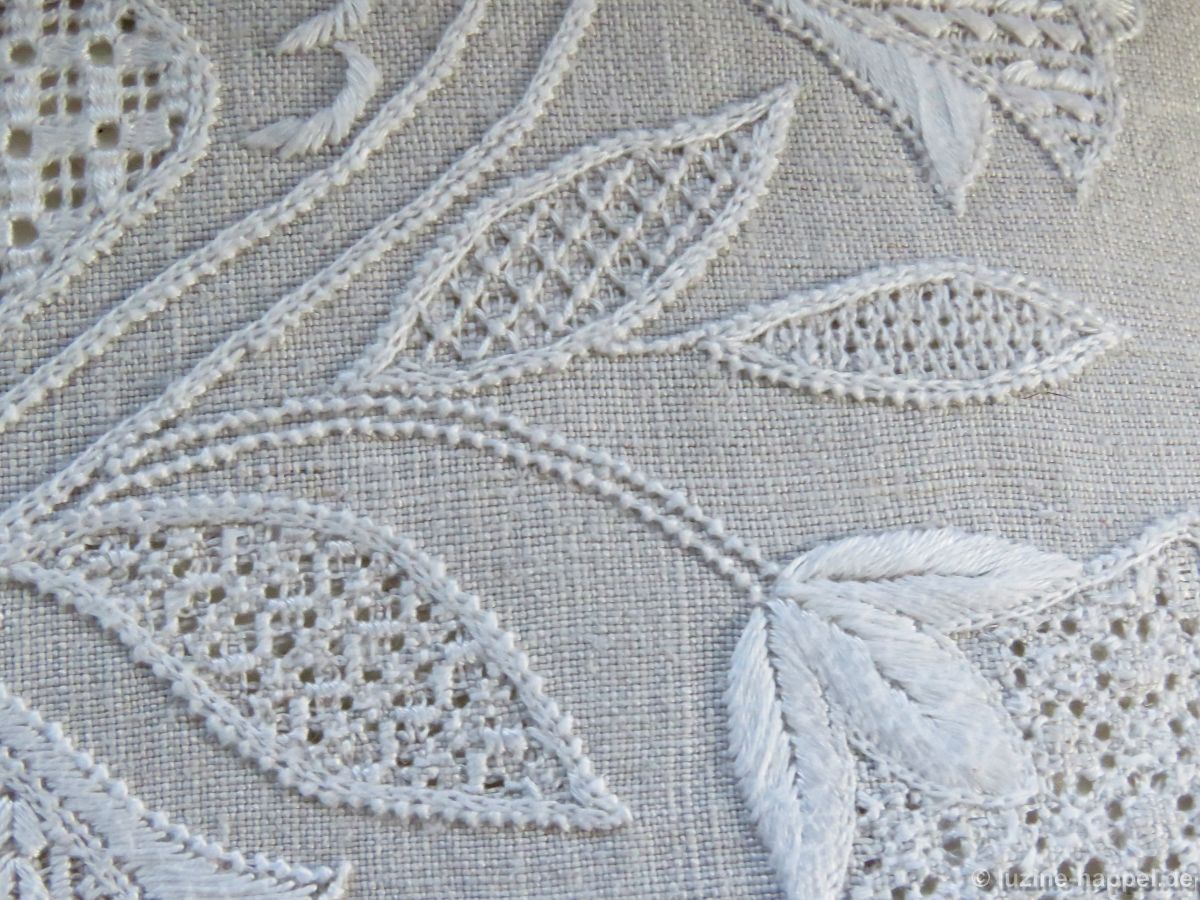
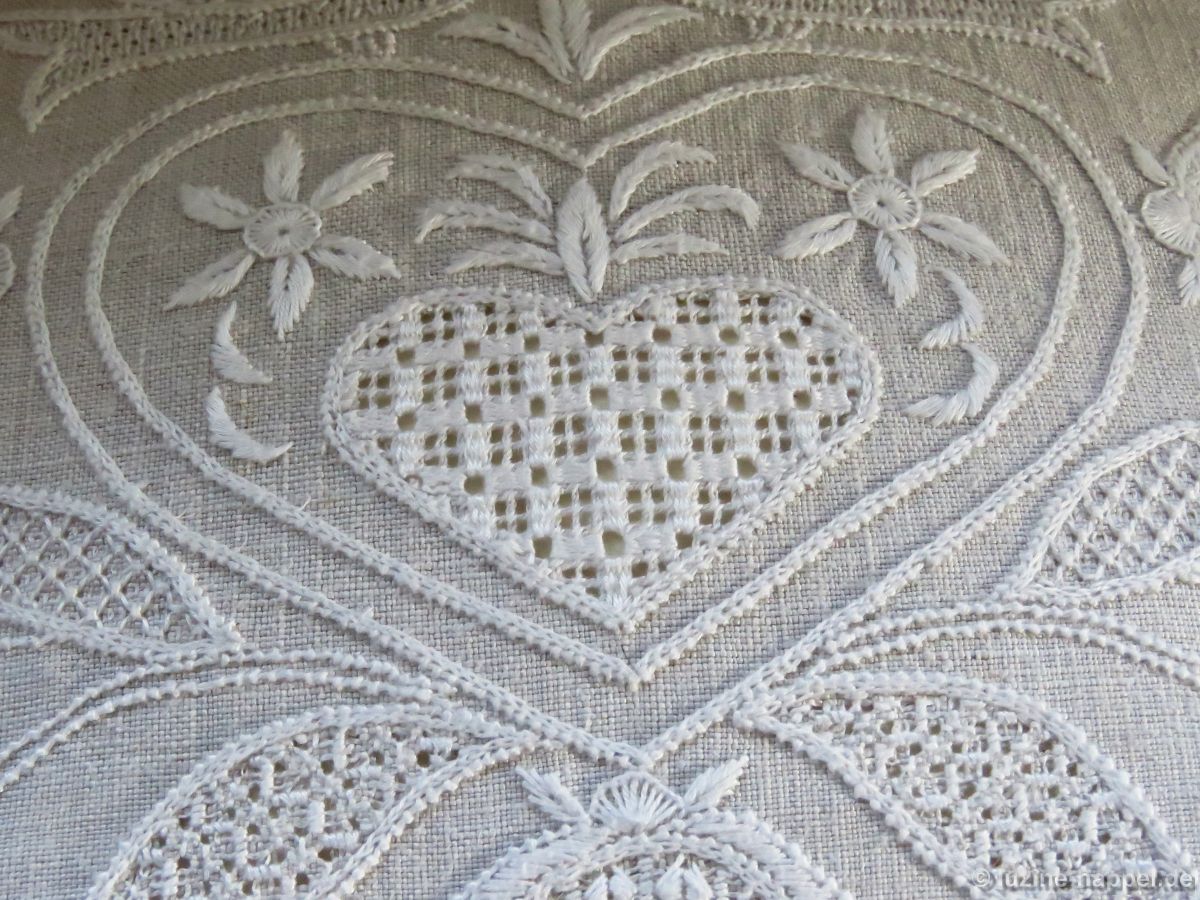
On the very fine linen, the “old” filling patterns, in combination with the raised whitework, are especially effective.
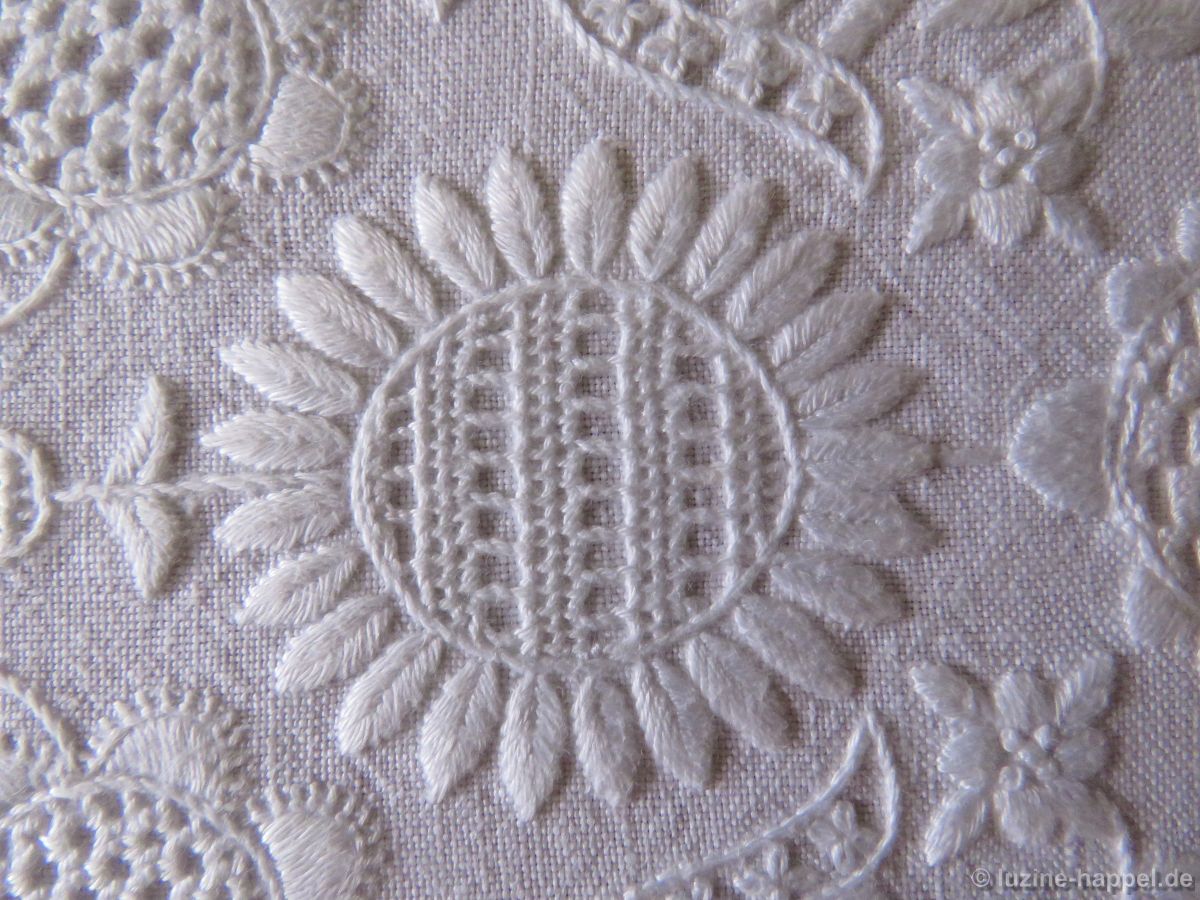
Although early Schwalm whitework does not include withdrawn-thread patterns,
the variety of filling patterns in this appealing technique is considerable. Many surface filling patterns can be found in my publication Early Schwalm Whitework.
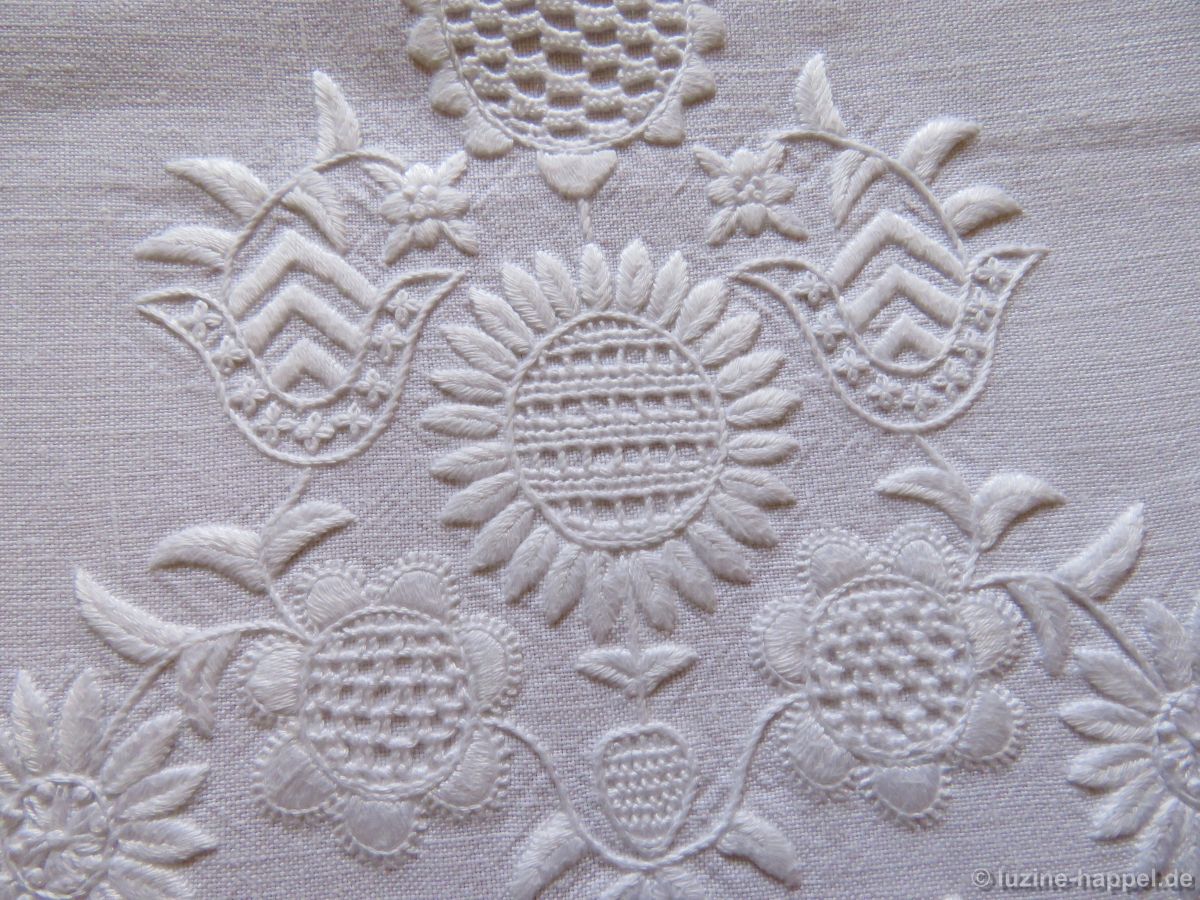
In addition to a couple of looped stitch patterns and interlaced stitch patterns,
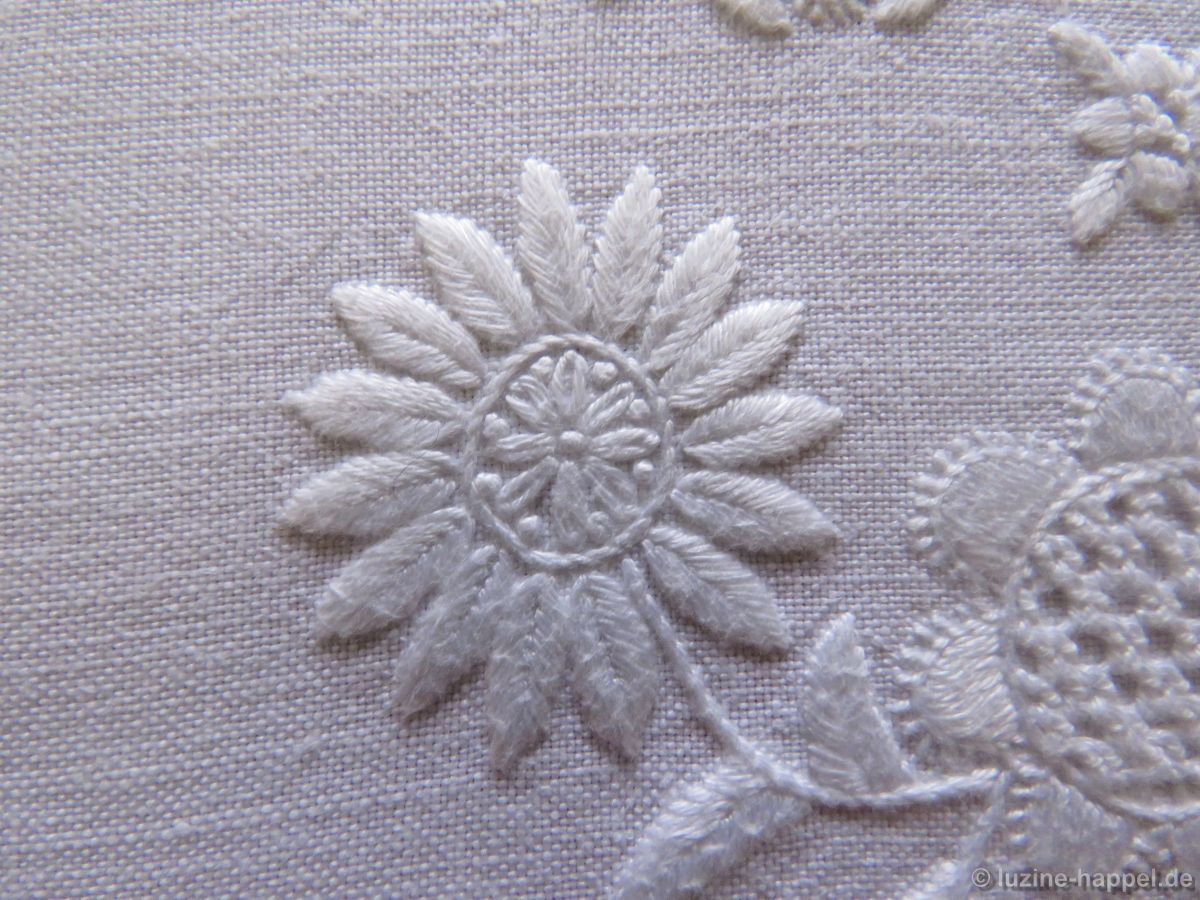
there are Chain stitches in many variations and Satin stitches.
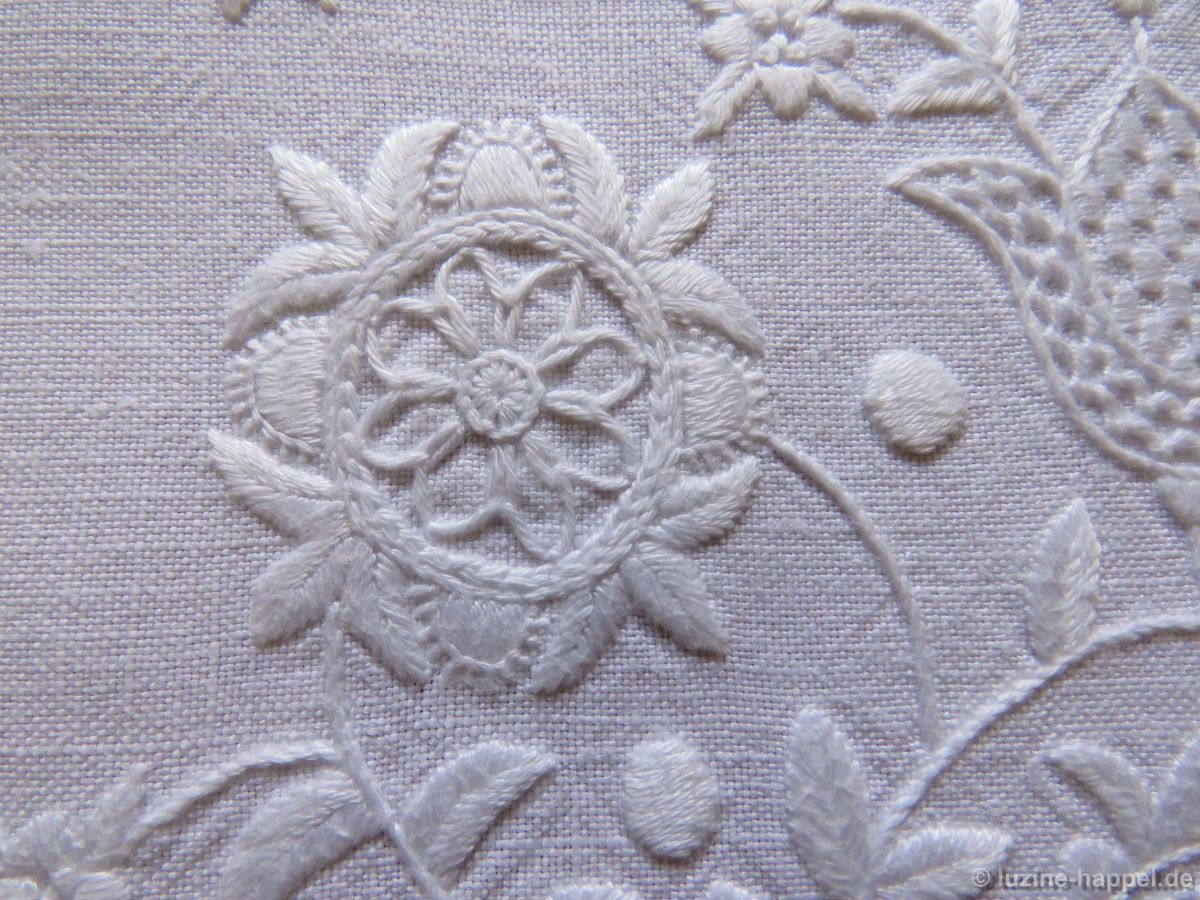
Most impressive are the evenness of the stitches (in early Schwalm whitework stems and outlines are made using Stem stitches instead of Coral Knot stitches)
and the perfection of the leaves.
This is an absolutely thrilling pattern that has been turned into a truly spectacular example of excellent needle art by Irmgard Mengel!
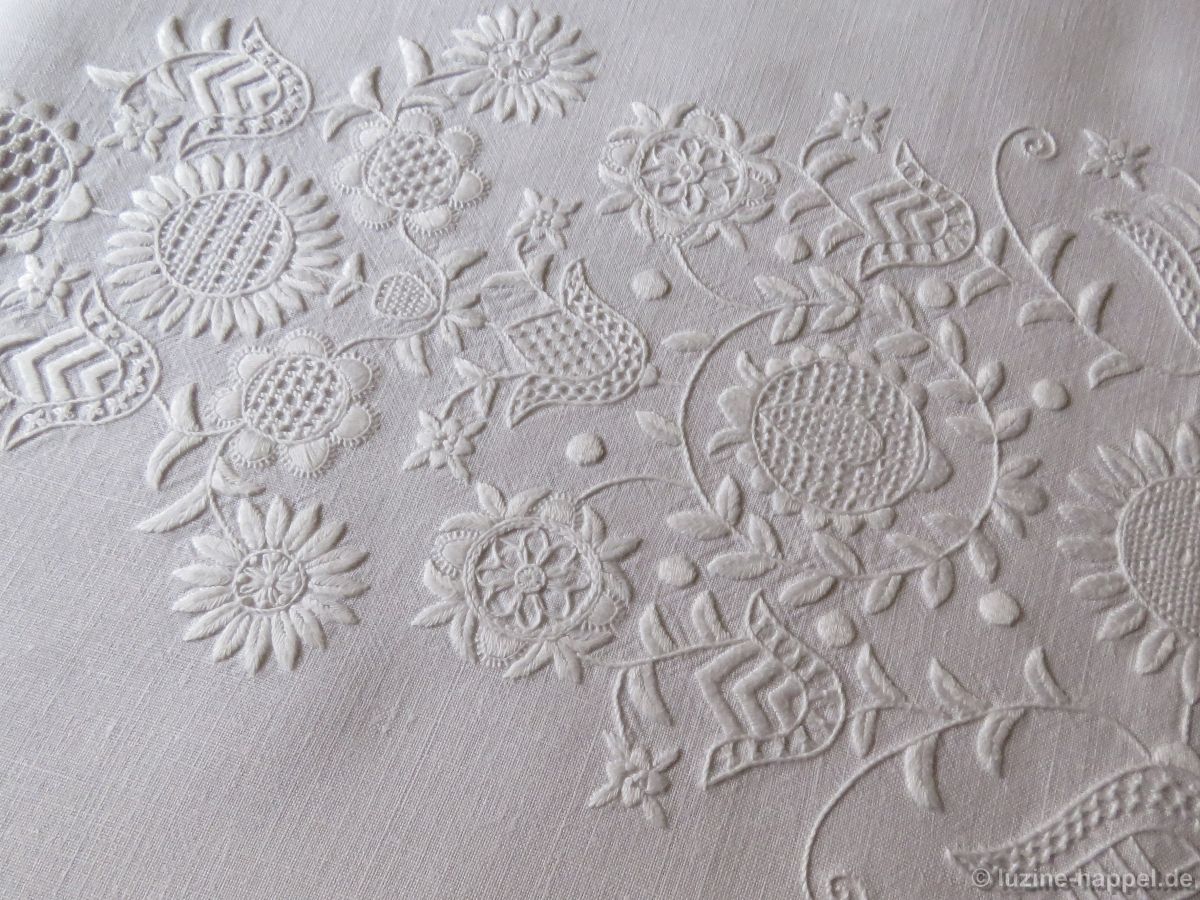
If you would like to try your hand at this technique, you can get this design printed on linen by Irmgard Mengel. Please email me with your request.
It has been a long-standing goal of mine to create a publication dedicated to these beautiful filling patterns, and now – just in time for Christmas, but adaptable to any purpose – I am happy to announce that it is finally finished. Honestly, I think that this just might be my favorite title.
In this book you will find unique patterns that up to now were unknown. And you will find that I have broken down complex patterns into easily understandable, precise, clear, coherent, and detailed instructions ensuring that you will be able to replicate them perfectly.
This is the publication that many embroiderers, while visiting my exhibitions and viewing the embroidered star pattern projects, have asked for over and over again.
“Stars – Filling Patterns illustrated with step-by-step instructions” includes eighteen different star elements with 133 variations.
Essential elements of the stars are Satin stitches, Blanket stitches, Double Back stitches, Lazy Daisy stitches, Four-Sided stitches, and many others; these make the stars always different and keep the embroidering always interesting.
Solitary small stars are particularly effective on wintry embroideries.
Stitched en masse and combined with other stitches, they become eminently impressive filling patterns. The different possible combinations make the pattern variety nearly limitless – by changing single elements there are always other variations to be discovered.
Fifty-eight especially attractive filling patterns are presented in this new publication. In addition, there are many project examples showing how one might use the patterns. Last but not least, some line-drawn designs are included to facilitate your getting started.
I invite you to discover the beauty and the nearly limitless possibilities of Stars in my latest book.
Filling Patterns
illustrated with step-by-step instructions

101 pages
616 images
text: English
plastic comb binding
€35.00
shop
Deeply impressed by the beauty of the apron square designs and the number of wonderful patterns that can be created using the same main motifs over and over again, I looked for a way to modify and then apply these designs to contemporary whitework designs. With the help of my designer, I have produced seven beautiful square designs. I have shown a variation of one in a previous article. It is a design axially symmetric; all others are centrically symmetric.
The designs measure 18 cm X 18 cm each, but it is possible to enlarge them. They are pretty made up as pillowcases, square doilies, and table runners. I am using five of the designs on each side to embroider a large tablecloth. Unfortunately it is not yet finished, so I cannot show a picture.
However, it looks like it will turn out very pretty. In addition to the pillowcase I showed in the previous article, I could finish six more square pillowcases using the centrically symmetric apron square designs.
The designs are beautiful.
The shapes are large enough to accommodate a variety of filling stitches or patterns. And the added Satin stitch embroidery makes a nice contrast to the drawn thread work areas.
Did I whet your appetite for more beautiful Schwalm-inspired designs?
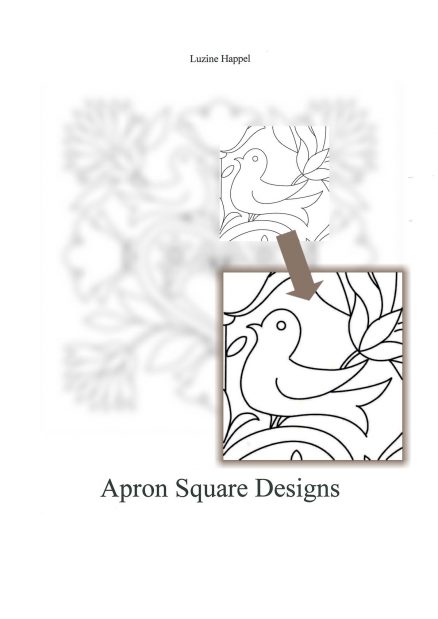
I now offer the 7 designs + 1 design variation as a document for downloading.

Apron Square Designs
line-drawn designs
8 pages
7 + 1 designs in a size of 18 cm X 18 cm
2,28 MB file size
item price: €25 (including 19 % sales tax), 21.01 € for customer outside the EU
download here
The aesthetic sense and impressive creativity that was able to create the beautiful apron squares inspired me to produce similar designs suitable for whitework. I sent pictures of my entire collection of apron squares and their templates to a designer, and I received in return wonderful square patterns.
One template – for me especially interesting because it included bird motifs – was the inspiration for a design.
I used the newly created line-drawn design to embroider a square pillowcase measuring 40 cm X 40 cm.
I chose an old handwoven linen because I particularly like white embroidery done on a natural colour linen; I think the combination is very pretty.
The shapes were filled with a combination of traditional and new filling patterns.
The result is a very successful adaptation of traditional Schwalm accessory design to contemporary whitework. I’ll tell you about the other designs inspired by apron squares soon.

The Schwalm apron squares are a very special accessory. They are not only splendid in their appearance but also very elaborate to work.
First a template is needed. It is made from paperboard.
Using fine sewing thread, the template is sewn on to a coloured fabric matching the Schwalm costume it will be worn with – here red.
Both layers are fastened on to a linen or cotton fabric.
With the prepared square stretched in a frame so that both hands can work – one from the front, the other from the back – the embroiderer stitches the fine silk threads precisely side by side upon the paperboard. Not all Schwalm women were able to do such fine embroidery. It was the work of those trained in this special traditional craft – the colour embroiderer.
From the front, the edges of the pattern sections are clear and close together; they are not so distinct on the back, and some of the linen fabric is seen between the sections.
Then sequins, bullion, and wire are added.
This created a confused mass of fine threads on the back.
The piece was trimmed and lined with a matching glossy paper to protect the apron fabric from abrasion.
The edges were covered with silk ribbons,
and the silk ribbons were additionally decorated with sequins and bullion. Often the initials of the owner were added.
It is amazing that such a beautiful apron square develops from the above template!
It is understandable that the Schwalm women wanted to protect these pretty and elaborate accessories when storing. (They only needed it for dancing, and this was usually only three times a year.) So, they often made custom storage bags to accommodate the apron squares. These were also made from glossy paper and had two separate compartments – one for each of the two apron squares – and were sewn closed with Running stitches.