My Needle-Weaving Band Sampler

While preparing to teach this summer, I worked a sampler consisting of thirty-one different needle-weaving bands with very different patterns. My students thought it gorgeous.

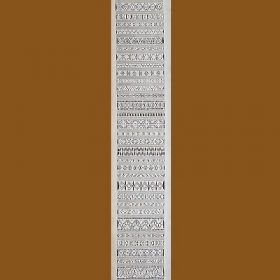
The picture below shows the entire sampler. Because I cannot show overly long pictures on my blog, I sized a picture of the entire sampler to internet standards to give you a visual of the length to width ratio. The finished piece, hemmed and laundered, measures 28 cm X 170 cm!
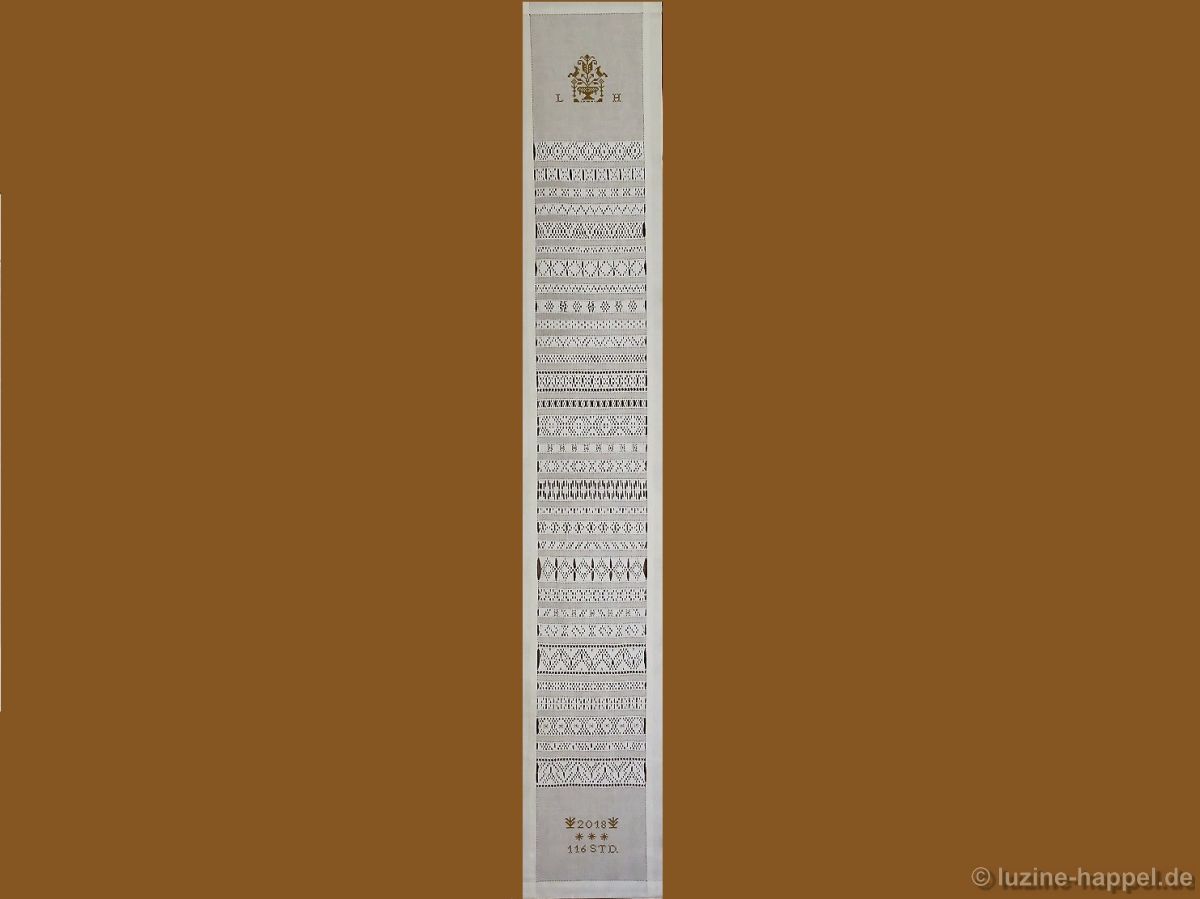
This sampler was worked on Weddigen linen with 13.5 threads per centimeter. The linen was cut to measure 40 cm X 183 cm. I used coton à broder No. 16 (16 skeins), No. 30 (5 skeins), and Anchor embroidery floss No. 888 (1 skein).


Tall bands alternate with small bands. Examples of all pattern categories were worked – A-patterns, one-piece block patterns, two-piece block patterns, two-piece block patterns with spiders, mirrored patterns. In addition divided patterns and needle weaving with wrapped bundles patterns were embroidered.
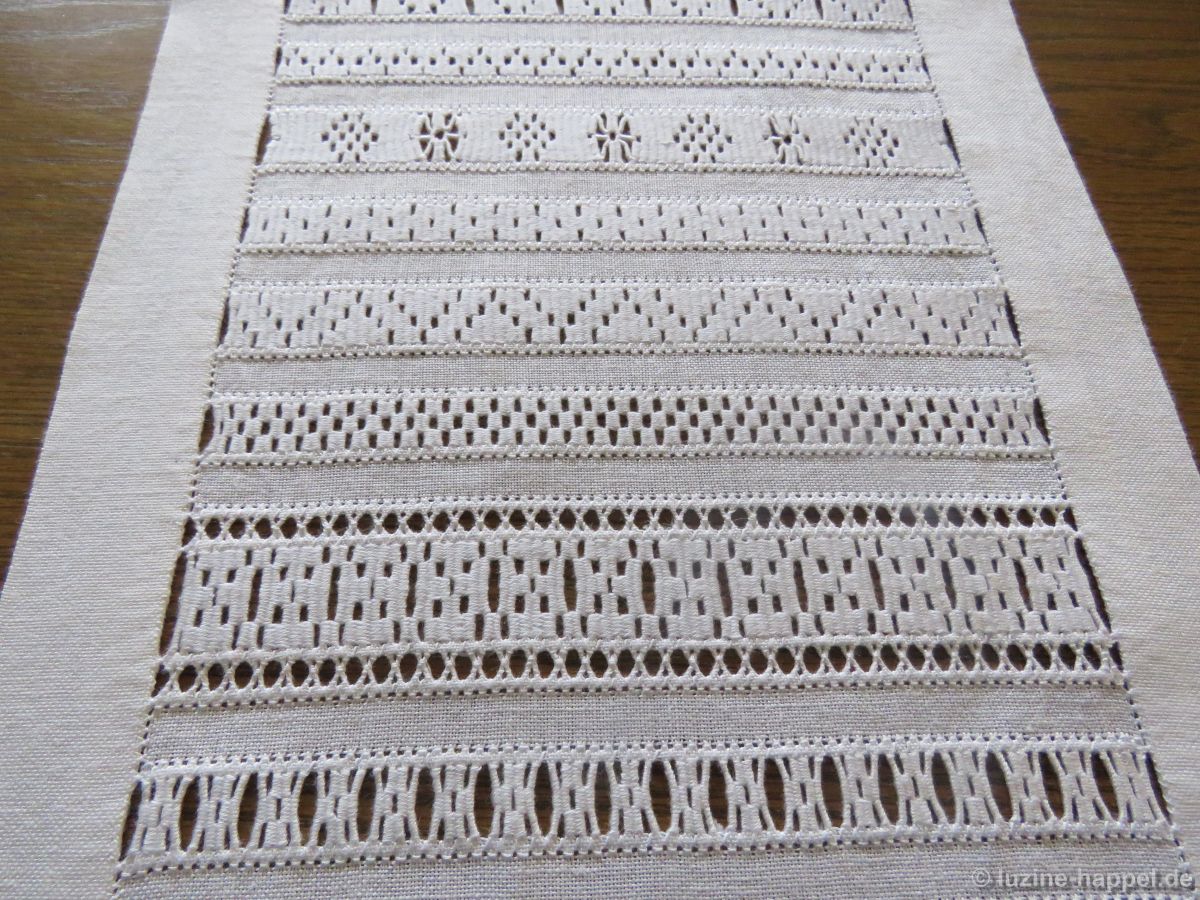

A huge collection of 193 – yes, 193! – beautiful patterns are found in my book Schwalm Needle-Weaving Bands (coming soon).


All needle-weaving bands were worked over seventy-two bundles. It is advisable to choose a 72 (or a divisor or multiple of 72) bundle section for a band sampler because 72 is divisible without a remainder by many numbers, namely 2, 3, 4, 6, 8, 9, 12, 18, 24, 36. So, all one-piece block, all mirrored, and all divided patterns that have segments with these bundle numbers can be worked easily.
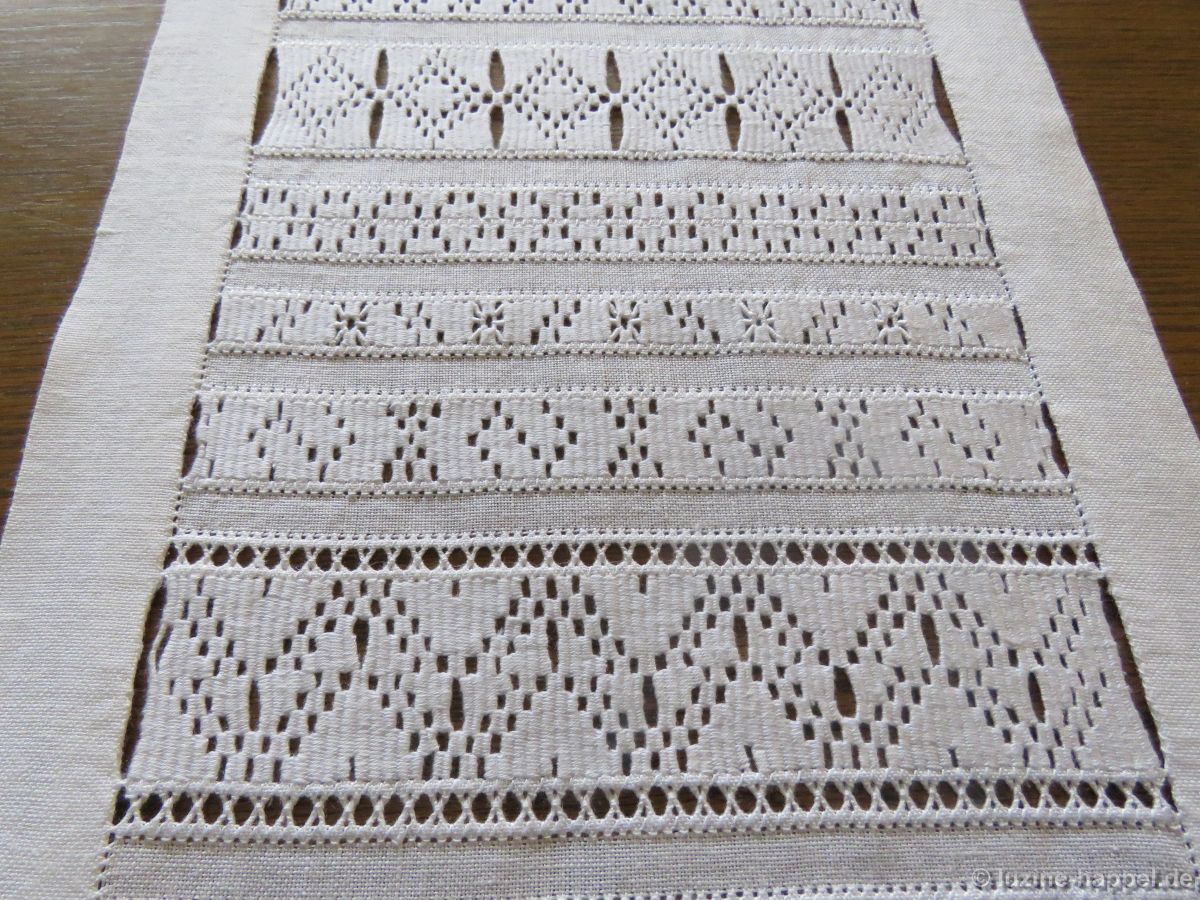

The bands were worked up to the hem, and the cut thread ends are hidden in the hem.
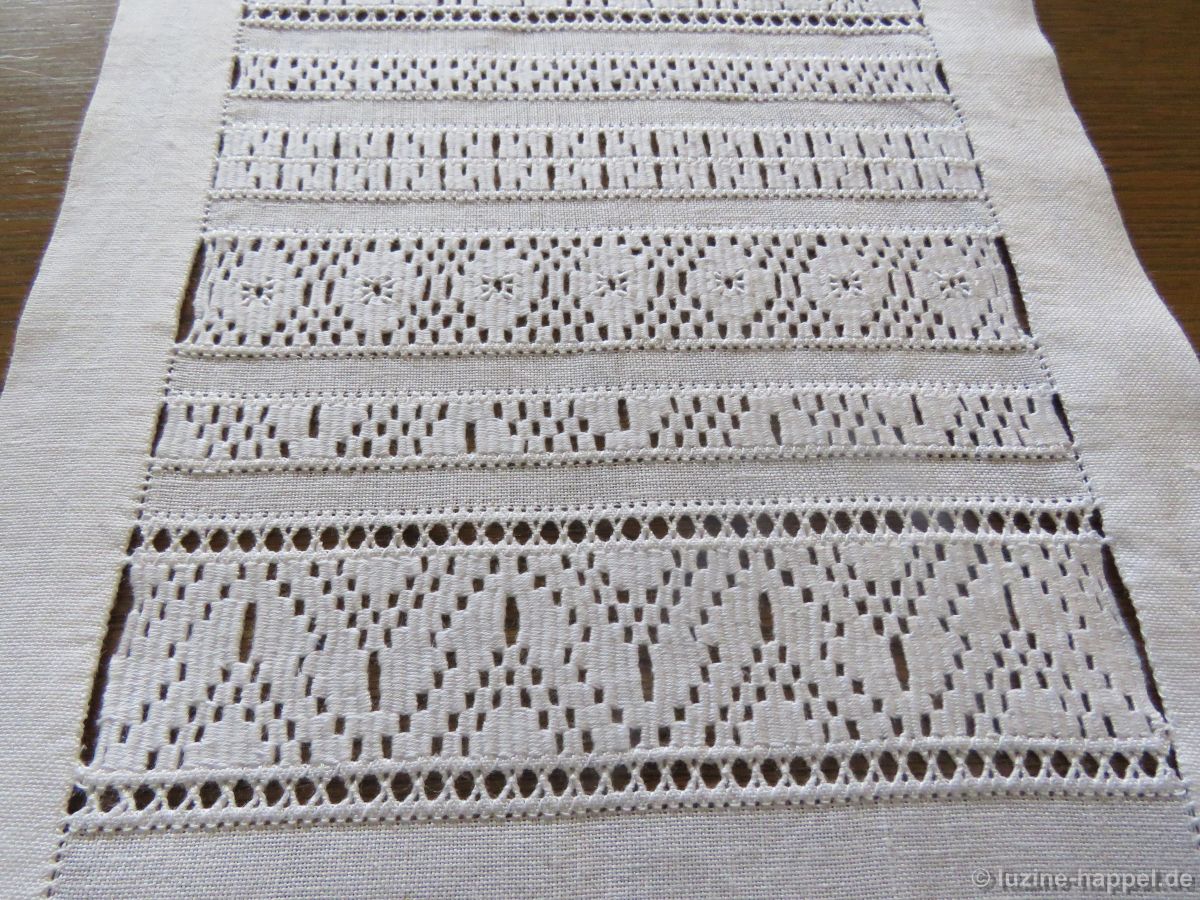

Perhaps this option looks less elaborate than securing the band ends with Blanket stitches, but there are some issues that make working Blanket stitches a little challenging. The thread ends have to be basted in place so to not hinder needle weaving, and later they have to be trimmed to match the width of the fold. (The hem is folded 1 cm. And if the thread ends are trimmed to fall within the fold section, they are not visible. If the thread ends are longer, they are visible through the fabric; they are not visible lying on top of two layers of fabric.)

If the large gaps at the band ends – established in the course of needle weaving the pattern – are too obtrusive, they can be closed with small stitches meeting the level of the units from the back after the hemming is finished.


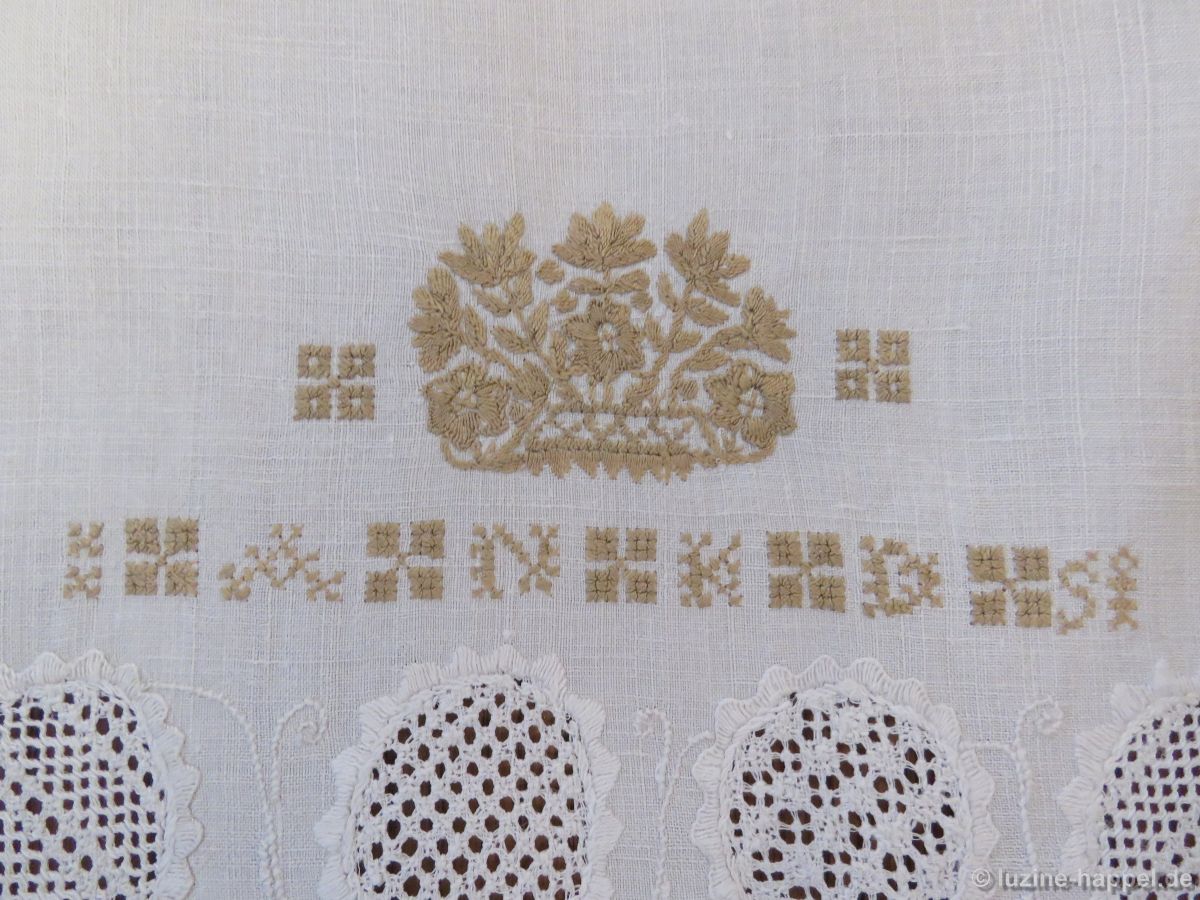
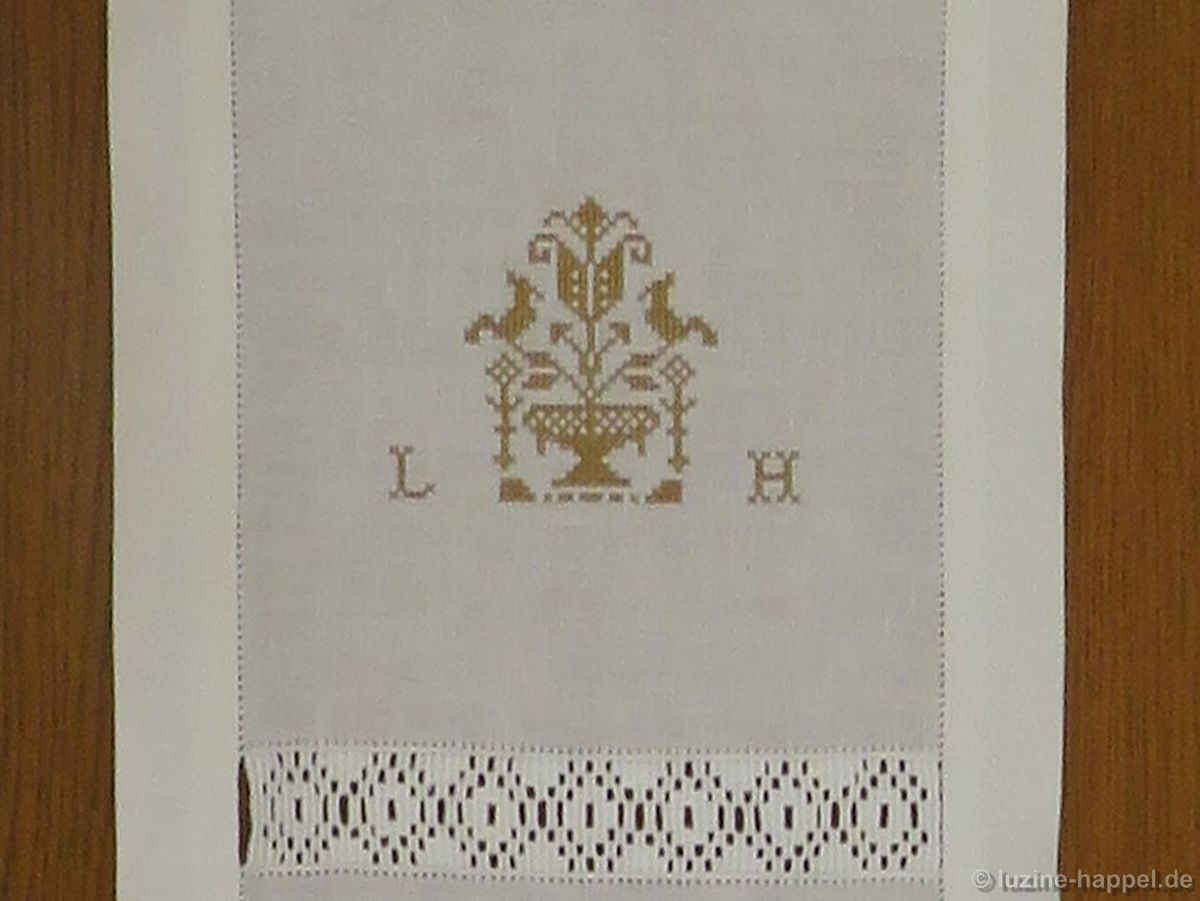
A Cross stitch crown and initials were stitched in the space remaining at the top of the sampler.

Crowning an elaborate piece is common in the Schwalm. Not all linen fabrics are woven densely enough to work Satin stitch crowns (see Schwalm Crowns and Grand Schwalm Crowns), but traditional Schwalm embroidery also provides a wide range of Cross stitch crowns. They can be found in Traditional Figural Patterns – charts for numbers, initials, birds and other animals, flowers, flowerpots, manikins, stars, ornaments, and others.

The year, hours of working, and some small Cross stitch ornaments were added below the needle-weaving bands.

It is always good to include the year in which a piece was worked. And it is common in the Schwalm to add small Cross stitch ornaments to numbers and letters.

I think it is also good to add the approximate hours (German: Stunden, abbreviation: Std) spent doing the embroidery. It is useful to the embroiderer when looking to the piece years later and can help people (now or in the future) understand its complexity and perhaps rate its value.


Even keeping the option open to cut the linen shorter at any time, I at first thought myself crazy to start such an elaborate piece with the goal to finish it within a few weeks. But after embroidering the first few bands, it was like an addiction. Every free minute I sat down to stitch. Weaving the stitches is so relaxing. It is similar to knitting socks; I could calm down and unwind while stitching.

So I can recommend a needle-weaving project to all people wanting to take life at a slower pace.

Are you interested in working such an eye-catching embroidery for your own home? Instructions, explained in great detail, for working needle-weaving bands and the different pattern categories are found in Schwalm Whitework Lesson #4 – Needle-Weaving Bands Sampler and Fancy Hems.
Sampler by Bärbel Kophamel

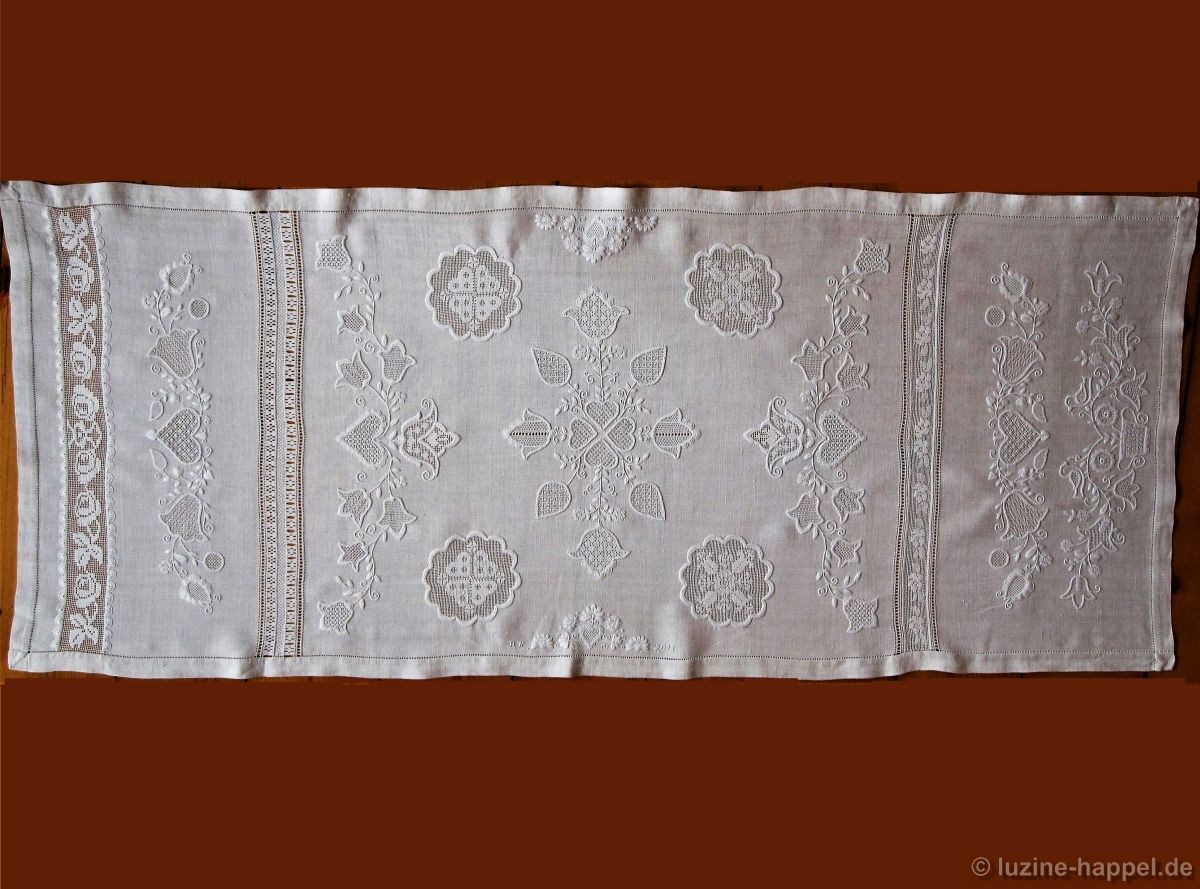
In 2013, a very special sampler cloth was made by Bärbel Kophamel.


She worked on very fine handwoven linen using dense stitches. This combination made outlines and leaves prominent.


By chance she found this linen piece at an antique market. She loved the feel of the fabric very much and enjoyed embroidering on it. From the onset she had no real plan. She began her sampler cloth in the center, adding all the elements that she was interested in.


Step by step she worked ornaments,


borders, and hems,


adding needle-weaving and openwork bands until the entire cloth was filled.


She embroidered creative filling patterns.


She finished the cloth by adding a crown, her initials, and the year. Because she did not like colours in combination with whitework, she embroidered the crown in white.


Bärbel Kophamel has stitched four different samplers in all. I am grateful to her for allowing me to share this beautiful and unique sampler with you today. Perhaps we will be able to have a look at another one of her lovely projects in the future.

A Framed Schwalm Sampler

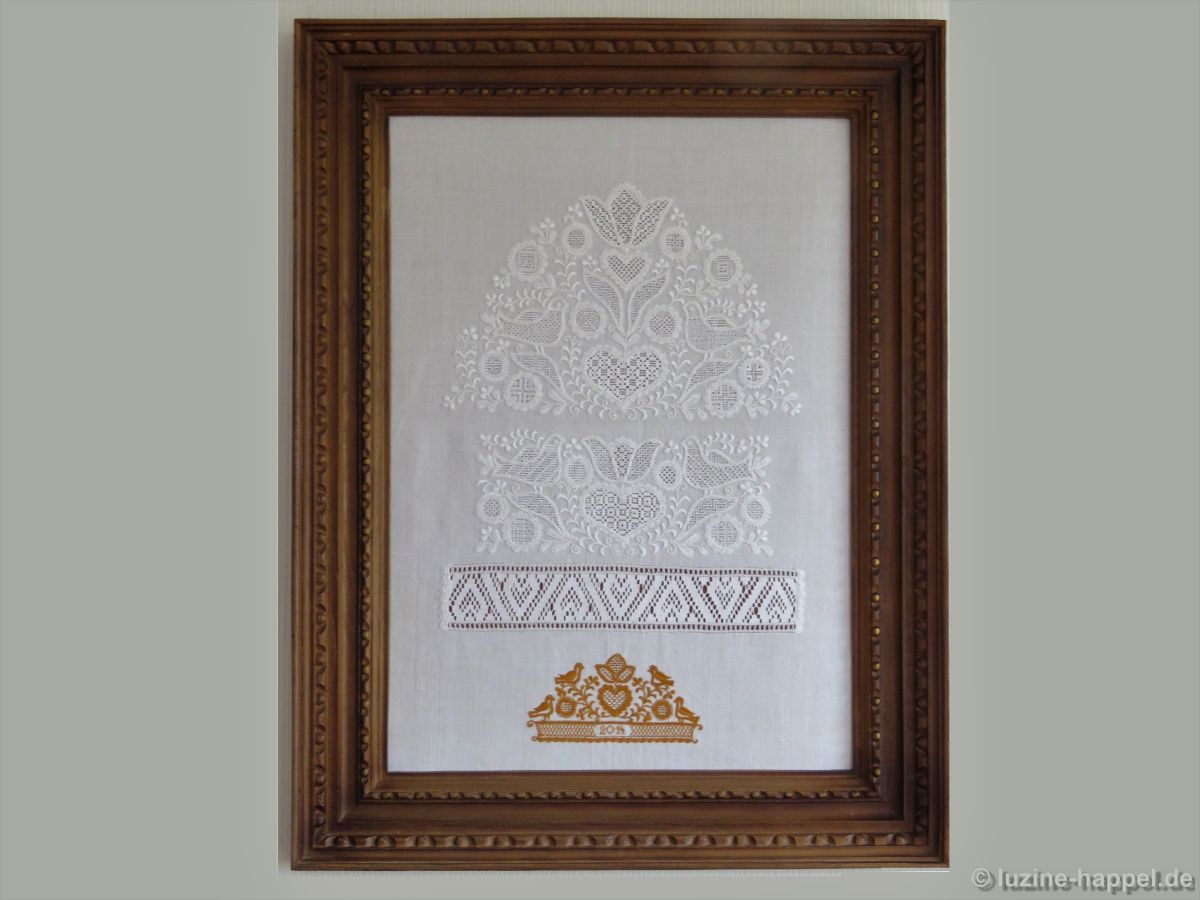
In previous articles I presented Schwalm sampler cloths, door, and wall hangings. Instead of hemming, a sampler can also be framed. Because a frame is an important design element and the size of the embroidery must be adjusted to the size of the frame, it is good to look for an appropriate frame beforehand.

If the embroidery matches the frame, a perfect presentation – as seen below – can be created.


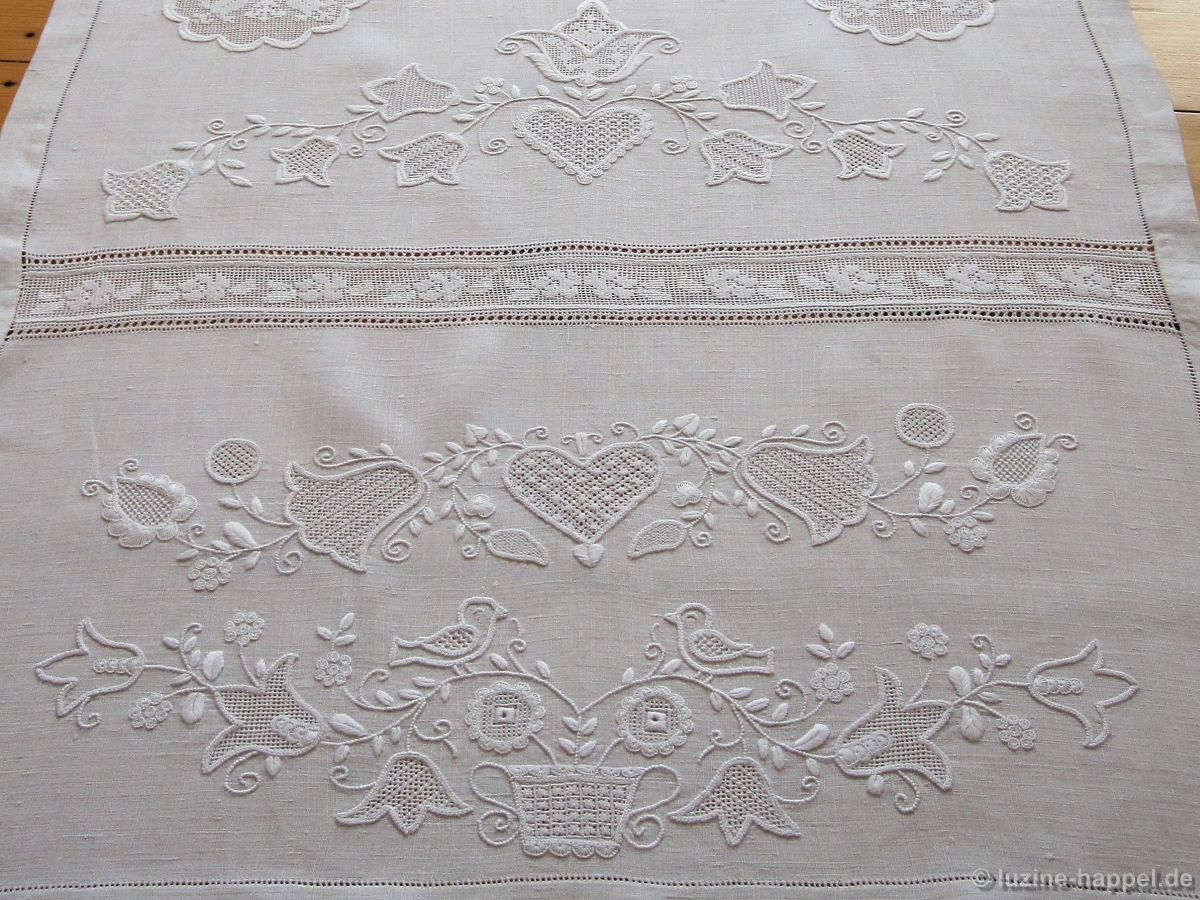
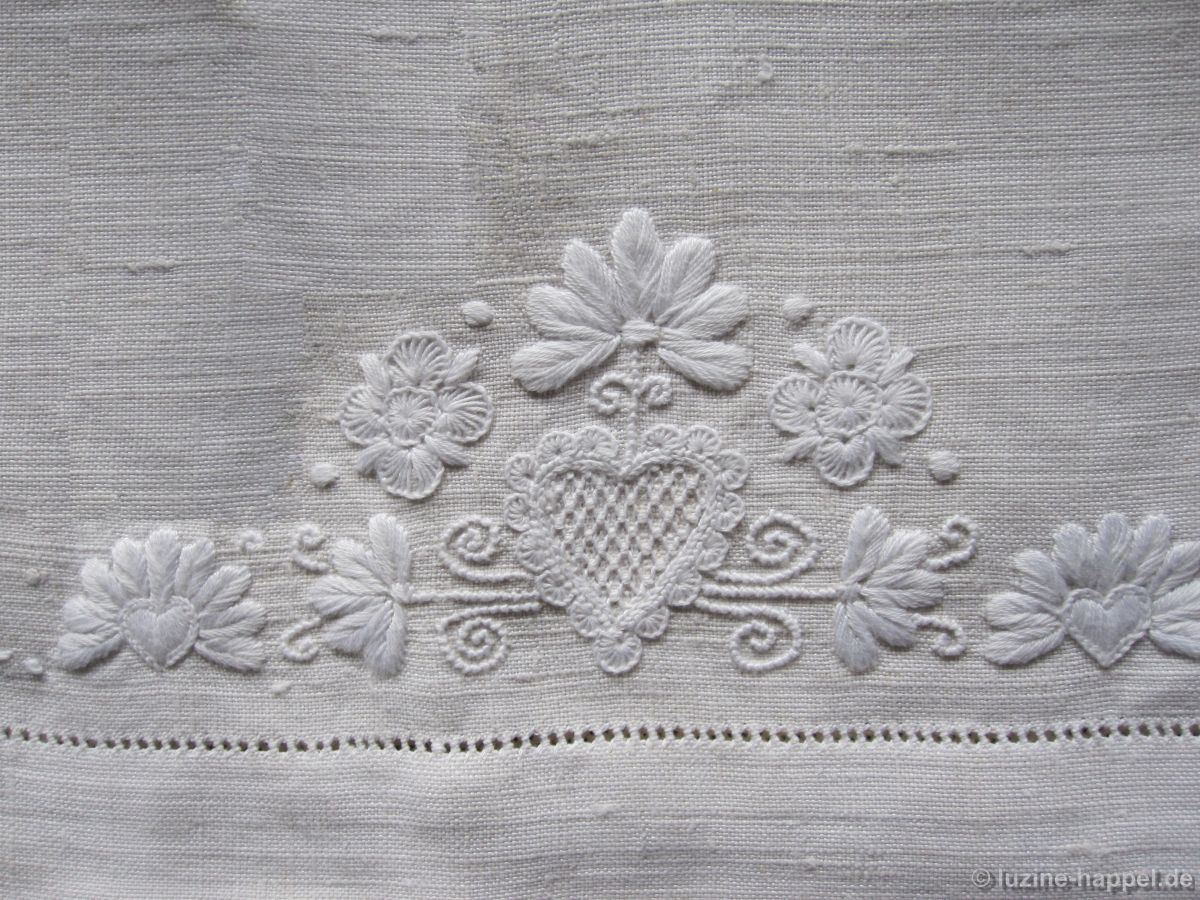
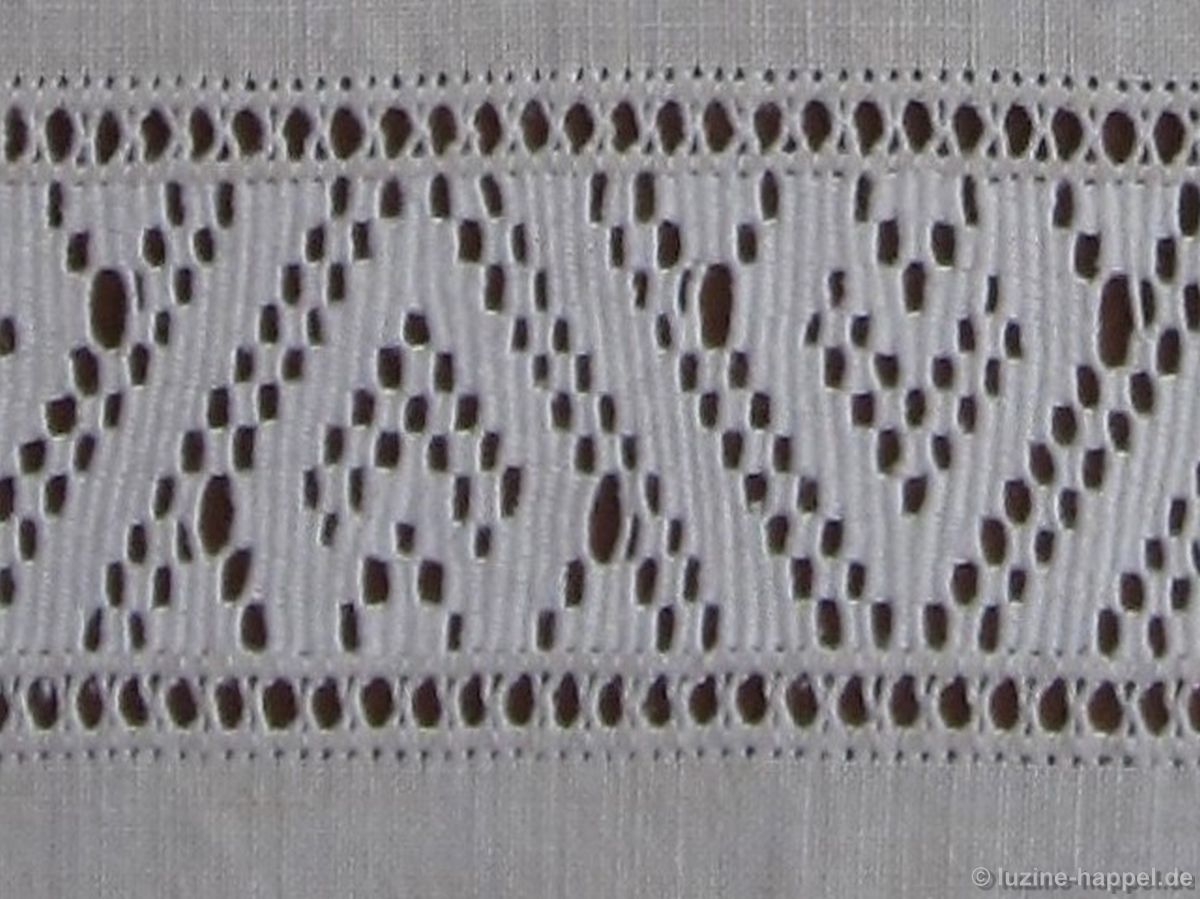
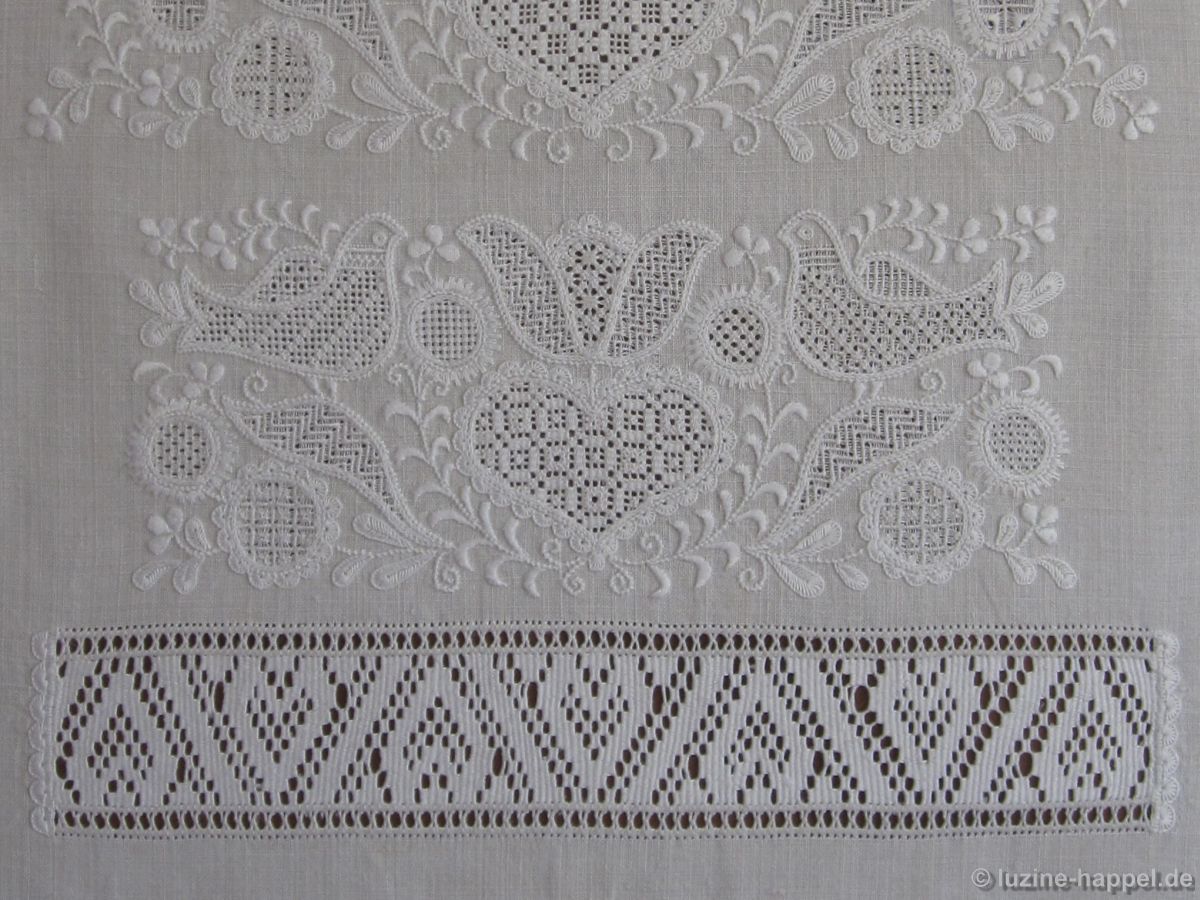
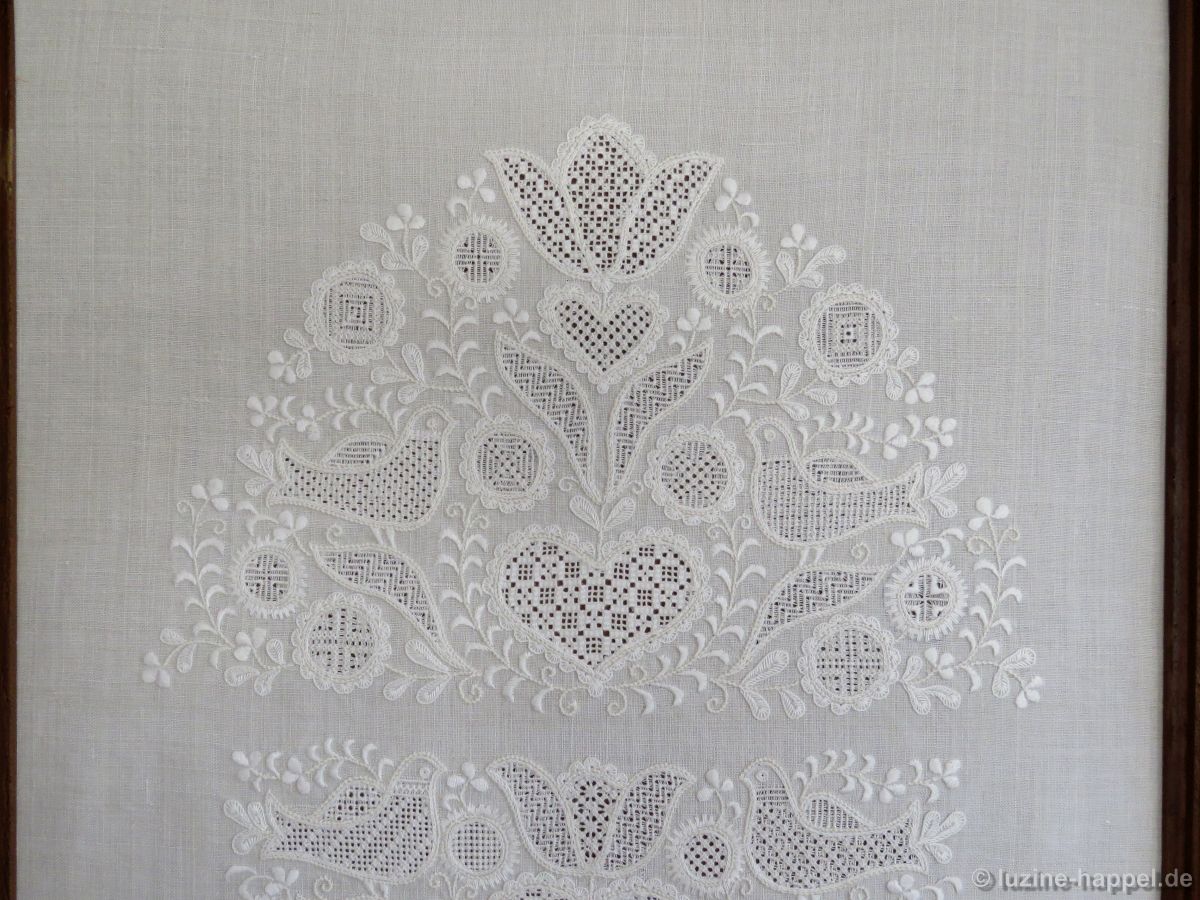
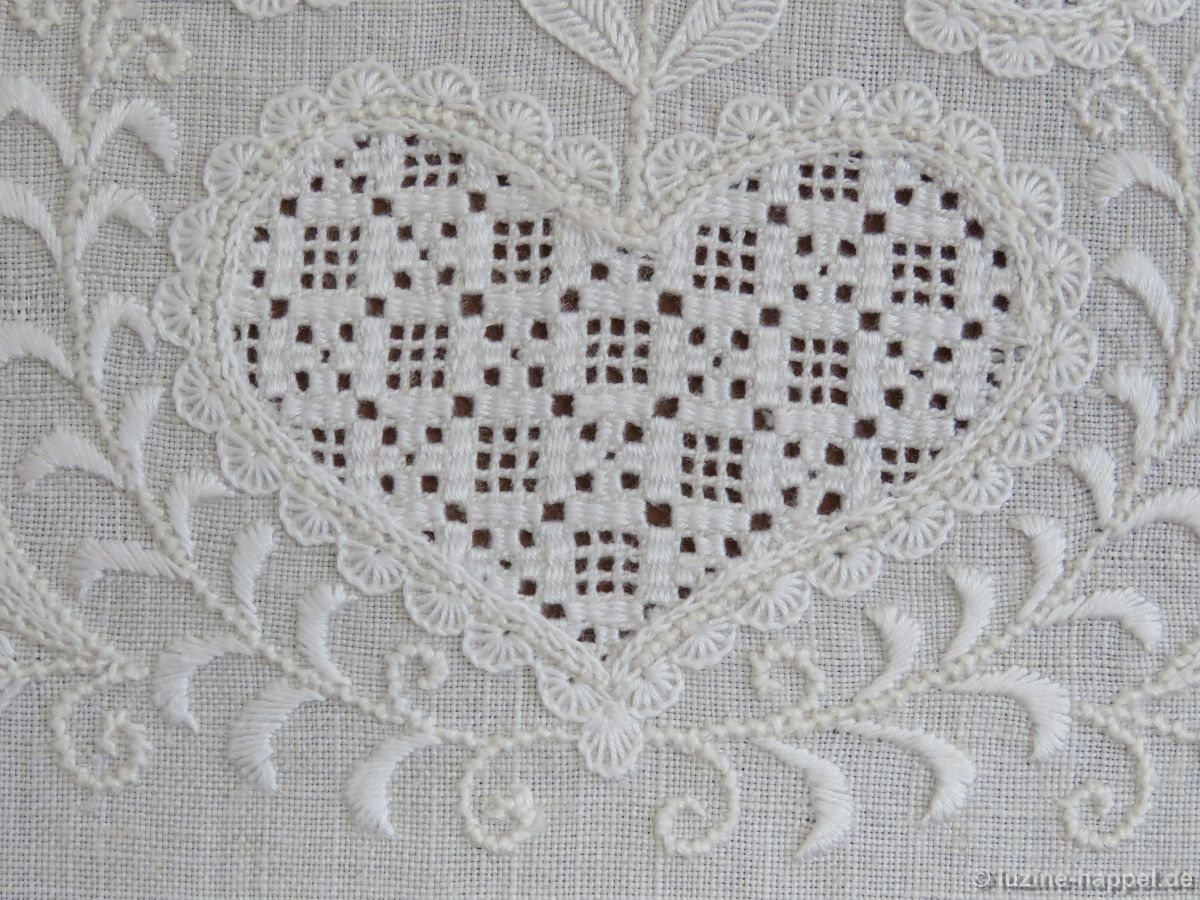
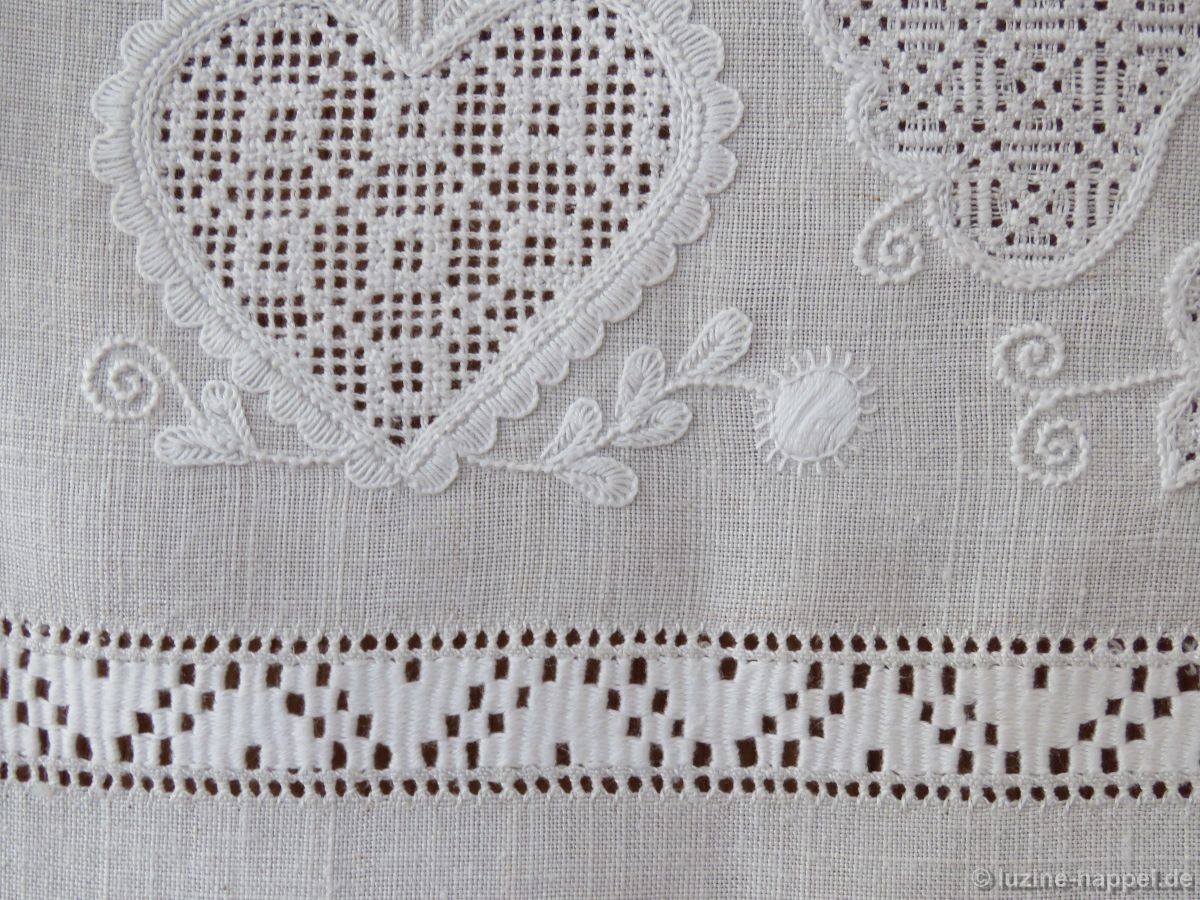
The sampler includes an elaborate and difficult-to-embroider needle-weaving band with a common Schwalm heart pattern.


The needle-weaving band is additionally embellished with half-eyelet scallops at the sides.
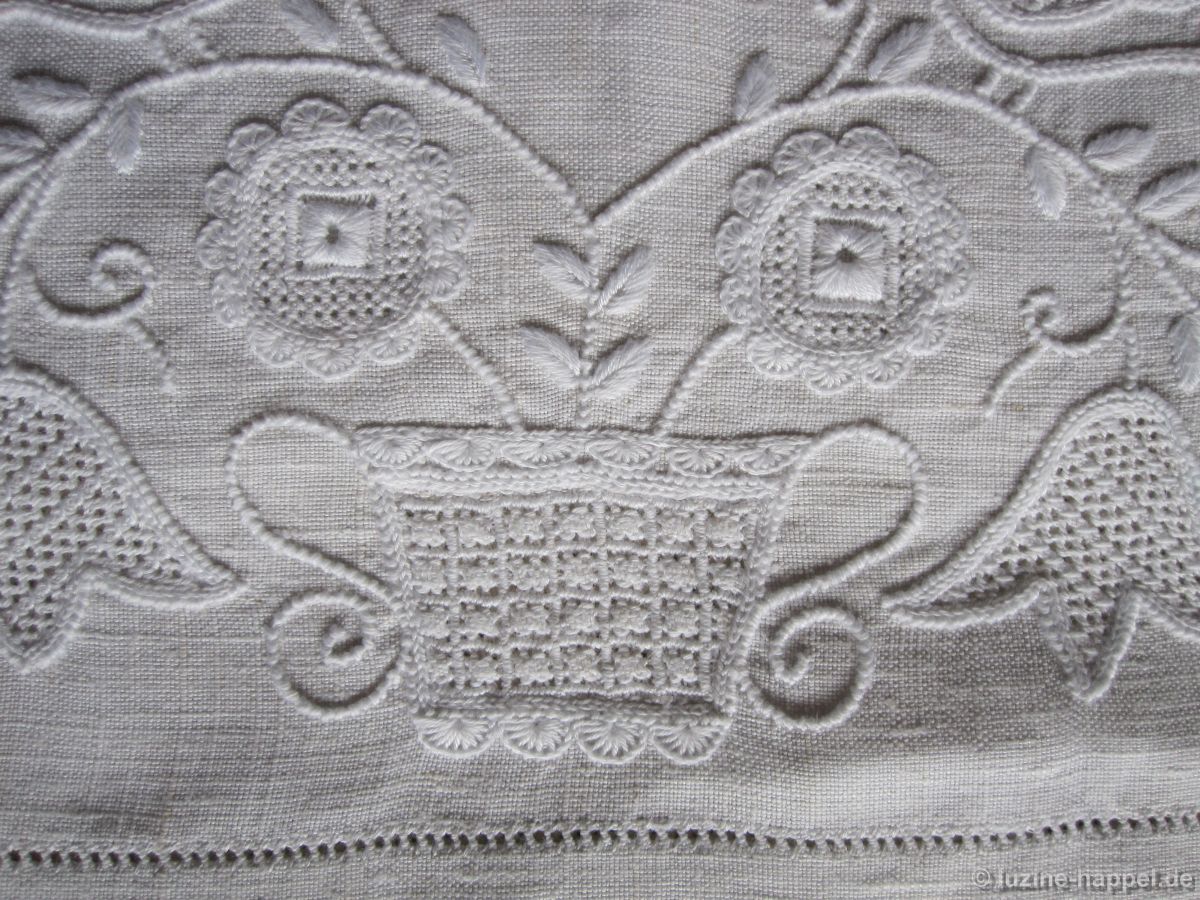
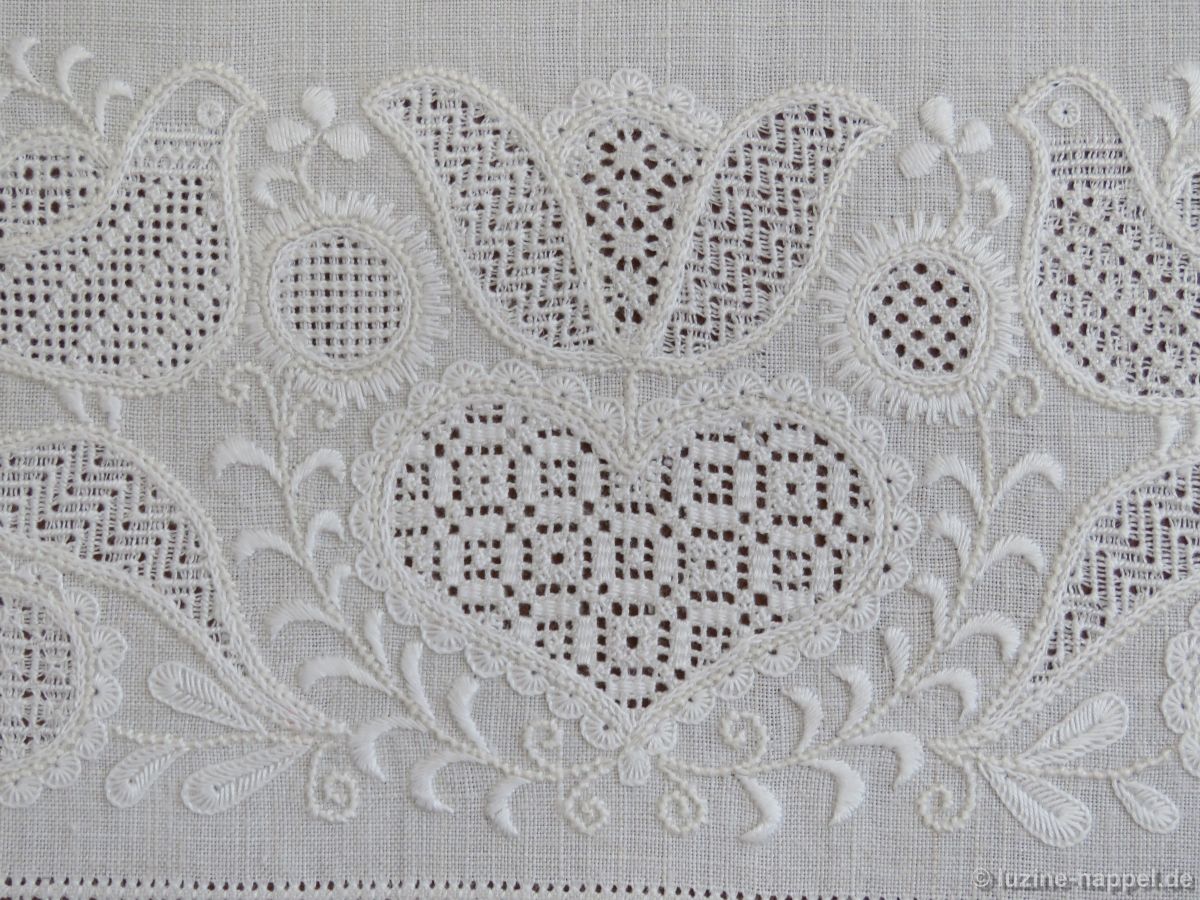
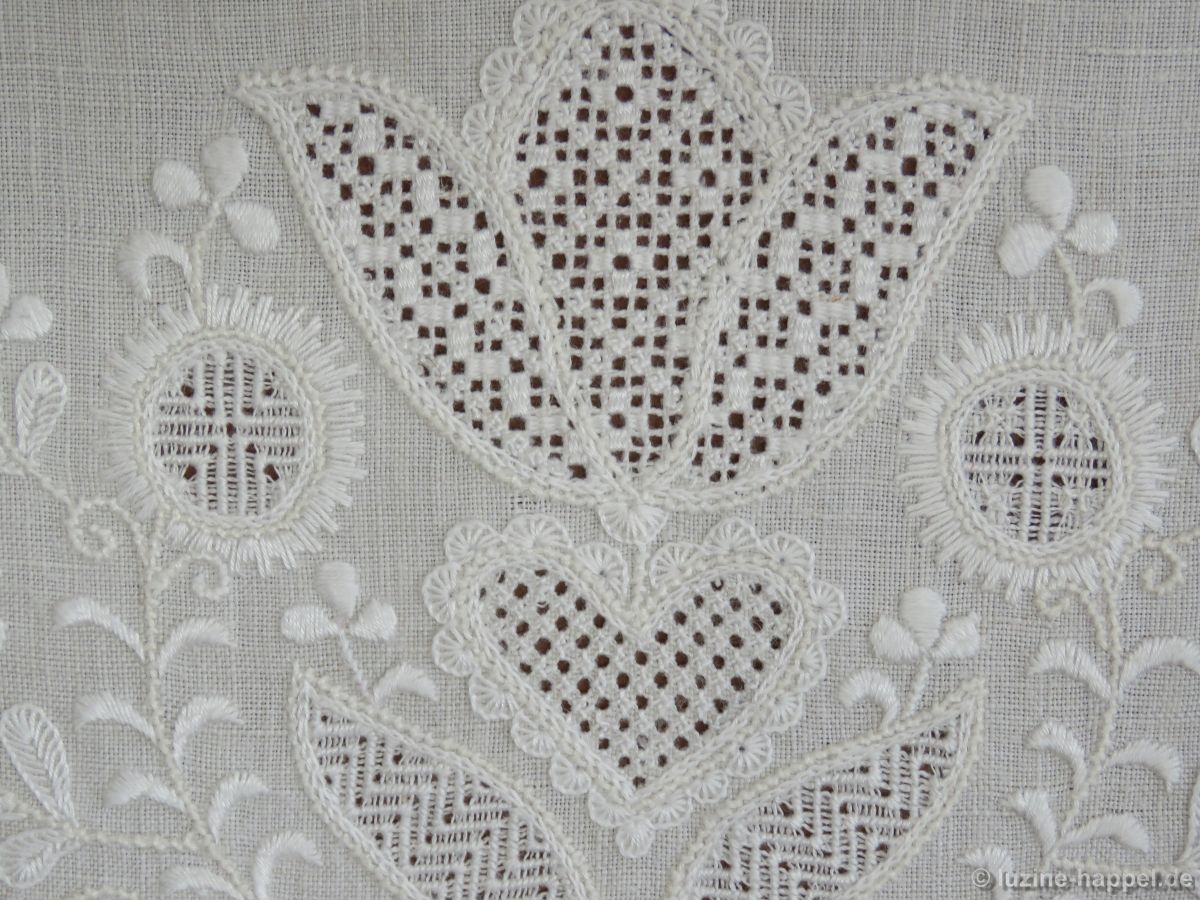
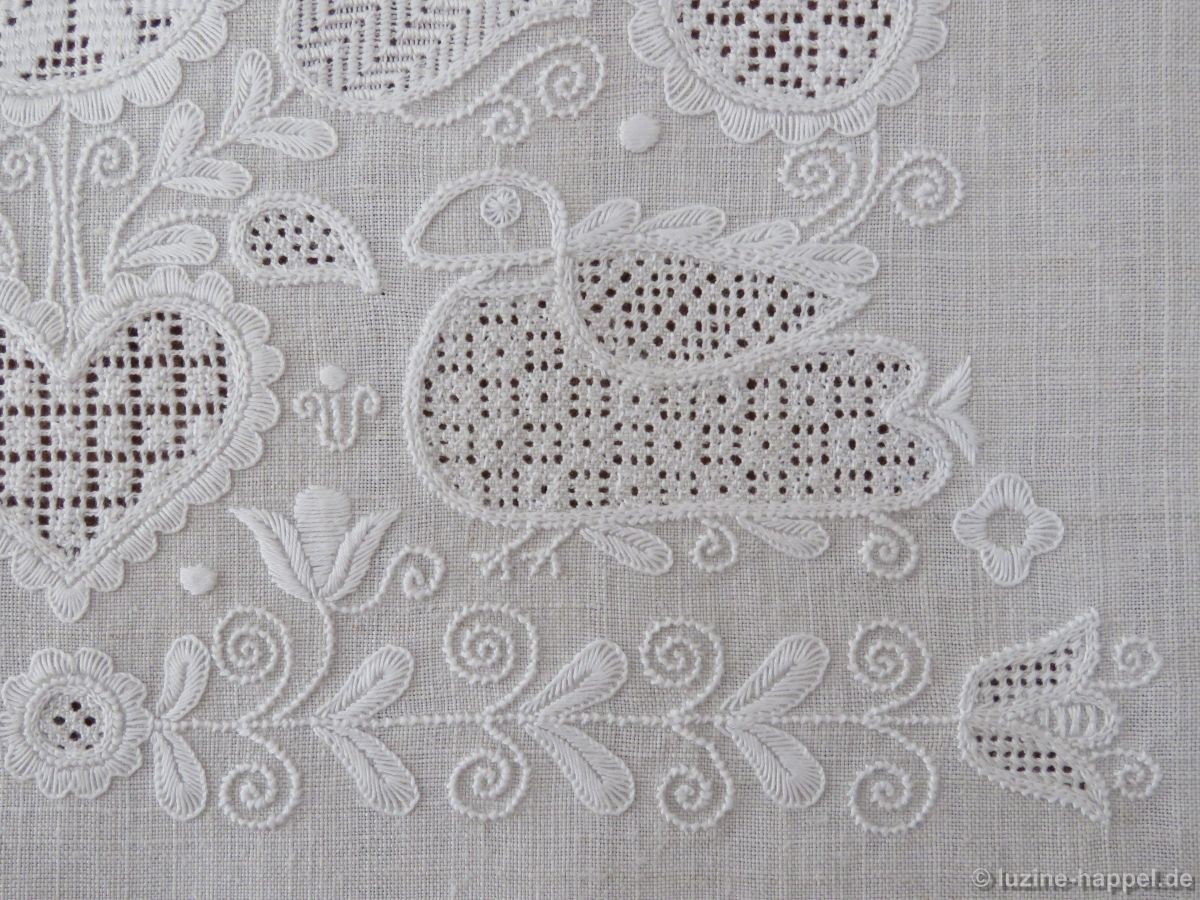
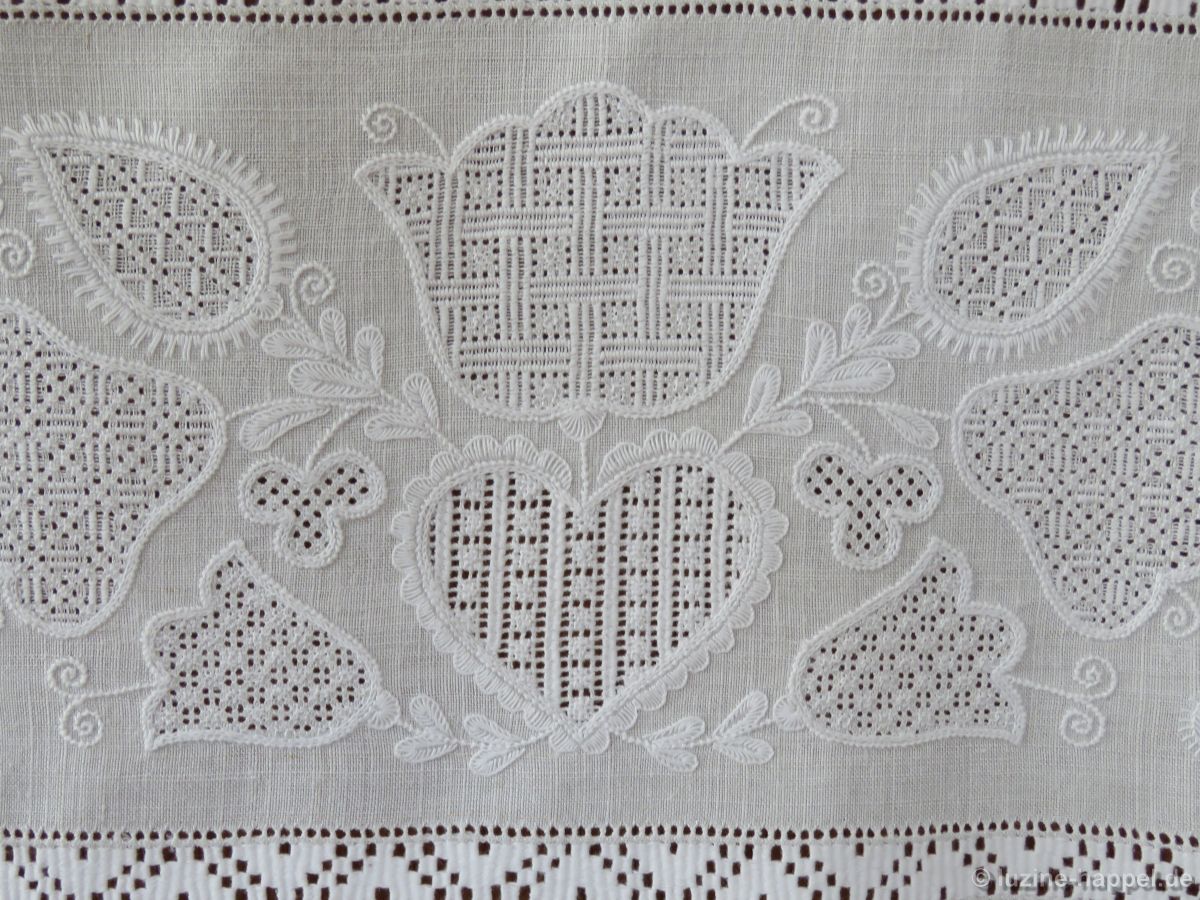
On top of the needle-weaving band, there is a rectangular whitework design that includes the most important Schwalm motifs – heart, tulip, bird, circle, and leaf. Between the densely arranged motifs, a lot of surface whitework embroidery was stitched including all the common elements, such as tendrils, pointed and rounded leaves, and small flowers.


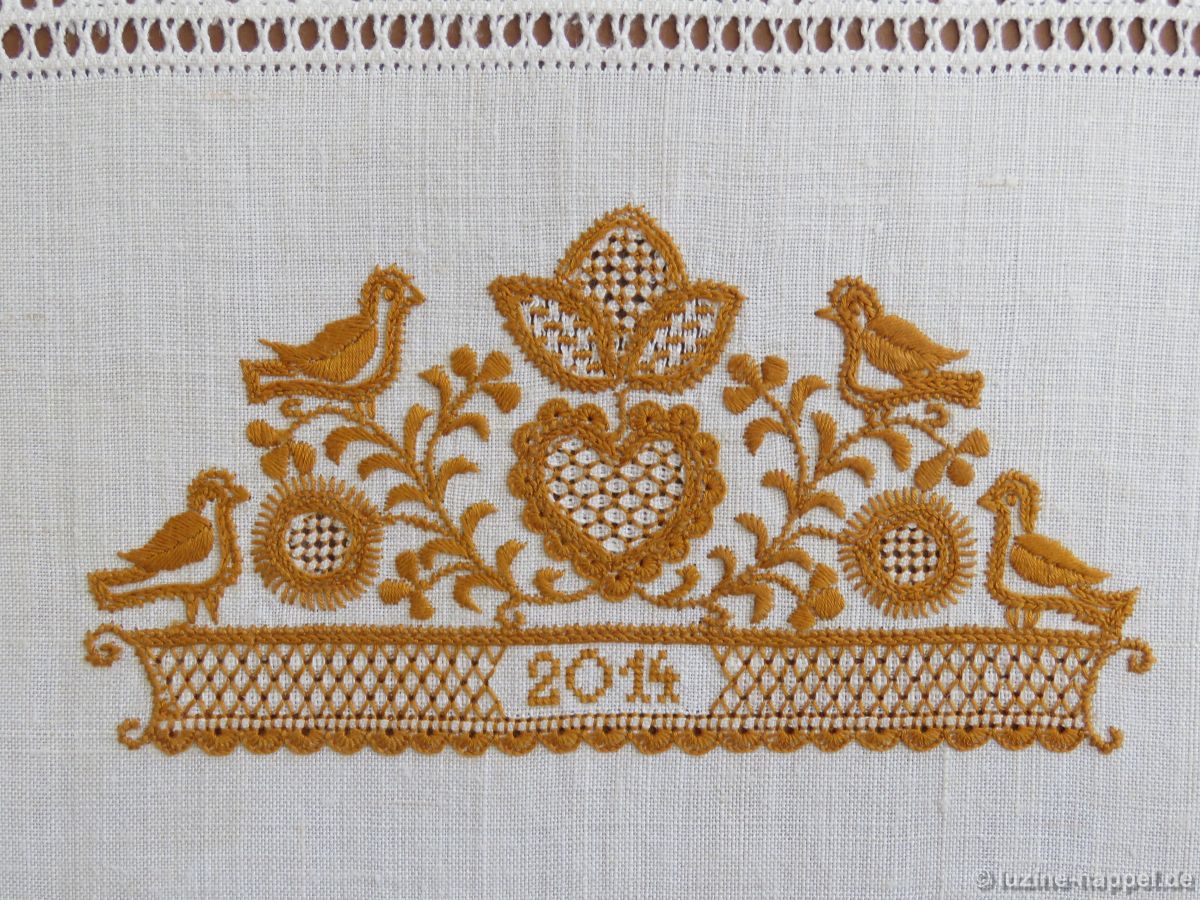
Matching the design elements of the border below and the width of the needle-weaving band, a whitework pattern was designed in the shape of a crown.


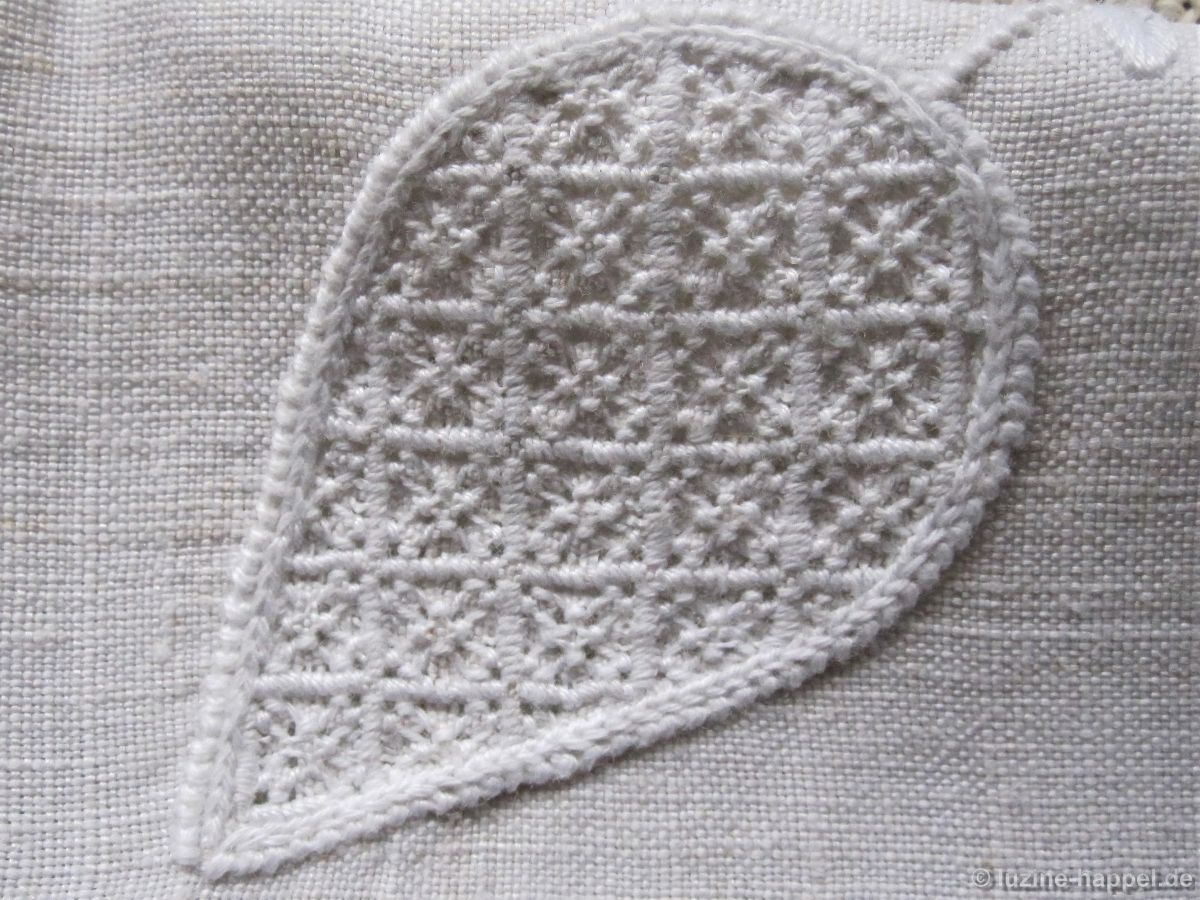
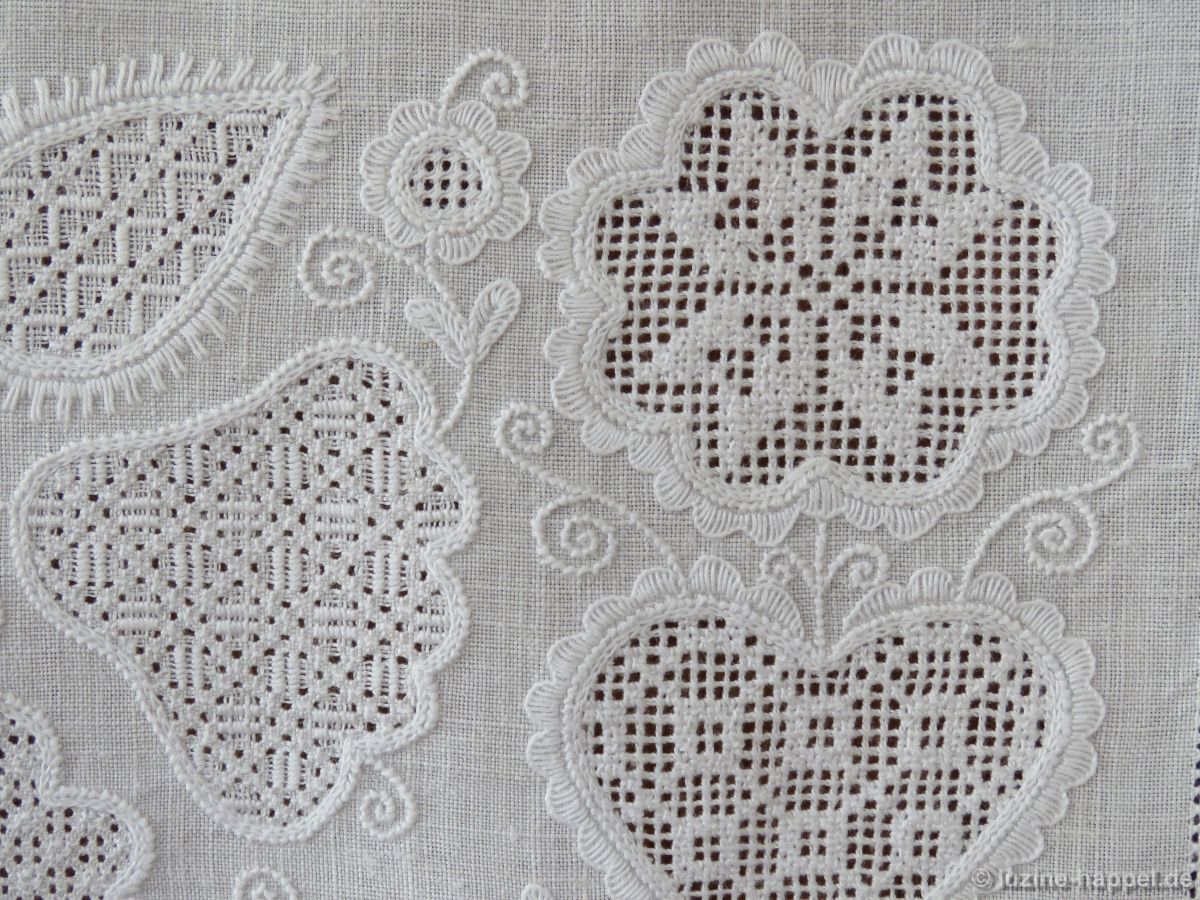
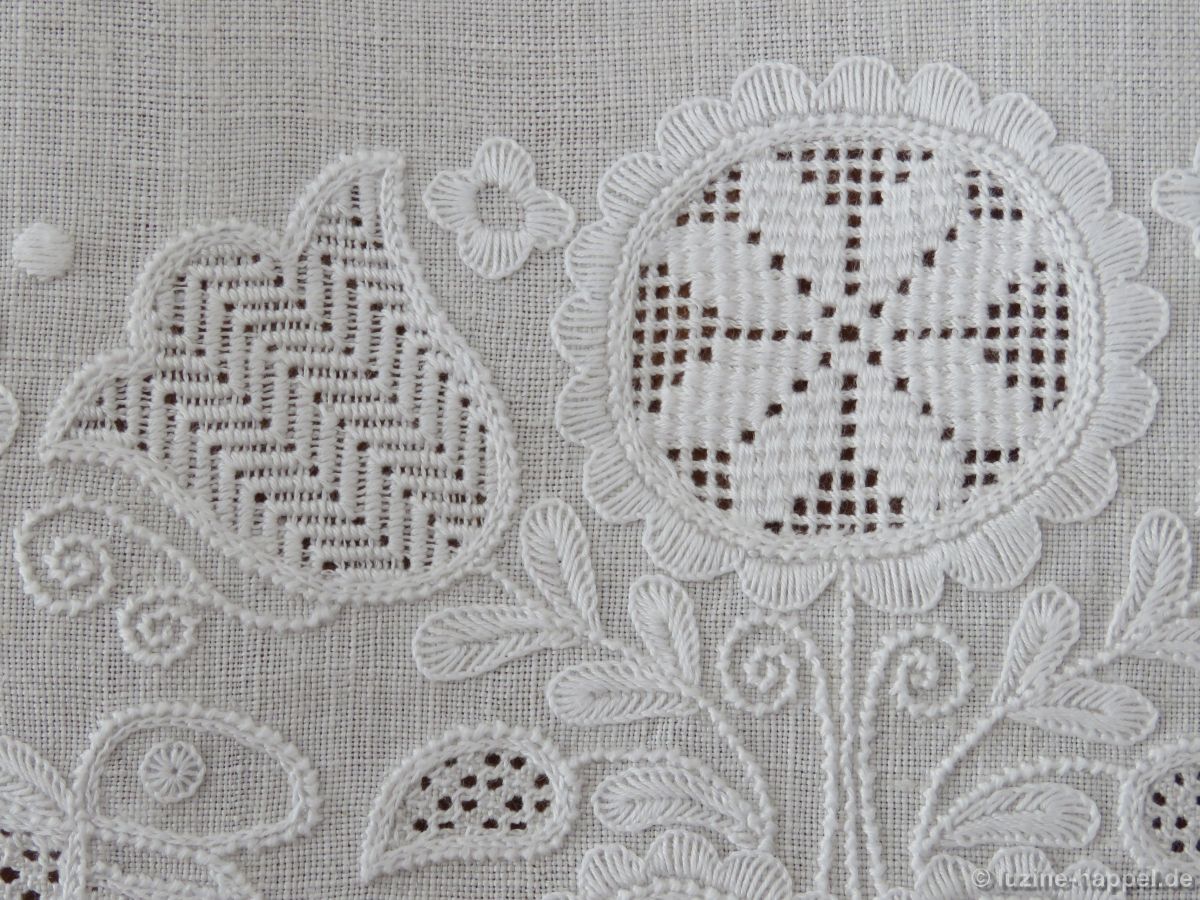
All three types of Schwalm filling patterns – simple withdrawn thread, Limet, and openwork – were embroidered.


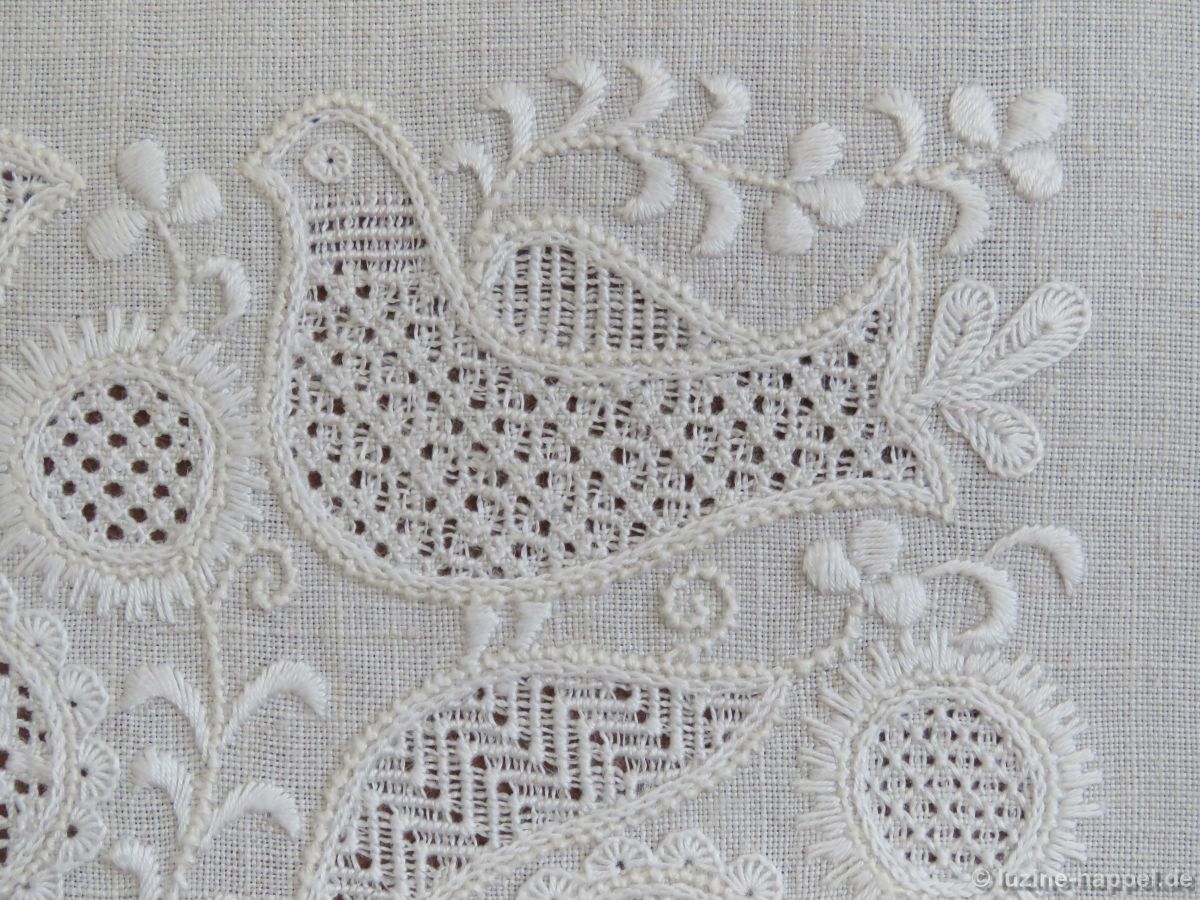
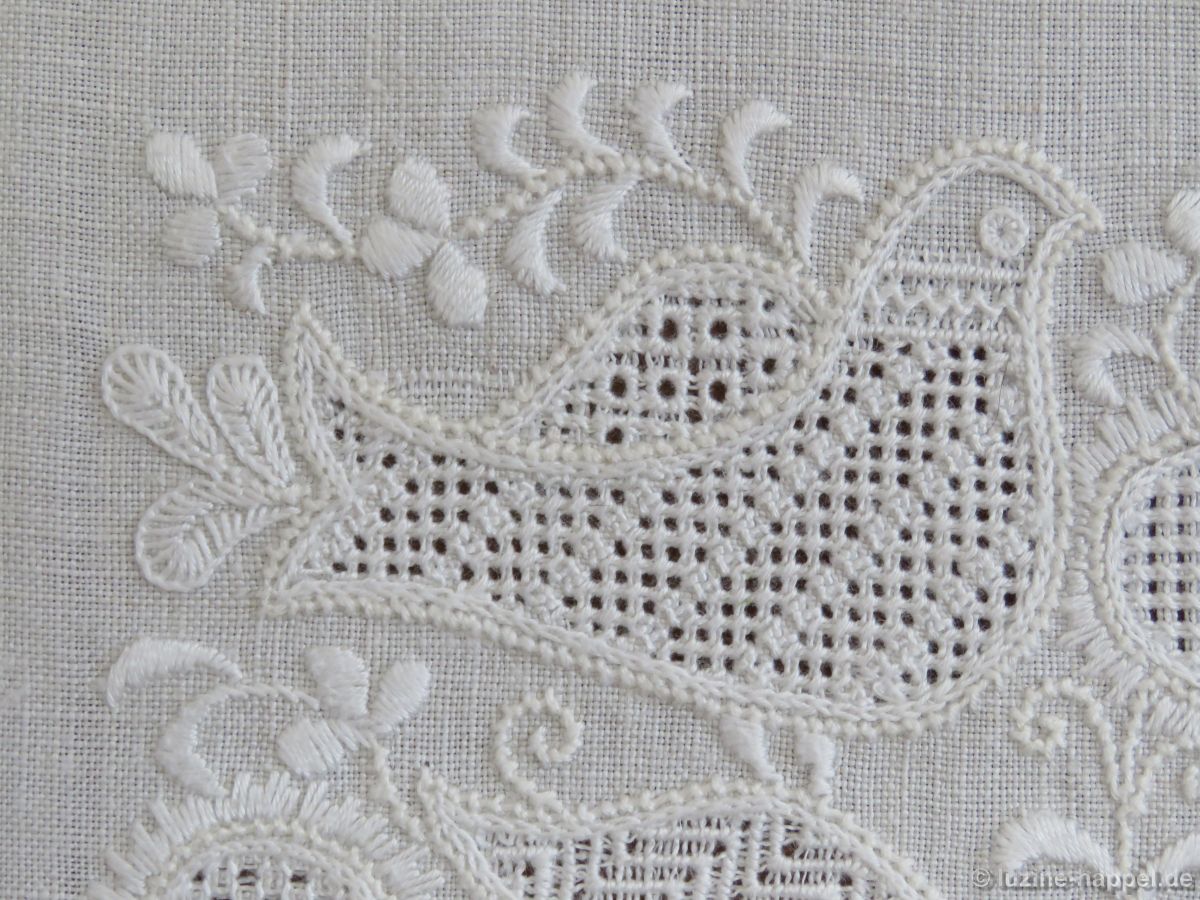
Many different patterns – perfectly matching the shapes – were chosen.


The embroiderer’s treatment of small details, like the ruffs of the birds, is notable.


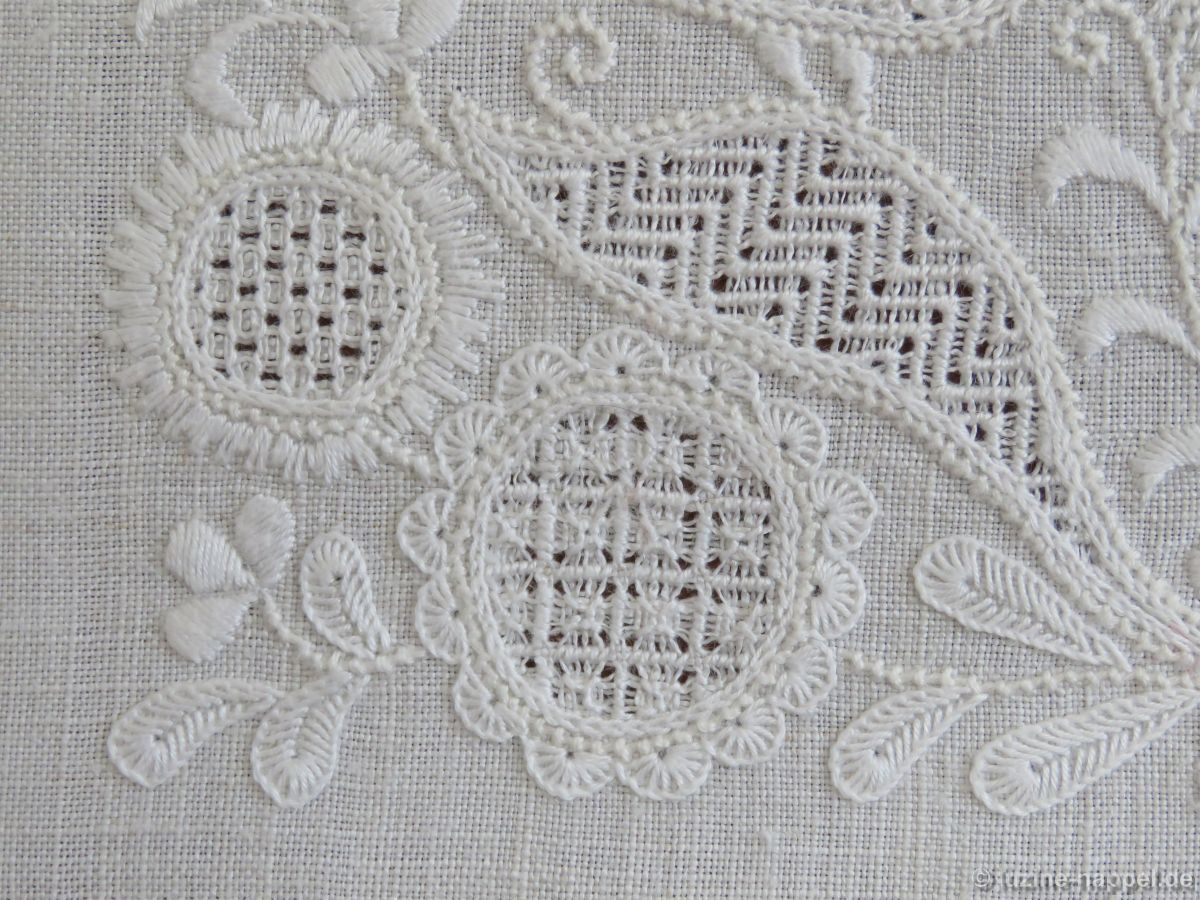
The embroiderer always looked for different patterns


to match the shapes.


Often the circles were filled with crosses


or squares.


In total the sampler shows 31 different filling patterns!


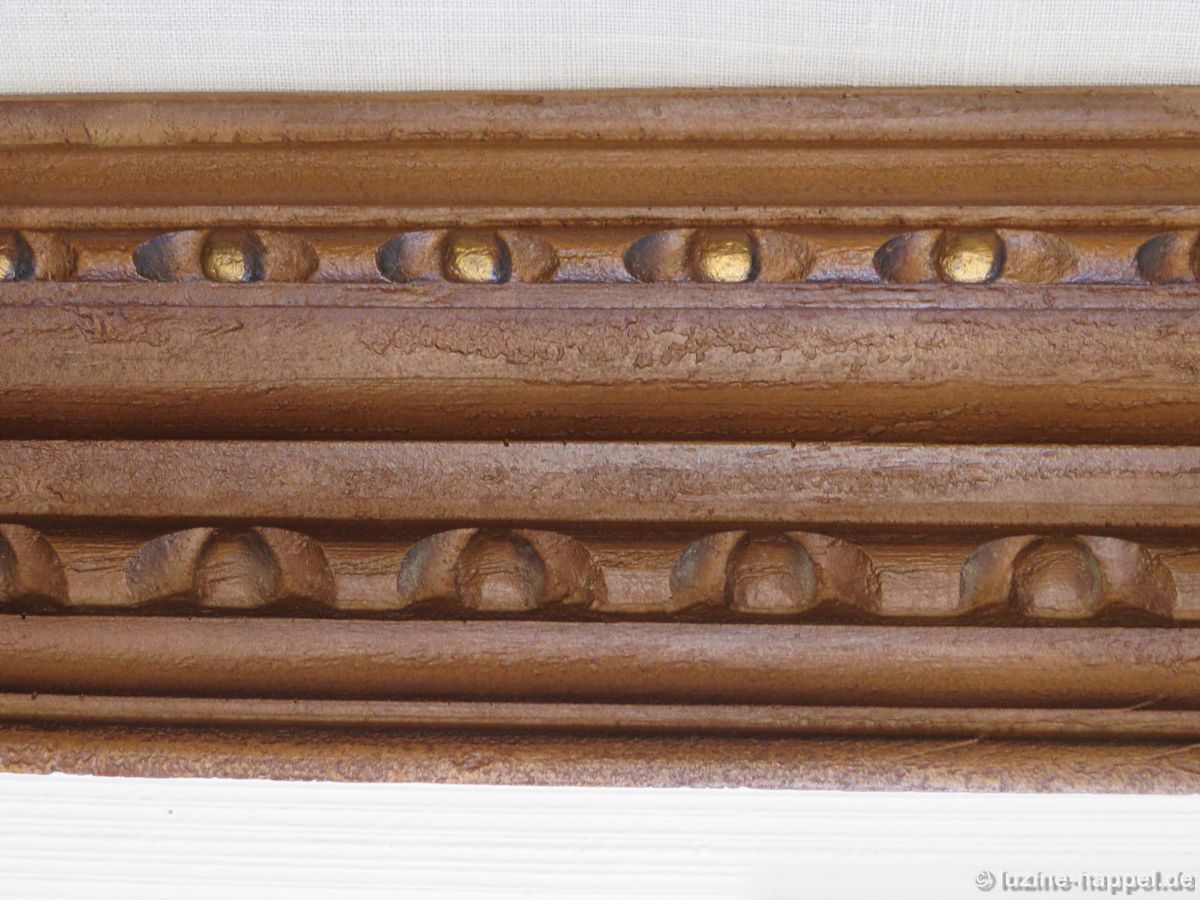
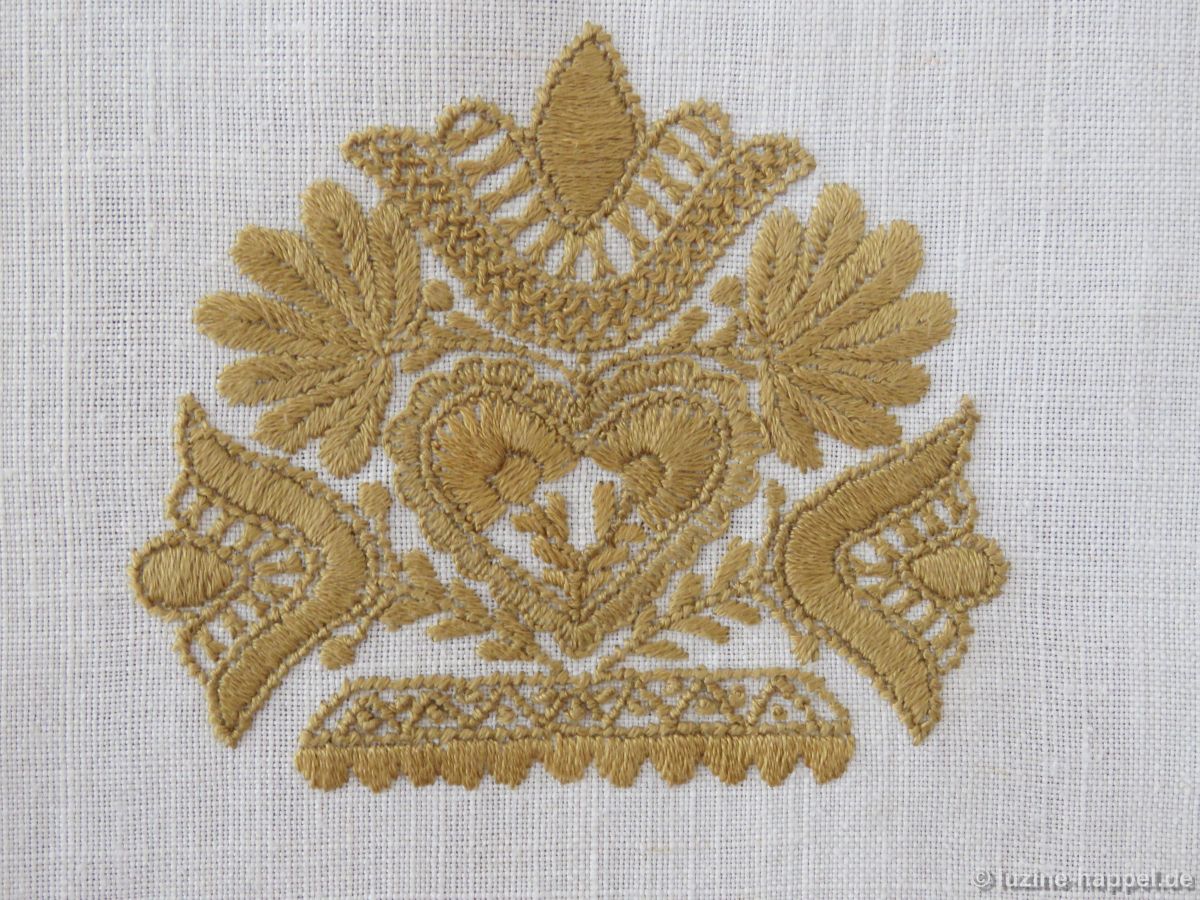
And the nice golden crown at the bottom of the sampler picture – especially created to match the design – tops off the beautiful Schwalm embroidery.


More pretty traditional Schwalm crown designs one can find in my books Schwalm Crowns and Grand Schwalm Crowns.

The sampler design is ready for all to enjoy as a downloadable document.

Contemporary Schwalm Wall Hangings


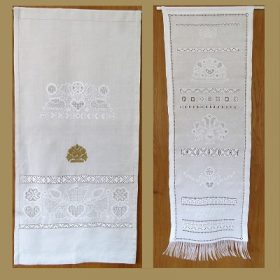
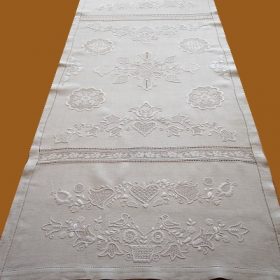
Both samplers show needle-weaving bands, whitework designs, and crowns. Yet the appearance of both is very different.

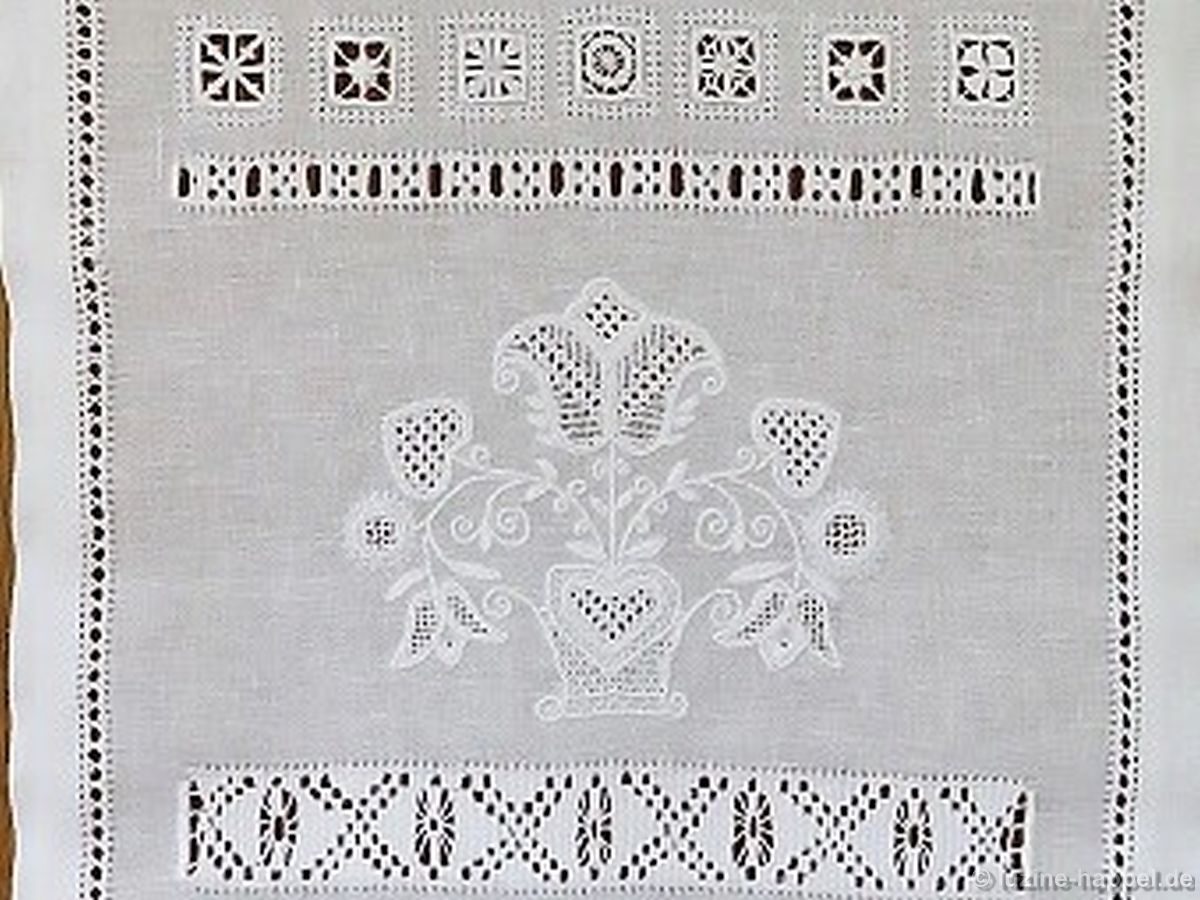
A novice to Schwalm whitework worked the example on the right in 2006. She separated small whitework designs with needle-weaving hems.
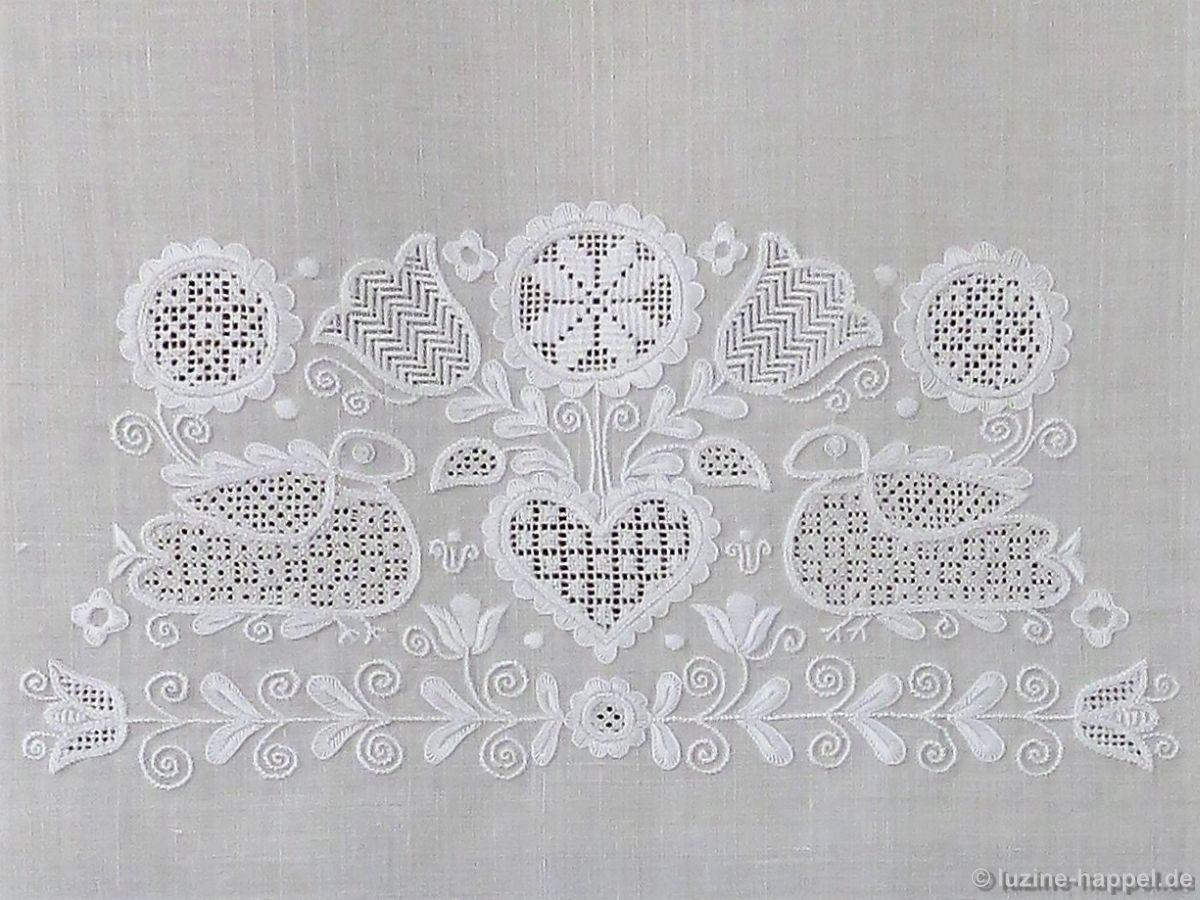

She chose one design in the shape of a crown,


one more fancy design, and one design with a flower basket. In relation to the thread count of the linen, her designs had small shapes. It is difficult to find different matching filling patterns for small areas.
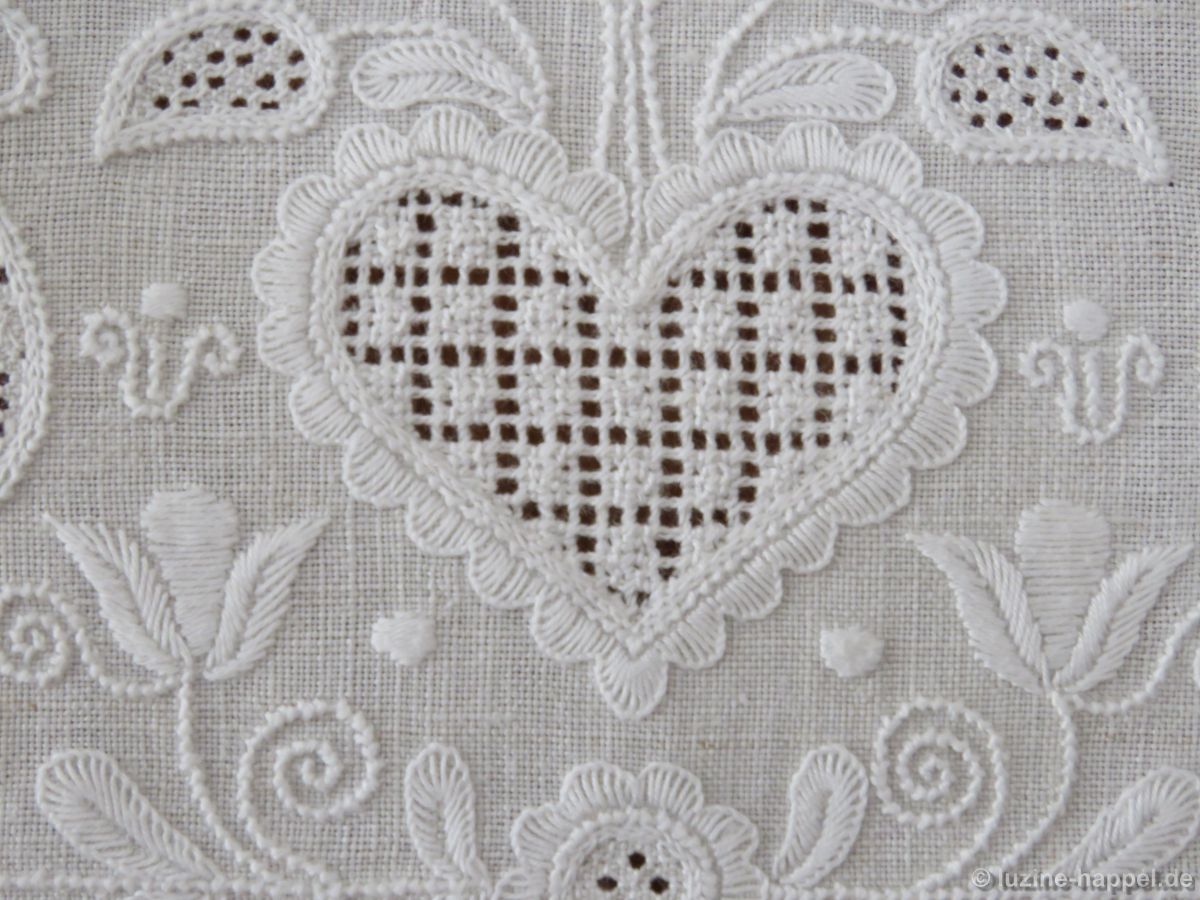
She added squares showing different corner solutions.


She created combinations of needle-weaving bands


with Peaholes and Herringbone stitches.


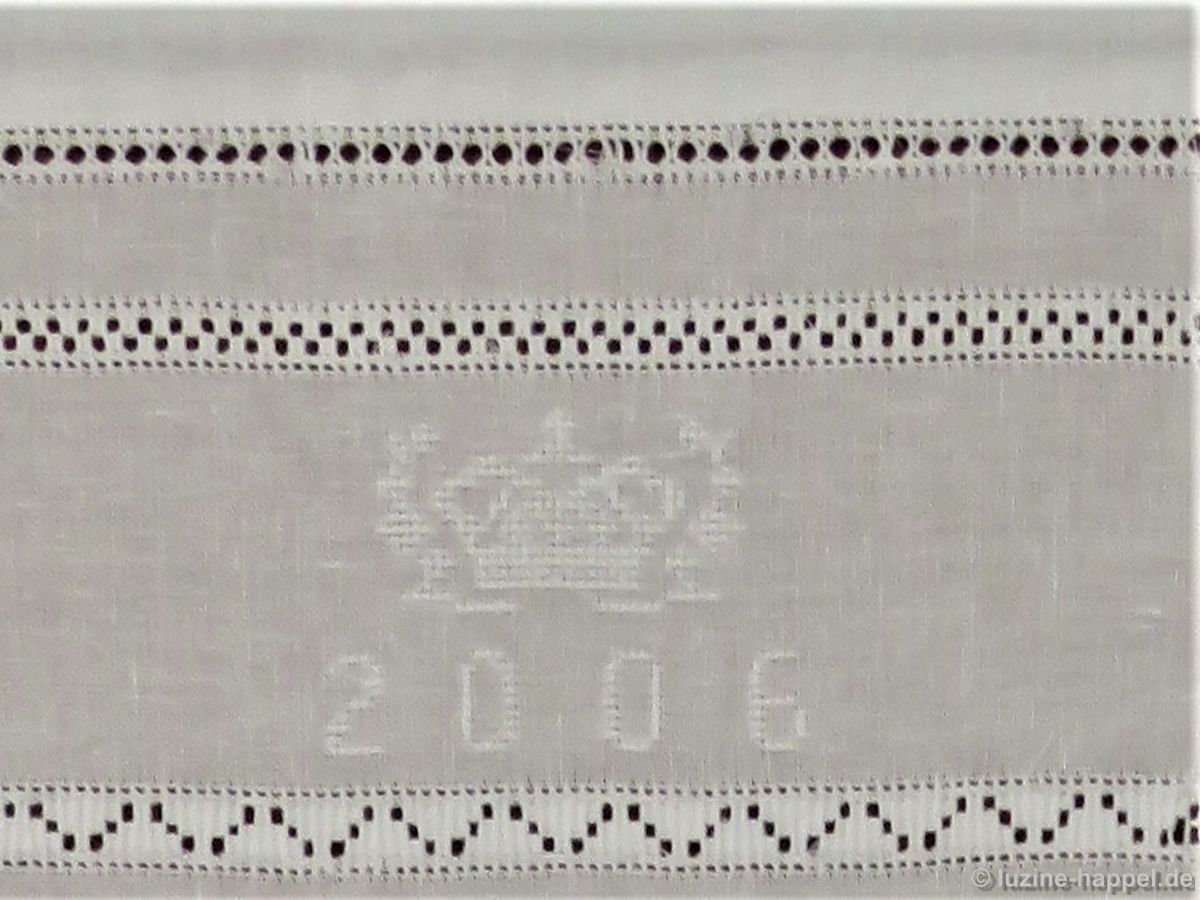
She added her name at the bottom and a crown along with the year in white Cross stitches at the top.


The piece was hemmed with a Peahole hem and frayed at the bottom edge. She learned all the basic stitches common to Schwalm whitework creating her own unique sampler wall hanging. Now – 12 years later – she told me that her skills are undeniably improved. Errors like too loosely bundling together the Peaholes or combining needle-weaving patterns with different non-matching pattern segments no longer happen. But it was her first piece; she learned a lot, and she is proud of it.

* * * *

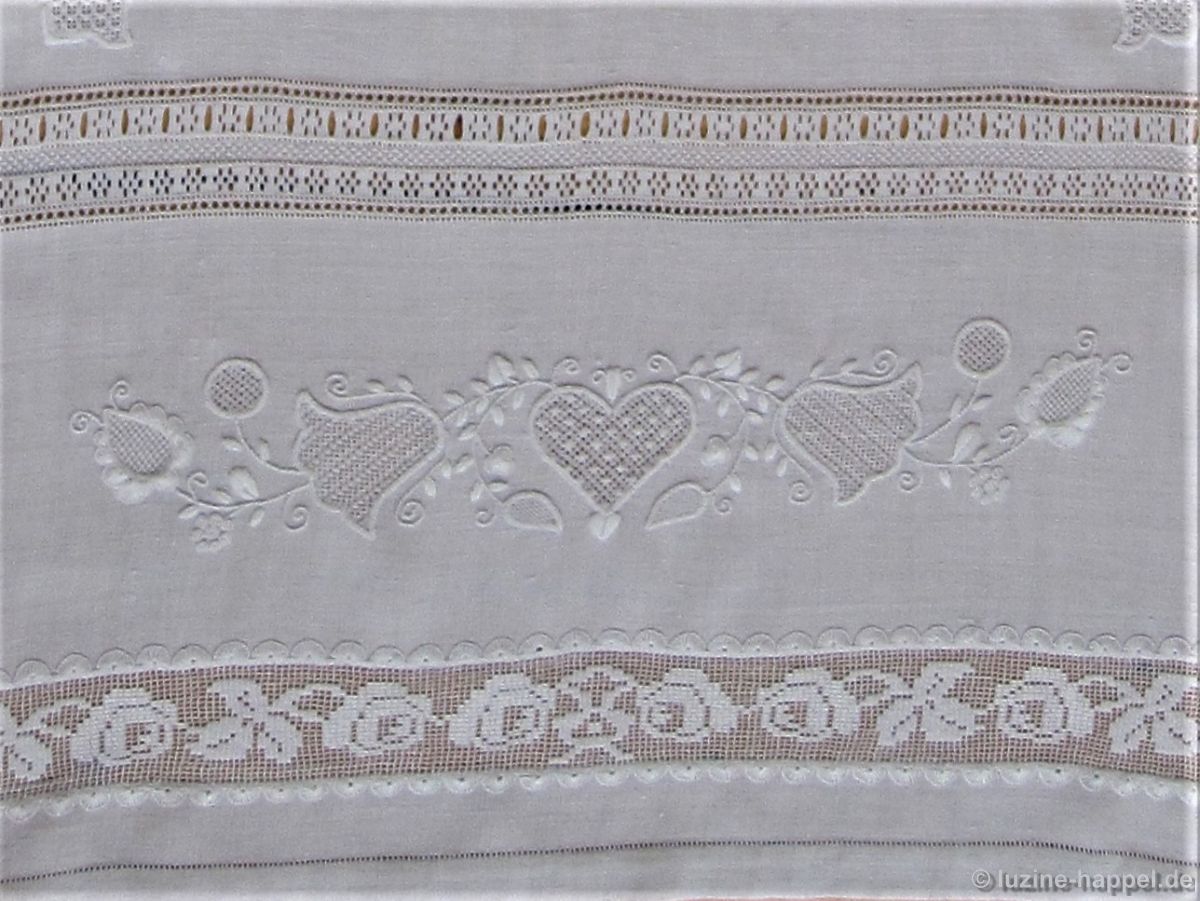
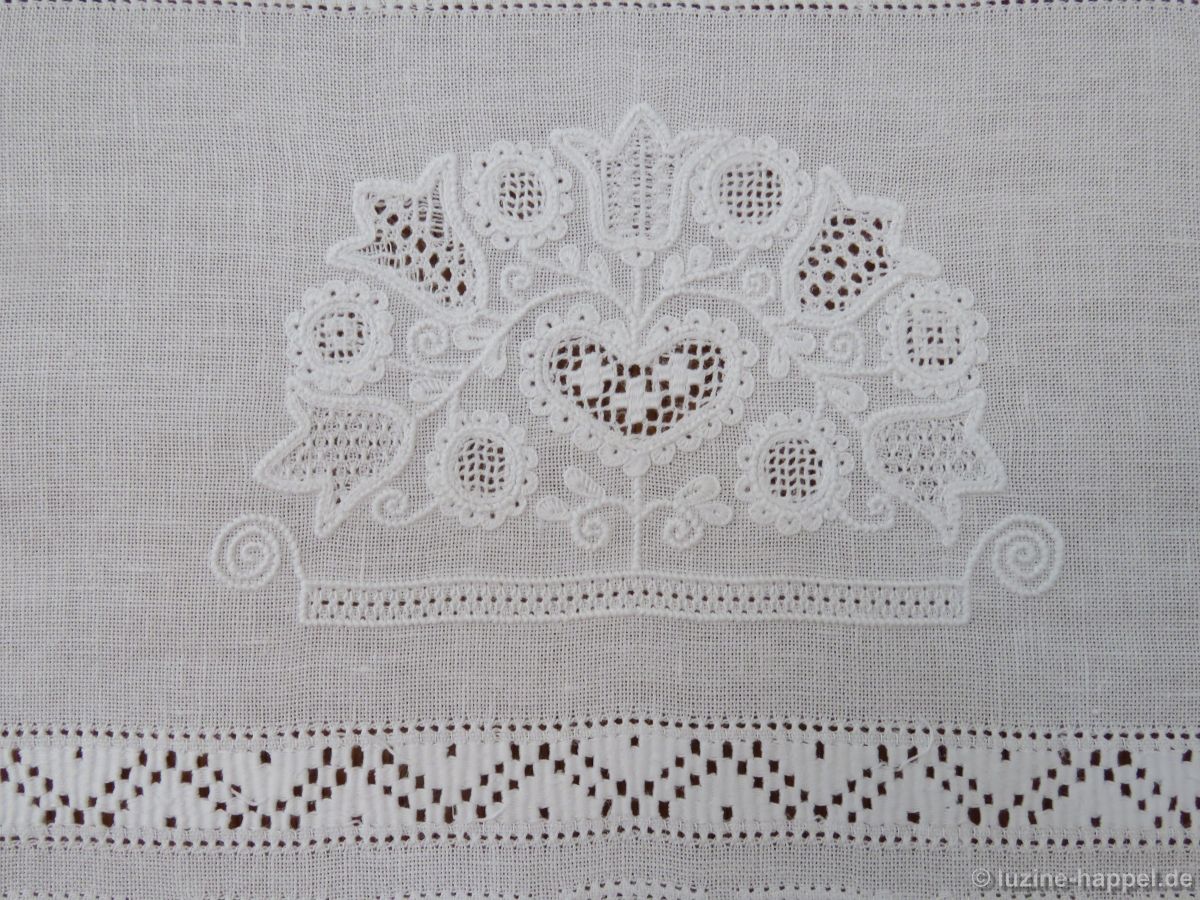
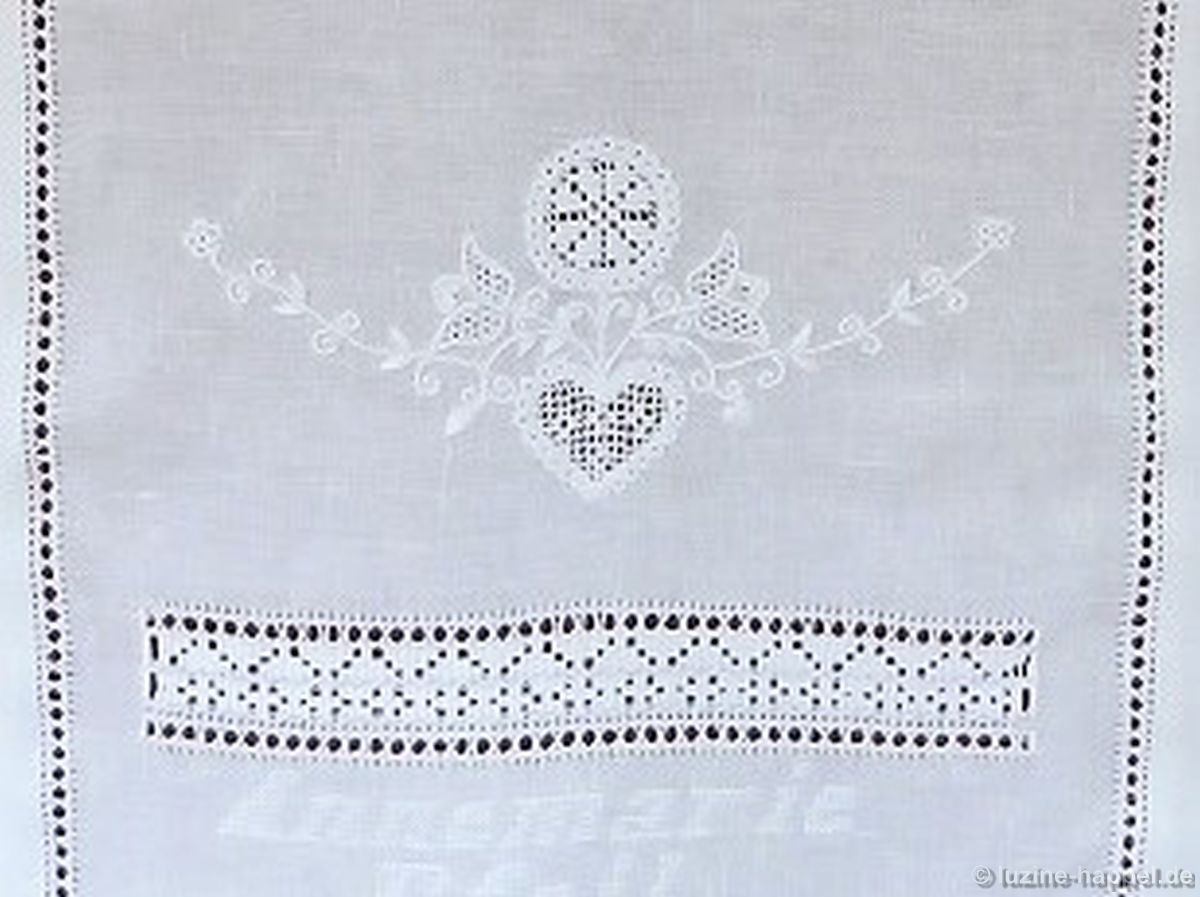
A more experienced embroiderer worked the example on the left in 2014. It is divided into three parts. The bottom section shows a typical Schwalm whitework design with hearts, tulips, buds, and clover leaf motifs bordered with needle-weaving bands.

As clearly seen, most of the motifs are distinctly larger than the motifs on the hanging to the right. This made embroidering different filling patterns much easier.
On top of the whitework border, a Satin stitch crown was placed.


Above the crown a whitework design in the shape of a crown was embroidered.


We can see heart, tulip, bud, circle, and bird motifs. Openwork fillings are mainly Limet filling patterns. Blanket stitch scallops, Eyelash stitches, and 2 short-2 long for outlining motifs, rounded leaves, Blanket stitch eyelets, Satin stitch elements, and many distinctive tendrils have been worked.


The embroiderer has achieved a balance between motif shapes and surface embroidery.


The filling patterns are perfectly chosen to match the respective shapes.


Also figured patterns like stars are worked.


A clear and orderly appearance has been established.


Two different common needle-weaving band patterns


are perfectly embroidered.


A golden Satin stitch crown tops off this special whitework sampler piece.


Did you notice that in all eighteen different filling patterns were worked in addition to all the various surface embroidery?

I hope you have enjoyed looking at another beautiful example of the richly diverse Schwalm whitework technique.

Traditional Schwalm Door Hangings

Long ago, it was common to work samplers containing manifold Schwalm techniques and to use them as door hangings. Today, people also like to use hangings – mostly wall hangings – to show off Schwalm techniques they think most important and most interesting. There are a wide variety of such samplers.

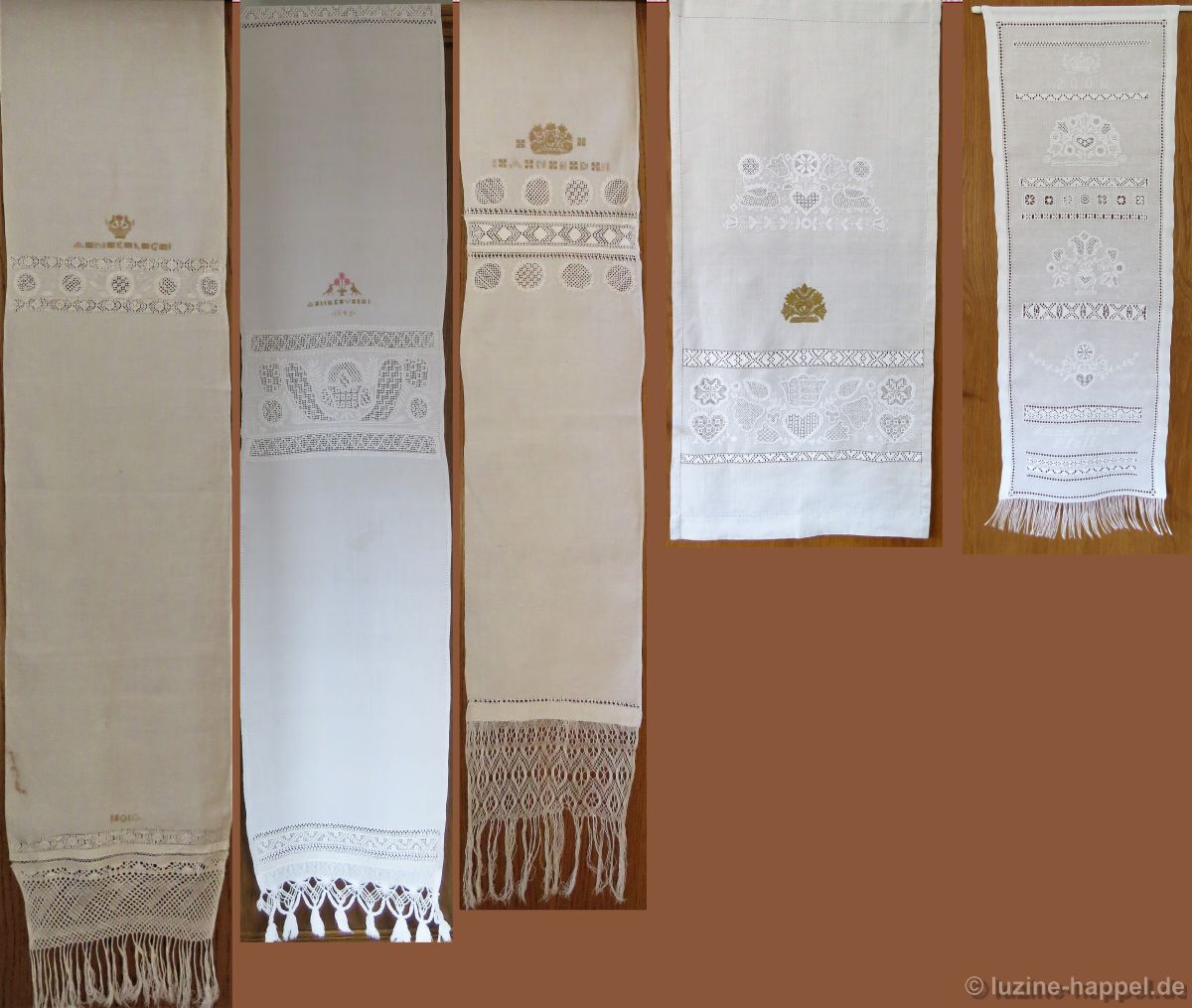
Here are some examples (three traditional and two contemporary pieces); I will describe them in detail step by step and from left to right.


The traditional pieces are characteristically longer than the contemporary samplers. The old pieces measure about 30–40 cm in the width and 1.90–2.00 m in the height. Because people back then were not as tall as people today, I doubt these were actually used as door hangings. Regardless of whether they were hung in the door way or on the wall, they were hangings.

Also distinctive are the lace edgings found at the bottoms of the hangings.

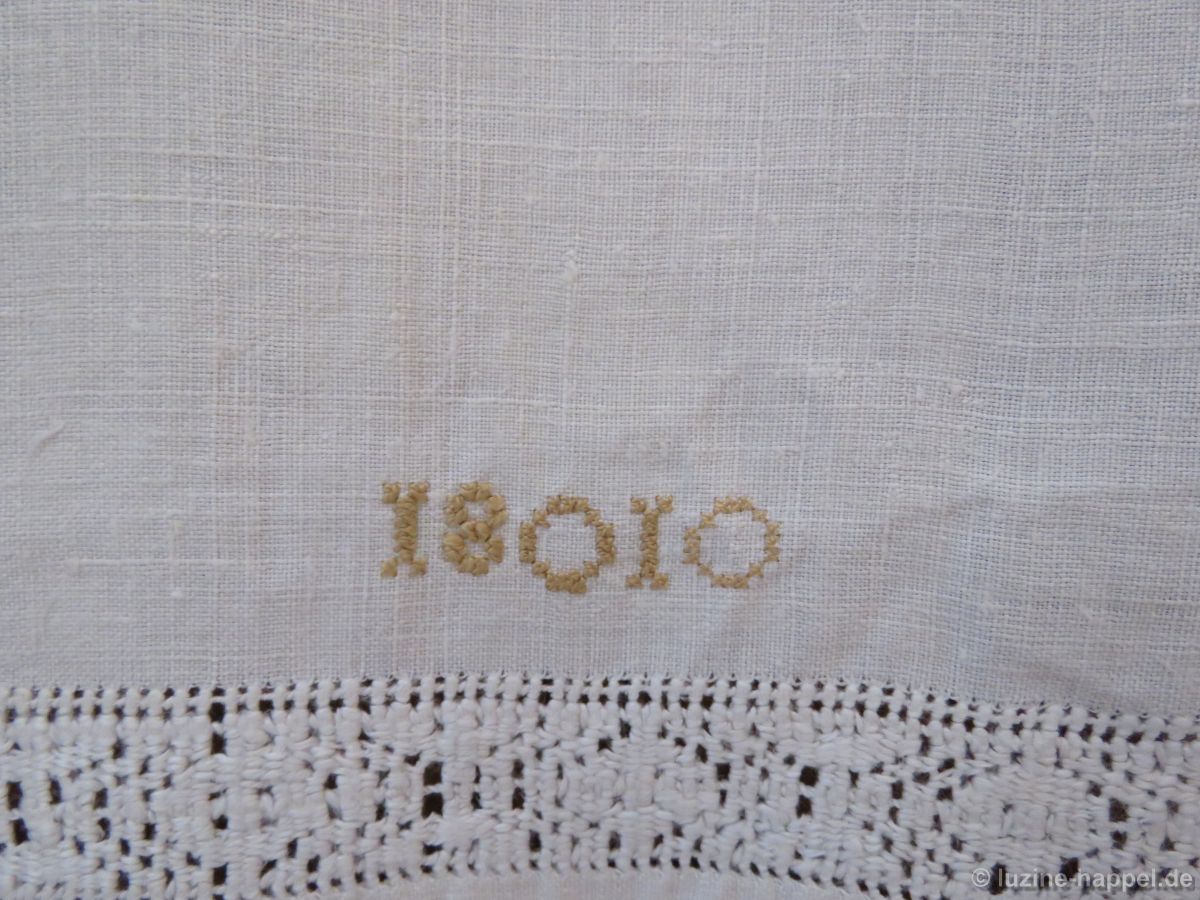
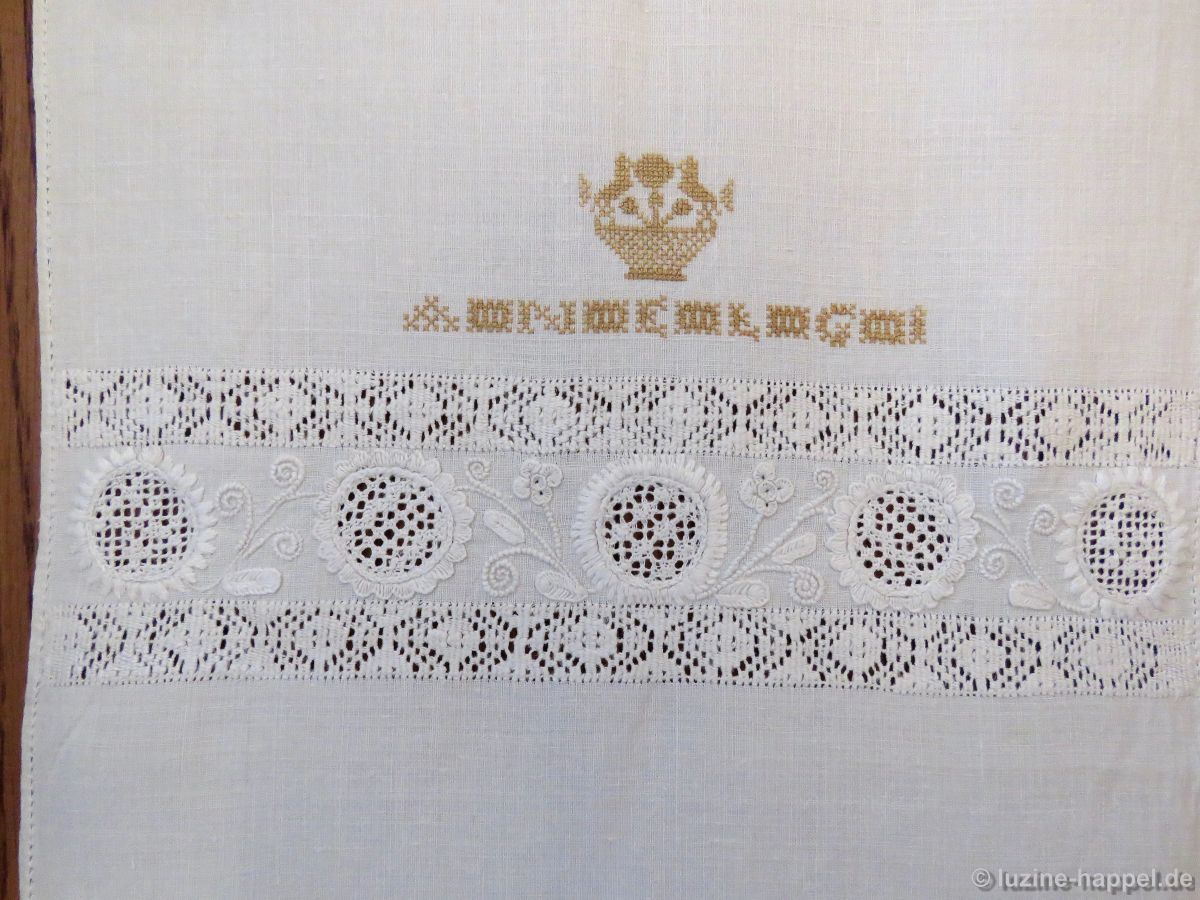
The oldest piece of my collection – at the far left – dates back to 1801 (or possibly 1810). Its full length is not pictured – the top part is unembroidered linen.


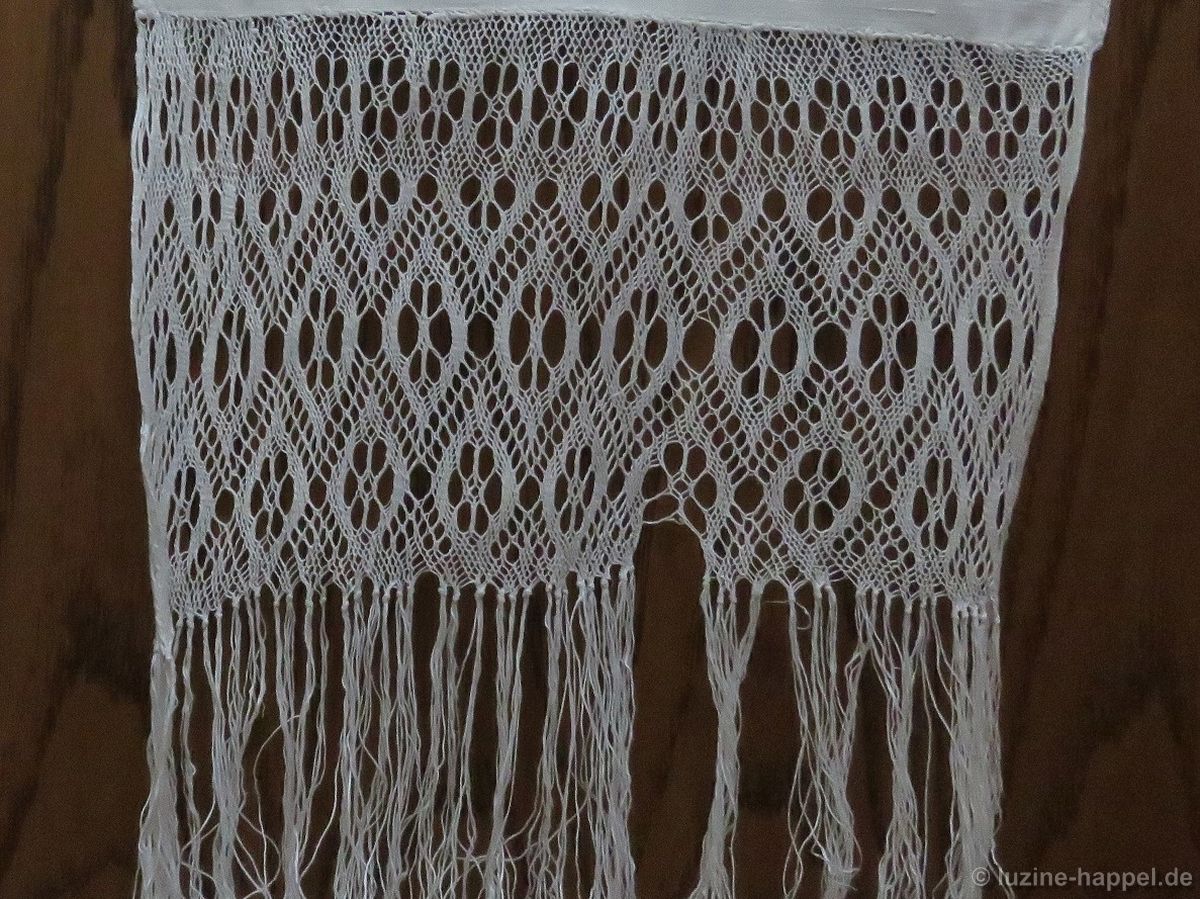
It has a needle-weaving band below the year and a Sprang lace on the bottom edge.

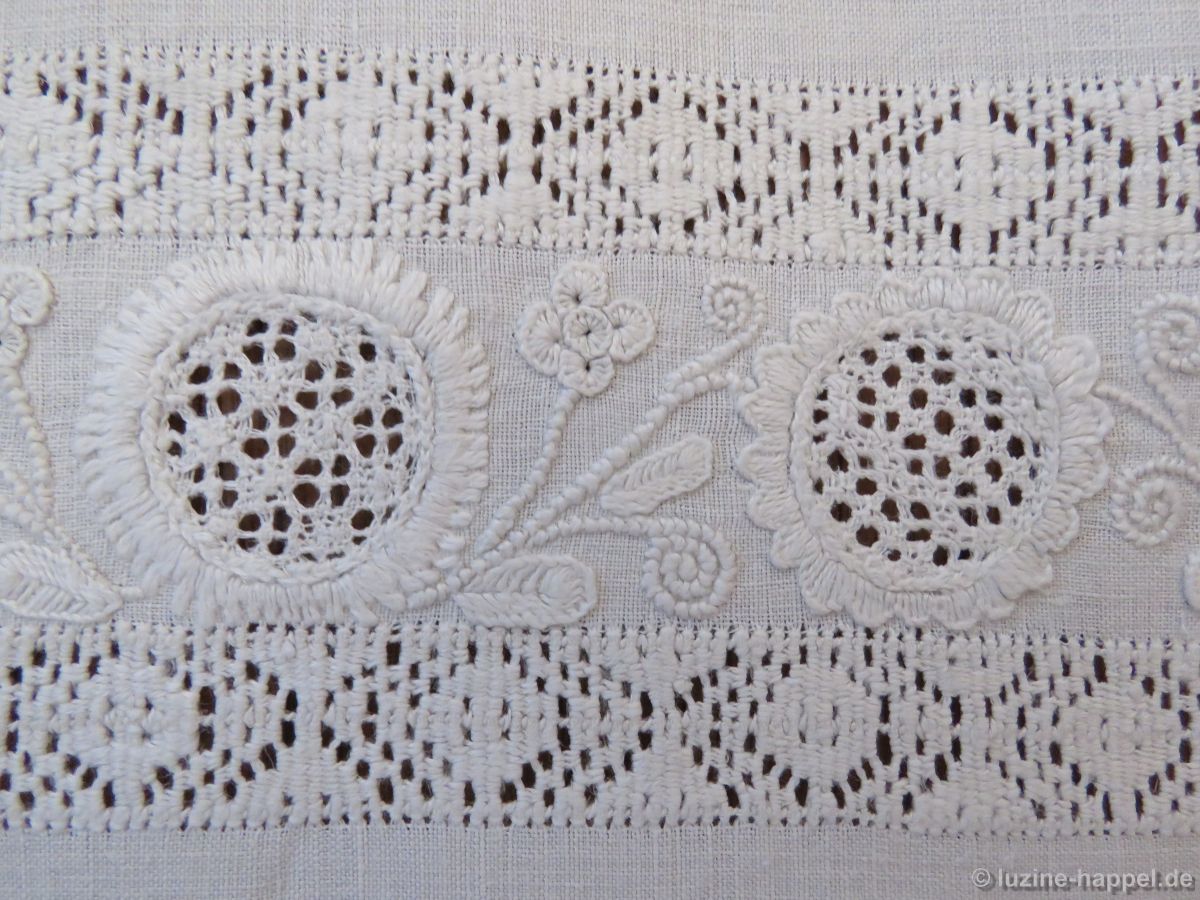
In the middle a small whitework border was stitched bordered by needle-weaving bands having the same patterns as the bottom band.


The whitework border includes only circle shapes that are outlined with 2 short-2 long, Blanket stitch scallops, and knife points. Small flowers worked with half-eyelet scallops, rounded leaves, and tendrils can also be seen. All motif fillings are openwork patterns; the far right motif includes the letter “G” (and possibly there is the incomplete letter “A” in the far left motif).


A Cross stitch crown, initials, and small rectangular ornaments complete the embroidery.


The second from the left is a small door hanging from 1845. It includes openwork bands with endless patterns. These types of openwork bands were rare in the Schwalm – openwork bands were usually decorated with figured patterns. The door hanging also includes a whitework border, initials, the year, and a Cross stitch crown stitched with two colours – again, a rarity. Detailed pictures can be seen in the article Historical Schwalm Whitework and Machine-Made Lace.


All filling patterns are openwork. Pointed Blanket stitches, rounded and pointed leaves, tendrils, curved lines, Blanket stitch eyelets (partly outlined with Eyelash stitches), and cross motifs can all be seen. The hem was secured with Four-Sided stitches.

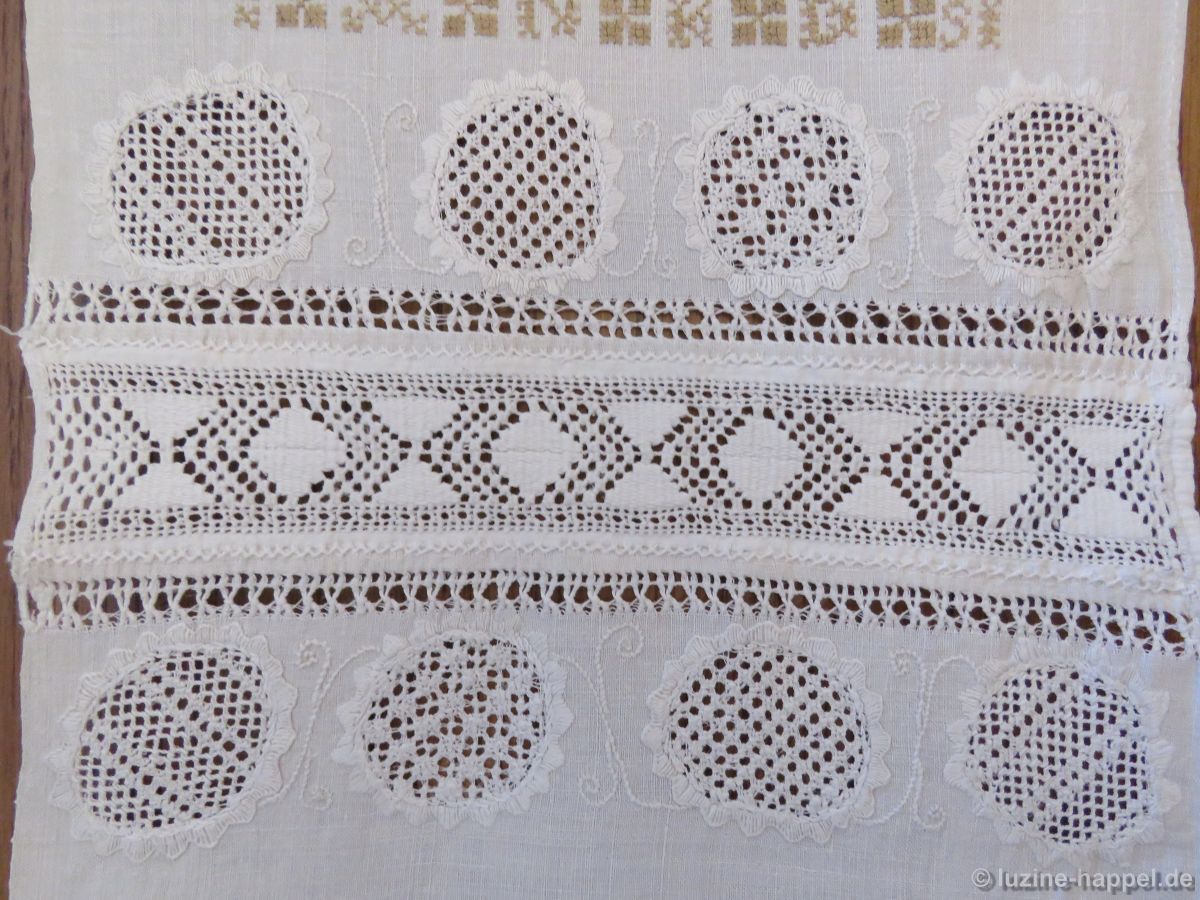
The hanging third from the left does not include a year. It shows two small borders designed with circles and a few Coral Knot lines and tendrils. All filling patterns are openwork and the outlines are Blanket and Satin stitch scallops. Between the borders a needle-weaving band was placed. The needle-weaving section is an extra piece that was inserted between the two embroidered linen pieces.

Peaholes were worked twice – bordering the needle-weaving band and bordering the inserted section.


The hanging includes a Satin stitch crown, initials, and small Cross stitch ornaments.


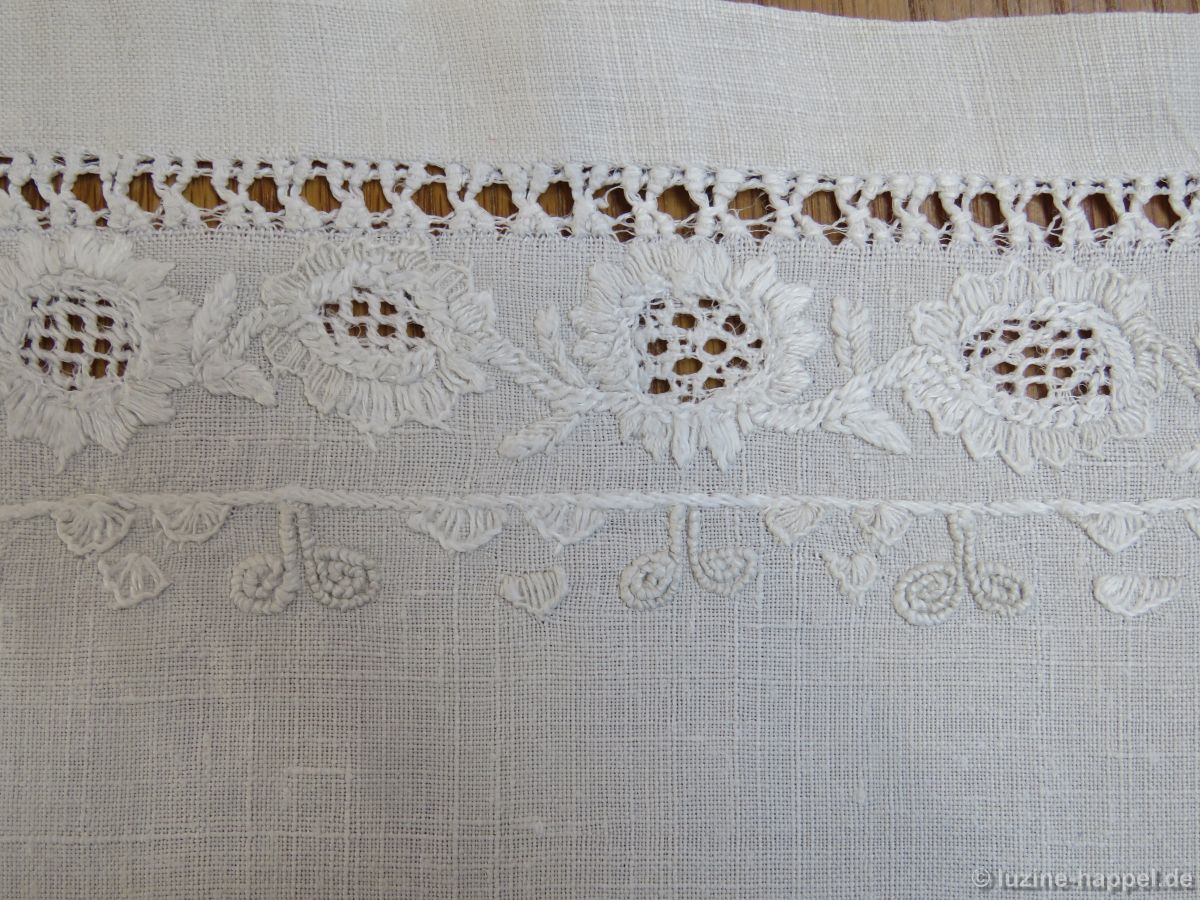
At the top a small border was worked along the Peahole hem. Small circles – outlined with Satin and Blanket stitch knife points – were further embellished with openwork fillings, pointed leaves, and wide stems worked with slanting Blanket stitches. Pairs of mirrored tendrils and triple scallops alternate along a Stem stitch line.


At the bottom a Sprang lace was attached.


It is interesting to see the manifold Schwalm whitework techniques of the particular era in these old pieces

I will present in detail the contemporary hangings in a future article.