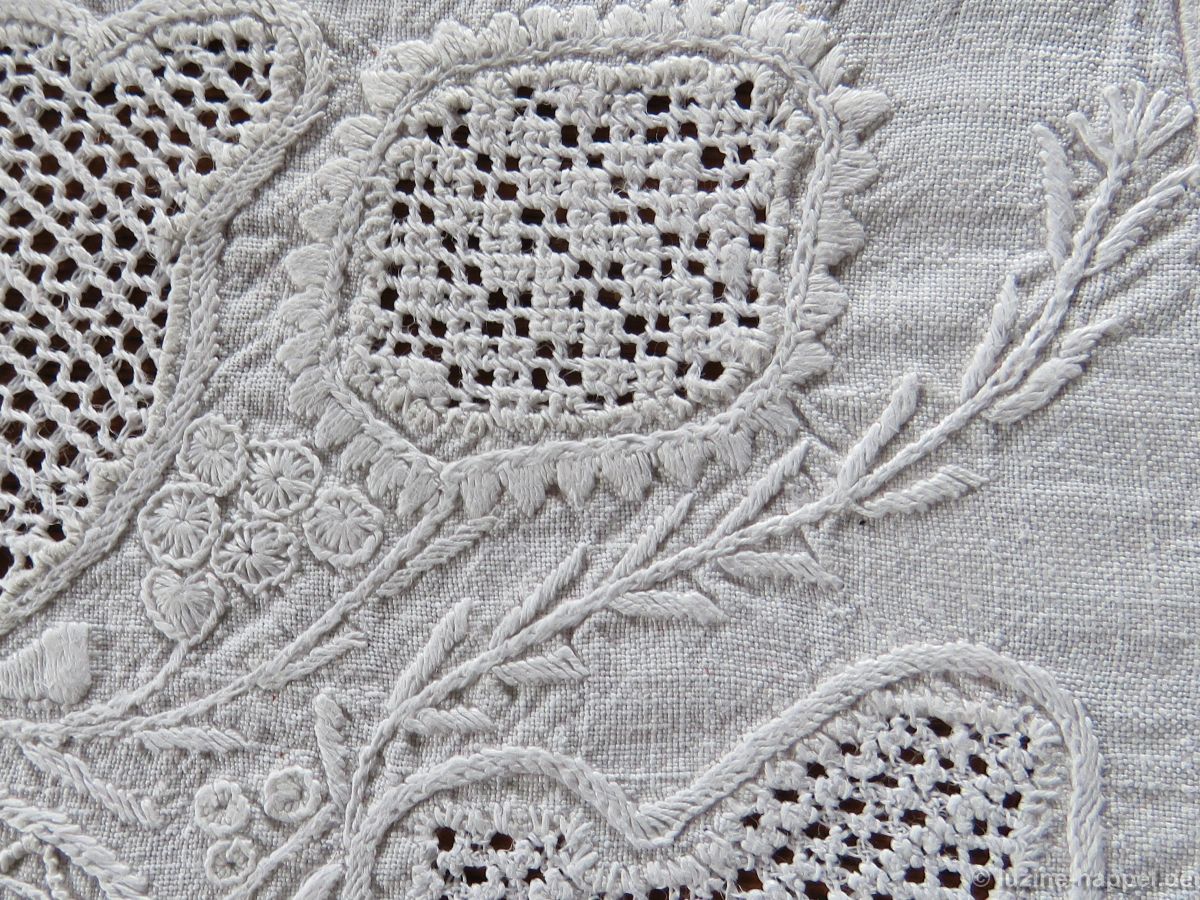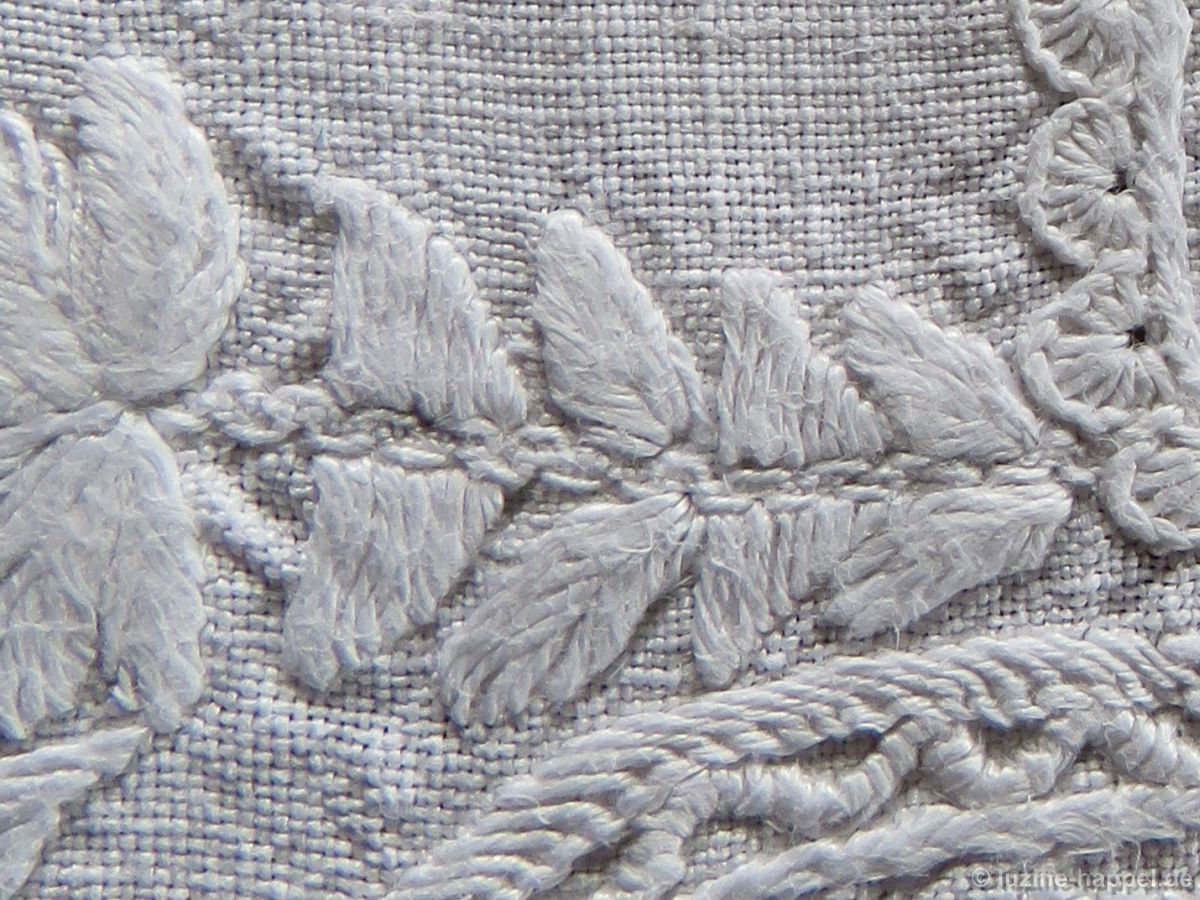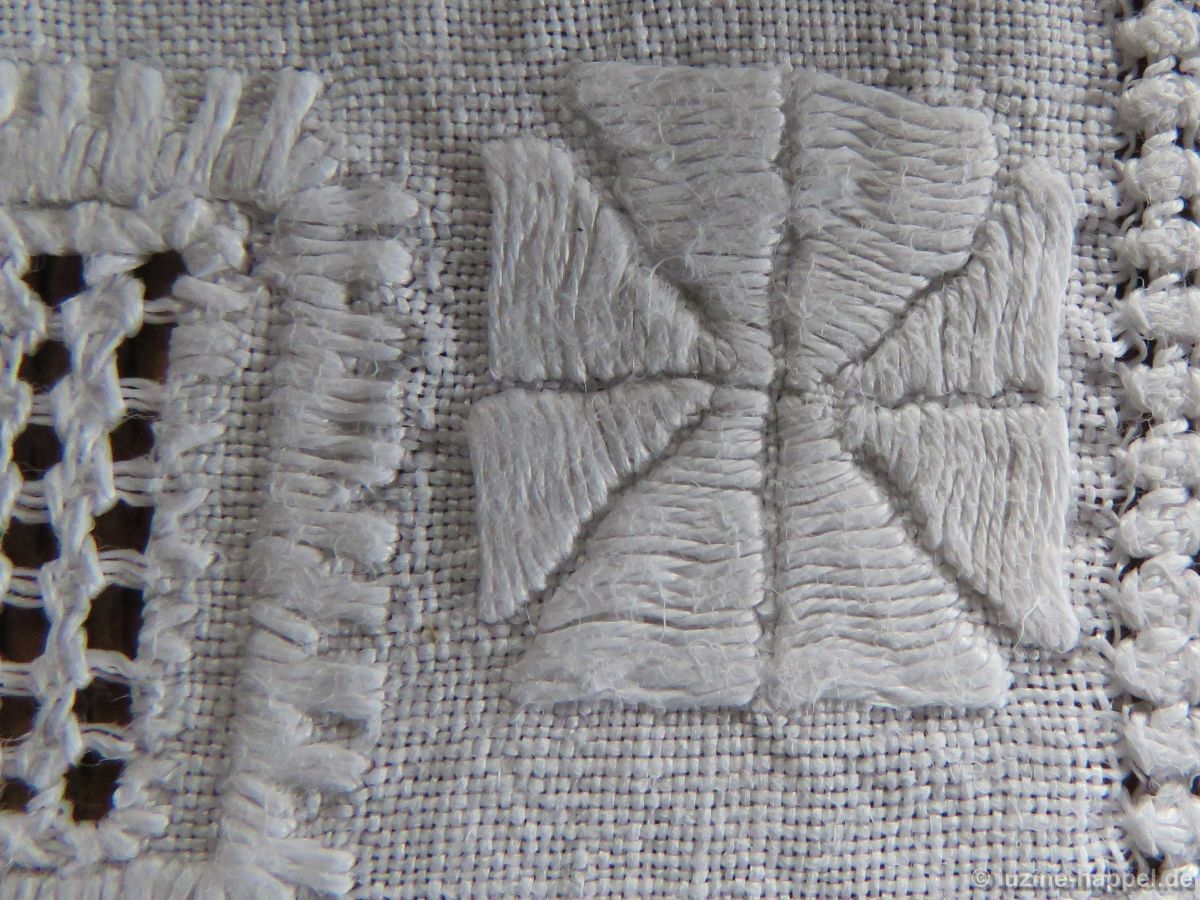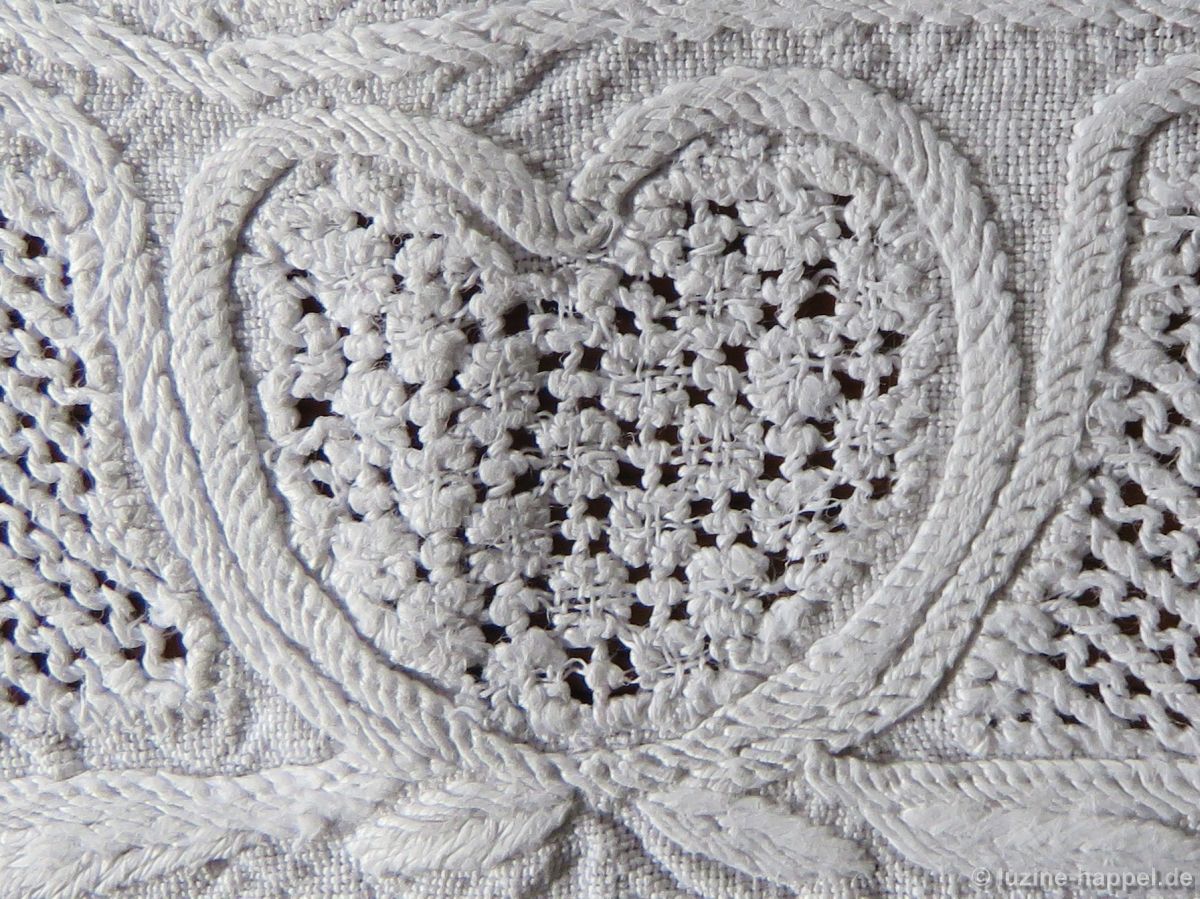
Schwalm Whitework Sampler Cloths

Embroidering samplers was and is popular and common. Schwalm women also created samplers – samplers with very different appearances. I will present some of them in different articles; the first deals with sampler chloths.

In the 1920s Alexandra Thielmann established a school for Schwalm whitework in Willingshausen. Here older girls and young women learned to embroider the Schwalm technique. And when they were able to embroider perfectly, they worked elaborate pieces that were sold all over Germany.

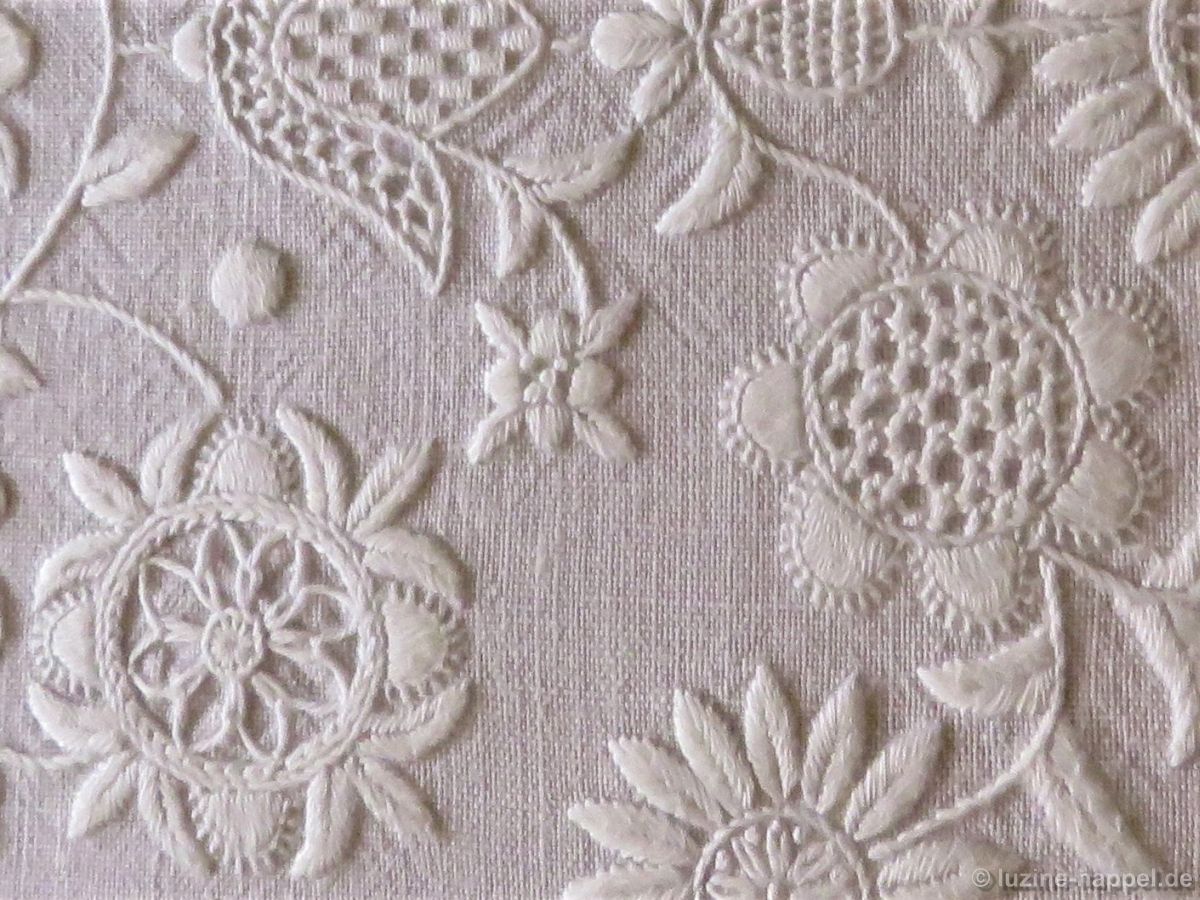
Alexandra Thielmann´s work was characterized by a preponderance of flower motifs including a wide variety of different tulips and other blooms. She preferred pointed leaves and combined single leaves with two- or three-piece leaf objects.

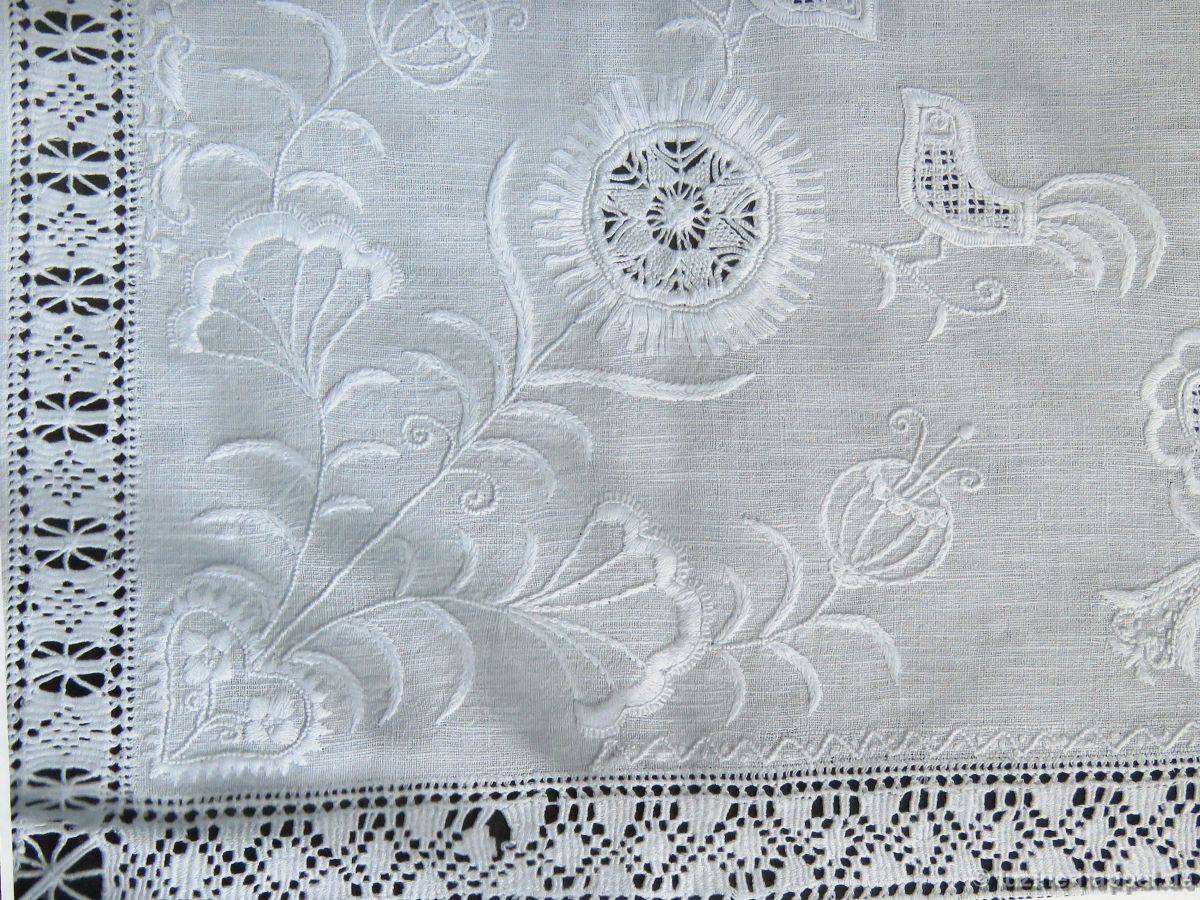
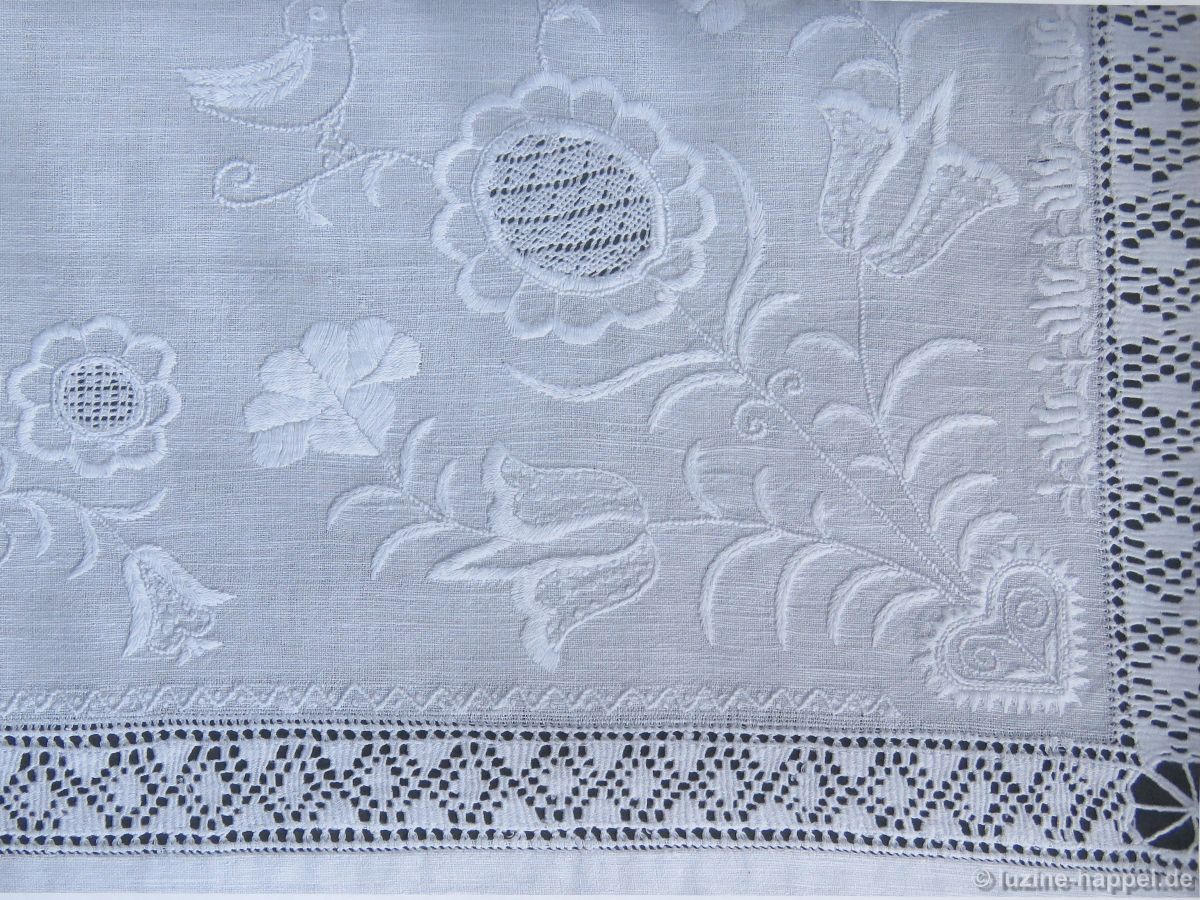
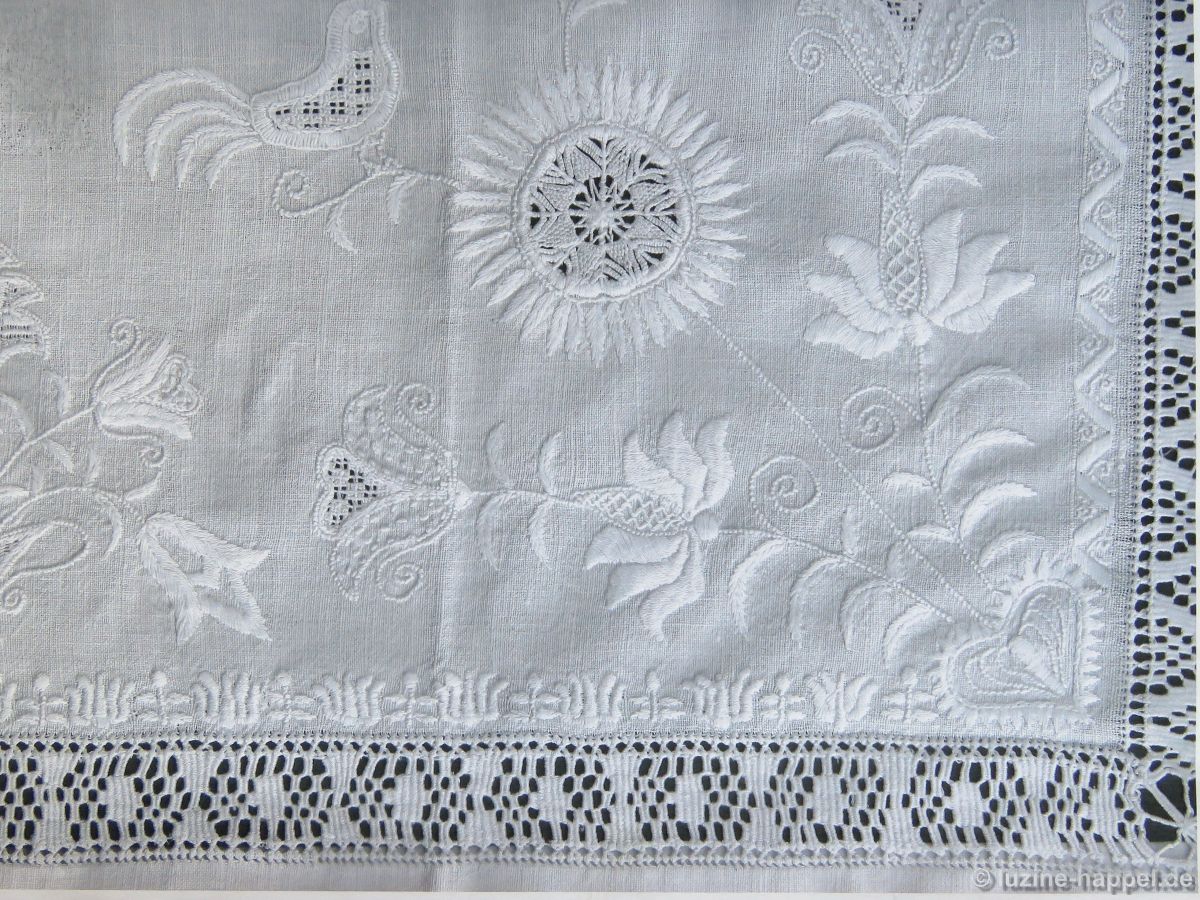
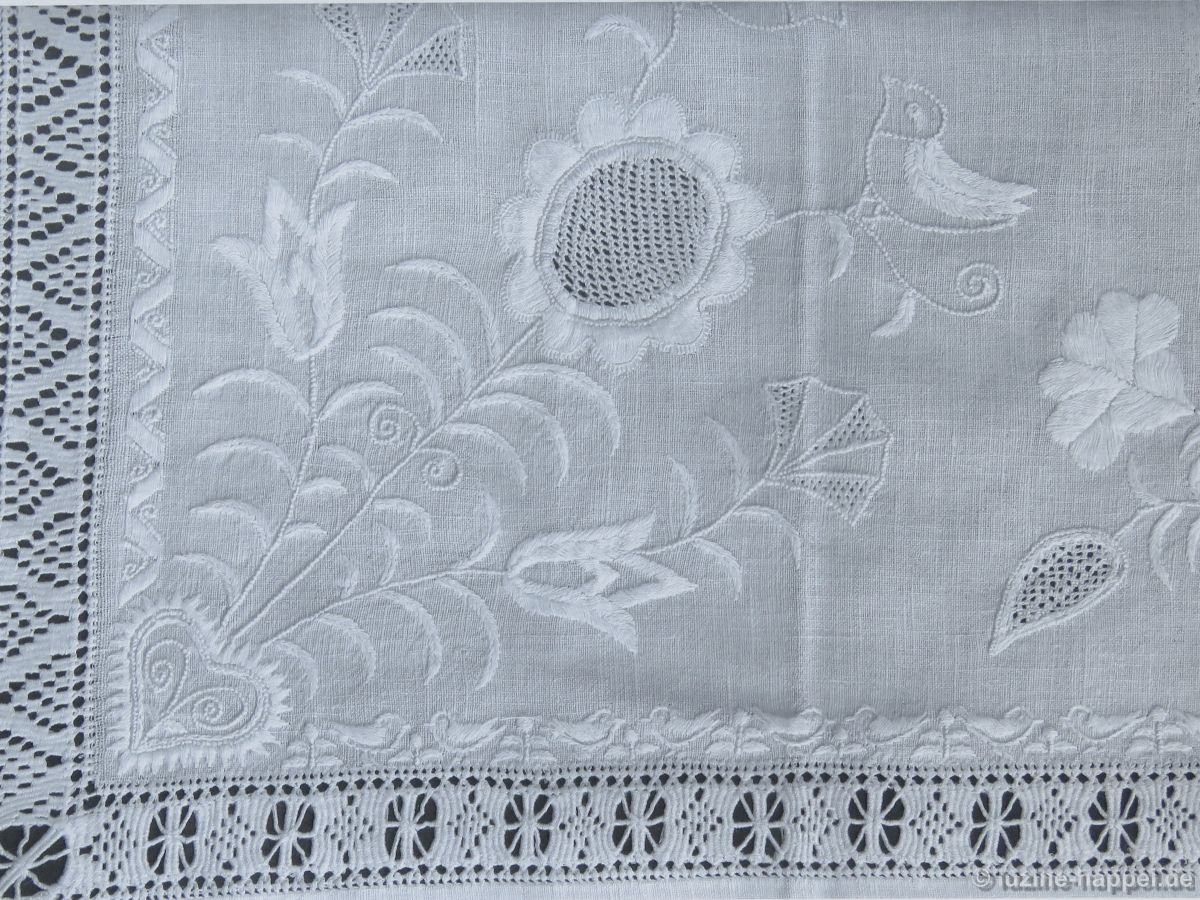
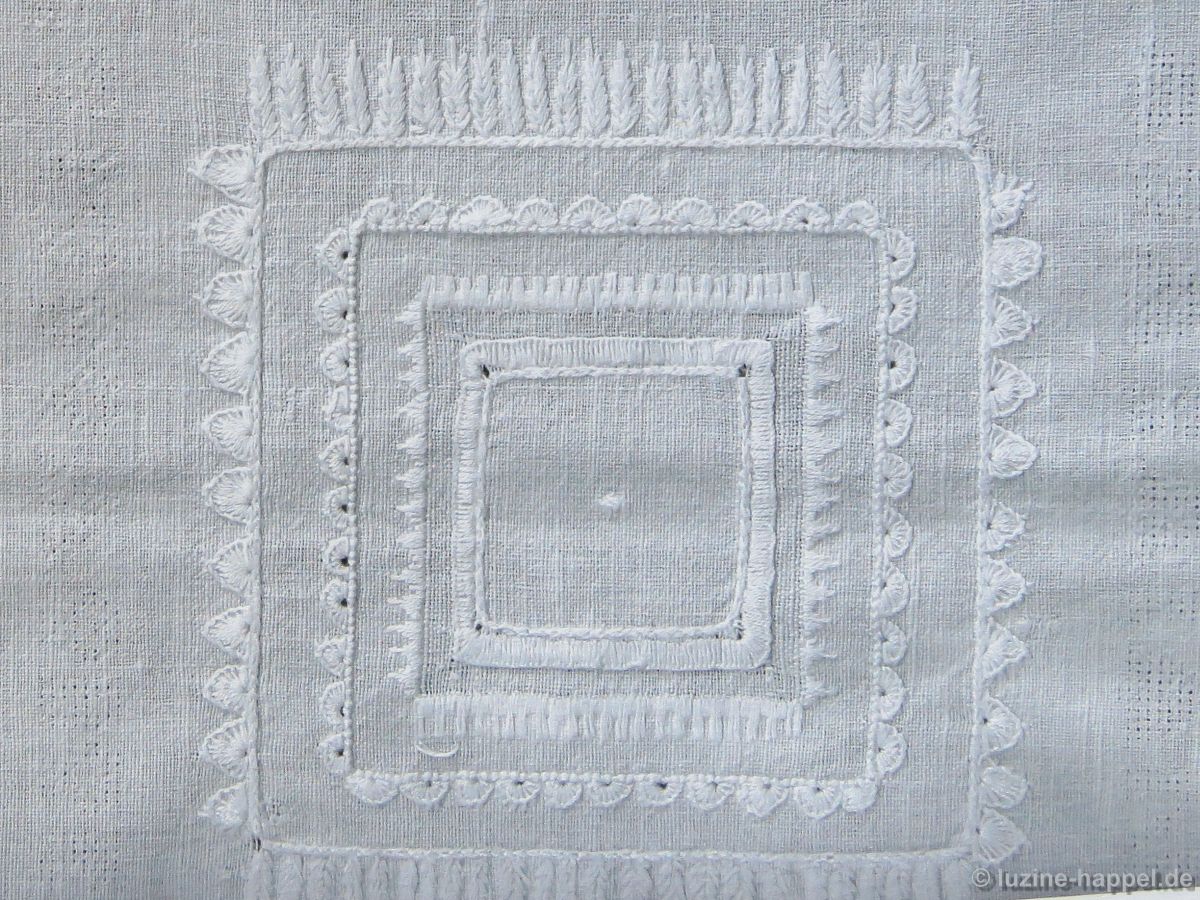
The students had to work a square sampler cloth first. The embroiderer´s skills varied. The sampler piece I found is not the most perfect, but one can see the lesson´s contents.
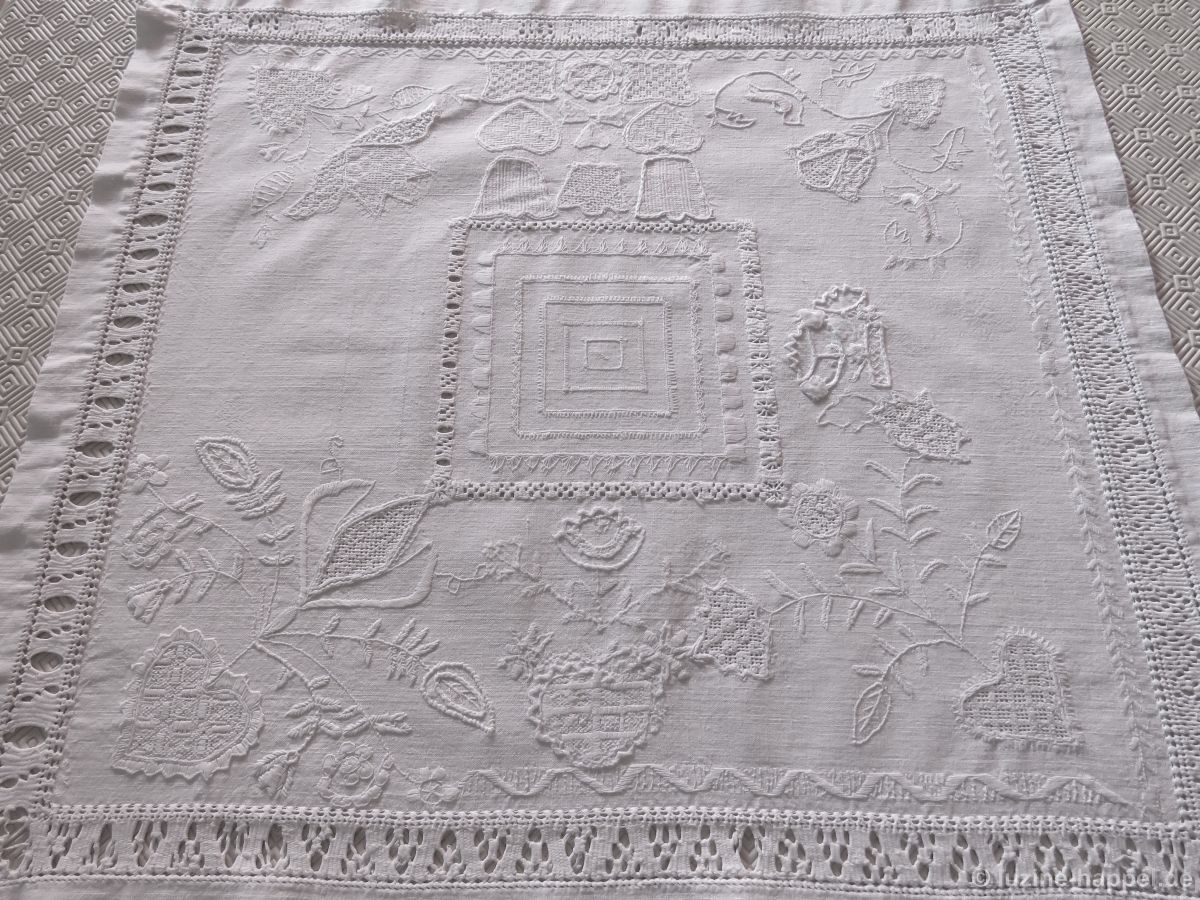

The students had to learn a lot:

In the center, squares were worked with rows of different scallops and half-eyelet scallops, 2 short-2 long stitches, knife points made with Satin stitches, Blanket stitches, and Blanket stitches worked as pointed half-eyelet scallops, Eyelash stitches, and pointed leaves. Often four different small needle-weaving bands were added.

At the hem Peaholes were worked in combination with four different needle-weaving hems, and there were four different corner arrangements. Beside the hems four different small borders were worked.

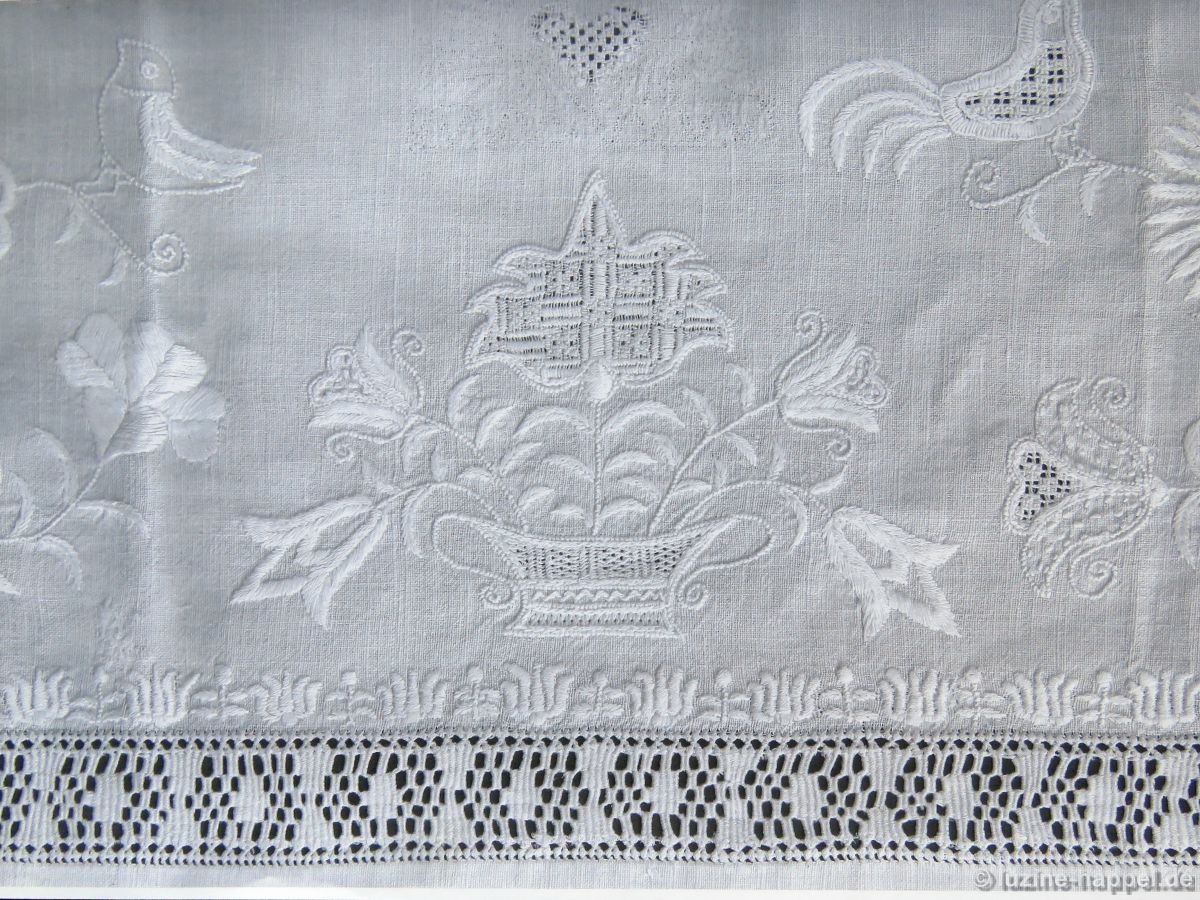
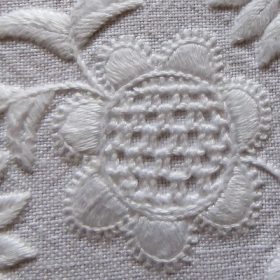
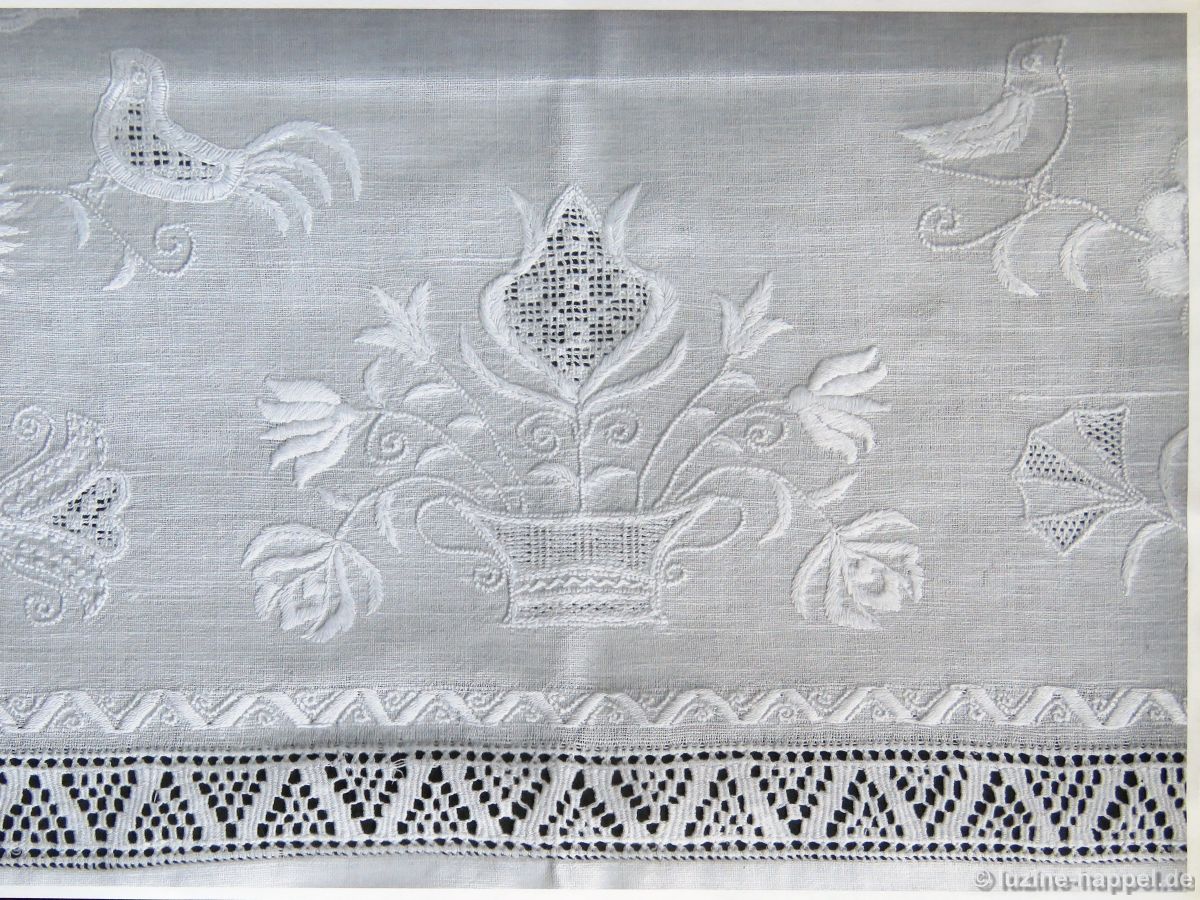
The section between the center squares and the hem was filled with different whitework motifs. The typical Thielmann flowers (such as the tulips and daffodils) and hearts were worked with different outlines. Shapes on the straight of grain and shapes on the bias were embroidered. All three types of filling patterns – simple drawn thread, Limet, and openwork – were practiced. Often a crown was added.

Here are details – some perfect and some less than perfect:


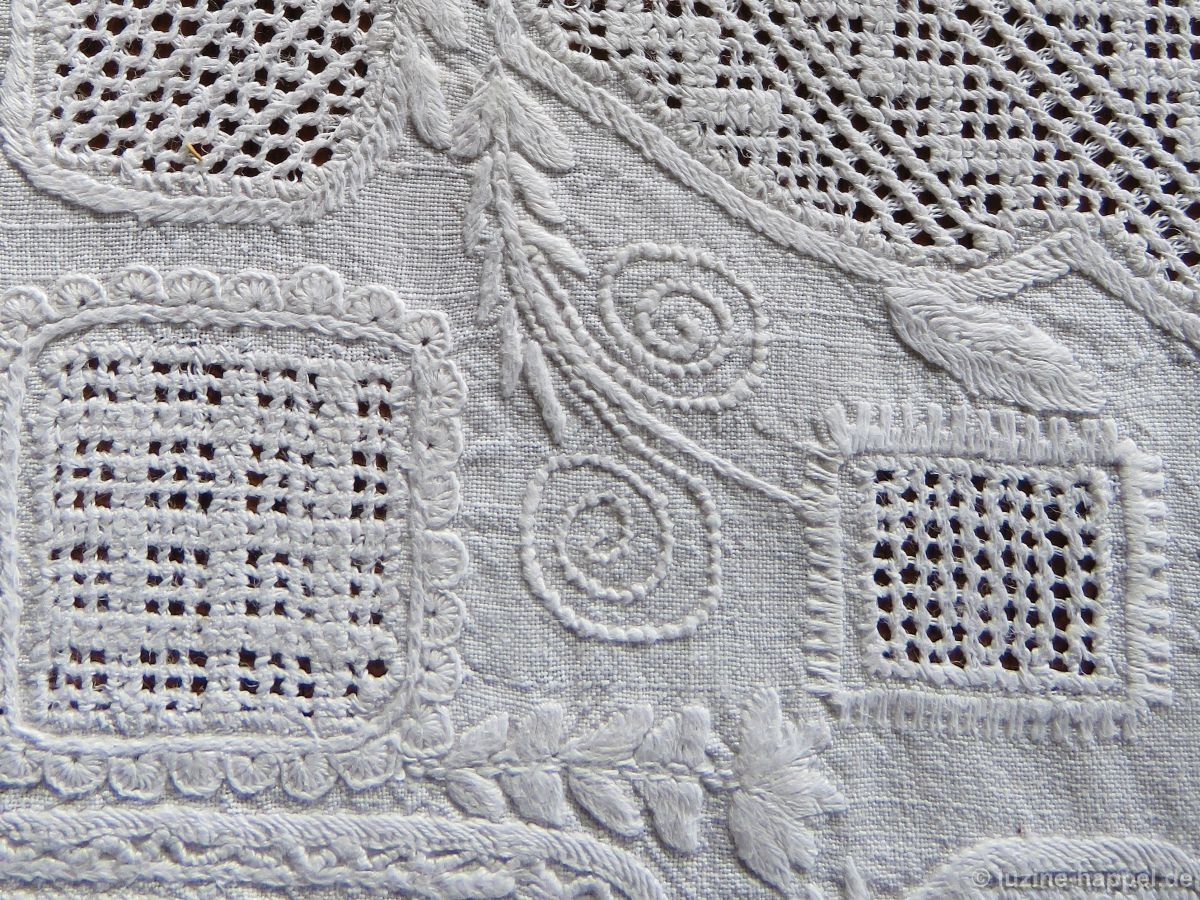
Pointed leaves, Blanket stitch half-eyelet scallops, Blanket stitch knife points, Satin stitch knife points, 2 short-2 long, Chain stitches, Blanket stitches, Eyelash stitches, Satin stitch scallops,


and different small needle-weaving bands were worked in rows to establish squares in the center.
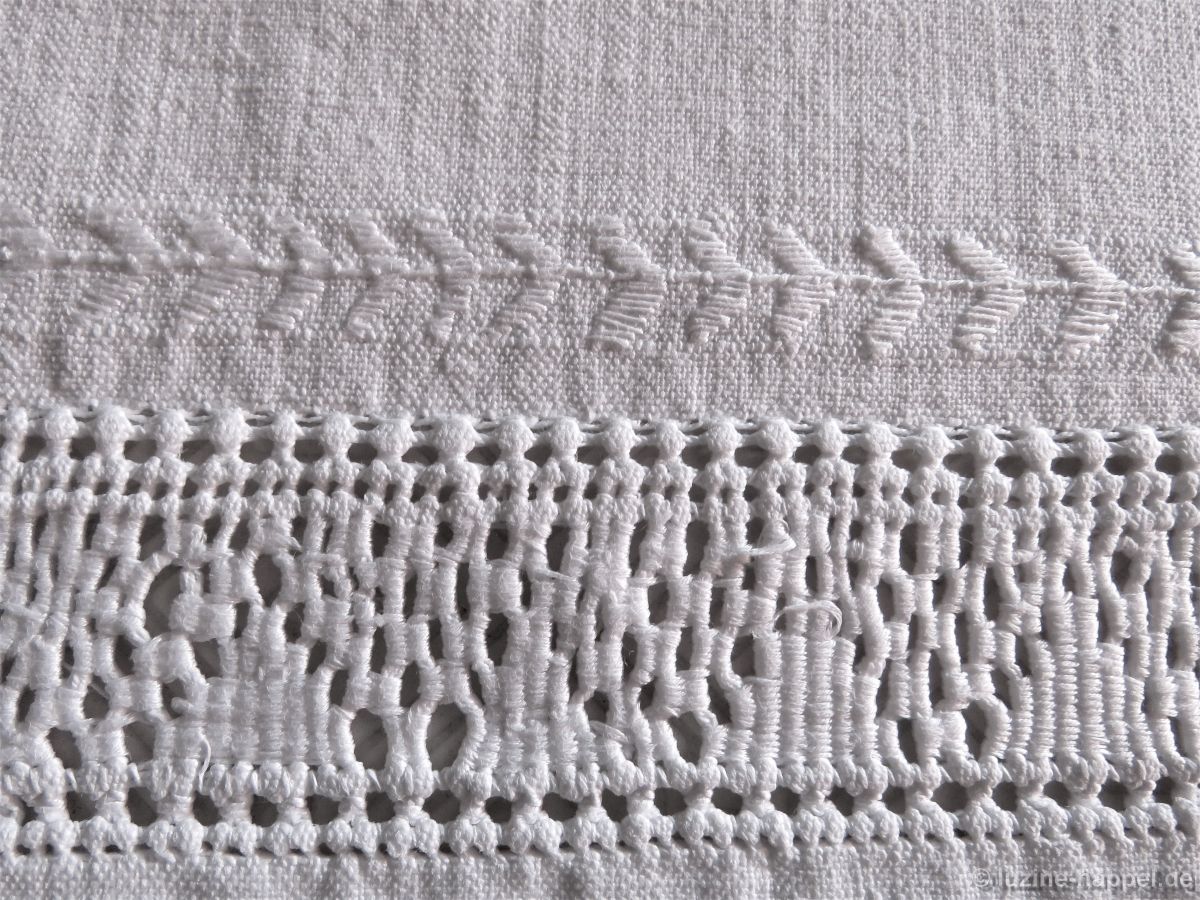

At the hem Peaholes were worked on both sides of needle-weaving bands.
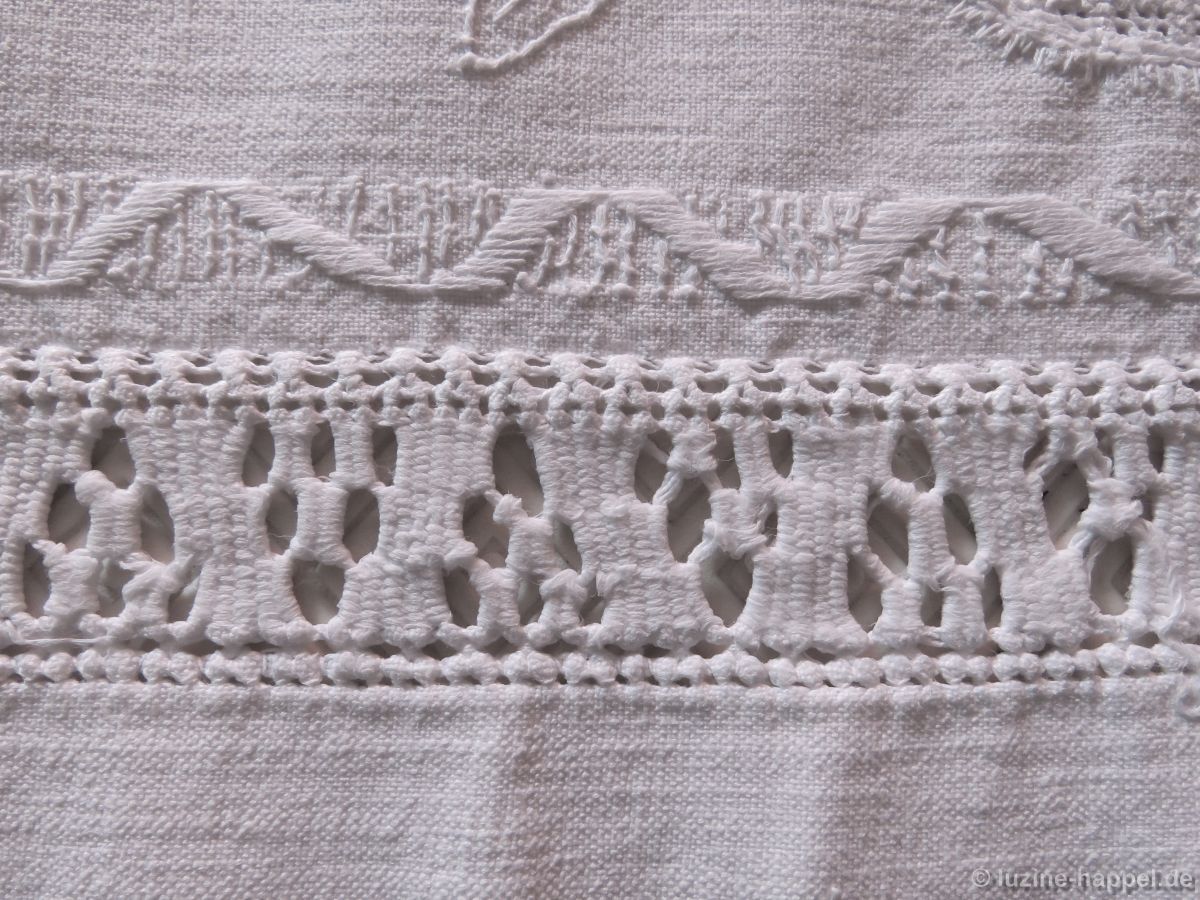

Different small borders are found inwards.
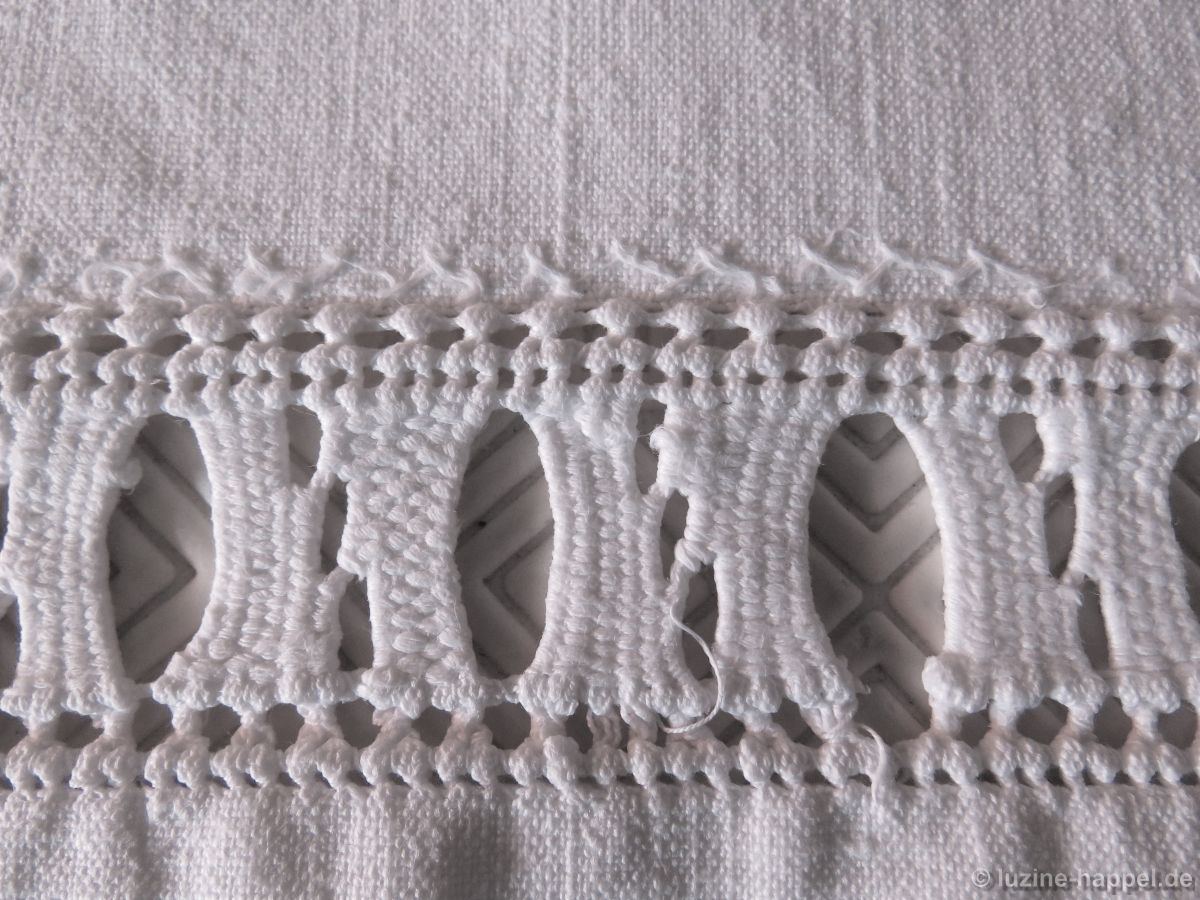

In the above image, Herringbone stitches were added as a small border.
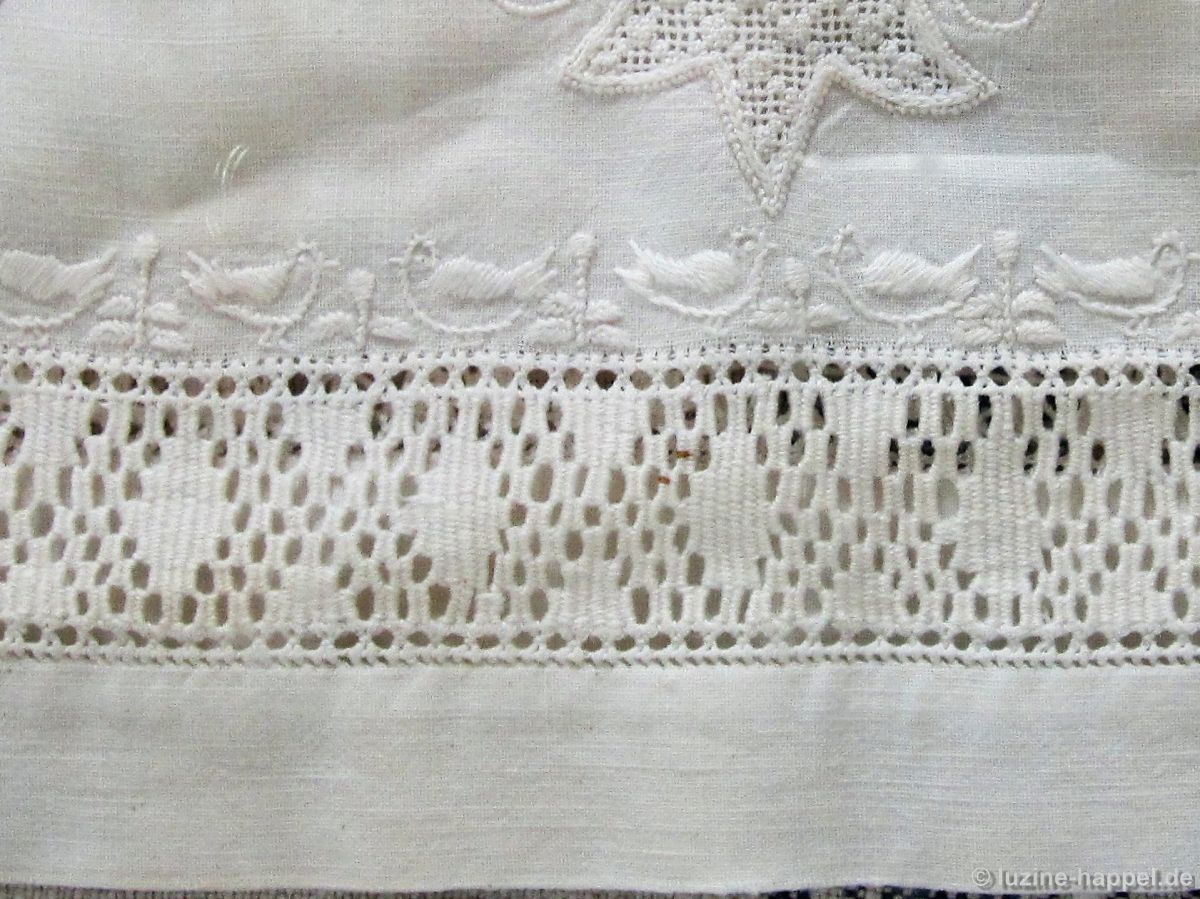

Depending on the skill of the student, additional elaborate motif borders were stitched.
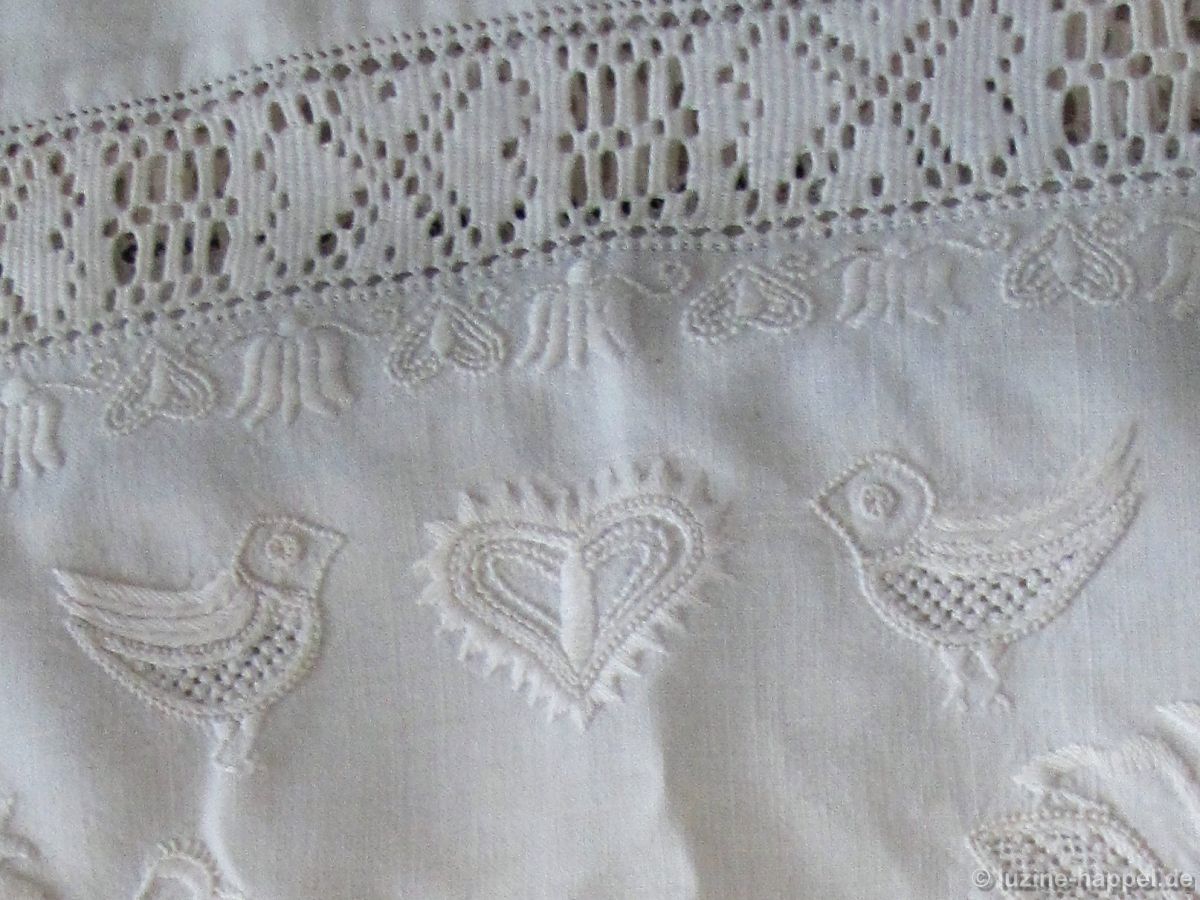

Designs for such borders can be found in my book Schwalm Curved Lines, Narrow Borders, and Ornamental Stitches
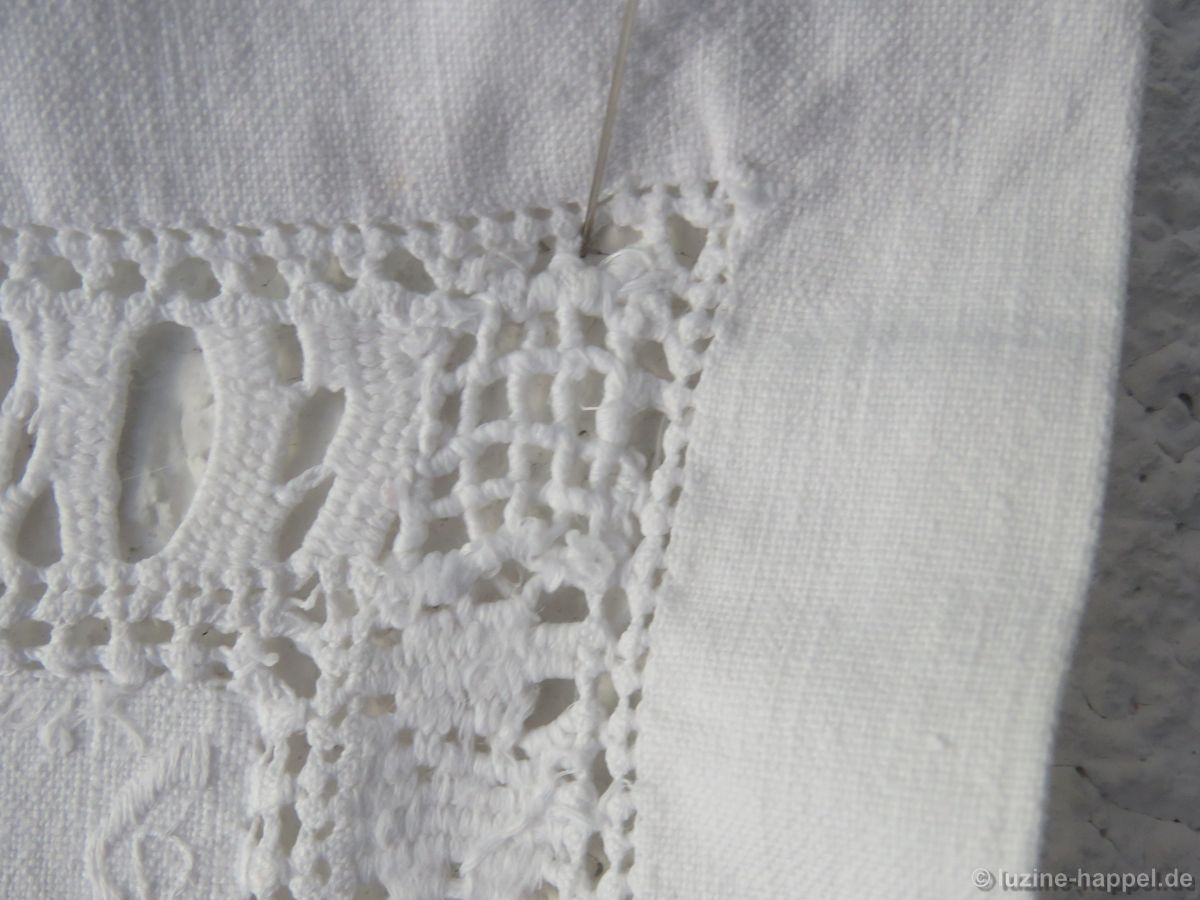

Common corner solutions for needle-weaving hems in Schwalm whitework were practiced. These included grids or
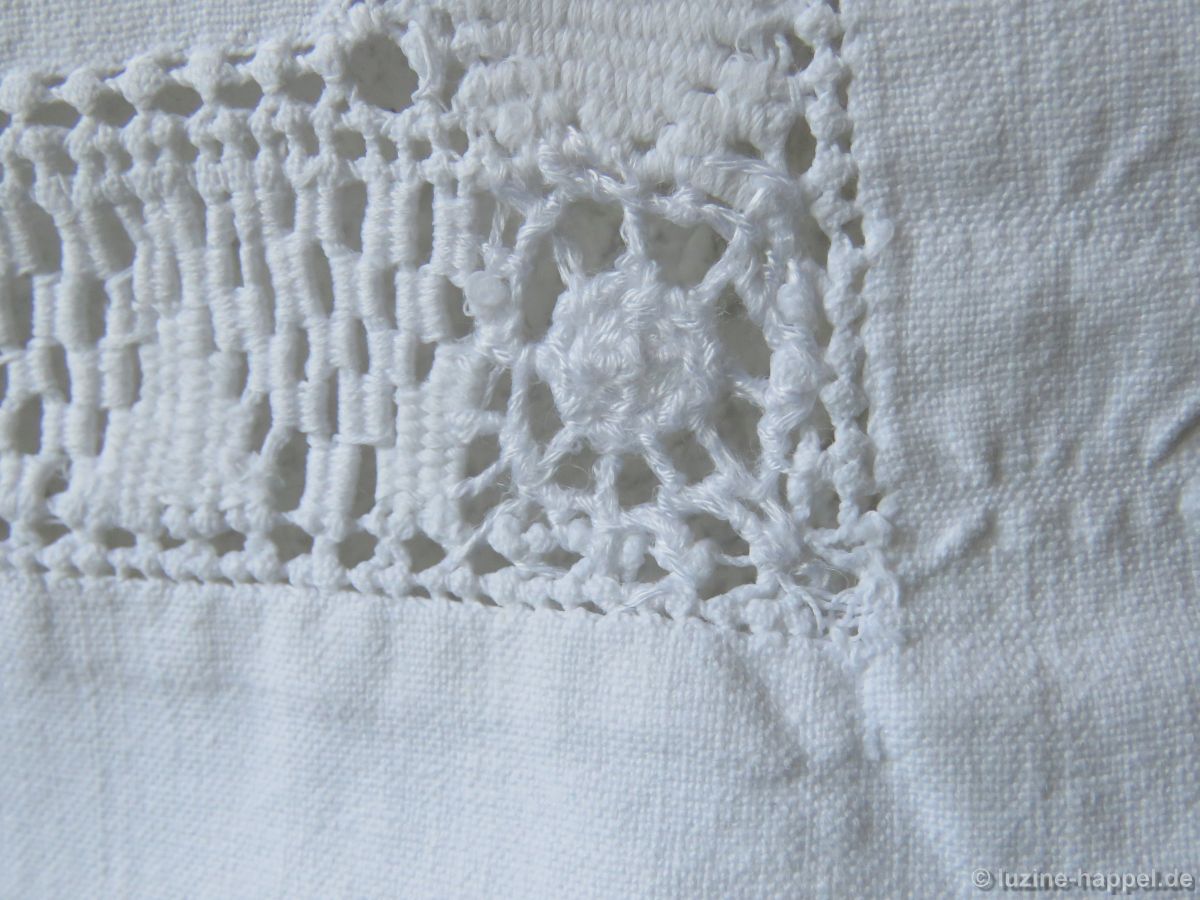

of course different spiders.
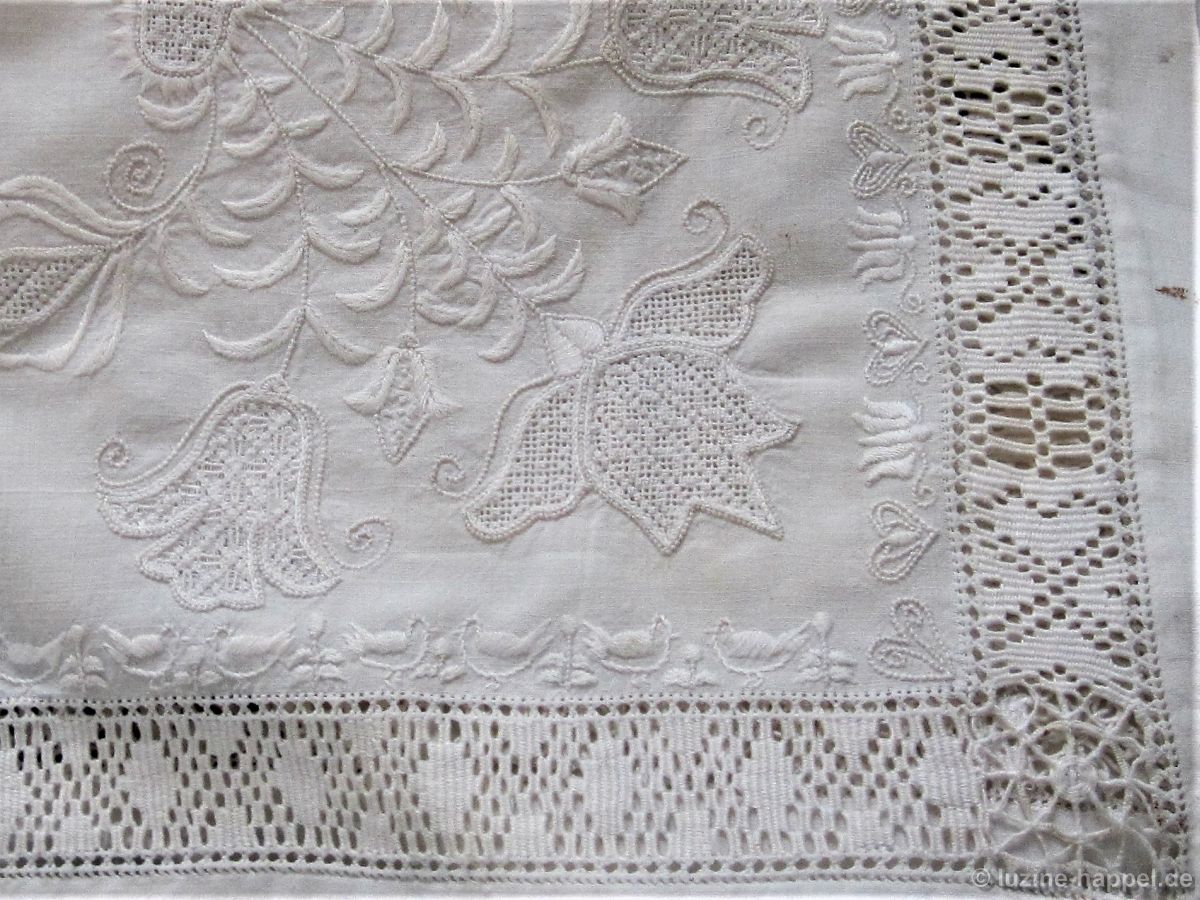

Different corner solutions can be found in my book Fancy Hems.
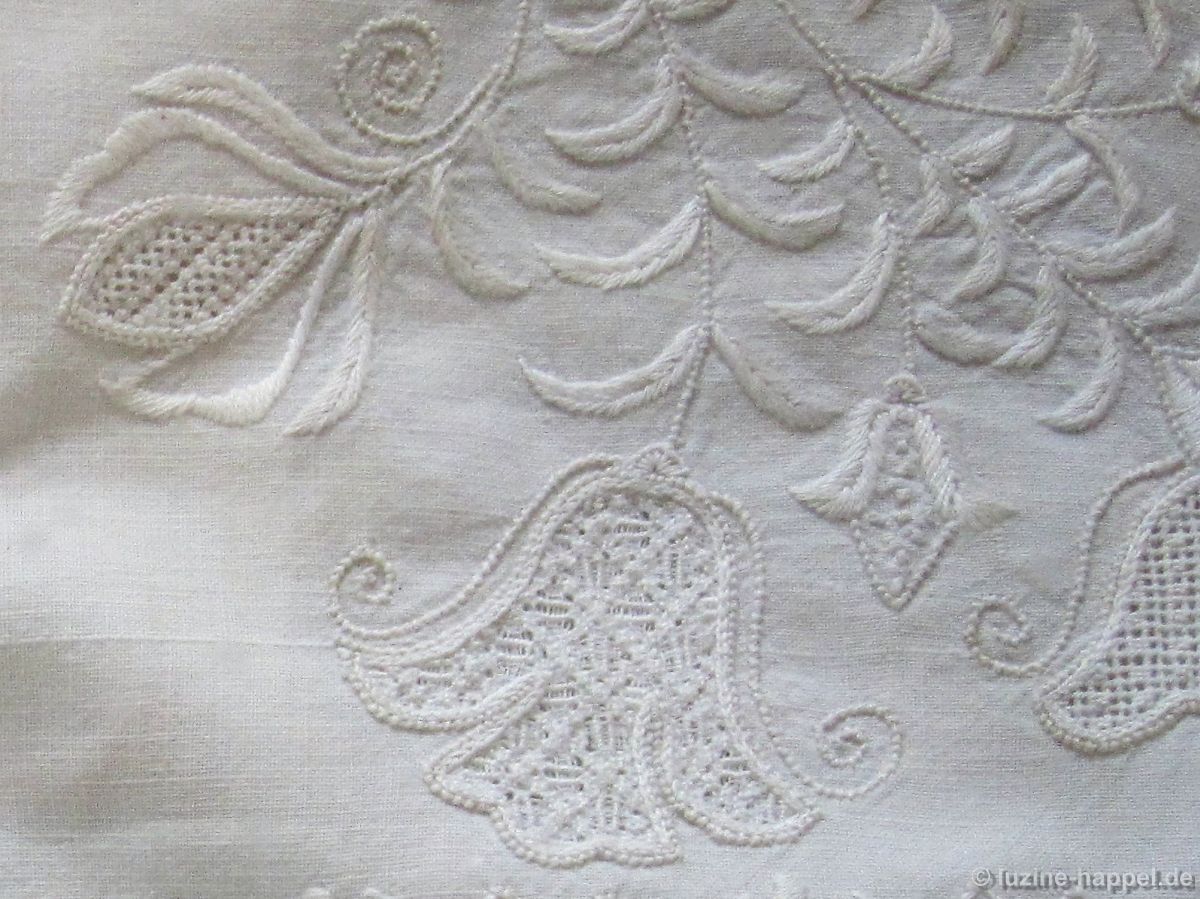

Many pointed leaves as well as
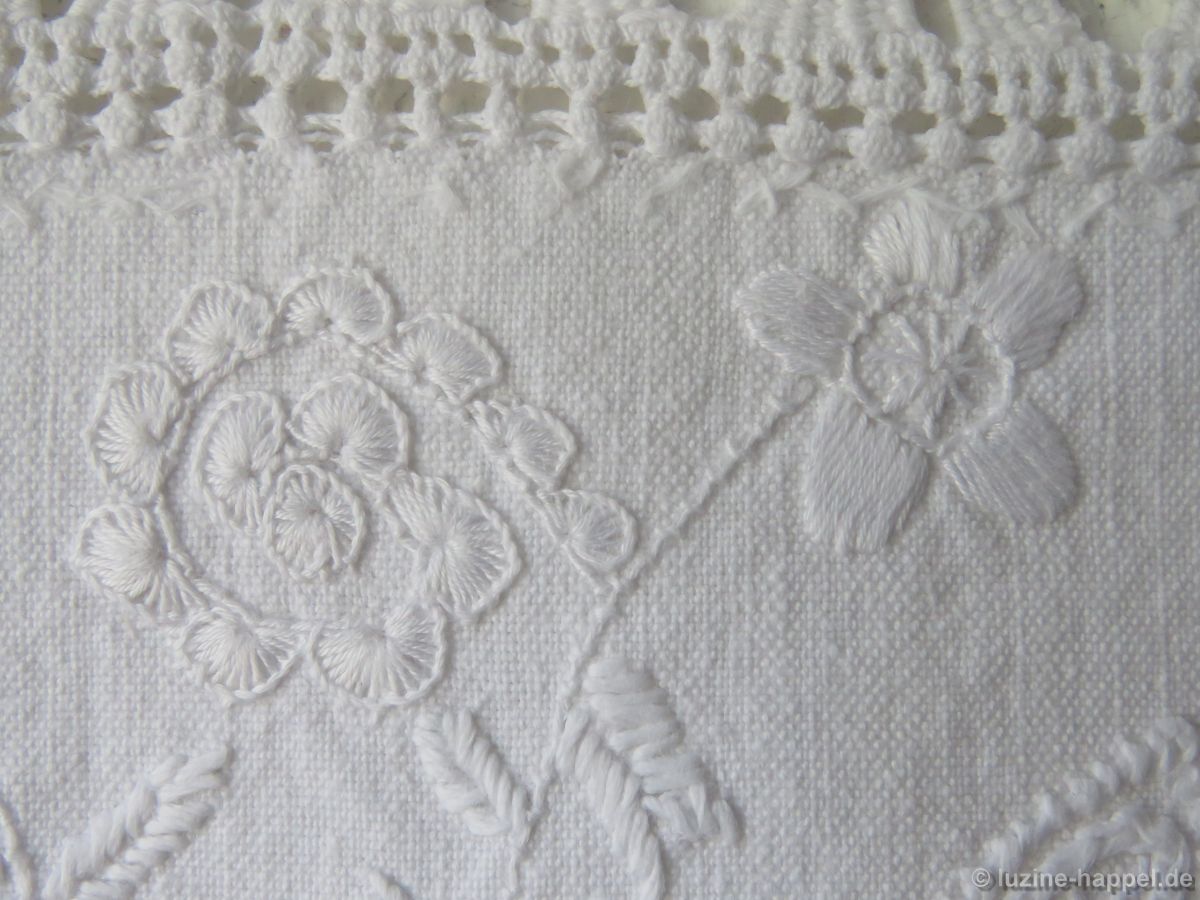

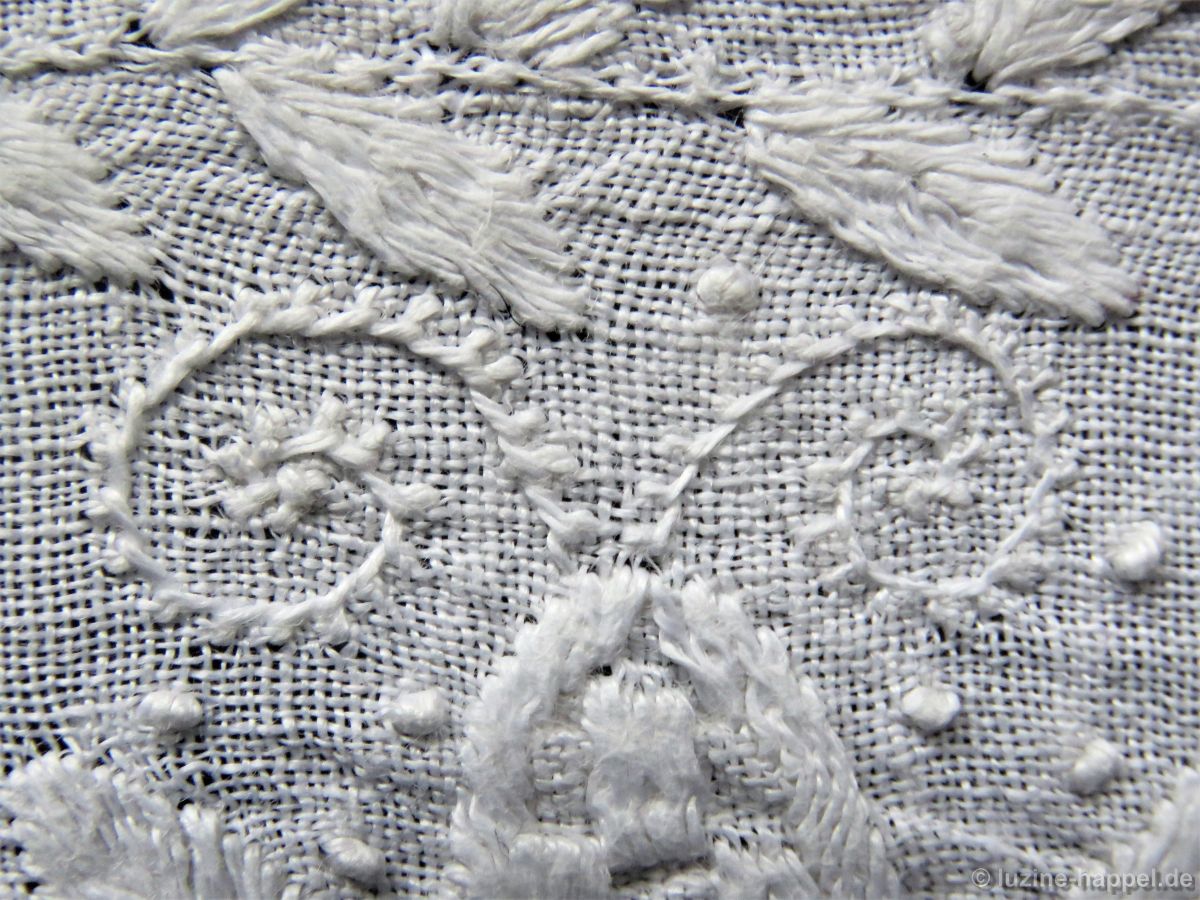
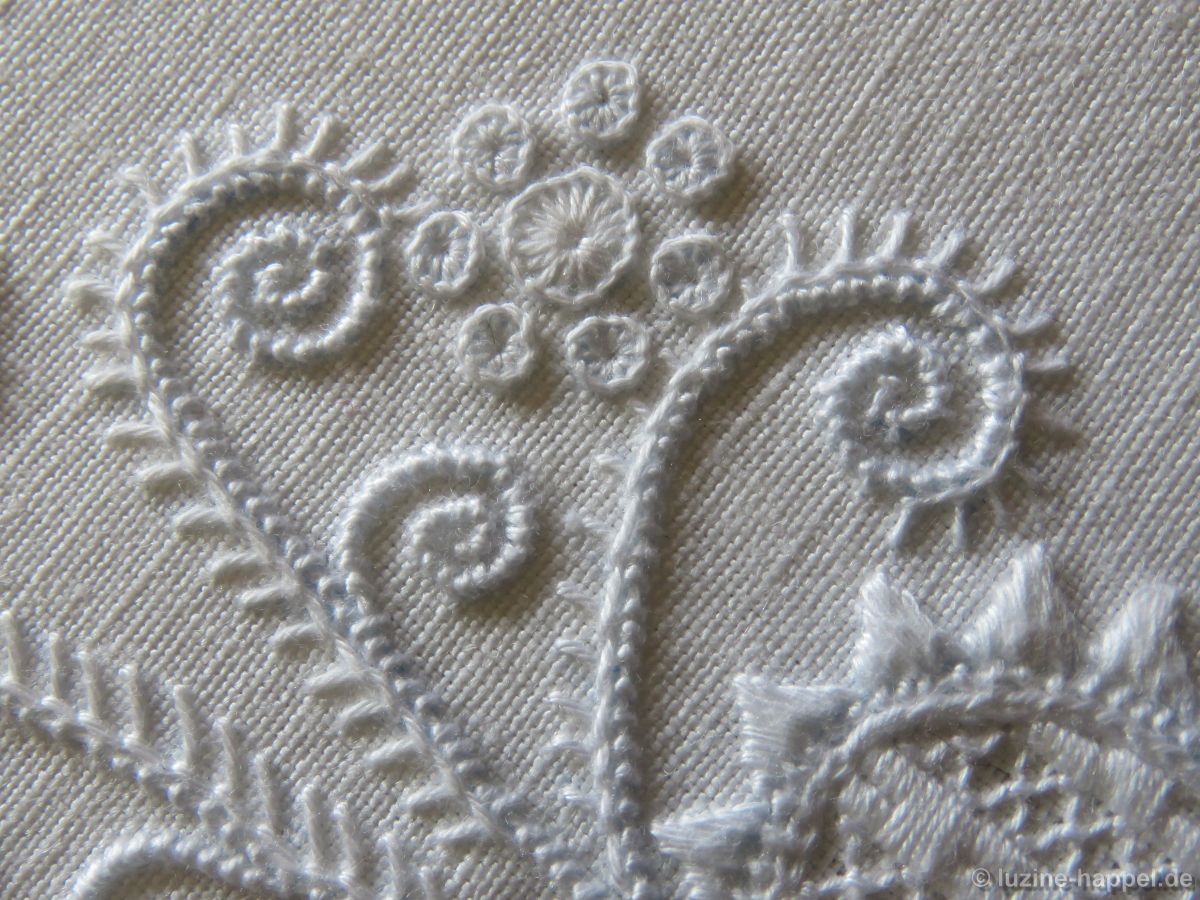
tendrils (made with Blanket stitch half-eyelet scallops) were stitched.
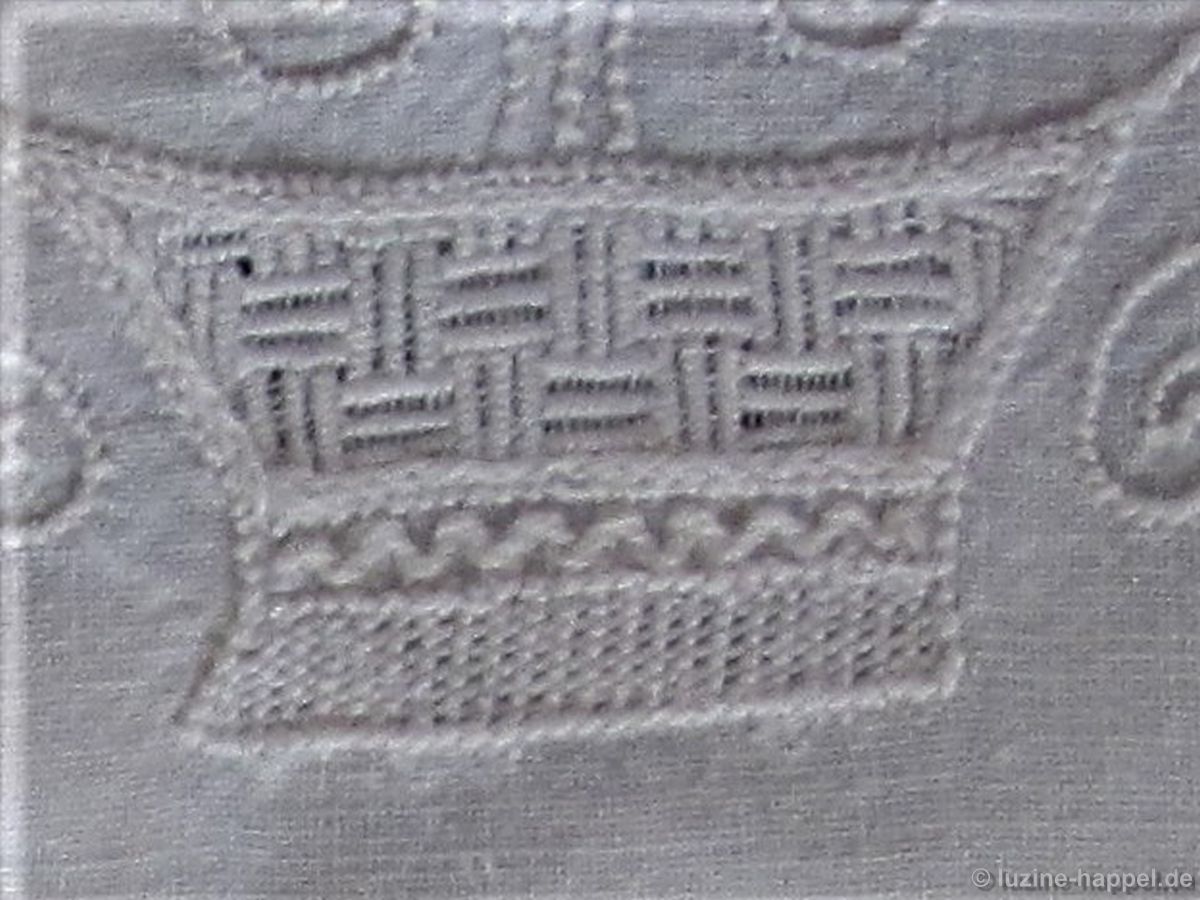

All common motifs can be seen: baskets,
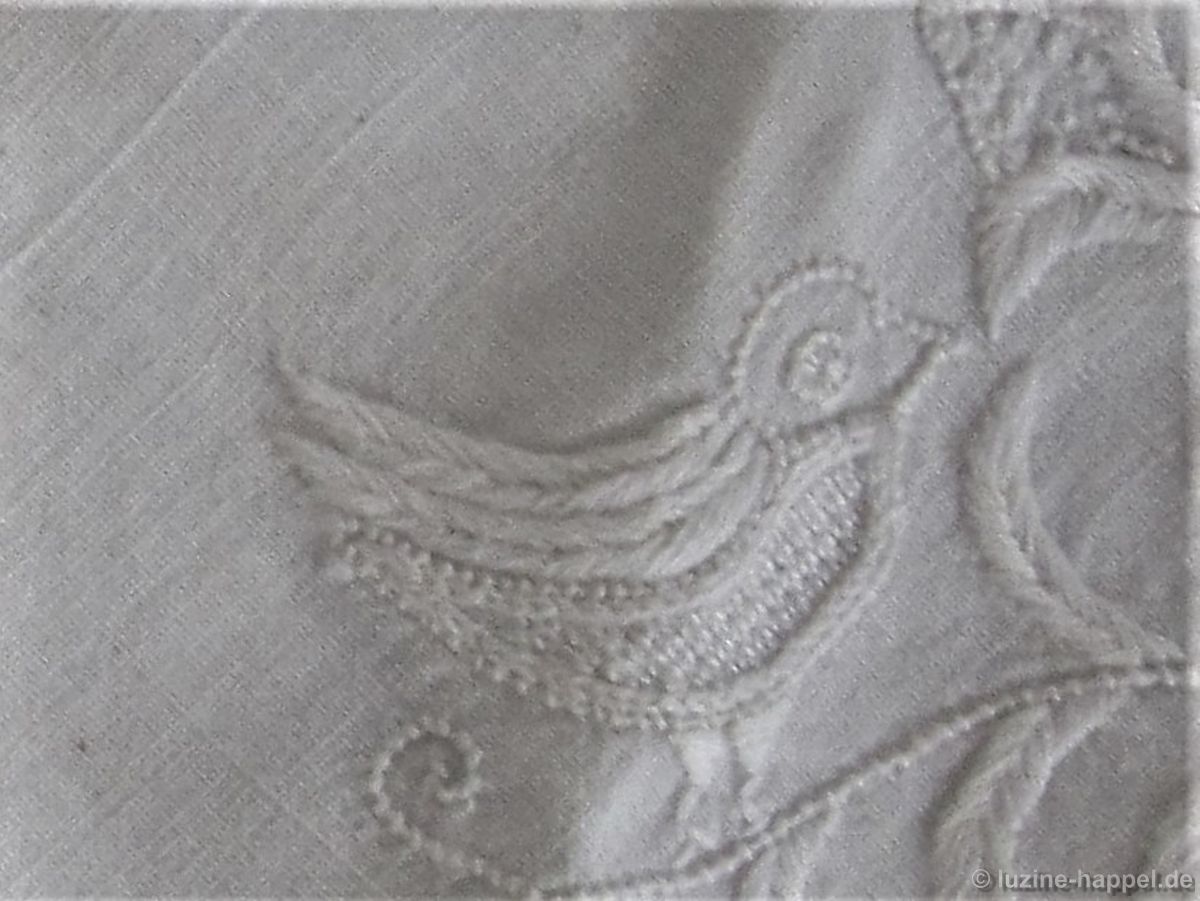

birds,


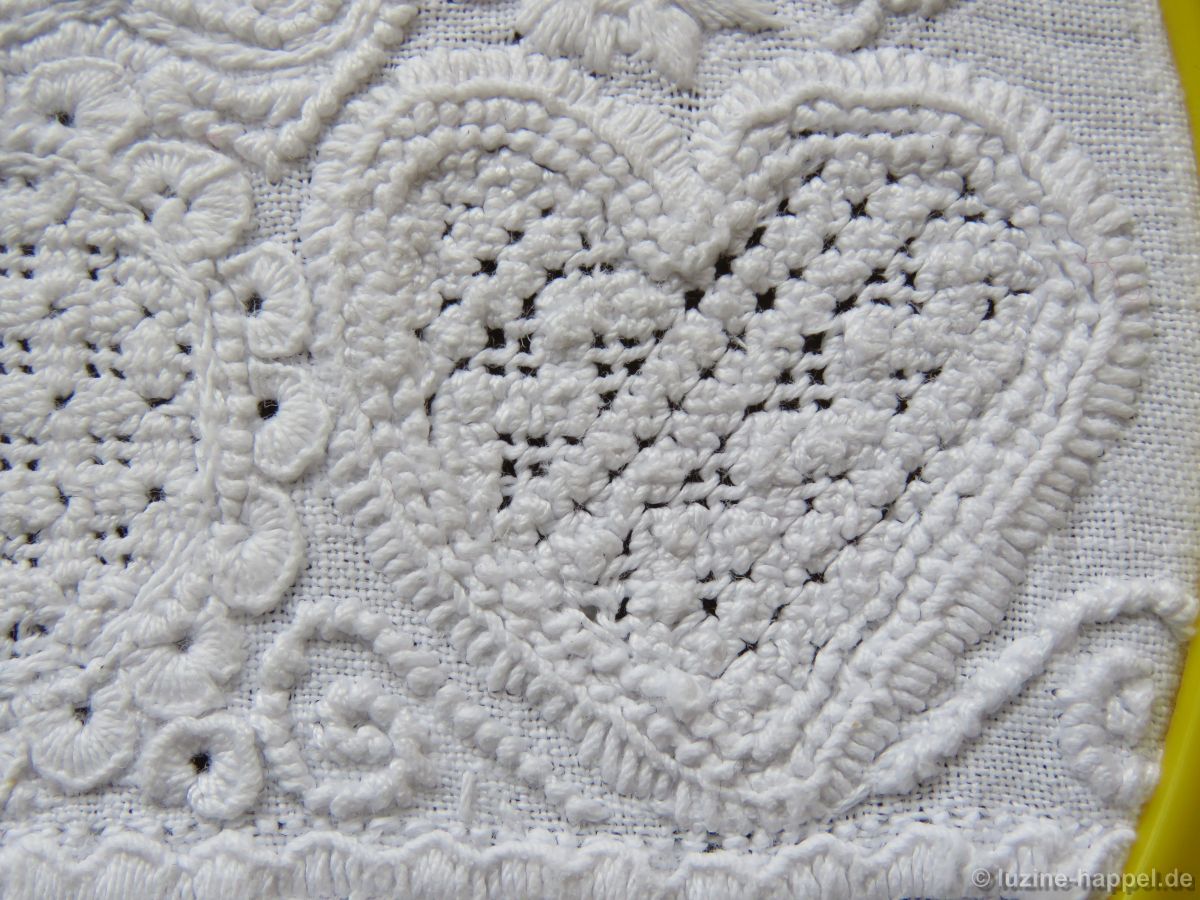
and, of course, hearts with different outlines (knife points or
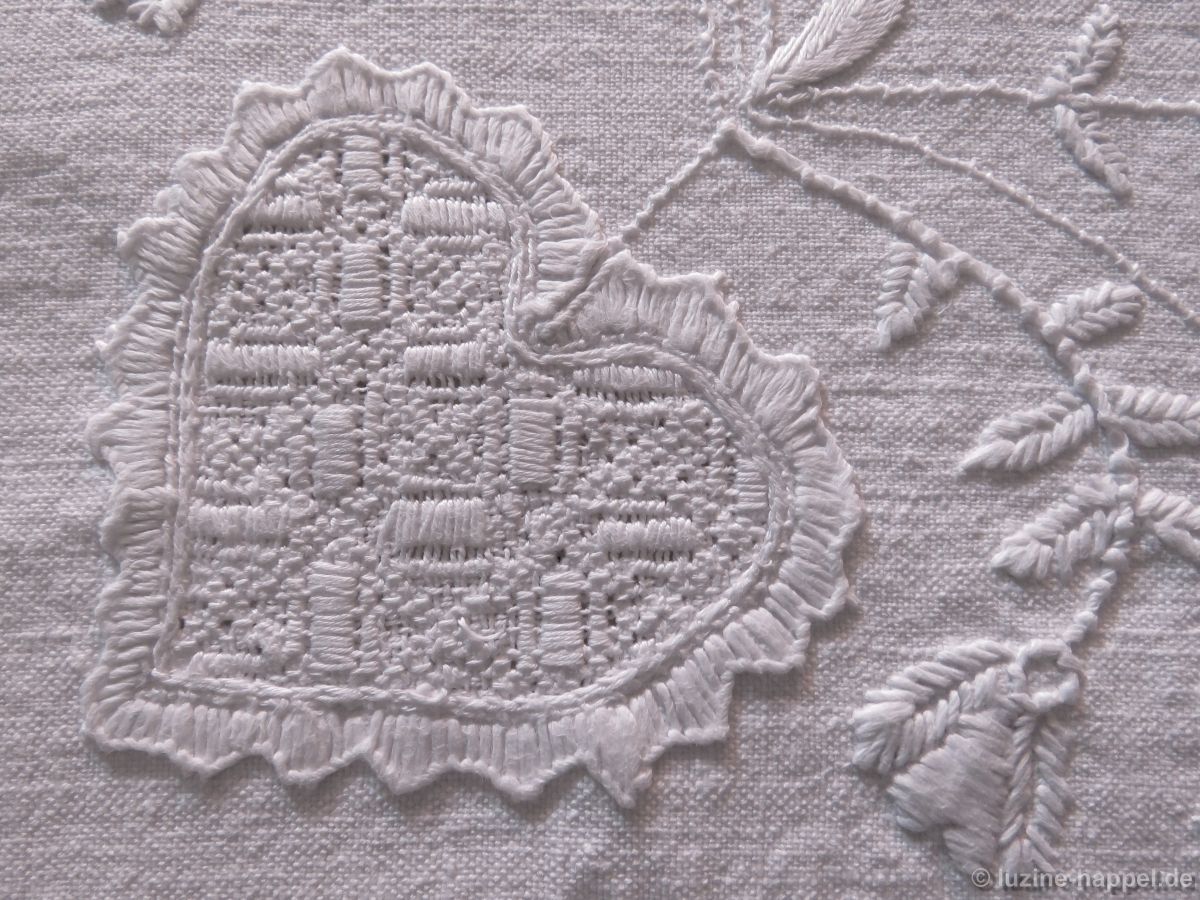

pointed Blanket stitches).
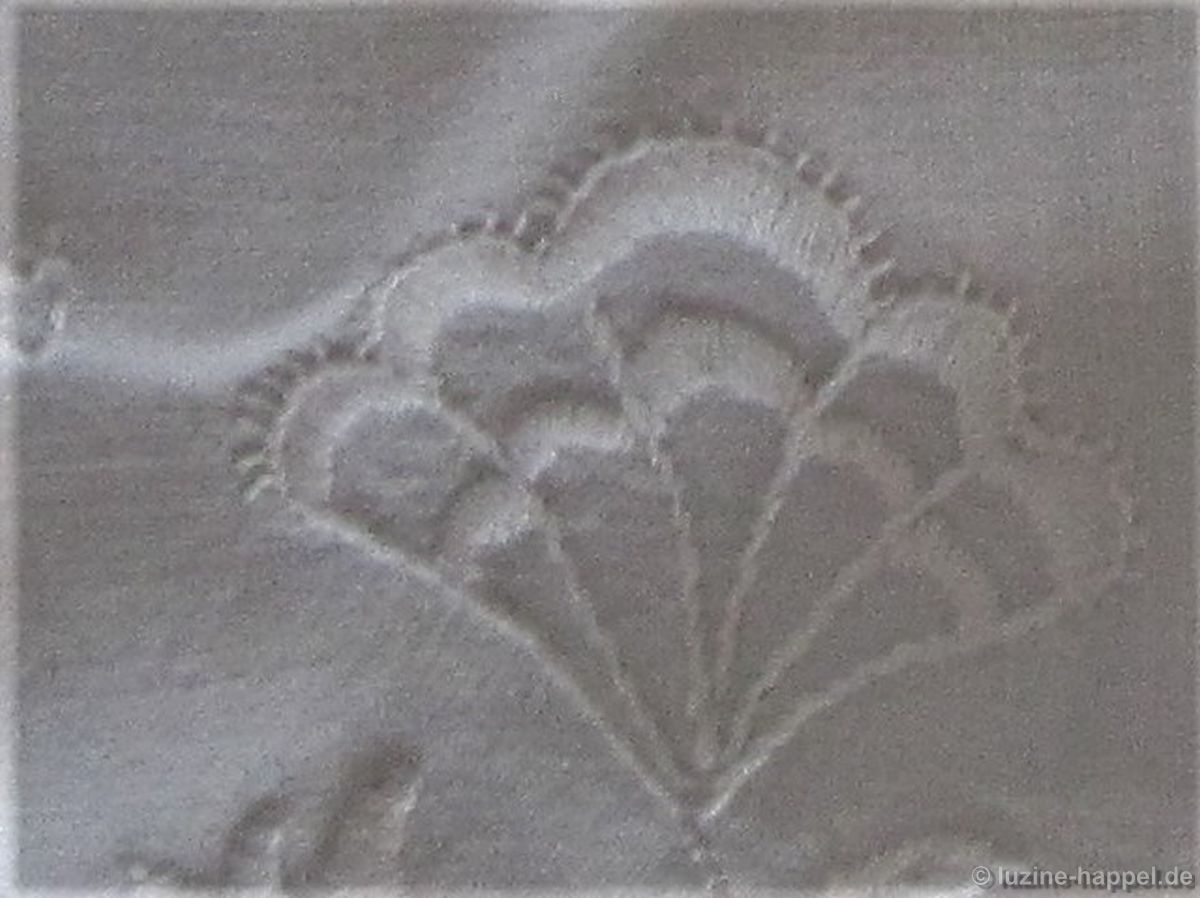

Very different flower shapes and circles can also be found.
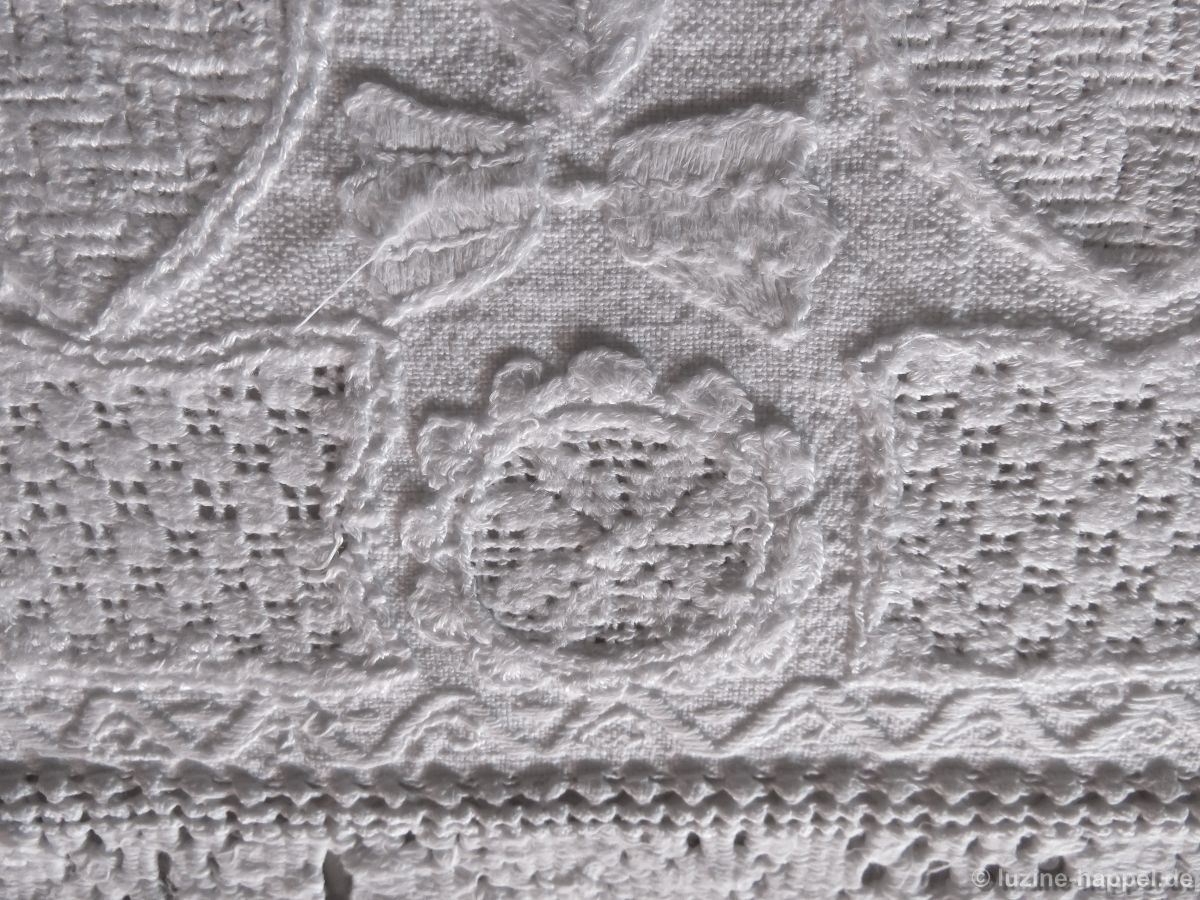

In addition, a wide range of openwork and Limet-filling patterns were worked. Figured patterns, such as stars, as well as


needlelace fillings are also found.


Topping off the work a crown was embroidered.

Many different Schwalm crown designs have been published in my books Schwalm Crowns and Grand Schwalm Crowns.

Most of the manifold and richly diverse Schwalm techniques were taught on a single cloth! Because pattern books were rare at the time, such a sampler cloth was a great resource for the embroiderer.

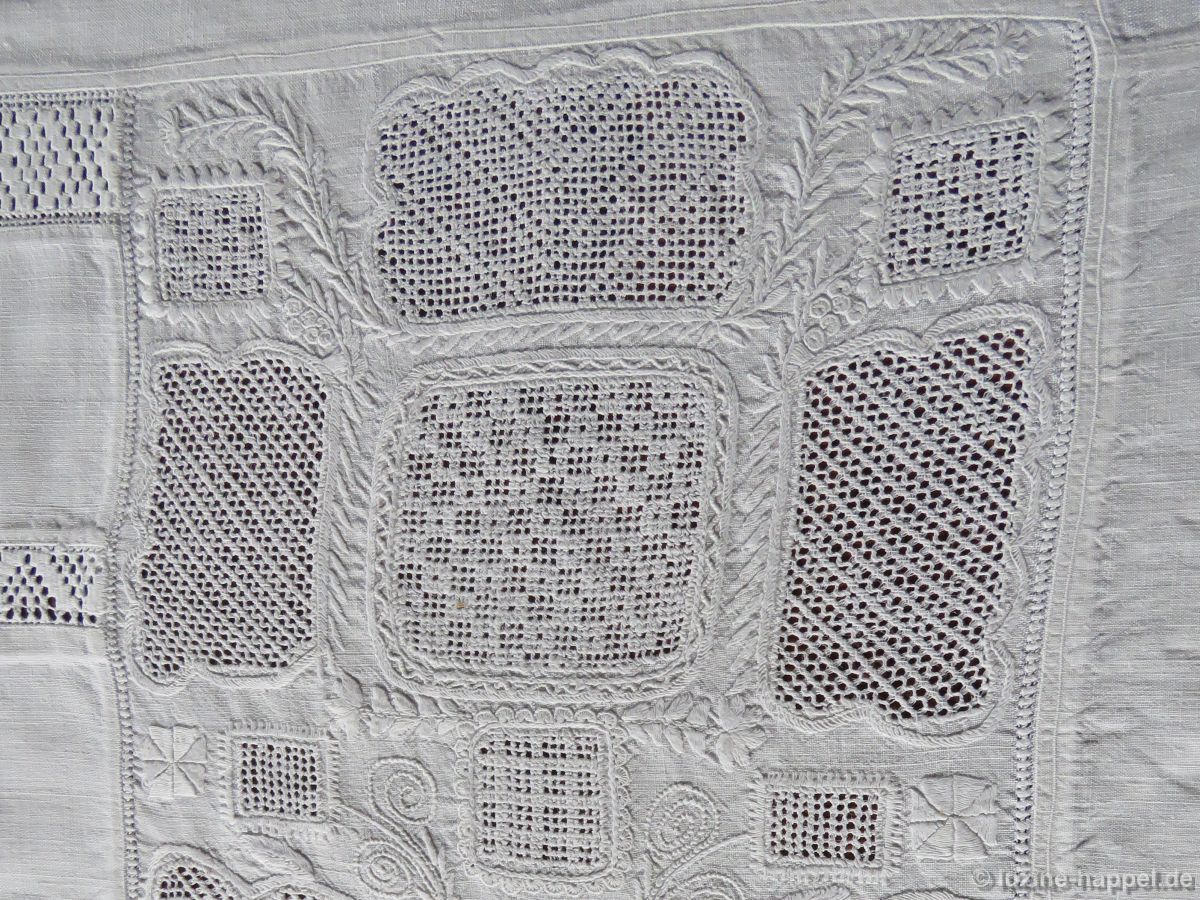
I just received pictures of another Thielmann practicing cloth. Especially interesting are the few early Schwalm whitework filling patterns. The pictures are of the center square, the four corner designs, and the four middle-section designs.
Traditional Schwalm Whitework

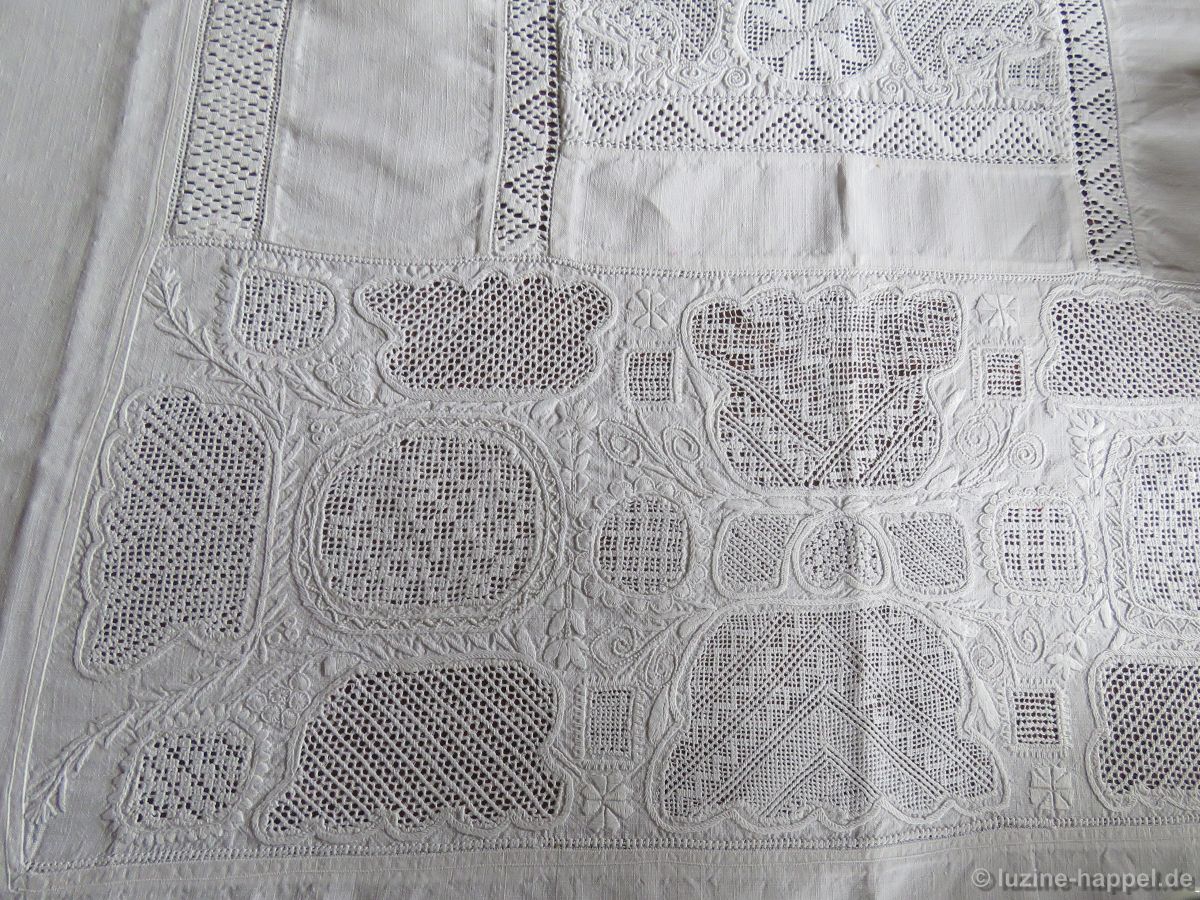
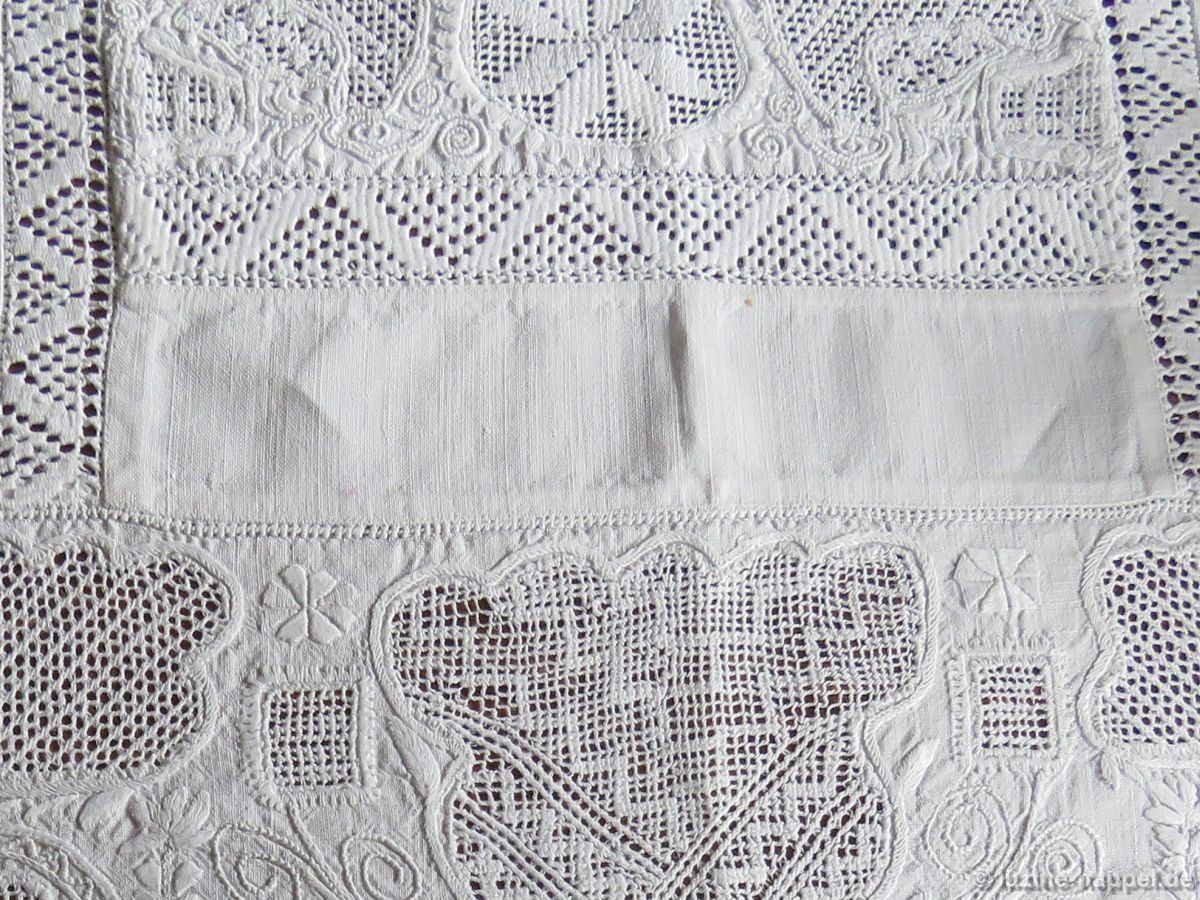
Some time ago I was allowed to view an extraordinary tablecloth. I want to share that experience with you. The tablecloth was made by piecing together several parts. And it seems that the single sections came from different old pieces. Only elaborately embroidered sections were cut out and recombined to establish one new piece.

Arguably the largest sections originate from about 200-year-old parade cushions – the width of the borders is consistent with those of parade cushions – however, the two similarly embroidered borders were worked by embroiderers possessing different levels of experience.


Between the wide borders there are smaller borders


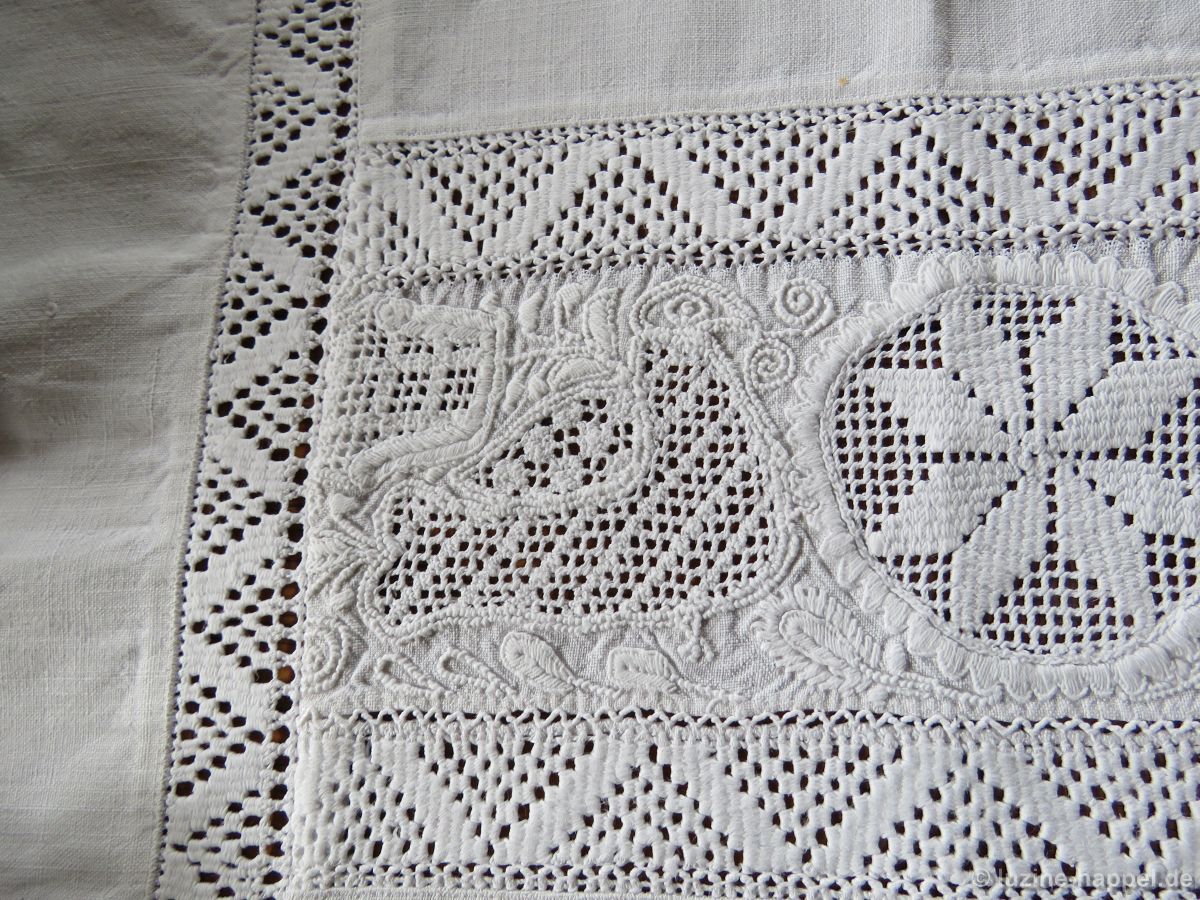
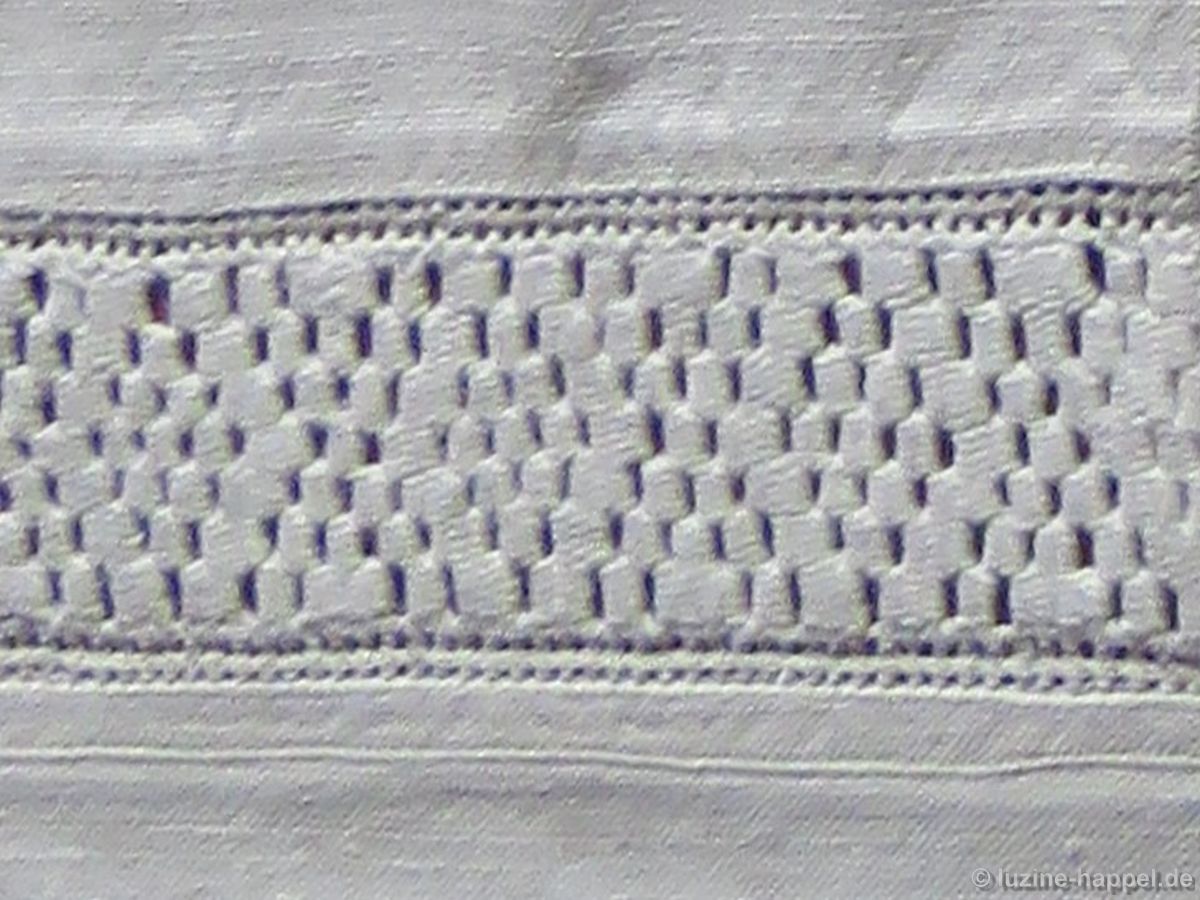
and elaborately worked needle-weaving bands


with different patterns


and in different widths.


The main focus is the parade cushion borders. Even though the pieces are not in their original condition, so many details of the embroidery of those days can still be seen in them. Interesting discoveries can be made.


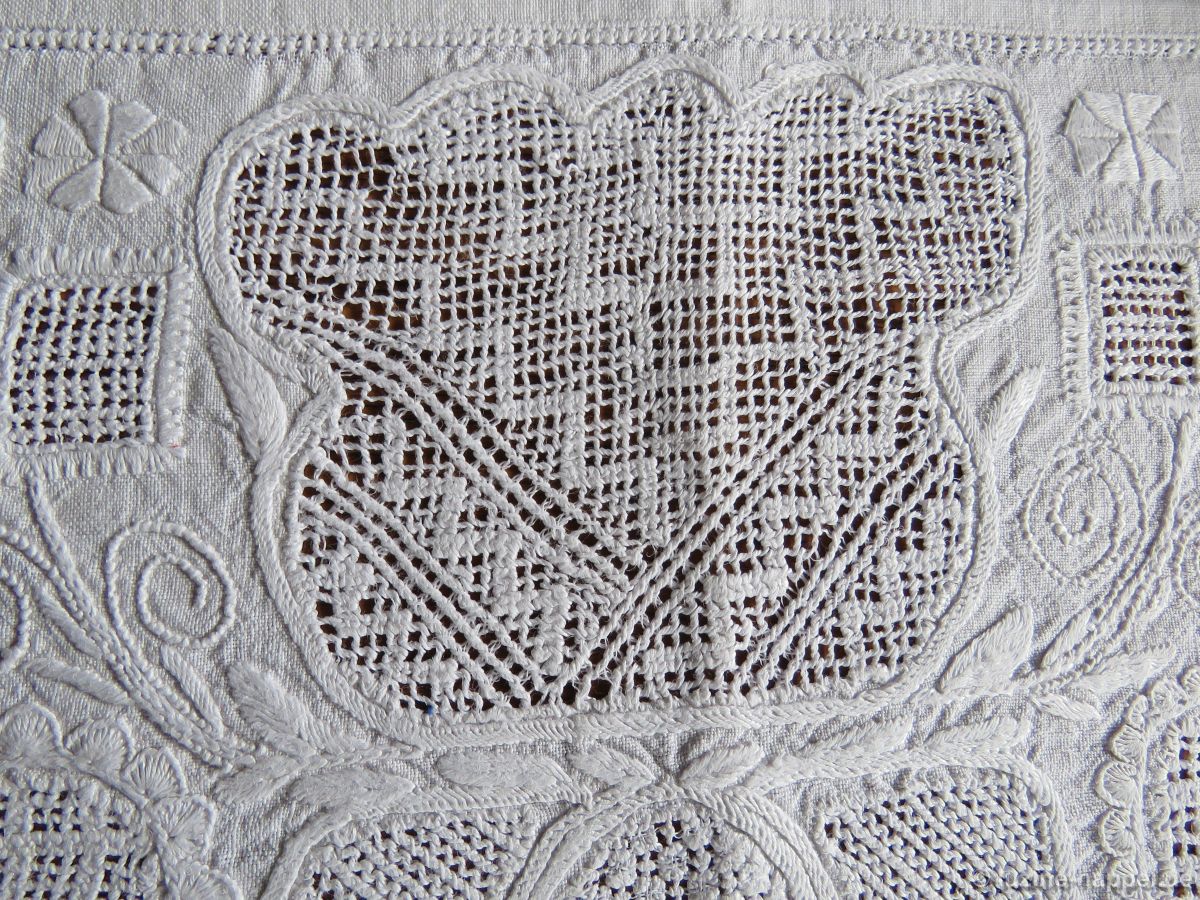
Especially eye catching are the huge tulip motifs (picture above: Cable stitches, Diagonal Cross stitches, and Rose stitches worked in a stair-step manner);


all are embroidered with similar patterns


but show definite differences in the embroiderer’s skill.

The other motifs, some of them also very large, have less conspicuous patterns.

Unusual are the many angular shapes, which were designed in different sizes.

Openwork patterns were used exclusively for filling the shapes.

Many motifs are outlined with long, closely worked and slanting Eyelash stitches. In addition, knife points, 2 short-2 long, and


half-eyelet scallops are found outlining shapes. Coral Knot stitches are only worked to establish tendrils and curved lines.


Stems were worked with Chain stitches and with the back of Wave stitches; small leaves were worked with Satin stitches.


Satin stitch motifs in geometrical forms and small Blanket stitch eyelets fill the spaces between the large motifs.


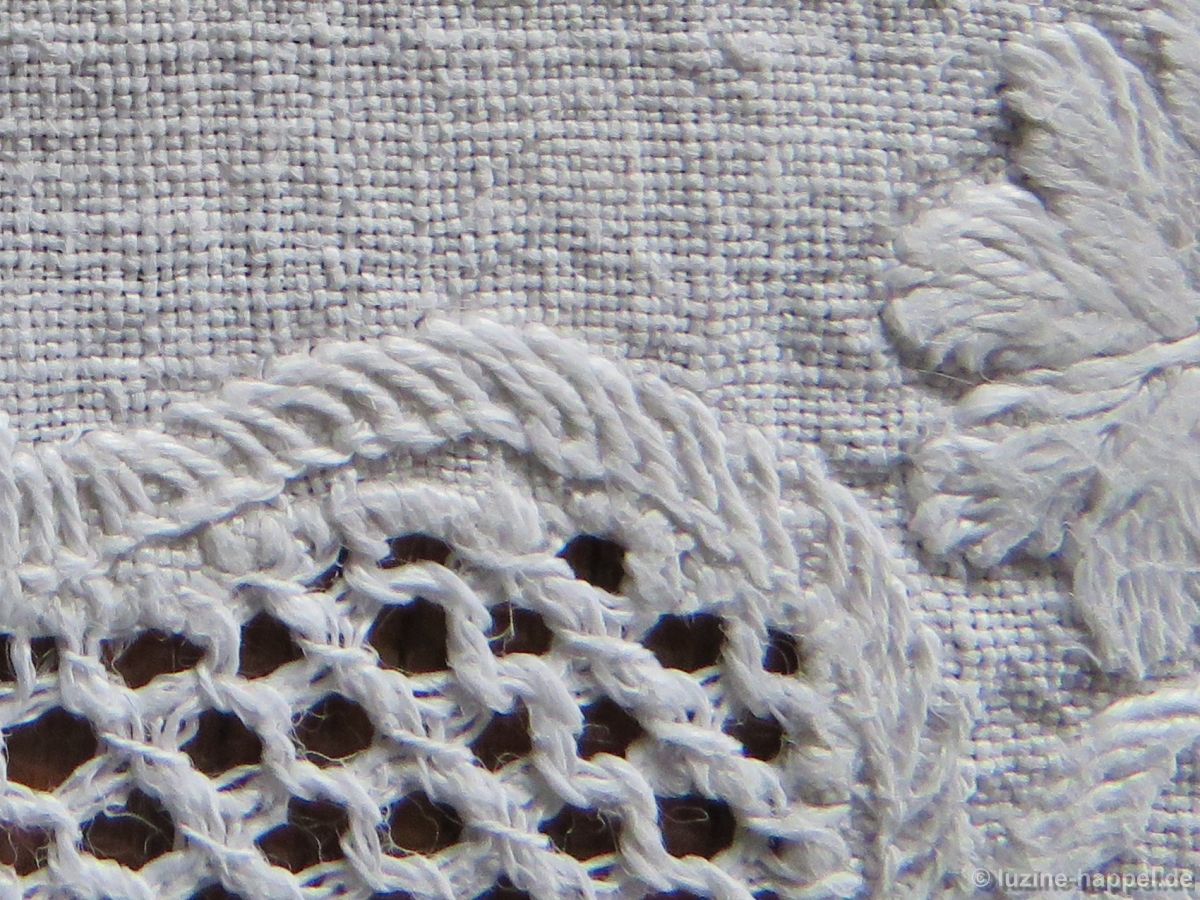
It is unique that thread withdrawing in the shapes was not made up to the edges. The cut edges were subsequently secured with Whip stitches.


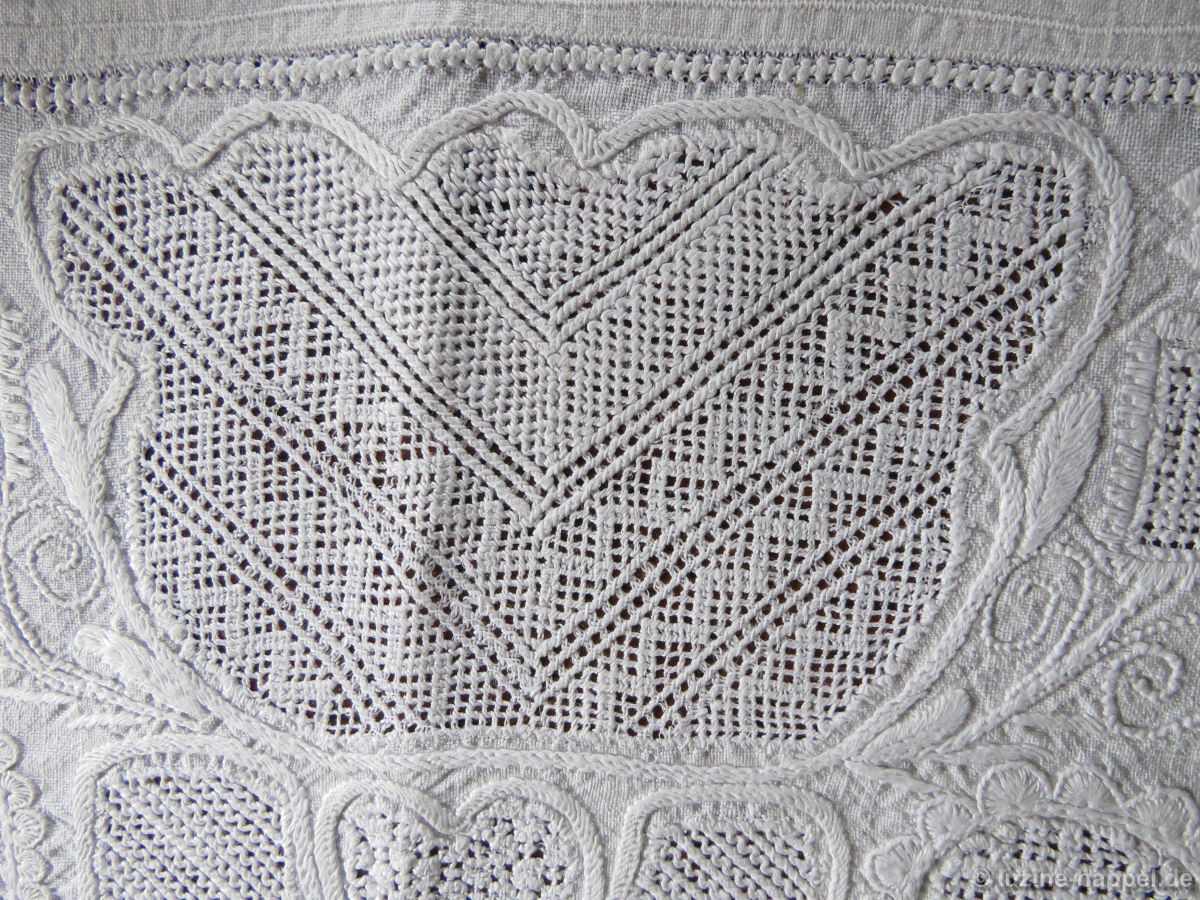
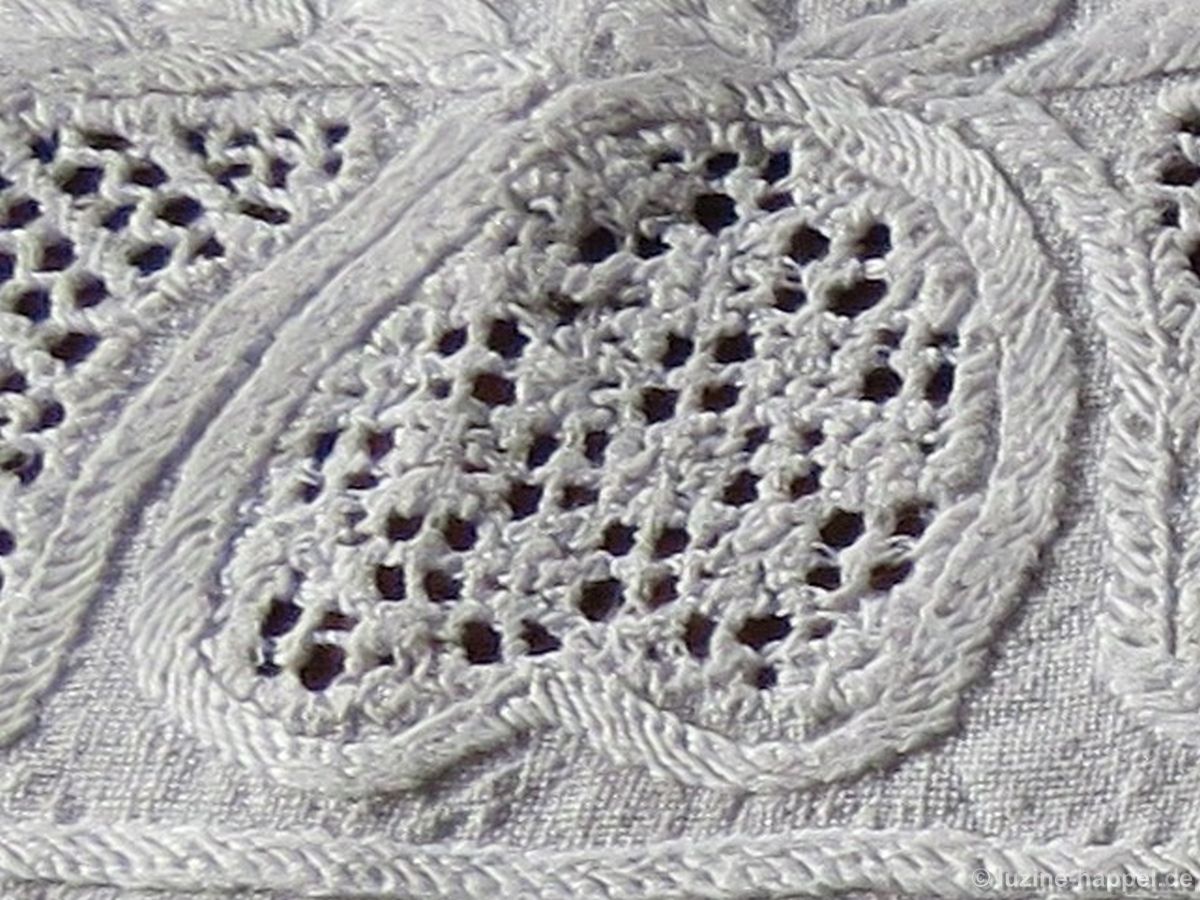
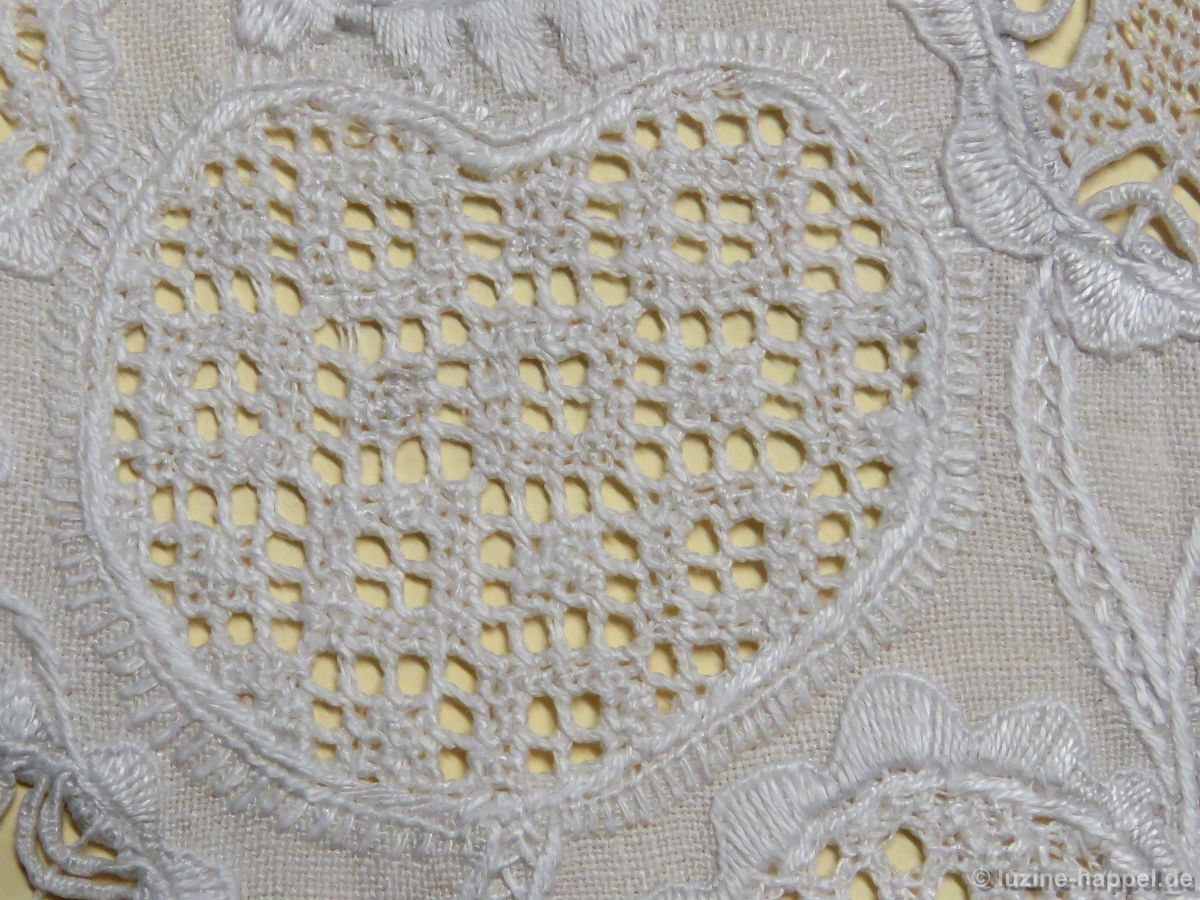
Most interesting is the pattern of the heart motif (image above). It is an openwork pattern without a Cable stitch grid. Four – apparently only partly worked – Rose stitches were worked to form a square. Those squares were worked like a checkerboard over the entire shape. One Four-Sided stitch was placed in each remaining section. I tried to replicate this pattern; I will share the result in a future article.
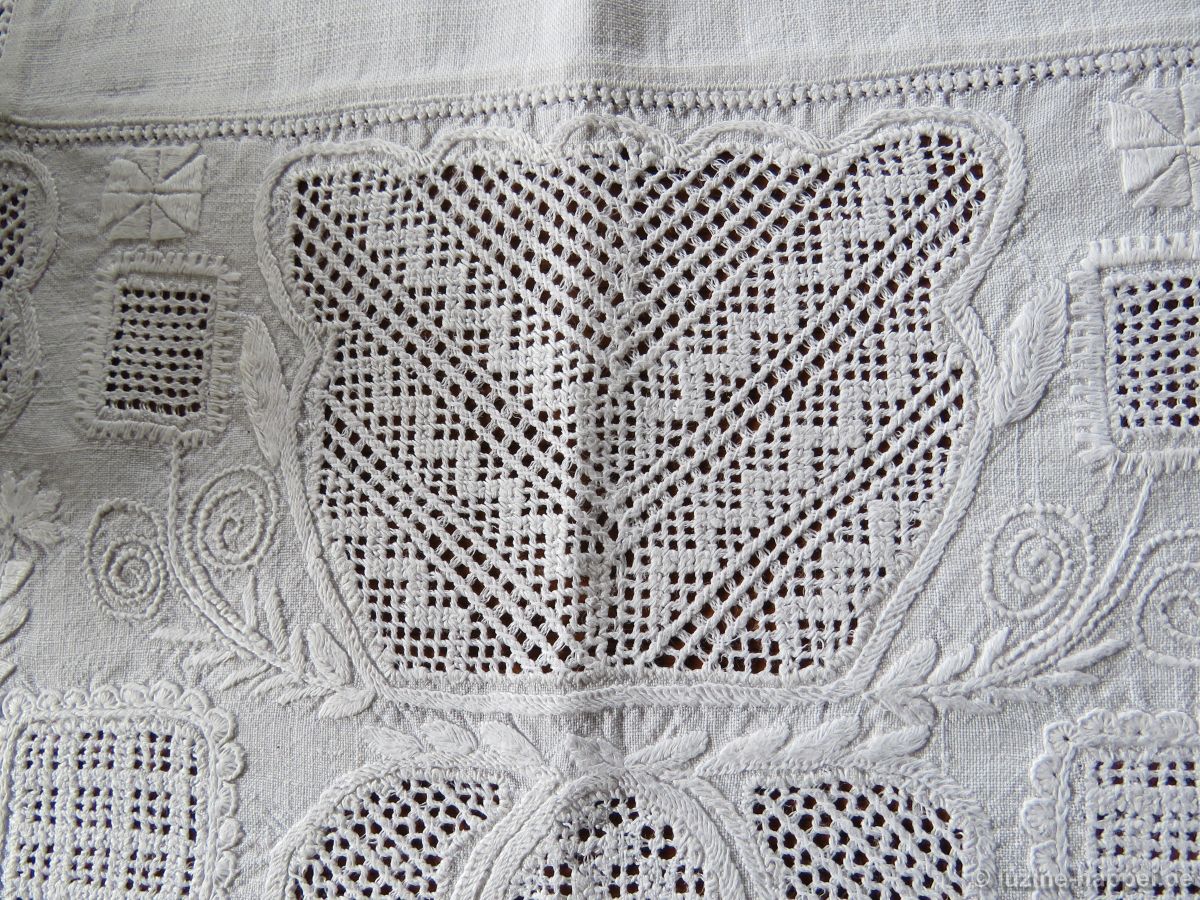
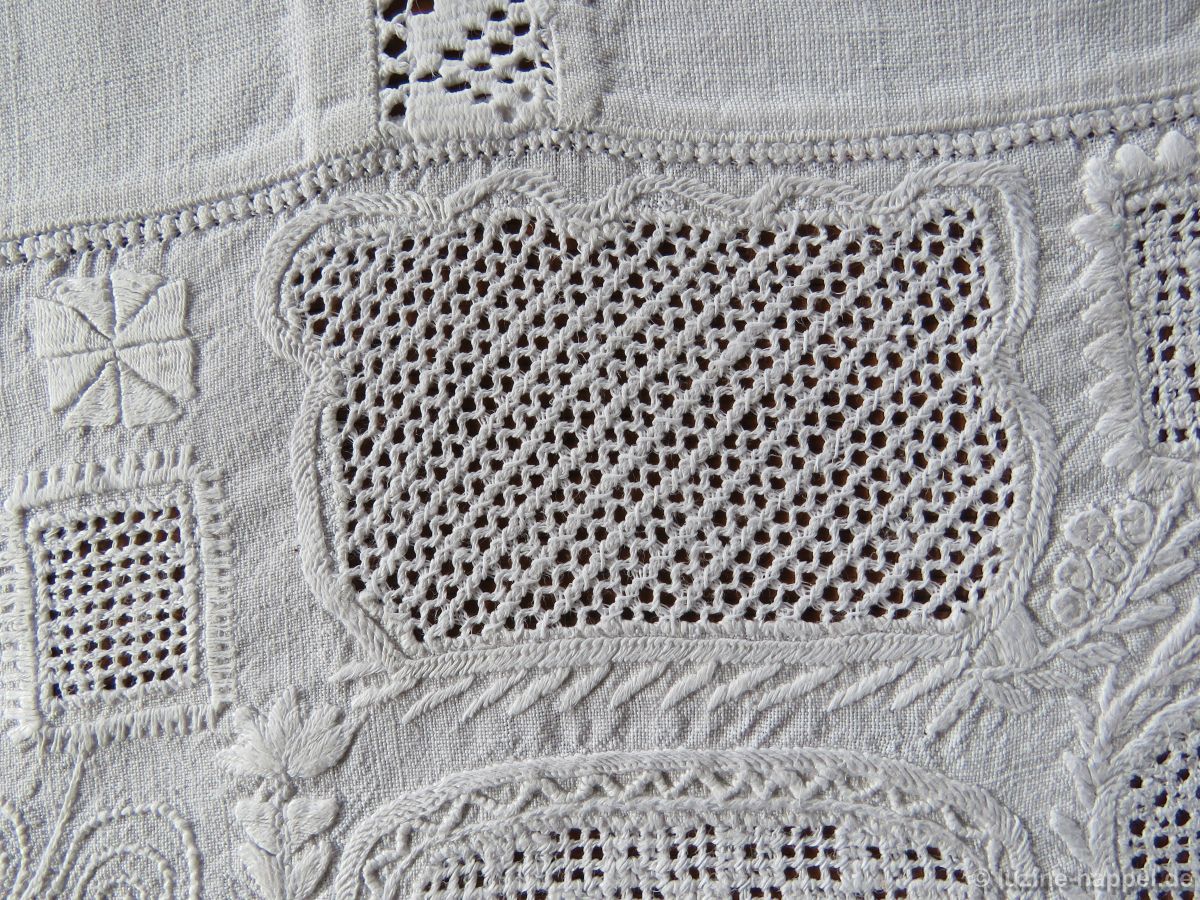
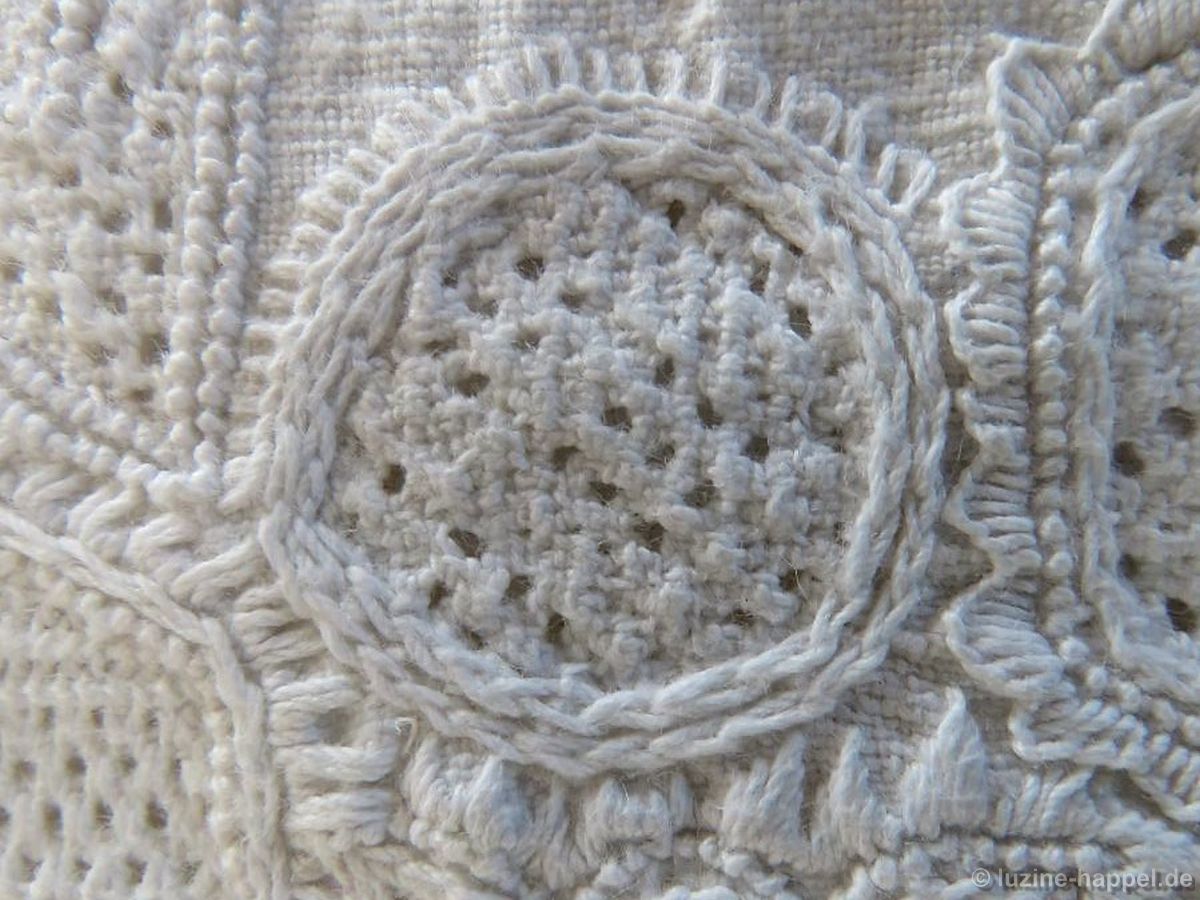
In contrast is the similar, but common, pattern (image below) of the counterpart. It was worked with squares of Rose stitches in a Cable stitch grid.


I hope you have enjoyed examining this very peculiar and individually developed embroidery. It is truly something that cannot be seen every day.

This is just the type of research I love to share with you. If you find it useful, enlightening, or simply enjoyable, please consider making a small donation to support the continuation of my blog.

Embroidered Easter Egg Wreath

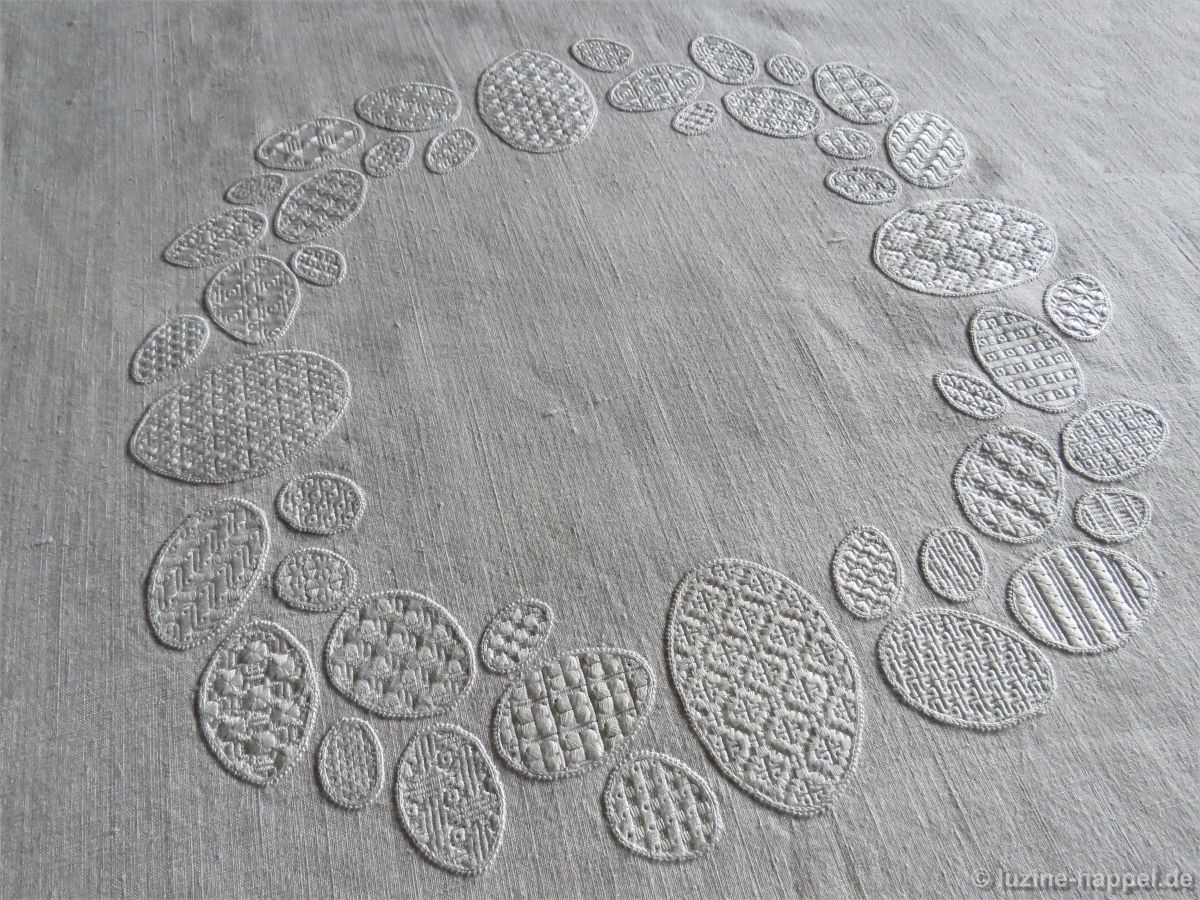
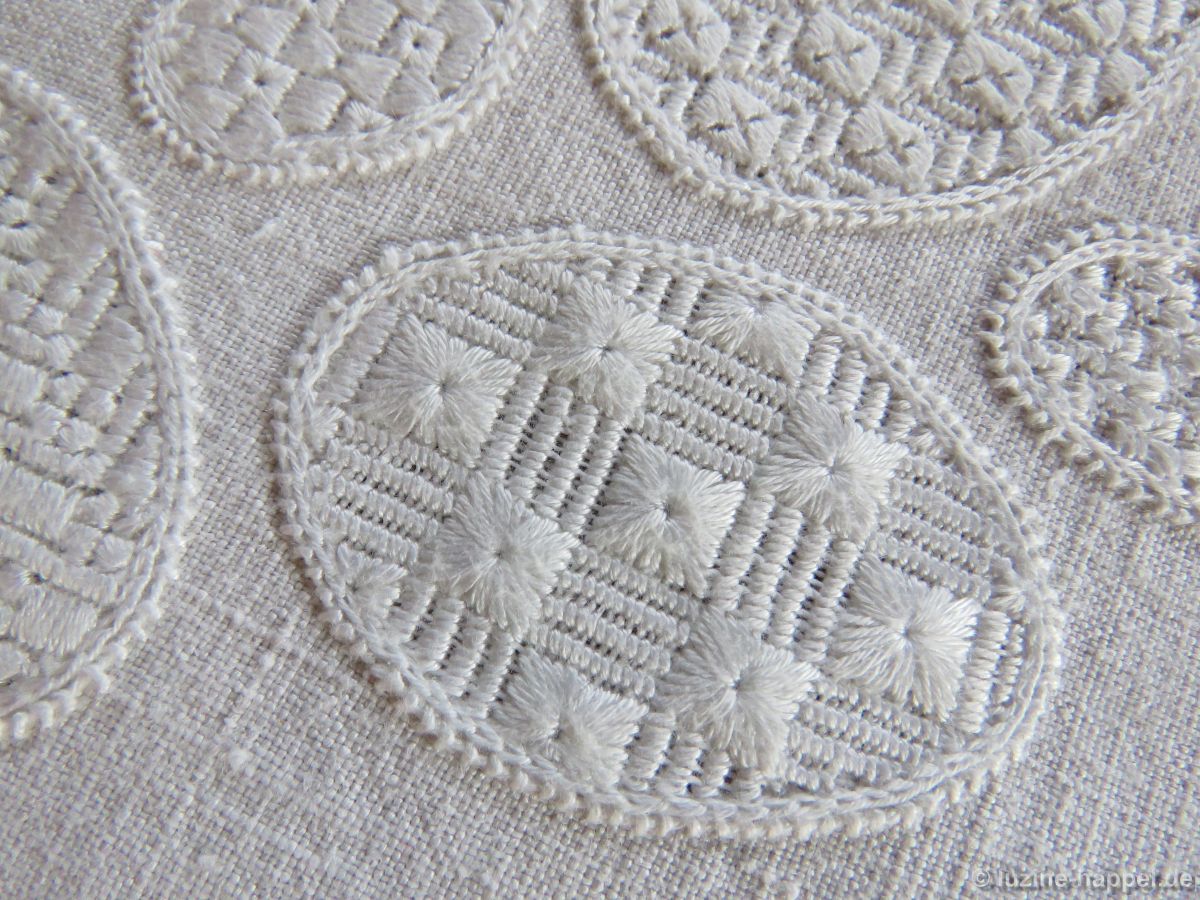
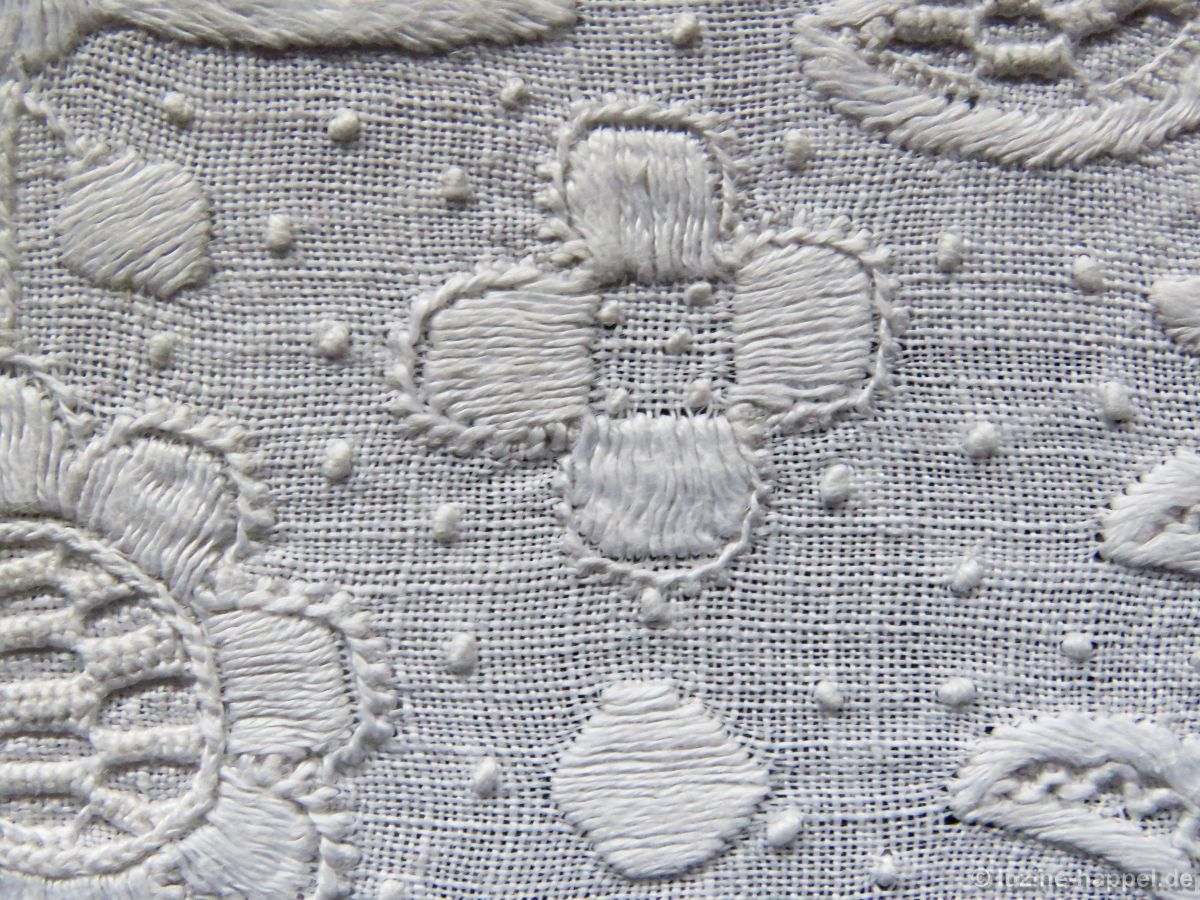
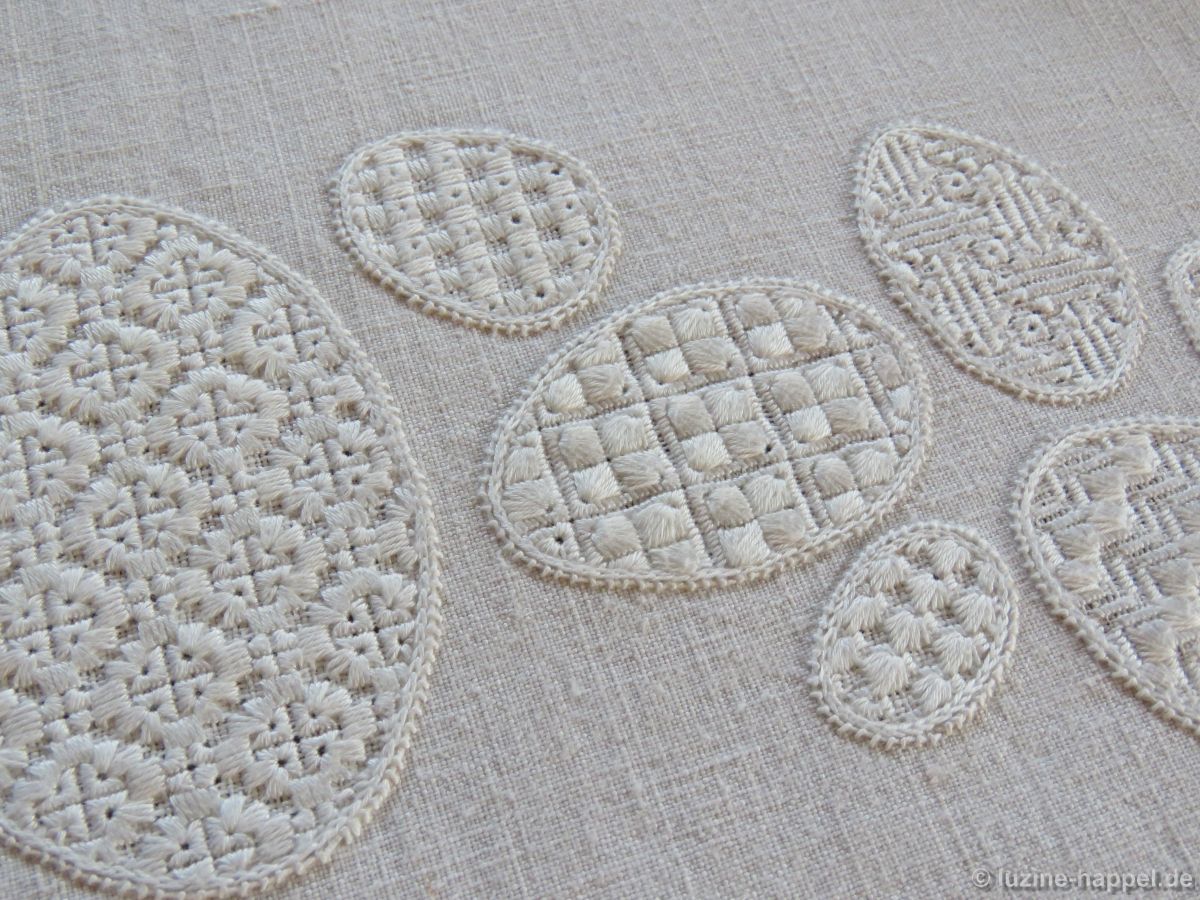
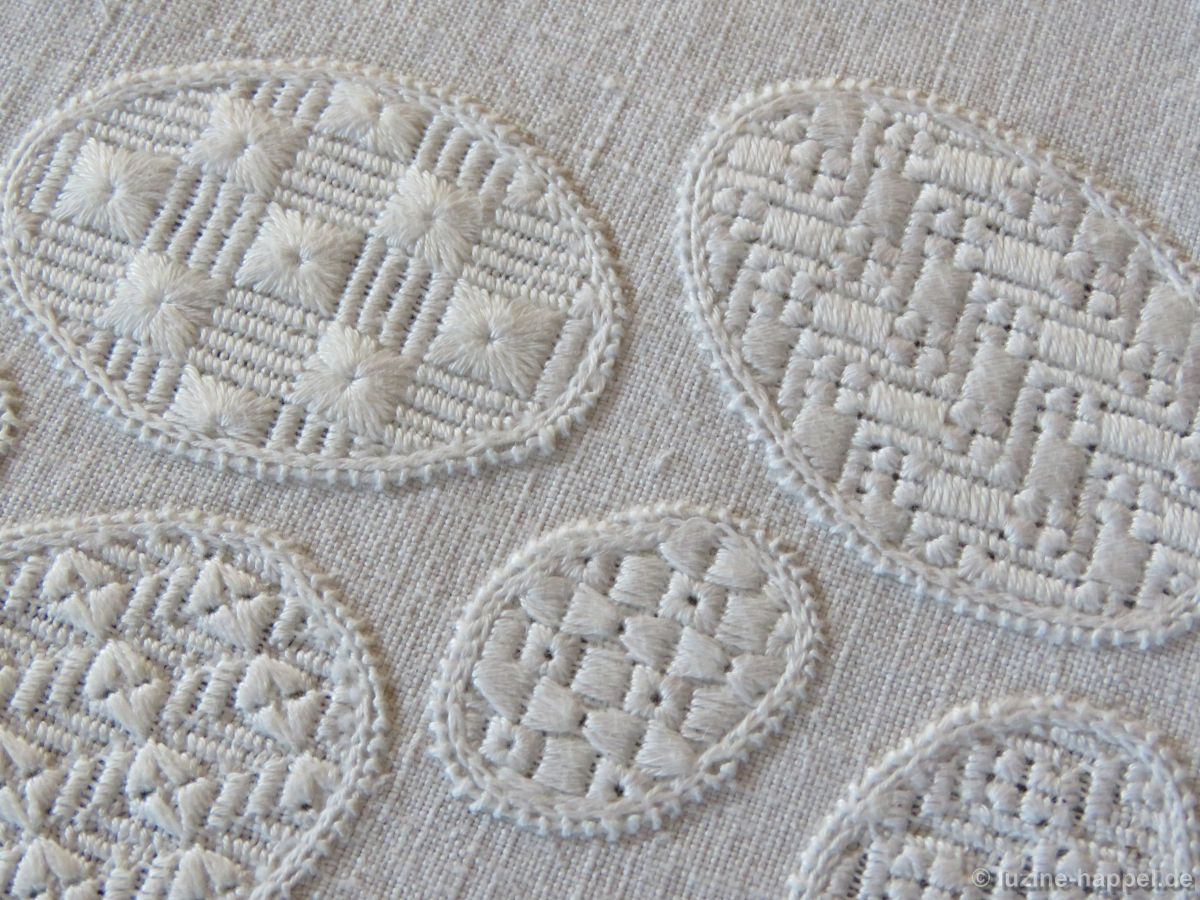
To create an Easter Egg Wreath design, the artist Gudrun Hartwig first arranged four big egg shapes to form a cross,


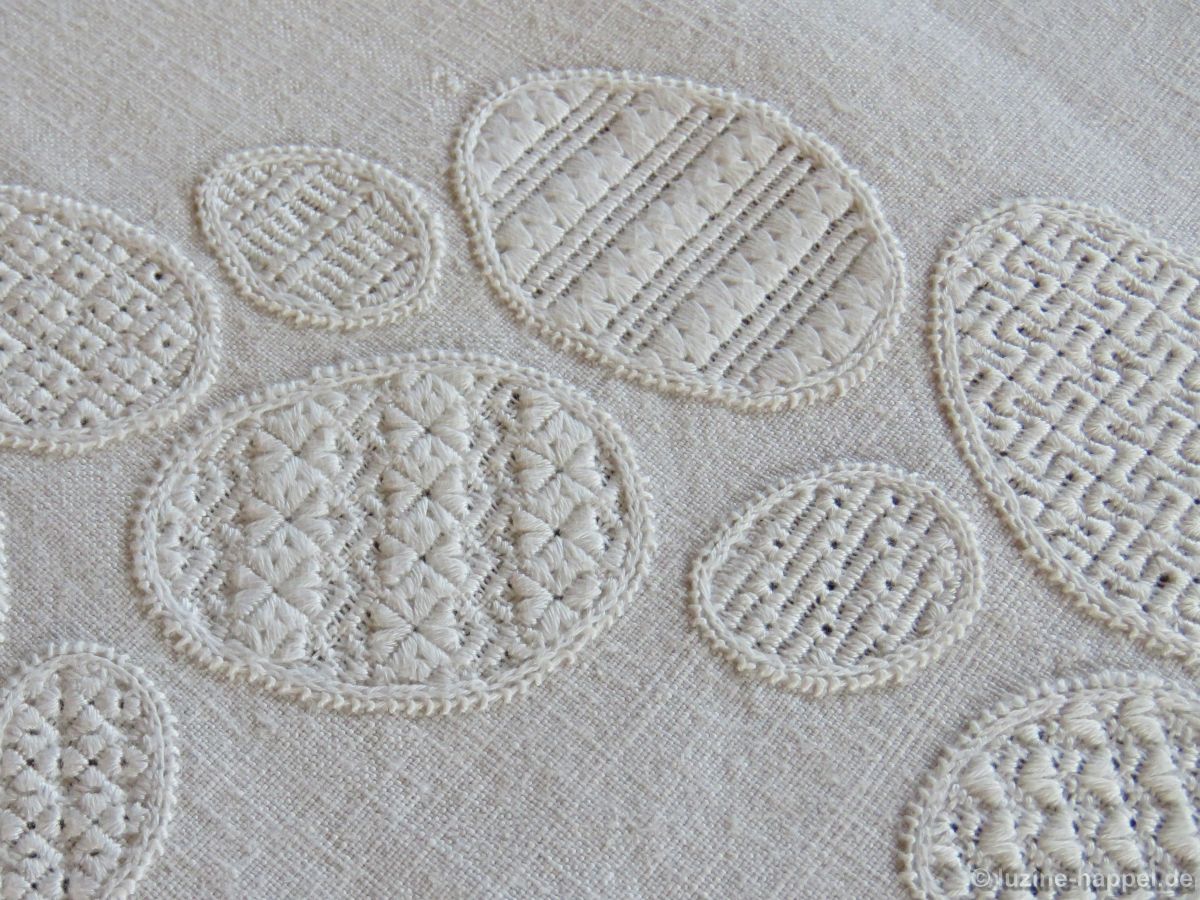
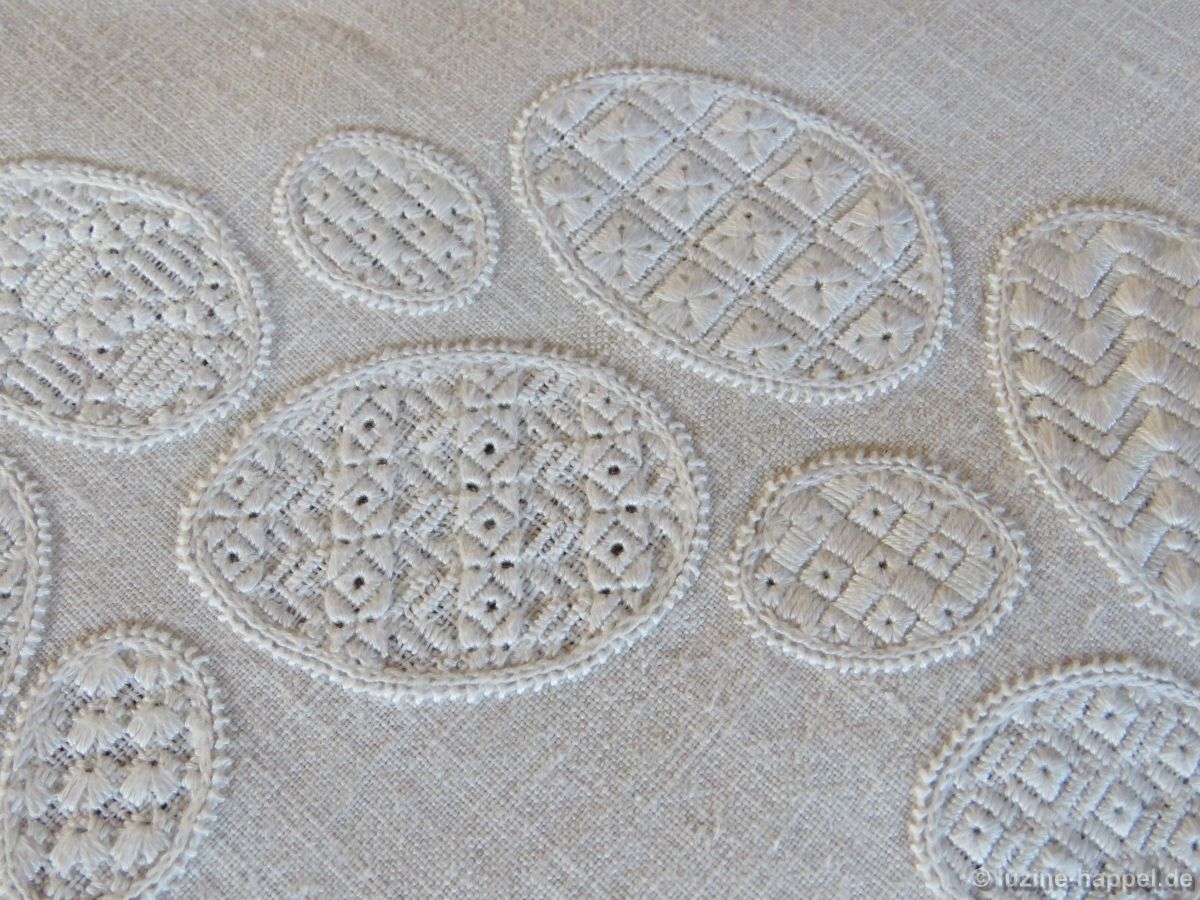
and then, in the four areas thus created, she randomly placed smaller eggs of different sizes.


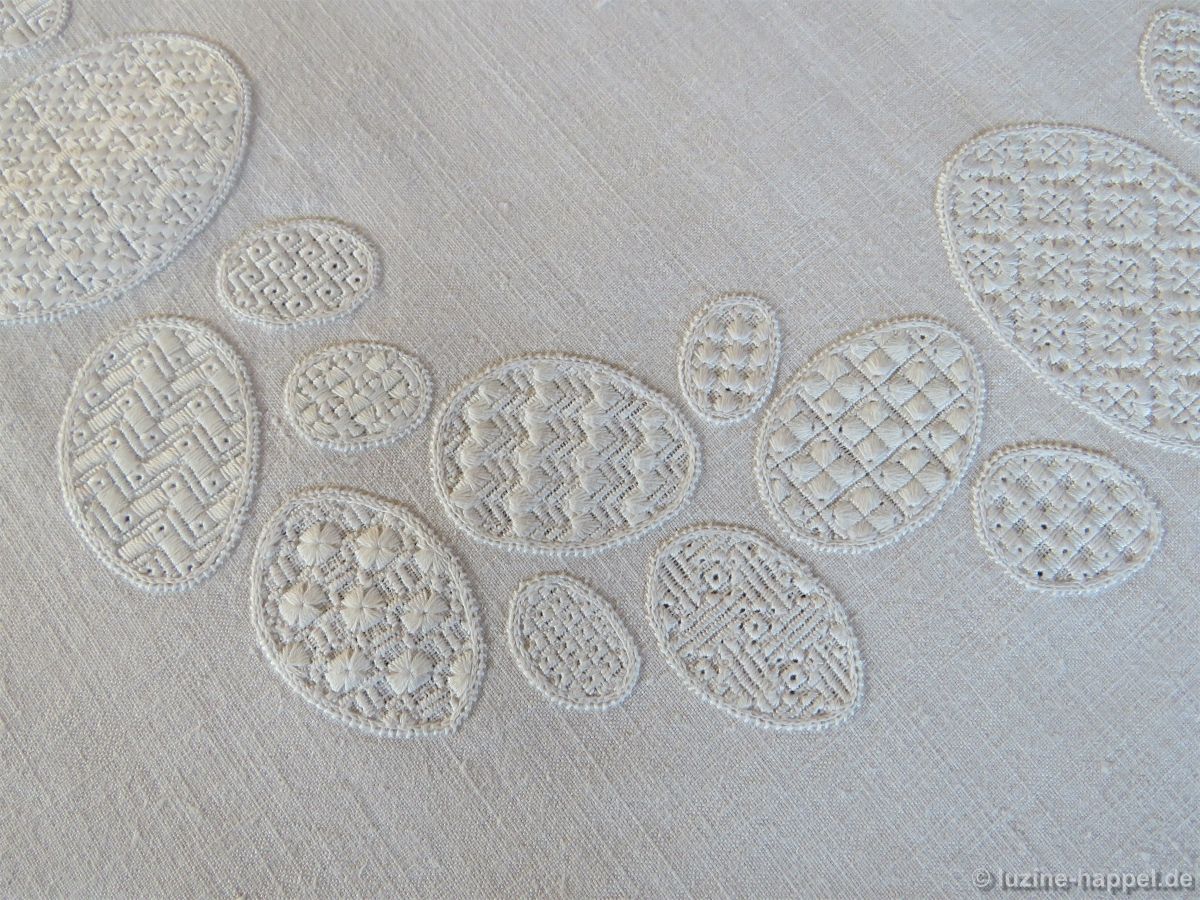
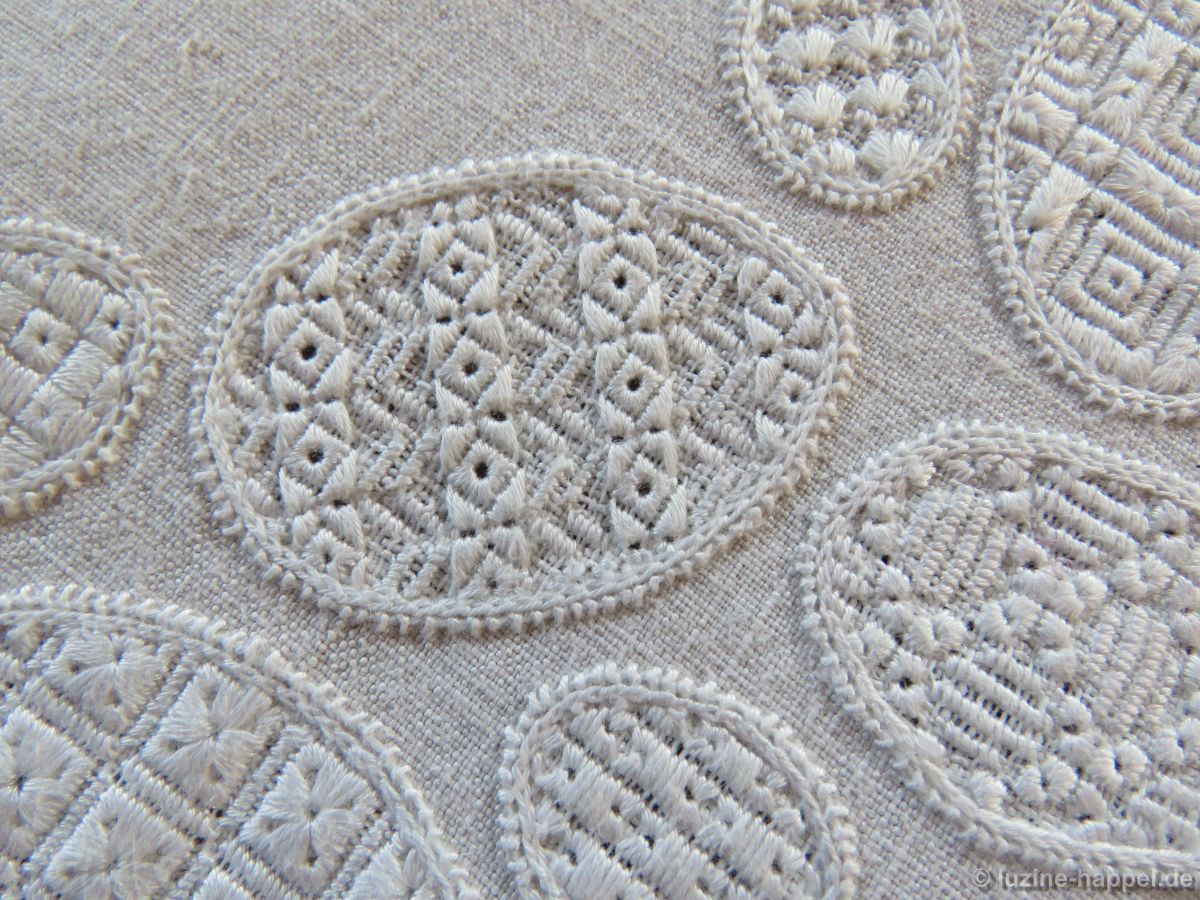
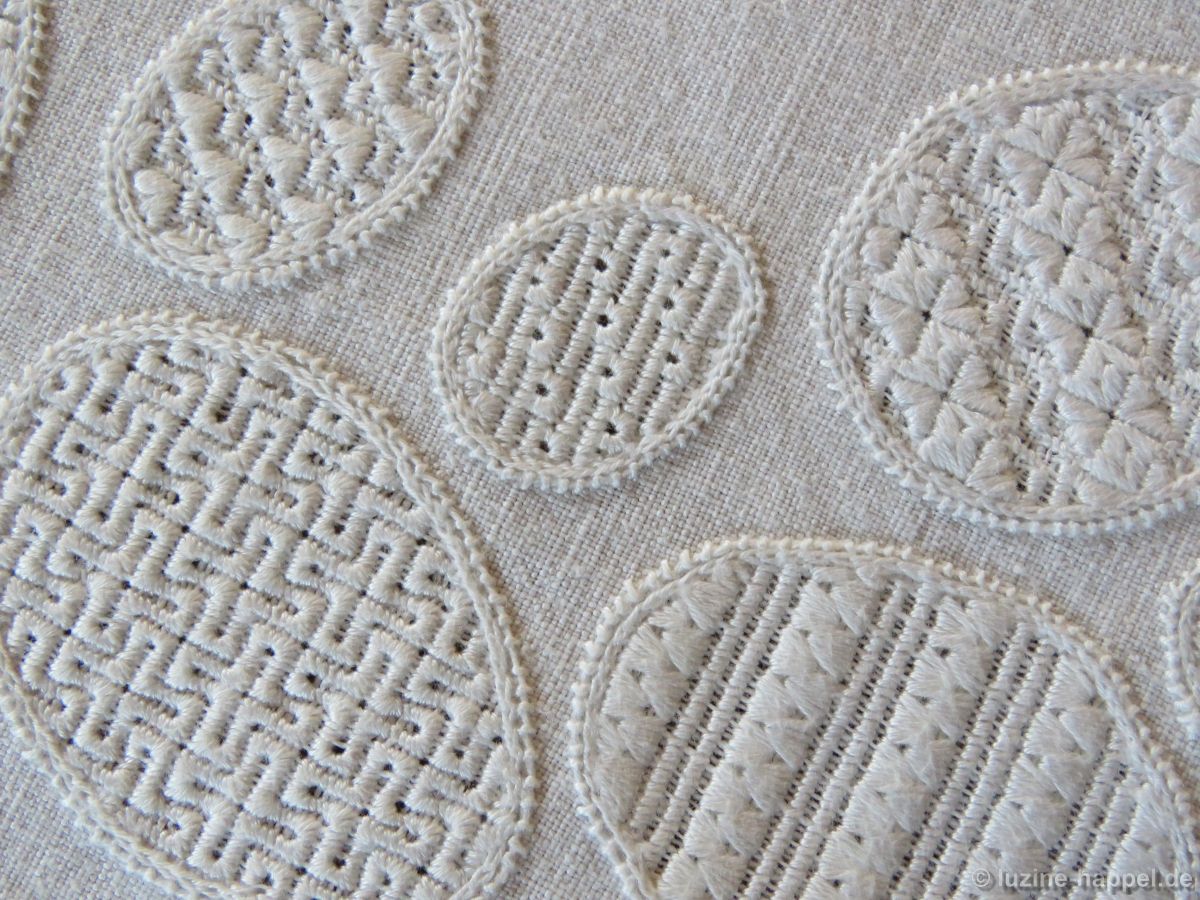
The egg shapes can be embroidered with a wide variety of filling patterns


matching the size of the egg shapes


and matching the lay of the threads within the egg shapes.


Many different patterns are suitable, such as the crosses formed with parts of square eyelets and Satin stitches. It is a nice pattern especially suited for an Easter decoration, isn´t it?


Combining delicate


and more prominent patterns


establishes a pleasing contrast.


This design is worked on a very dense handwoven linen with a thread count of 20/cm.

Historical Schwalm Whitework and Machine-Made Lace

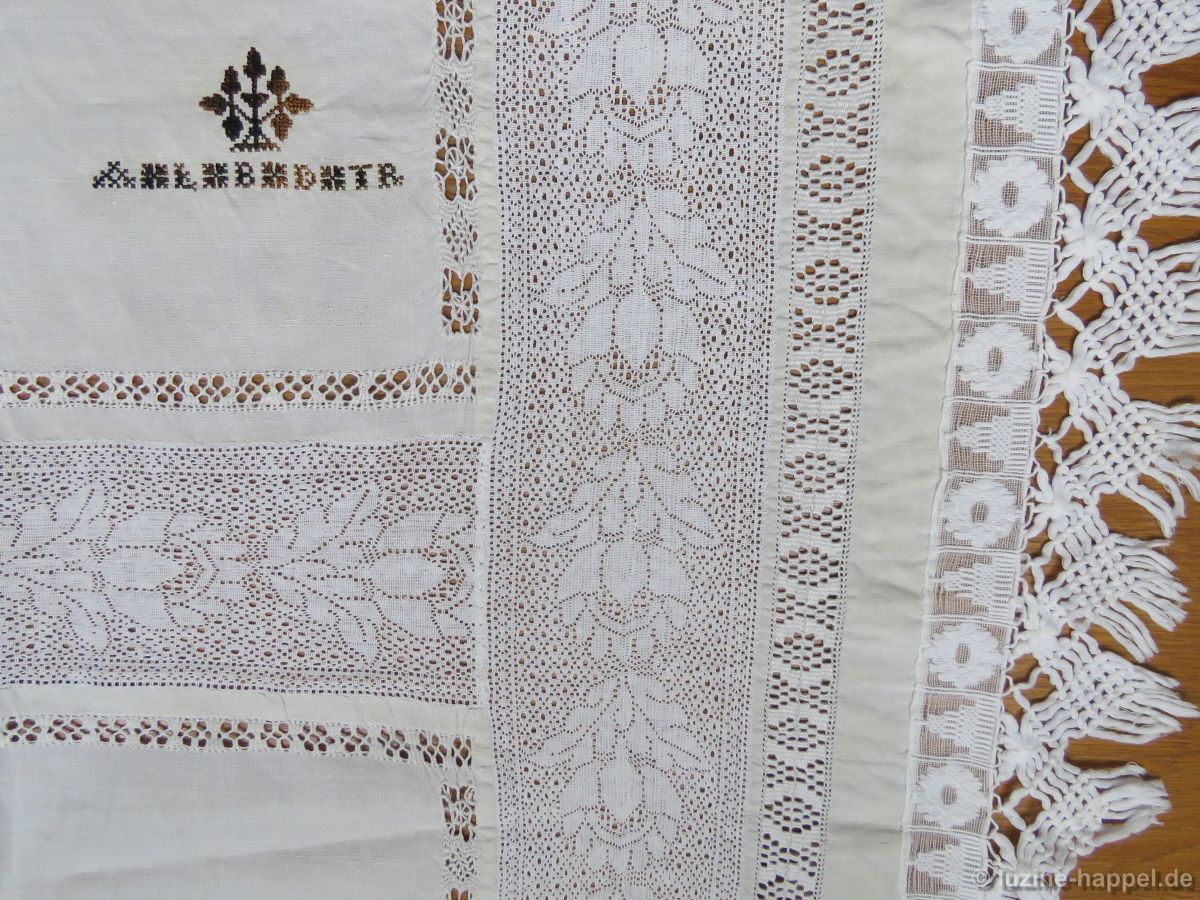
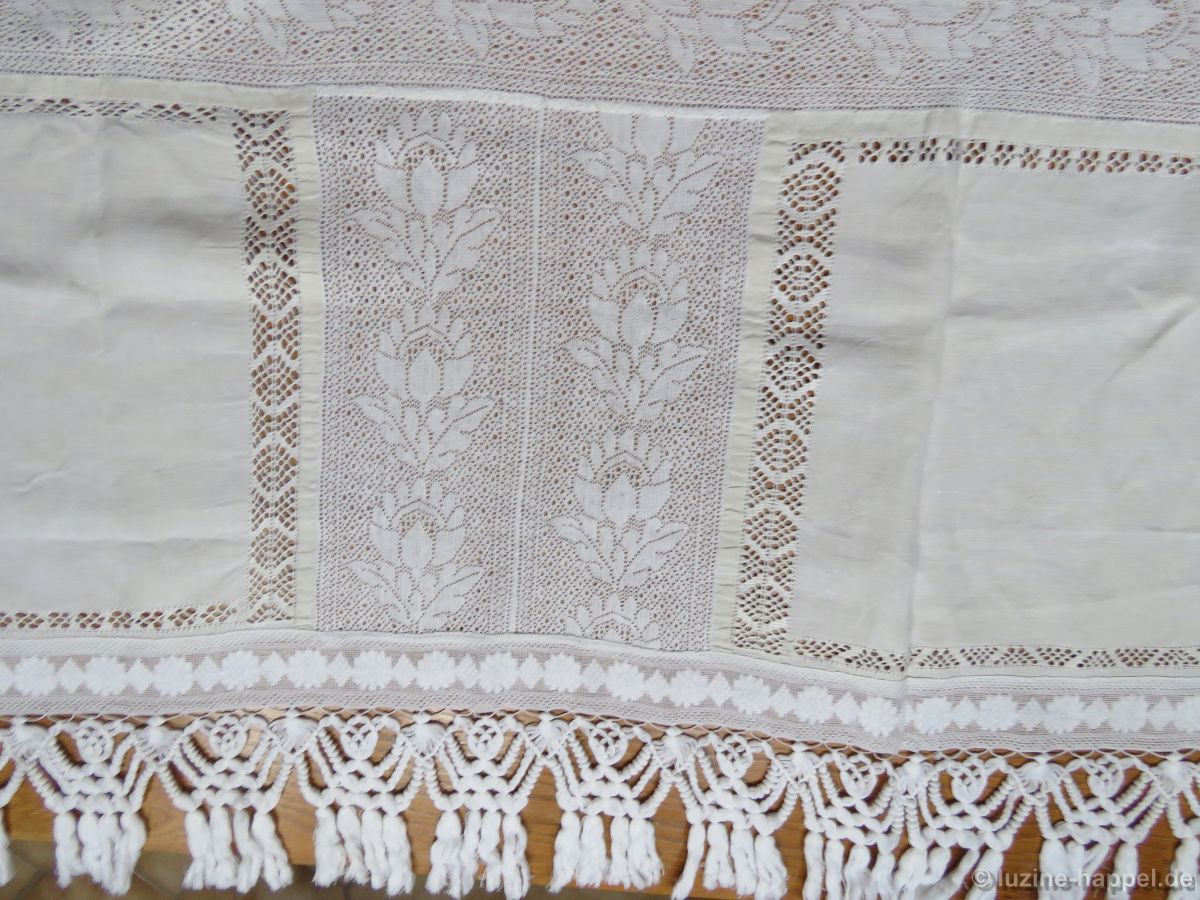
Schwalm people often considered ready-made items more valuable than precious hand-made items. So they liked to add machine-made lace to their elaborate and finely embroidered cushions, bed coverings, and door hangings.

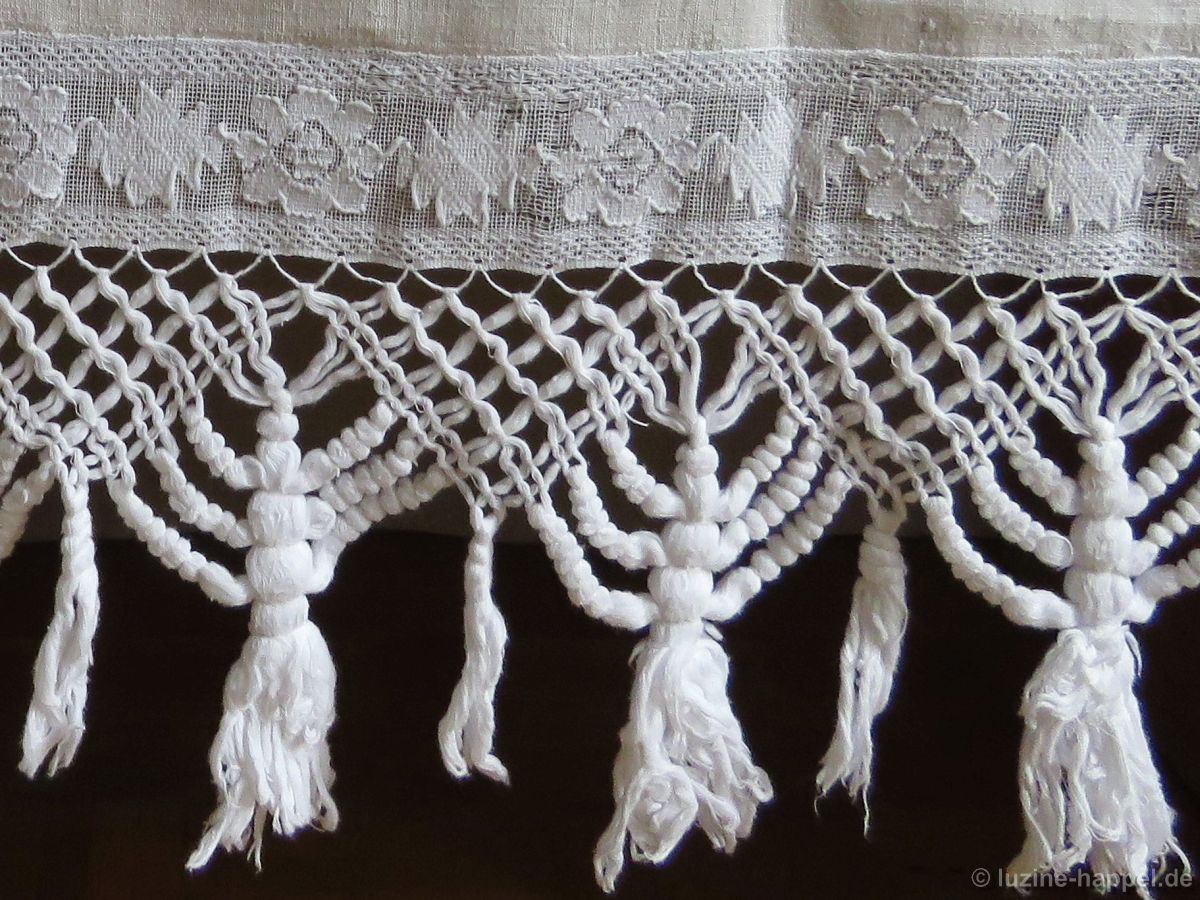
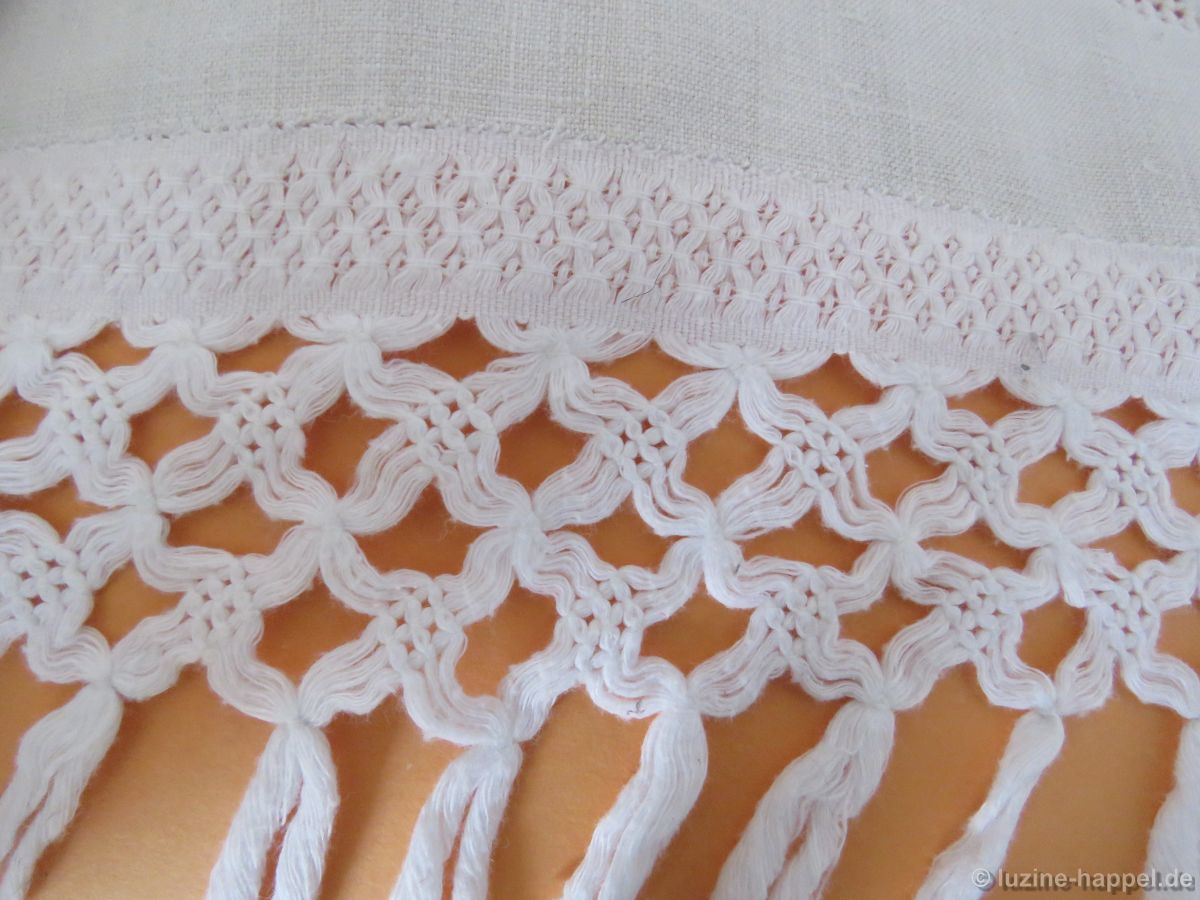
Especially popular were the so-called bell borders that edged some projects.

These were fine machine-made cotton lace bands combined with prominent and fancy knotted fringes.

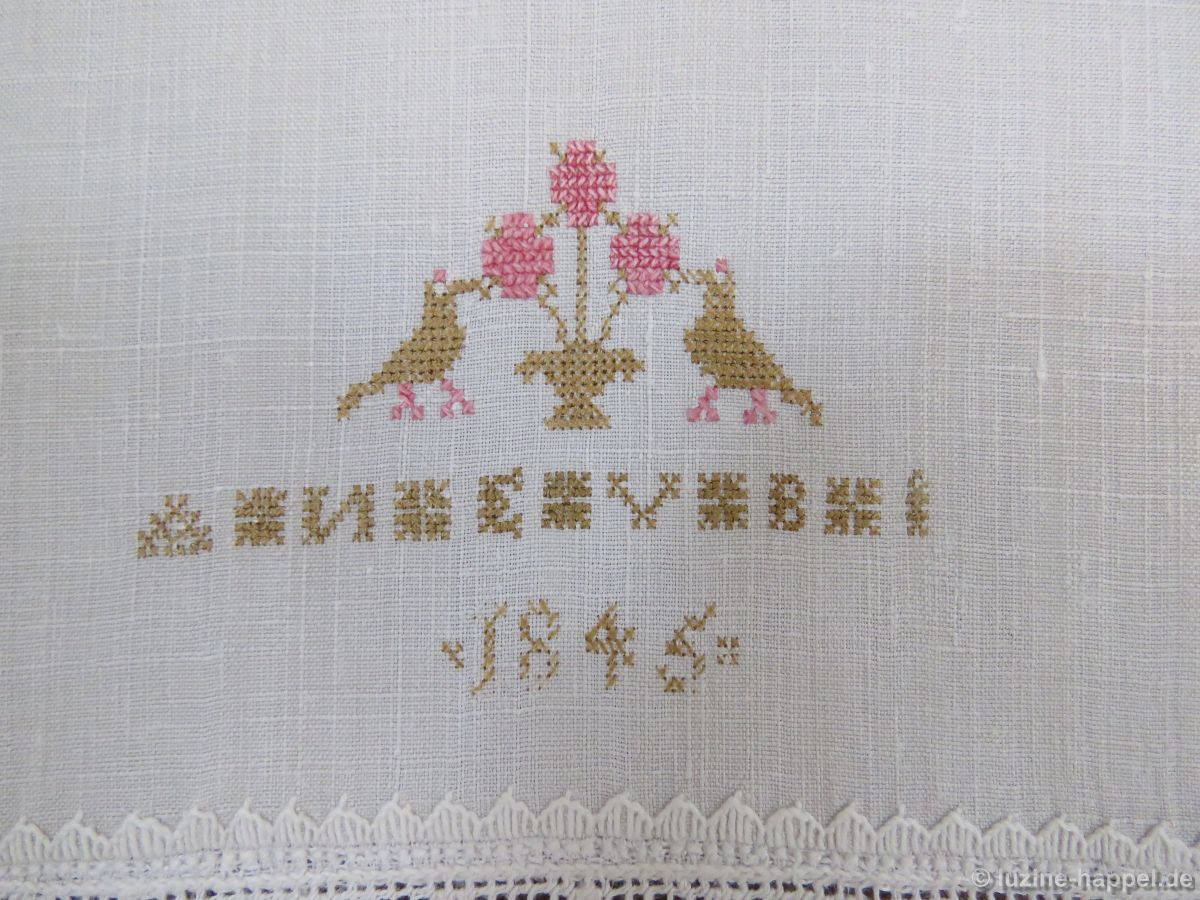
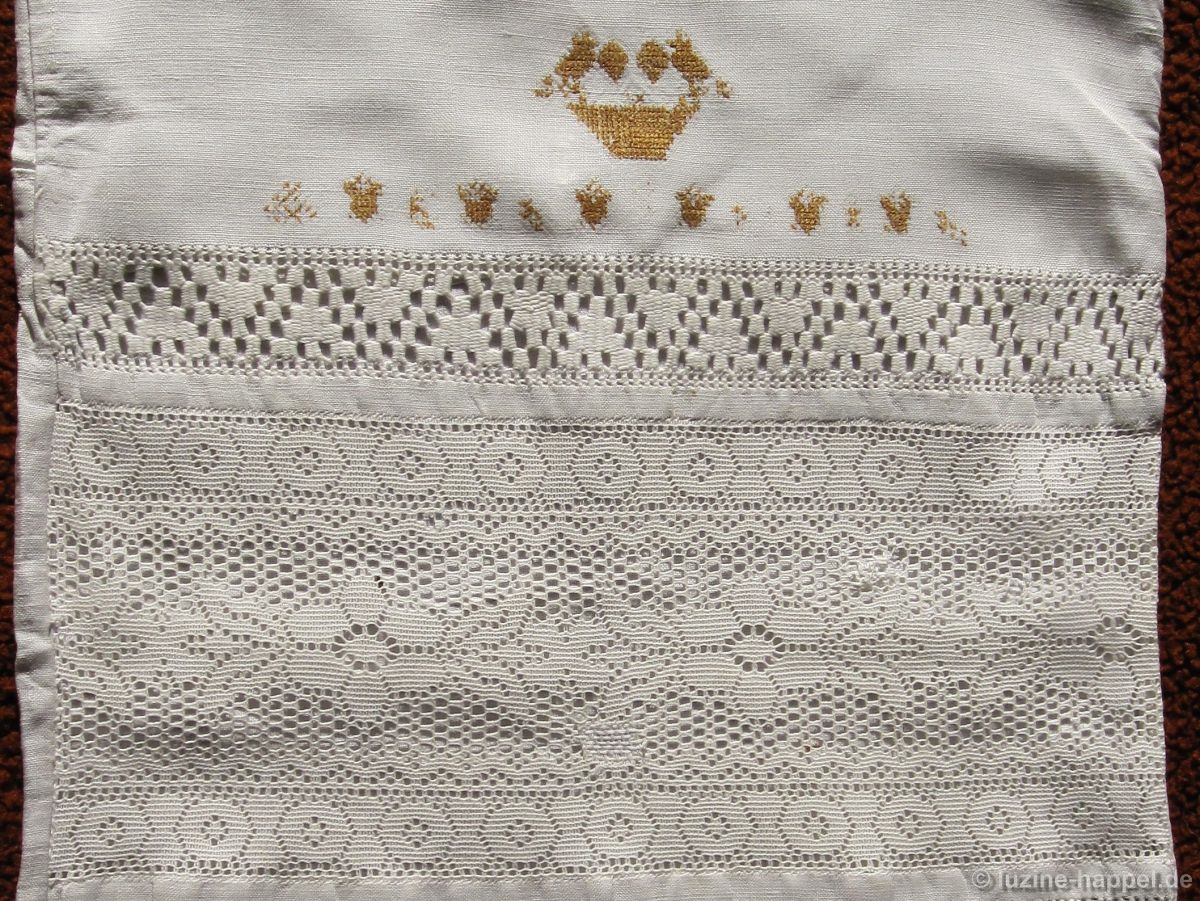
A door hanging from 1845 with a cross stitch crown,


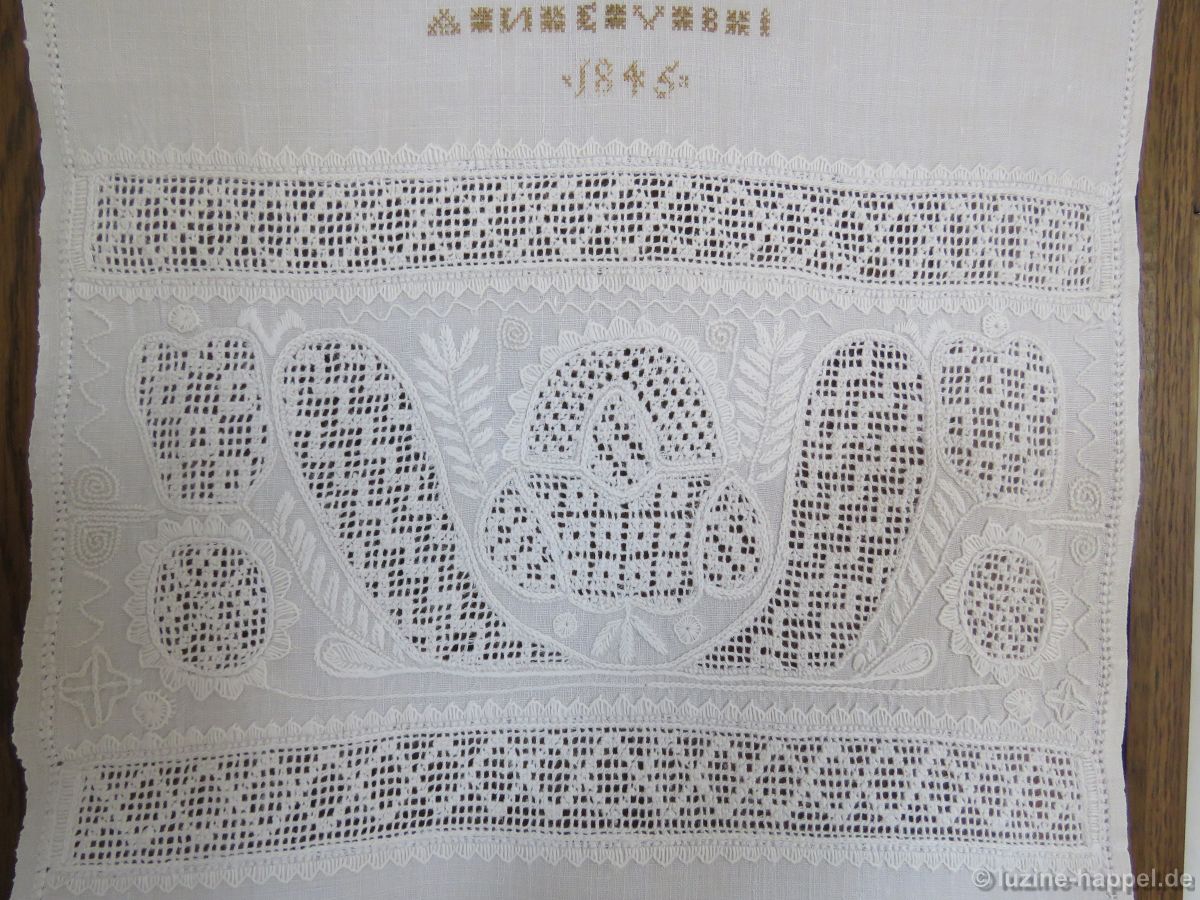
a tall whitework border with openwork needleweaving bands in the middle part,


and, at the bottom, more openwork pattern bands bordered with double Peahole and Four-Sided stitch hems on top and on bottom got a bell border for its bottom edging.


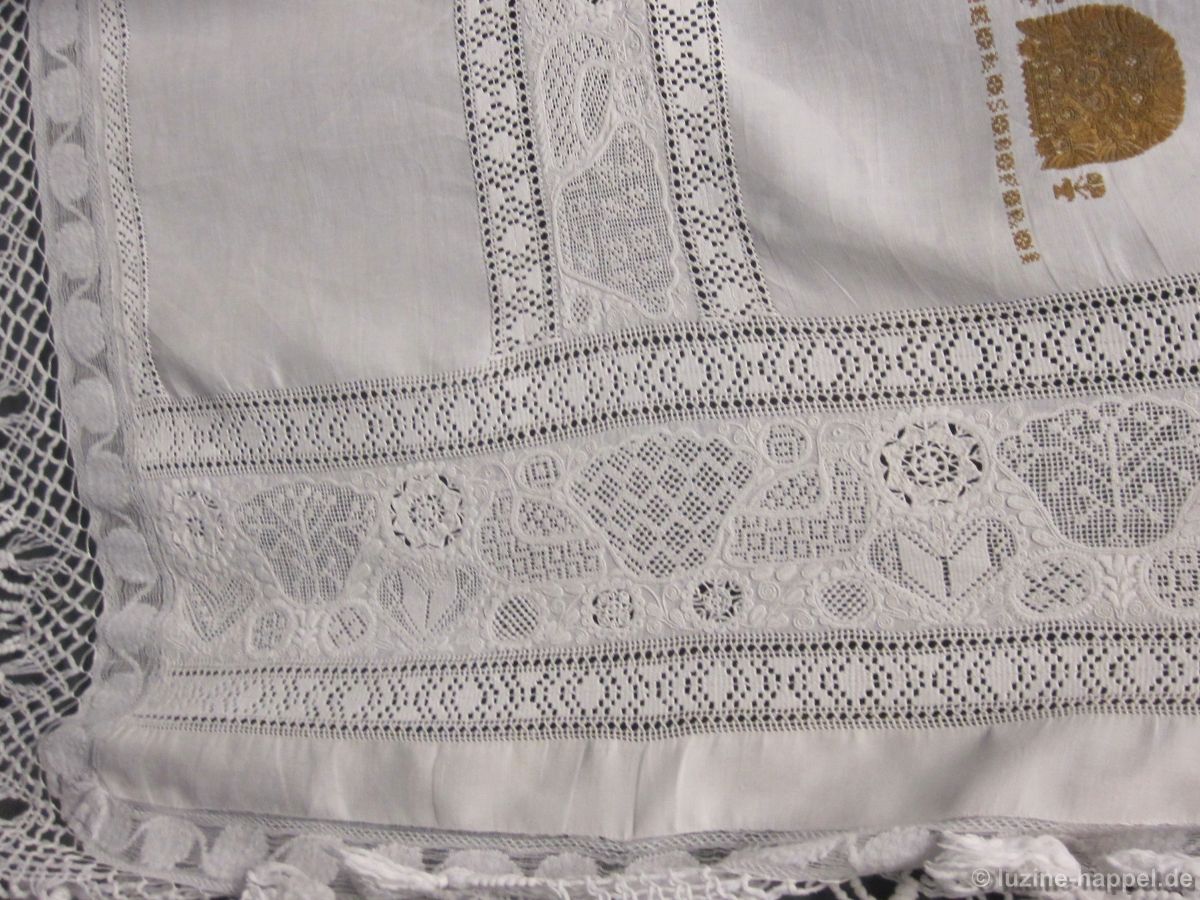
An old bed covering with a grand Schwalm crown, elaborate needleweaving hems, and bobbin lace inserts


got an edging of machine-made lace.


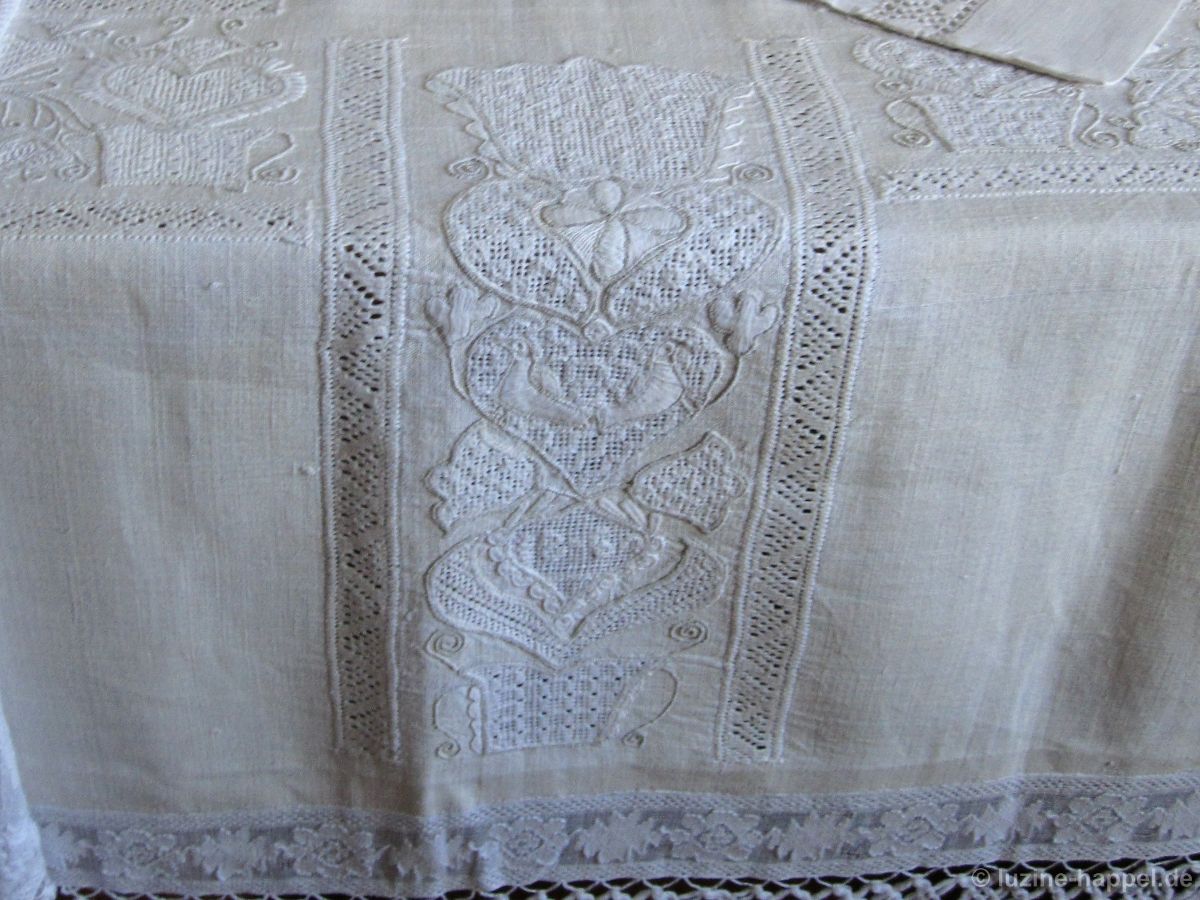
Also a bed covering from about 1860 – unique and elaborately embroidered –


got such a machine-made edging.


This piece, from 1839, and more outstanding examples of the finest whitework embroidery combined with machine-made lace can be found in the museum of Holzburg. This small village museum is always worth a visit.


Besides these machine-made lace edgings, the Schwalm people often inserted machine-made lace bands between hand embroidery.
On the pincushion in the image below, the machine-made band is bordered by needleweaving hems on both sides.


A bed covering shows a cross stitch crown, many different hem patterns, inserted machine-made lace,


and two kinds of machine-made lace edging.


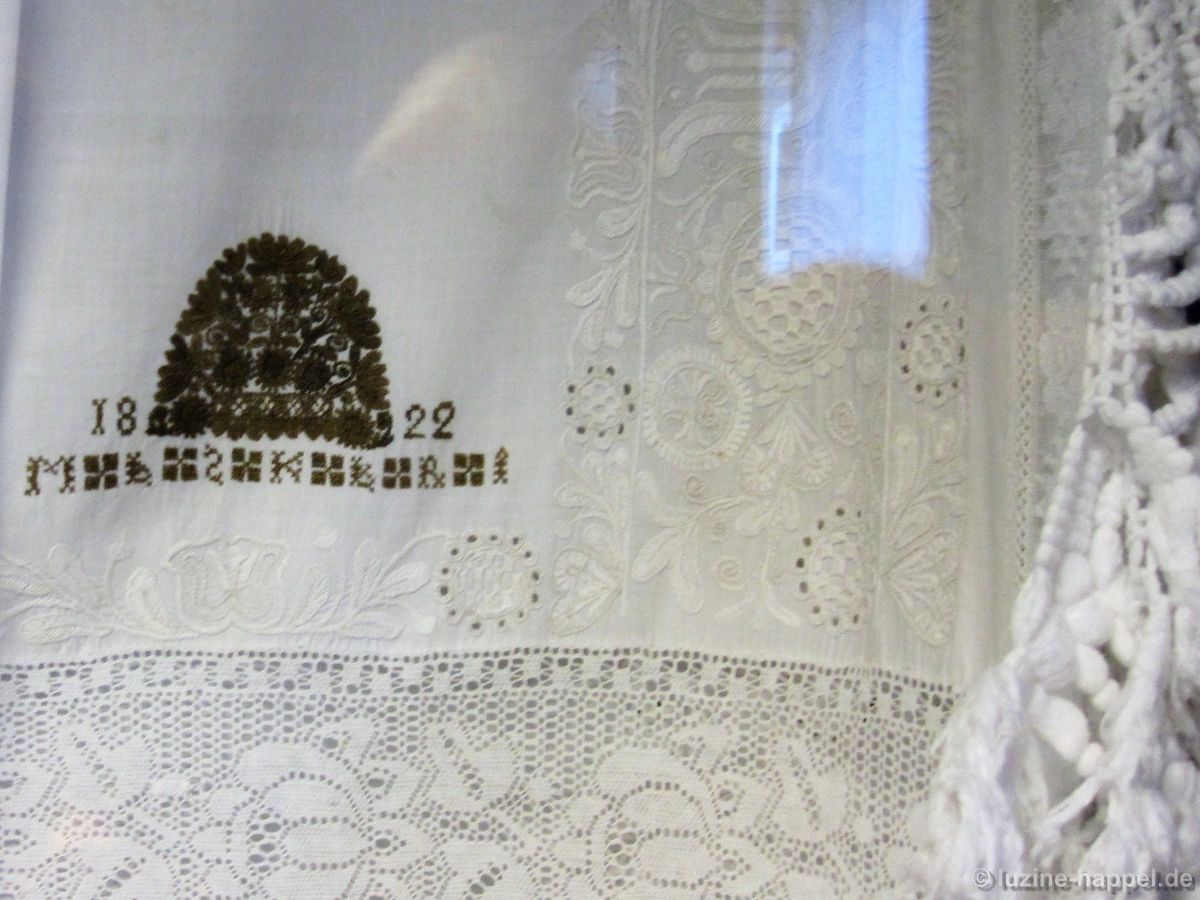
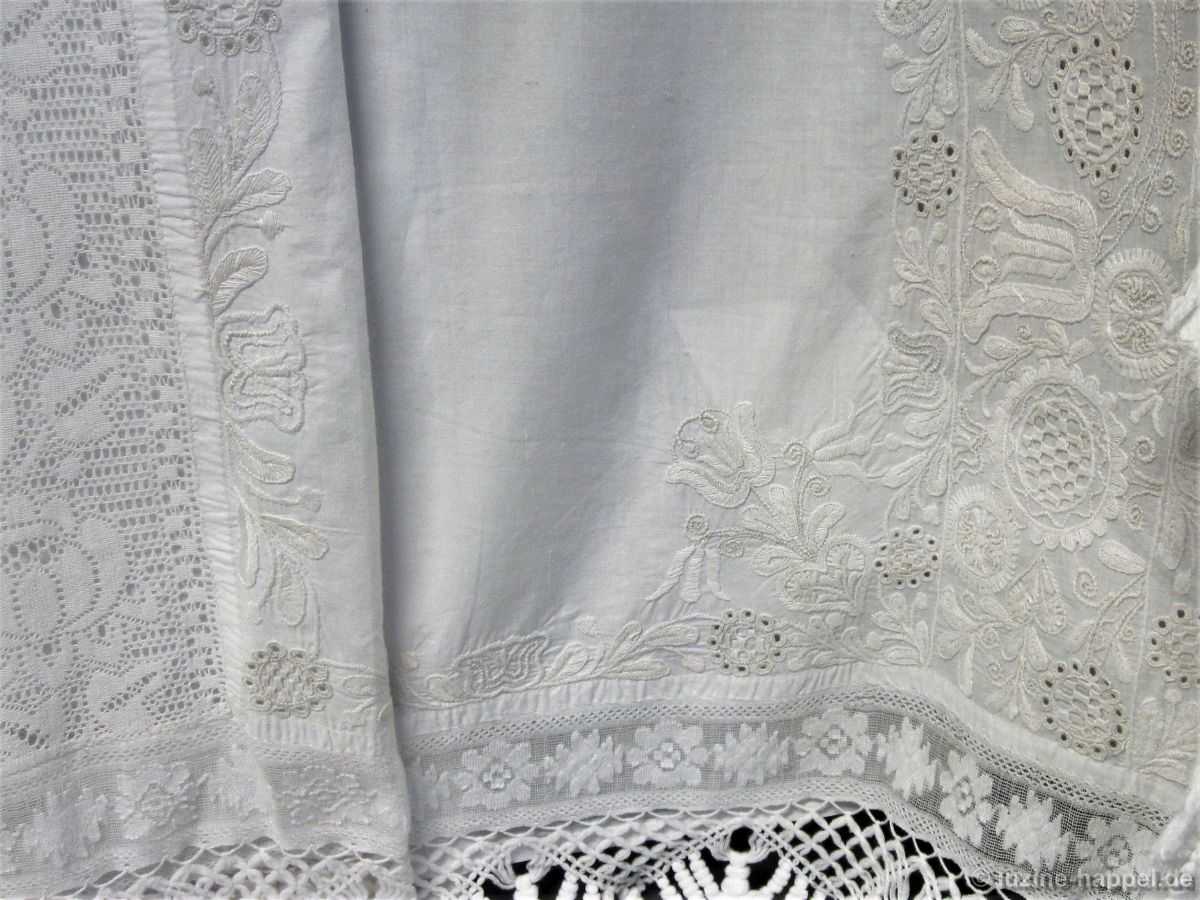
The museum in Holzburg has an interesting bed covering on display. It is elaborately embroidered with elements of early Schwalm whitework and boasts a grand Schwalm crown showing the year 1822.


Additionally, it is decorated with an inserted band of machine-made lace and machine-made lace edging. I was kindly allowed to show these images on my blog. The partial details cannot show the full spendor of the exhibit, but one can get an idea of the magnificence. The museum welcomes every visitor interested in the details of such selected works.

Eyelash Stitches in Schwalm Whitework

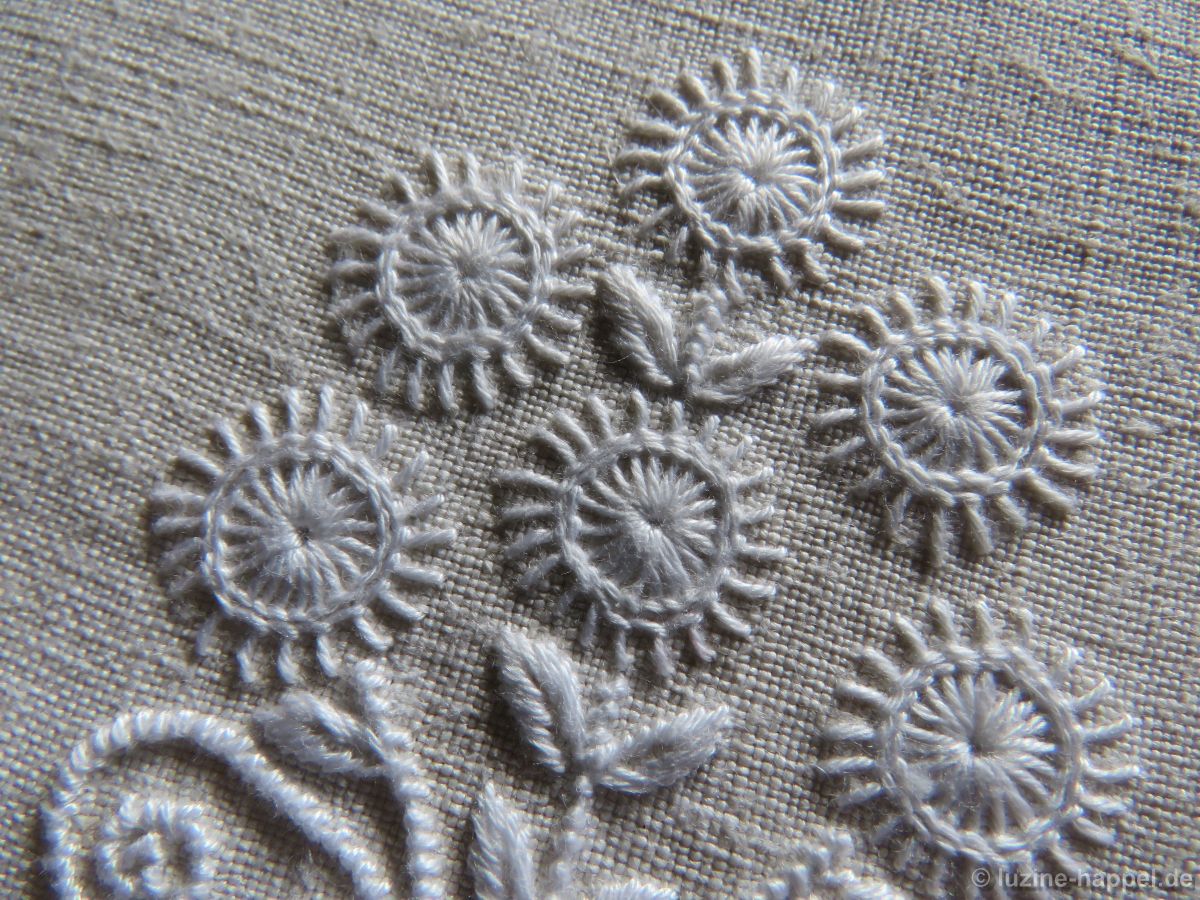
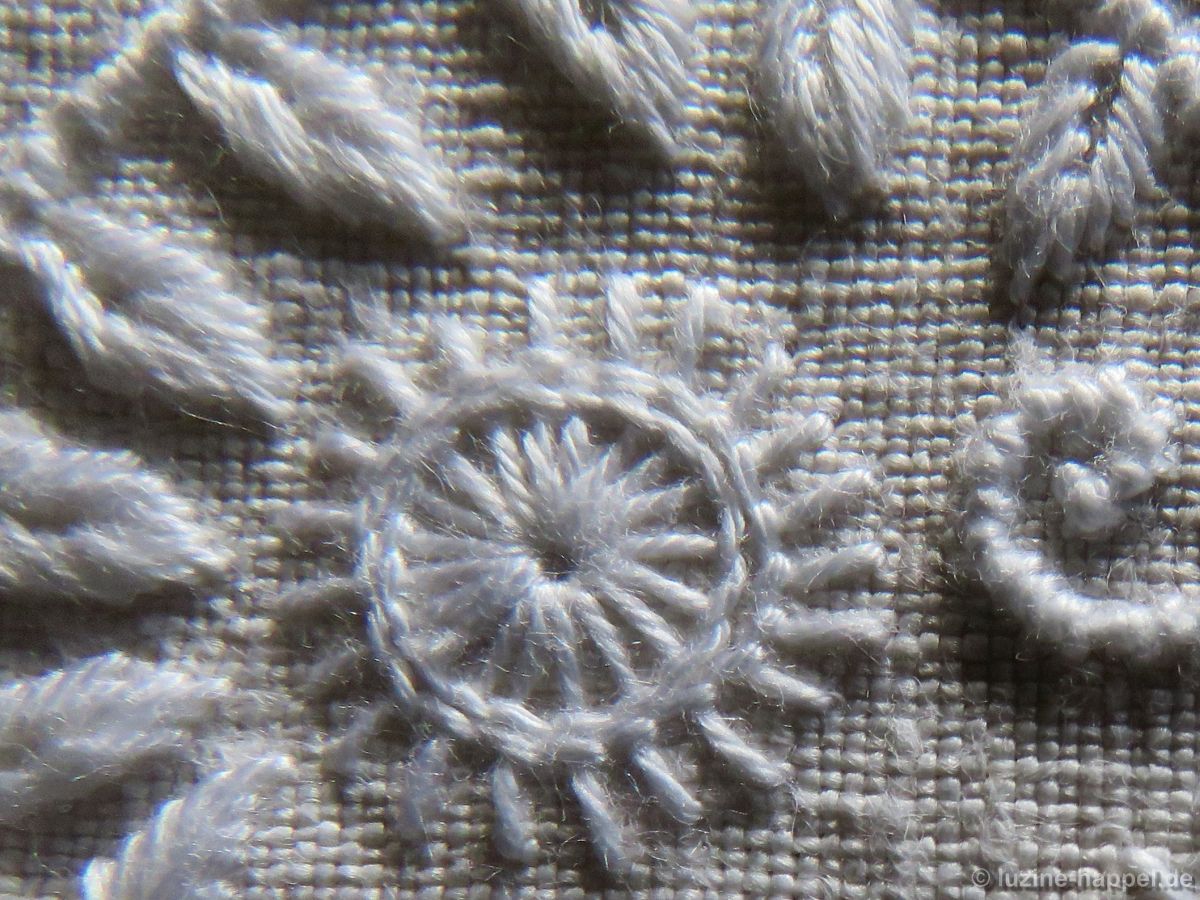
Eyelash stitches are Blanket stitches spaced further apart – the loops lie a little bit closer than the “legs.”


In the past, it was quite common for Schwalm whitework embroiderers to outline shapes with Eyelash stitches or to work Eyelash stitches as a decorative element. Also many examples of early Schwalm whitework document the use of these stitches. As time passed, Eyelash stitches were worked less often. In embroideries of the last decades they are scarcely seen – that´s a pity because Eyelash stitches are decorative and effective.

I have shown on my blog the use of Eyelash stitches on embroideries. The border from 1804 has some shapes that were outlined with Eyelash stitches.


And one shape of the traditional Schwalm bodice A is partly outlined with Eyelash stitches.


Eyelash stitches – embroidered with heavier thread and worked more densely – outline the heart shape of a sleeve cuff border.


Very short Eyelash stitches are found on a delicate example of early Schwalm whitework from about 1780.


Here they outline petals and are also used to make tendrils.


Short Eyelash stitches also outline the Satin stitch petals of a gorgeous contemporary table runner, which was embroidered using traditional patterns in the style of the early Schwalm whitework.


Some longer Eyelash stitches decorate a line of design No. 1 of my 2017 Advent calendar


They can be seen on other parts of the Advent Calendar. as well – here Eyelash stitches outline Blanket stitch eyelets.


If, like here, Blanket stitches meet with the loops of the Eyelash stitch, a raised double line is established


making the pattern especially effective.

I found a very singular variation of Eyelash stitches on a very old embroidery. On this piece all shapes were outlined with long, closely worked and slanting Eyelash stitches.


Eyelash stitches are suitable for many uses, and they establish a decorative effect.