Easter Decoration 2018

Having a look around the shops, I found hangings decorated for Easter – simple to rework with a touch of embroidery.

They are made from wooden discs and wooden beads alternately strung on a rustic thread
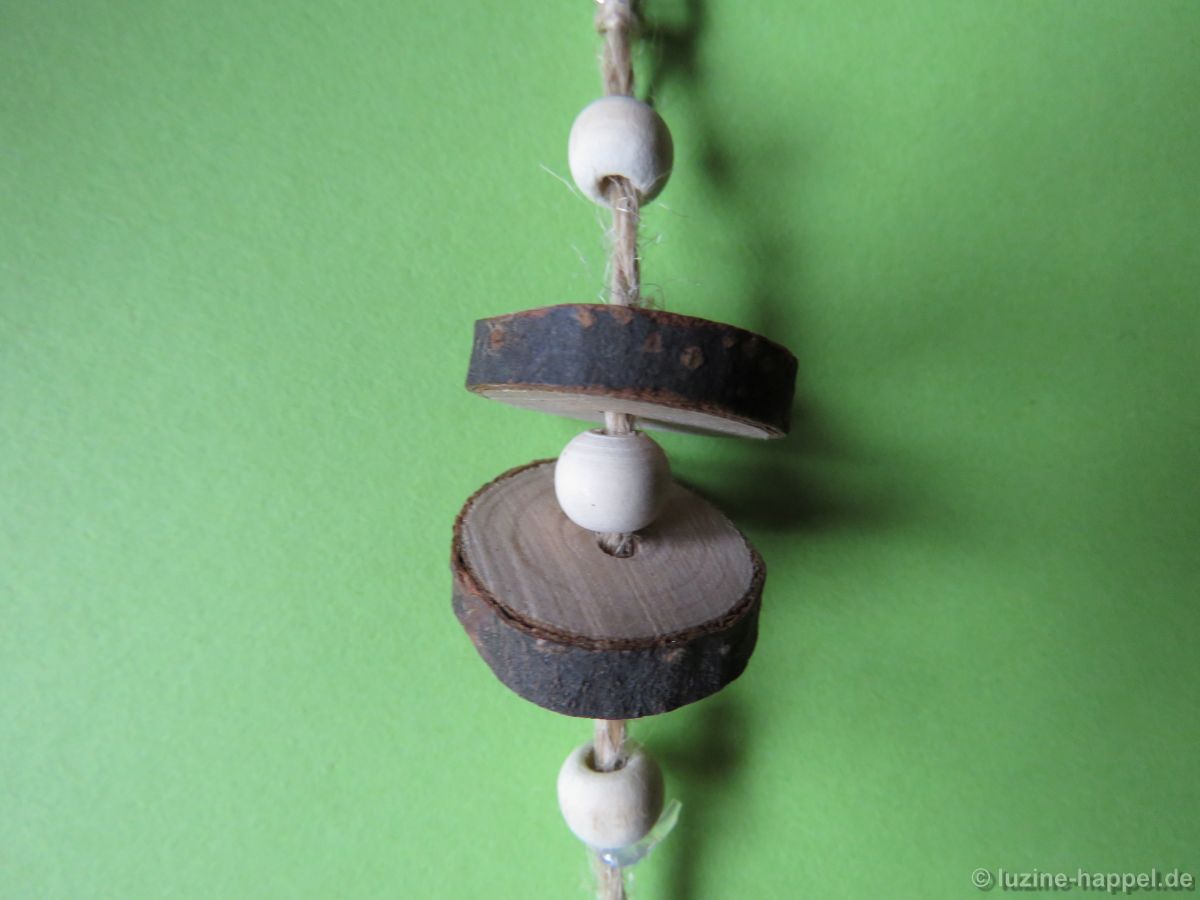
with a metallic Easter egg randomly placed between.
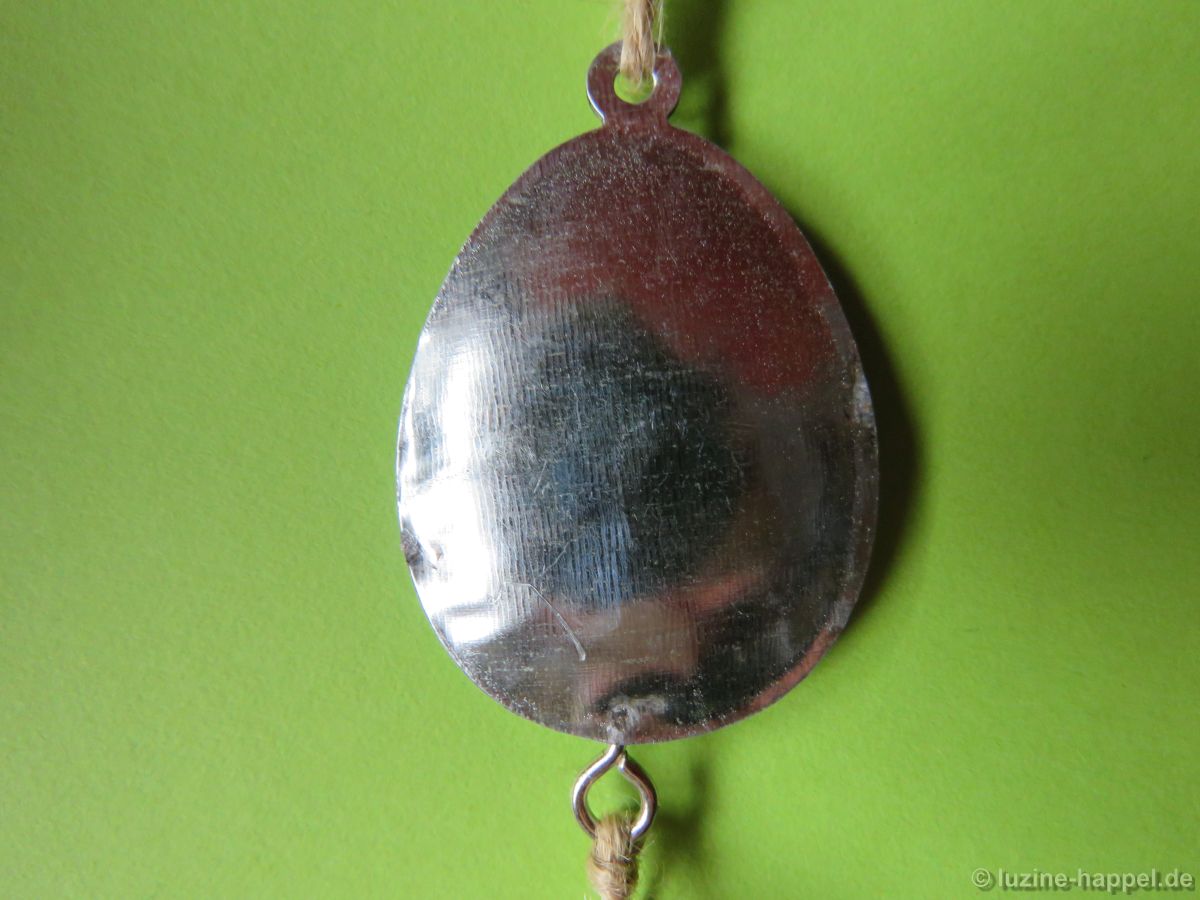

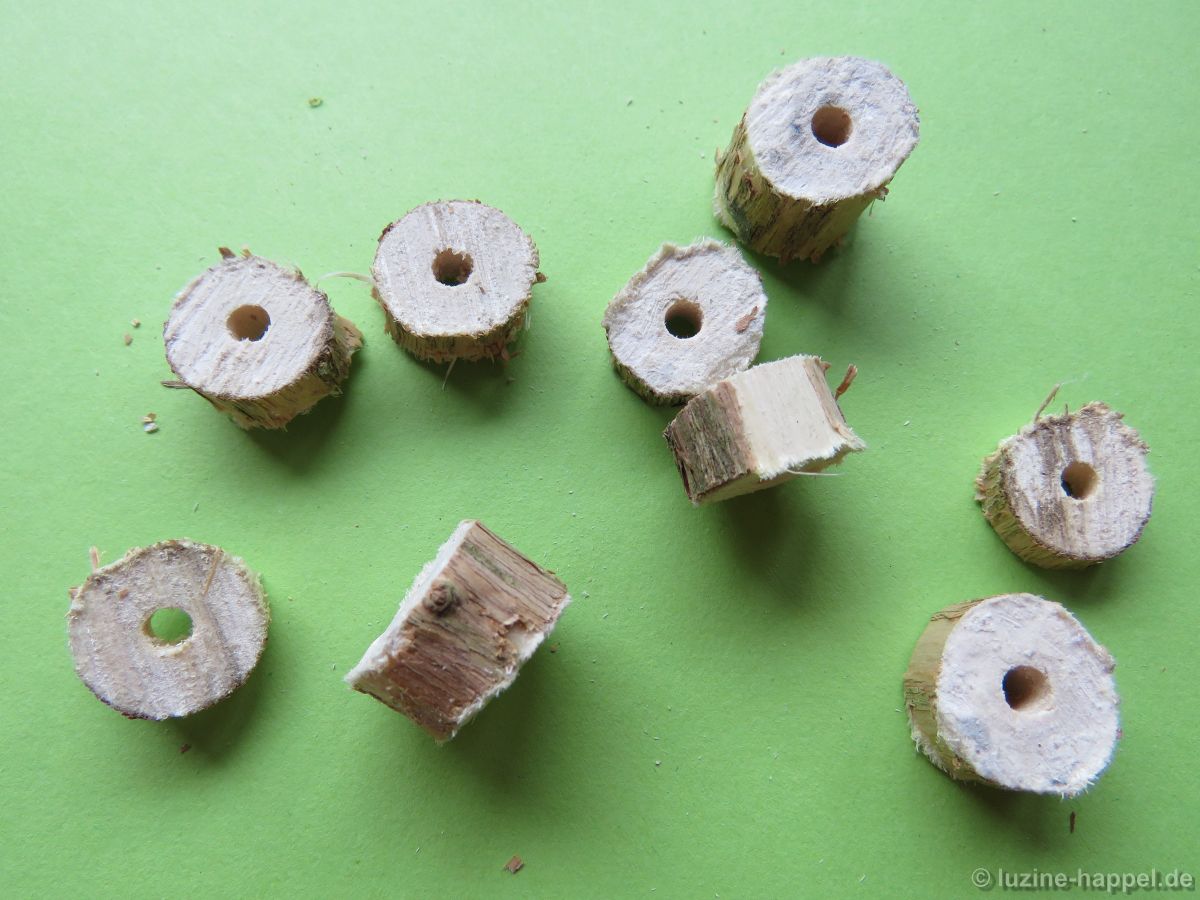
Taking a thick branch from my garden and using a small saw and a thin drill bit, I easily got the required discs. I had some beads on hand.

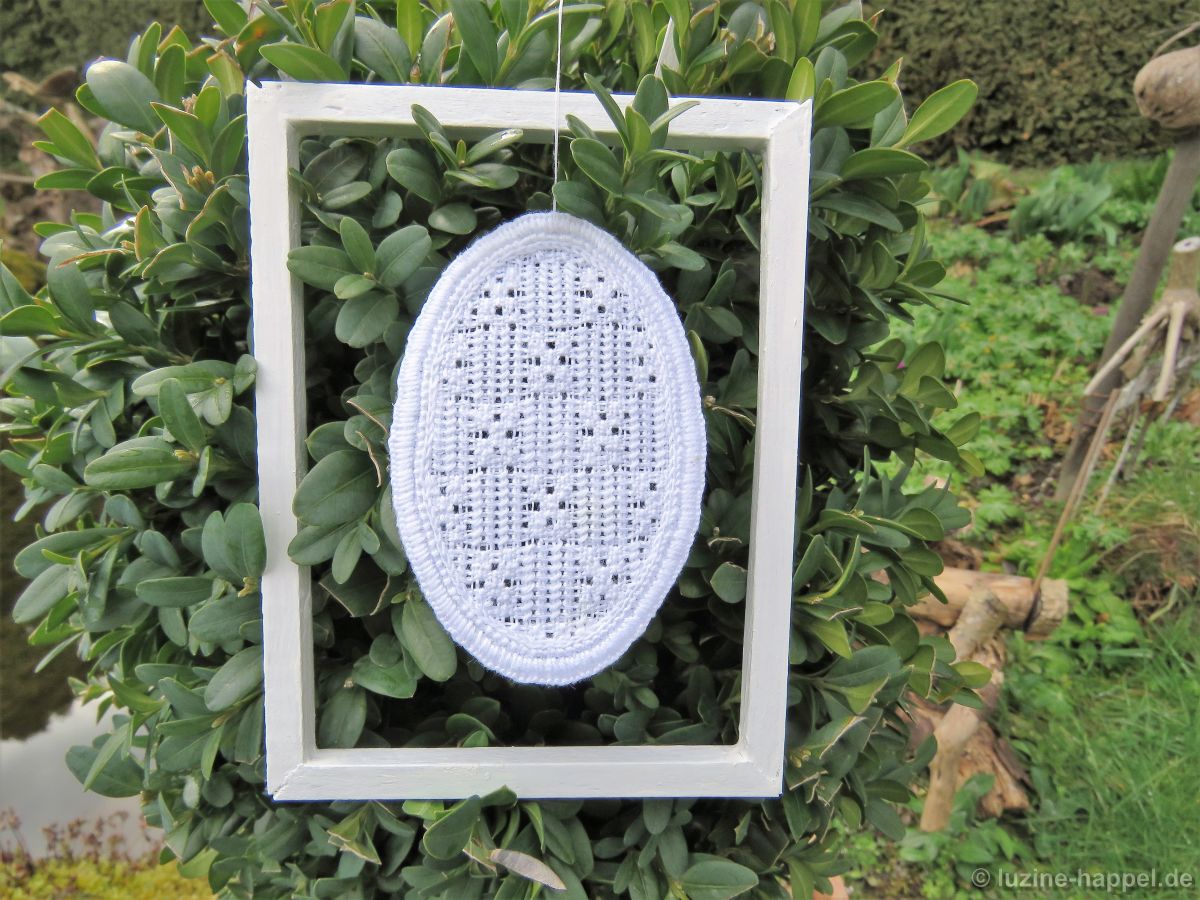
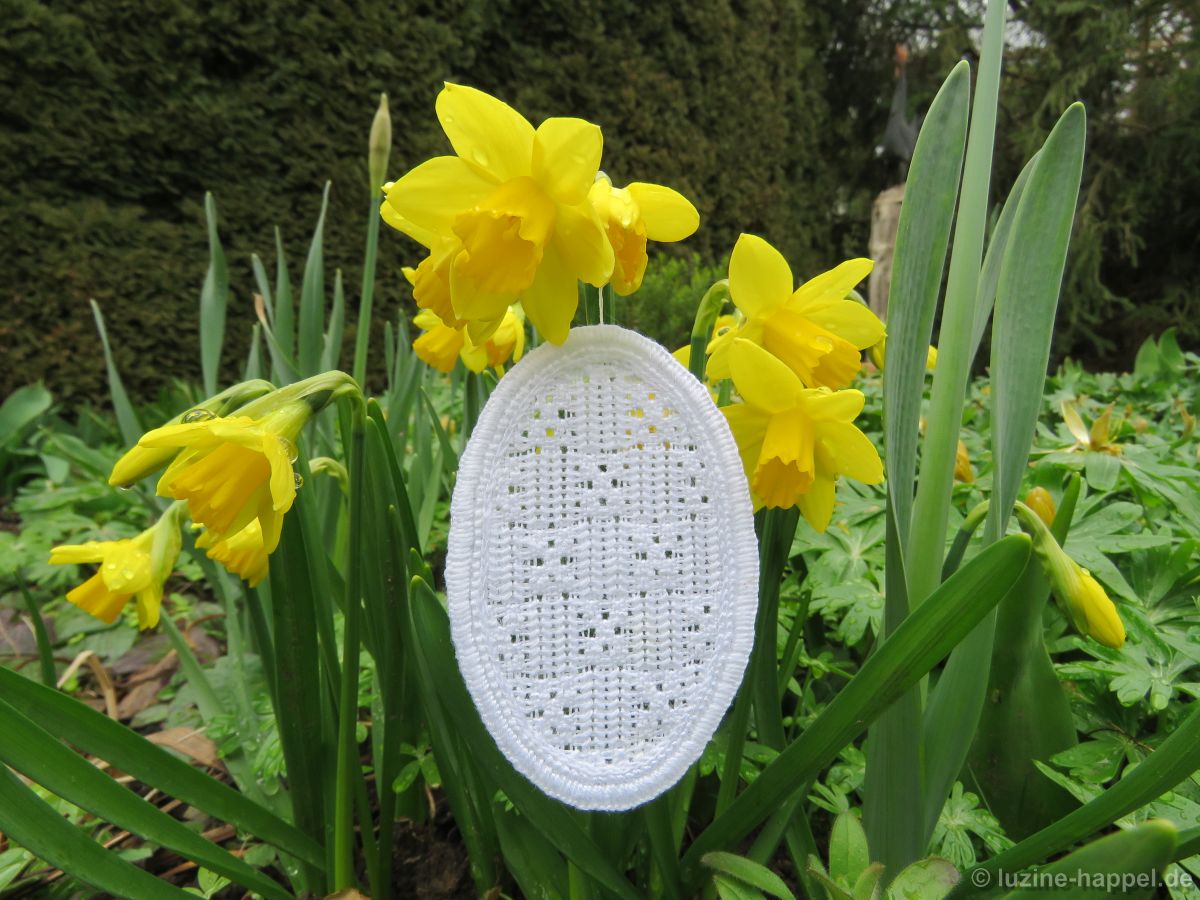
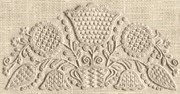
I replaced the metallic eggs with small embroidered Easter eggs. I used the design presented here and embroidered white eggs using filling patterns No. 540
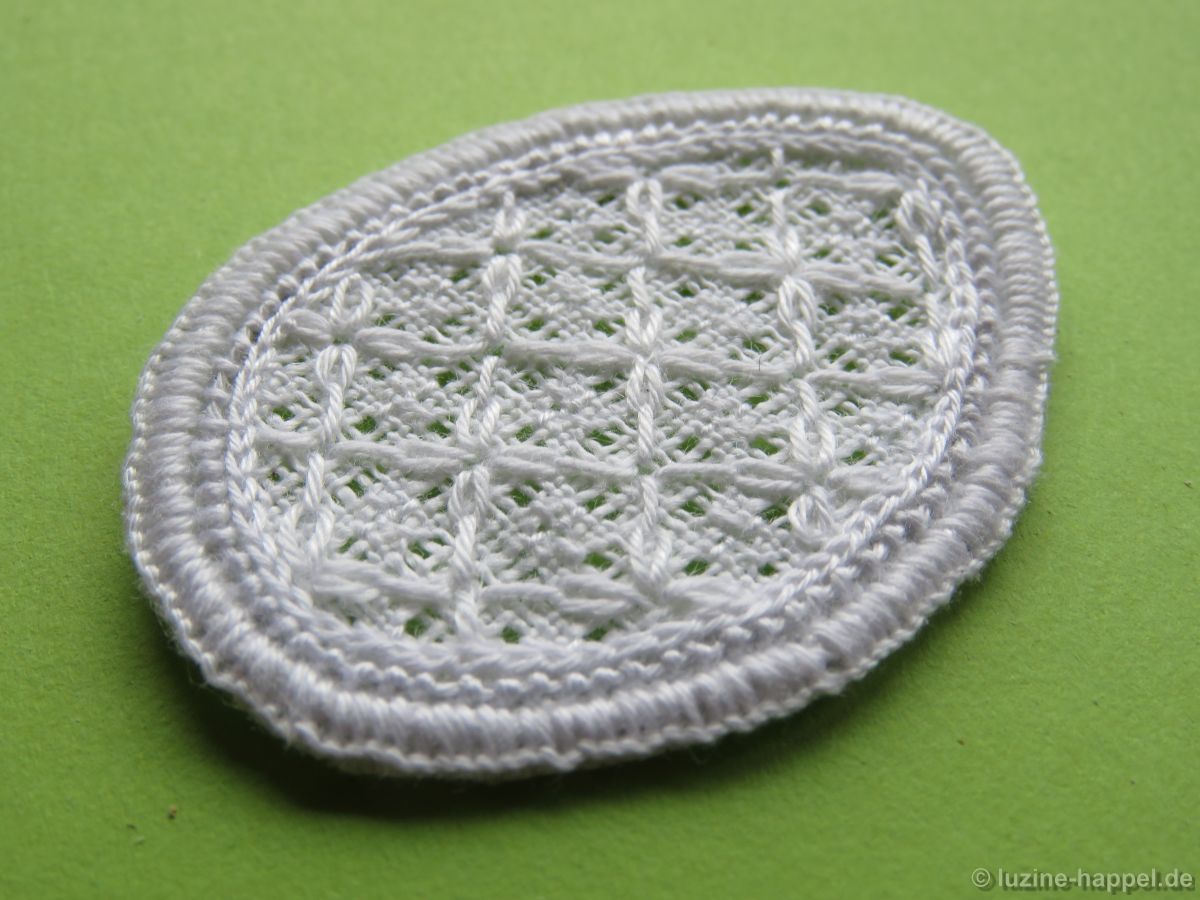

and “Kronjuwel” from the book Limetrosen II.
After boiling, the embroidery was heavily starched so that the cut piece holds its form.


I used a continuous white thread, because I found the big knots distracting,
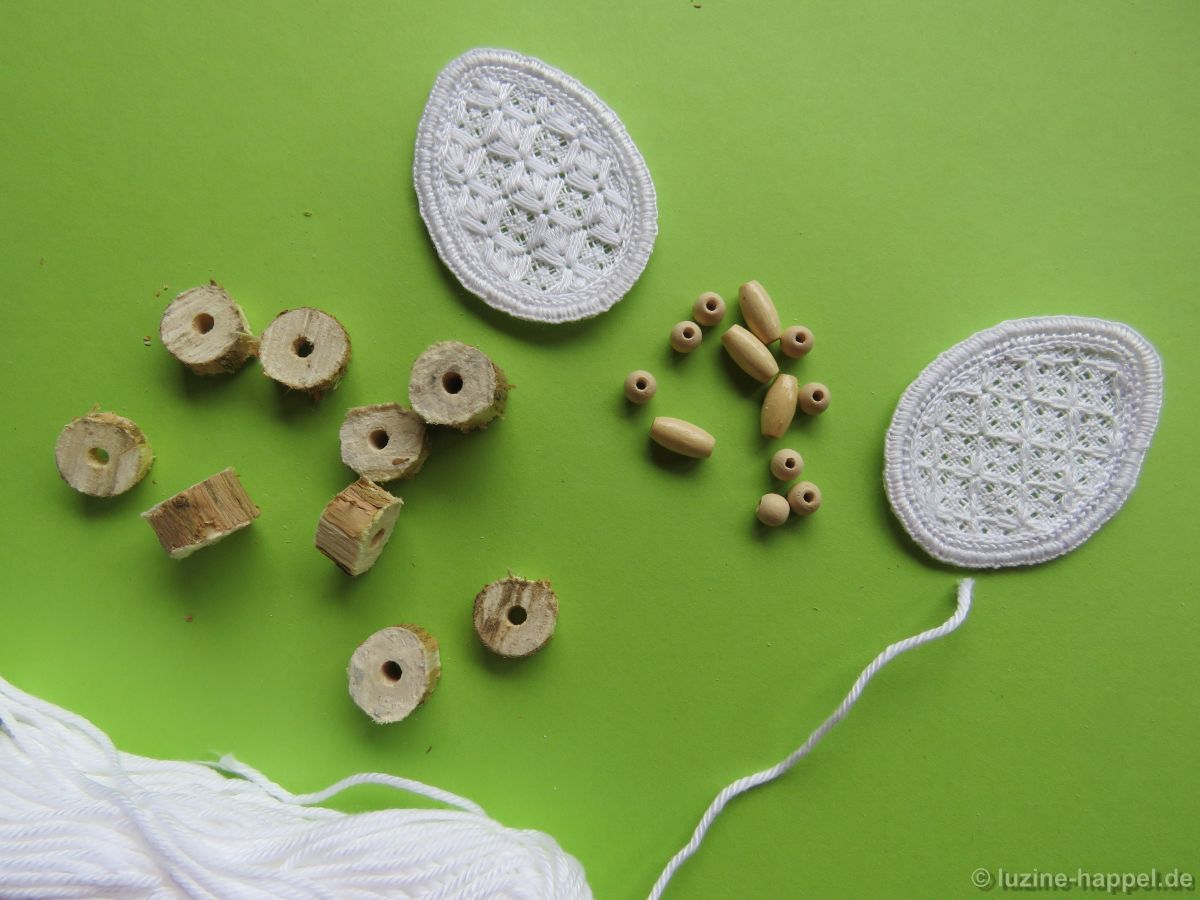

and alternately strung beads, wooden discs, and embroidered Easter eggs on it.
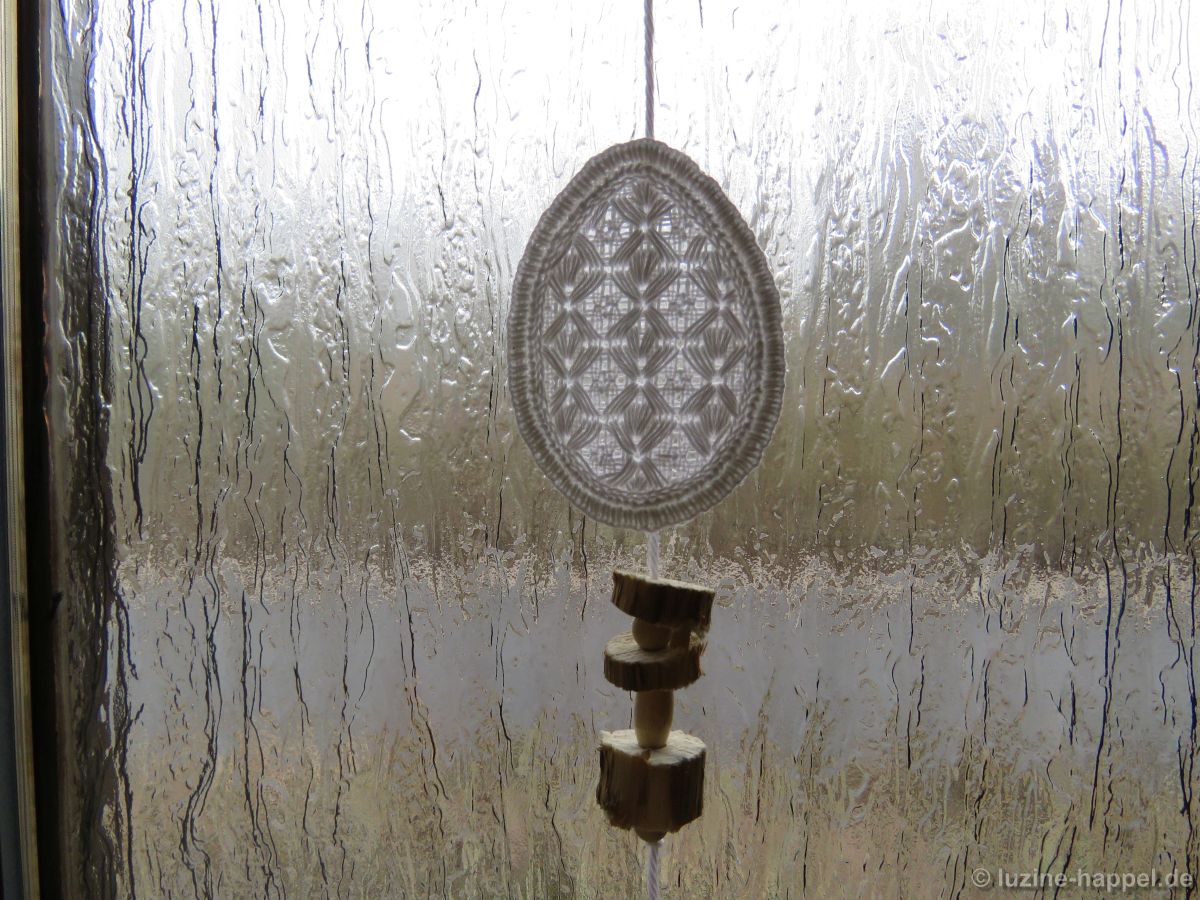

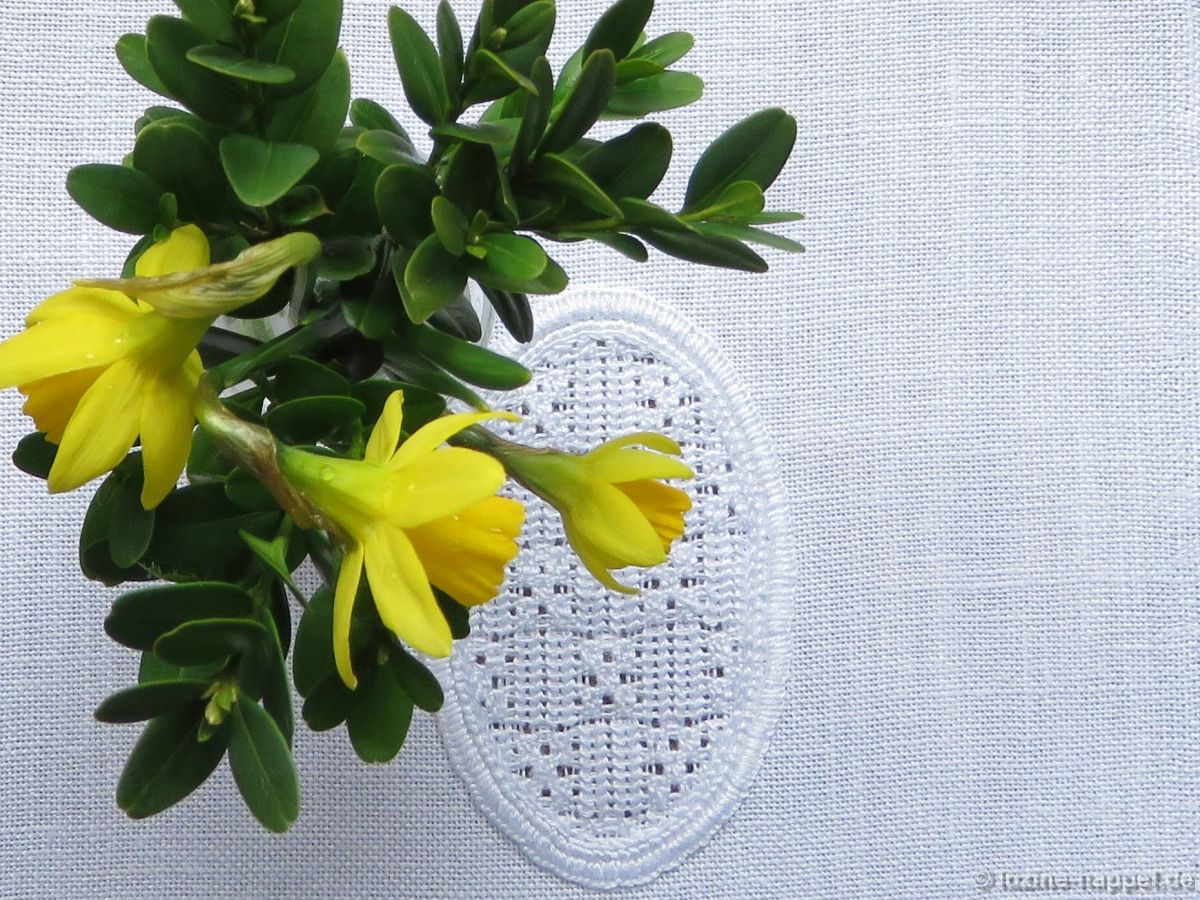
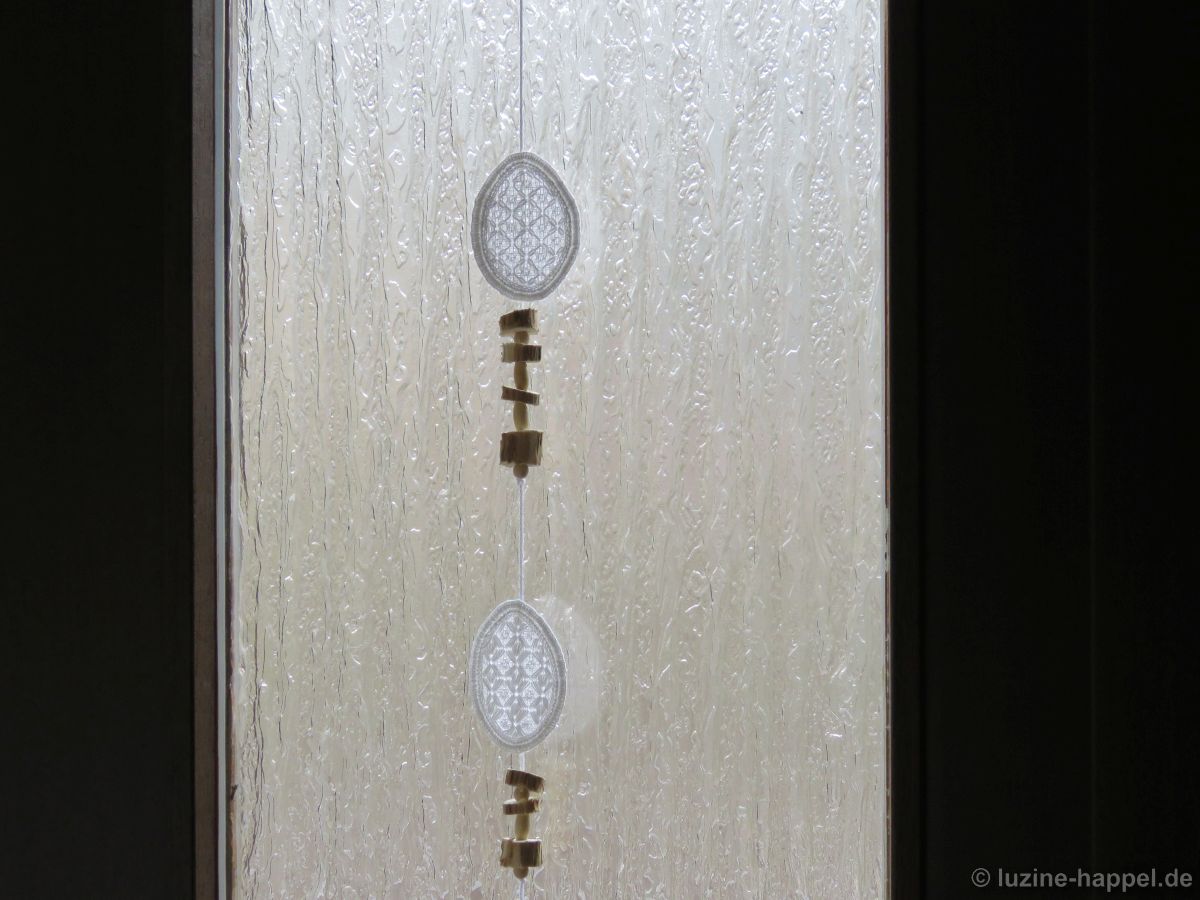
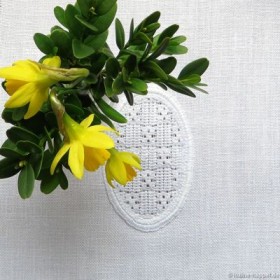
Illuminated from behind, as when placed on a window, the embroidery takes on an especially beautiful effect.


One can create short hangings with only one egg or longer hangings with a couple of eggs.
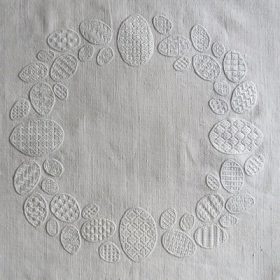
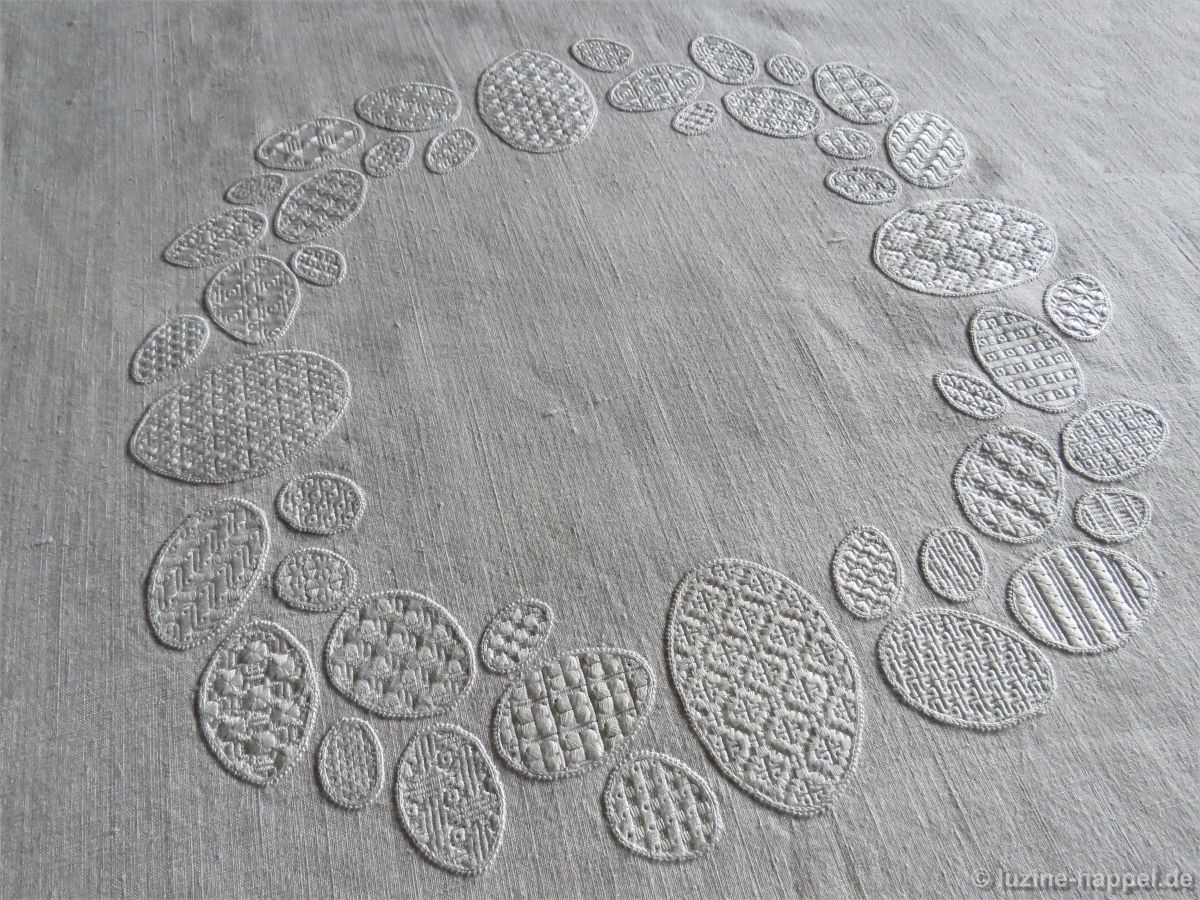
Embroidered Easter Egg Wreath

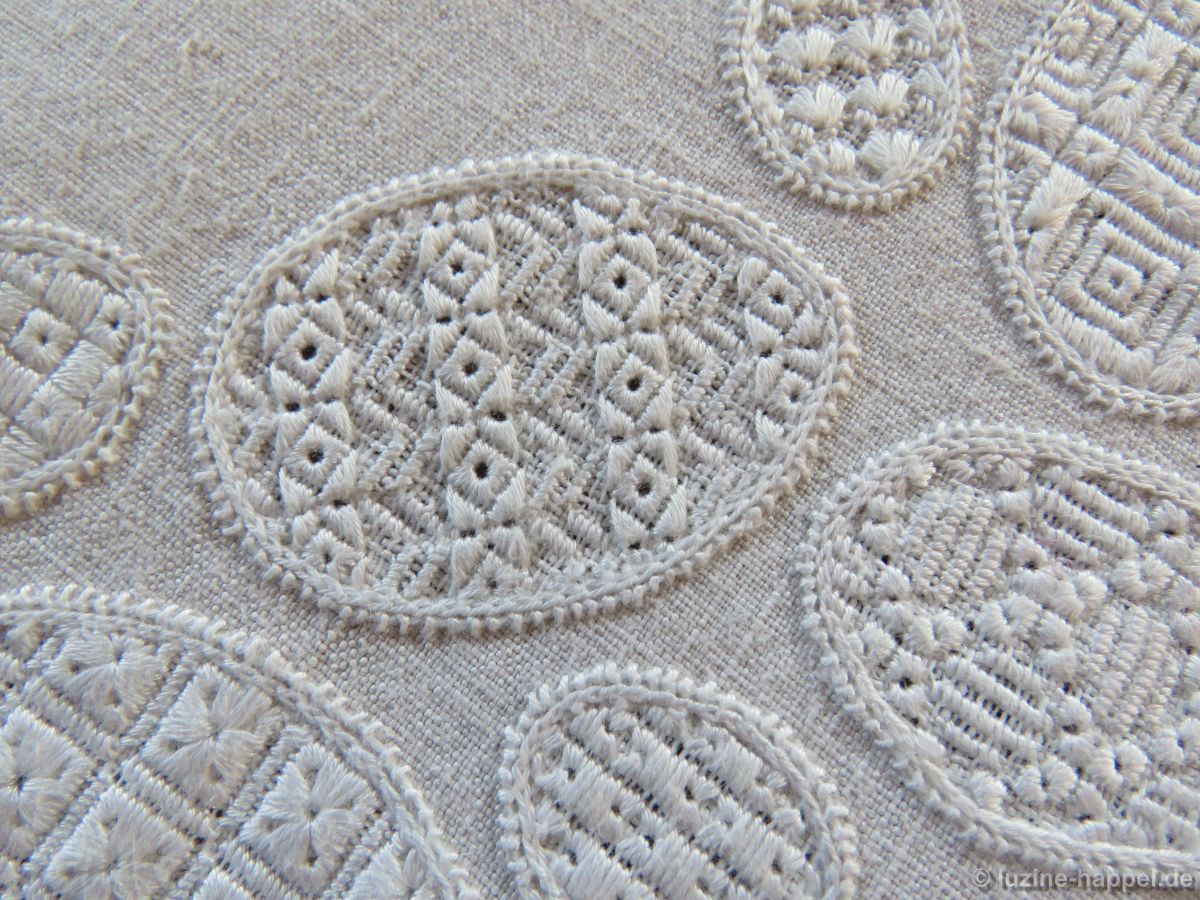
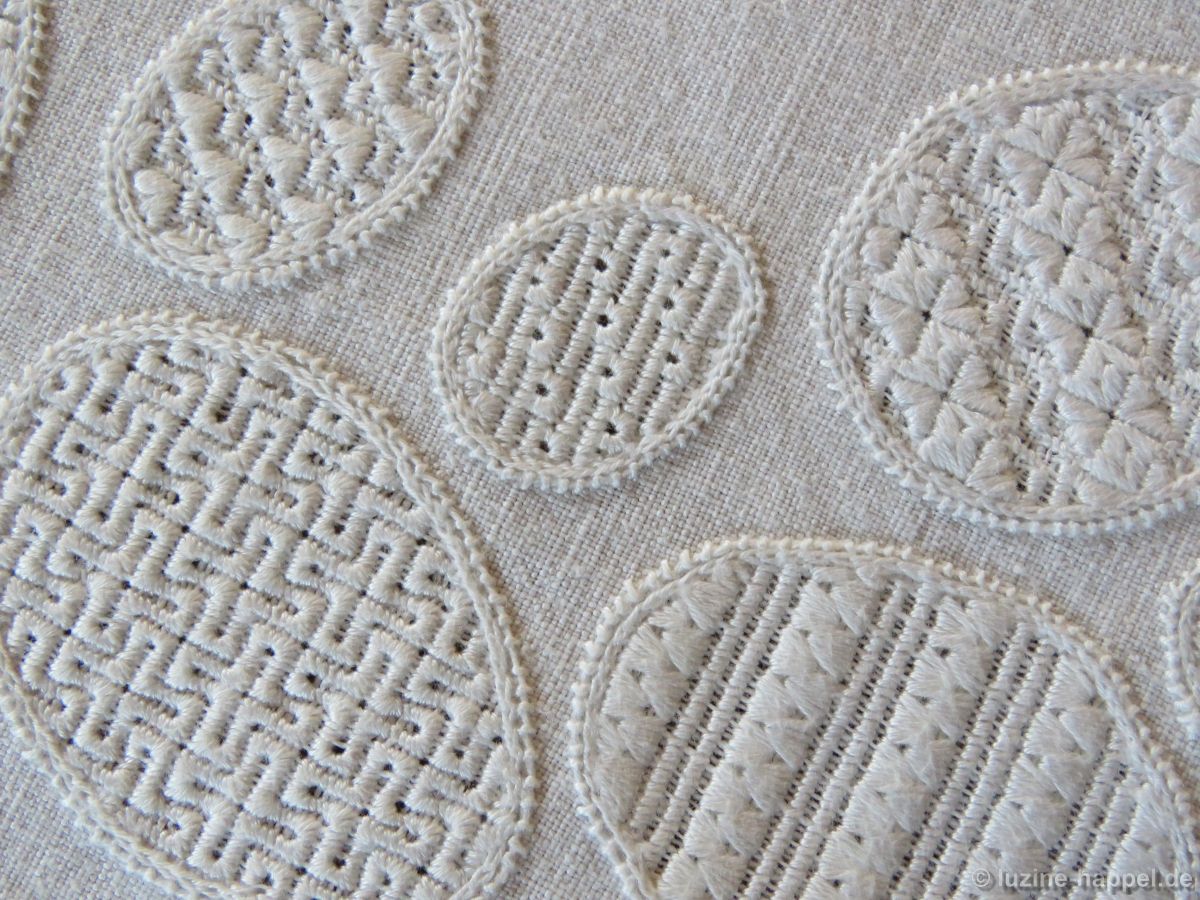
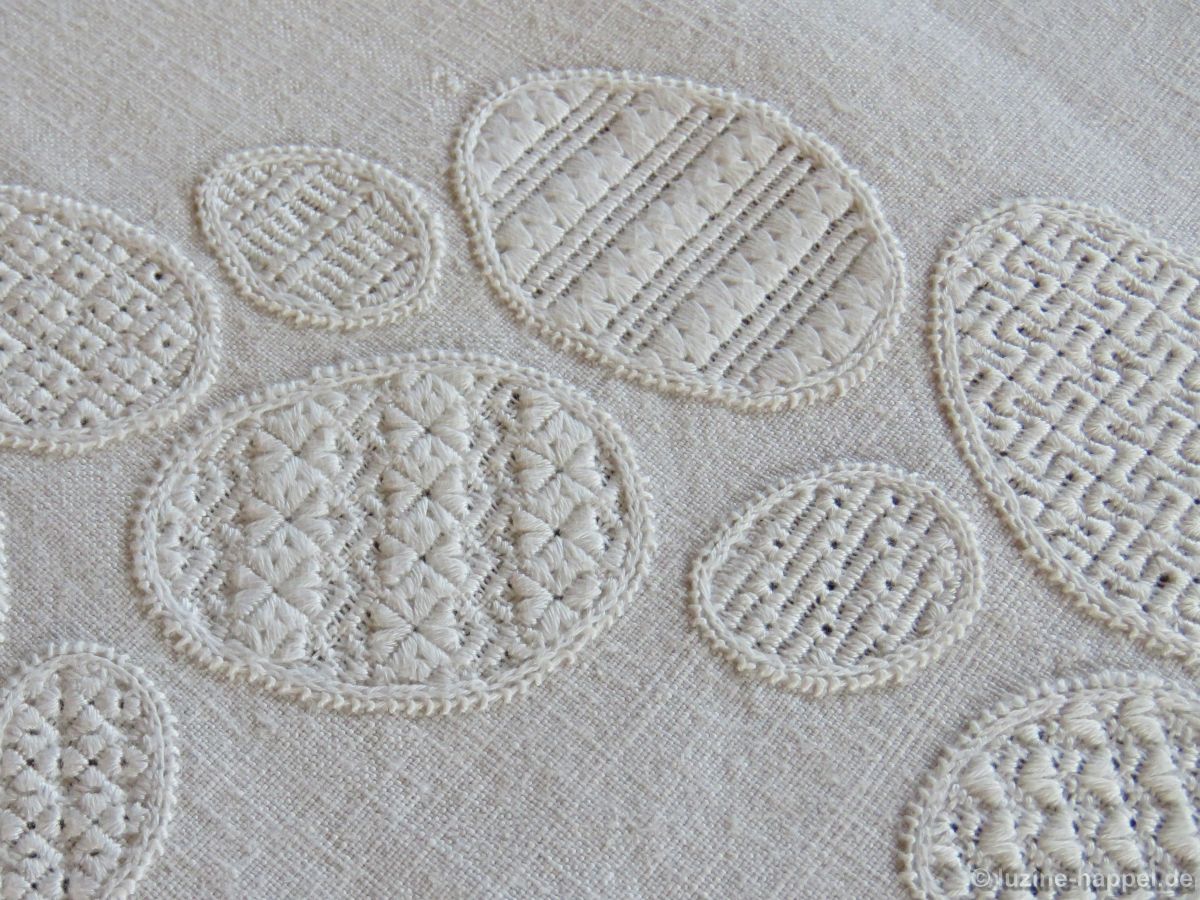
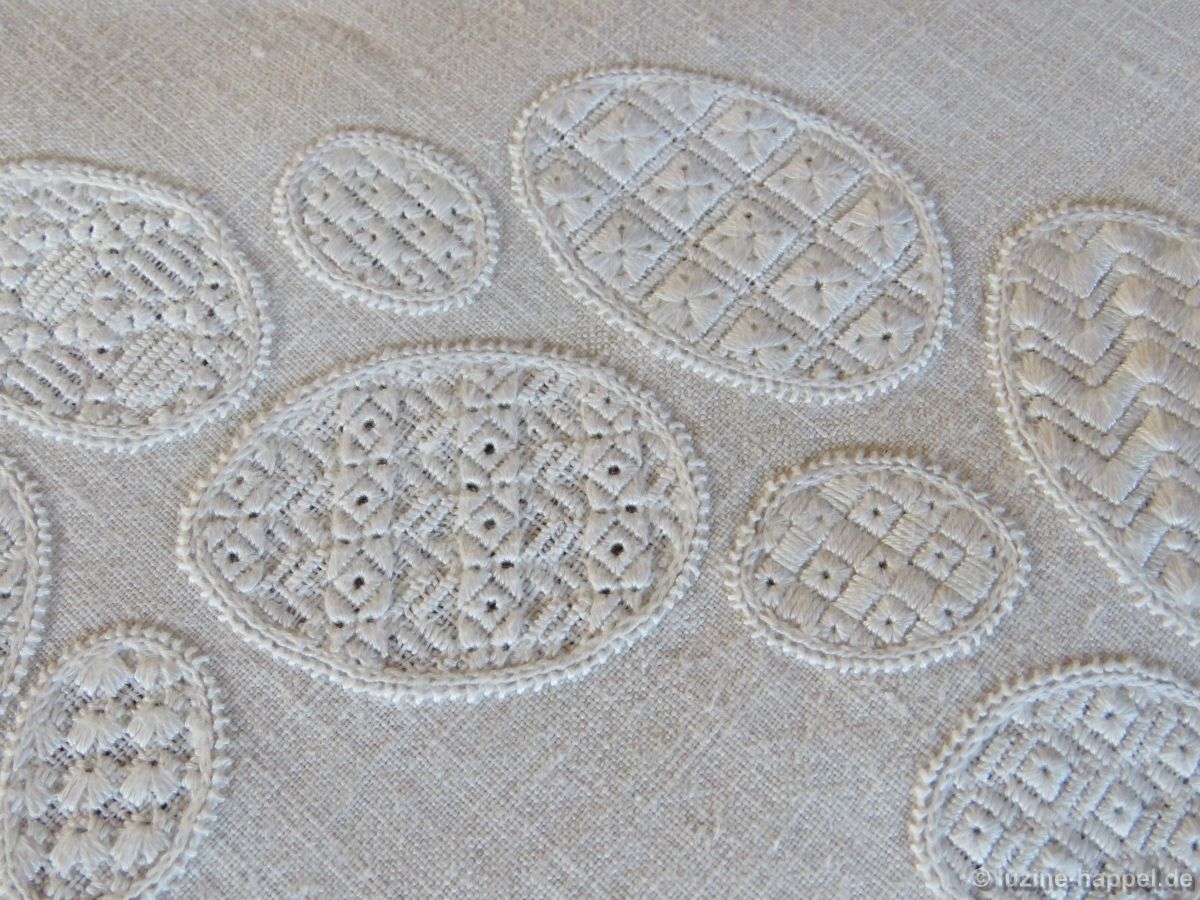
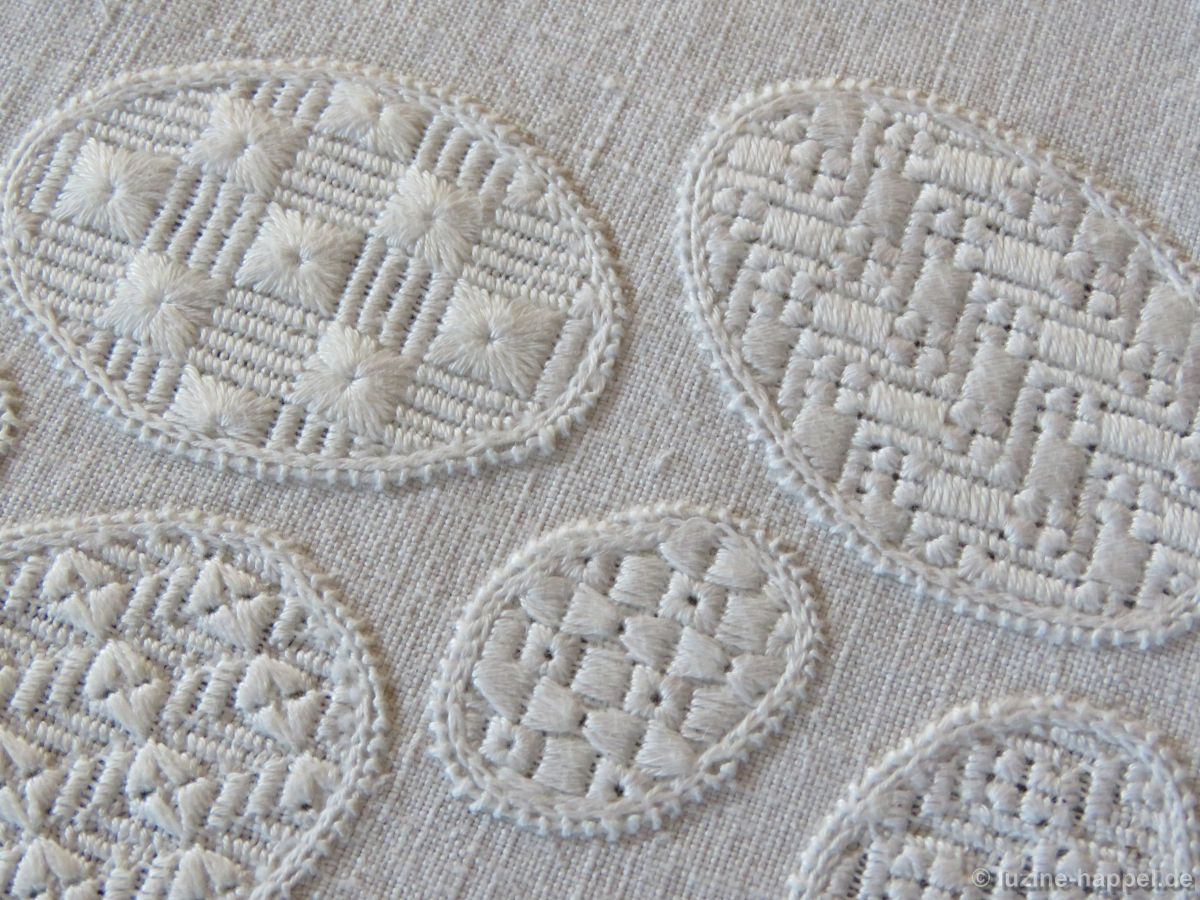
To create an Easter Egg Wreath design, the artist Gudrun Hartwig first arranged four big egg shapes to form a cross,


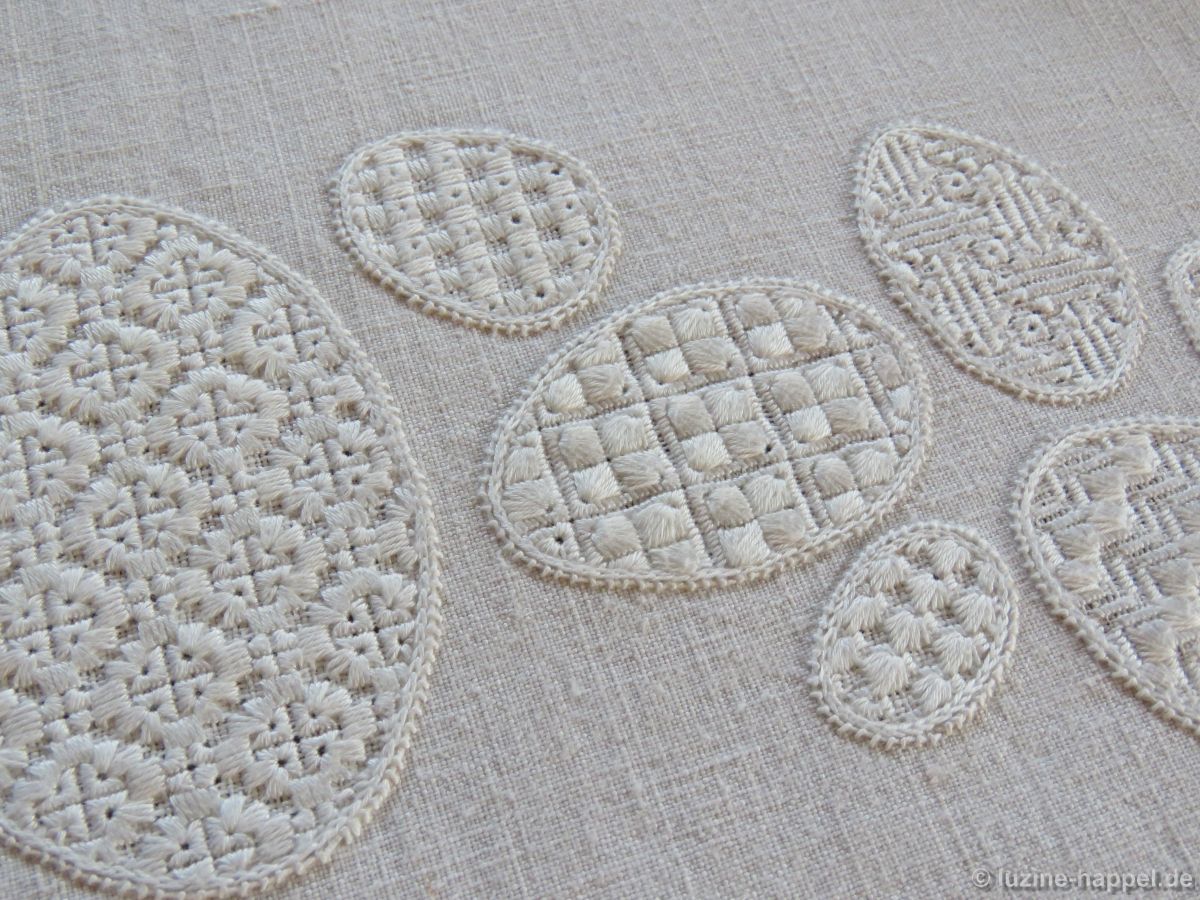
and then, in the four areas thus created, she randomly placed smaller eggs of different sizes.


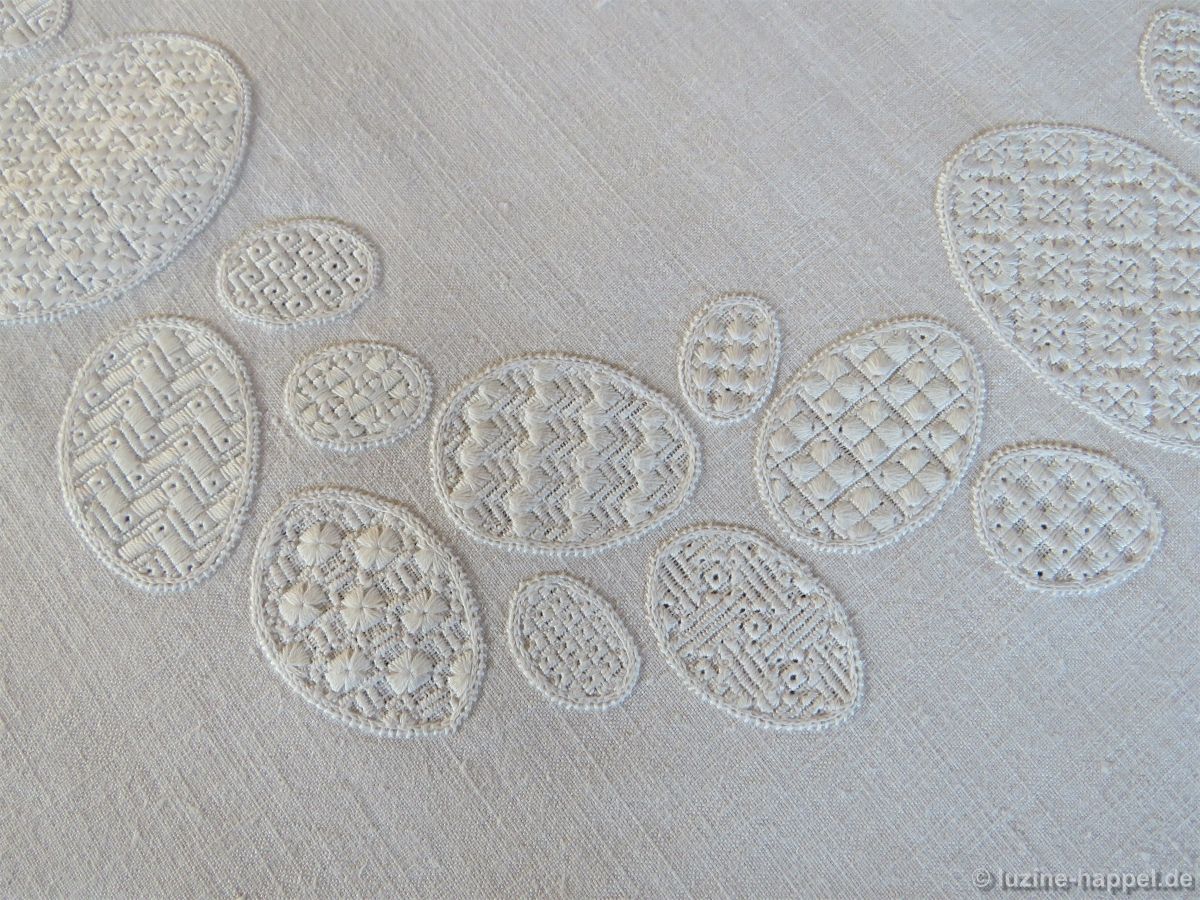
The egg shapes can be embroidered with a wide variety of filling patterns


matching the size of the egg shapes


and matching the lay of the threads within the egg shapes.


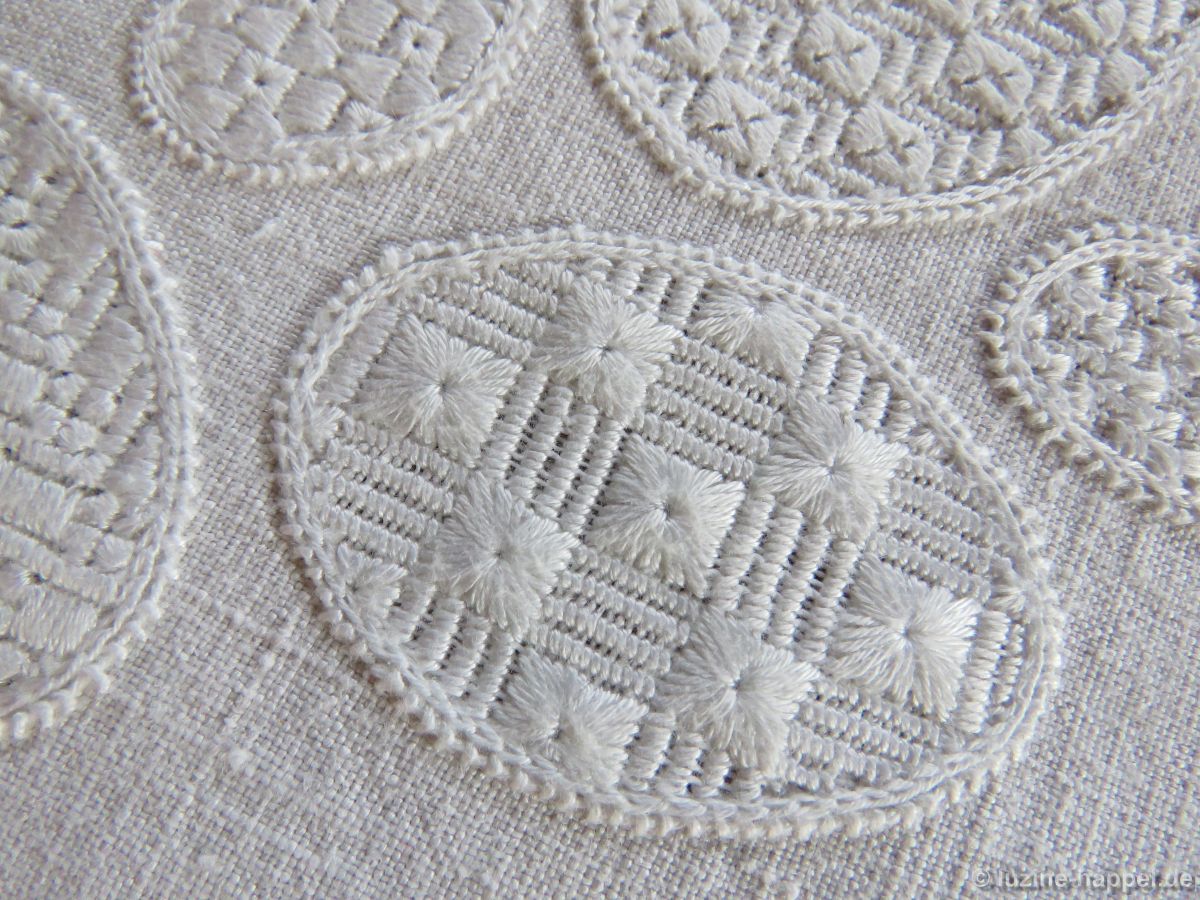
Many different patterns are suitable, such as the crosses formed with parts of square eyelets and Satin stitches. It is a nice pattern especially suited for an Easter decoration, isn´t it?


Combining delicate


and more prominent patterns


establishes a pleasing contrast.


This design is worked on a very dense handwoven linen with a thread count of 20/cm.

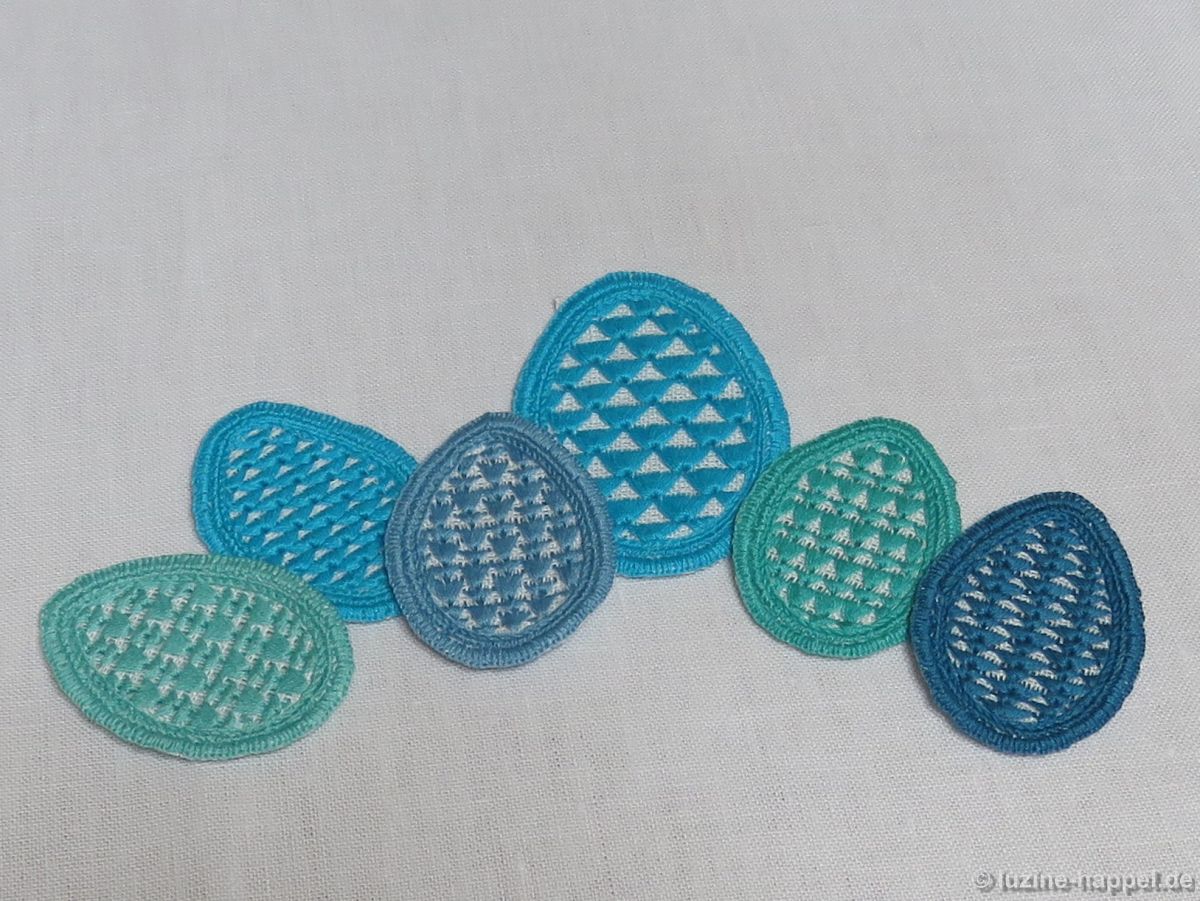
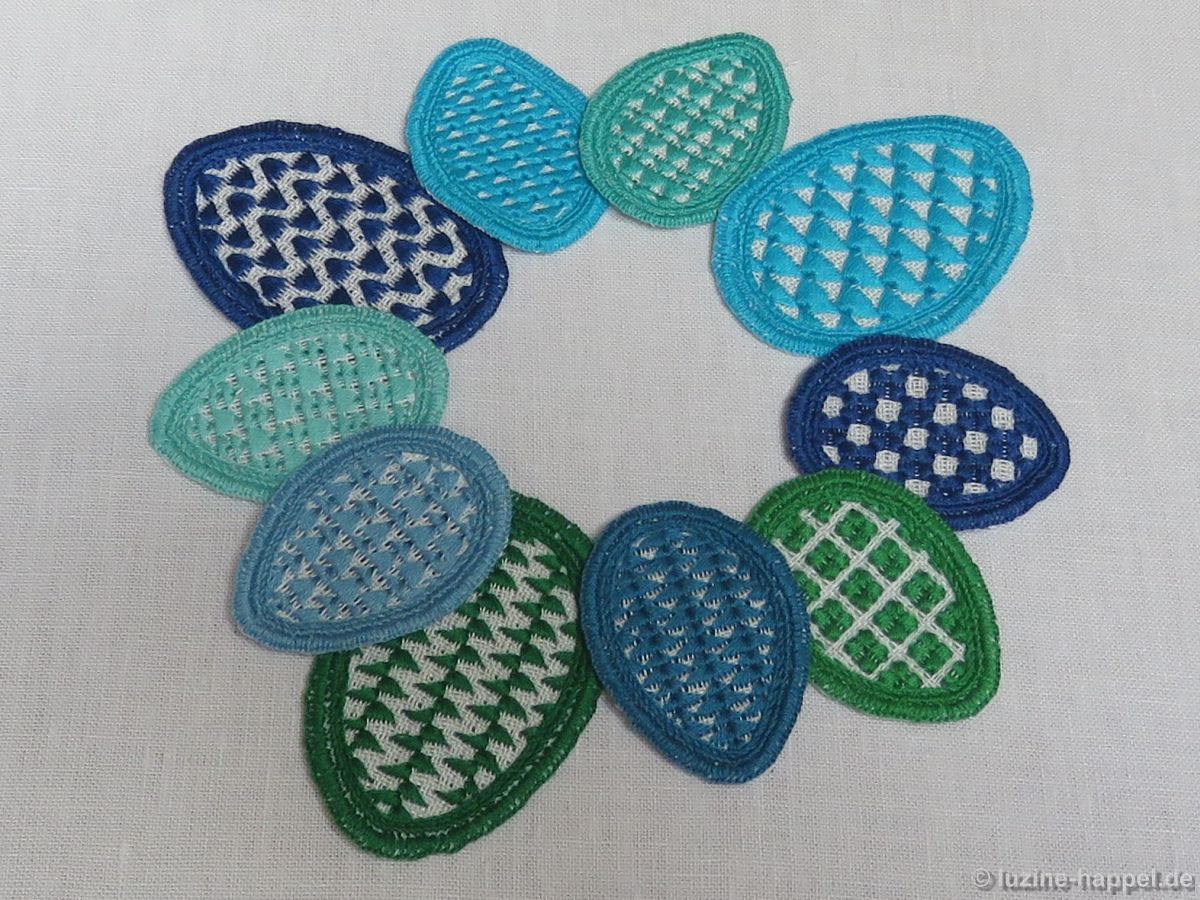
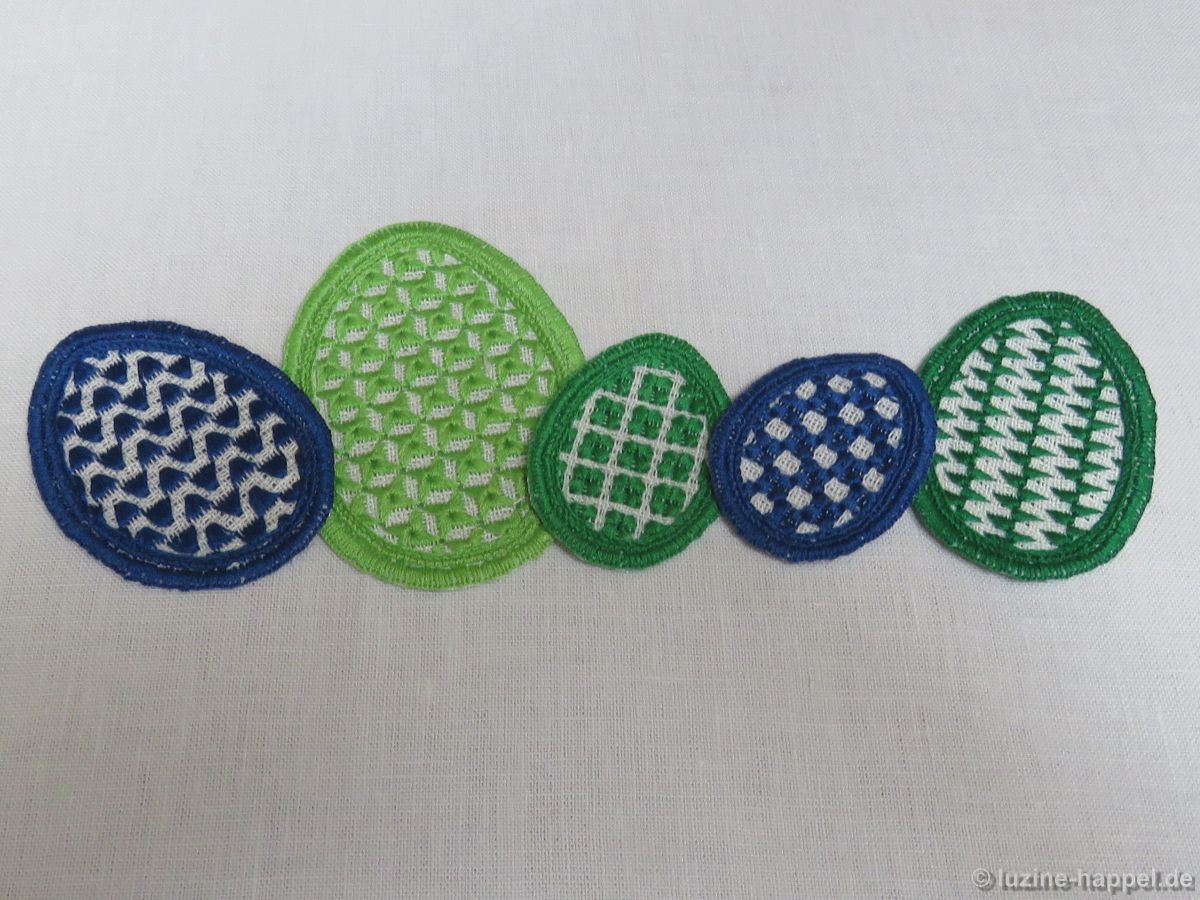
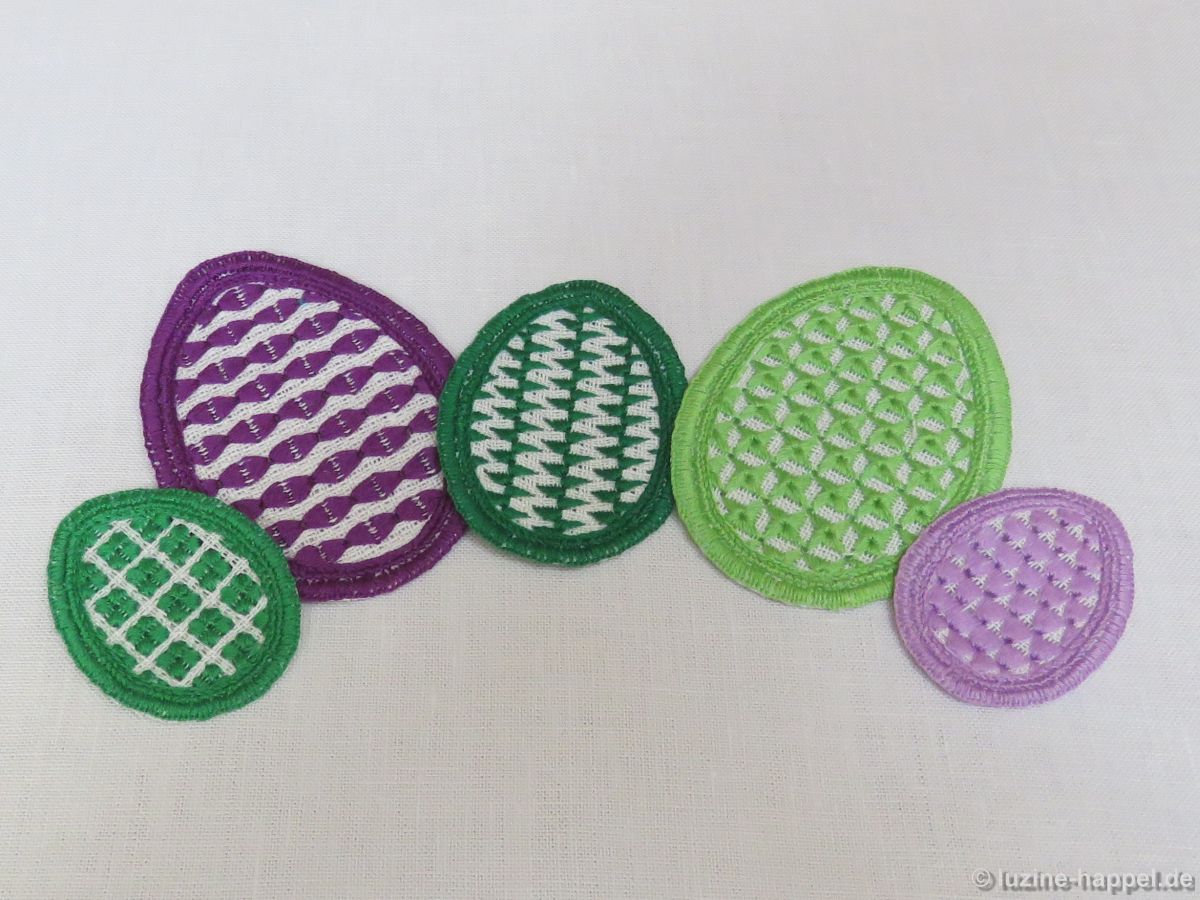
Coloured Easter Eggs

As already mentioned, Easter eggs are especially suited for trying out different patterns. And square eyelet patterns are perfect for egg shapes.

Here I will show that the patterns are not only well suited to whitework or Schwalm whitework but also to other embroidery techniques that use coloured threads to attractively fill shapes.
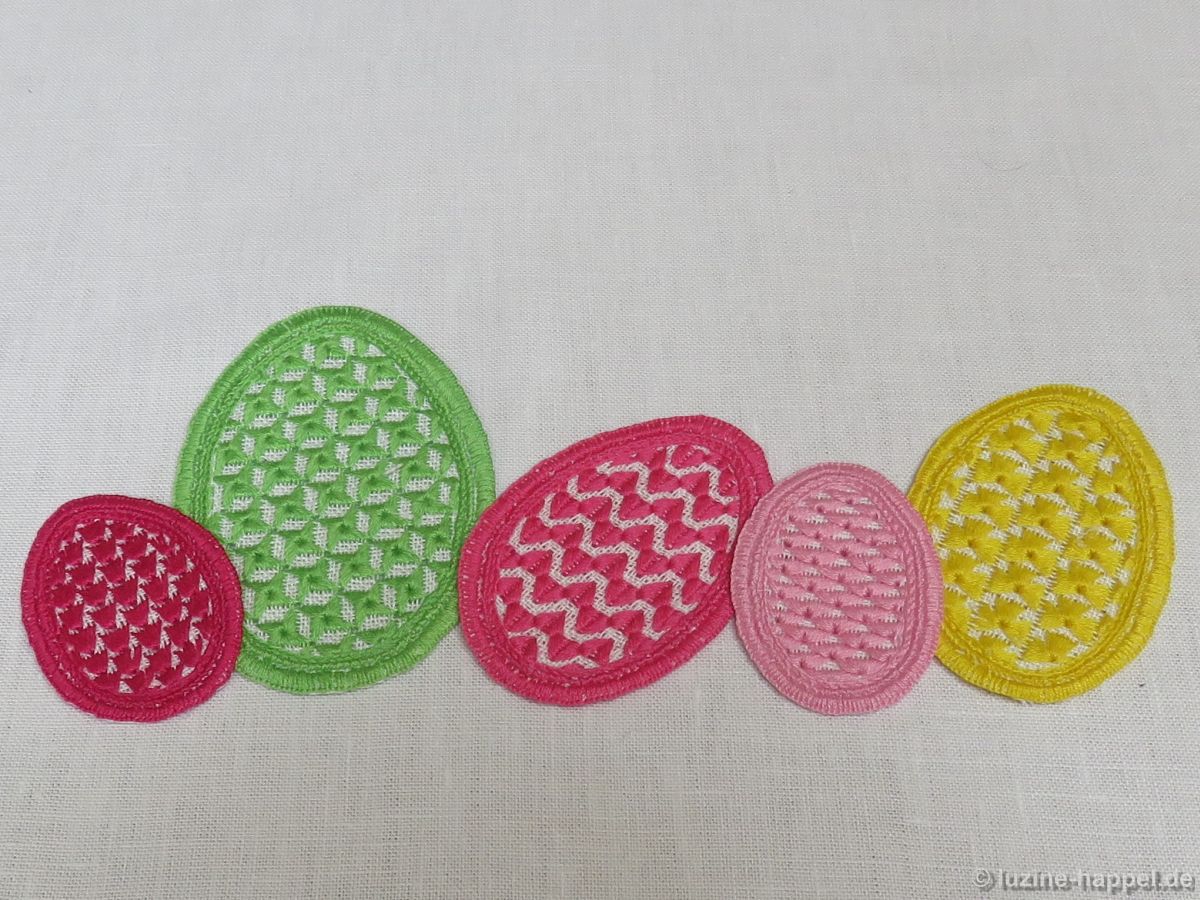
1_13-2017Easter eggs are embroidered in different sizes (the first steps can be found here – please see images 2–5) and cut out after finishing. This allows one to create different arrangements as the mood and decor dictate. I used linen with a 13.5/cm thread count and two strands of the six-strand embroidery floss.
2_13-2017I used different colours and different filling patterns – that made embroidering a real pleasure. I was always excited to see the patterns develop. It was fun to “paint” the eggs so differently with striped (horizontal, vertical, diagonal), dotted, or zigzag patterns.
3_13-2017The cut eggs are especially suited to various arrangements. For example, one can arrange eggs in spring-like colours in a straight line.
4_13-2017Or if one prefers water colours, it is no problem to find attractive arrangements using only those colours
5_13-2017in straight lines
6_13-2017or circles.
7_13-2017The combinations of colour and arrangement are endless: green combined with blue …
8_3-2017or green combined with lilac …
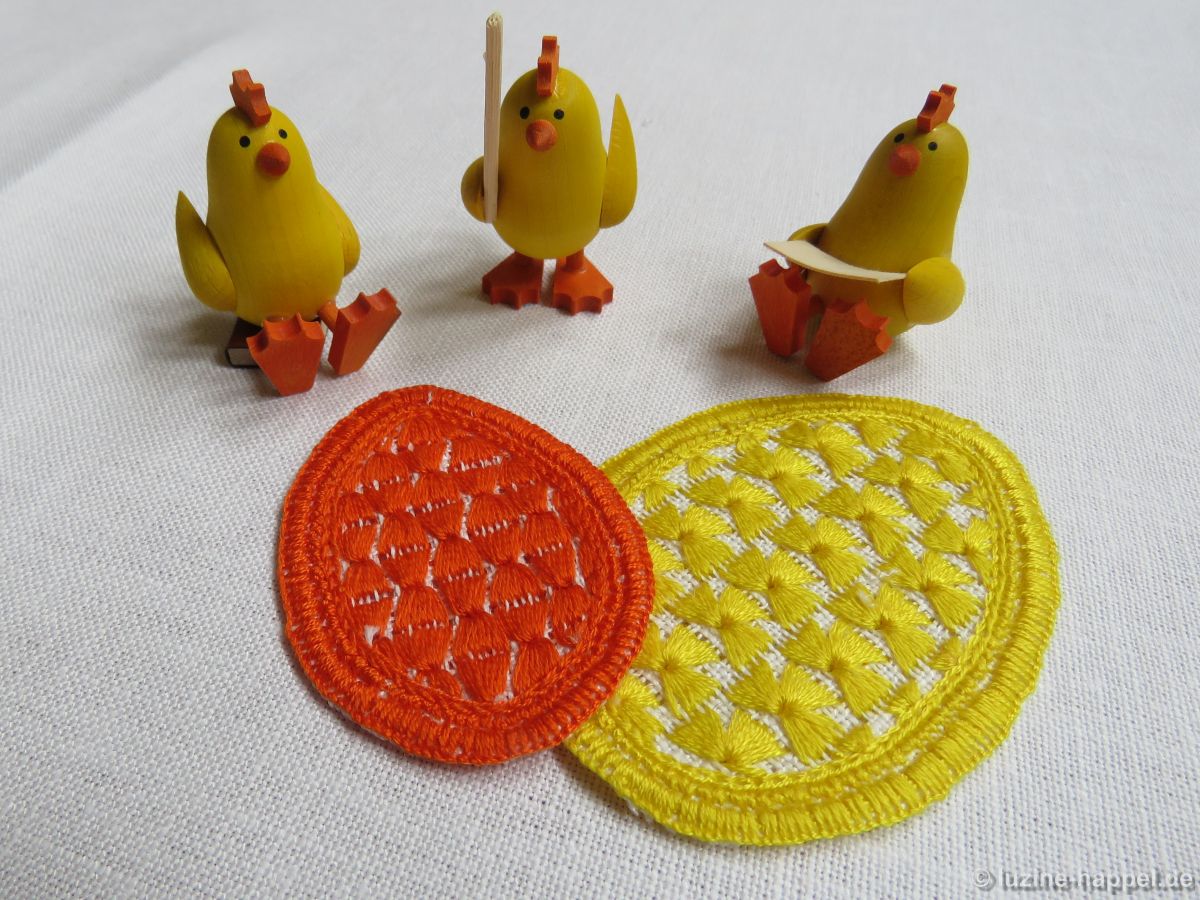
9_13-2017colours matching special decorations, here yellow and orange …
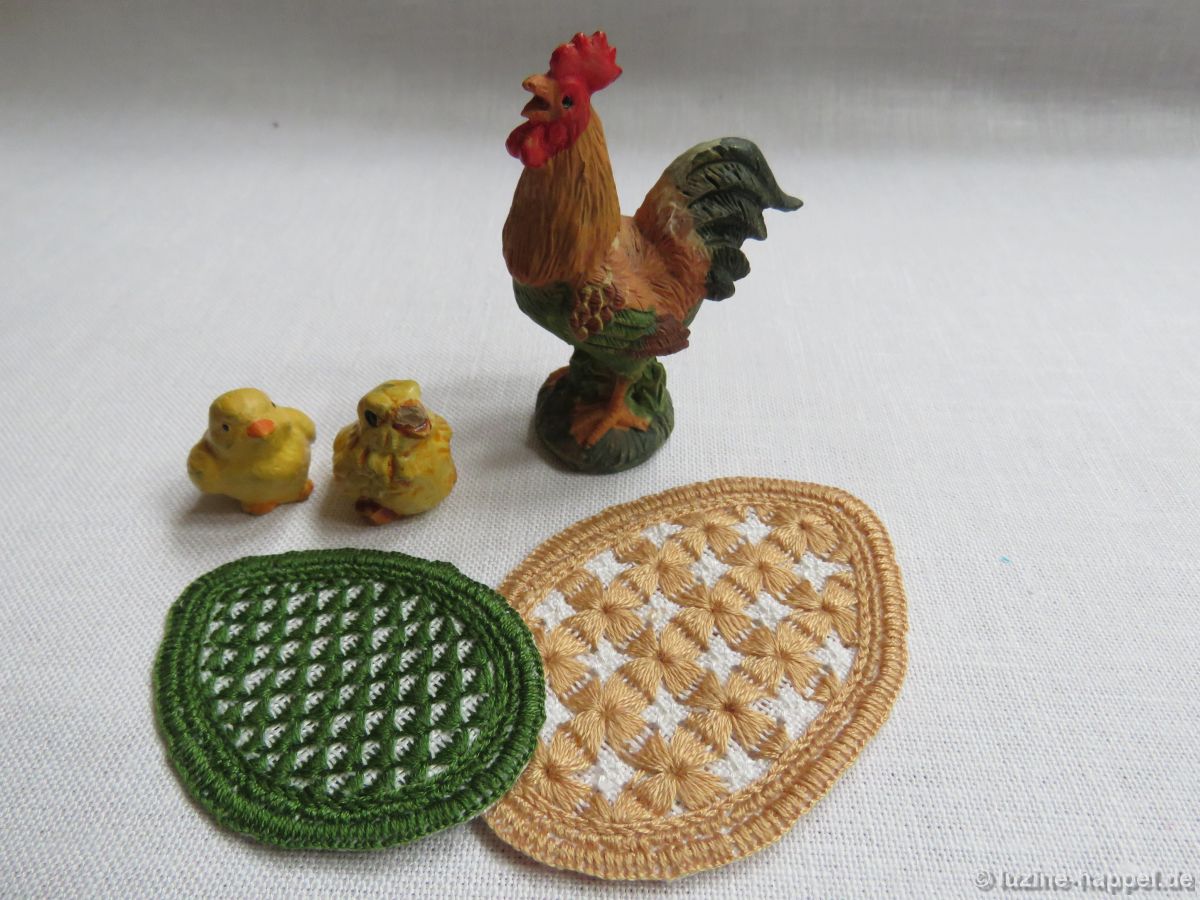
10_13-2017or here green and beige …
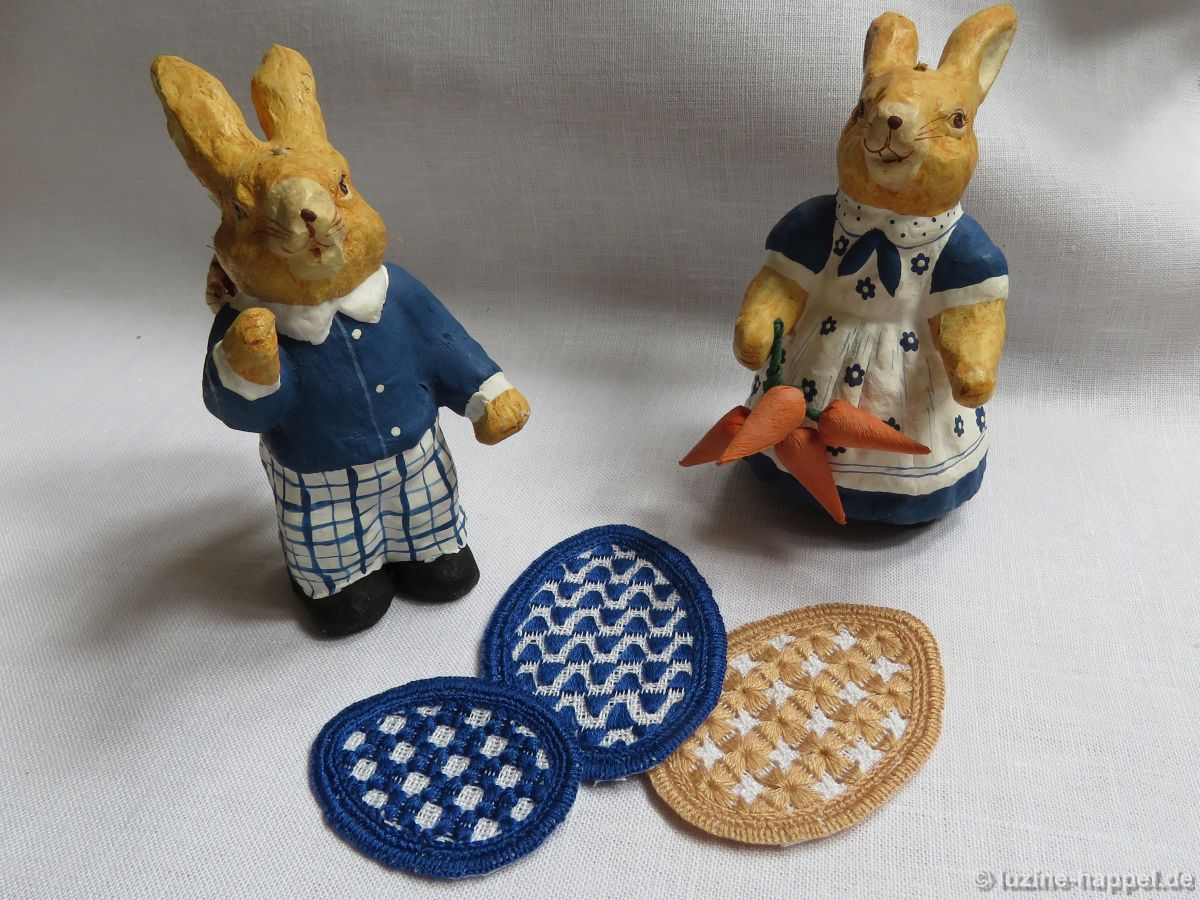
11_13-2017of course blue and white always look fresh.
12_13-2017As you can see these embroidered Easter eggs are manifestly combinable and adaptable. With only a little imagination, they are easily assembled into yet another new arrangement.
13_13-2017Making a colourful arrangement is not only fun with eye-catching results but also a good way to use
up leftover threads!

Most of the square eyelet patterns seen in the pictures above can be found in my books Limetrosen I and Limetrosen II.

Jessica Grimm has used these patterns – different and very interesting – to variegate her fishes.

An Easter Egg Border

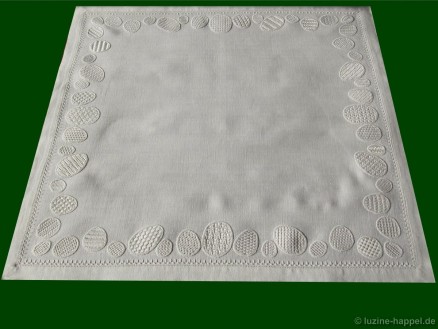
Easter eggs are especially suited for trying out different patterns. Because of the rounded shape without small or pointed areas, the arrangement of the pattern at the edges is easy to work. I wanted a border design, but there were so many issues to consider: Which sizes of eggs create a nice balance? Which shapes are best? How tall should they be? How should they be angled? I preferred to ask an artist; Artist Gudrun Hartwig designed this special Easter border.

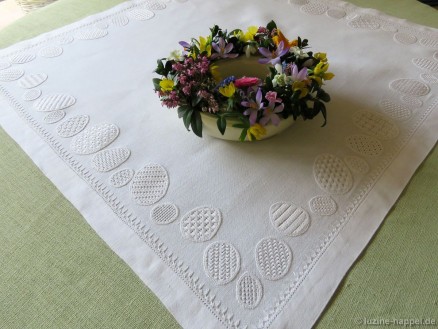
The border shows Easter eggs lying in the grass. Some Easter eggs lie on the straight of grain and some on the bias. I decided to decorate the edges of a square tea cloth with the border. It measures 75 cm X 75 cm.
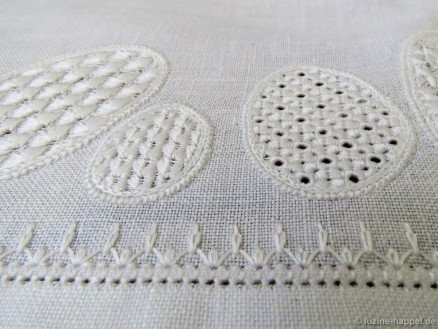
1_12-2017To simulate grass, I used “Trachtenstitch” (see Fancy Hems pages 14–16).
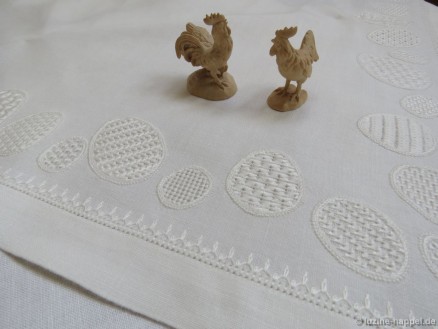
2_12-2017Each of the fifty-four eggs got its own special pattern. This was a real pleasure to stitch. I used exclusively square eyelet patterns, most can be found in my Limetrosen I book. The patterns in Limetrosen I are perfect for the egg shapes. And the variety of patterns in the book is vast – there are patterns for small shapes and big shapes, patterns appropriate for working on the straight of grain and on the bias. There are even some patterns for slanting shapes.
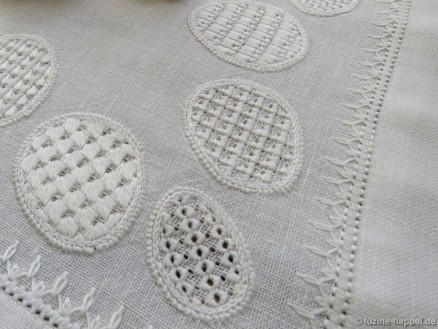
3_12-2017The Easter eggs can be decorated with striped patterns
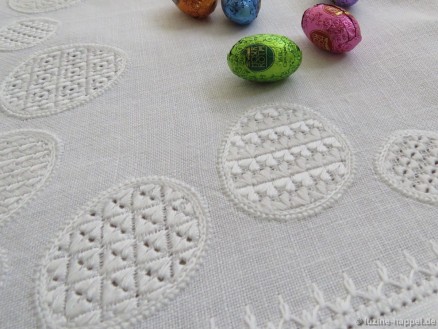
4_12-2017or with dots.
5_12-2017The Limetrosen patterns use more thread than many other stitches. But the effect of the threads, dense and lying in different directions on top of the fabric, is very pleasant indeed. Chiaroscuro – the interplay of light and shadow – makes the border beautiful, although is is unadorned. My tea cloth is eye catching. The whitework is timeless; it complements all kinds of crockery, flowers, and contemporary decorations.
6_12_2017

An Easter Egg

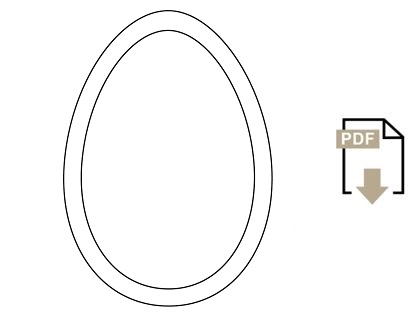
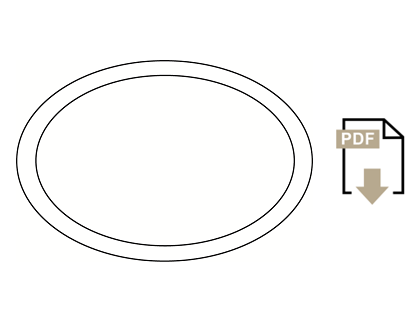
A simple oval design with a double line (Here: external measurements 8 cm X 5.28 cm)
2016-03-23_pdf
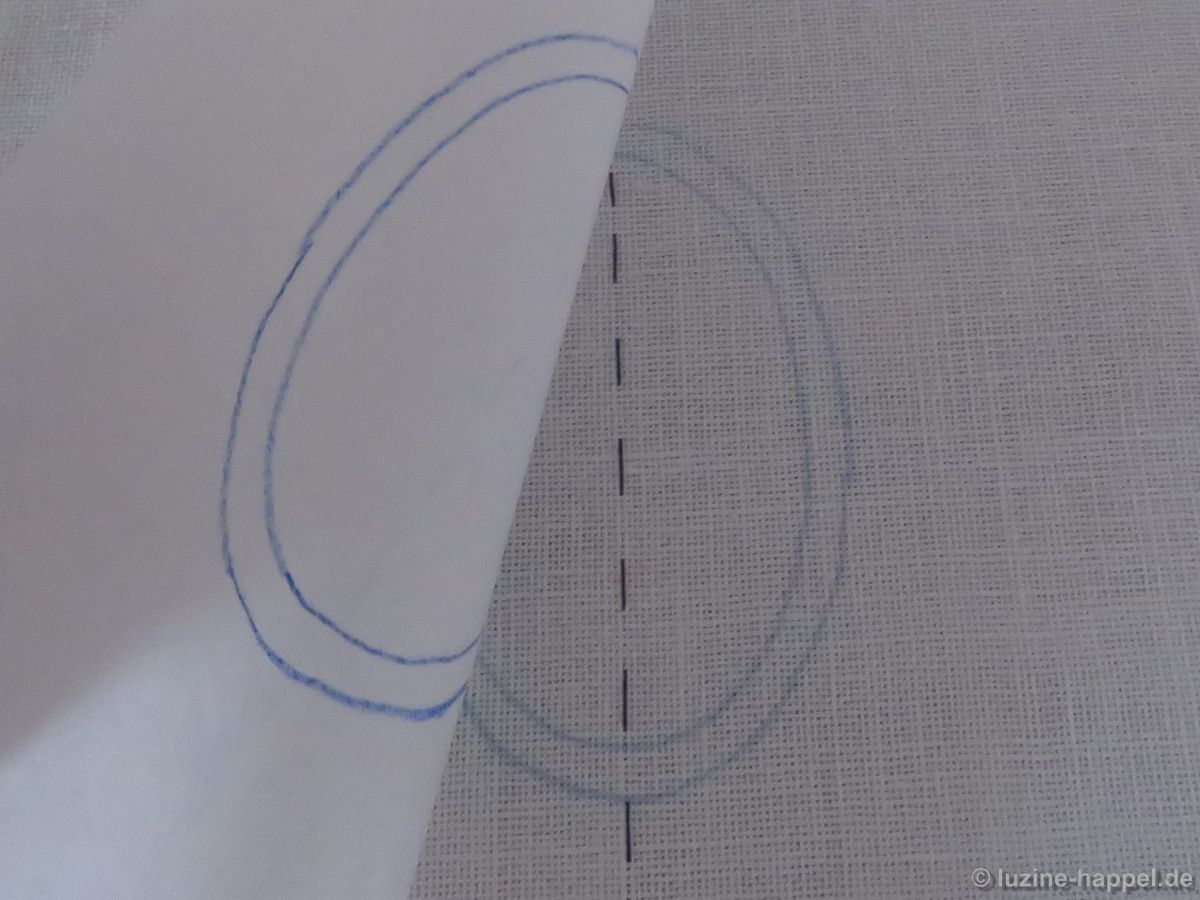
was ironed on Weddigen linen, 13.5/cm thread count.
OE_2Coton à broder No. 16 is used for the Coral Knot stitches, No. 20 for both the Blanket stitches and the filling pattern, and No. 25 for the Chain stitches.
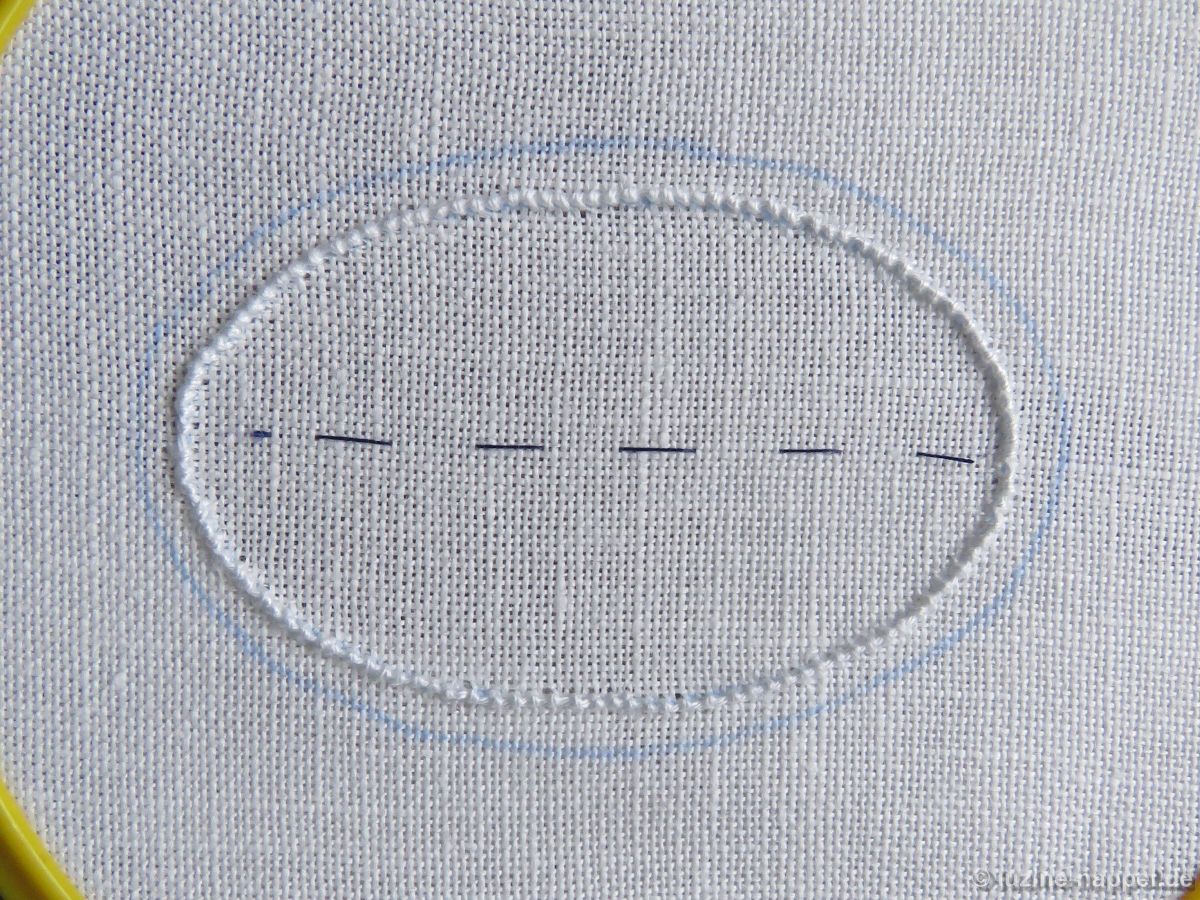
Coral Knot stitches are worked along the inner line.
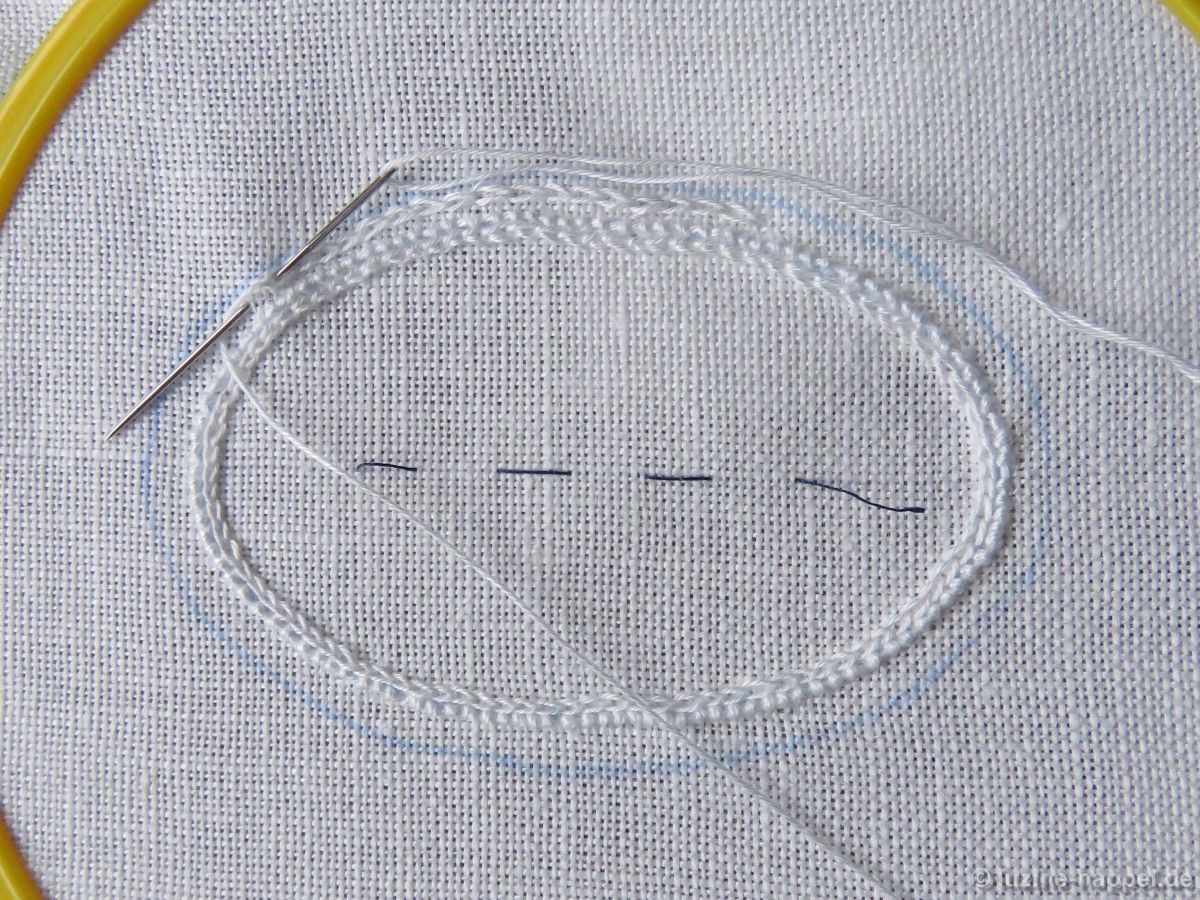
OE_3Chain stitches are worked directly inside the Coral Knot stitches.
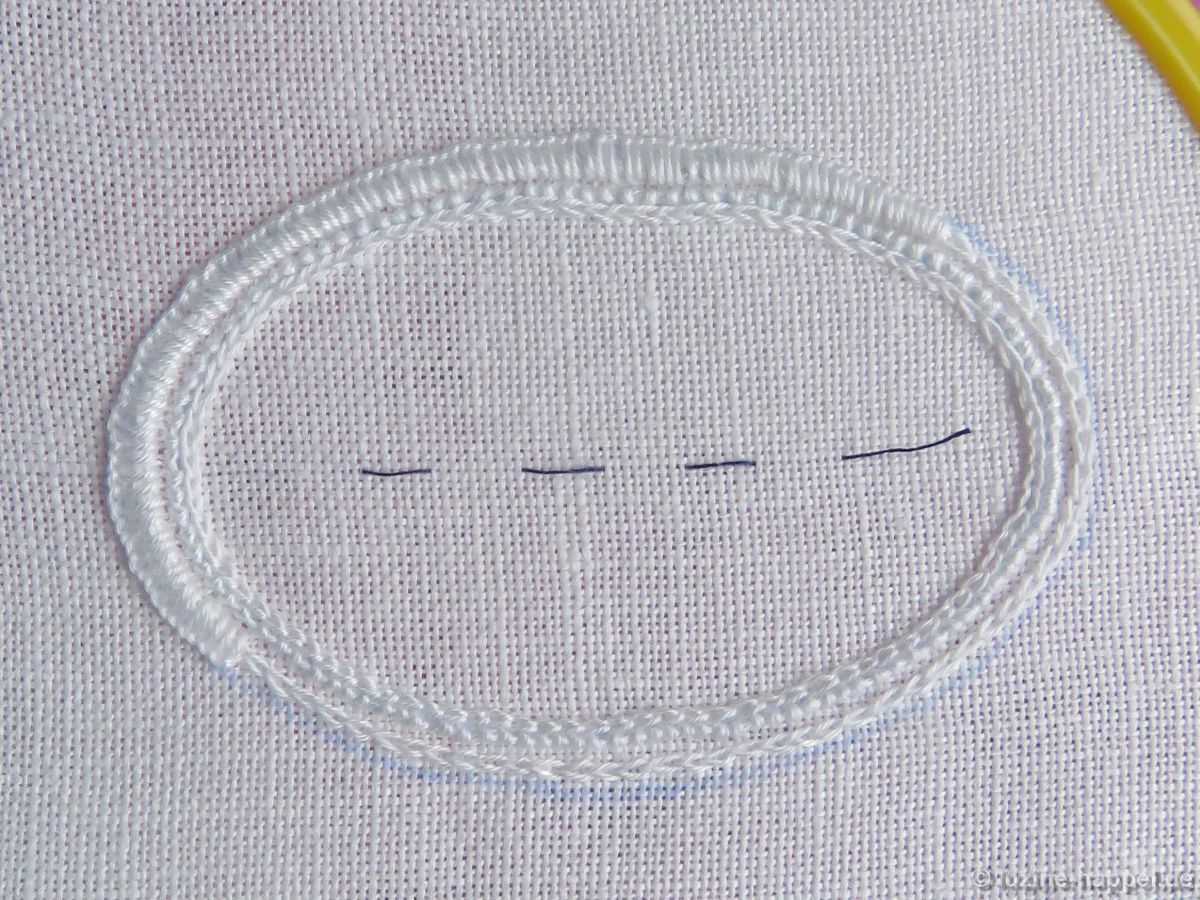
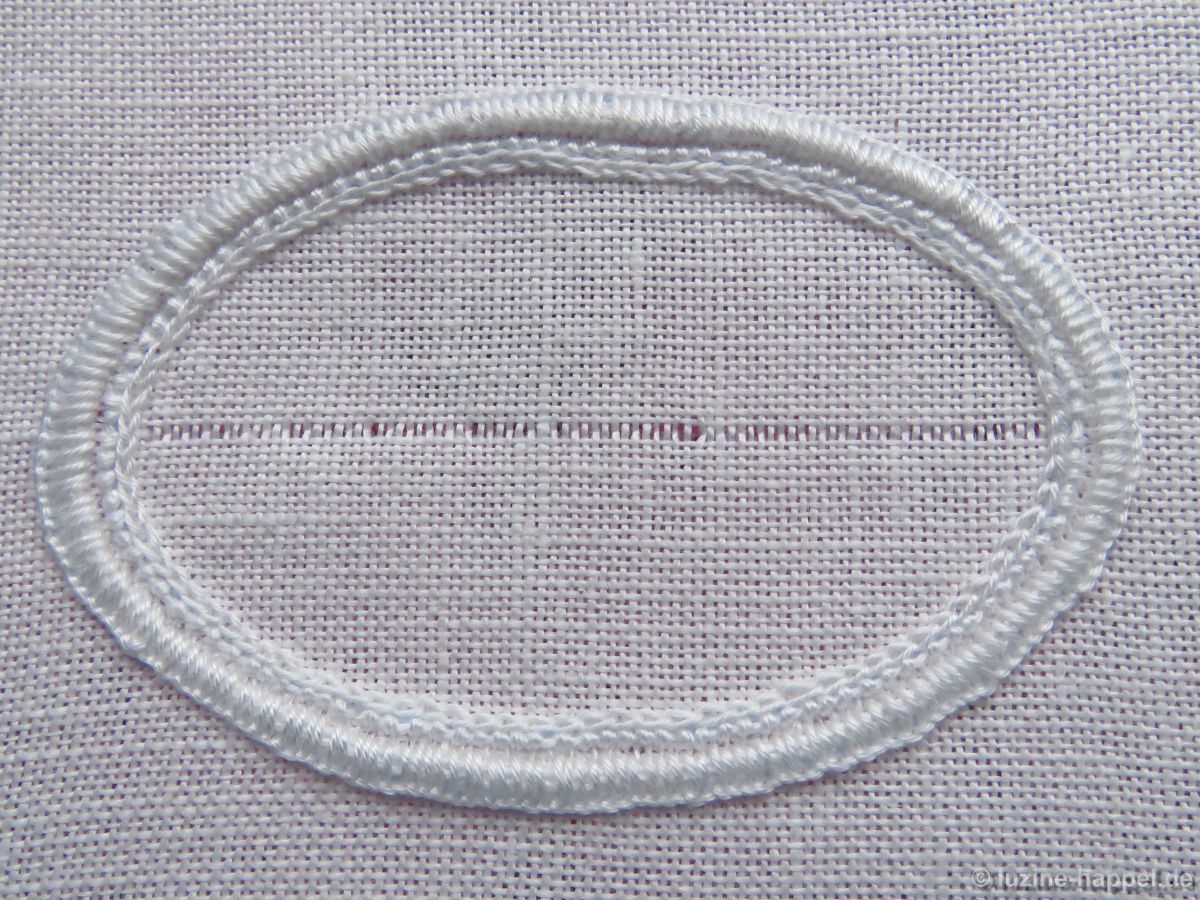
OE_4Chain stitches are worked a small distance outside the Coral Knot stitches. The outside Chain stitches are covered with densely worked Blanket stitches between the outline and the Coral Knot line.
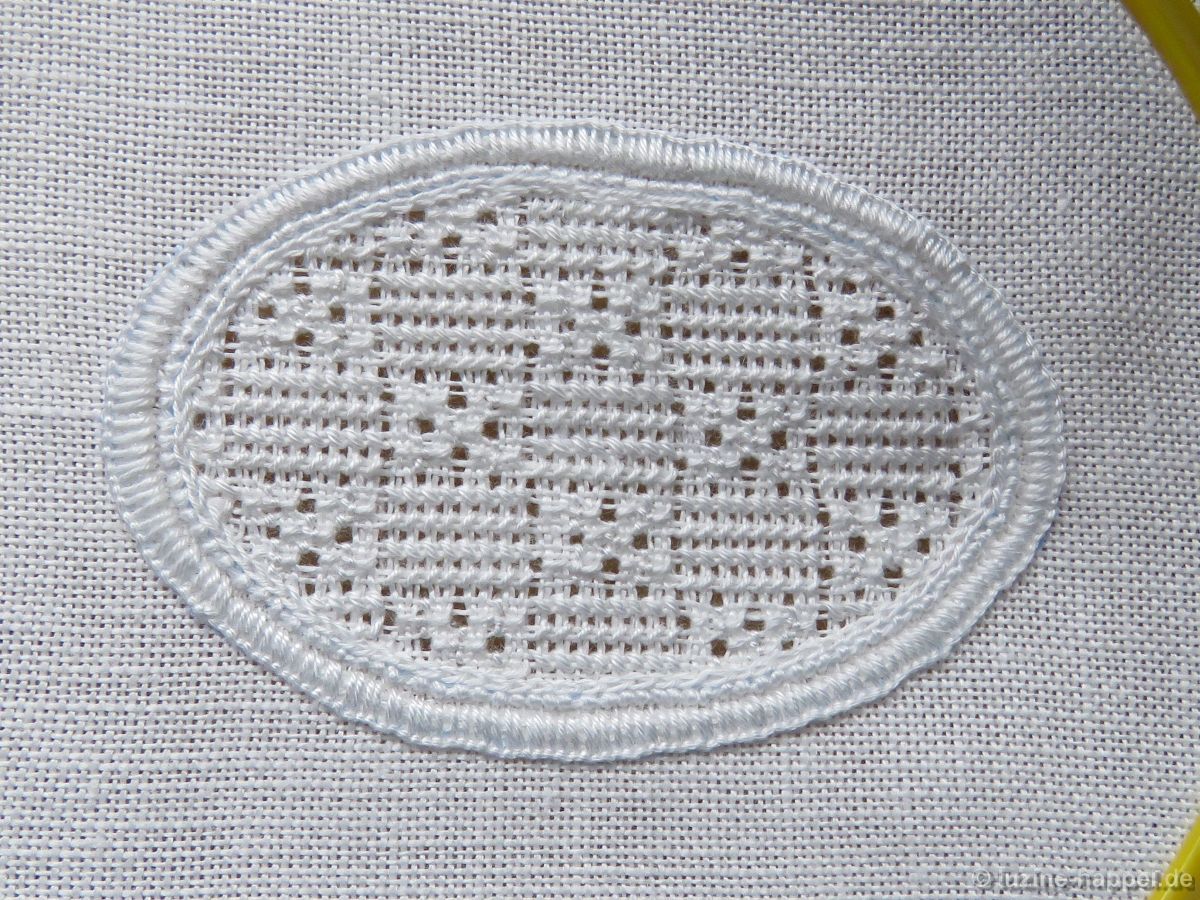
OE_5The shape was filled with pattern “478”.
Starting in the middle, alternate withdrawing 1 vertical thread and leaving 2 vertical threads.
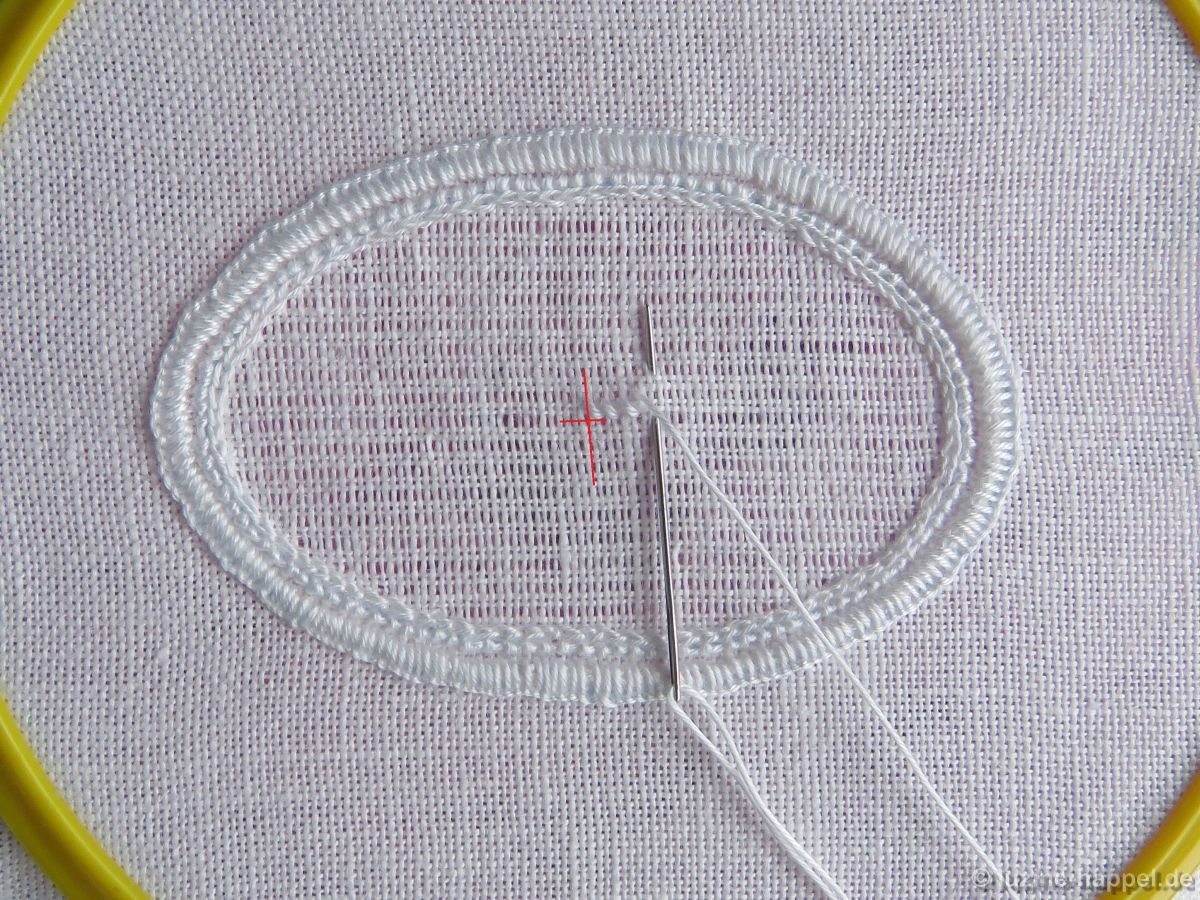
OE_7Start at the center (red marked)
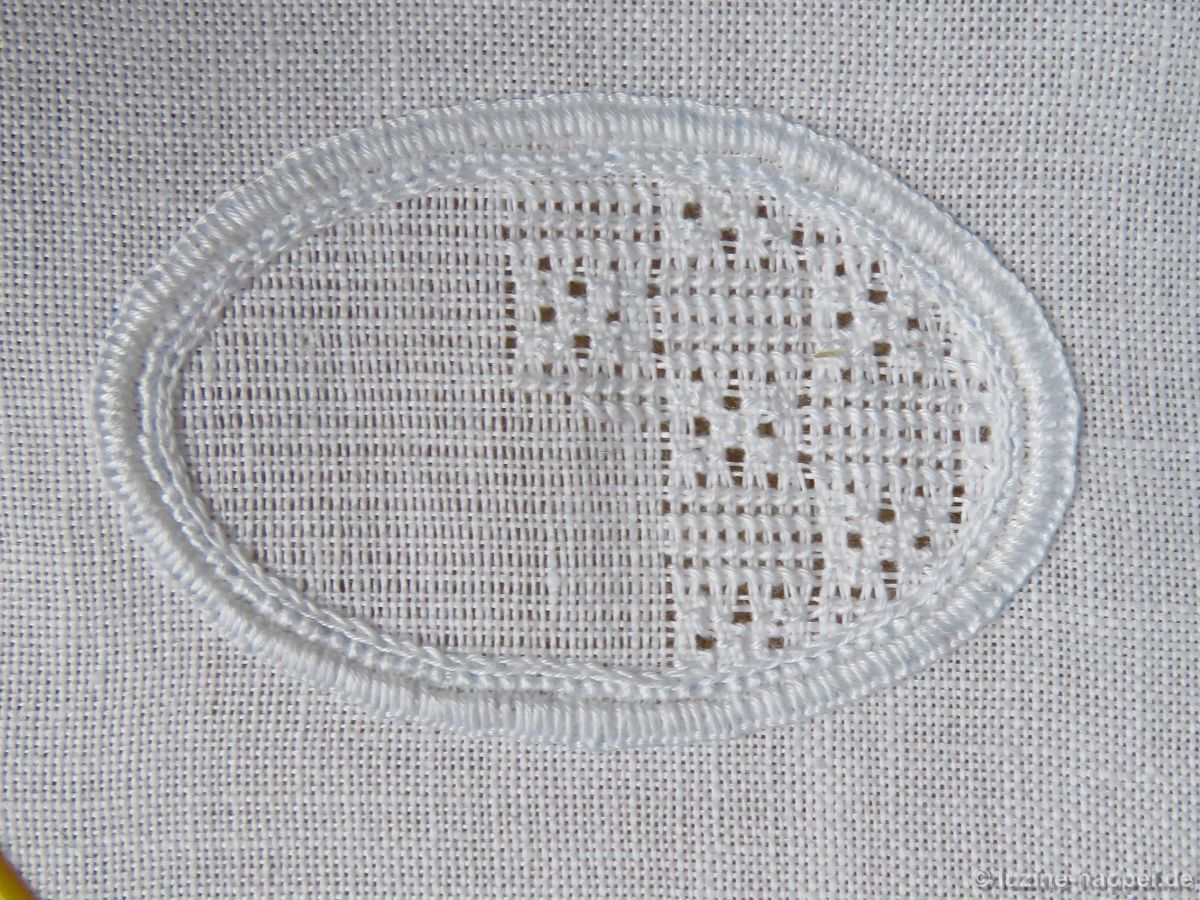
OE_8always alternate working four blocks of Satin stitches and 5 Rose stitches.
OE_9The first row is finished up from the already worked section.
OE_10After finishing, the embroidered piece is washed (boiled), starched and ironed. Then, the egg is cut.
OE_11If needed, such closely trimmed embroidery can be washed and ironed – quick and easy – at any time, but never spun in a washing machine!
OE_12Whether you choose to place the egg on a surface, to hang it, or to mount it in a frame, cutting out the embroidery opens up manifold ways for decorations.
OE_13

Happy Easter!