Global Schwalm Sampler – Update (5)

Global Schwalm Sampler – Update (5)

Unfortunately, shipping in some regions of the world is currently either impossible or only possible to a limited extent. Please let me know your intention to contribute and your anticipated ship date by the beginning of July. I will then wait for all committed submissions to arrive here. I would like them to arrive by the end of July, but of course we will have to be flexible during these uncertain times.
Shipping within Germany and from some neighboring countries is not affected. So today I can present five new contributions to the global sampler.


#6
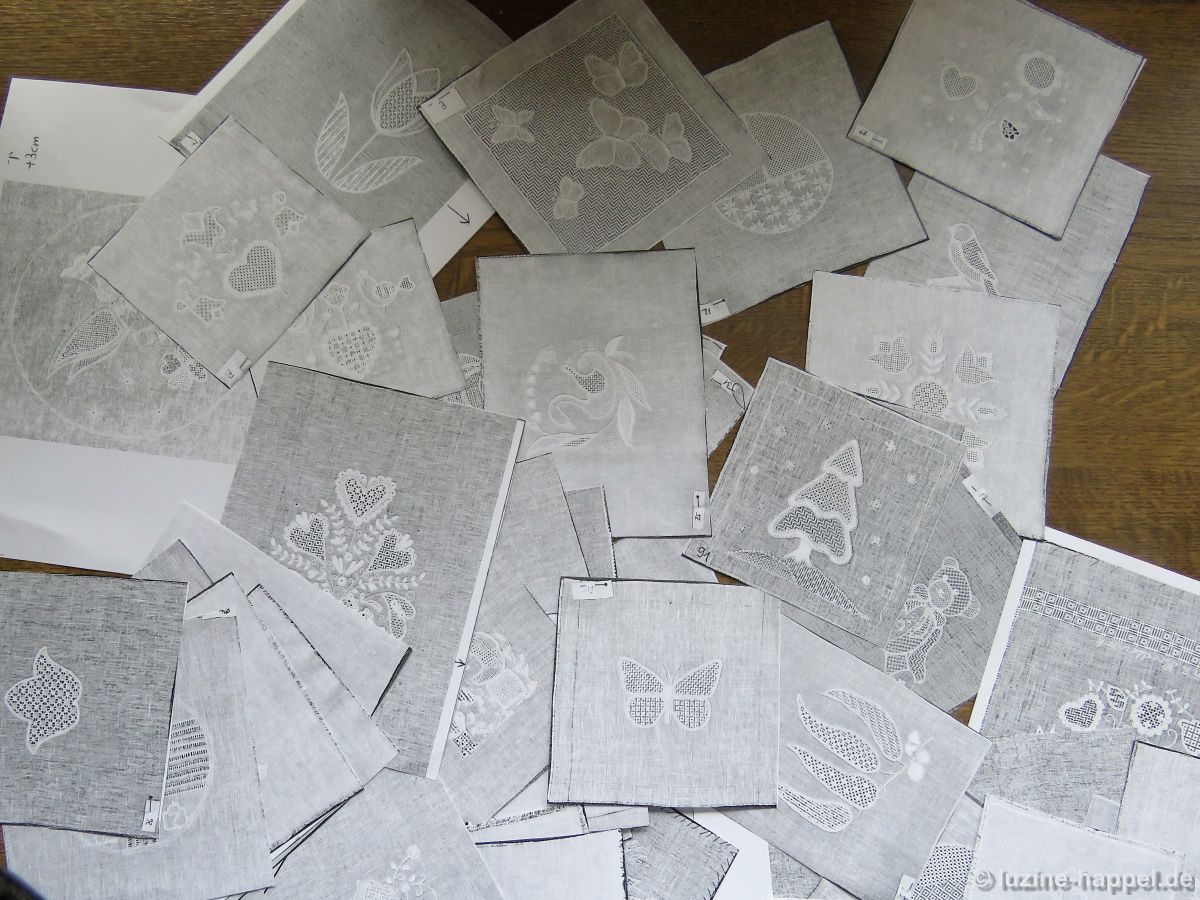
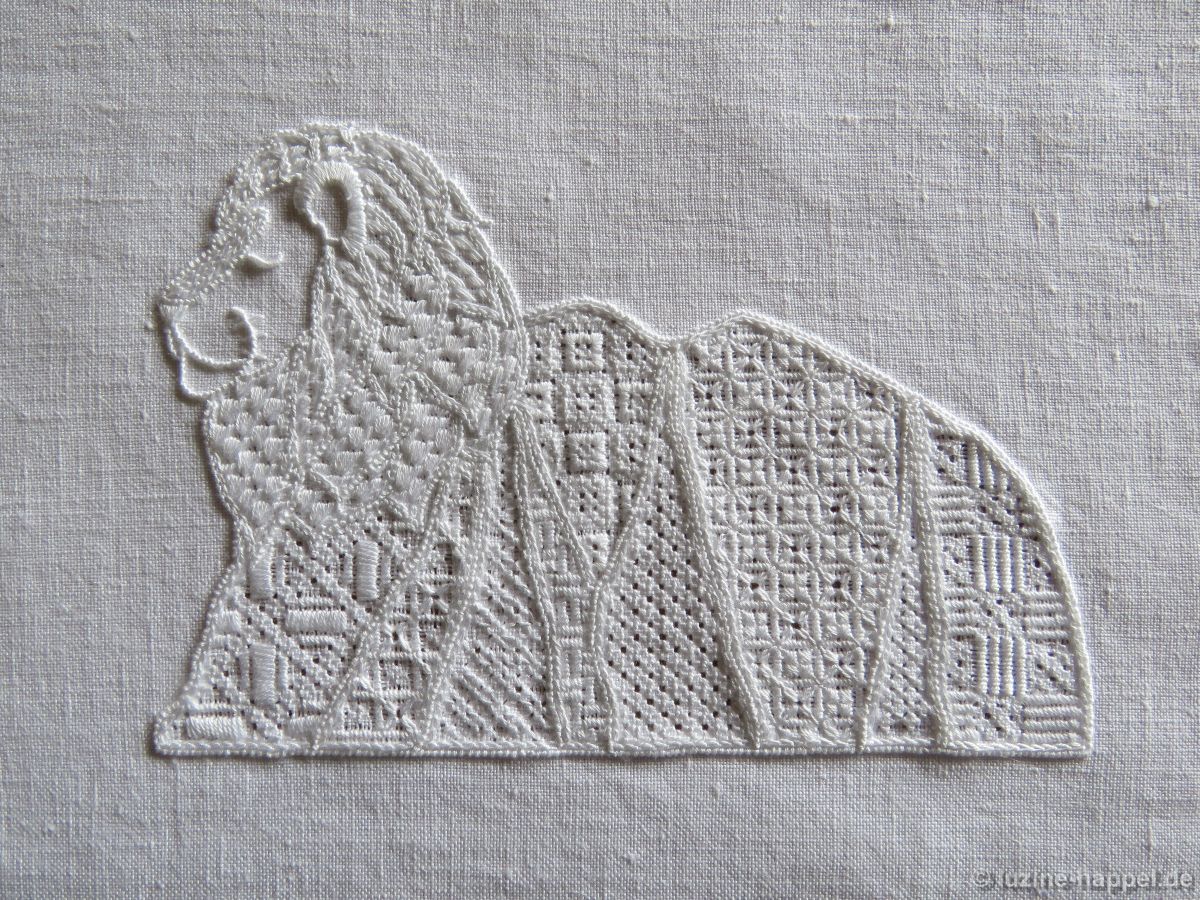
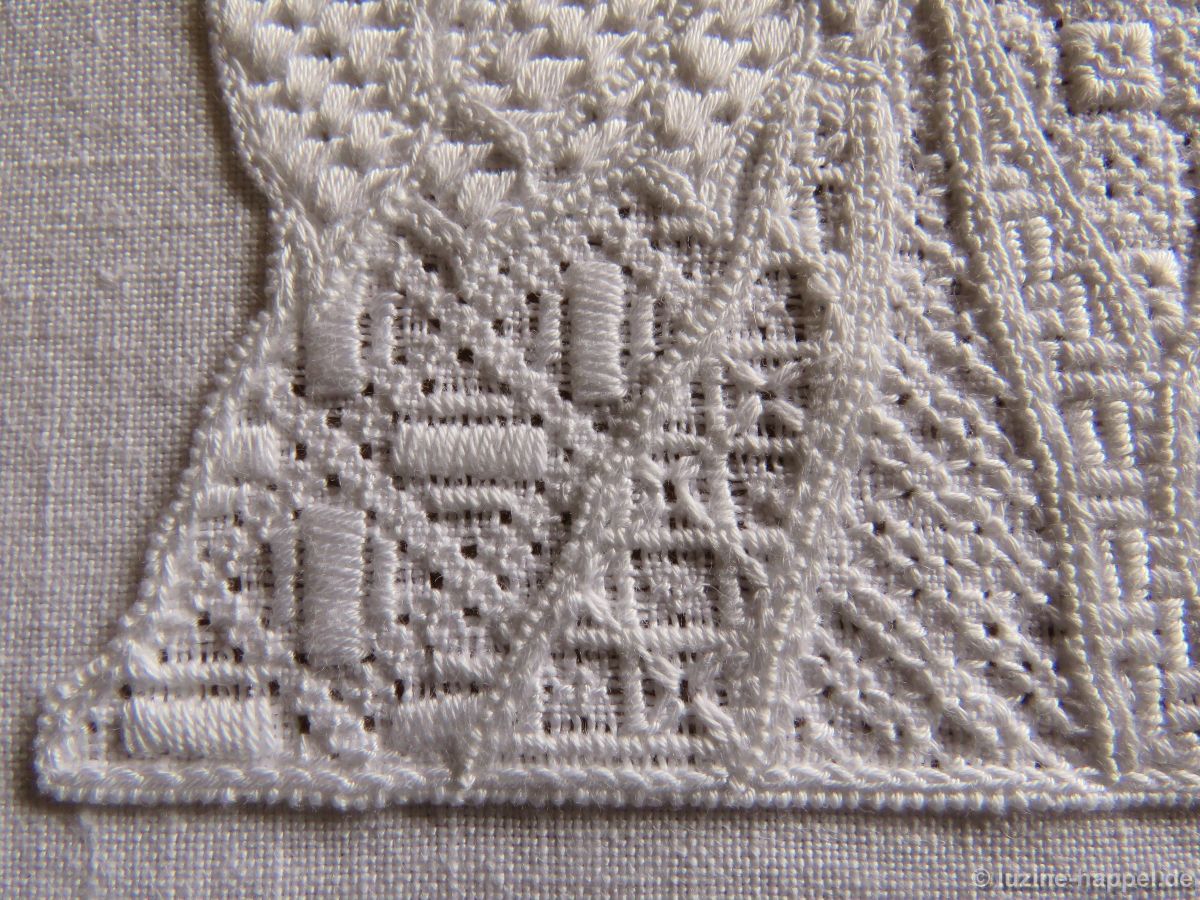
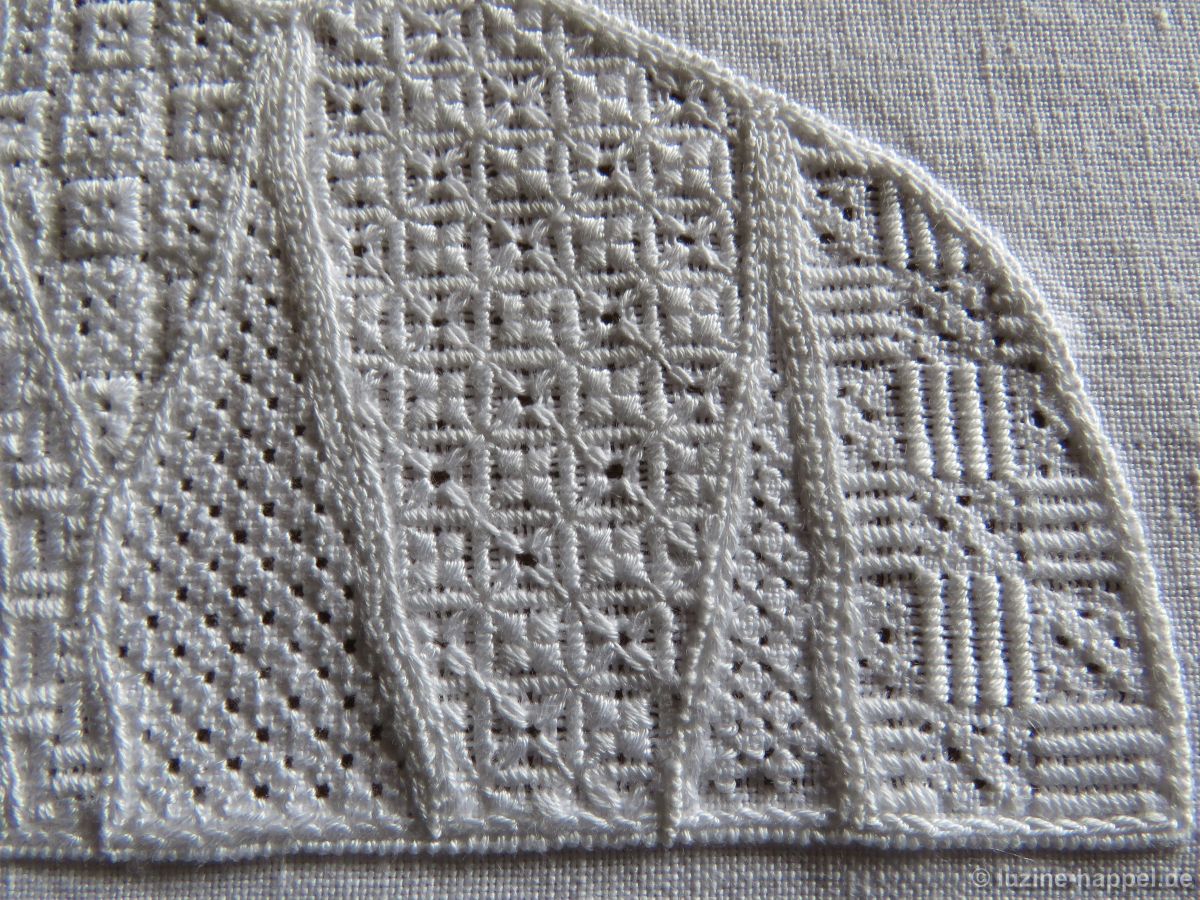
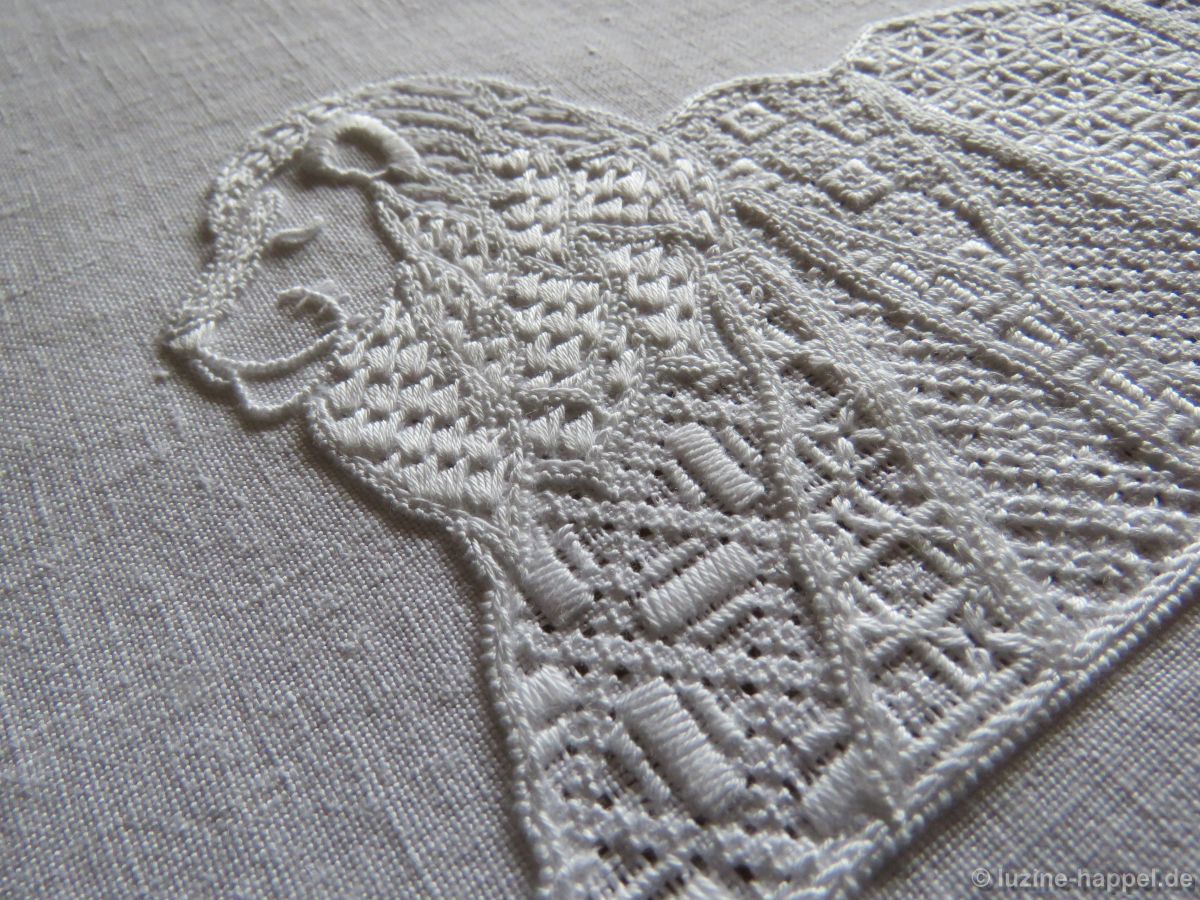
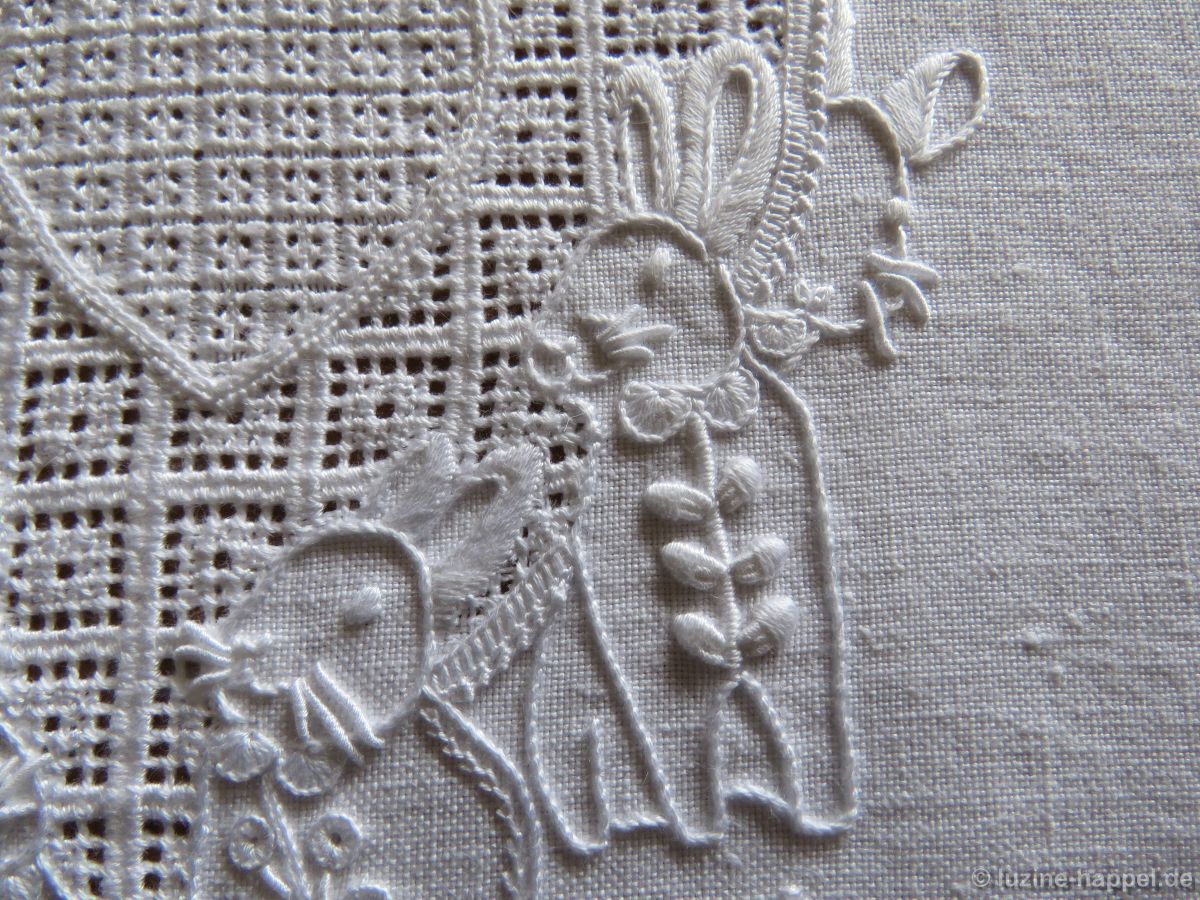
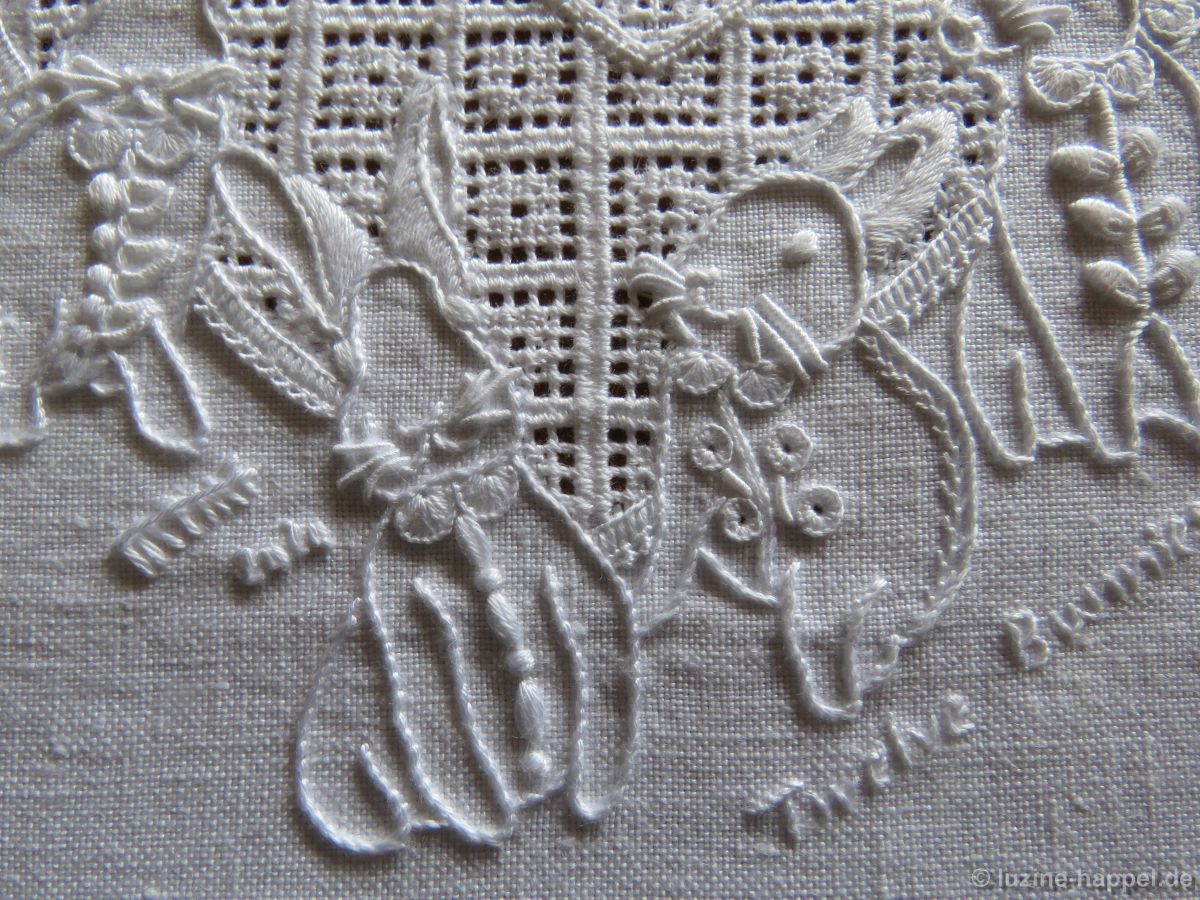
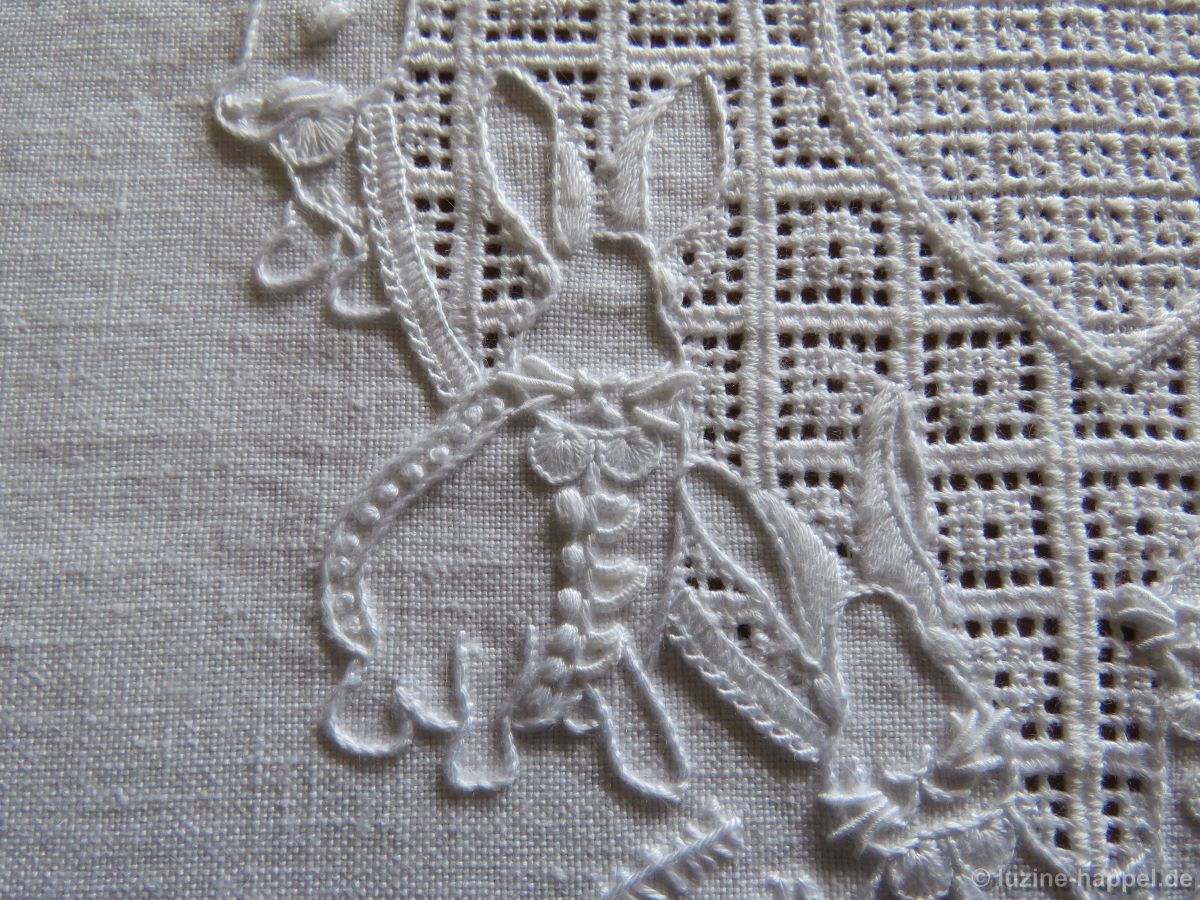
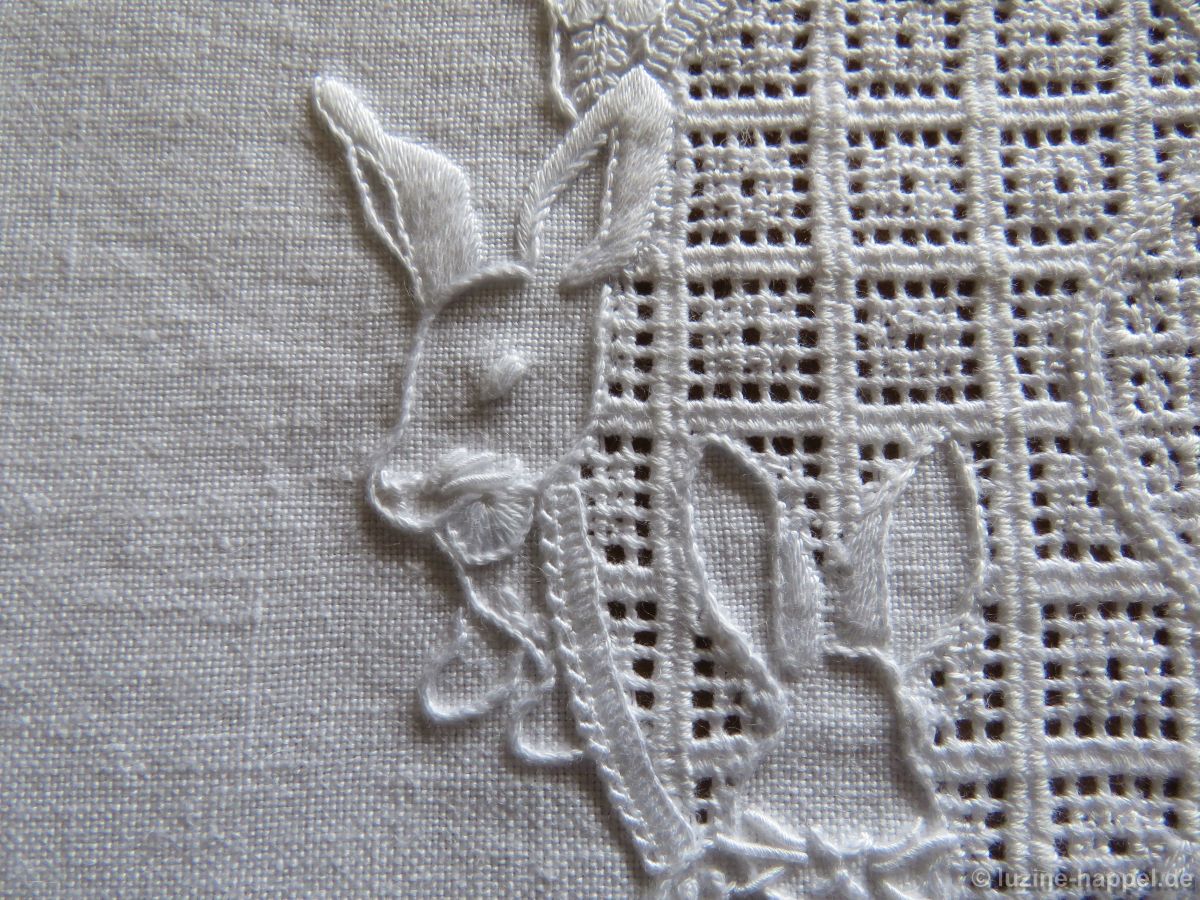
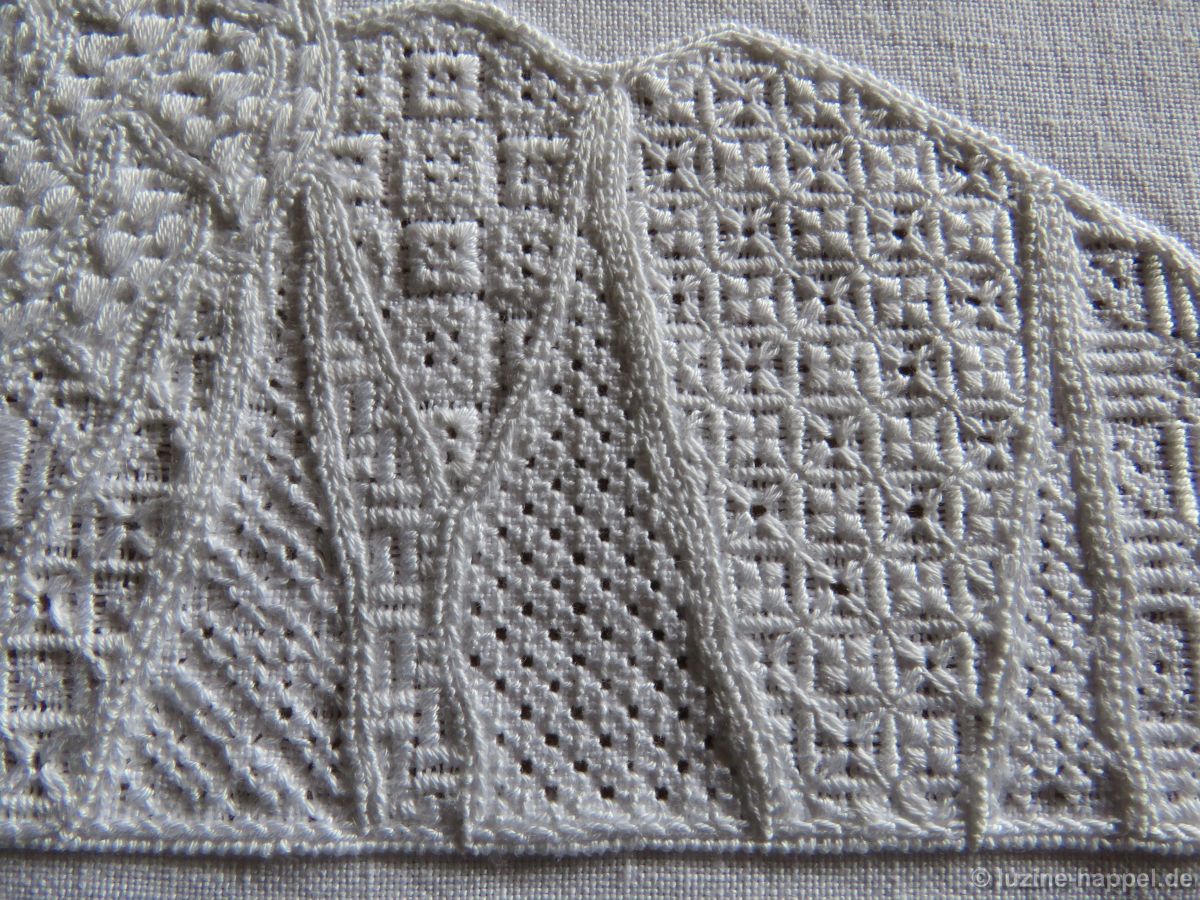
Anita Bischof from Germany embroidered an animal motif.

She wrote: “The elephant is my favorite animal. He has thick skin, but is also sensitive and very social as a herd animal. He has everything we need to get through this time. It’s better together. ”

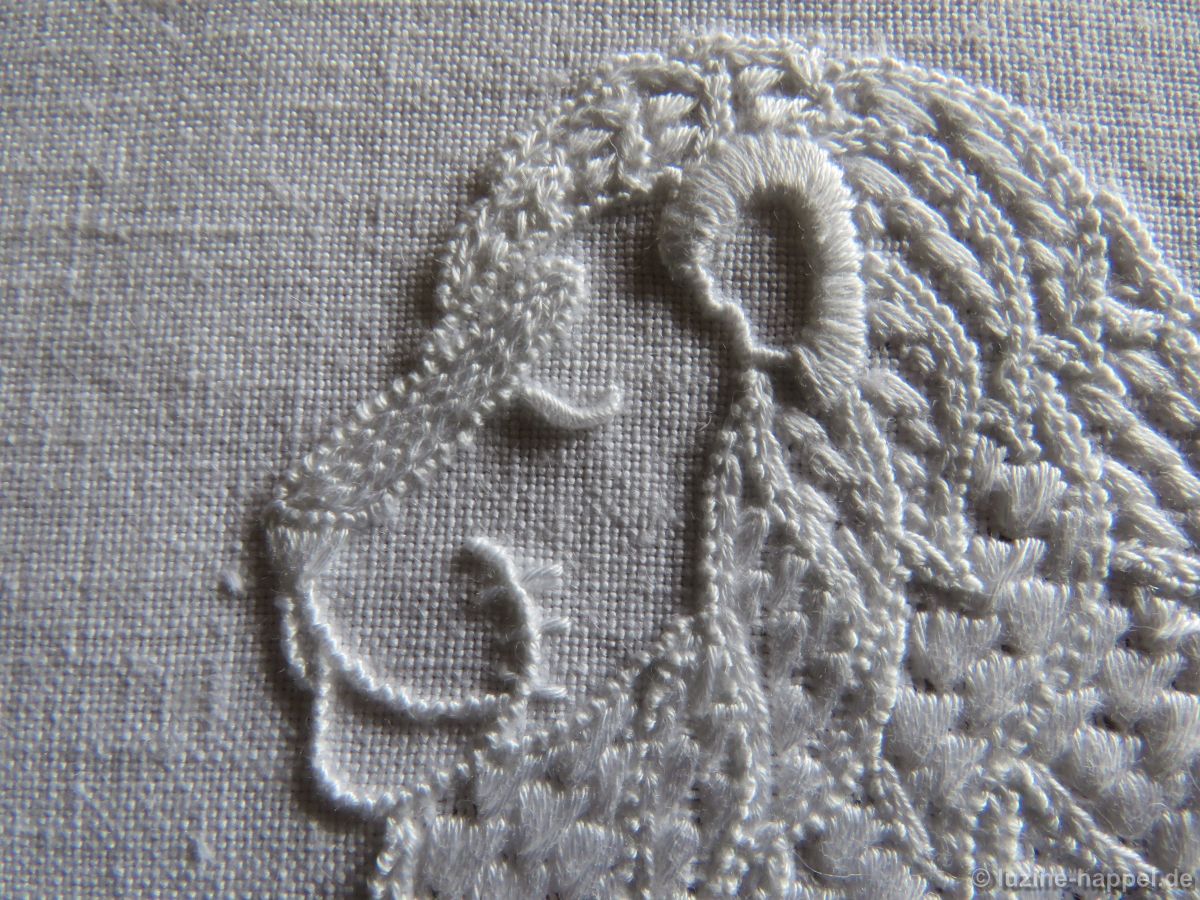
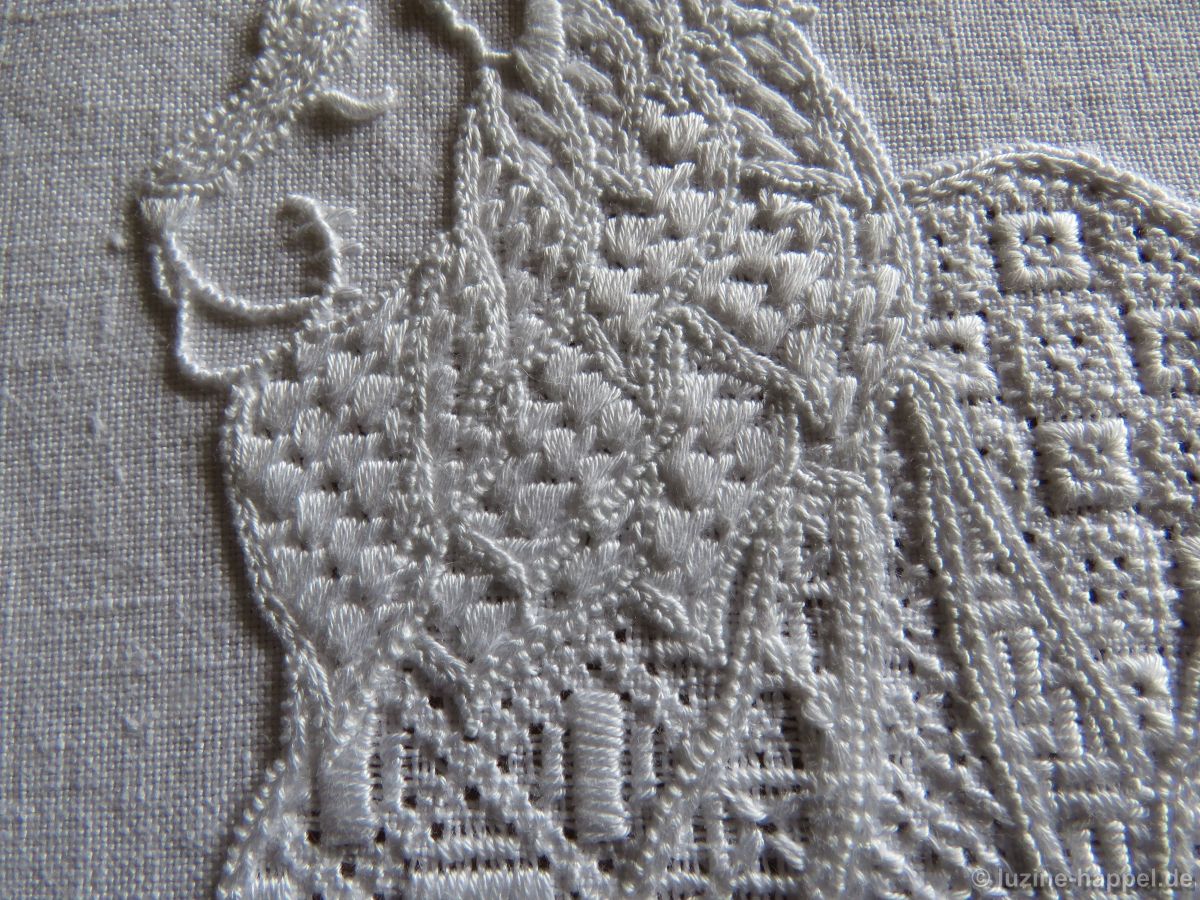
She depicted the weighty animal with matching Limet- Filling patterns. She chose Rose stitches for the body and the dense one-pattern for the ear. The tusks were given Stain stitch bars. The bend in the trunk was “drawn” with short rows of Coral knots. A Blanket stitch eyelet forms the eye and half-eyelets the toes.


#7
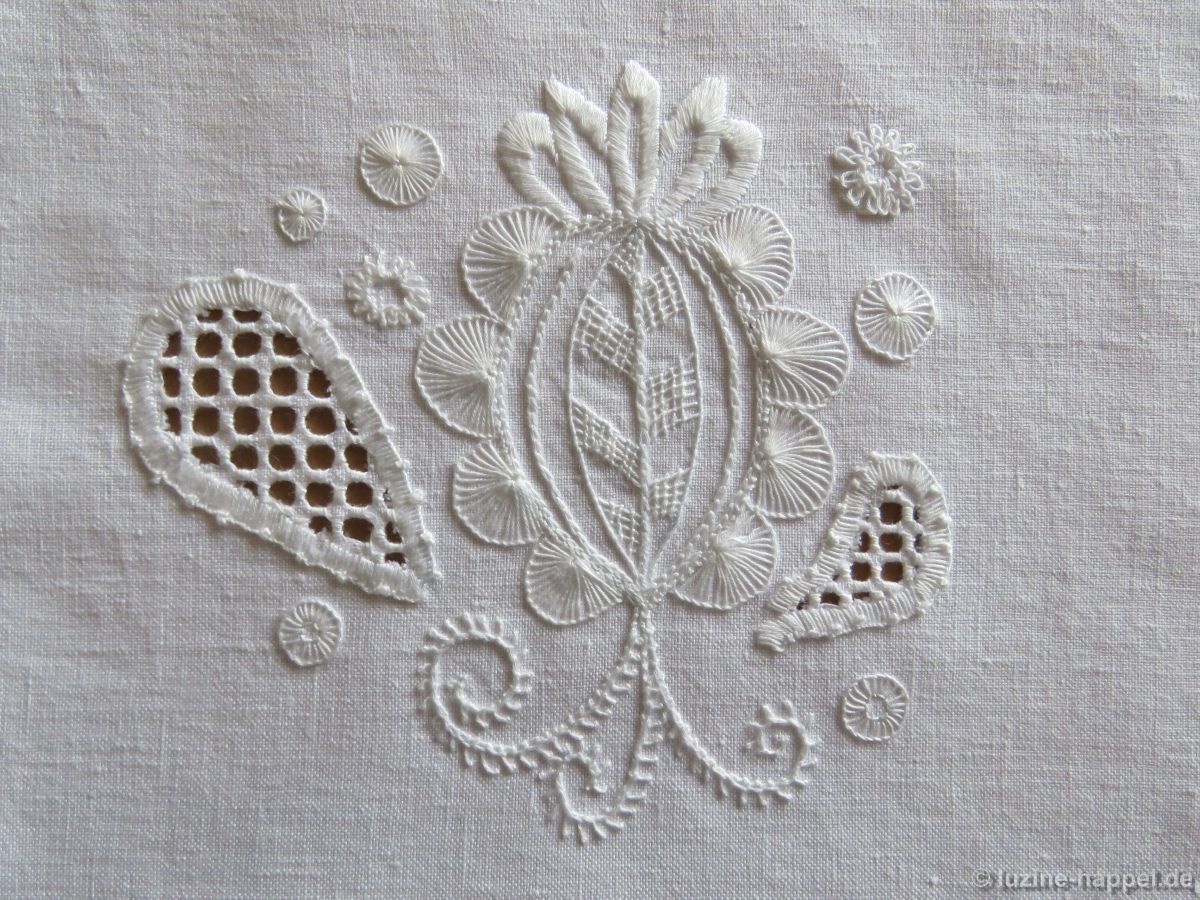
Hedwig Clausmeyer from Germany also wanted to be part of the great community effort.

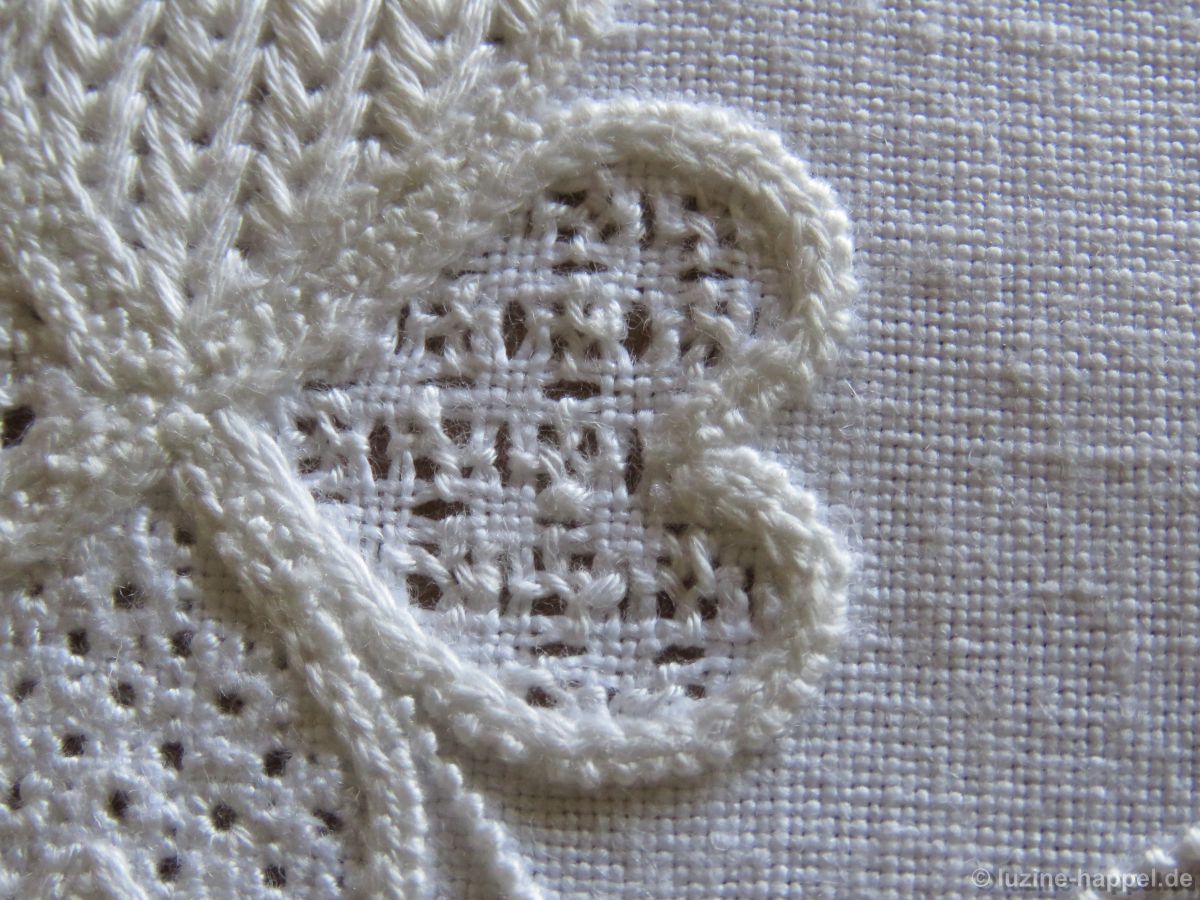
She has rendered the traditional tulip motif of Schwalm whitework into a modern silhouette and perfectly embroidered on handwoven linen. Satin stitch bars, Wave stitches, a Röserich pattern and Herringbone curved lines fill the areas. The large motif with its simple shape is impressive, and the small insect is the icing on the cake.


#8 and #9
Jacqueline Blanot from France submitted two very different embroidery designs.

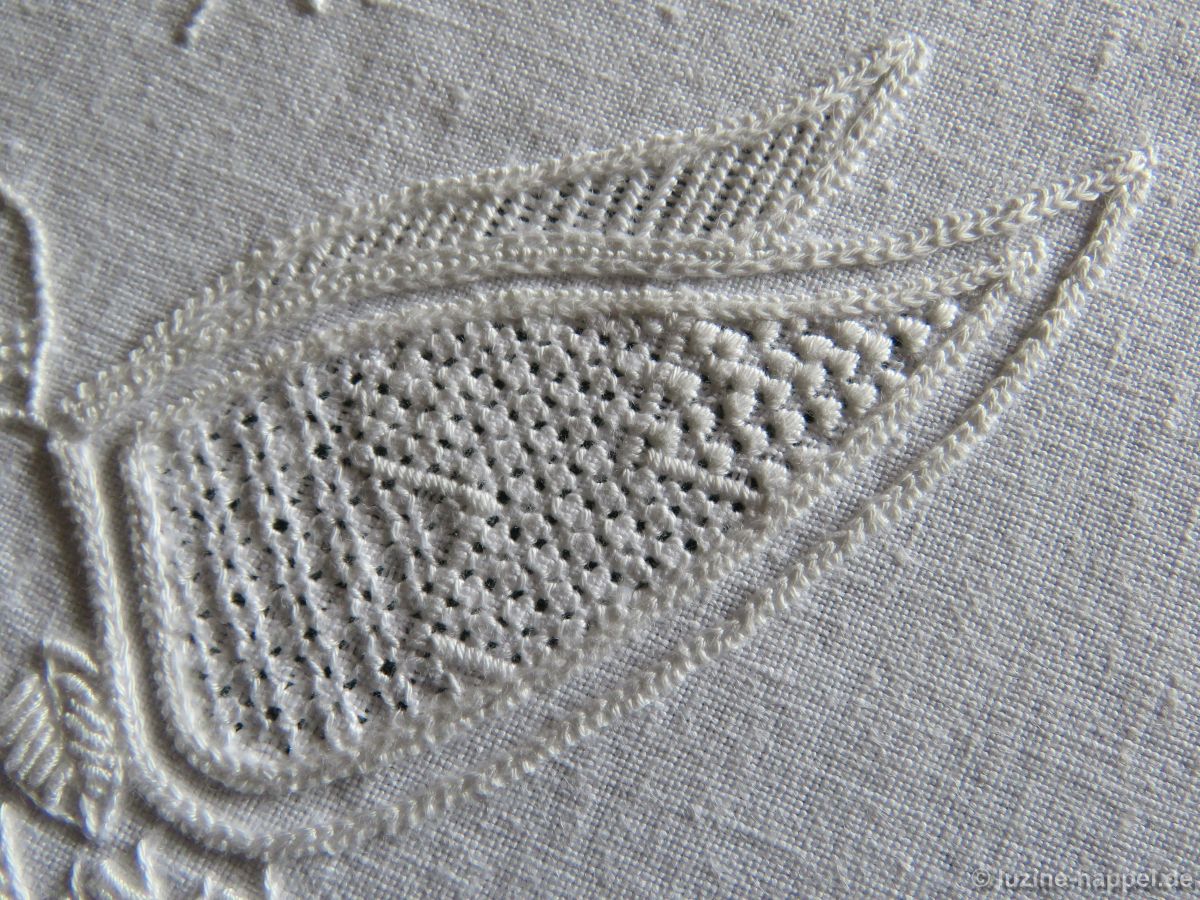
The large butterfly is elegant simplicity. This is achieved through her choice of the filling patterns. An openwork pattern, a Limet pattern, and a simple withdrawn-thread pattern with Honeycomb Darning stitches can be found.

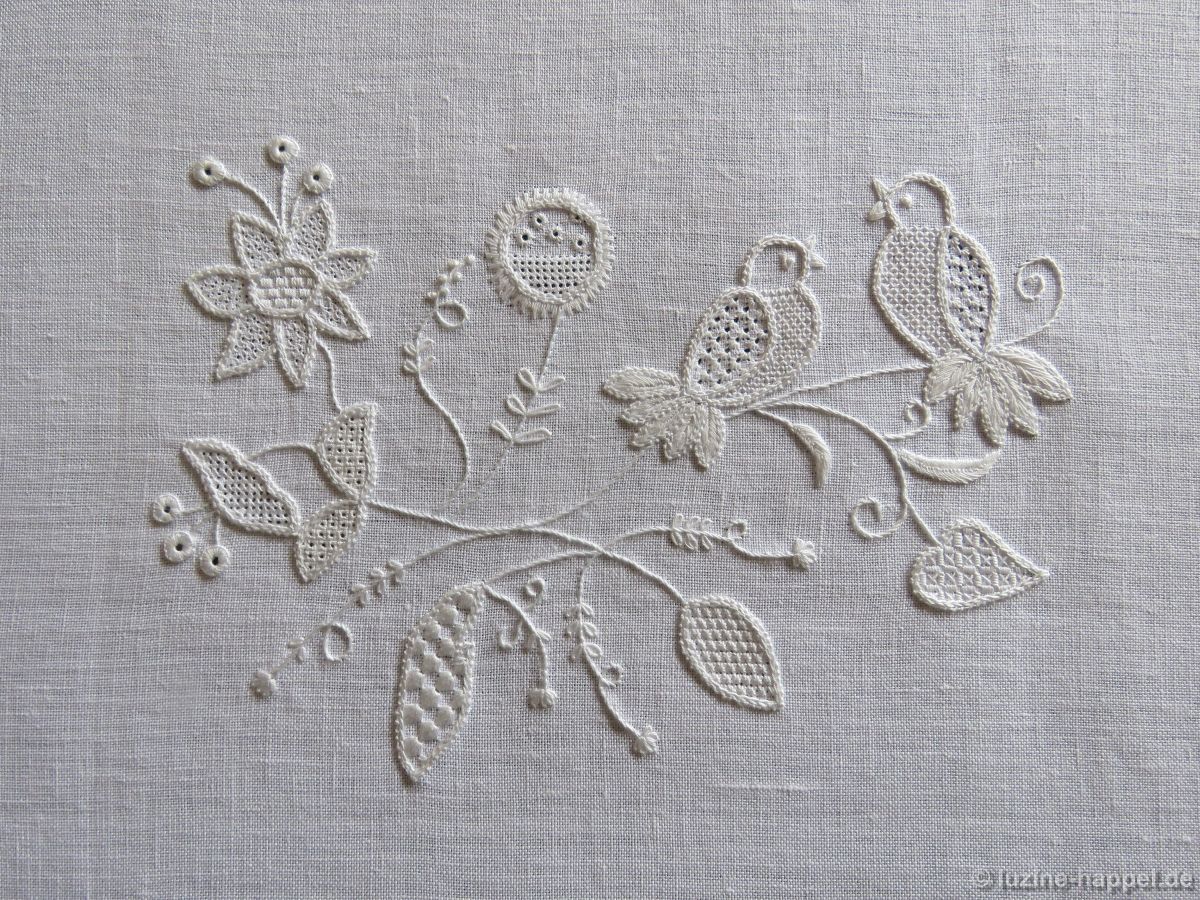
For the second contribution, Jacqueline modified a motif from Jacobean embroidery and skillfully translated it into Schwalm embroidery. She chose a branch with flowers, leaves, and tendrils. The long-time teacher and translator of my books into the French language used a wealth of Limet patterns and a simple withdrawn-thread pattern with Honeycomb Darning stitches to design the areas. So that the embroidery would not appear excessively heavy, some shapes were simply outlined.


#10
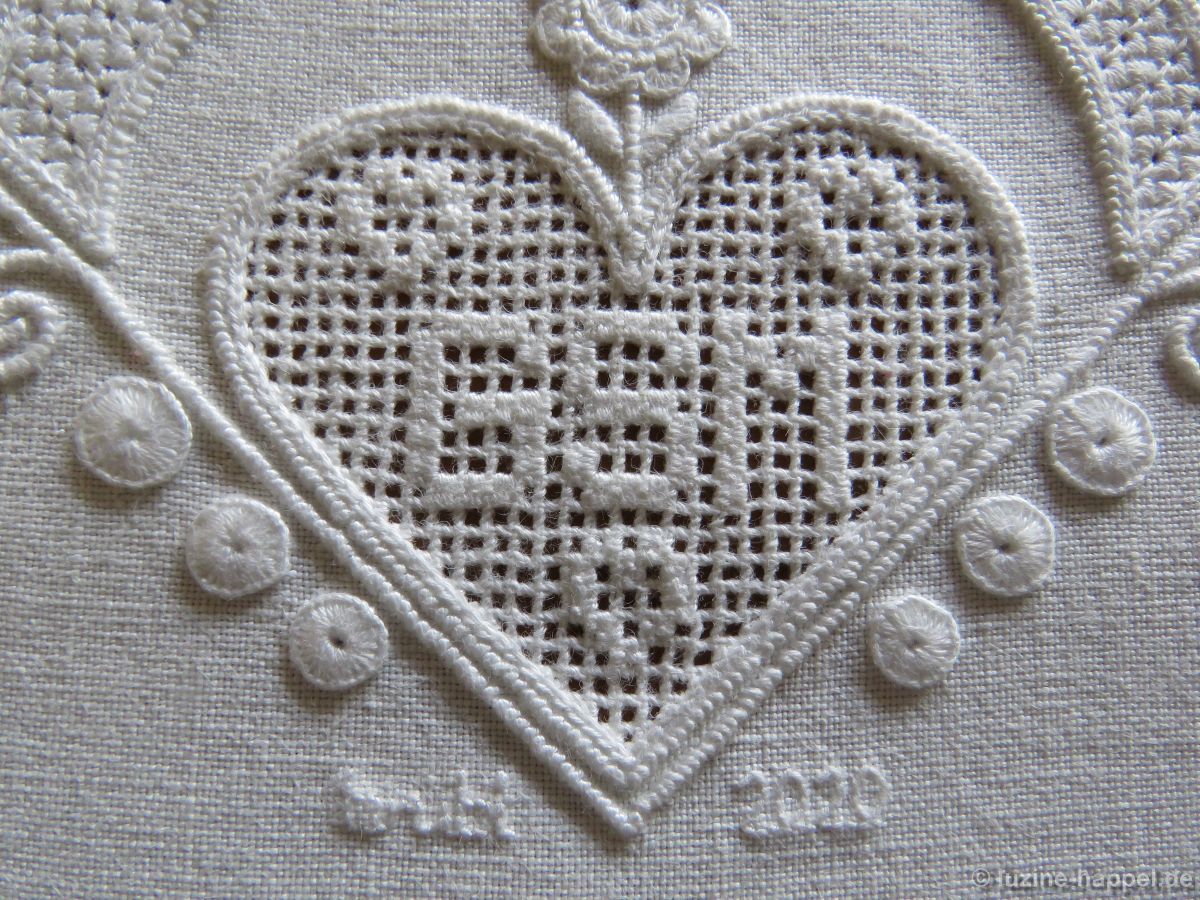
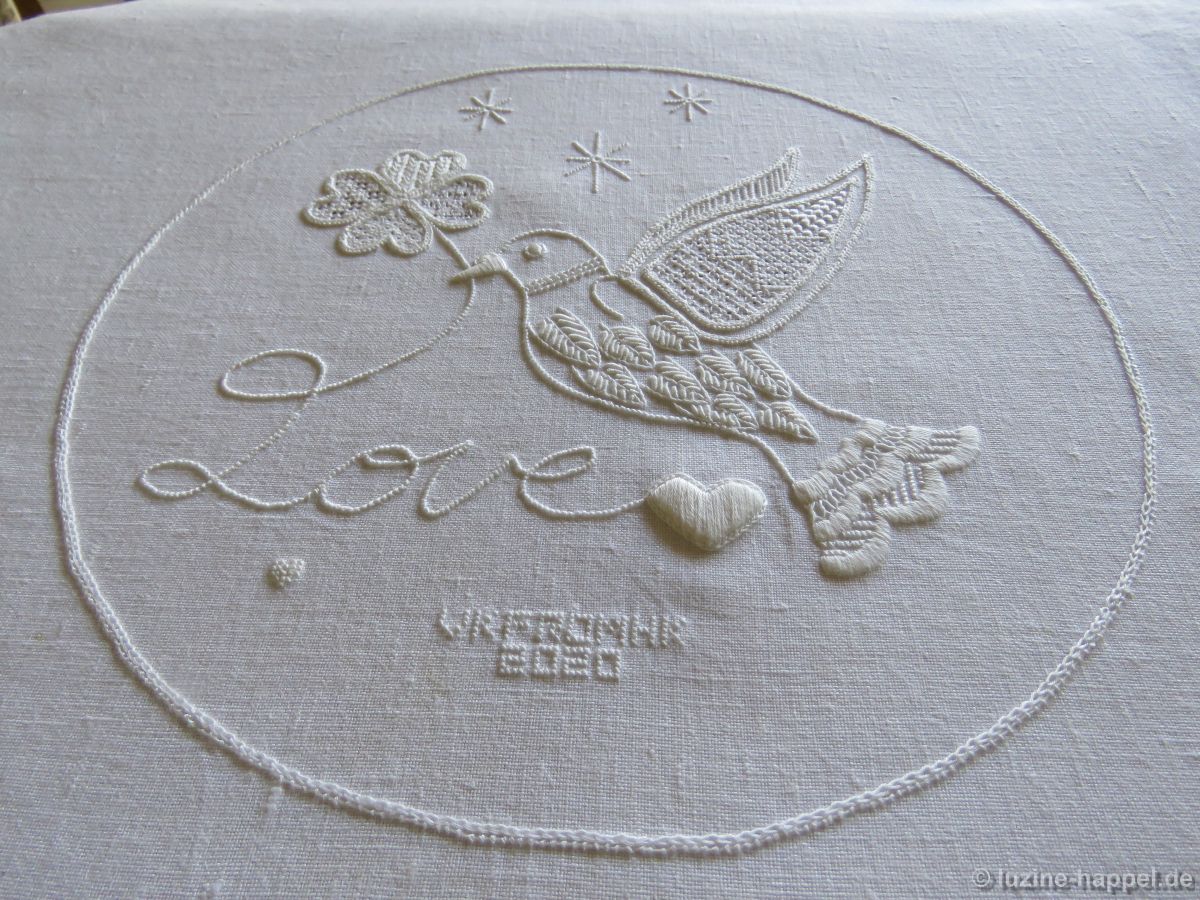
Christa Waldmann from Germany had embroidered a commemorative picture for her silver wedding anniversary. She generously decided to donate it to the global sampler. It provides us with a treasure trove of ideas.

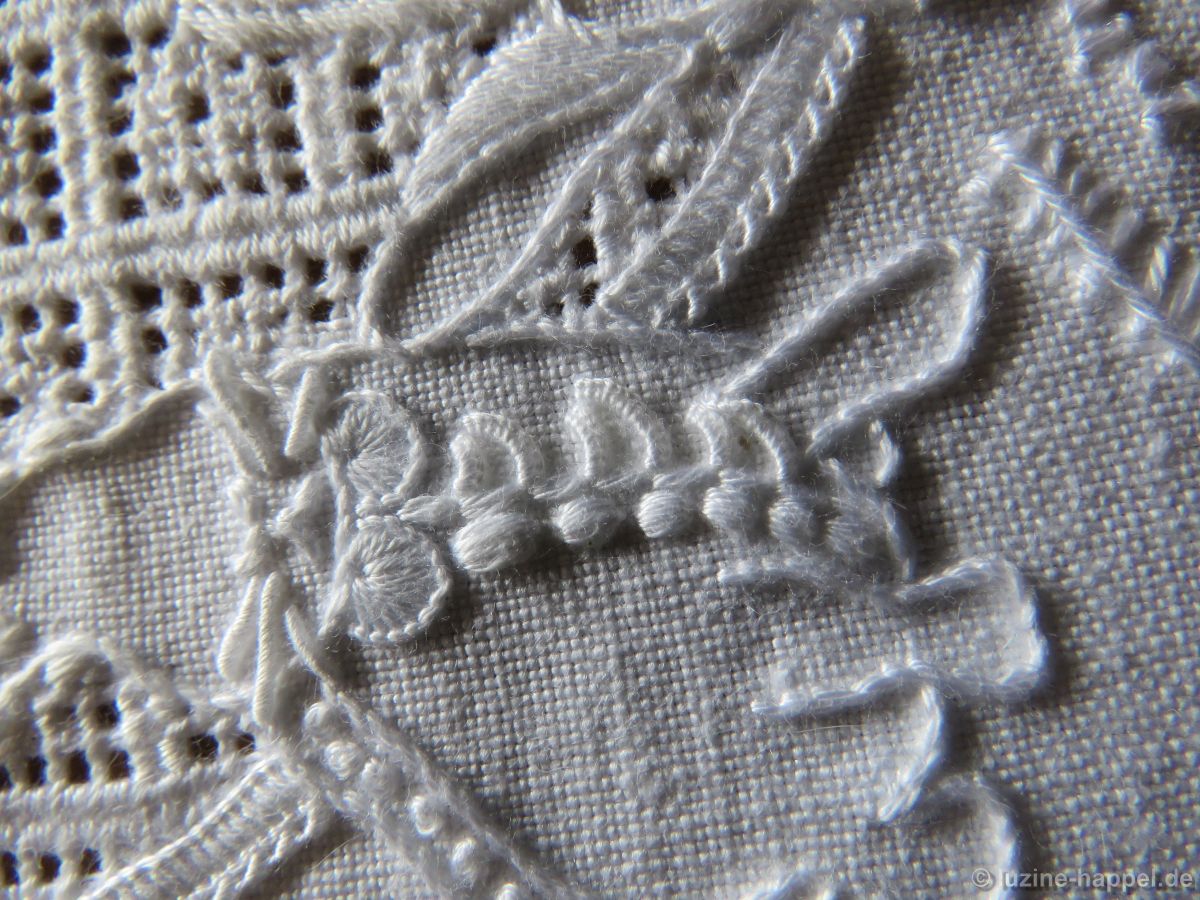
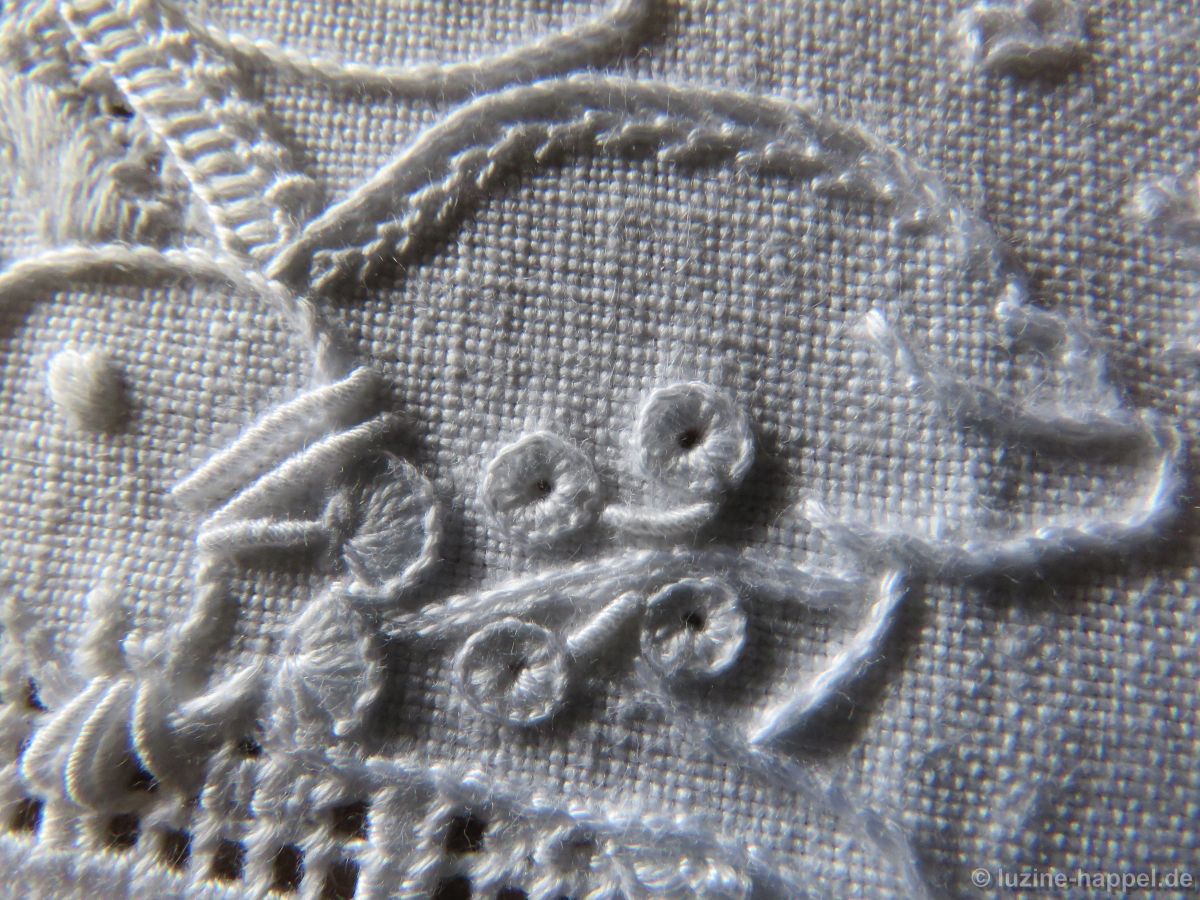
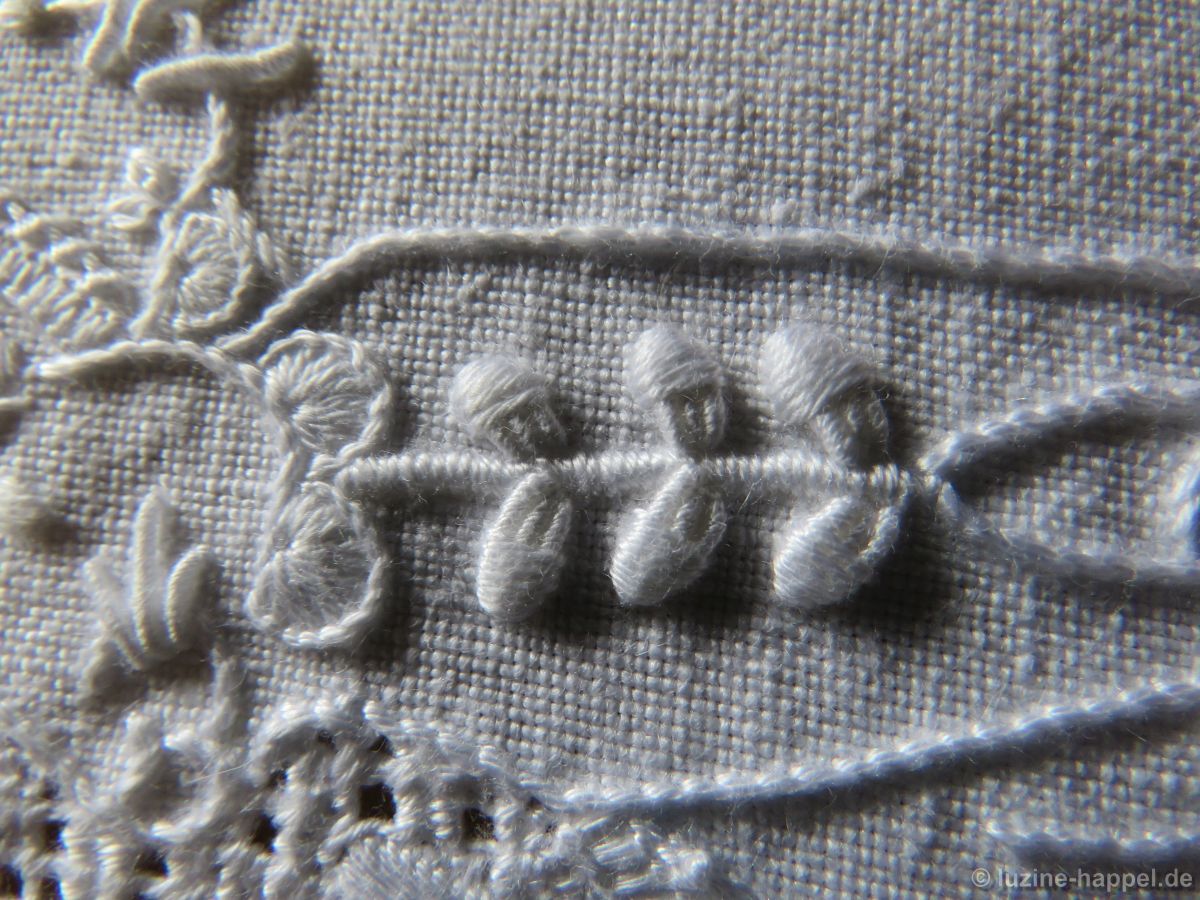
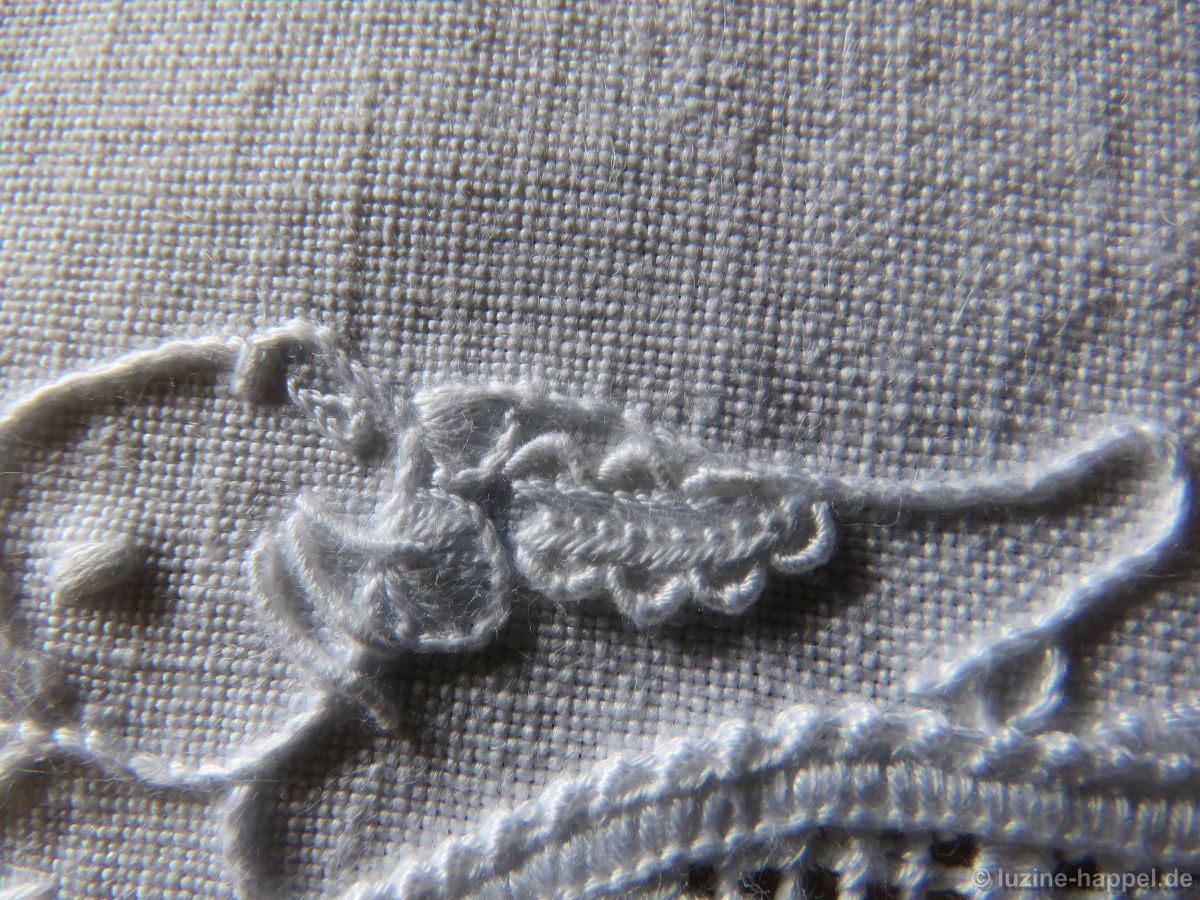
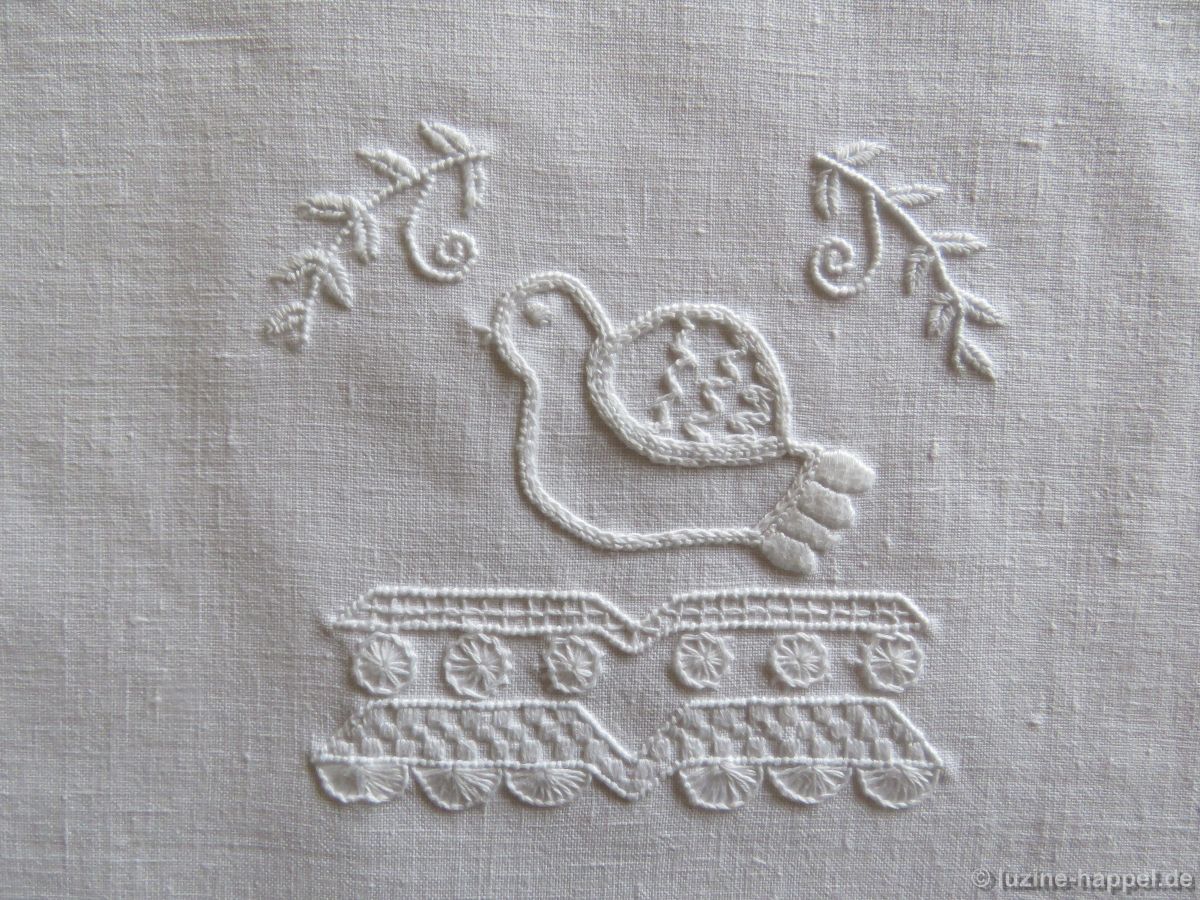
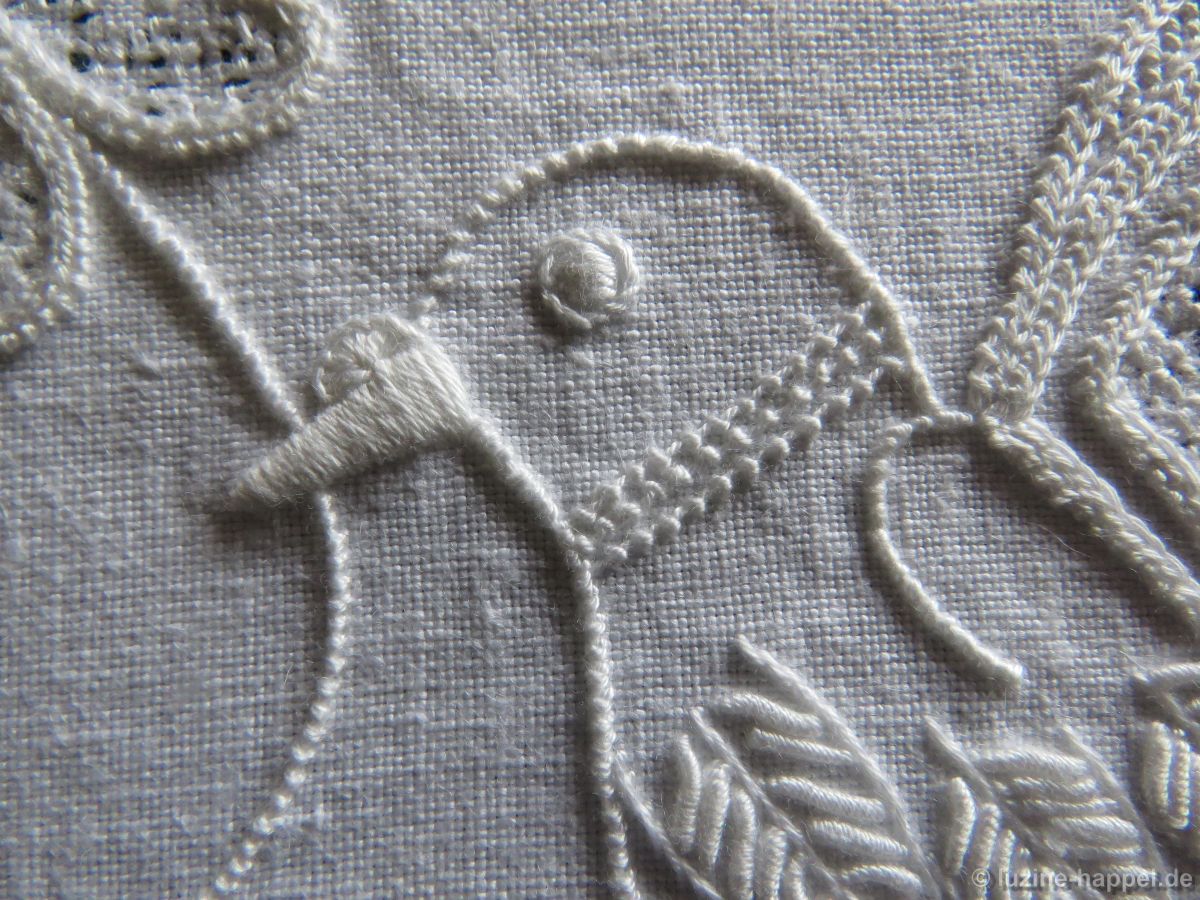
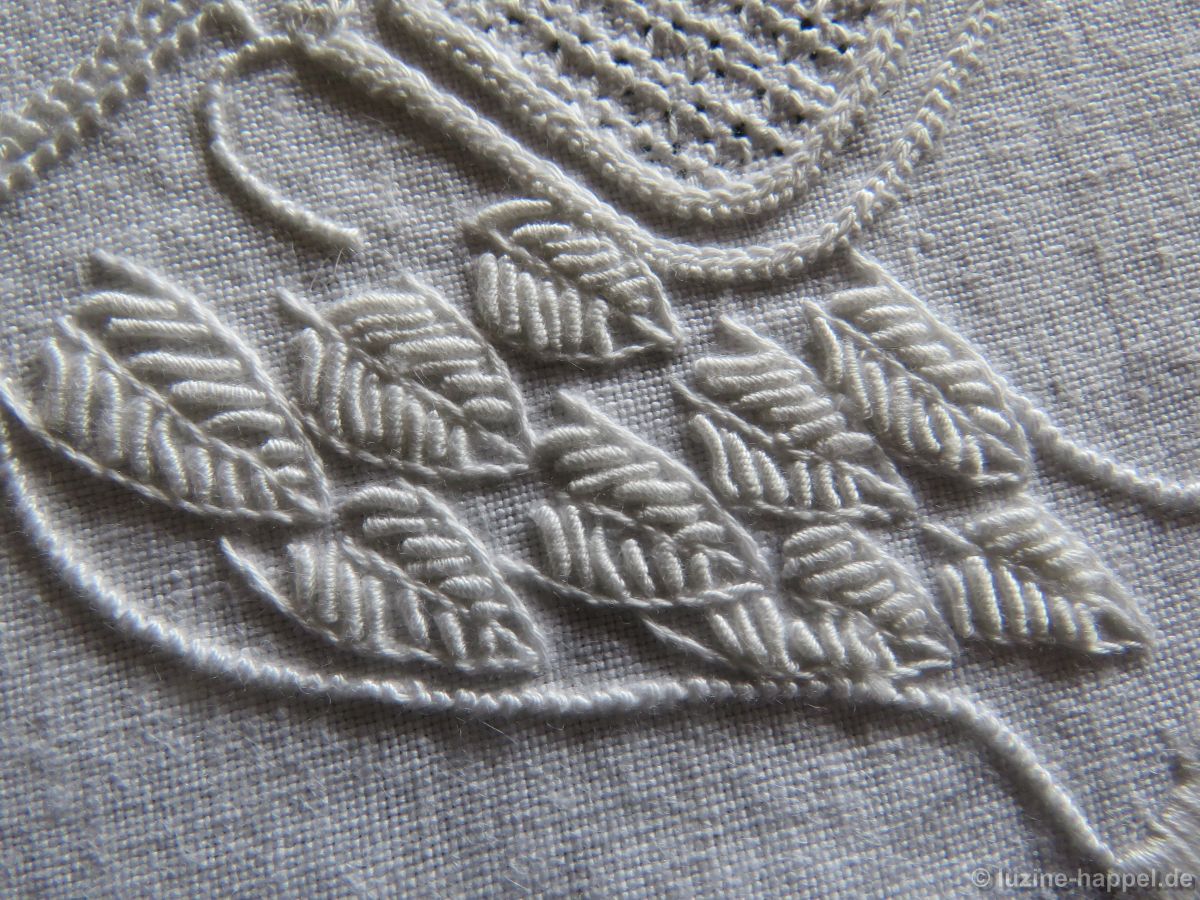
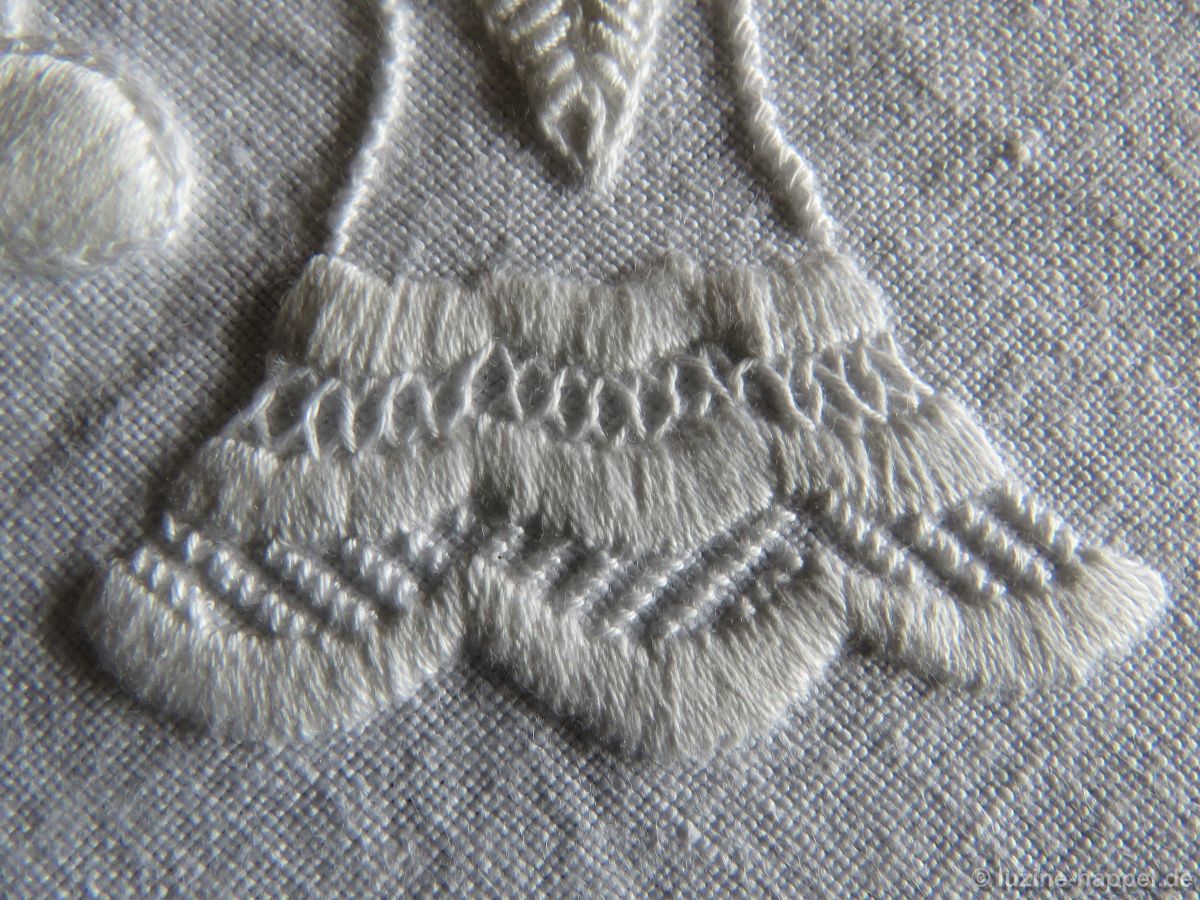
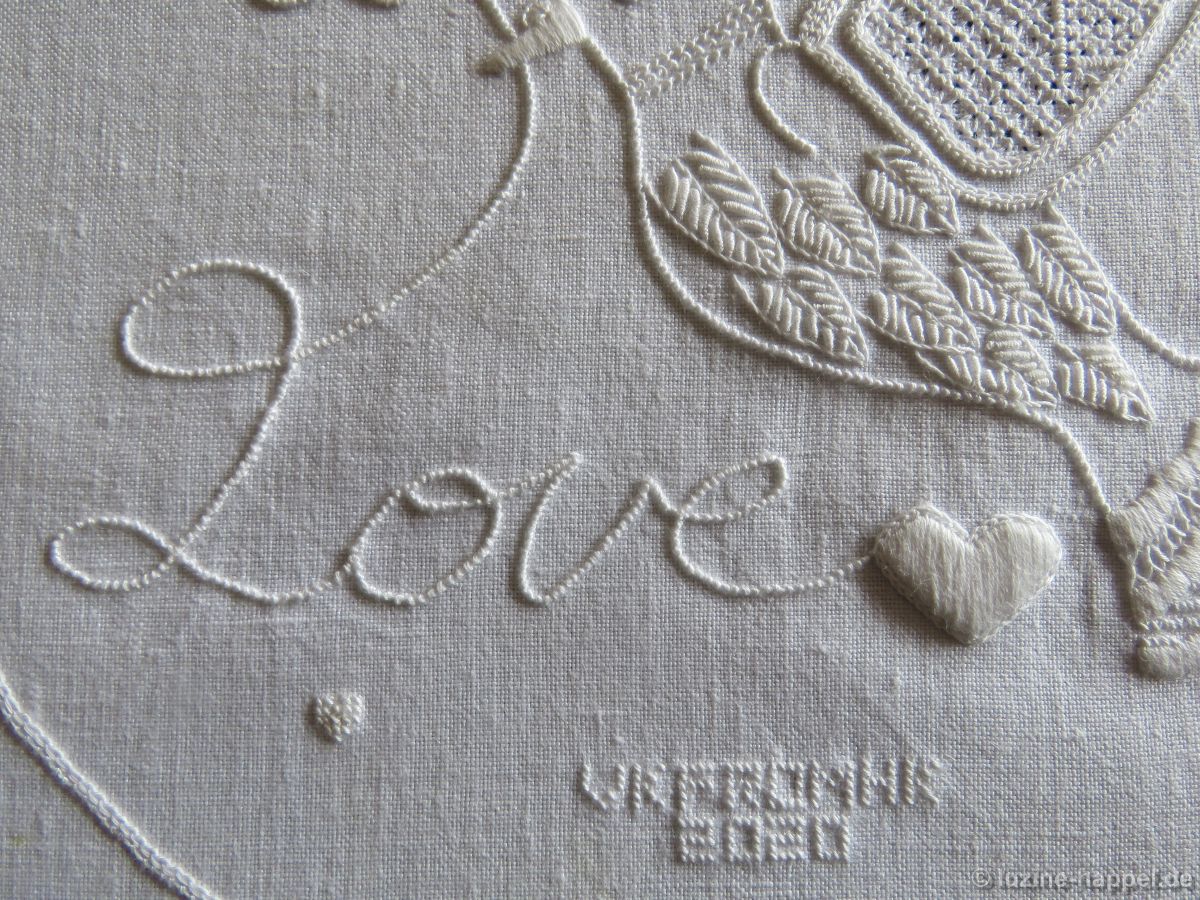
The designer and long-time teacher has included all the elements of Schwalm embroidery in her magnificent work. Heart, tulip, sun, and bird can be found as traditional motifs. Blanket stitch half-eyelets and 2 short-2 long stitches surround the motifs. Herringbone curved lines on the neck of the birds and around the heart complete the decorations. Various openwork and Limet filling patterns were used. Many spirals, undivided Satin stitch leaves, rounded Blanket stitch leaves as well as various small flowers with Blanket stitches, Satin stitches, and Eyelash stitches fill the areas between the motifs. A needle-weaving hem with spiders completes the work.

One can find more contributions in Update (4)

Bird Motifs (2)

Bird Motifs (2)

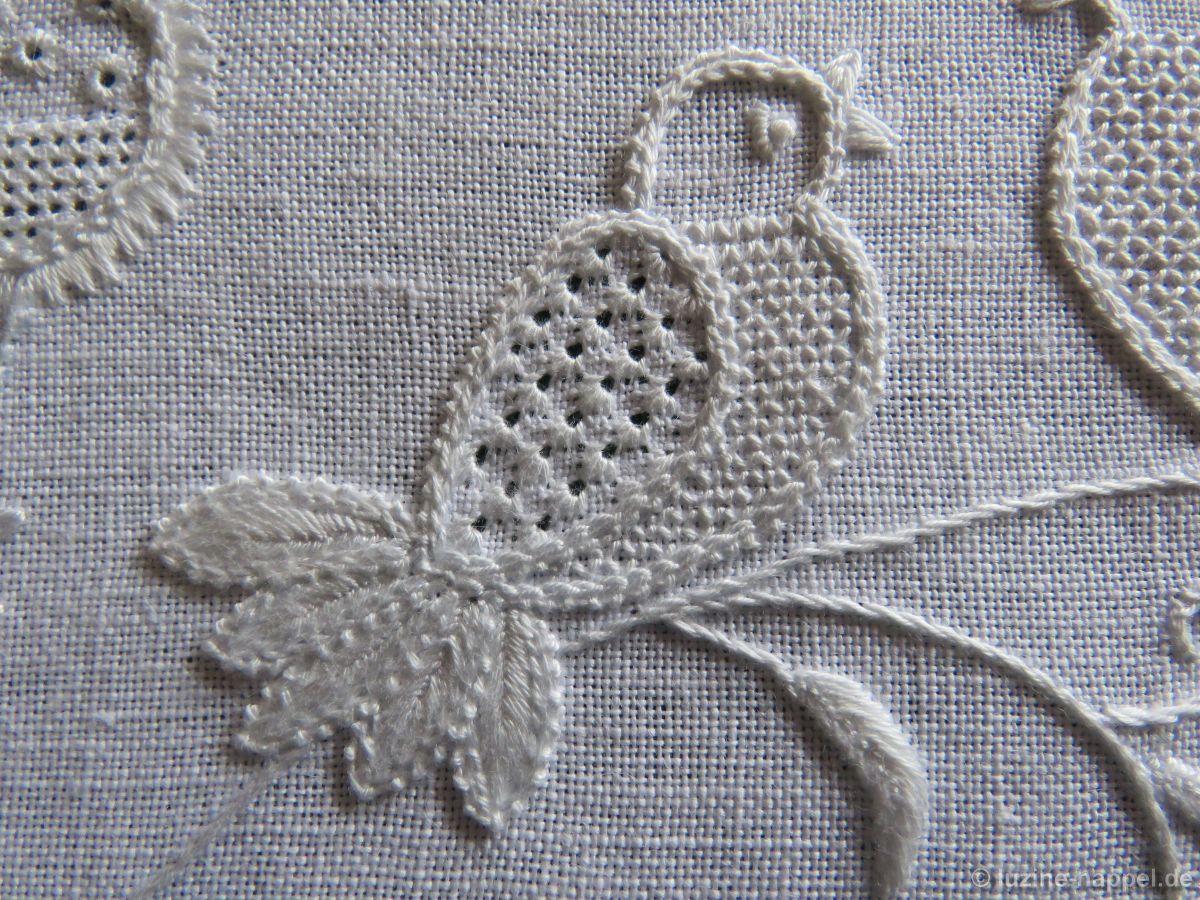
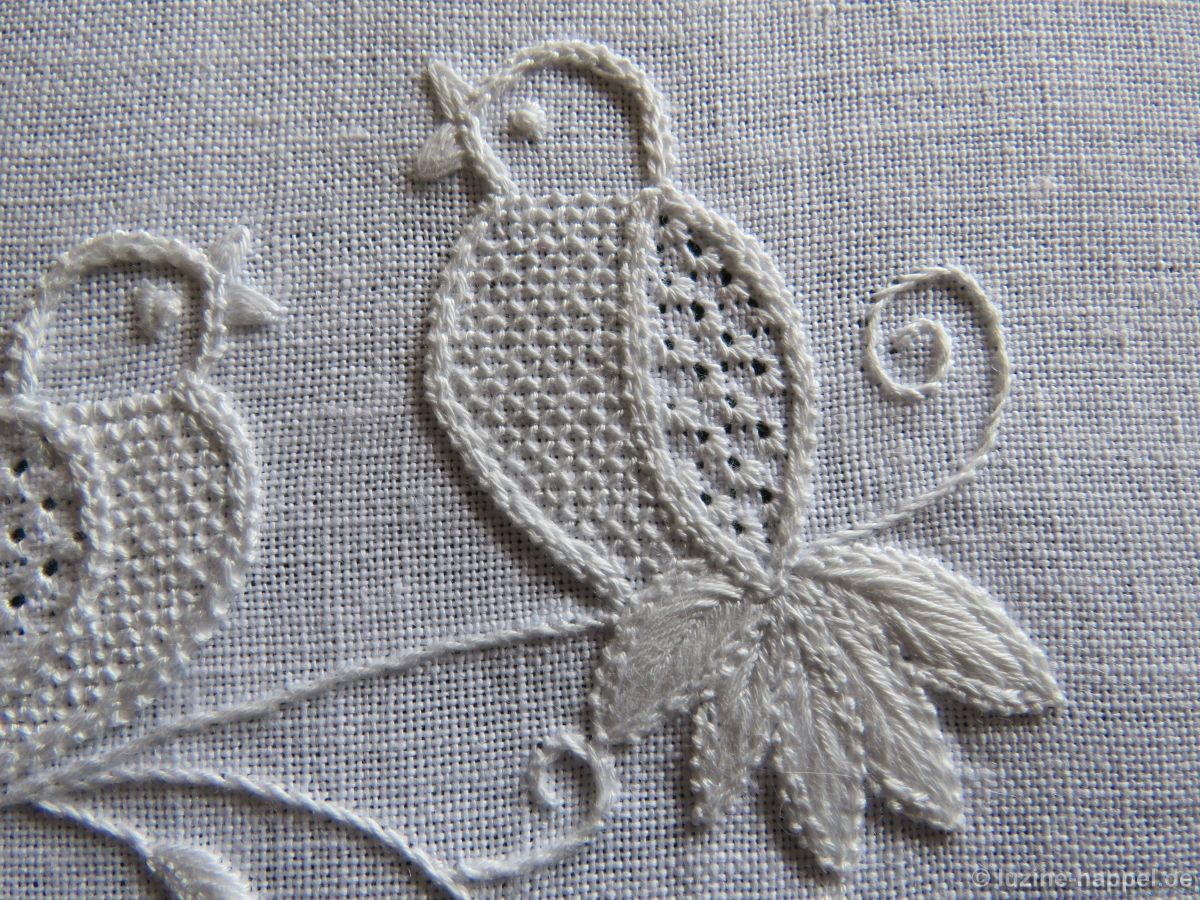
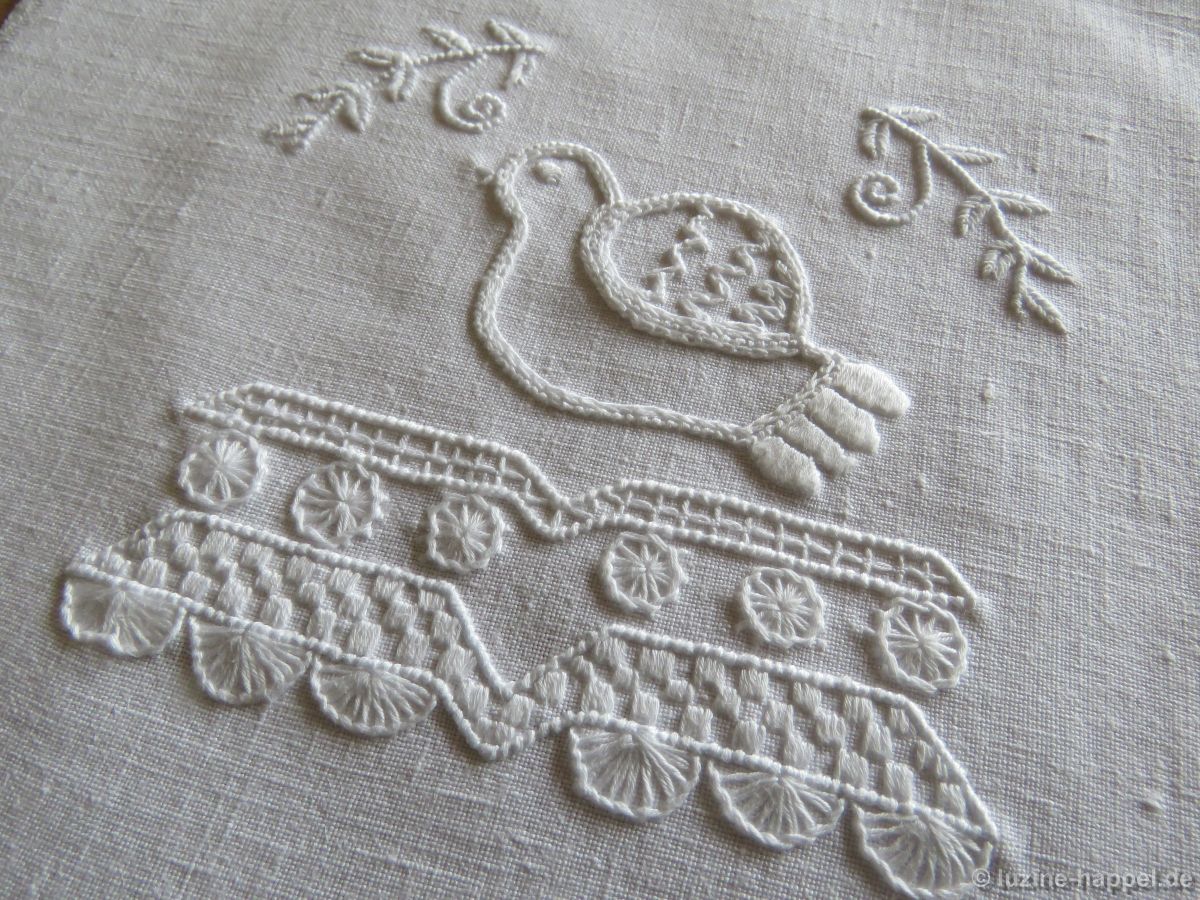
While the bird representations in Schwalm whitework of the 19th century were mostly relatively large, often a little clumsy, and almost always very closely embedded in the surrounding embroidery, in the 20th century the same motifs became smaller with more balanced proportions, and they are more dicernible from the surrounding embroidery. Other forms were also gradually added.

At the end of the 20th and the beginning of the 21st centuries, the bird representations experienced an enormous change. They became more diverse, playful, and closer to nature.

If you are interested in lovely balanced designs with birds, you can find them in my shop.

Bird motifs designed by the artist Gudrun Hartwig according to traditional models are included in the exquisite border designs Vertical Bird Border and Horizontal Bird Border.

At my request, the designer Christa Waldmann created two beautiful and unique patterns: a tree of life filled with birds – the Schwalm Bird Tree – extended and fourteen very different pairs of birds – the Schwalm Bird Wedding Designs

Global Schwalm Sampler – Update (4)

Global Schwalm Sampler – Update (4)

Two more contributions to the global sampler have arrived.


#4
Colette Bonnet from France is currently learning Schwalm whitework.

She wrote: “J´ai choisi ce motif simple justement à cause de mon inexpérience, et aussi parce qu´il symbolise pour moi les fleurs que j´aime tant.”
Roughly translated: “I chose this simple motif precisely because of my inexperience and also because it symbolizes for me the flowers that I love so much.”

She included a couple of elements of Schwalm whitework in her project including an openwork pattern and two Limet filling patterns. The small leaves turned out as did the forks on the Coral Knot stitch lines. Half-eyelet scallops round off the embroidery.


# 5
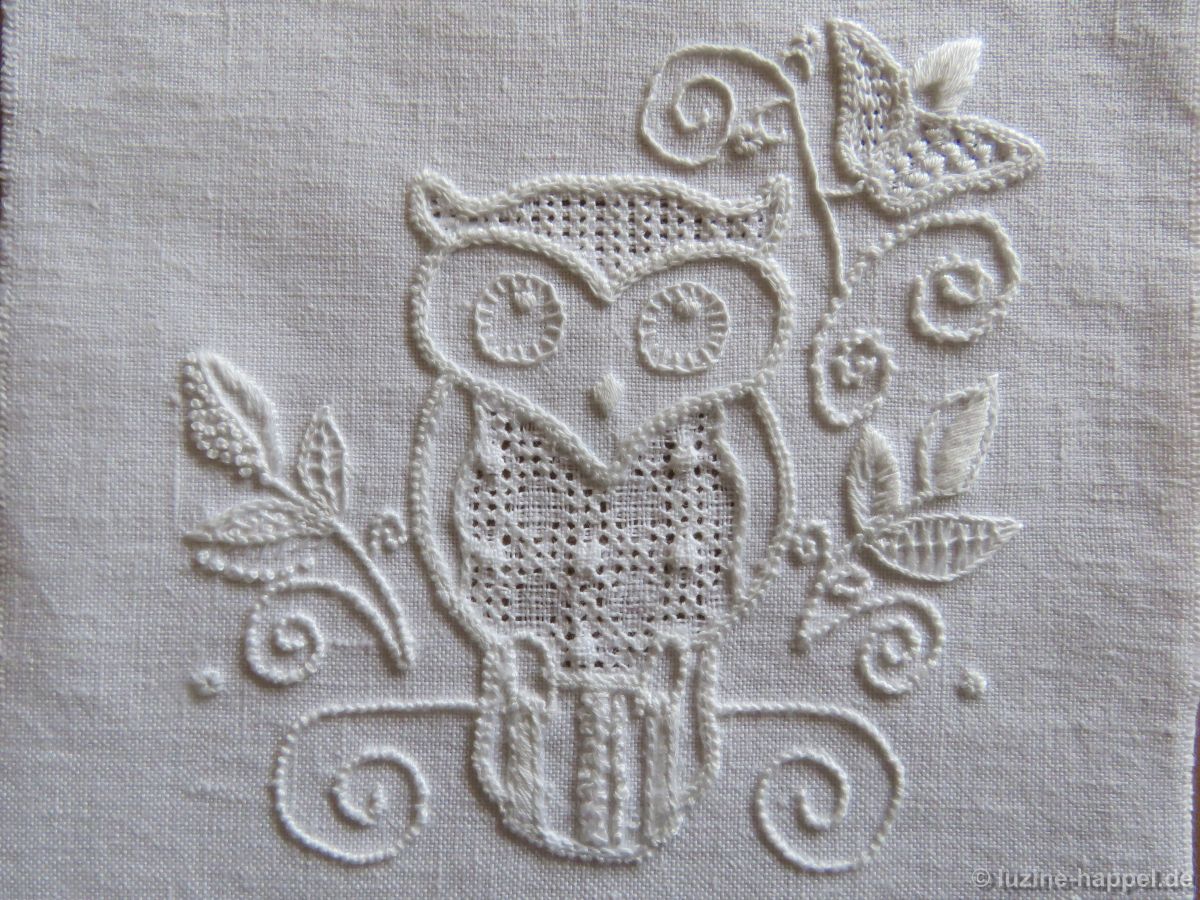
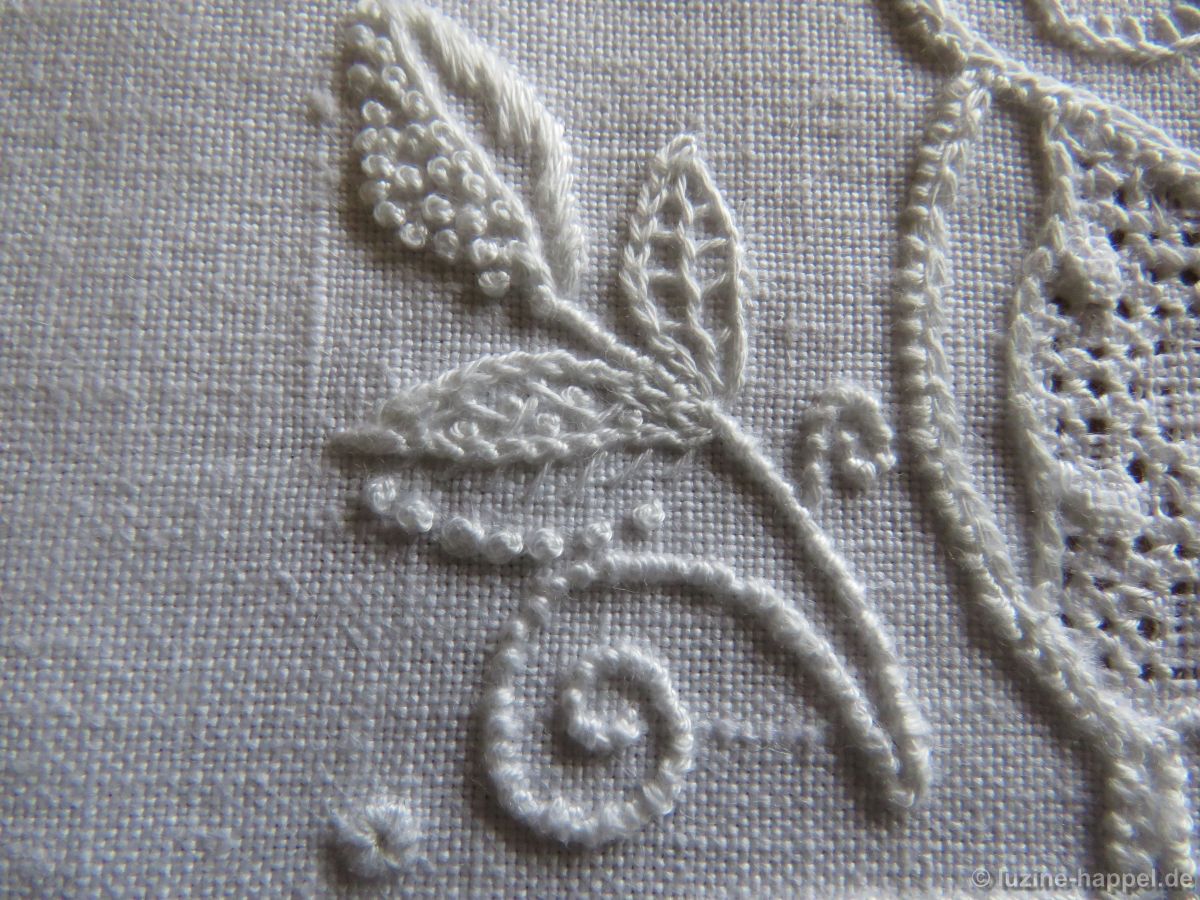
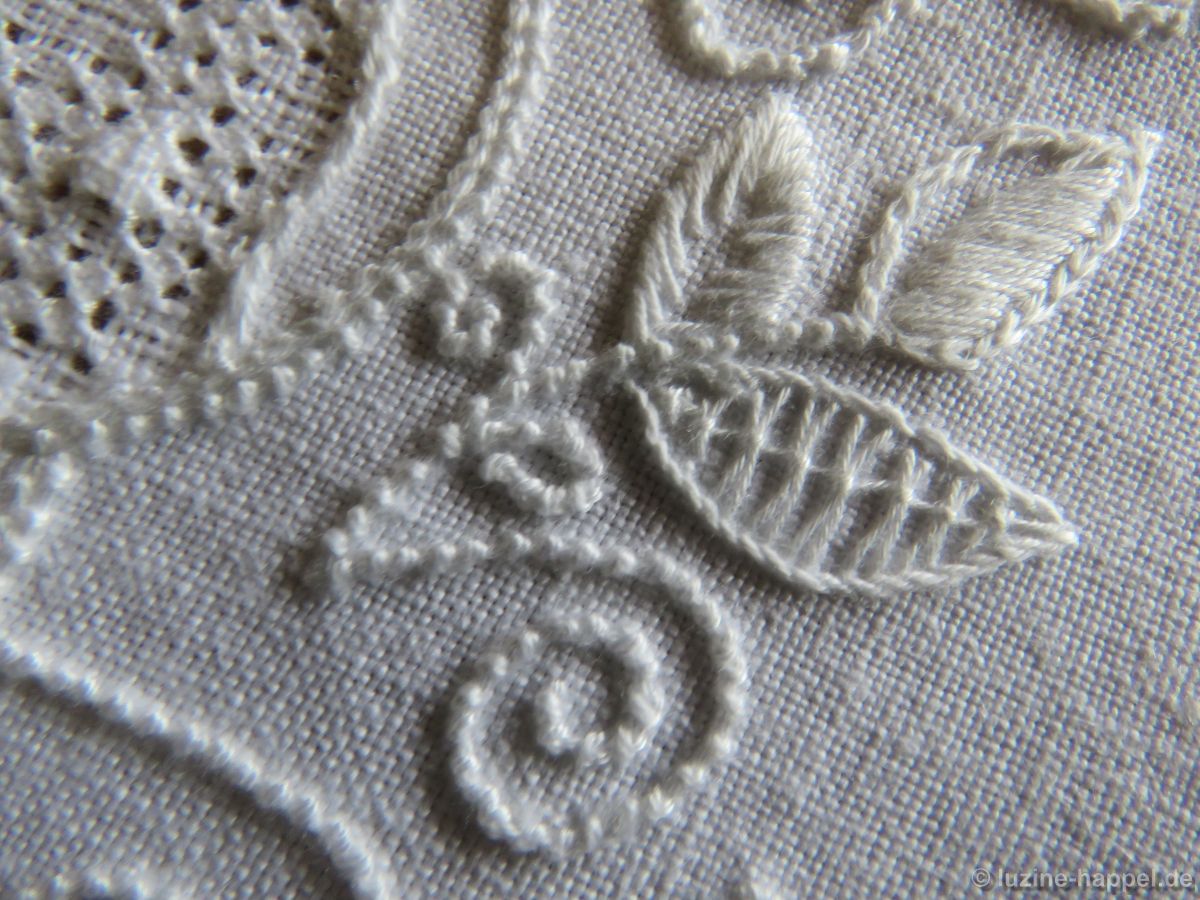
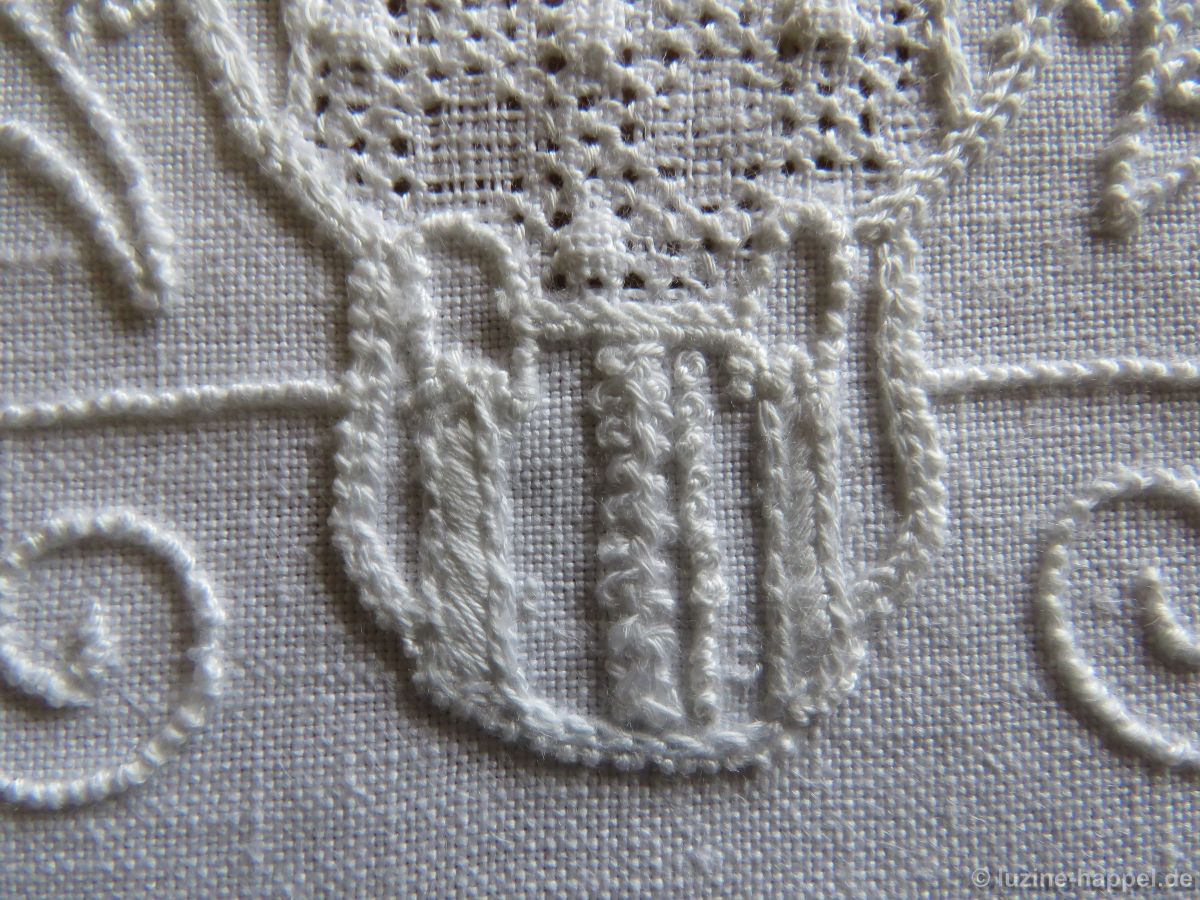
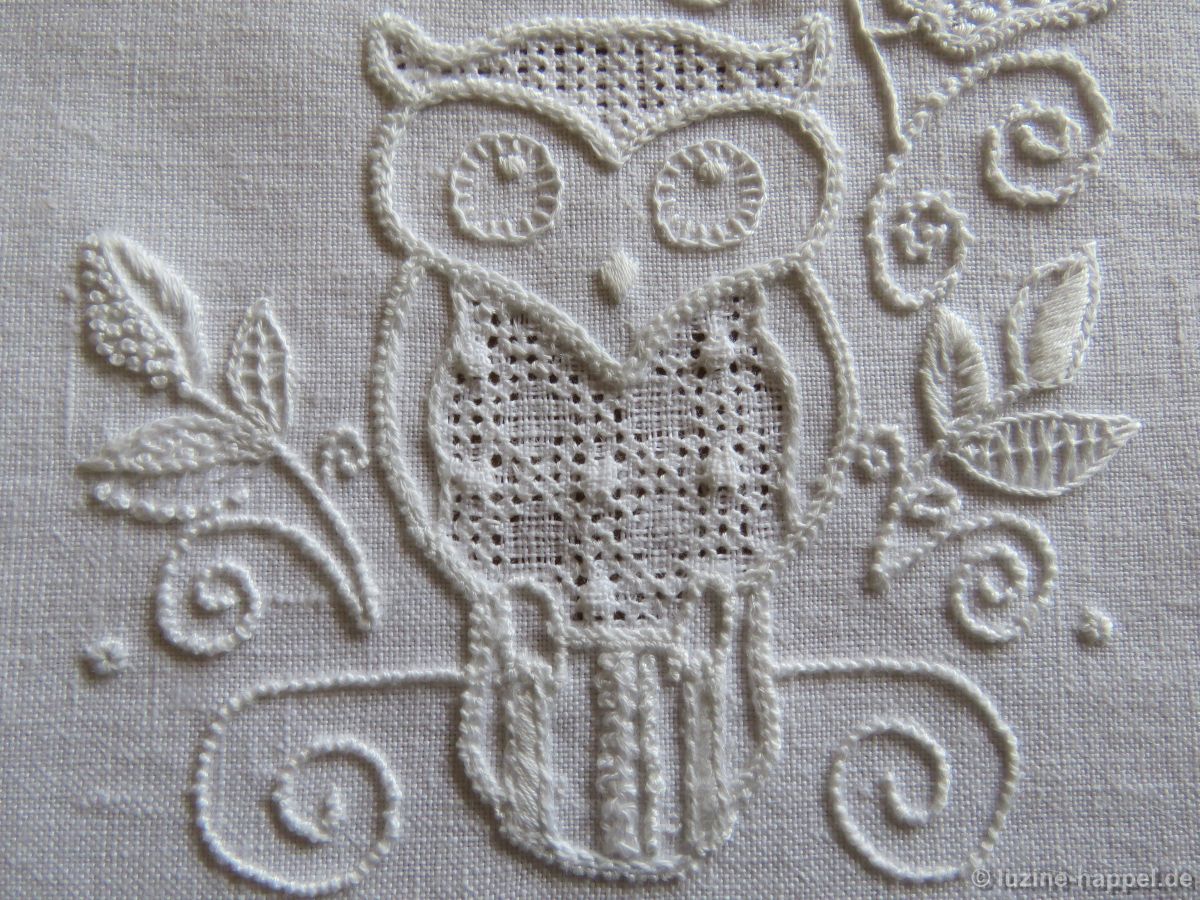
Ute Hogen from Germany is a bird lover, and so she has chosen owls as her motif. For this contribution, she modified a design by Elisabeth Baumgart.

The experienced embroiderer loves variety and likes to be creative when developing filling patterns. She combined Limet withdrawn-thread patterns and surface patterns and thus achieved an attractive contrast between the separate areas. Blanket stitch eyelets outlined with Eyelash stitches form the eyes of the owls. The branch on which the pair is sitting has been filled with Chain stitches.

One can find more contributions in Update (3).

Bird Motifs (1)

After different pomegranate representations and various butterfly pictures, I now focus on birds in Schwalm whitework.

Bird Motifs (1)

Bird motifs have a long tradition in Schwalm whitework.

The early bird motifs shown here are often depicted very abstractly; nevertheless quite different bird species are recognizable. The complexity of the interpretations is also variable. The pictures show embroidery worked between 1800 and 1900. The Satin stitch bird (fig. 1) probably originated before 1800.

Global Schwalm Sampler – Update (3)

Global Schwalm Sampler – Update (3)

The second and third contributions to the global sampler have arrived.


#2
Born in Sweden, Elisabet Vogt Pleijel once embroidered a lot of Schwalm whitework. After years of not doing this kind of needlework, she decided to embroider a project to contribute to the global sampler.

She wrote: “I tried to combine old and new Schwalm whitework in a mini sample cloth and to use as many variants as possible.”

This turned out well. She used the design of a flower and filled the center with a pattern of early Schwalm whitework. The petals were filled with simple and Limet withdrawn thread patterns (Wave, Rose, and Diagonal Cross stitches). In addition, the 2-pattern can be found as a Limet filling pattern and a needleweaving ornament as an openwork pattern. Half-eyelet scallops, Blanket stitch eyelets, tendrils, small leaves, and a piece of Peahole hem complete the embroidery.


#3
Gertrude Vorwerk from Germany submitted a very special contribution. She filled the entire background with a Satin stitch Limet filling pattern and scattered butterflies all over the area.

Regarding to the Corona crisis, she wrote: “Just when the caterpillar thought the world was going under, it became a butterfly.”

The simple butterflies stand out from the background. Coral Knot and Chain stitches shape the outlines of the wing; wrapped Chain stitches and Blanket stitch eyelets decorate them. Satin stitches form the body; the antennae were embroidered with Coral Knot stitches and French knots. Illuminated from behind this embroidery takes on an especially beautiful effect.

One can find the first contribution in Update (1).